

Most preschoolers are over the screen limit. A review of 89,163 children found only 35.6% of two to five year olds inside the one hour a day guideline. [1]
Printable. For the next long indoor afternoon.
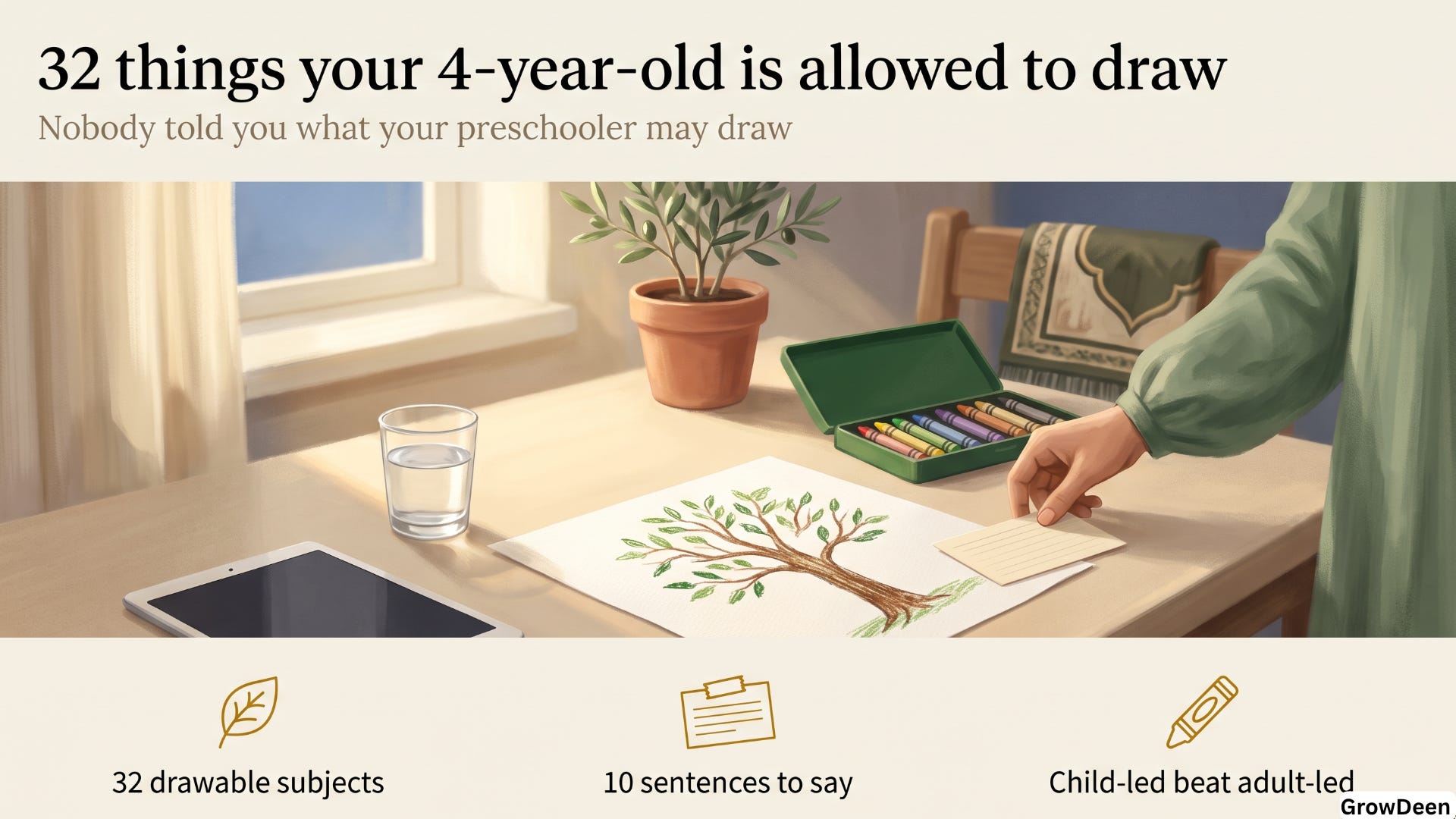
The paper has been on the table for ten minutes.
Your four-year-old asked if she could draw, you said yes, and then she asked what she should draw and you felt the pause. Not because you don't know what children draw. Because you weren't sure what she's allowed to.
So the paper stays blank, the moment passes, and twenty minutes later the tablet is open. Nobody decided that. It just happened, the way it happens in a lot of houses, and the thing that caused it was never a rule. It was uncertainty.
Why This Guide Is Different From Generic Preschool Activity Lists
The evidence is current and quoted accurately. The AAP's clinical report on play, WHO movement guidelines, CDC milestones and a 2022 meta-analysis of 39 guided-play studies, including the one large review that found many popular play claims overstated [3][4].
The Islamic question gets an actual answer. Not a vague "be careful" but the scholarly position on what a child may draw, the Companion-era precedent behind it, and a long list of permitted subjects your child will enjoy [9][10][11].
You already have the free Draw and Make Pack from the top of this page. It carries a printable subject bank, a card of exact sentences to use while your child plays, and a reflection page for you.
The Hesitation Nobody Names
Ask a Muslim parent why their preschooler watches more than they would like, and almost nobody says they chose it.
What they describe instead is a series of small stalls. The craft box is in the cupboard and getting it out means twenty minutes of clearing up later. The child wants to draw people and you aren't sure. Every activity list online is built on songs and instruments. Dress-up feels a bit pointless. And underneath all of it, a quieter question that rarely gets said out loud: is any of this actually doing anything, or is it just mess with extra steps?
That last one deserves a straight answer before anything else, because it is the question that decides whether the box comes out of the cupboard.
What Your Four-Year-Old Is Actually Doing In There
Between three and five a child crosses from copying into inventing, and role play is usually the first visible sign. By four, a typical child can hold a role that is not her own, becoming a shopkeeper, a doctor, a cat or a bus driver for as long as the game runs [3]. Around the same age her hand gains enough control to hold a crayon between fingers and thumb rather than in a fist, and she can tell you what happens next in a story she knows [3].
The work underneath is harder than it looks. A child playing shop has to remember that the cushion is a till, agree with her brother on who is serving, and hold both facts steady for ten minutes while the real room keeps contradicting them. That is memory, negotiation and attention control running at the same time, which is why the American Academy of Pediatrics ties play of this kind to language, early social skill and the ability to hold attention and resist impulse [6].
There is a second effect that gets much less attention. The AAP also describes play as a buffer against stress, and names parent and child playing together as what strengthens the bond between them [6]. Twenty minutes of being a shopkeeper with your daughter is twenty minutes of your undivided face and voice, which in most households is rarer than any toy.
The Research, Read Without The Marketing
You deserve the evidence as it actually stands, in place of the version printed on activity-kit boxes.
A review of more than a hundred and fifty studies on pretend play concluded that many of the popular claims had been inflated [4]. The reviewers found no good evidence that pretend play makes children more intelligent, more creative, or better at solving problems [4]. What they did find reasonable support for was narrower: language, storytelling, social development and self-regulation [4].
That is still a serious list. It is simply shorter than the one you have been sold.
Which changes what you are aiming for. Give your preschooler creative play because the stage calls for it and because it is where her language and self-control get their practice. Treating it as a method for producing a gifted child goes past what any study has shown, and the pressure to convert every afternoon into brain training is exhausting and unearned.
Let the washing basket be a boat.
The Sentence That Changes The Play
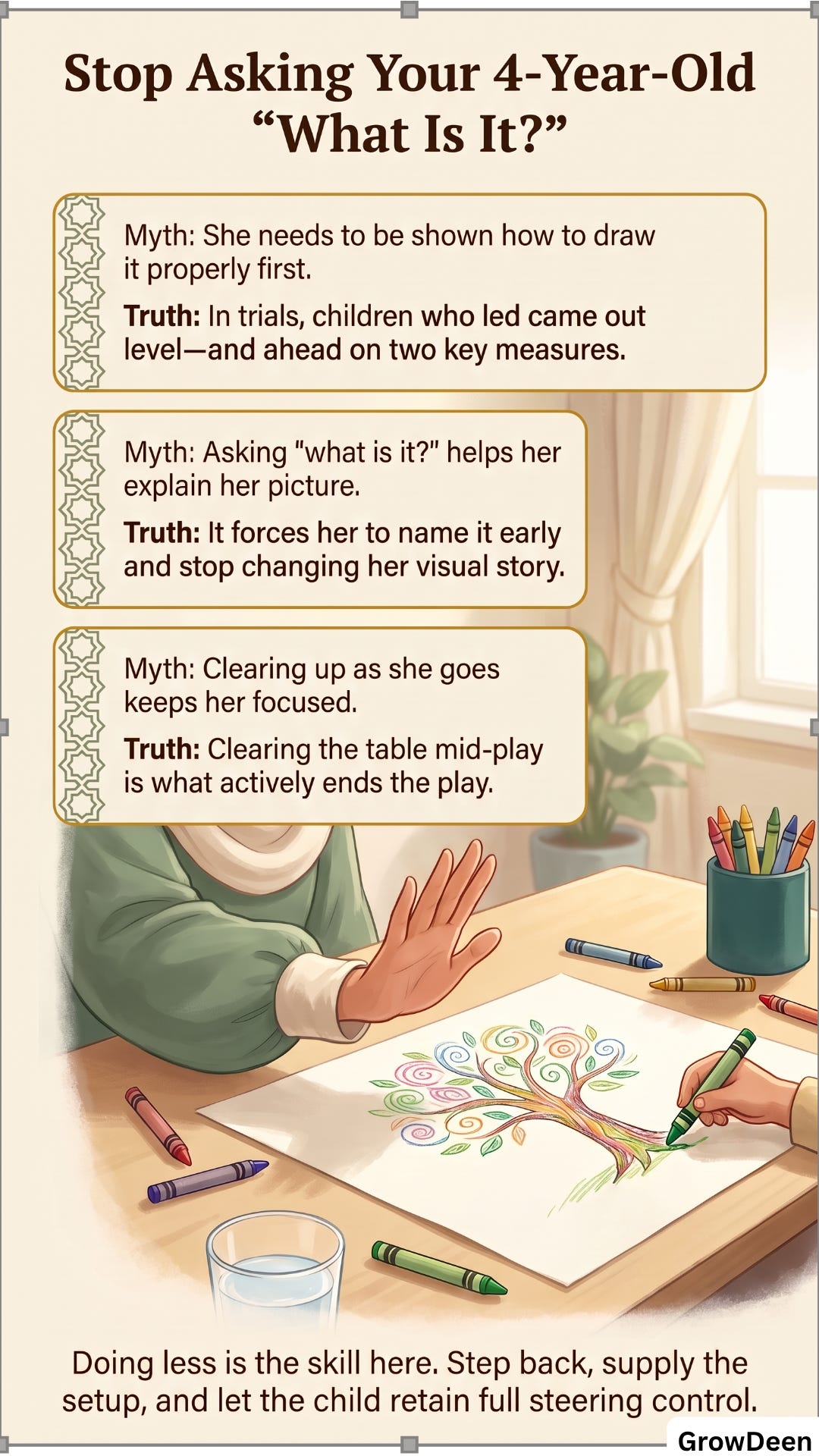
Most advice gives you two settings. Leave her entirely alone, or sit down and teach her.
There is a third, and on some measures it beats both. Guided play means you set up the materials and hold a loose goal in mind while your child keeps control of what actually happens. A 2022 systematic review pooled 39 studies covering roughly 3,800 children aged three to eight and set guided play against direct instruction [5]. Guided play came out ahead on early maths, with an effect size of 0.24, and on shape knowledge, at 0.63 [5]. On every other outcome examined, including literacy, social skills and executive function, it was never significantly worse than being taught [5].
In practice it is one sentence, said once, and then silence.
You put out the blocks and say you wonder whether a tower could be built taller than the chair. Then you say nothing else. You lay out the leaves she collected and ask which ones belong together, without telling her what the categories are. You hand her the clay and ask how many different shapes are hiding in it.
You supply the setup and the question. She keeps the steering wheel.
This is the same mechanism the Center on the Developing Child calls serve and return, where the adult answers what the child starts rather than directing it, and which the Center links to measurable differences in developing brain architecture, including the number of conversational turns a child experiences [7]. Guided play is serve and return with materials on the table.
Three sentences worth keeping in your head:
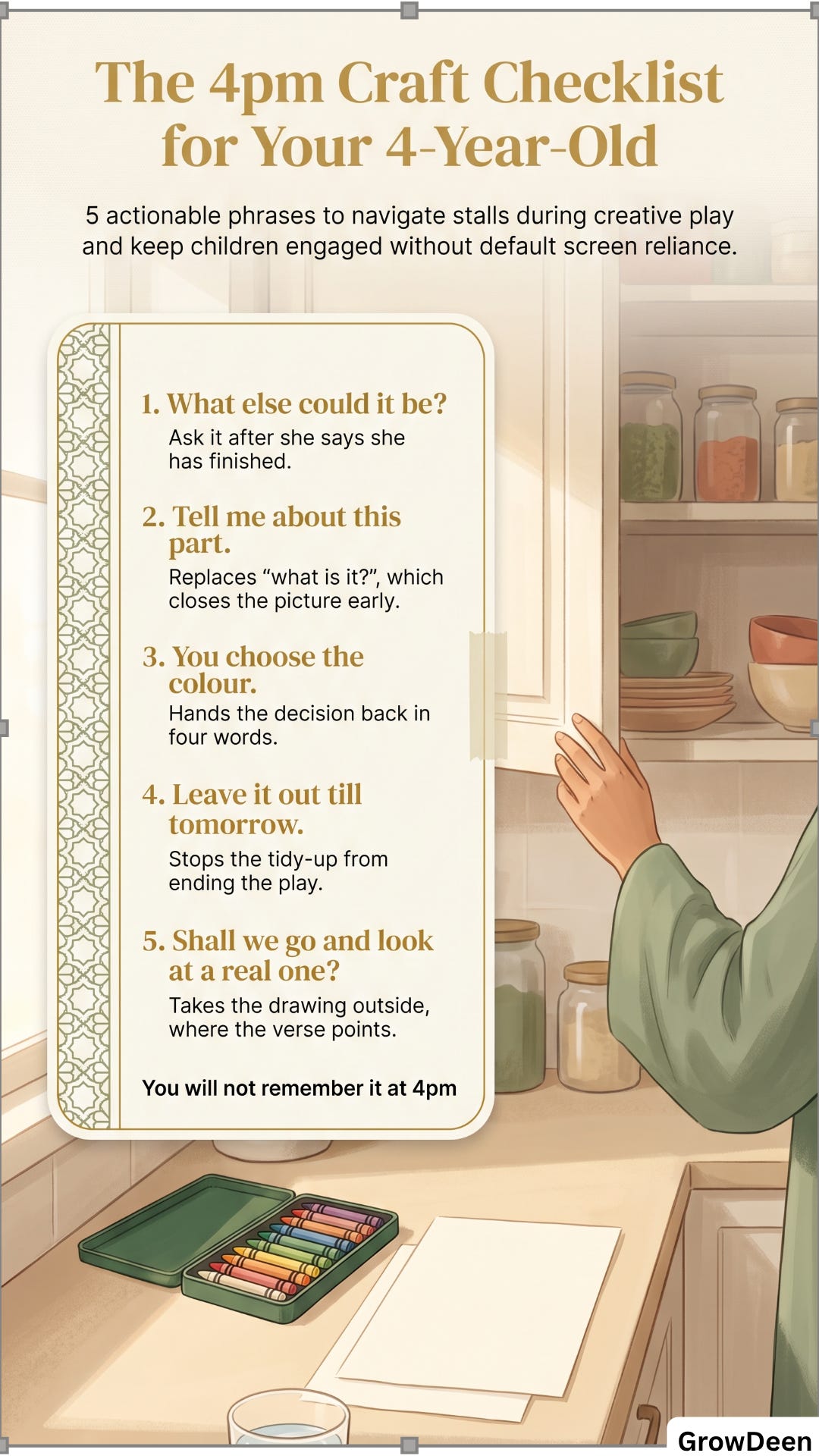
Tell me what is happening in your picture. You are asking about the process, not marking the result.
What else could this box become? That question moves her away from trying to get it right.
You chose colours that go beautifully together. That lands differently from "lovely", which is background noise she stops hearing by four.
A Pack We Made For The 4pm Stall
Knowing all of this at 4pm, with one child pulling at your sleeve and dinner not started, is a different problem from agreeing with it now.
That is why the free Draw and Make Pack exists: a printable subject bank for the moment she asks what to draw, a card of the exact sentences above for the moment you go blank, and a reflection page for you. The download button is at the top of this page, and there is a full description of what is inside it below.
So what can she actually draw?
This is the question that stalls the most households, and most mainstream guides walk straight past it by suggesting you ask a child how many different ways she can draw a person.
The scholars at Islam Q&A hold that making images of animate beings is not permitted, including drawings on paper, and they advise parents to steer children towards subjects that have no soul [10]. The alternatives they list are wide: trees, fruit and vegetables, oceans, mountains, and other inanimate things [10].
That guidance has an early precedent, and it is worth knowing because it changes the tone of the whole conversation. Sa'id ibn Abu al-Hasan reported that a man came to Ibn 'Abbas and said he made his living making pictures. Ibn 'Abbas told him what he had heard from the Prophet ﷺ about the image-maker, and the man went pale. Then Ibn 'Abbas gave him something to do instead: if you must make images, make images of trees and of things that have no soul [9]. The redirection in that narration is Ibn 'Abbas's own counsel rather than a saying of the Prophet ﷺ, and that distinction is worth keeping straight.
Notice what he did not do. He did not leave the man with an empty page.
So here is the long version of the permitted list, which is the part nobody hands you. Geometric pattern, which is a gift to a four-year-old who already loves repetition. Islamic tile designs drawn large in strong colour, which hold attention longer than most parents expect. Date palms. Mountains and rivers. A masjid with its minaret. The Ka'bah drawn simply. Stars and the night sky. The fruits named in the Qur'an. Boats, trains, houses, your street, the inside of your kitchen. Leaves, seeds and shells she collected herself. None of that is a consolation prize, and a child who gets a list instead of a hesitation will fill a sheet in ten minutes.
Dolls sit differently in the scholarship. Islam Q&A permits young children to keep and play with dolls, treating them as instruments of play and of practising the care a child sees at home [11]. Families who follow that position are on firm ground, and pretend play with dolls, puppets and dress-up is where a great deal of the language practice happens.
If any of this is new to you, take it to a scholar you trust rather than settling it on one article. Families differ in what they follow here, and the subject carries more detail than a few paragraphs can hold.
Support Muslim Parenting Lab ❤️
Think your amount is too small to matter? Give whatever you have with the button below.
The Prophet ﷺ said to shield yourself from the Fire even with half a date. (Sahih al-Bukhari 1417)
The Spiritual Dimension Of A Child's Wonder
Underneath the practical questions sits a heavier one, which is whether hours spent wondering at leaves and clouds are hours borrowed from tarbiyah.
Consider what Allah instructs in Surah Al-Ankabut: "Travel through the land and observe how He began creation" [8]. Tafsir Ibn Kathir reads this as a call to reflect on the visible signs of creation, connecting it to the way Ibrahim taught people to contemplate the heavens, the earth and the things Allah made, so that what is seen points back to the One who said "Be" and it was [8].
Notice the shape of that instruction. It opens with going out, and with looking closely at something made.
Your preschooler cannot carry the theology in that verse. She can carry the looking. When you crouch beside her over a seed and say that Allah made this, and that it will one day be taller than your house, you are not pausing her Islamic education in order to let her play. You are training the exact faculty the verse asks a believer to use, in the only form a four-year-old can hold it. The wonder arrives first and the understanding grows into it later.
Which is why the small things she stares at are worth taking seriously. What she looks at closely, she learns to love.
What To Put On Instead Of Music
Almost every preschool creativity list leans on songs, instruments and dance, which leaves families who avoid music with the sense that the whole category is closed to them. It isn't.
Rhythm survives perfectly well without instruments. Clap along with a dripping tap. Stamp out a counted pattern. Tap the syllables of her name, then yours, then everyone else's in the house. The pleasure a preschooler takes in a steady beat does not depend on anything being played.
Spoken repetition does the work nursery rhymes were doing. Short adhkar learned by ear and counted on fingers sit beautifully in that space. So do simple spoken chants about ordinary things, invented by you on the spot and immediately forgotten. Gentle Qur'an recitation playing while she draws or builds gives her an ear for the words long before any memorisation starts.
Storytelling needs no equipment and no preparation, and the WHO specifically names reading and storytelling with a caregiver as the kind of quiet time young children benefit from [2]. Tell the accounts you already carry: the Prophets, the Companions, the small moments from the seerah that make a child laugh. Tell them in your own words rather than reading them, tell the same one many times, then hand it back and ask her to tell it to you. Let her get it wrong. Let her add a camel that was never in it. At this age the retelling is the point, not the accuracy.
And keep the movement up. The WHO asks for at least 180 minutes of physical activity across the day for three and four year olds, with at least 60 of those minutes at moderate to vigorous intensity, alongside 10 to 13 hours of sleep including any nap [2]. Ask her to move like an elephant, then a cat, then a bird, then a camel. Race her down the hallway.
What Quietly Shuts Creative Play Down
A few ordinary habits do more damage than any missing resource.
Correcting the output is the most common. A purple sun is a perfectly good sun at four, and saying so out loud costs nothing. Taking over because it is faster runs a close second, and your hands finishing her craft teach her that her own attempt fell short. Filling every hour with structured activity creates a subtler problem, since it removes the empty stretches that creative play tends to grow out of. Mess is the last of them, and a floor covered in paper scraps is evidence that something happened.
Then there is the screen, which deserves separate naming because it is the one that feels like a solution. With under 36% of two to five year olds inside the one-hour guideline already [1], treating a tablet as the creative outlet is rarely a decision anyone made on purpose. Where screens are used, keep them music-free and Islamically suitable, and keep the choosing in your hands rather than an algorithm's.
Adapting All Of This For Diverse Abilities
Every activity here can be adjusted, and the obstacle is usually not the activity.
Researchers who interviewed parents and professionals about inclusive play for children with physical disabilities found the social barrier weighed more heavily than the physical one [12]. Children were kept out of play less often by equipment than by the assumptions of the adults around them [12]. The recommendations were to start active play early so it becomes unremarkable, and to equip the child and the parent rather than waiting for others to make room [12].
If starting is hard, model one simple action first, break the activity into smaller steps, or use pictures to show what comes next. For sensory sensitivities, offer tools for handling messy materials, keep any recitation quiet, and introduce new textures one at a time. For vision impairment or difficulty with fine movements, scale everything up: large leaves rather than petals, chunky crayons rather than pencils. For a child with a lot of energy, build in jumping, stretching, crouching and shaking. Where mobility is limited, bring the materials over and set them within reach.
When To Speak To Your Doctor
Creative development varies widely, and most of what worries parents turns out to be ordinary variation. Speak to your doctor or health visitor if your child is not pretending at all by four, has lost skills she previously had, cannot be understood by people outside the family, shows no interest in other children, or if anything about her hearing, vision or movement concerns you. Trust the instinct and ask. Nothing here replaces advice from someone who can see your child.
Inside The Draw And Make Pack
If you have read this far, you are the kind of parent who takes your child's imagination seriously enough to want it done properly rather than done quickly. That says something good about you.
Inside the Draw and Make Pack (one comprehensive PDF, 3 pages):
Page 1: The What Can We Draw? Subject Bank. Thirty-two permitted drawing subjects grouped into six categories, each with the two or three simple shapes a four-year-old needs to build it, so the next time she asks what to draw you have an answer in under five seconds. Designed as a laminated card for the kitchen wall or inside the lid of the craft box.
Page 2: The Ten Sentences Card. The exact words that turn free play into guided play, laid out as ten short lines you can read off the fridge: the setup sentence, the process question, the "what else could this become" prompt, and the specific praise line, with a one-line note on what each one is doing. So you can run a useful twenty minutes of play without planning any of it.
Page 3: The Go Out and Look Reflection Page. Surah Al-Ankabut 29:20 with its Tafsir Ibn Kathir commentary, and the narration of Ibn 'Abbas redirecting the image-maker towards trees, both in English with full source references, alongside a short reflection connecting them to the ordinary minutes you spend crouched next to your child over a seed or a stone.
This isn't a PDF to download and forget. It is built to live on your fridge or inside the craft box lid, where the stall actually happens.
The Draw and Make Pack is what every subscriber receives with each article. Muslim Parenting Lab covers the whole arc of raising young Muslim children, from newborn care through the preschool years, all backed by current research and rooted in Qur'an and Sunnah.
Before You Close This Page
Go and get the craft box out of the cupboard and put it somewhere your child can reach without asking you. Not tomorrow. Now, while you are thinking about it. Half of what stops creative play in a house is the twenty seconds of effort between the cupboard and the table.
May Allah place barakah in the hours you give your children, and make the small things you teach them now the things they carry for life.
Share This With Someone Who Needs It
Think of one person right now: the sister at the masjid who mentioned her four-year-old is on the tablet more than she would like, the friend whose craft cupboard has not been opened since Ramadan, the cousin who asked you last month whether her son is allowed to draw animals and you weren't sure what to tell her.
This article answers the exact question they got stuck on. Share it with them today, not as advice but as the thing you wish someone had handed you. Sometimes the most useful thing we can pass on is a straight answer to a question people are embarrassed to ask.
Frequently Asked Questions
Q: Can Muslim children draw people and animals? A: The scholars at Islam Q&A hold that making images of animate beings is not permitted, including drawings on paper, and advise redirecting children to subjects without souls such as trees, fruit, mountains and oceans [10]. Ibn 'Abbas gave the same redirection to a man who made pictures for a living [9]. Families do differ on the details here, so take anything specific to a scholar you trust.
Q: What can my child draw instead? A: Far more than most parents expect. Geometric and Islamic tile patterns, date palms, mountains, rivers, the Ka'bah drawn simply, a masjid with its minaret, stars, boats, trains, houses, your own street, and anything she collected on a walk. See "So what can she actually draw?" above for the full list, and Page 1 of the free pack has thirty-two of them with the shapes to build each one.
Q: Are dolls allowed for young children in Islam? A: Islam Q&A permits young children to keep and play with dolls, treating them as tools for play and for practising the care a child sees modelled at home [11]. That matters practically, because dress-up and doll play are where a lot of a preschooler's language practice happens.
Q: What can we do instead of songs and nursery rhymes? A: Clapping and stamping out rhythms without instruments, short adhkar learned by ear and counted on fingers, invented spoken chants, parent-led storytelling from the seerah, and gentle Qur'an recitation playing while your child draws or builds. Preschoolers respond to the beat and the repetition, and neither of those requires an instrument.
Q: How much screen time is too much for a 3 to 5 year old? A: The WHO caps sedentary screen time at one hour a day for this age and recommends less [2]. For scale, a 2022 meta-analysis of 89,163 children found only 35.6% of two to five year olds were inside that guideline [1].
Q: Does pretend play really make children smarter? A: No, and it is worth knowing that. A review of over 150 studies found no good evidence that pretend play raises intelligence, creativity or problem-solving, though it did support links to language, storytelling, social development and self-regulation [4]. That is a good enough reason on its own, without the inflated claims.
References
[1] McArthur, B.A., Volkova, V., Tomopoulos, S., Madigan, S. (2022). Global prevalence of meeting screen time guidelines among children 5 years and younger: A systematic review and meta-analysis. JAMA Pediatrics, 176(4), 373-383.
[2] World Health Organization. (2019). Guidelines on physical activity, sedentary behaviour and sleep for children under 5 years of age. Geneva: WHO.
[3] Centers for Disease Control and Prevention. Important milestones: your child by four years.
[4] Lillard, A.S., Lerner, M.D., Hopkins, E.J., Dore, R.A., Smith, E.D., Palmquist, C.M. (2013). The impact of pretend play on children's development: A review of the evidence. Psychological Bulletin, 139(1), 1-34.
[5] Skene, K., O'Farrelly, C.M., Byrne, E.M., Kirby, N., Stevens, E.C., Ramchandani, P.G. (2022). Can guidance during play enhance children's learning and development in educational contexts? A systematic review and meta-analysis. Child Development, 93(4), 1162-1180.
[6] Yogman, M., Garner, A., Hutchinson, J., Hirsh-Pasek, K., Golinkoff, R.M.; AAP Committee on Psychosocial Aspects of Child and Family Health, Council on Communications and Media. (2018). The power of play: A pediatric role in enhancing development in young children. Pediatrics, 142(3), e20182058.
[7] Center on the Developing Child at Harvard University. Serve and return.
[8] Qur'an, Surah Al-Ankabut 29:20 (Saheeh International), with Tafsir Ibn Kathir.
[9] Sahih al-Bukhari 2225 — Graded: Sahih
[10] Islam Q&A. Is it permissible for children to draw pictures of animate beings? Fatwa no. 102277.
[11] Islam Q&A. Ruling on keeping dolls and computer games in which the player dresses dolls. Fatwa no. 129324.
[12] van Engelen, L., Ebbers, M., Boonzaaijer, M., Bolster, E.A.M., van der Put, E.A.H., Bloemen, M.A.T. (2021). Barriers, facilitators and solutions for active inclusive play for children with a physical disability in the Netherlands: a qualitative study. BMC Pediatrics, 21(1).
We combine scientific research with Qur’an and authentic Sunnah, and we cite our sources. Even so, this is general guidance and no substitute for a doctor who can examine your child.