


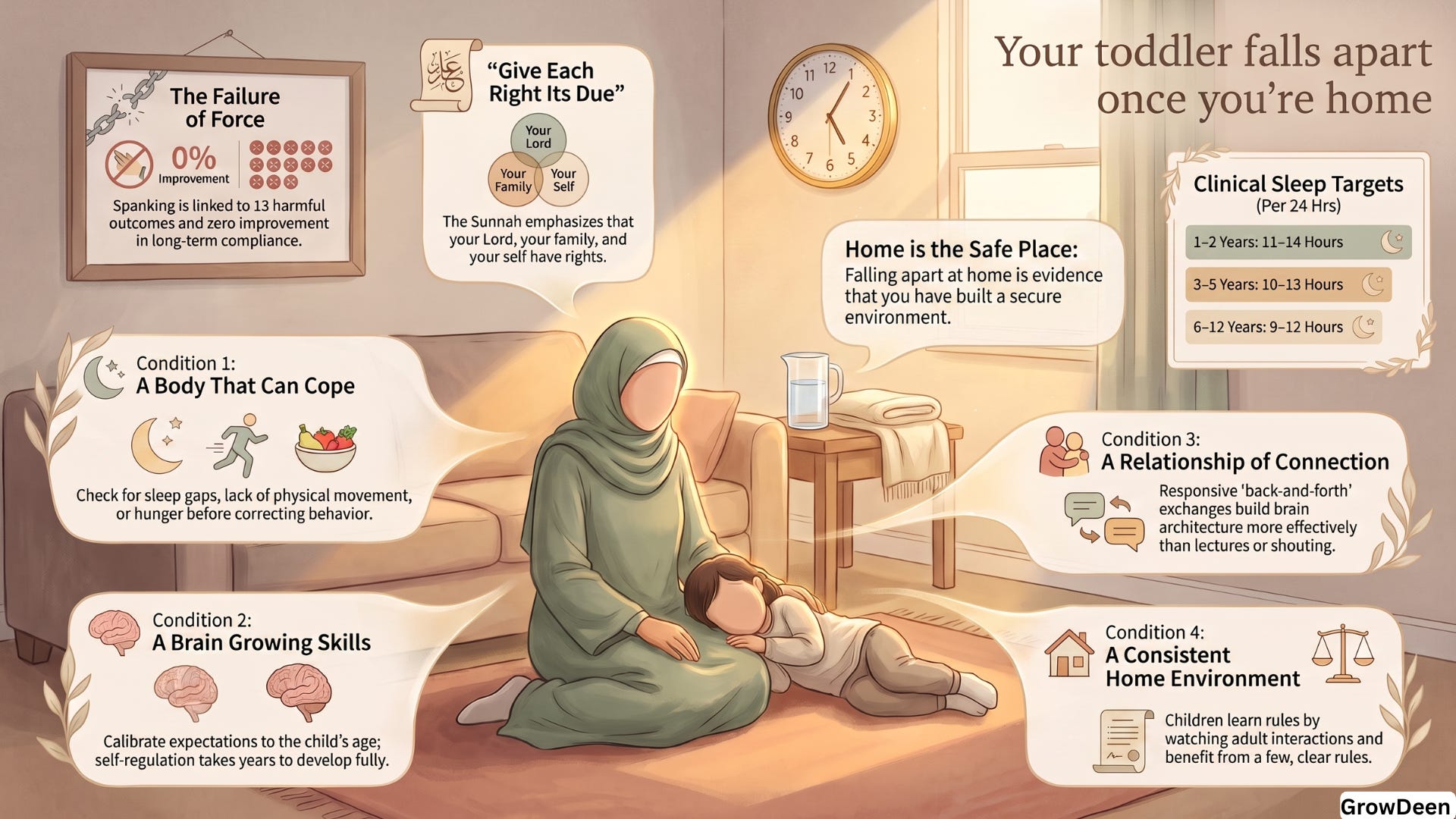
A 2016 meta-analysis of 160,927 children found spanking linked to 13 of 17 harmful outcomes and no gain in obedience at all. [1] Here are the four conditions that actually drive behaviour, and which one to check tonight.
It happens again at 5:40pm.
Same child, same request, same result. You ask them to put the shoes away. They look straight at you and drop them on the floor. And something in your chest goes tight, because this is the third time today and you have officially run out of ideas.
You are not failing. You have been given the wrong tool.
Most parenting advice treats behaviour as a discipline problem and hands you a technique to fix it. A reward chart. A firmer voice. A calmer one. But when researchers at the University of Texas and the University of Michigan pooled 111 effect sizes covering 160,927 children, they found something that should end the argument: spanking was associated with 13 of 17 measured outcomes, all of them bad, and with no improvement in either immediate or long-term compliance. [1] The most forceful technique available produces the opposite of what parents want.
So if technique is not the lever, what is?
Behaviour is a readout. What your child does at 5:40pm is the visible output of four conditions running underneath, and when one of them fails, no technique holds. Which brings up the question worth carrying through the rest of this article: why does the same child who holds it together for six hours at nursery fall apart within four minutes of walking through your front door?
The answer is in the four conditions. Let’s go through them.
Why This Guide Is Different
Every claim carries a source and a year. The sleep figures come from the American Academy of Sleep Medicine, endorsed by the American Academy of Pediatrics [2]. The activity figures come from WHO 2019 [3]. The discipline evidence comes from the AAP’s 2018 policy statement [4] and a five-decade meta-analysis [1].
The Islamic layer is load-bearing rather than decorative. This article rests on a narration in Sahih al-Bukhari that settles the guilt Muslim parents carry about resting, and it is the reason the fourth section exists at all.
You get the Four Conditions Behaviour Audit free. A printable one-page diagnostic that tells you which condition failed, so you stop guessing at 5:40pm.
Condition One: A Body That Can Cope
Think about the last three meltdowns. Now think about what time they happened.
If most of them clustered between four and seven in the evening, you already have your first clue. Regulating an impulse costs energy, and a body running low on sleep or food has less of it to spend.
Here are the numbers to check yourself against. The American Academy of Sleep Medicine, whose recommendations the AAP endorses, advises 11 to 14 hours per 24 hours for one and two year olds including naps, 10 to 13 hours for three to five year olds including naps, 9 to 12 hours for six to twelve year olds, and 8 to 10 hours for teenagers. [2] Children who regularly hit those numbers show measurably better attention, behaviour, memory and emotional regulation. [2]
Count your child’s real total for one week. Naps included. Count from when they actually fell asleep rather than from when they went to bed.
Most parents find a gap of forty to ninety minutes they did not know was there.
Movement matters on the same axis. WHO advises at least 180 minutes of physical activity across the day for children aged one to four, with at least 60 of those minutes at moderate to vigorous intensity for three and four year olds. [3] Infants not yet mobile need 30 minutes of tummy time spread through the day. [3] A child who has been indoors since breakfast is not being difficult. They are discharging unspent energy in the only direction left open.
Then food. Regular meals, water instead of sugary drinks, and a snack before the supermarket rather than after the scene in aisle four.
None of this is exciting advice. It is the advice that works most reliably, because everything else is built on top of it.
And when researchers looked at what those depleted bodies are actually failing at, the answer reframed the whole problem.
Condition Two: A Brain That Has Grown the Skill
You have probably said this to yourself: he knows better than this.
Sometimes he does. Often he does not, and the gap between what a parent expects and what a child’s brain can currently deliver is where most of the conflict lives.
Inhibitory control, the ability to stop yourself doing the thing you want to do, appears gradually across toddlerhood, and parental co-regulation supports its growth rather than replacing it. [5] Across infancy to adolescence, self-regulation develops over years and is continuously shaped by how caregivers respond. [6] In early childhood, children shift from external compliance toward regulation they generate themselves, and responsive parenting is what drives that shift. [7]
This is worth building carefully, because a meta-analytic review of longitudinal studies found that self-regulation in childhood predicts outcomes across health, education and social functioning decades later. [8] The capacity you are constructing at four is still paying out at twenty-four.
So calibrate what you ask for:
Under two. Redirect instead of explaining. Keep them close, keep the space safe, and name the feeling aloud even though they cannot name it back yet.
Two to five. Big feelings, short fuse. Lean hard on routine. Praise the specific act. Warn before every transition.
Six to eleven. They can hold a rule in mind now and reason about it. Bring them into setting the rules. Explain why something matters instead of stopping at the fact that it does.
Twelve and up. Influence has replaced control. Keeping the conversation open matters more than winning any single exchange.
Two things change this timeline. Temperament is one: some children arrive with a nervous system that fires faster and settles slower, visible from the first months, and nothing you did caused it. Additional needs are the other. If your child is autistic, has ADHD, a developmental delay or a disability, the same skills may arrive later or by a different route. Speak with your doctor or paediatrician about assessment and support. That is a reason to change the scaffolding rather than to lower what you hope for them.
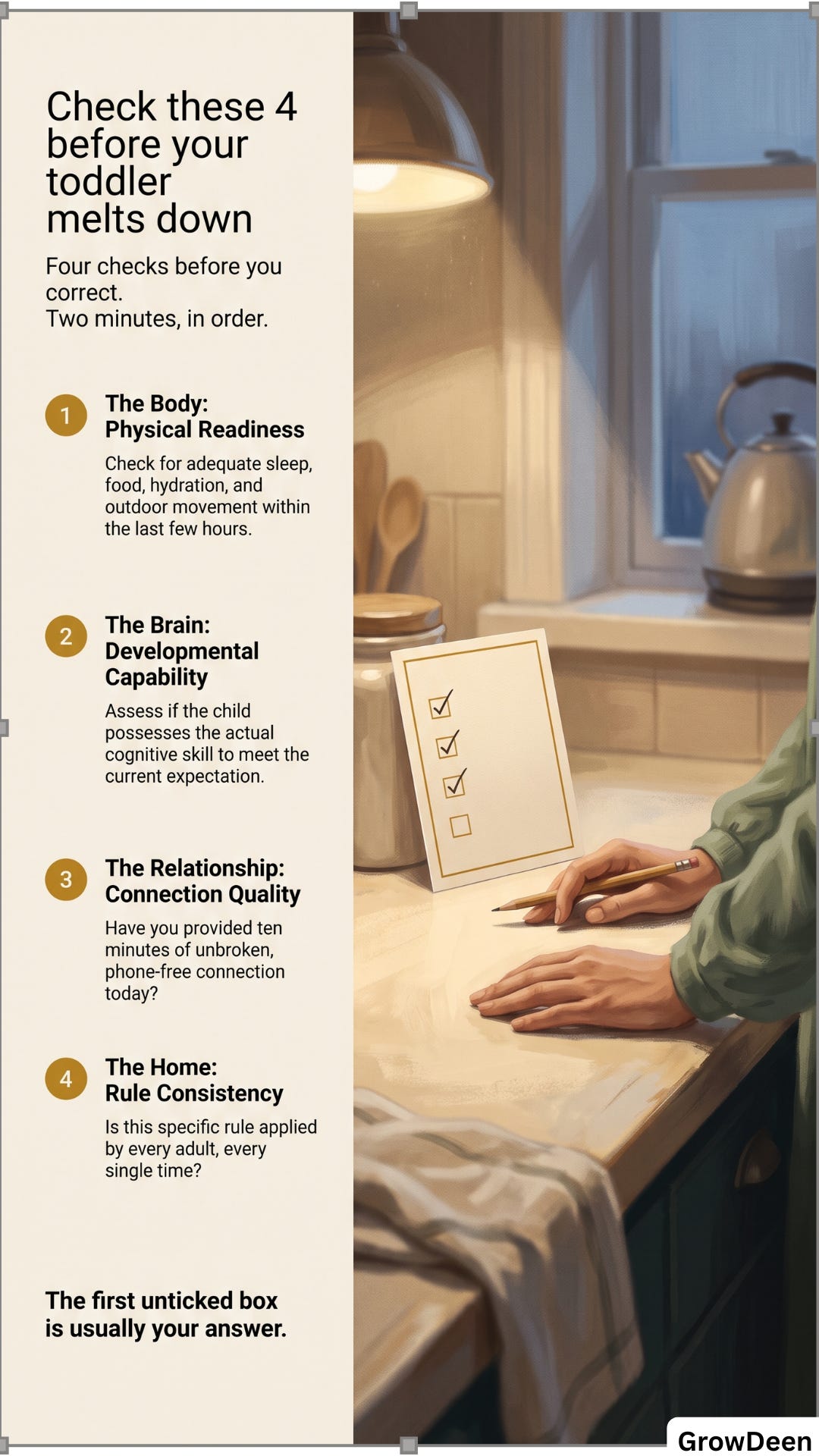
This is a lot to hold in your head at 5:40pm on a Tuesday when you are already cooking and someone is crying. That is exactly why there is a free Four Conditions Behaviour Audit waiting at the end of this article: a printable one-page diagnostic that walks you through which condition failed, plus a seven-day tracker with the clinical target numbers printed right on it. Keep reading and it is yours. It is built to sit on your fridge, where the 5:40pm decisions actually get made.
Condition Three: A Relationship Worth Cooperating For
Here is a moment you will recognise. You sit down next to a child mid-meltdown and do nothing. No lecture, no fixing. And somehow they settle faster than when you tried to talk them out of it.
Researchers have a name for what you just did, and a body of evidence behind it. The Center on the Developing Child at Harvard University describes the back-and-forth exchanges between a young child and a responsive adult as shaping early brain architecture and supporting the language and social skills that everything else is built on. [9] Sustained across years, that same responsiveness is what a meta-analysis of maternal and paternal parenting connected to higher prosocial behaviour in children. [10] An intervention study that followed children to ages three and six found responsive parenting in infancy still improving self-regulation years later. [11]
Which means the ten minutes on the floor with the phone in another room does more for tomorrow evening than the lecture you were planning tonight.
It also means something harder to hear. What you spend when you shout is not authority. It is connection, and rebuilding it costs more than spending it did.
Two things make this practical.
Praise the act rather than the person. “You waited while I finished the call. That was hard, and you did it.” That gives a child something to repeat. “You’re such a good boy” gives them a label to defend, which is heavier for a five year old than it looks.
Repair beats never rupturing. Every parent loses their temper. What separates households is whether the adult comes back afterwards, names what happened, and restores the connection. A child who watches that learns to do it, which is a skill most adults never picked up.
Condition Four: A Home That Teaches the Same Thing Every Day
Your child learns the rules of your house by watching it run.
Your tone during a disagreement with your spouse is a lesson. So is how you speak on the phone, how you handle a spilled drink, and what you do when you turn out to be wrong.
Consistency is the second piece. Rules that hold on Tuesday but not Friday, or for one sibling but not another, train a child to test rather than absorb. The CDC’s guidance for parents of two to four year olds is built on exactly this: clear directions, consistent structure, and positive attention aimed at the behaviour you want repeated. [12]
Keep the rules few enough to remember under pressure. Three or four, phrased as what to do rather than what to stop, agreed with the children old enough to take part, and applied identically by every adult in the house. We speak kindly. We help clear the table. We ask before we take. That beats fifteen prohibitions nobody can recall at 5:40pm.
Expect the whole thing to wobble during change. A new baby, a house move, illness, a school transition, a parent going back to work, separation, or something frightening will surface in behaviour before your child can put it into words. What helps then is more connection rather than more control.
Check the conditions before you correct the child.
Give Each Right Its Due: The Sunnah Balance Behind a Steady Home
You have probably felt this and never said it out loud: a quiet guilt about resting. As though every hour not spent in worship or on the children is an hour you stole.
The Sunnah answers that directly, and more generously than most parents expect.
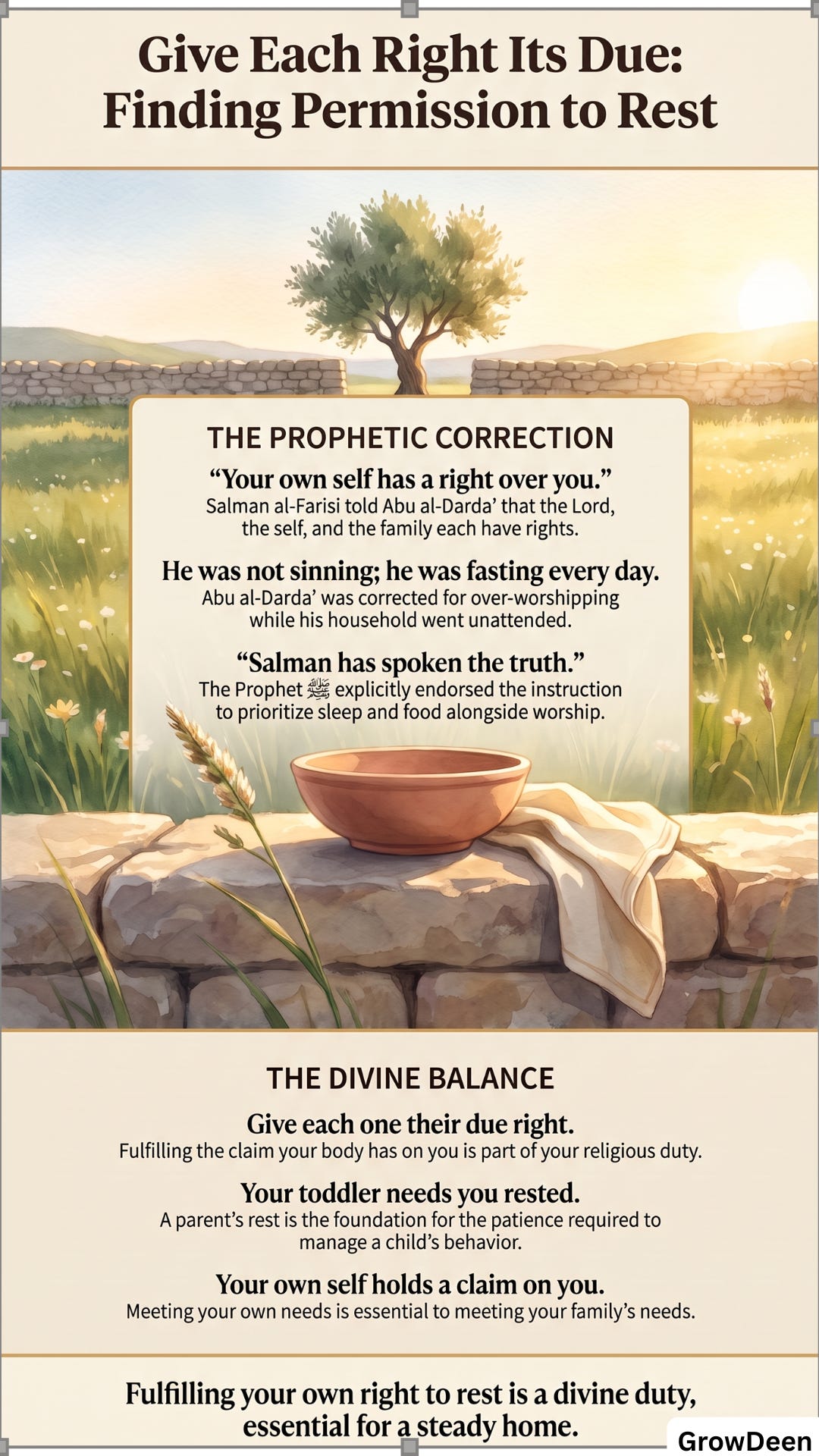
Al-Bukhari records that the Prophet ﷺ paired Salman al-Farisi with Abu al-Darda’ as brothers. Visiting, Salman found Umm al-Darda’ neglected and unkempt, because Abu al-Darda’ was fasting every day and praying most of the night. Salman made him eat. Made him sleep. Woke him only near dawn to pray. Then he said to him: “Your Lord has a right over you, your own self has a right over you, and your family has a right over you. So give each one who has a right his due right.” They took it to the Prophet ﷺ, who said, “Salman has spoken the truth.” [13]
Notice what is being corrected. Abu al-Darda’ was not sinning. He was doing good things in a way that starved his body and his household, and the correction came with prophetic endorsement.
Which lands squarely on the fourth condition. A parent running on no sleep and no support has less patience to give a difficult four year old. Your own self has a claim on you. Meeting it is part of meeting your family’s.
What the Evidence Says Not to Do
The AAP reviewed two decades of research and concluded that aversive strategies, including all forms of corporal punishment along with yelling at or shaming children, work poorly in the short term and fail completely in the long term. [4] The Academy advises parents not to spank, hit, slap, threaten, insult, humiliate or shame. [4]
Alongside that, five more things worth dropping:
Threats you will not carry out. Each one teaches your child that your words are negotiable.
Sibling comparisons spoken aloud.
Correction delivered in front of an audience when a private word would do the same job.
Long explanations offered mid-meltdown, when the listening part of the brain is offline.
Labels attached to the child instead of the act. “That was unkind” teaches. “You are unkind” installs.
So Why Do They Fall Apart at Home?
Back to the question from the opening.
By 5:40pm, three of the four conditions are at their weakest. Sleep pressure has been building since morning. The last proper meal was hours ago. Regulatory capacity, which we know is finite and effortful [5][6], has been spent all day on holding it together somewhere the child had to.
And then there is the fourth condition, which cuts the other way. Home is the one place where letting go is safe, because the relationship there is strong enough to survive it.
Your child falling apart in your kitchen and not in their classroom is not a verdict on your parenting. It is, uncomfortably, evidence that you built the safe place.
Check the conditions before you correct the child.
When to Get Help
Speak with your doctor, paediatrician or a qualified counsellor if the behaviour is not improving despite weeks of consistent effort, if it puts your child or others at risk, if there has been a sudden change or a loss of skills they previously had, if it is affecting learning or friendships, if you are worried about their development, or if you are struggling to hold your own temper.
This article does not replace medical advice. On Islamic questions where scholars differ, ask a trusted scholar rather than a general article.
Your Free Companion Pack
If you have read this far, you are the kind of parent who wants to understand your child rather than just manage them. That says something about you.
Inside the Four Conditions Behaviour Audit (one comprehensive PDF, 3 pages):
Page 1: The Four Conditions Behaviour Audit. A one-page diagnostic grid with four numbered panels and eleven tick-box prompts, so that after any incident you can find in under two minutes which condition failed instead of guessing. Designed as a laminated card for your fridge door.
Page 2: The Seven-Day Body Check Tracker. A printed week grid for sleep total, outdoor movement minutes and mealtime gaps, with the AASM and WHO target numbers printed directly on the sheet, so you can see your child’s real gap without looking anything up.
Page 3: Give Each Right Its Due. An English reflection card built on the narration in Sahih al-Bukhari where Salman tells Abu al-Darda’ that his Lord, his own self and his family each hold a right over him, with three short prompts for a parent deciding whether to skip sleep again tonight.
This isn’t just a PDF to download and forget. It’s a tool designed to stay on your fridge, where you’ll actually use it when you need it most.
This Four Conditions Behaviour Audit is what every subscriber receives with each article. Muslim Parenting Lab covers raising Muslim children from newborn through the school years, all backed by peer-reviewed research and rooted in Qur’an and Sunnah.
If you want both evidence-based guidance and Islamic perspective in one place, subscribe free so the next resource arrives before you need it.
Subscribe free for parenting resources backed by both science and Sunnah, guidance so unique you literally can’t get it anywhere else. No spam, no clutter, just resources that matter.
Do This in the Next Five Minutes
Open your phone’s notes app. Write down what time your child actually fell asleep last night and what time they woke. That’s it. Do it for seven nights and you’ll know more about your child’s behaviour than any discipline article can tell you.
May Allah place barakah in your effort, accept your intention, and make the care you give more merciful and more rewarded than it feels in the moment.
Share This With Someone Who Needs It
Think of one person right now. The sister at the masjid who mentioned last week that evenings have become a battle. The friend whose messages sound exactly like your own did a year ago. The cousin who told you she shouts more than she wants to and then goes quiet about it.
This article could take a weight off them. Send it today as company rather than as advice. Sometimes the kindest thing we can do is tell someone the problem was never their parenting.
Frequently Asked Questions
Q: Why does my child behave at school but not at home?
A: Because holding it together all day costs energy your child does not have left by evening, and because home is the one place safe enough to let go. [5][6] The full answer is in “So Why Do They Fall Apart at Home?” above.
Q: How much sleep does my child actually need?
A: 11 to 14 hours per 24 hours for one and two year olds including naps, 10 to 13 hours for three to five year olds including naps, 9 to 12 hours for six to twelve year olds, and 8 to 10 hours for teenagers. [2] Count naps, and count from when they fell asleep rather than when they went to bed.
Q: Is smacking ever effective for discipline?
A: No. A meta-analysis of 160,927 children found spanking associated with 13 of 17 harmful outcomes and with no improvement in obedience, immediate or long-term. [1] The AAP advises against spanking, threatening, shaming and yelling. [4]
Q: At what age can a child actually control their behaviour?
A: Inhibitory control builds gradually from toddlerhood and keeps developing through adolescence. [5][6] A two year old can hold back for seconds, a five year old for longer with support, and even teenagers are still building the capacity.
Q: What does Islam say about disciplining children?
A: The model the Prophet ﷺ gave is built on mercy and gentleness, and the Sunnah is explicit that a parent’s own body and household hold rights that must be met rather than sacrificed. [13] For Islamic rulings where scholars differ, ask a trusted scholar.
Q: My child is autistic. Does any of this still apply?
A: Yes, though the timeline changes. The same skills often arrive later or by a different route, which means smaller steps and more repetition rather than firmer discipline. Speak with your paediatrician about assessment and targeted support.
Q: How long before I see a change?
A: Most families notice something within a week of fixing sleep and adding daily outdoor movement. If seven consistent days produce nothing, that itself is worth taking to your doctor.
References
[1] Gershoff, E.T., & Grogan-Kaylor, A. (2016). Spanking and child outcomes: Old controversies and new meta-analyses. Journal of Family Psychology, 30(4), 453-469. https://doi.org/10.1037/fam0000191
[2] Paruthi, S., Brooks, L.J., D’Ambrosio, C., et al. (2016). Recommended Amount of Sleep for Pediatric Populations: A Consensus Statement of the American Academy of Sleep Medicine. Endorsed by the American Academy of Pediatrics. https://aasm.org/advocacy/position-statements/child-sleep-duration-health-advisory/
[3] World Health Organization. (2019). Guidelines on physical activity, sedentary behaviour and sleep for children under 5 years of age. Geneva: WHO. https://www.who.int/publications/i/item/9789241550536
[4] Sege, R.D., & Siegel, B.S.; Council on Child Abuse and Neglect; Committee on Psychosocial Aspects of Child and Family Health. (2018). Effective Discipline to Raise Healthy Children. Pediatrics, 142(6), e20183112. https://doi.org/10.1542/peds.2018-3112
[5] Gärtner, K.A., Vetter, V.C., Schäferling, M., Reuner, G., & Hertel, S. (2018). Inhibitory control in toddlerhood: the role of parental co-regulation and self-efficacy beliefs. Metacognition and Learning, 13, 241-264.
[6] Wesarg-Menzel, C., et al. (2023). Development and socialization of self-regulation from infancy to adolescence: A meta-review. Developmental Review, 69, 101090.
[7] Feng, X., Hopper, E.G., & Jia, R. (2017). From compliance to self-regulation: Development during early childhood. Social Development, 26, 981-995.
[8] Robson, D.A., Allen, M.S., & Howard, S.J. (2020). Self-regulation in childhood as a predictor of future outcomes: A meta-analytic review. Psychological Bulletin, 146(4), 324.
[9] Center on the Developing Child at Harvard University. Serve and Return. https://developingchild.harvard.edu/key-concept/serve-and-return/
[10] van der Storm, L., van Lissa, C.J., Lucassen, N., Helmerhorst, K.O., & Keizer, R. (2022). Maternal and paternal parenting and child prosocial behavior: A meta-analysis using a structural equation modeling design. Marriage & Family Review, 58(1), 1-37.
[11] Hernandez Acton, E., Kubiniec, E., Bhargava, S., Tauriello, S., Paul, I.M., Savage, J.S., & Anzman-Frasca, S. (2025). INSIGHT responsive parenting intervention effects on child self-regulation at ages 3 and 6 years. Developmental Psychology, 61(8), 1413-1426.
[12] Centers for Disease Control and Prevention. Essentials for Parenting Toddlers and Preschoolers. https://www.cdc.gov/parenting-toddlers/about/index.html
[13] Sahih al-Bukhari 1968 — Graded: Sahih — https://sunnah.com/bukhari:1968