

Nearly half of healthy infants (46.6%) show some degree of head flattening by three months,[1] and research shows babies who don’t receive adequate tummy time are more likely to experience motor delays.[2] This guide shows you exactly when to start, how much time is enough, and what to do when your baby resists—backed by AAP 2022 guidelines and Prophetic wisdom about nurturing strength.
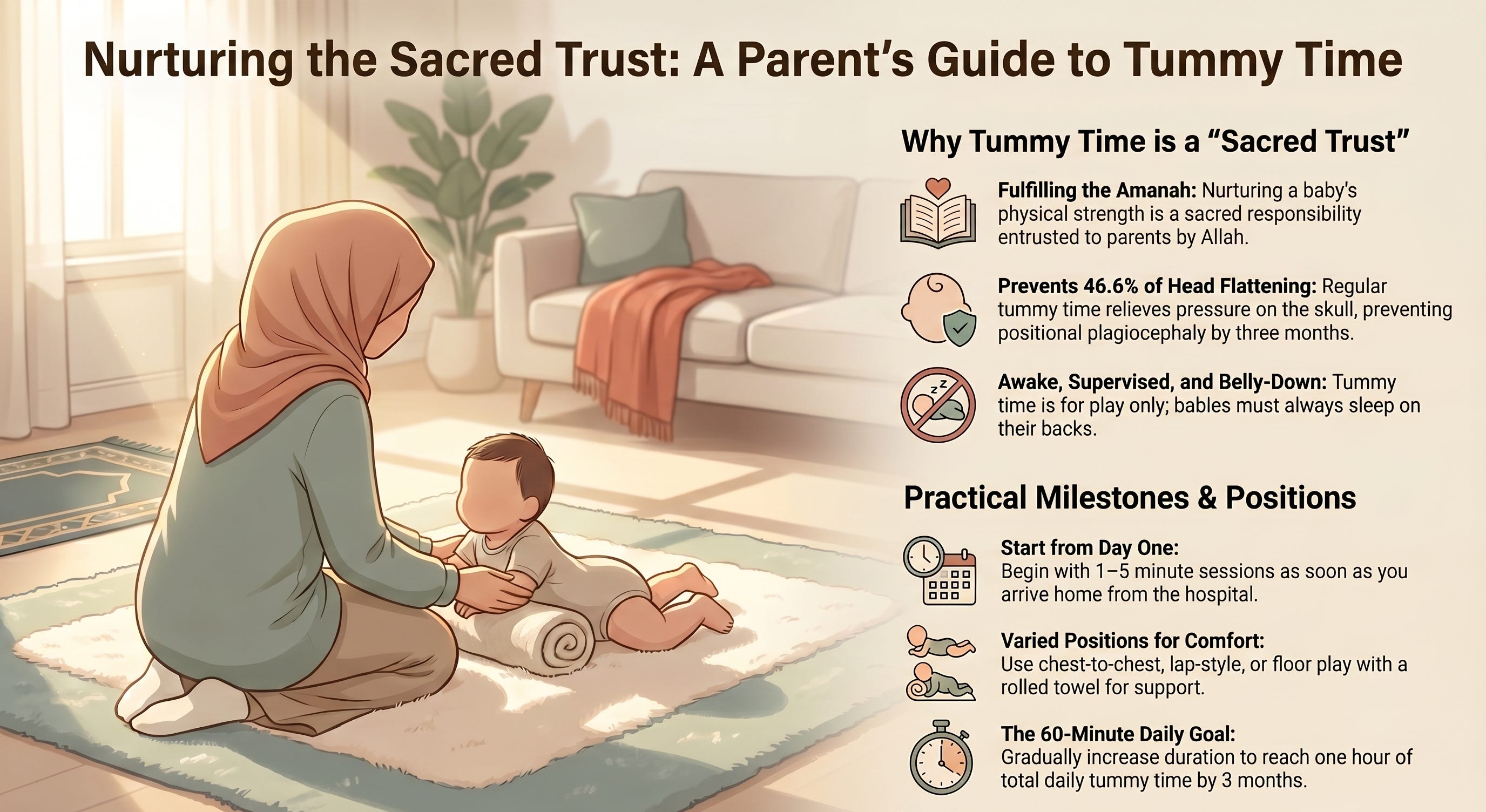
It’s 2 AM. Your newborn is finally asleep after an hour of settling. You’re scrolling through parenting advice on your phone, half-awake, and you see it again: tummy time.
The term is everywhere. Your pediatrician mentioned it. That Instagram account you follow posts about it. The developmental checklist in your baby book lists it as essential.
But you’re not entirely sure what it means, when to start, or how long is actually enough. And honestly? Your baby seems to hate being on their stomach.
You’re not alone. Nearly half of babies develop some degree of flat spots on their heads by 3 months—most of it preventable through regular tummy time.[1] Babies who don’t get adequate tummy time are also more likely to show delays in motor milestones like rolling and crawling.[2]
Tummy time isn’t just a trendy parenting tip. It’s your baby’s first exercise—the foundation for every movement they’ll make in their first year.
Why This Guide Is Different
Evidence-based and current. Every recommendation here comes from the American Academy of Pediatrics’ 2022 updated guidelines and peer-reviewed studies published between 2020 and 2026—not outdated parenting blogs.
Rooted in Islamic wisdom. This isn’t just about developmental science. It’s about fulfilling the amanah (sacred trust) of nurturing the physical strength Allah designed into your baby’s body—the strength the Prophet ﷺ taught us to cultivate.
Practical tools included. You’ll get the Tummy Time Tracker & Milestone Guide—a 3-page PDF with age-by-age charts, troubleshooting solutions, and Islamic supplications for your baby’s development.
What Tummy Time Actually Is
Tummy time means placing your baby on their stomach while they’re awake and you’re watching them closely.[3,4]
That’s it.
This supervised, belly-down time is how your baby builds strength. When they’re on their stomach, they have to work against gravity to lift their head, push up on their arms, and eventually move their whole body. All that effort builds muscle, coordination, and confidence.[5,6]
Tummy time is not the same as stomach sleeping.
Let me say this clearly, because it matters:
Tummy time = awake + supervised + on stomach
Sleep time = on back + safe sleep space
Babies should always sleep on their backs—every sleep, naps and nighttime included—until their first birthday.[7,8] Back sleeping dramatically reduces the risk of SIDS. It’s non-negotiable.[7,8]
The AAP uses the phrase “Back to sleep, tummy to play”[3,4] to help parents remember: your baby needs back time for safe sleep AND stomach time for healthy development. Both matter.
If your baby falls asleep during tummy time, gently roll them onto their back and move them to their crib or bassinet.[9,10]
Why Tummy Time Matters
It Builds Strength Your Baby Needs for Every Movement
When your baby is on their stomach, they instinctively try to lift their head to see around them. This builds neck strength—the foundation for head control, which underlies nearly every motor skill they’ll develop.[5,11]
As they push up on their arms, they’re building strength in their shoulders, arms, chest, and upper back.[5,12] These are the same muscles they’ll need to roll over, sit up, crawl, stand, and walk.[6,11]
Tummy time also engages core muscles—their trunk—which provides stability for all movement.[12,13] A strong core helps babies sit upright, crawl efficiently, and eventually walk independently.
It Prepares Your Baby to Move
Research shows that babies who get regular tummy time:[6,14,15]
Roll over sooner
Develop the arm and core strength needed to sit independently
Build the upper body strength required for crawling
Strengthen the muscles they’ll need to pull up, stand, and walk
It Prevents Flat Head
Since the “Back to Sleep” campaign started in the 1990s—which cut SIDS deaths by over 50%[16]—babies spend significantly more time on their backs. That’s essential for safety, but it also means babies can develop flat spots (positional plagiocephaly) from constant pressure on the same area of their head.[17,18]
Studies show 46.6% of healthy infants have some degree of head asymmetry by three months.[19] Tummy time relieves that pressure on the back of the head, allowing the skull to maintain a rounder shape.[17,18,20] It’s one of the most effective ways to prevent flat spots.[20,21]
It Supports Visual and Sensory Development
On their stomach, babies experience the world from a completely different angle. They practice tracking objects, focusing at different distances, and exploring their environment visually.[22] This strengthens visual coordination.
Tummy time also exposes babies to different textures, temperatures, and surfaces—helping them learn about their body in space and how their movements affect the world around them.[22,23] This sensory input supports brain development and body awareness.
When to Start
Tummy time can start as soon as you bring your baby home from the hospital.[3,4,24]
According to the AAP and major health organizations, you can begin on day one.[3,4,9] There’s no need to wait weeks or even days.
What Tummy Time Looks Like for Newborns
For newborns, tummy time looks different than it does a few months later. In the early days, it can include:[3,4,24,25]
Chest-to-chest tummy time: Lie on your back and place your baby belly-down on your chest so you’re face-to-face.[4,25] This is often the easiest, gentlest way to start. Your baby gets the benefit of the position while also feeling close to you and hearing your heartbeat.
Lap tummy time: Sit down and lay your baby belly-down across your lap.[4,25] You can gently rub their back or talk to them.
Brief floor tummy time: Place your baby on a firm, clean surface—a play mat or blanket on the floor—and stay right there with them.[3,4] Keep sessions very short: even 30 seconds to 2 minutes is beneficial for a newborn.[9,24]
What About the Umbilical Cord Stump?
Chest-to-chest and lap tummy time are generally safe even while the cord stump is still attached.[26] If you’re concerned about doing floor tummy time before it falls off, stick with chest and lap positions until it heals.
What About Premature Babies?
If your baby was born prematurely or has any medical conditions, always check with your pediatrician, neonatologist, or physical therapist about when and how to safely start tummy time.[25,27] Even premature babies can often begin with guidance from their healthcare team.[25,27]
Why Start Early?
Starting tummy time from birth helps babies get used to the position before they develop strong preferences or aversions.[24,28] Newborns who experience tummy time early often tolerate it better as they grow.[28] And even though they can’t lift their head much at first, they’re still building awareness and strength.[5,12]
How Much Time Your Baby Needs
The amount increases as your baby grows and gets stronger.
Newborn (Birth to 1 Month):
2 to 3 short sessions daily, 3 to 5 minutes each (or shorter if needed).[3,4,9]
For some newborns, 1 to 2 minutes at a time is a good start.[9,24] The key is frequency, not duration. Multiple short sessions throughout the day help babies adjust.[3,4]
1 to 2 Months:
Several short sessions throughout the day, gradually building toward 15 to 30 minutes total daily.[3,4,9]
By 7 weeks to 2 months, aim for 15 to 30 minutes total each day.[3,9] This can still be broken into many small chunks—five 3-minute sessions or three 5–10 minute sessions.[4,24]
3 Months:
Work toward approximately 60 minutes (1 hour) total daily.[11,19,29]
At this age, most babies are stronger and can handle longer sessions.[11,29] But that hour should still be spread throughout the day.[11] Ten 6-minute sessions or six 10-minute sessions is more realistic than one long stretch.
4 to 6 Months:
Continue aiming for at least 60 minutes daily—more is even better.[25,29,30]
By 6 months, some sources suggest 60 to 90 minutes daily.[30,31] At this stage, babies often enjoy tummy time more and may spend longer periods playing on their bellies.[29,30] Tummy time naturally blends into floor play.[29,30]
After 6 Months: When Your Baby Rolls and Crawls:
Once your baby can roll over consistently in both directions and starts scooting, pivoting, or crawling, formal “tummy time sessions” become less necessary.[29,30,32] Your baby is spending plenty of time on their stomach naturally during play.[32] But continued supervised floor play remains important.[32]
Does It Need to Happen Every Day?
Yes, daily tummy time is ideal.[3,4] Consistency helps babies build strength progressively and develop skills steadily.[6,14]
Think of it like exercise—regular practice leads to better results than sporadic effort. Babies who get daily tummy time tend to tolerate it better, build strength faster, and enjoy it more over time.[28]
If you miss a day or two occasionally, your baby will be fine. What matters most is the overall pattern over weeks and months, not perfection every single day.[24]
When to Do Tummy Time
Timing matters. Your baby’s tolerance for tummy time depends heavily on when you try it.[3,4,9,10]
When your baby is awake and alert: Not drowsy or about to fall asleep.[3,9,10] A well-rested baby is more likely to cooperate.[24]
After diaper changes: Many parents find doing tummy time after every diaper change makes it easy to remember and naturally builds it into the routine.[3,4,9]
After naps: When your baby wakes from a nap, they’re often in a good mood and ready to play.[3,4]
When your baby is calm but not overtired: An overtired, fussy baby is going to resist.[24] Look for that sweet spot—when your baby is awake, calm, and content.
Not right after feeding: Tummy time immediately after a full feeding can be uncomfortable and may lead to spitting up.[9,10,33] Wait at least 20 to 30 minutes after feeding.[9,10,33]
For babies with reflux: If your baby has reflux or spits up frequently, wait 30 to 60 minutes after feedings before trying tummy time.[25,33,34] You can also try positions that keep your baby slightly inclined (like propped on a rolled towel under their chest).[25,34]
Avoid when hungry: Feed them first, wait appropriately, then try.[24]
Where to Do Tummy Time (Safely)
Safety is essential.[3,9,10,25]
Safe Surfaces
Firm, flat floor: The best place is on the floor.[3,9,25] Use a clean play mat, blanket, or activity mat on a firm, flat surface.
Your chest: Lying on your chest while you’re reclined is safe and comforting for young babies.[3,4,25]
Your lap: Laying your baby belly-down across your lap while you’re sitting is another safe option.[4,25]
Unsafe Surfaces to Avoid
Soft beds or mattresses: Never do tummy time on a soft mattress, adult bed, or waterbed.[11,35] Babies can sink into soft surfaces, which increases suffocation risk.
Sofas or couches: Soft, cushioned furniture is not safe.[11,35] Your baby could roll off, sink into the cushions, or suffocate.
Elevated surfaces: Don’t place your baby on changing tables, countertops, or other high surfaces.[11] Babies can roll unexpectedly, and falls cause serious injury.
Surfaces with pillows, blankets, or loose items: Keep the area clear.[3,9] Remove pillows, soft toys, and loose blankets that could obstruct breathing.
Support Muslim Parenting Lab ❤️
Would you like a deed that keeps earning for you after you die? Start one in a few seconds with the button below.
The Prophet ﷺ named ongoing charity and beneficial knowledge among the three things that keep counting after death. (Sahih Muslim 1631)
Supervision Is Non-Negotiable
Never leave your baby unattended during tummy time.[3,9,10,11] Stay with your baby and watch them closely the entire time. Babies can tire quickly, position themselves unsafely, or become distressed.[9,24] Your constant presence ensures you can respond immediately.
If you’ve read this far, you’re the kind of parent who takes your baby’s development seriously—not as a checklist to complete, but as a foundation to understand. Here is a gift for you from us - Tummy Time Tracker & Milestone Guide.
Inside the Tummy Time Tracker & Milestone Guide (one comprehensive PDF, 3 pages):
Page 1: Age-by-Age Tummy Time Chart — Shows you exactly how much time your baby needs from birth to 6 months, what milestones to expect at each stage, and red flags that warrant a doctor visit—all on one visual reference you can keep on your fridge.
Page 2: “My Baby Hates It” Troubleshooting Flowchart — A simple decision tree: Baby is crying → Check this → Try this → Still resisting? Do this—so you can move through resistance strategies confidently, even when you’re exhausted.
Page 3: Du’a for Your Baby’s Strength & Growth — The authentic Sunnah supplication for your child’s physical and spiritual strength, with Arabic text, transliteration, and English meaning—something you can make during tummy time as you nurture both body and faith.
This isn’t just a PDF to download and forget. It’s designed to stay in your nursery or on your phone—where you’ll actually use it when you need it most.
Different Approaches to Tummy Time
There’s more than one way to do this. [3,4,25]
Chest-to-Chest
Lie on your back and place your baby belly-down on your chest face-to-face.[3,4,25] Perfect for newborns who need extra comfort. Your baby gets the benefit of the position while feeling secure and seeing your face.[4,25]
Lap Tummy Time
Sit down and lay your baby belly-down across your lap.[4,25] Great for newborns and young babies, especially during burping. Gentle and calming.[4,25]
Floor Tummy Time
Place your baby belly-down on a firm, flat surface like a play mat on the floor.[3,4,9] Appropriate for all ages starting from birth. This gives the most opportunity to practice pushing up, reaching, and moving.[5,12]
With a Rolled Towel
Roll up a small towel and place it under your baby’s chest and armpits, creating a slight incline.[9,25,36] Your baby’s arms rest on top. Helpful for newborns who struggle to lift their head on a flat surface.[25,36] Also useful for babies with reflux.[25,34]
Tummy-Down Carry (Football Hold)
Hold your baby belly-down along your forearm, with their head near your elbow and their body extending along your arm.[4,25] Great for fussy babies or when you need to move around.[25] Many babies find this very soothing.
With You Face-to-Face
Place your baby on the floor and lie down yourself face-to-face at their eye level.[3,4] Excellent for engaging with your baby and encouraging them to lift their head.[3,4,24] Your presence can motivate them to stay in the position longer.[4,24]
With Toys, Mirrors, or Books
Place safe, age-appropriate toys, an unbreakable baby mirror, or a high-contrast book in front of your baby.[3,4,9] Once your baby is older and more alert (around 2 to 3 months and beyond), visual stimulation can hold their attention.[4,11] Engaging objects encourage them to lift their head, reach, and stay in position longer.[4,25]
Side-Lying Play
Lay your baby on their right or left side.[37] You can use a rolled blanket behind their back for support. Place toys or a mirror at eye level.
This is an alternative or complement to tummy time, especially for babies who are very resistant to being on their bellies.[37] Also helpful for babies with reflux, torticollis, or neck muscle tightness.[37,38] Side-lying allows babies to move their arms and legs freely without working as hard against gravity.[37] Give equal time on both sides.
Short, Frequent Sessions Throughout the Day
Instead of one long session, spread several short sessions throughout the day—after each diaper change, after each nap, before bath.[3,4,9] This works well for babies who get frustrated quickly or for busy parents.[24] Frequency often matters more than duration.[3,4]
When Your Baby Resists
Many babies don’t love tummy time at first.[3,25] This is one of the most common concerns parents have—and there are reasons for it.
Why Babies Resist
Weak muscles: Tummy time is hard work.[5,12] If their neck, shoulder, and core muscles aren’t strong yet, being on their stomach feels tiring and frustrating.
Reflux or digestive discomfort: Babies with reflux, gas, or stomach discomfort may find lying on their stomach uncomfortable, especially soon after eating.[33,34,39]
Tired or hungry: An overtired or hungry baby doesn’t have the patience or energy for it.[24]
Unfamiliar: If tummy time hasn’t been part of the routine, your baby may simply not be used to it.[28]
Sessions too long: Expecting a newborn to handle 10 or 15 minutes right away is unrealistic.[24] They’ll get frustrated quickly.
Positioned flat too quickly: Some babies (especially very young ones) feel insecure or startled when placed flat on the floor.[25] They may prefer chest or lap first.
Nothing interesting to look at: If there’s nothing engaging to see, babies may get bored or frustrated.[4,25]
Frustration from inability to move: Babies may want to move or reach but can’t yet, which can be upsetting.[29]
What to Try
Start with very short sessions: Even 30 seconds counts for a newborn.[9,24] Build up gradually.
Use chest-to-chest tummy time: Often the easiest way to start.[3,4,25] Your baby gets the benefit while feeling close, safe, and comforted.
Try lap tummy time: Soothing and gentle.[4,25]
Get down face-to-face: Your face is the most interesting thing to your baby.[4,24] Lie at their eye level to keep them engaged.
Use mirrors or high-contrast toys: Babies love looking at faces—including their own.[4,25] An unbreakable mirror or high-contrast images can capture their attention.
Try after diaper changes: Builds it into routine and catches your baby when they’re often calm.[3,4,9]
Try when rested: A well-rested baby is much more likely to tolerate tummy time.[24]
Avoid right after feeding: Wait at least 20 to 30 minutes.[9,10,33]
Break it into many short attempts: Multiple brief sessions add up.[3,4]
Celebrate small progress: Praise your baby, smile, encourage them.[24] Positive reinforcement helps.
Use gentle support when appropriate: A rolled towel under the chest can give just enough boost to make them feel more successful.[25,36]
Stop when truly distressed and try again later: If they’re really upset, it’s okay to pick them up and try later.[24,25] Tummy time should be positive, not a battle.
Keep Trying
Most babies improve with practice.[3,25,28] What feels hard at first gets easier and even enjoyable as muscles strengthen and confidence builds.[28] Consistency is key—even if your baby protests, keep offering tummy time daily, and over time, they’ll adapt.[3,25]
If You Haven’t Done Tummy Time Yet
If your baby hasn’t been doing tummy time consistently—or at all—you may be wondering what happens. Here’s the truth: not doing tummy time doesn’t mean disaster, but it does mean missing important opportunities.[6,19,40]
What Can Happen
Delayed head control: Babies who don’t spend time on their stomachs may take longer to develop the neck strength needed to hold their head steady.[5,11,40]
Weaker upper body strength: Without practice, these muscles don’t get the same workout, which can lead to weaker upper body strength overall.[5,12,40]
Less practice for rolling and crawling: Rolling and crawling require specific muscle strength and coordination that tummy time develops.[14,15] Babies who skip it may take longer to roll or may skip rolling entirely.[40]
More time on back while awake: If tummy time isn’t happening, babies often spend most of their awake time on their backs in bouncers, swings, or car seats.[18,41] This limits movement variety and can contribute to developmental delays.[19,40]
Possible flat head: Babies who spend very little time on their stomachs and a lot of time on their backs are at higher risk of developing flat spots.[17,18,20,21]
Reduced opportunity for motor experiences: Tummy time provides a chance to practice lifting, pushing, reaching, shifting weight—all building blocks for later movement.[5,12,15]
If You’re Starting Late
It’s never too late to begin.[24,30] Even if your baby is several months old and hasn’t done much (or any) tummy time, start now. Begin gently and gradually, just like you would with a newborn.[24] Older babies may resist more because the position is unfamiliar, but with patience and consistency, they can catch up.[24,30]
If you’re concerned about your baby’s development or motor skills, talk to your pediatrician or ask for a referral to a pediatric physical therapist.[42]
The Islamic Perspective: Physical Development as Sacred Responsibility
Fulfilling the Amanah
In Islam, caring for our children goes beyond meeting basic needs. It includes nurturing every aspect of their being—physical, emotional, intellectual, spiritual. When we support our baby’s physical development through tummy time, we’re fulfilling a sacred trust (amanah) that Allah has placed in our hands.
The Prophet Muhammad ﷺ taught that every person has responsibility for those in their care. Abdullah ibn Umar (may Allah be pleased with him) narrated that the Messenger of Allah ﷺ said:
“Every one of you is a shepherd and is responsible for his flock. The leader of people is a guardian and is responsible for his subjects. A man is the guardian of his family and he is responsible for them. A woman is the guardian of her husband’s home and his children and she is responsible for them.” (Sahih al-Bukhari 893, Sahih Muslim)[48]
This establishes a core Islamic principle: parents have direct responsibility for their children’s wellbeing and development. Creating the conditions that allow our babies to grow strong and healthy isn’t just a medical recommendation—it’s part of the amanah we hold as Muslim parents.
The Strong Believer
Islam encourages Muslims to cultivate strength in all its forms—spiritual, emotional, intellectual, and physical. The Prophet Muhammad ﷺ emphasized the value of strength in a well-known hadith narrated by Abu Hurairah (may Allah be pleased with him):
“The strong believer is better and more beloved to Allah than the weak believer, although both are good. Strive for that which will benefit you, seek the help of Allah, and do not feel helpless.” (Sahih Muslim 2664)[49]
While scholars primarily understand this to refer to strength of faith (iman) and determination, many classical commentators also acknowledge that physical strength supports a believer’s ability to fulfill religious obligations and serve their community.[50]
From the earliest days of life, we begin building the foundation for this strength. Tummy time—though it may seem like simple baby exercise—is the beginning of your baby’s journey toward developing the physical capabilities they’ll need throughout their life.
Patience, Consistency, and Trust
Many parents feel frustrated when their babies resist tummy time. This is an opportunity to practice Islamic virtues.
Sabr (patience) is one of the most emphasized qualities in Islam. Allah says: “O you who have believed, seek help through patience and prayer. Indeed, Allah is with the patient.” (Quran 2:153)
Istiqamah (consistency) means staying steady in good practices. The Prophet Muhammad ﷺ said: “The most beloved of deeds to Allah are those that are most consistent, even if they are small.” (Sahih al-Bukhari 6464, Sahih Muslim 782)[51]
Tawakkul (trust in Allah) reminds us that while we make our best efforts, the ultimate outcome rests with Allah.
Before you keep reading—do this: Get down on the floor right now, even if your baby isn’t with you. Lie on your stomach for 30 seconds. Feel how your neck has to work to hold your head up. Feel the pressure on your chest. That’s what your baby is building strength to do. Now you understand why they might resist—and why it matters so much that they practice.
May Allah grant your child strength in body and faith, and may He make your parenting efforts a source of continuous reward.
The Companion Pack You’ll Actually Use
This Tummy Time Tracker & Milestone Guide is what every subscriber receives with each article. We cover the full journey of raising Muslim children—from newborns through adolescence—all backed by scientific research and rooted in Islamic wisdom.
If you’re a Muslim parent who wants both evidence-based guidance AND Islamic perspective, subscribe for free so future resources arrive in your inbox before you need them.
[SUBSCRIBE BUTTON]
You’ll only hear from us when there’s something valuable to share—no spam, no clutter, just resources that matter.
Share This With Someone Who Needs It
Think of one person right now: a new mother in your family who just brought her baby home, a friend whose baby is a few months old and she’s never mentioned tummy time, a sister at the masjid whose baby has a slightly flat spot on the back of their head.
This article could help them prevent developmental delays and build their baby’s strength from the start. Share it with them today—not because you’re being preachy, but because you care. Sometimes the most loving thing we can do is pass along knowledge that makes a real difference.
[SHARE BUTTON]
Frequently Asked Questions
Q: Can tummy time start from birth?
A: Yes. You can begin tummy time as soon as you bring your baby home from the hospital. Start with short, gentle sessions using chest-to-chest or lap positions.[3,4,24]
Q: What if my baby cries during tummy time?
A: Some fussing is normal, especially at first. Try shorter sessions, different positions, and engaging your baby with your face or toys. If they’re truly distressed, pick them up and try again later. Consistency and patience help.[3,24,25]
Q: How long should tummy time sessions last?
A: Start with 1 to 5 minutes at a time for newborns, gradually increasing as your baby grows. By 2 months, aim for 15-30 minutes total daily. By 3 months, work toward 60 minutes total daily.[3,4,9,11,19,29]
Q: Is tummy time still needed once my baby can roll over?
A: Formal tummy time becomes less necessary once your baby can roll independently and spends lots of time on their stomach naturally during play. But continued supervised floor play is still important for development.[29,30,32]
Q: Can tummy time help prevent flat head syndrome?
A: Yes. Tummy time is one of the most effective ways to prevent positional plagiocephaly (flat head syndrome) because it relieves pressure on the back of the head.[17,18,20,21,43]
Q: What if I’m just starting tummy time and my baby is already several months old?
A: It’s never too late to start. Begin with short, gentle sessions and gradually increase. Older babies may resist more at first because the position is unfamiliar, but with patience and consistency, they can catch up.[24,30]
Q: Should I do tummy time after every diaper change?
A: Many parents find this to be a helpful routine that makes tummy time easy to remember and builds it naturally into the day when babies are often calm.[3,4,9]
Q: What’s the difference between tummy time and letting my baby sleep on their stomach?
A: Tummy time is supervised, awake belly-down time. Sleep time should always be on the back in a safe sleep space. Never let your baby sleep on their stomach until they can roll independently.[3,7,8,9]
Q: Can I do tummy time right after feeding?
A: No. Wait at least 20-30 minutes after feeding to avoid discomfort and spitting up. If your baby has reflux, wait 30-60 minutes.[9,10,33,34]
Q: When should I be concerned and talk to my doctor?
A: Contact your pediatrician if: your baby can’t lift their head at all by 2 months; always turns their head to one side; seems excessively stiff or floppy; you notice a flat spot on their head; your baby isn’t meeting motor milestones; or you just sense something isn’t right.[24,38,42]
References
[1] Exploring the use of tummy time guidelines to improve infant development in rural primary care. (2024). Journal of Pediatric Nursing, 78, 141-149.
[2] Hewitt, L., Kerr, E., Stanley, R. M., & Okely, A. D. (2020). Tummy time and infant health outcomes: A systematic review. Pediatrics, 145(6), e20192168.
[3] American Academy of Pediatrics. (2022). Back to sleep, tummy to play. HealthyChildren.org.
[4] American Academy of Pediatrics. (2022). Back to sleep, tummy to play. Pediatric Patient Education.
[5] Moon, R. Y., Carlin, R. F., & Hand, I. (2022). Sleep-related infant deaths: Updated 2022 recommendations. Pediatrics, 150(1), e2022057990.
[6] Carson, V., Zhang, Z., Predy, M., Pritchard, L., & Hesketh, K. D. (2022). Longitudinal associations between infant movement behaviours and development. International Journal of Environmental Research and Public Health, 19(15), 9277.
[7] Task Force on Sudden Infant Death Syndrome. (2022). SIDS and other sleep-related infant deaths. Pediatrics.
[8] National Institute of Child Health and Human Development. (2024). Safe to Sleep campaign.
[9] National Institutes of Health, Safe to Sleep Campaign. (2024). Benefits of tummy time.
[10] St. Louis Children’s Hospital. (n.d.). Tummy time is important for your baby.
[11] Nemours KidsHealth. (n.d.). Tummy time.
[12] Schmitt, B. D. (2024). Tummy time. Pediatric Patient Education, American Academy of Pediatrics.
[13] Lovevery. (2024). Tummy time milestones by month.
[14] Baby Acrobatics. (2025). Tummy time by age: Week-by-week guide.
[15] Frontiers. (2024). Early motor developmental milestones and health outcomes in preadolescent children.
[16] National Institutes of Health. (n.d.). The Safe to Sleep campaign—Celebrating 25 years of progress.
[17] Johns Hopkins Medicine. (2021). Deformational plagiocephaly.
[18] Cleveland Clinic. (2017). Plagiocephaly (flat head syndrome).
[19] Exploring the use of tummy time guidelines to improve infant development in rural primary care. (2024). Journal of Pediatric Nursing, 78, 141-149.
[20] Families First Pediatrics. (2026). Plagiocephaly explained.
[21] Children’s Hospital of Atlanta. (n.d.). How to prevent a flat head in babies.
[22] Pathways.org. (n.d.). Tummy time: Essential guide for parents.
[23] Baldwin Baby Co. (2025). Tummy time by age.
[24] Cleveland Clinic. (2025). When to start tummy time and how to do it safely.
[25] Pathways.org. (n.d.). Tummy time positions and variations.
[26] CanDo Kiddo. (2022). Tummy time milestones for babies.
[27] Summer Health. (2024). Understanding the importance of tummy time for your baby.
[28] BabySparks. (2021). Tummy time: Almost as essential as milk to your baby’s day.
[29] Huckleberry. (2026). Tummy time chart and positions by age.
[30] Cleveland Clinic. (2025). When to start tummy time, how to do it and benefits.
[31] Kaiya Baby. (2024). Tummy time chart by age.
[32] NHS. (n.d.). Your baby’s development from 2 to 12 months.
[33] Foundations Pediatric PT. (2025). The connection between infant reflux and torticollis.
[34] Infant Insights. (n.d.). Understanding common baby diagnoses.
[35] Healthline. (2023). Baby sleeping on stomach: When it’s safe and when it’s not.
[36] National Childbirth Trust (NCT). (2024). Top tips for tummy time.
[37] Cleveland Clinic. (2025). Side-lying play for babies.
[38] Nemours KidsHealth. (n.d.). Torticollis in infants.
[39] Milestones & Motherhood. (2026). Early rolling and body tension in babies explained.
[40] Connecticut Children’s Hospital. (n.d.). Are you doing tummy time correctly with your baby?
[41] Felzer-Kim, I. T., & Hauck, J. L. (2020). Assessment of tummy time frequency, duration, and position during infancy. Advances in Neonatal Care, 20(5), E81-E87.
[42] Help Me Grow MN. (n.d.). Baby milestones.
[43] NJ Craniofacial Center. (2026). 7 proven ways to prevent flat head in babies.
[48] Sahih al-Bukhari, Book of Friday Prayer, Hadith 893; Sahih Muslim.
[49] Sahih Muslim, Book of Destiny, Hadith 2664.
[50] Al-Hakam. (2023). The Prophet’s path: Importance of physical wellness in Islam.
[51] Sahih al-Bukhari, Book of Heart-Softening Narrations, Hadith 6464; Sahih Muslim, Hadith 782.
We combine scientific research with Qur’an and authentic Sunnah, and we cite our sources. Even so, this is general guidance and no substitute for a doctor who can examine your child.