

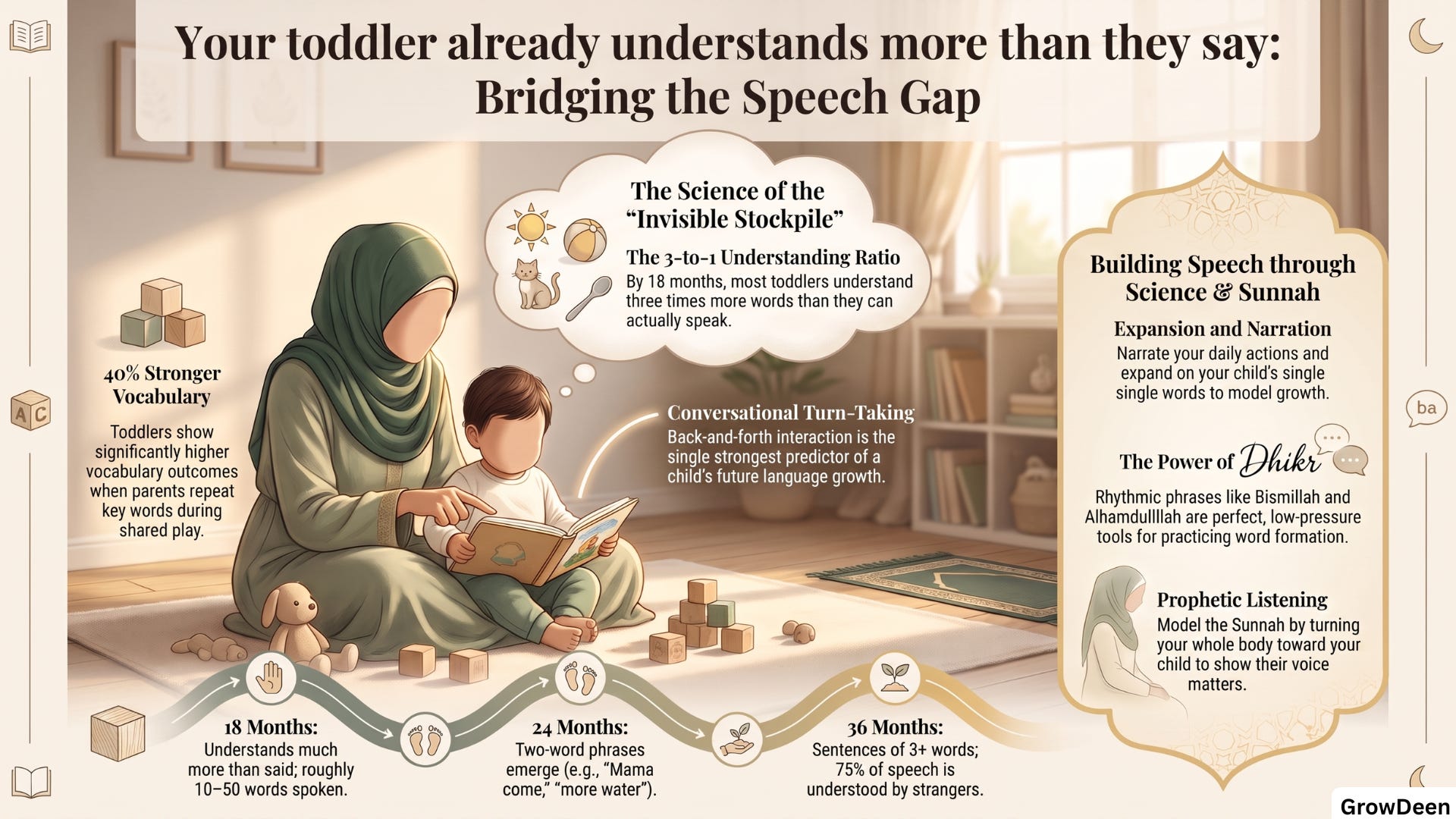
A 2018 study in the Journal of Experimental Child Psychology found that when fathers repeated key words during play, their toddlers showed up to 40% stronger vocabulary outcomes by age two. [1] The same principle applies to every parent: the words you say to your child during ordinary moments are the single most powerful language tool you own.
She is saying “ba” and pointing at the cup. You hand it to her. She shakes her head. “Ba,” she says again, more urgently. You try the banana. Wrong again.
This happens six times a day in your house, and each time you wonder: is she behind? Should she be saying more by now? Is there something I’m supposed to be doing that I’m not?
Here is what I want you to hear before anything else: you are not failing. The fact that you are paying attention to your toddler’s attempts at speech, responding to them, trying to understand, that is the thing. That back-and-forth you just had, frustrating as it felt? Researchers call it “conversational turn-taking,” and it is the single strongest predictor of a child’s language growth. [2]
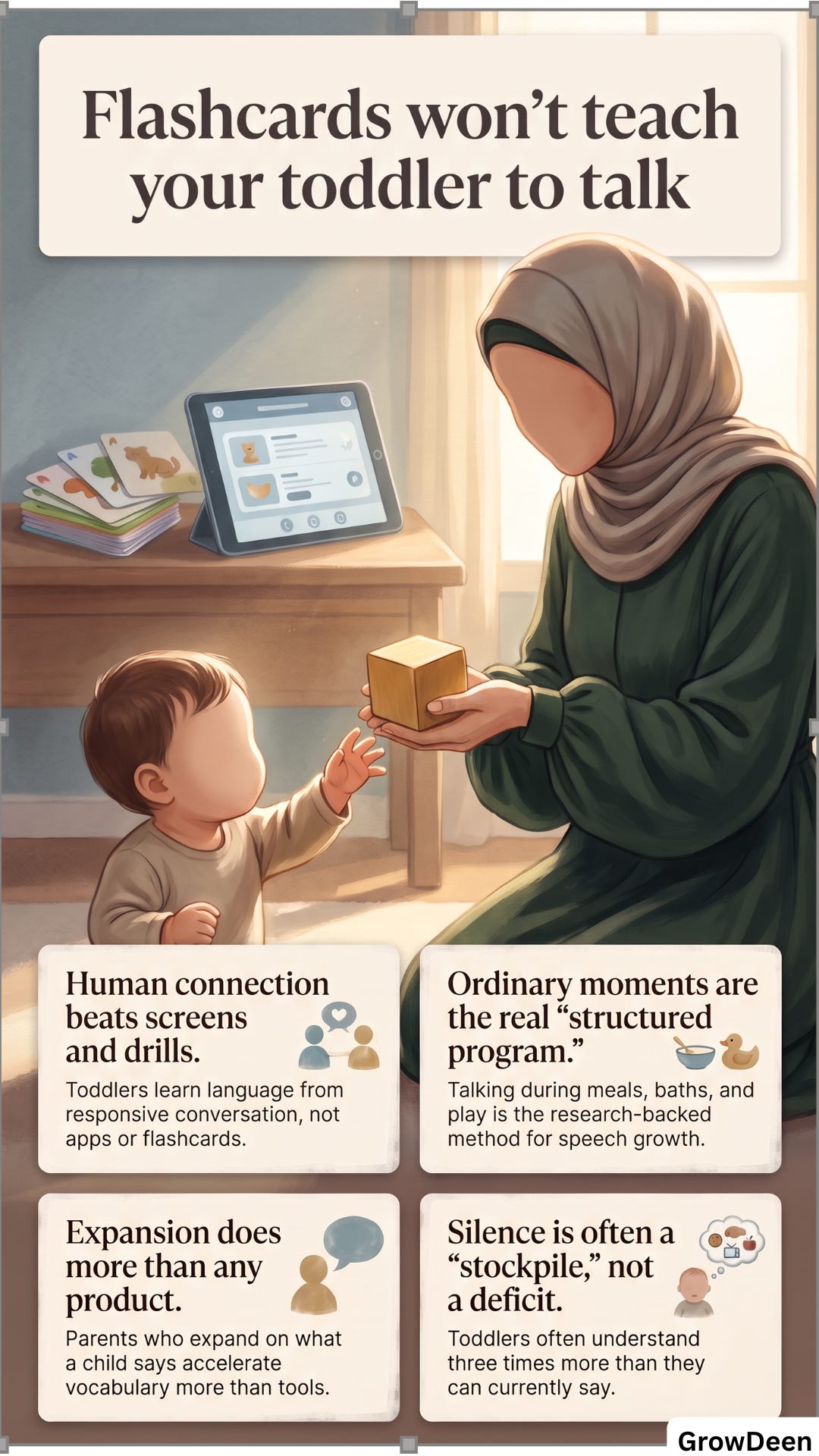
But here is the part most parents miss. There is no special technique you need to learn. No programme to buy. The myth that language development requires flashcards, apps, or structured “learning time” has sold a lot of products, but the research tells a different story. Your toddler’s language develops from the same thing you are already doing: talking to them. Reading to them. Answering their babbles as if they said something meaningful. And yes, saying Bismillah before lunch. We will come back to that.
Why does your child understand “give it to Baba” perfectly but still only say five words? That question will make sense by the time you finish reading.
What Makes This Guide Different From Generic Parenting Advice
Research-backed and current. Every recommendation draws from peer-reviewed developmental research published between 2013 and 2022, including findings from the AAP, Harvard’s Center on the Developing Child, and leading child language studies. [1] [2] [3]
Islamically integrated, not bolted on. The Islamic perspective here is woven into the practical advice, because Bismillah, Alhamdulillah, and SubhanAllah are not decorative. They are language-building tools that happen to also be acts of worship.
Comes with a free printable companion pack. You will get the Toddler Talk-Along Pack, a 3-page PDF with daily conversation prompts, a milestone reference card, and an Islamic speech reflection page you can keep where you actually parent.
The Gap Between Understanding and Speaking Is Normal (and Bigger Than You Think)
Picture this: your 18-month-old says maybe ten words. You are watching other children at the masjid playgroup string two words together, and yours is still pointing and grunting. You search “18-month-old not talking” at 11pm. You find seventeen contradictory answers.
Here is what the research actually says.
At 18 months, most toddlers understand roughly three times more words than they can say. [2] Their brain is absorbing everything: your tone, your sentence patterns, the words you repeat most. They are building an internal dictionary they cannot access yet. When the words do come (and they will), they come from this invisible stockpile.
Between 12 and 18 months, most toddlers say a handful of recognisable words. Between 18 months and two years, two-word phrases start appearing: “Mama come,” “more water.” By three, sentences of three or more words are typical, and strangers can understand about three-quarters of what your child says. [5]
They speak what they hear you speak.
Some children move through this faster. Some take longer. Small differences are normal. But here is the part that matters: the pace depends less on the child and more on what happens around the child. Children who hear more conversational speech directed at them (not background TV, not overheard phone calls, but words aimed at them during shared activity) develop larger vocabularies earlier. [1] [3]
You are the curriculum.
7 Things You Can Do Tonight That Actually Build Language
This is not a list of “enrichment activities.” These are things you are probably half-doing already. The research says: do them on purpose.
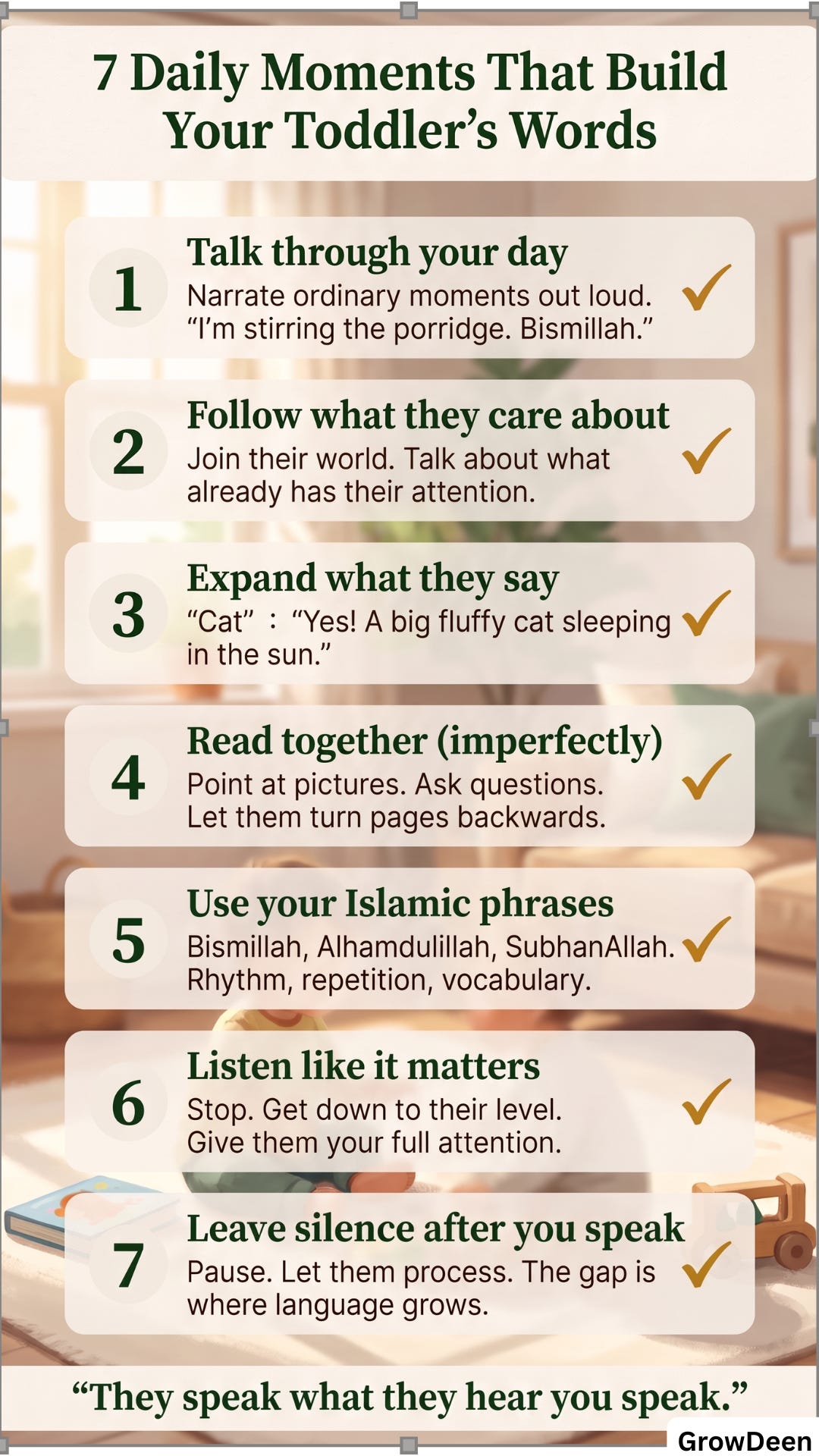
Talk through what you are doing
“I am washing your hands. See the water? Bismillah. Now we dry them.” This running narration sounds odd at first, but it works. It exposes your toddler to verbs, nouns, prepositions, all anchored to things they can see and touch. [2] No special vocabulary. No preparation. Just describe what is happening.
Follow what they care about
When your toddler is absorbed in something, lining up cars, examining a bug, feeding a stuffed bear, talk about that. Not the thing you planned. Children acquire vocabulary fastest when the words they hear connect to whatever already has their attention. [1] “You are feeding the bear! Is the bear hungry? What should we give him?”
Expand what they say
Your toddler points at a bird and says “bir.” You say, “Yes! A bird. A big bird in the tree. SubhanAllah, look how it flies.” This technique, called expansion, is a strong predictor of vocabulary growth. [3] You are not correcting them. You are showing them the next step.
Read together (imperfectly)
Reading aloud introduces words your child would never hear in daily conversation. [4] With toddlers, you do not need to follow the text. Point at pictures. Ask questions. Let them turn the pages backwards. “Look, a camel! Allah made camels so strong.” Islamic picture books, stories of the Prophets, board books about Allah’s creation: these give your child language and identity at the same time.
Use the Islamic phrases you already have
Here is the part most parenting guides miss entirely.
Bismillah. Alhamdulillah. SubhanAllah. Allahu Akbar. These are rhythmic, repetitive, easy-to-pronounce phrases that a toddler hears dozens of times a day in a Muslim home. They are, by accident of design, perfect language-building material. Rhythm and repetition are exactly what developmental research says young children need for speech acquisition. [6]
A toddler who learns to say “Alhamdulillah” after eating is practising word formation while learning to express gratitude to their Creator. You did not need a flashcard for that.
“Who made the sun? Allah. Who made the moon? Allah. Who made you? Allah.” No instruments needed. The call-and-response is enough.
Listen like the Prophet ﷺ listened
When your toddler is trying to tell you something, stop. Get down to their level. Look at their face. Wait. [7]
The Prophet ﷺ would turn his whole body toward whoever was speaking to him. He did not multitask. He did not cut people short. When you give a two-year-old that same quality of attention while they babble about a puddle, you are modelling how people deserve to be treated, and you are teaching them that their voice matters enough to be heard.
Leave silence after you speak
Pause. Give them time to respond. They might babble, gesture, or stare at you. That is fine. They are learning that conversation goes in two directions, and turn-taking is foundational to communication. [2]
The most productive thing you can sometimes do is say nothing at all.
I know this feels like a lot to hold in your head, especially at the end of a long day when your toddler is pointing at something unidentifiable for the eighth time. That is exactly why I created the Toddler Talk-Along Pack, a 3-page printable PDF with daily conversation prompts organised by routine, a clear milestone guide, and an Islamic speech reflection card. Keep reading to download it at the end of this article.
The Words You Choose Around Your Toddler Leave a Mark
When I read the verse where Allah says, “And tell My servants to say that which is best” [Qur’an 17:53] [8], I think about what “best” means in a house with a toddler. It means the tone you use when the milk spills for the third time. The phrases you repeat during play. The words that fill the gaps between tasks.
The Prophet ﷺ understood that speech could be warm without being hollow. He would joke with those around him, including children, but he would never say anything except what was true. [9] His playfulness was rooted in sincerity. He showed us that language can be light, present, and tender while still meaning something real.
A parent who weaves Bismillah into a pretend tea party, or answers “who made the rain?” with “Allah,” or pauses to say Alhamdulillah together after a snack, is choosing the best words. And those words become the child’s first vocabulary. They shape how your child speaks, thinks, and understands the world.
They speak what they hear you speak.
What About Heritage Languages? Keep Speaking Them
If you speak Arabic, Urdu, Bangla, Turkish, Somali, or any other language at home, keep speaking it. Research consistently confirms that bilingualism benefits children’s cognitive and linguistic development. [10] [11] It does not cause confusion, and it does not delay speech. Children may mix languages temporarily, and that is normal. They sort it out.
Your heritage language carries your family’s history, your connection to extended relatives, and often your access to the Qur’an. It is a gift no monolingual environment can replace.
What About Screen Time?
Current guidelines from the AAP and WHO recommend no screen time before age 2 (except video calls with family), and limited, shared screen time after 2. [12] [13] The reason is straightforward: toddlers learn language through live, responsive, face-to-face interaction. Screens, even educational ones, do not provide the same back-and-forth.
For older toddlers, shared screen time works. Watch together, talk about what you see, choose content that is Islamically suitable, music-free, and parent-approved. But the core of your child’s language should come from you.
When Should You Actually Worry?
If your child is not babbling by 12 months, not using any words by 18 months, or seems to struggle significantly with understanding language, talk to your doctor or a speech-language pathologist. Early intervention makes a measurable difference. [14]
Make du’a for your child’s development, and take the practical step. Both are part of the Islamic approach.
Your Free Toddler Talk-Along Pack
If you have read this far, you are the kind of parent who takes your child’s development seriously. Not anxiously, but intentionally. That tells me something about you.
Inside the Toddler Talk-Along Pack (one comprehensive PDF, 3 pages):
Page 1: The Daily Talk-Along Card — 7 daily routine moments (waking, meals, dressing, play, outdoors, bath, bedtime) with specific conversation prompts and Islamic phrases for each. Designed as a reference card you can stick on your fridge or keep near the changing table.
Page 2: When to Wait, When to Ask — A Toddler Speech Milestone Guide — A clear visual showing what is typical at 12, 18, 24, and 36 months, what is worth watching, and when to speak with a professional. So you can stop Googling at midnight and trust what you see.
Page 3: “The Words That Stay” — An Islamic Speech Reflection Card — Featuring the Qur’anic instruction to “say that which is best” (Qur’an 17:53) with a parent reflection exercise connecting your daily speech to your child’s developing voice and worldview. A quiet reminder that the words you choose today become the words your child carries tomorrow.
This is not a PDF to download and forget. It is designed to stay in your kitchen, your living room, or on your phone, in the places where you actually parent.
This Toddler Talk-Along Pack is what every subscriber receives with each article. We cover the full journey of raising Muslim children, from newborns to school-age, all backed by scientific research and rooted in Islamic wisdom.
If you are a Muslim parent who wants both evidence-based guidance and Islamic perspective, subscribe for free so future resources arrive in your inbox before you need them.
Subscribe free for parenting resources backed by both science and Sunnah, guidance so unique, you literally cannot get it anywhere else. No spam, no clutter, just resources that matter.
Your Micro-Action for Tonight
The next time your toddler says a word (any word, even a garbled one), stop what you are doing. Get down to their level. Repeat the word back, and add one more. If they say “ball,” you say “yes, ball! Big ball.” That is it. That is the practice. Five seconds. Tonight.
May Allah place barakah in every word you speak to your child, and may He make their tongue a source of goodness in this life and the next.
Share This With Someone Who Needs It
Think of one person right now: the mother at the masjid whose toddler is the same age as yours and who mentioned, quietly, that she is worried about his speech. The sister-in-law whose WhatsApp voice notes are full of the same questions you had six months ago. The friend who just moved to a new country and is wondering whether speaking her heritage language at home is holding her child back.
This article could ease that worry. Share it with them today. Not as advice-giving, but as support. Sometimes the most loving thing we can do is share what finally made sense to us.
Frequently Asked Questions
Q: When should a toddler start talking? A: Most toddlers say their first recognisable words between 12 and 14 months, though some start a little earlier and some a little later. By 18 months, most have around 10–50 words. [5] If your child has no words at all by 18 months, that is a good time to speak with your doctor.
Q: Is it normal for a toddler to understand words but not say them? A: Completely. At 18 months, most toddlers understand roughly three times more words than they can produce. [2] Think of it as a stockpile: they are absorbing everything and will start using those words when their mouth catches up with their brain.
Q: Does speaking two languages at home delay a toddler’s speech? A: No. Research consistently shows that bilingualism does not cause speech delays. [10] [11] Children may mix languages temporarily, but they sort it out. The long-term cognitive and linguistic benefits of growing up bilingual are well established.
Q: How much should I talk to my toddler each day? A: There is no magic number of words. What matters more than volume is responsiveness: talking to your child during shared activities, responding to their attempts at speech, and building on what they say. [1] Quality of interaction beats quantity of words.
Q: Should I correct my toddler when they say a word wrong? A: Rather than correcting, expand. If your toddler says “nana,” you say “yes, banana! You want banana.” [3] This models the correct form without making them feel wrong for trying. They pick it up naturally.
Q: Is screen time bad for toddler language development? A: The AAP and WHO recommend no screen time before age 2 (except video calls) and limited screen time after 2. [12] [13] Toddlers learn language through live interaction, and screens do not provide the same back-and-forth. Shared screen time with conversation works better than passive viewing.
References
[1] Schwab, J.F., Rowe, M.L., Cabrera, N., & Lew-Williams, C. (2018). Fathers’ repetition of words is coupled with children’s vocabularies. Journal of Experimental Child Psychology, 166, 437–450. https://doi.org/10.1016/j.jecp.2017.09.012
[2] Rowe, M.L., Leech, K.A., & Cabrera, N. (2017). Going beyond input quantity: Wh-questions matter for toddlers’ language and cognitive development. Cognitive Science, 41(Suppl. 1), 162–179. https://doi.org/10.1111/cogs.12349
[3] Hoff, E. (2003). The specificity of environmental influence: Socioeconomic status affects early vocabulary development via maternal speech. Child Development, 74(5), 1368–1378.
[4] American Academy of Pediatrics. (2014). Literacy promotion: An essential component of primary care pediatric practice. Pediatrics, 134(2), 404–409.
[5] Speech Pathology Australia. (2023). Communication milestones. Retrieved from https://www.speechpathologyaustralia.org.au
[6] Fellowes, J., & Oakley, G. (2019). Language, literacy and early childhood education (3rd ed.). Oxford University Press.
[7] Owens, R.E. (2021). Language development: An introduction (10th ed.). Pearson.
[8] Qur’an, Surah Al-Isra 17:53 — https://quran.com/17/53
[9] Jami’ al-Tirmidhi 1990 — Graded: Hasan — https://sunnah.com/tirmidhi:1990
[10] Conboy, B.T., & Montanari, S. (2016). Early lexical development in bilingual infants and toddlers. In E. Nicoladis & S. Montanari (Eds.), Bilingualism across the lifespan (pp. 63–80). American Psychological Association & Walter de Gruyter.
[11] Hoff, E. (2018). Bilingual development in children of immigrant families. Child Development Perspectives, 12(2), 80–86. https://doi.org/10.1111/cdep.12262
[12] World Health Organization. (2019). Guidelines on physical activity, sedentary behaviour and sleep for children under 5 years of age. WHO.
[13] American Academy of Pediatrics. (2016). Media and young minds. Pediatrics, 138(5), e20162591.
[14] American Academy of Pediatrics. (2020). Language delays in toddlers: Information for parents. HealthyChildren.org.