

A 2019 longitudinal study in Developmental Science found that how often a caregiver responds to a baby’s vocalizations is the single strongest predictor of their transition to language — stronger than any toy, app, or educational product. [1] This guide shows you exactly what to do with your voice in your baby’s first year and how the Prophetic model of speech already has you covered.
Your baby can’t say a word yet. They’re lying there, kicking their feet, staring at the ceiling. And you’re wondering whether you should be doing something more — something educational, something structured.
Here’s what no one tells you clearly enough: what they need most is you. Talking. Present. Responding to every gurgle like it’s a sentence.
Because in your baby’s brain, it is.
When I looked at the research on early language development, one number stopped me: babies who receive frequent, responsive speech from their caregivers in the first year show dramatically stronger vocabulary outcomes — not just months later, but years. [1] Not “educational” speech. Not formal teaching. Just a parent talking warmly, consistently, and responding to what the baby does.
That’s it. That’s the intervention.
Why This Guide Is Different From Generic Parenting Advice
Every recommendation comes from peer-reviewed research — including a 2019 longitudinal study tracking infants from 7 months through their first words, and guidance from the Harvard Center on the Developing Child. [1,4]
This isn’t just developmental science — it’s tarbiyah. The Prophet ﷺ modelled exactly the kind of clear, patient, repeated speech that research now confirms is most effective for language learning. [11]
You’ll get a free Baby’s First Words Companion Pack — a printable three-page guide with a month-by-month milestone tracker, daily talking prompts rooted in Sunnah routines, and an Islamic speech card you’ll want to keep near your prayer space.
What Is Actually Happening Month by Month
Here’s the thing most parents miss: language development doesn’t begin when your baby speaks. It begins when they listen. And the sequence it follows is built in.
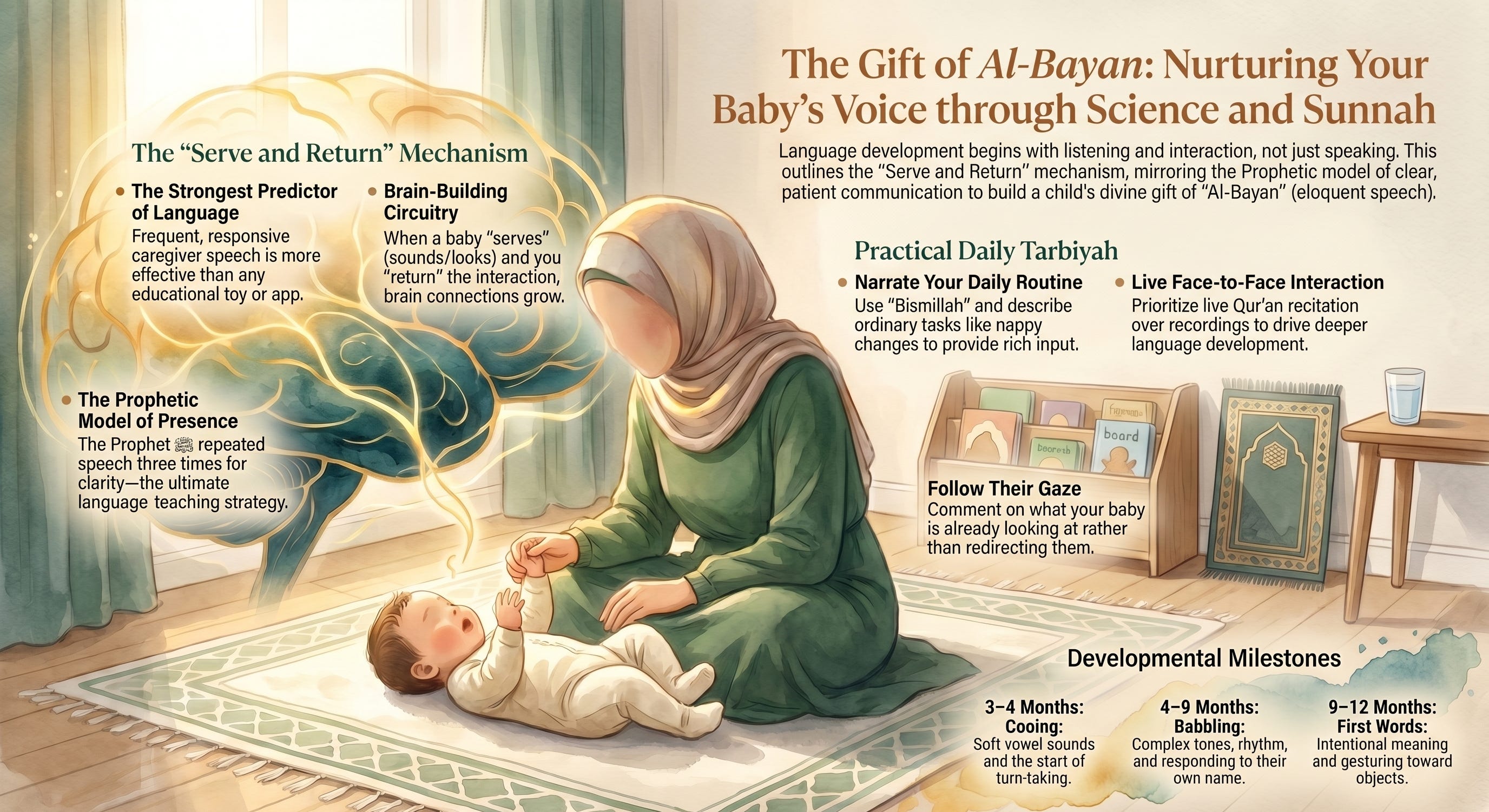
3–4 months: Cooing arrives — soft vowel sounds, your baby’s first experiments with their own voice. They smile when you speak. They track your face. The turn-taking of conversation has begun, even if their “turn” is just a sound and a blink.
4–6 months: Babbling. “Ba.” Then “bababa.” Then something that almost sounds like they’re telling you a story. They’re not yet making words — but they are practising the rhythms, the melody, the patterns of speech. [2]
6–9 months: The babbling gets more complex. Different tones start appearing — questions, statements, exclamations. Your baby begins responding to their own name, and they’re working out something important: that their voice gets a response. [2]
9–12 months: This is when everything shifts. Words begin carrying meaning. “Where’s Baba?” gets a head-turn. They point, gesture, reach. And somewhere in these months — often quietly, often when you’re half-awake — the first true word arrives. [2]
Small differences in timing are normal. Bilingual babies may reach certain milestones differently while showing the same depth of comprehension. [3] If something doesn’t feel right, speak with your child’s paediatrician early. Early support makes a real difference.
The Single Most Important Thing You Can Do
Researchers call it “serve and return.” [4] Your baby initiates — a sound, a look, a reach — and you respond. They serve. You return. Back and forth, thousands of times over the first year. Harvard’s Center on the Developing Child describes this as the mechanism that actually builds the brain’s circuitry for language, attention, and connection. [4]
It doesn’t require special toys. It doesn’t require educational videos. It requires presence.
What struck me when I studied the research is how completely this mirrors the Prophetic model. When I read that the Prophet ﷺ used to repeat himself three times until he was understood — narrated by Anas ibn Malik in Sahih al-Bukhari [11] — I thought: that’s not just courtesy. That’s the single best language-teaching strategy we have. Patient, clear, repeated speech. Given with full presence.
I know this feels like a lot to remember.
Especially when you’re already exhausted, feeding around the clock, trying to figure out if that colour on the nappy is normal. That’s exactly why I created a free Baby’s First Words Companion Pack — a three-page printable guide with a month-by-month language tracker, Sunnah-rooted daily talking prompts, and an Islamic speech card. Keep reading to download it at the end of this article — it’s designed to make this easier, not add to your mental load.
What the Qur’an Tells Us About the Gift of Speech
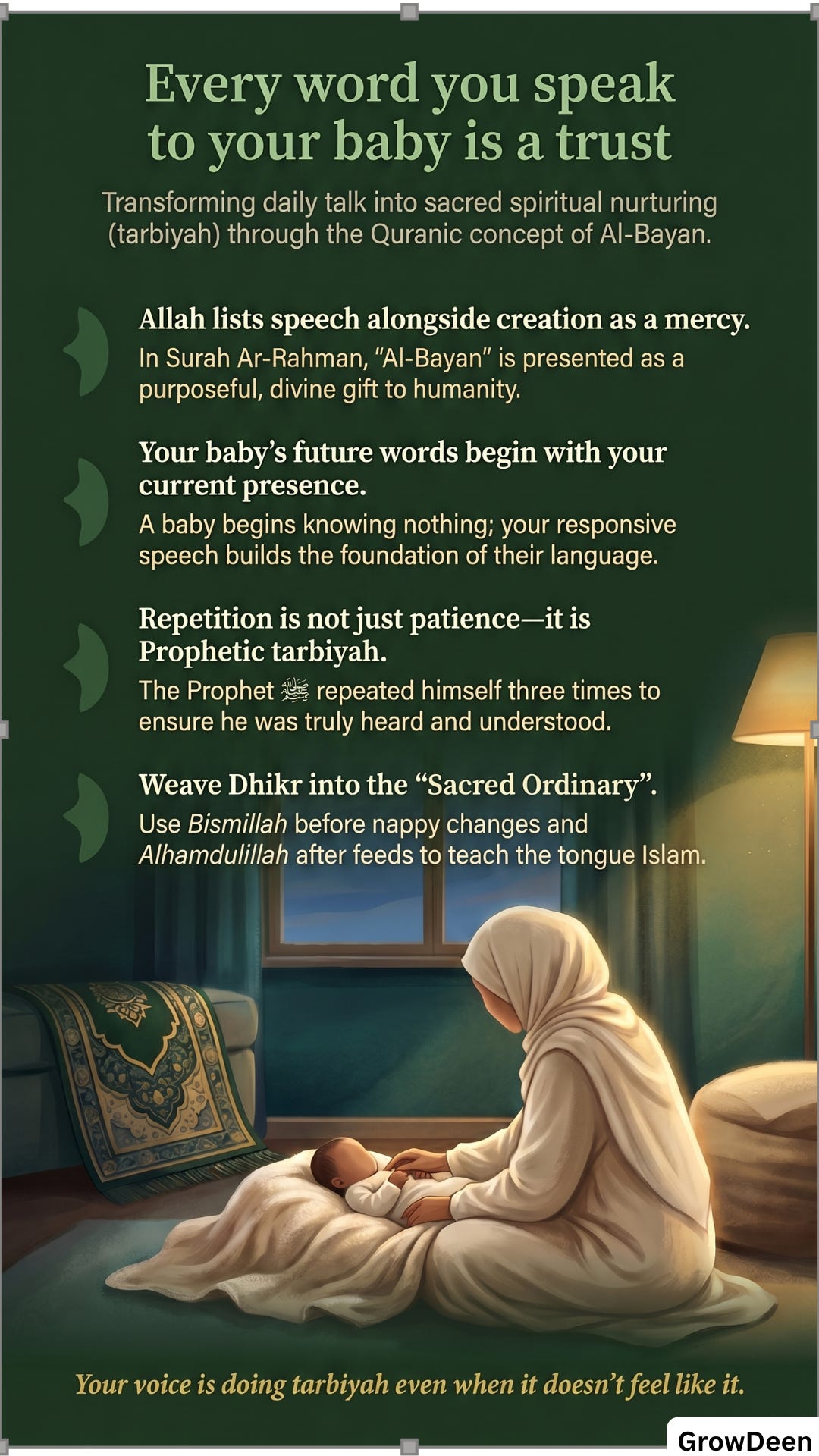
When I sit with Surah Ar-Rahman, the opening sequence moves me every time. “Ar-Rahman. He taught the Qur’an. He created man. He taught him al-bayan” — eloquent speech, articulate expression. [10]
According to Tafsir Ibn Kathir, Al-Hasan explained al-bayan here as the ability to speak — specifically, Allah making it easy for the human being to produce letters and words through the instruments of the mouth: the tongue, the lips, the palate. The physical apparatus of language is presented not as a biological accident, but as a divine gift, purposefully made.
Your baby spending their first year moving toward speech — that babbling, that cooing, those first careful words — is Allah’s design unfolding in front of you. And your voice, responding to theirs, is part of what makes it possible.
The Prophet ﷺ modelled this. He spoke clearly. He repeated himself. He greeted children warmly and by name. When I study what the research says about what drives early language development and then read Sahih al-Bukhari 95 — the Prophet repeating himself three times until understood — I don’t experience that as a coincidence. I experience it as confirmation. [11]
Practical Guidance: What to Do, Day by Day
You don’t need a curriculum. You need the following — and you probably already do most of it without realising:
Narrate your day — especially during caregiving. “Bismillah — let’s change your nappy.” “SubhanAllah, look at that light.” Every word counts. [5]
Face-to-face time — get down to their level. Respond to every coo as if it were a real sentence. It is. [4]
Qur’an recitation — live, with your face toward your baby, not just played in the background. Live speech drives language development in a way that recordings don’t. [6]
Let du’as become their language too — Bismillah, Alhamdulillah, SubhanAllah, repeated in the same moments every day. Short, rhythmic, predictable phrases in consistent contexts are among the most effective inputs for early vocabulary. [6]
Follow their gaze — respond to what they’re already looking at. “SubhanAllah! A leaf!” Research shows this is more effective than redirecting their attention. [5]
Read Islamic books — even now, when they don’t understand. The rhythm, the closeness, your voice — it’s all doing the work. [7]
What to avoid: Screens before 18 months don’t replicate the responsive, face-to-face interaction that builds language. [9] The most important language input is a person who turns toward your baby when they make a sound.
When to Speak to a Professional
Talk to your child’s paediatrician or a speech-language pathologist if you notice: [8]
No smiling or eye contact by 3 months
No babbling by 6 months
No responding to name by 9 months
No pointing or gesturing by 12 months
No first words by 12–16 months
Trust your instinct. Early support matters.
Your Baby’s First Words Companion Pack
If you’ve read this far, you’re the kind of parent who takes your baby’s development seriously — not as a competition, but as an amanah. That tells me something beautiful about you.
Inside the Baby’s First Words Companion Pack (one comprehensive PDF, 3 pages, portrait orientation):
Page 1: Language Milestone Tracker (3–12 Months) — A month-by-month visual checklist showing what to listen for (cooing → babbling → first words), what to try at each stage, and simple green-flag/watch-for-this indicators — designed as a printable card you can keep on your fridge or in your baby bag.
Page 2: Daily Talking Prompt Cards — 20 Sunnah-rooted conversation starters organized by your daily routine (feeding, nappy changes, bath time, salah preparation, and bedtime), so you always have something warm and specific to say — even on the days your brain is running on empty.
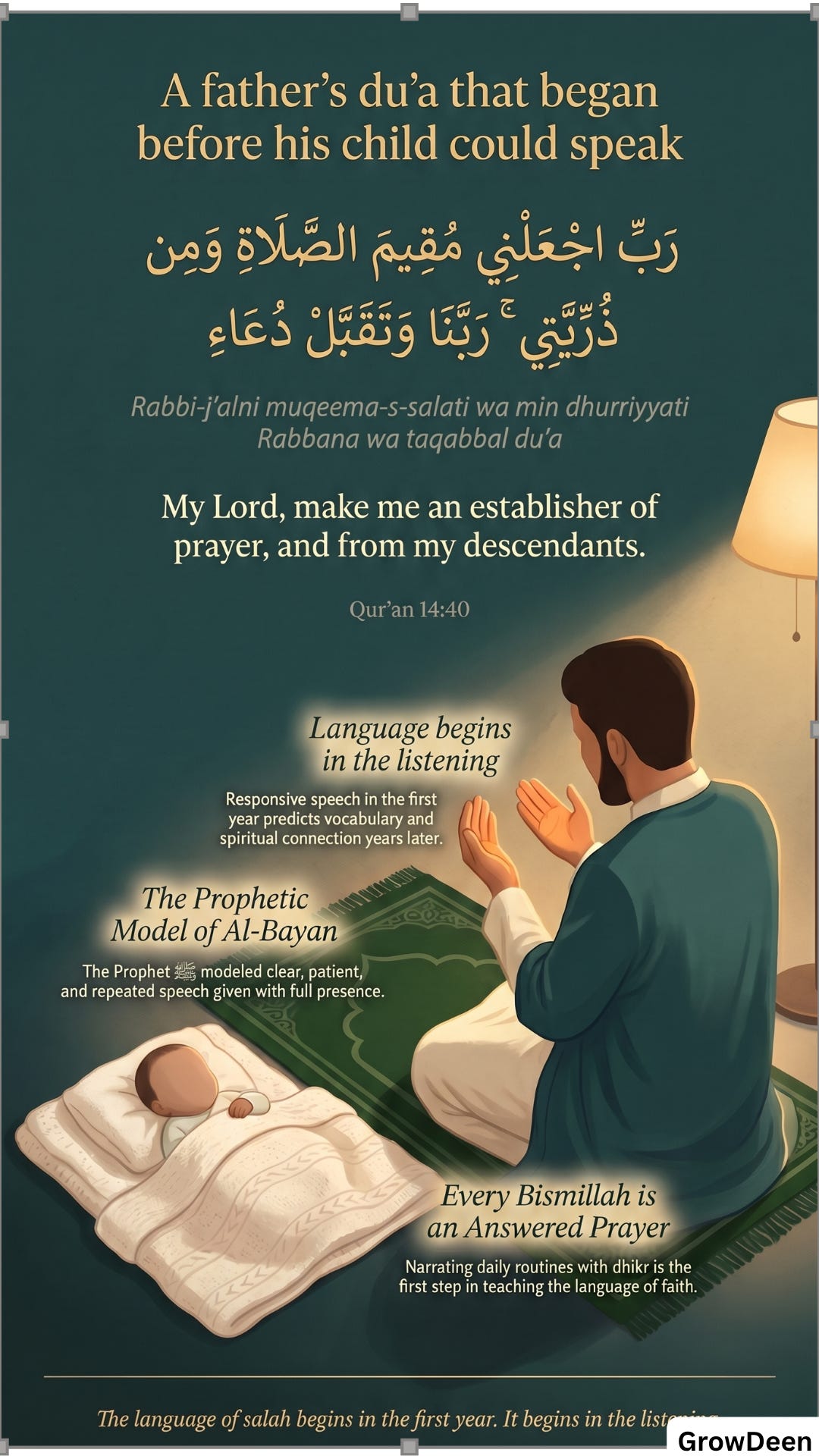
Page 3: The Gift of Al-Bayan — Islamic Speech Card — Qur’an 55:3–4 in Arabic with transliteration and meaning, paired with the du’a of Ibrahim ﷺ for his offspring (Rabbi ij’alni muqimas-salati wa min dhurriyyati — Qur’an 14:40), with a note on when and how to recite it with your baby — a card designed to sit near your prayer space as a daily reminder that your baby’s language is a divine gift.
This isn’t a PDF to download and forget. It’s a tool designed to stay in the spaces where you’ll actually use it — on the fridge, in the nappy bag, beside the musalla.
This companion pack is what every subscriber receives with each article. We cover the full journey of Muslim parenting — from newborns to school age — all backed by research and rooted in the Qur’an and Sunnah.
If you want evidence-based guidance with an Islamic soul, subscribe free so each new resource arrives in your inbox before you need it.
Subscribe free for parenting resources backed by both science and Sunnah — guidance so specific to Muslim families, you genuinely can’t find it anywhere else. No spam, no clutter, just what matters.
Your Micro-Action for Today
The next time you go to your baby for a nappy change — say Bismillah out loud first. Then narrate the whole thing. “Bismillah. Now we take off the nappy. One leg. Two legs. Alhamdulillah, clean!” That’s it. That’s the practice. You just gave your baby 30 seconds of the most effective language input available.
May Allah place barakah in every word you speak to your child, and make your home one where the sound of His remembrance is as natural as breathing.
Share This With Someone Who Needs It
Think of one person right now: a new mother in your family who’s been quietly wondering whether she’s doing enough, a friend whose baby is three months old and who told you last week that she feels like she’s “just sitting there” — or a sister whose Substack inbox is full of parenting content that never quite speaks to her as a Muslim.
This article could give her the clarity and the confidence she’s been looking for. Share it with her today — not as unsolicited advice, but as a gift. Sometimes the most loving thing we can do is pass along something that makes the road a little lighter.
Frequently Asked Questions
Q: When do babies say their first word?
A: Most babies say their first recognizable, intentional word somewhere between 10 and 12 months, though the range extends to 16 months and is considered normal. [2] What matters more than timing is the trajectory — are they babbling, gesturing, responding to their name? Those are the signs that language is developing well.
Q: Does talking to my baby before they can understand make a difference?
A: Yes — significantly. Babies begin processing language patterns from the first days of life, and the quantity of responsive speech they hear in the first year directly predicts vocabulary size years later. [1] They don’t need to understand the words yet; they’re absorbing rhythm, tone, and the fundamental structure of communication.
Q: Can bilingual babies learn language normally?
A: Absolutely. Research consistently shows that hearing two languages from birth does not delay language development — it builds two parallel language systems. [3] Bilingual babies may appear to reach certain spoken milestones slightly differently, but their overall comprehension and communication development follow the same path.
Q: Is screen time okay for babies under one year?
A: The American Academy of Pediatrics recommends avoiding entertainment screen media for babies under 18 months, with the exception of video calls with family. [9] The reason is simple: screens don’t respond to your baby the way a person does, and that responsiveness is what drives language development.
Q: How often should I talk to my baby?
A: As often as you’re with them. Every nappy change, every feed, every moment of awake time is an opportunity. You don’t need to schedule it or make it formal — the goal is simply to narrate, respond, and be present. [5]
Q: What if I speak a language other than English at home?
A: Speak it freely and richly. Your heritage language is an asset, not a disadvantage. Whatever language carries the most warmth, the most natural flow, and the most Qur’anic dhikr is the right language to use with your baby. [3]
Q: What’s the difference between babbling and first words?
A: Babbling is sound-play — your baby experimenting with combinations like “bababa” or “mamama” without consistent meaning. A first word is a sound used deliberately and consistently to refer to the same person, object, or concept. [2] “Mama” said to get attention counts. “Mama” said whenever mum walks in counts even more.
References
[1] Donnellan, E., Bannard, C., McGillion, M.L., Slocombe, K.E., & Matthews, D. (2019). Infants’ intentionally communicative vocalizations elicit responses from caregivers and are the best predictors of the transition to language. Developmental Science, 23(1), e12843. https://doi.org/10.1111/desc.12843
[2] National Institute on Deafness and Other Communication Disorders (NIDCD). (2010). Speech and language developmental milestones. https://www.nidcd.nih.gov/sites/default/files/Documents/health/voice/NIDCD-Speech-Language-Dev-Milestones.pdf
[3] Fellowes, J., & Oakley, G. (2019). Language, literacy and early childhood education (3rd edn). Oxford University Press.
[4] Harvard Center on the Developing Child. (2018). Serve and return interaction shapes brain circuitry. https://developingchild.harvard.edu/science/key-concepts/serve-and-return/
[5] Tamis-LeMonda, C.S., Custode, S., Kuchirko, Y., Escobar, K., & Lo, T. (2019). Routine language: Speech directed to infants during home activities. Child Development, 90(6), 2135–2152. https://doi.org/10.1111/cdev.13089
[6] Newman, R.S., Rowe, M.L., & Ratner, N.B. (2016). Input and uptake at 7 months predicts toddler vocabulary. Journal of Child Language, 43(5), 1158–1173. https://doi.org/10.1017/S0305000915000446
[7] Owens, R.E. (2021). Language development: An introduction (10th edn). Pearson.
[8] Speech Pathology Australia. (2023). Communication milestones. https://www.speechpathologyaustralia.org.au/Public/Public/Comm-swallow/Speech-development/Communication-milestones.aspx
[9] American Academy of Pediatrics. (2016). Media and young minds. Pediatrics, 138(5), e20162591. https://doi.org/10.1542/peds.2016-2591
[10] Qur’an, Surah Ar-Rahman 55:1–4 — https://quran.com/55/1
[11] Sahih al-Bukhari, Hadith 95 — Graded: Sahih — https://sunnah.com/bukhari:95
Well written, mashaAllah!