

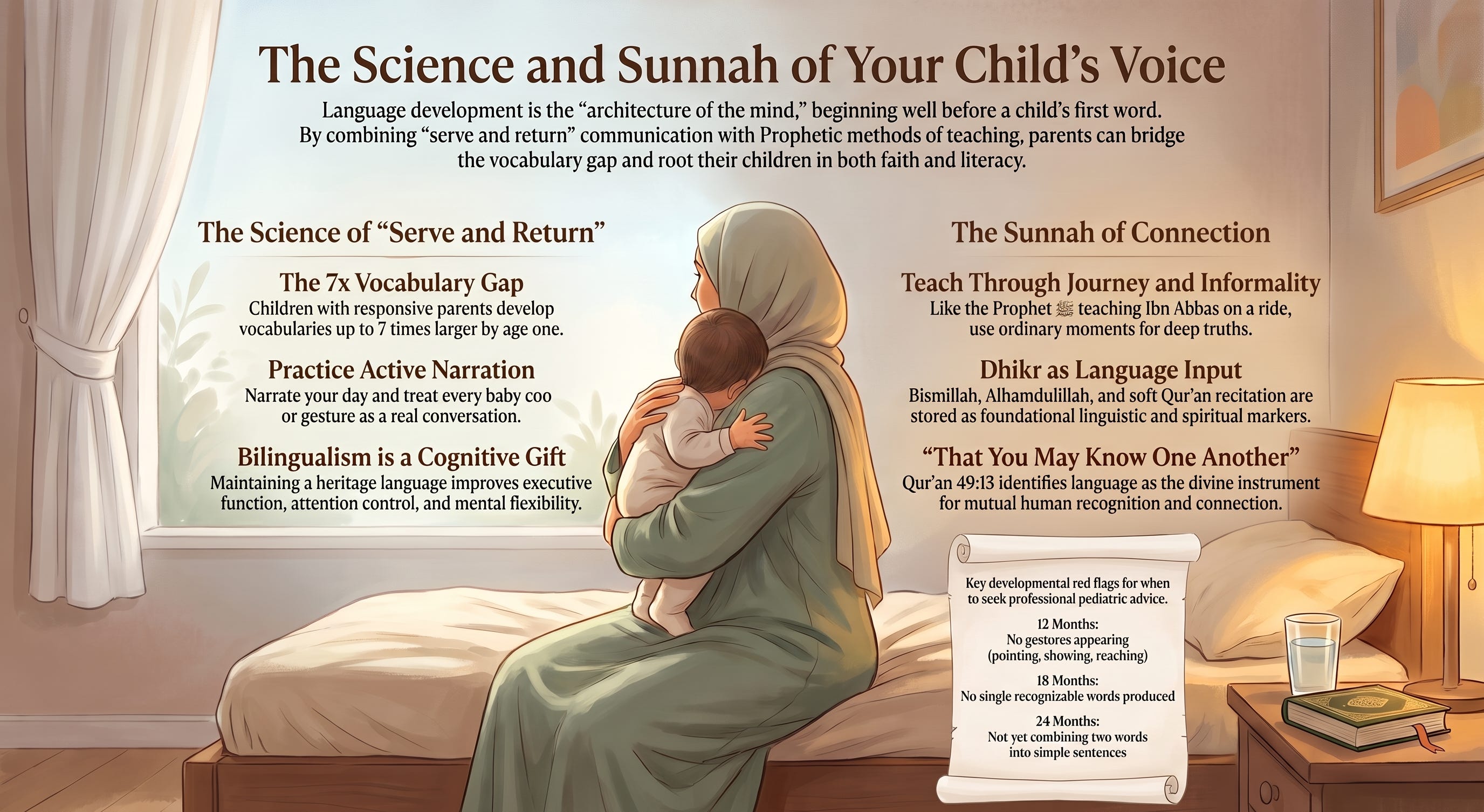
Research from the Journal of Developmental and Behavioral Pediatrics found that children with responsive parents can develop a vocabulary up to 7 times larger by 12 months than those without — a gap that tracks into literacy, learning, and life. [1]
There is a moment most parents miss. It happens before the first word. Before babbling, even.
A newborn — just days old — turns toward a familiar voice. Yours from before birth. They mapped your voice in the final weeks in the womb, and now they are using it like a compass. [7]
That turning? That is language. It just does not look like what we expect language to look like.
Here is what I mean: most of us think language development starts when a child starts talking. Research is clear that this is wrong. [1] Language starts the moment your baby begins taking in sounds — and the single most powerful factor in how it develops is not a toy, an app, or a special programme. It is you. It is whether you talk to them, respond when they reach back, and treat their earliest sounds as real communication.
Children whose parents respond consistently — not perfectly, just consistently — can have vocabularies up to seven times larger by 12 months than children whose attempts go mostly unanswered. [1] Seven times. That gap tracks into reading, school, and life.
You are doing this because you care. That already tells me a lot about you.
Why This Guide Is Different From Generic Language Development Advice
Every recommendation is grounded in peer-reviewed research from journals like Pediatrics, the Journal of Child Psychology and Psychiatry, and the Journal of Developmental and Behavioral Pediatrics — not parenting blogs or generalised tips.
It integrates authentic Islamic guidance from the Qur’an and verified hadith, woven through the practical advice — because that is exactly where it belongs.
You will receive the Your Child’s Voice Companion Pack — a free 3-page printable with a language milestone reference card, a daily Sunnah-rooted language planner, and a full Prophetic hadith card that frames this entire guide.
The Window Is Real. And It Starts Now.
Language is not a skill that sits alongside other skills. It is the architecture of the mind. [9]
Children who develop rich oral language in the early years are better equipped to manage emotions, build friendships, solve problems, and — for Muslim families — to one day engage deeply with the Qur’an and pass knowledge to their own children. [8]
The research keeps coming back to one thing: the foundation is laid in the first five years. [8] It does not require a curriculum.
From Birth: The Conversation That Has No Words Yet
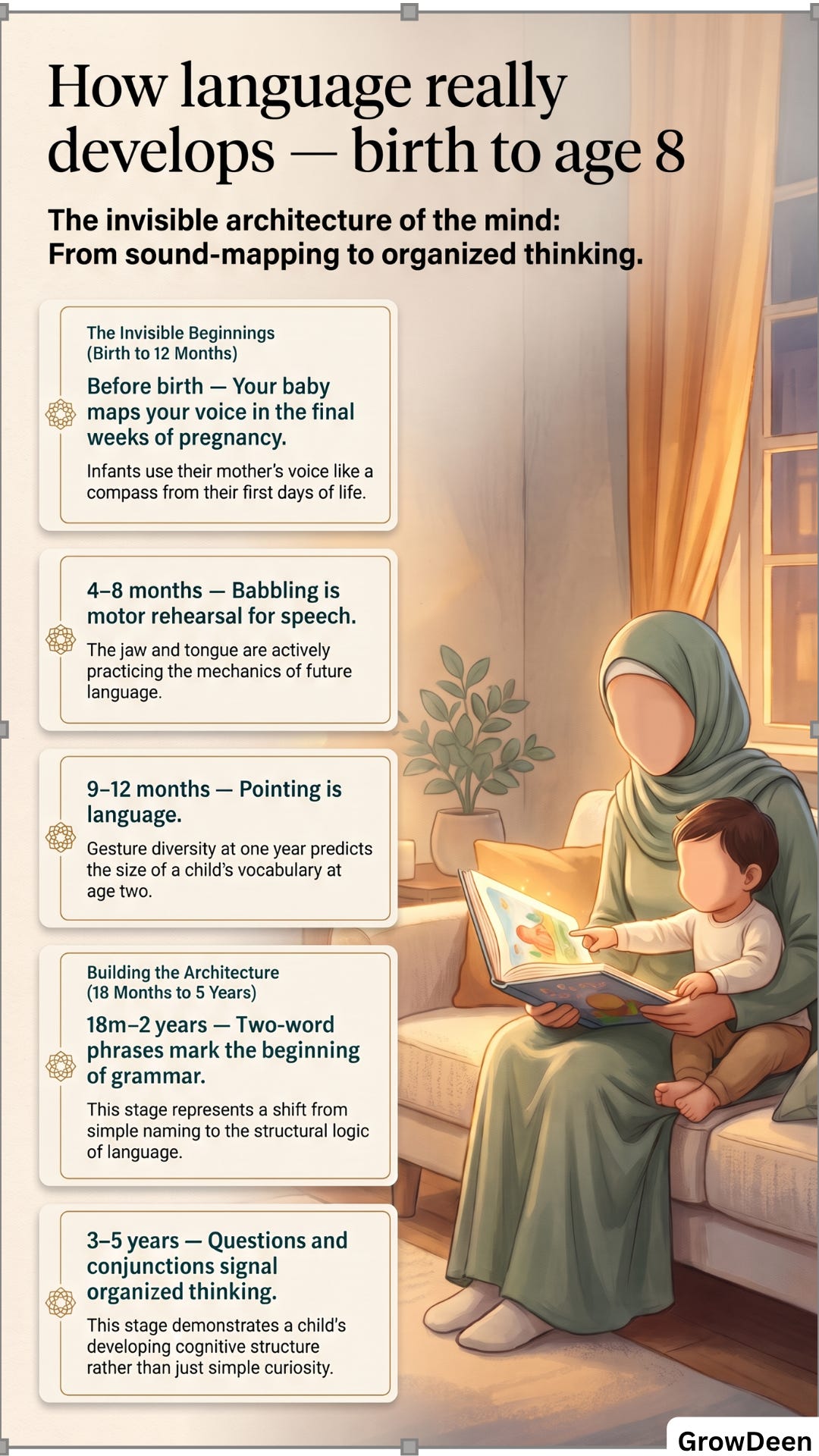
Your newborn already knows your voice. By two months, most babies can distinguish their home language from other languages — the brain does this quietly, automatically, while they sleep and feed and watch your face. [2]
What supports this is not special. It is narration. Talk about what you are doing. Use their name. When they coo, coo back. Pause and wait. That back-and-forth — researchers call it “serve and return” — is one of the most reliable predictors of early language development. [3] Babies whose communication is met with responsive conversation babble more, diversify their sounds faster, and reach milestones earlier.
And here is something beautiful: the Bismillah before actions, the Alhamdulillah after ease, the Qur’an recited softly — these are language input. They are being heard. Stored. They will surface one day as something your child simply knows.
The Milestones: What to Watch For
3–6 months: Cooing begins. Respond to every sound.
4–8 months: Babbling arrives — motor practice for speech. The more you engage, the more it develops. [2]
9–12 months: Gestures appear — pointing, showing, reaching. These are language. Name what your baby points at. Gesture diversity at 12 months predicts vocabulary size at two years. [3]
12–18 months: Words build steadily. Comprehension runs ahead of production. No single words by 18 months? Speak to your paediatrician. [6]
18 months–2 years: Two-word sentences begin. Expand them: “Yes, daddy went — he went to the masjid!” This technique — expansion — is one of the most evidence-backed tools in early language development. [3]
2–3 years: Sentences lengthen. Stories begin. Prophet stories work beautifully here — they model narrative structure exactly as developing language brains need. [4]
3–5 years: Questions arrive. Answer them. Children whose questions are taken seriously develop stronger reasoning and larger vocabularies. [4] One book a day with real conversation makes a measurable difference in literacy readiness.
5–8 years: Language becomes the vehicle for learning. The oral foundation you built allows the written code to make sense. [8]
Not combining two words by age 2? Speak to a paediatrician. Early referral to a speech pathologist is the most effective intervention — not a last resort. [6]
A Note on Bilingual Families — Because This Matters for Most Muslim Parents in the West
If you are a Muslim parent in a Western country, there is a very good chance your family lives across two languages. Your mother tongue — the language of your parents, your upbringing, your du’as — and English, the language of school and the wider world your child is growing into.
Many parents in this position carry a quiet worry: will two languages confuse my child? Will it slow their English? Should I just choose one and stay consistent?
Here is what the research says clearly: no. [5] Children raised bilingually develop strong, functional language in each, and the occasional mixing — called code-switching — is a normal, temporary phase that resolves naturally as each language system matures. What bilingual children also develop is stronger executive function: better attention control, mental flexibility, and the ability to switch between tasks. [5] Maintaining two language systems trains the brain in ways that extend far beyond language itself.
And from an Islamic perspective, Qur’an 49:13 frames this with beauty: “We made you into nations and tribes that you may know one another.” [10] A child who speaks the language of their grandparents, their community, and who grows up hearing the Arabic of the Qur’an is not divided. They are multiply rooted. That is a gift — not a problem to manage.
There is a lot here. I know that. And I know you will not remember all of it in the middle of a difficult morning.
That is why I created the Your Child’s Voice Companion Pack — a free 3-page guide with a birth-to-8 milestone card, a daily language planner built around your family’s Islamic routines, and a tarbiyah card featuring the full Prophetic hadith that frames this guide. Keep reading to download it at the end.
The Islamic Framework for Language Development: What the Qur’an and Sunnah Show Us
There is a verse in Surah Al-Hujurat I return to whenever I think about why language matters so much:
“O mankind! We have created you from a male and a female, and made you into nations and tribes that you may know one another.” [Qur’an 49:13] [10]
According to Tafsir Ibn Kathir, the purpose of all this human diversity is knowing one another. [10] Language is the instrument of that knowing. When we raise children who can speak clearly and express what is inside them, we are raising people who can truly know and be known.
And then there is the hadith that moves me every time I read it in full.
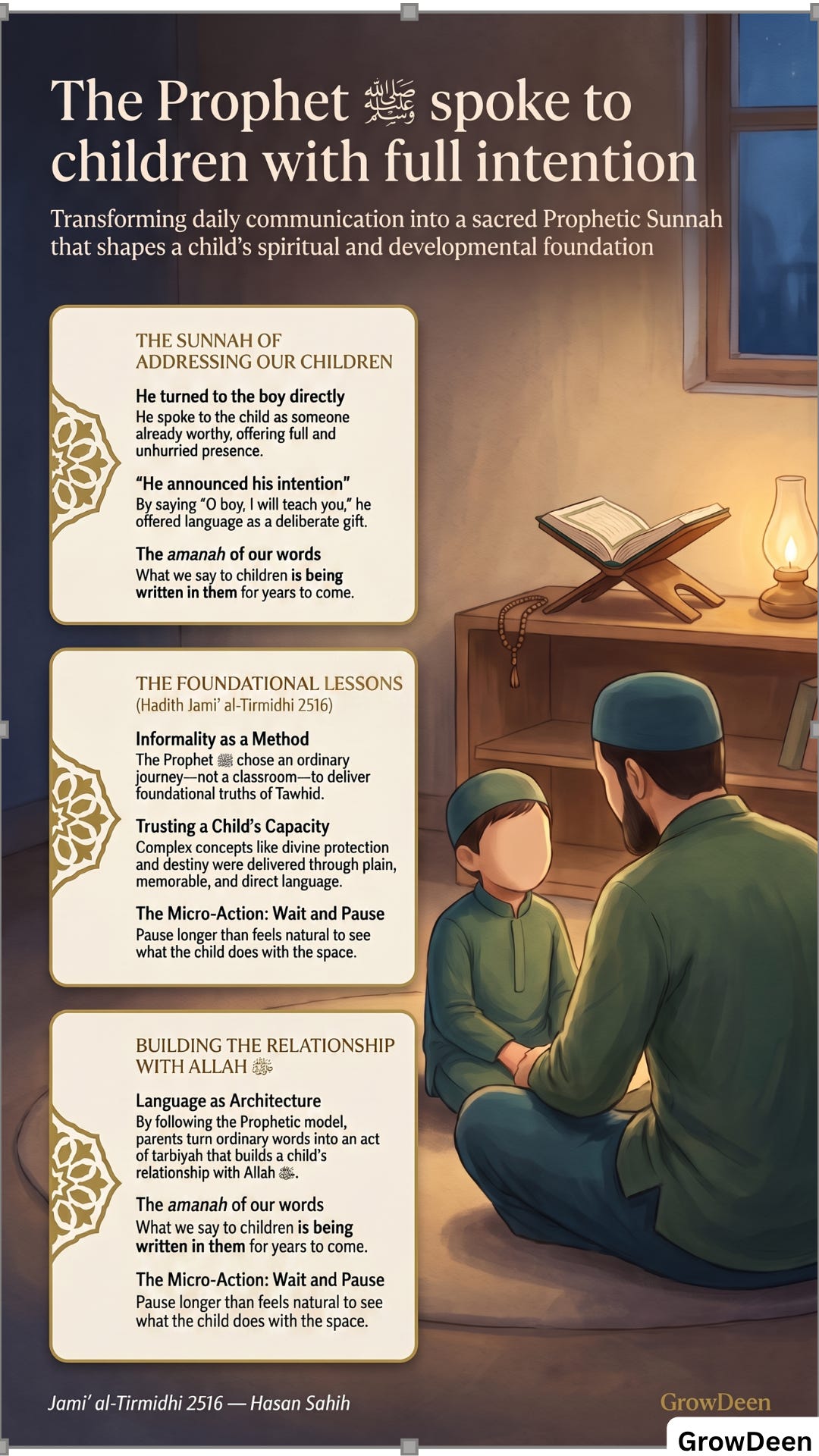
Ibn Abbas رضي الله عنه was a boy — riding with the Prophet ﷺ on an ordinary journey. The Prophet ﷺ turned to him and said:
“O boy! I will teach you a statement: Be mindful of Allah and He will protect you. Be mindful of Allah and you will find Him before you. When you ask, ask Allah, and when you seek aid, seek Allah’s aid. Know that if the entire creation were to gather to benefit you — you would never receive any benefit except that Allah had written for you. And if they were to gather to harm you — you would never be harmed except that Allah had written for you. The pens are lifted and the pages are dried.”
Jami’ al-Tirmidhi 2516 — Graded: Hasan Sahih [11]
These are the foundational pillars of a child’s relationship with Allah ﷻ — tawhid, tawakkul, complete reliance — delivered in plain, direct, memorable language to a boy on an ordinary trip.
What if you did the same?
Not in a classroom. Not with a whiteboard. The Prophet ﷺ chose a journey. The informality was part of the method.
Ages 3–6 — Simplify and repeat. Start with one line: “When you are scared or sad, who do you ask? You ask Allah.” Plant it. Return to it often. Repetition does the work.
Ages 7–10 — Tell the story first. Set the scene: Ibn Abbas, a boy, riding with the Prophet ﷺ — just the two of them. Then walk through the hadith line by line. Ask: “What do you think it means — the pens are lifted and the pages are dried?” Let them wonder.
Ages 10 and up — Read it together and sit with it. Ask: “If you truly believed that no one can benefit or harm you except by what Allah has written — how would that change how you feel when something goes wrong?” Do not rush the answer. The silence is part of the conversation.
Language development and tarbiyah are not separate projects. Every word you speak to your child — including the words of the Prophet ﷺ — is building something. Make what you build worth carrying.
The Gift of Words: Your Free Companion Pack
If you have read this far, you are the kind of parent who thinks carefully about how your words shape your child. That already tells me something beautiful about you.
Inside the Your Child’s Voice Companion Pack (one PDF, 3 pages):
Page 1: Birth-to-8 Language Milestone Reference Card — A clean, printable age-by-age milestone guide from birth to eight years, with one “what you can do” action at each stage and clear markers for when to seek help — designed as a card you can keep on your fridge or saved in your phone.
Page 2: Your Daily Language Moments Planner — 7 Sunnah-Rooted Conversation Starters — Seven daily moments mapped to your existing Islamic family routine: morning salaam, wudu time, mealtime, read-aloud, outside walk, salah time, and bedtime — each with a simple language-building practice woven in. Not extra work. Just doing what you already do, more intentionally.
Page 3: The Prophetic Conversation Card — The full text of Jami’ al-Tirmidhi 2516 (graded Hasan Sahih), set in a beautiful printed frame: the complete words the Prophet ﷺ spoke to Ibn Abbas — a boy — on an ordinary journey, including “the pens are lifted and the pages are dried.” Below the frame, a short reflection on the structure of that conversation and what it looks like to replicate it at home — not just the content, but the intention, the directness, and the trust in a child’s capacity to receive real wisdom.
This is not a PDF to open once and forget. It is a tool designed to stay in your home — where the conversations actually happen.
This companion pack is what every subscriber receives with each article. We cover the full journey of raising Muslim children — from birth through adolescence — all backed by peer-reviewed research and rooted in Islamic wisdom.
If you are a Muslim parent who wants both the science and the Sunnah, subscribe free so future resources arrive before you need them.
Subscribe free for parenting resources backed by both science and Sunnah — guidance so unique, you genuinely cannot find it anywhere else. No spam, no clutter, just resources that matter.
Your Micro-Action for Today
The next time you are with your child — whether they are three weeks old or three years old — say something to them, then stop. Wait. Pause longer than feels natural.
Watch what they do with the space you held open.
A baby will coo or look. A toddler will babble or reach. A preschooler will say something. Whatever they give you — respond to it as if it was exactly what you were hoping they’d say.
Because it was.
May Allah ﷻ grant our children tongues of truth, hearts that understand, and words that carry them closer to Him.
One More Thing Before You Go
Think of one person right now: a friend whose toddler has gone quiet in ways she cannot quite explain, a sister who mentioned her two-year-old is not talking yet, a cousin who has just arrived from back home and is navigating a new language alongside her child — and has no idea that what she already does in her mother tongue is exactly enough.
This article might be exactly what they need. Not because you want to give parenting advice — but because you care.
Frequently Asked Questions
Q: When should my child say their first word?
A: Most children say their first recognisable word between ten and fourteen months, though there is real variation in what is normal. [2] What matters as much as the word is that your child is communicating beforehand — gesturing, pointing, showing. If there are no gestures by 12 months and no words by 18 months, speak to your paediatrician.
Q: My toddler understands everything but barely talks — is something wrong?
A: Most likely not. Comprehension nearly always runs ahead of production in the toddler years. [2] A child who follows instructions, responds to their name, and clearly understands what is happening around them is showing strong receptive language. If you are at 18 months with no words at all, speak to your paediatrician — but a gap between understanding and speaking is usually just how development unfolds.
Q: Does growing up bilingual really slow language development?
A: No — and I want to say this clearly because so many families carry this worry unnecessarily. Children raised in two languages develop strong language in both, and research consistently shows cognitive advantages including stronger attention and executive function. [5] Keep using your heritage language. It is a gift. For more detail, see “A Note on Bilingual Families” above.
Q: How much does screen time affect language development?
A: Passive screen exposure does not build language the way live interaction does. [3] Language develops through real conversation — someone responding to what your child communicates. A programme playing in the background does not provide that. For children under two, live interaction is far more valuable than any screen content.
Q: When should I worry about my child’s pronunciation?
A: Most children are still developing many sounds well into their third and fourth year — this is completely typical. [2] By age three, strangers should understand most of what your child says. If strangers cannot understand your three-year-old at all, a speech pathologist assessment is worthwhile — not alarmist, just early.
Q: Is reading to babies really worth it if they cannot understand yet?
A: Yes. Unequivocally. Even before comprehension, shared book reading exposes babies to vocabulary, sentence structure, and the rhythm of language in a way that predicts literacy years later. [4] And the closeness — someone choosing to sit with them and share something — matters too.
References
[1] Levickis, P., Reilly, S., Girolametto, L., Ukoumunne, O.C., & Wake, M. (2014). Maternal behaviors promoting language acquisition in slow-to-talk toddlers: Prospective community-based study. Journal of Developmental and Behavioral Pediatrics, 35(4), 274–281. https://doi.org/10.1097/DBP.0000000000000056
[2] Reilly, S., Eadie, P., Bavin, E.L., Wake, M., Prior, M., Williams, J., Bretherton, L., Barrett, Y., & Ukoumunne, O.C. (2006). Growth of infant communication between 8 and 12 months: A population study. Journal of Paediatrics and Child Health, 42, 764–770. https://doi.org/10.1111/j.1440-1754.2006.00974.x
[3] Rowe, M.L. (2012). A longitudinal investigation of the role of quantity and quality of child-directed speech in vocabulary development. Child Development, 83(5), 1762–1774. https://doi.org/10.1111/j.1467-8624.2012.01805.x
[4] Reilly, S., Wake, M., Ukoumunne, O.C., Bavin, E., Prior, M., Cini, E., Conway, L., Eadie, P., & Bretherton, L. (2010). Predicting language outcomes at 4 years of age: Findings from Early Language in Victoria Study. Pediatrics, 126(6), e1530–e1537. https://doi.org/10.1542/peds.2010-0254
[5] Rowe, M.L., & Zuckerman, B. (2016). Word gap redux: Developmental sequence and quality. JAMA Pediatrics, 170(9), 827–828. https://doi.org/10.1001/jamapediatrics.2016.1360
[6] Kamhi, A.G., & Clark, M.K. (2013). Specific language impairment. Handbook of Clinical Neurology, 111, 219–227. https://doi.org/10.1016/B978-0-444-52891-9.00022-1
[7] DeCasper, A.J., & Fifer, W.P. (1980). Of human bonding: Newborns prefer their mothers’ voices. Science, 208(4448), 1174–1176. https://doi.org/10.1126/science.7375928
[8] Snowling, M.J., & Hulme, C. (2020). Annual research review: Reading disorders revisited – the critical importance of oral language. Journal of Child Psychology and Psychiatry, 62, 635–653. https://doi.org/10.1111/jcpp.13324
[9] Snow, P.C. (2020). SOLAR: The science of language and reading. Child Language Teaching and Therapy, 37(3), 222–233. https://doi.org/10.1177/0265659020947817
[10] Qur’an, Surah Al-Hujurat 49:13. Tafsir Ibn Kathir — verified via quran.com. Ibn Kathir explains Allah created peoples and tribes “that you may know one another,” affirming language as the instrument of the divine purpose of mutual human recognition. — https://quran.com/49/13
[11] Jami’ al-Tirmidhi 2516 — Graded: Hasan Sahih (graded by Imam al-Tirmidhi; confirmed Sahih by al-Albani) — https://sunnah.com/tirmidhi:2516
Very informative alhamdulillah. And proves what we have known all along. The best thing to do is to respond to our children. Our responses help them grow and learn. This is a reminder that what they hear before they enter the world is part of their development, and that we need to talk to them and read to them even though they won’t understand everything.