

Research shows children from warm, communicative families are 40% more likely to develop strong emotional resilience, healthy friendships, and the confidence to navigate difficulty and the Qur’an named this principle long before any study could measure it. [1]
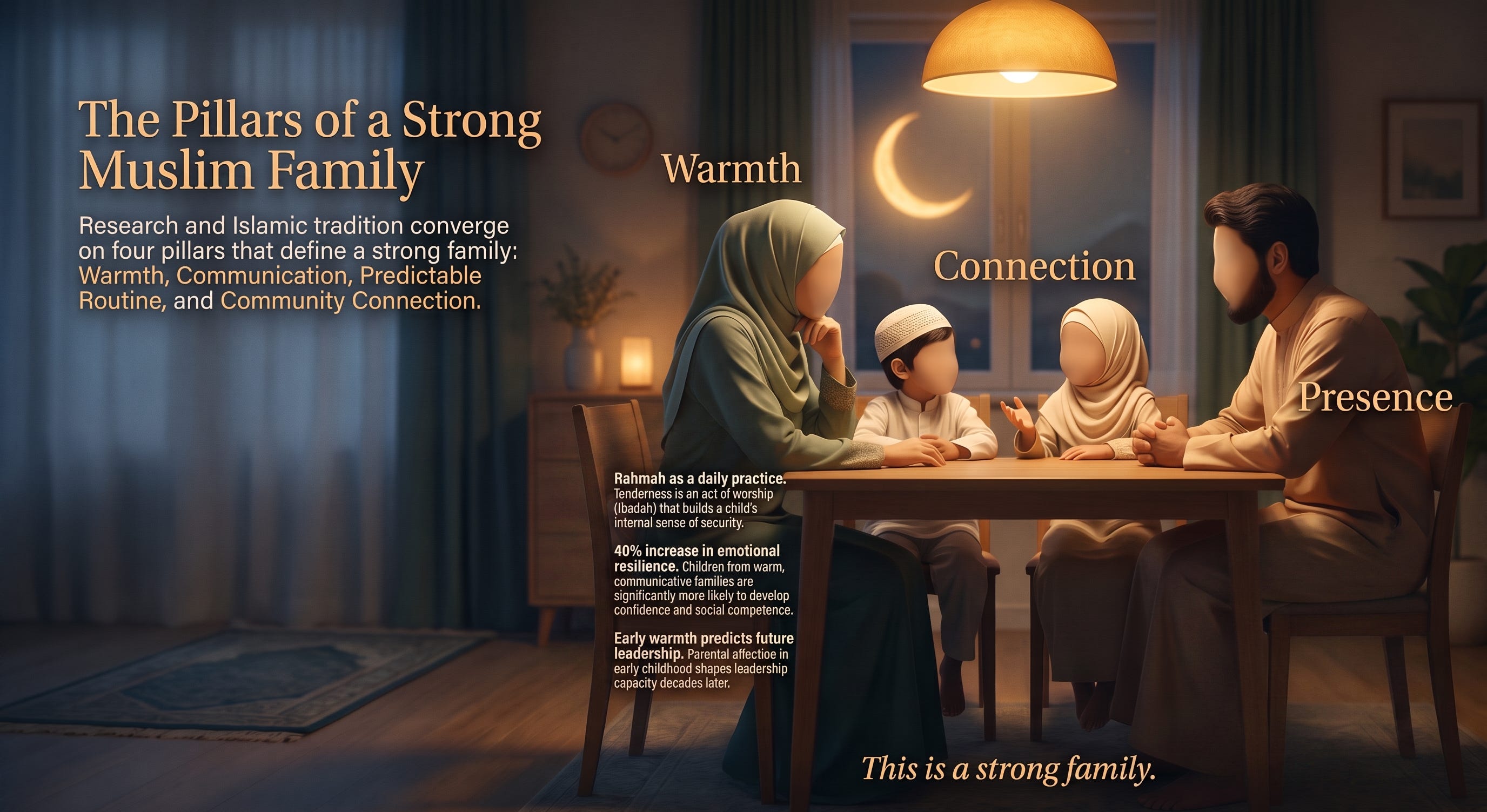
It was an ordinary Tuesday. Dinner was late, the toddler had already melted down twice, and the eight-year-old was somewhere in the middle of a very long story about something that happened at school that nobody could quite follow. And then — somehow — everyone started laughing. Nobody remembered why later. But for a few minutes, the table was just full. Present. Warm.
That moment. That’s what this article is about.
Not a parenting programme. Not a curriculum. Just that feeling — the sense that this family is a we — and the practical, Islamic-rooted question of how to build it deliberately, not just hope it happens.
Why This Guide Is Different From Generic Parenting Advice
Built on peer-reviewed research, not opinion. Every recommendation draws from developmental psychology, attachment science, and family studies published in the last five years — and every claim is cited so you can check it yourself.
Rooted in Islamic principles from the start, not added at the end. The Qur’anic framework of silat al-rahim (honouring family ties) and the Prophetic model of warmth aren’t an appendix here — they’re the spine of this guide, because Islam described what children need long before developmental science named it.
Comes with a free printable resource. The Strong Muslim Family Pack includes a family conversation starter guide, an Islamic home rhythm reference card, and a tarbiyah intentions card — tools designed to stay visible in your home, not sit in a folder.
What the Research Actually Says About Strong Families
Here’s the truth the research keeps confirming: children from families characterised by warmth, honest communication, and predictable routine develop better in almost every measure — stronger mental health, more stable peer relationships, greater resilience in adversity, and better emotional regulation across childhood and into adulthood. [1][2]
What’s striking is not that these qualities matter. It’s that they matter so much more than the things parents tend to worry about — the right school, the right activities, the right approach to screen time. A longitudinal study tracking children from infancy to adulthood found that the quality of early family relationships shapes confidence, social competence, and capacity for leadership decades later. [9] The foundation is not what children are taught. It’s what they feel, consistently, at home.
Four qualities appear across the research as the pillars of a strong family: warmth and positive connection, honest communication, predictable routine, and connection to people beyond the immediate household. [1][2] The rest of this guide walks through each one — what it looks like, why it matters, and how Islamic family life already gives us the tools.
Warmth: The Prophetic Principle of Rahmah in the Home
Warmth is not a personality type. It’s a practice — a series of small, repeated choices made in ordinary moments.
The Prophet ﷺ was the most documented example of warmth in the early Muslim community. When Al-Aqra’ ibn Habis saw him kissing his grandson and said he had ten children and had never kissed a single one of them, the Prophet ﷺ responded: “Whoever does not show mercy will not be shown mercy.” [Sahih al-Bukhari 5998] [3] This was not a private preference. It was a lesson — made public, deliberately. Tenderness toward children is not an optional personality trait. It is part of what it means to be a believer.
Research supports this with precision. Children from warm, affectionate homes develop stronger peer relationships, have fewer behavioural difficulties, and show significantly less conflict in their relationships as they grow. [2] One longitudinal study found that parental warmth in early childhood directly predicts social competence and leadership capacity in adolescence. [4] The connection runs deep and runs long.
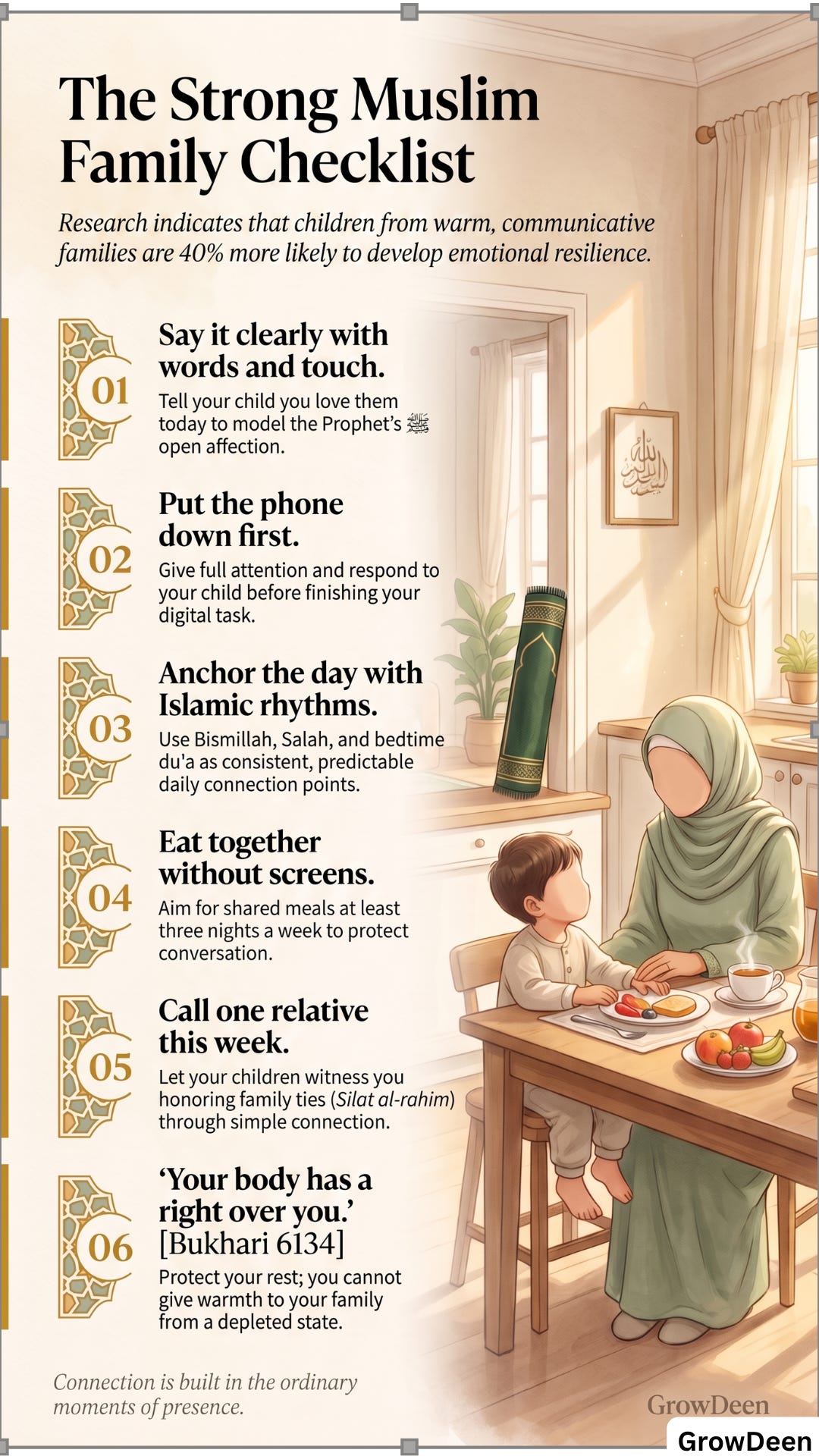
Practical ways to build warmth in your home:
Say “I love you” — and pair it with physical affection. The Prophet ﷺ kissed children openly, in public. We can do the same.
Look into your child’s eyes when they speak to you. Full attention, not half-attention.
Praise specifically and sincerely: “SubhanAllah, you were so patient just then” or “JazakAllah khayran for helping without being asked.” Gratitude modelled at home becomes gratitude carried for life.
Notice and name your child’s good character: “I saw how you waited your turn today — that’s sabr, and it matters.”
Create everyday moments of quality time: wudu together before salah, reciting together before sleep, sitting at the dinner table without devices. These ordinary moments are where love is deposited in small, compounding amounts.
Communication: What Happens When Children Know They Can Tell You
Strong families talk about hard things. Not just the achievements and the good news — the embarrassments, the confusions, the fears, the small failures that sting. [1] This is not a natural state for most families; it is built deliberately, over many small interactions where a child tests whether you can be trusted with something real.
Here’s what the research is specific about: children open up most when parents respond to small disclosures without alarm, lecture, or immediate problem-solving. [2] When a child shares something difficult and a parent responds with “that sounds hard — tell me more” rather than “here’s what you should have done,” the child learns: this is a safe person. And that learning compounds.
Practical ways to build communication in your home:
Protect regular, low-stakes family conversation. The dinner table, the car, the ten minutes before bed — these informal contexts are where children do their most authentic talking.
Ask open questions, not yes/no questions: “What made you laugh today? What felt hard? What are you thinking about?”
Help children name emotions: “You seem quiet tonight — are you frustrated? Worried?” A child who can name what they feel navigates difficulty differently from one whose emotions remain wordless.
Listen before you advise. When your child brings you something difficult, reflect first. You don’t always need to solve it.
Model how to navigate conflict. When adults in a household disagree and then resolve that disagreement with calm and respect, children absorb something no lesson can teach directly: relationships can hold difficulty.
Hold family meals together as often as possible, with screens put away. Research consistently finds that regular shared meals predict better academic outcomes, stronger mental health, and greater resilience — not because of the food, but because of the daily practice of telling each other things. [5]
Predictability: Why Routine Is a Form of Love
Children are, underneath everything, small scientists. They observe their world, form hypotheses, and — when results are consistent — they relax. That relaxation is not passivity. It is the foundation of learning, curiosity, and emotional availability.
A predictable family environment is one where children know: this is how we do things here. Who gets them up. What happens after school. What the end of the day sounds like. These patterns are the container inside which a child can grow.
Here’s what I find quietly extraordinary about Islamic family life: it already provides this structure. The five daily prayers create a natural rhythm to the day that no parenting book can replicate. Fajr opens the morning. Asr marks the afternoon shift. Isha closes the day. A child who grows up with these anchors does not need a parenting technique — they have a framework built into the fabric of the day itself.
Practical ways to build predictability in your home:
Build your family’s daily routine around the prayers. Even young children can participate: rolling out the prayer mat, saying Bismillah before eating, hearing a brief Qur’an recitation before sleep. These anchors build security alongside spiritual habit.
Create consistent bedtime routines that include du’a, gentle Qur’an recitation, and reconnection. The same words every night become a child’s anchor — something that says: the day has an ending, and it is peaceful.
Establish loving family expectations: “In our family, we greet each other with salām. In our family, we help before we’re asked. In our family, we ask before we take.” These are not rules — they are your family’s identity.
When change is coming — a new school, a house move, a new sibling — name what will stay the same: “This will be different. But we will still do this together.” Constancy within change reduces anxiety.
For children with additional needs or sensory sensitivities, routine carries even greater weight. A predictable structure reduces cognitive load and creates more space for connection.
I know this covers a lot of ground. That’s exactly why I created something to help you hold it.
The Strong Muslim Family Pack gives you a family conversation starter guide sorted by age, an Islamic home rhythm reference card you can post on your fridge, and a tarbiyah intentions card to display in your home. Keep reading to download it at the end of this article.
Support Muslim Parenting Lab ❤️
Would you like a deed that keeps earning for you after you die? Start one in a few seconds with the button below.
The Prophet ﷺ named ongoing charity and beneficial knowledge among the three things that keep counting after death. (Sahih Muslim 1631)
Silat Al-Rahim: Your Child Needs More People Than You
Here’s something Western parenting culture genuinely underestimates: no family is designed to exist in isolation, and no parent was meant to raise a child alone.
The Prophet ﷺ described the believers as “one body — if any part aches, the whole body shares the sleeplessness and fever.” [Sahih al-Bukhari 6011] [6] The family is the first cell of that body. Extended family and community are the wider body around it. And children — even very young children — need that wider body to develop a full sense of who they are and where they belong.
Research confirms this precisely. Children with strong connections to extended family and community show stronger social competence and are more resilient during periods of family difficulty. [2] They have more models of how to be. More people who know their name. More places where they are known.
Silat al-rahim is not an abstract virtue. It is visible in whether you call a relative you haven’t spoken to in months, whether you attend a cousin’s milestone, whether your children see you as part of a wider community that is also their community.
Practical ways to build connection beyond the home:
Visit extended family regularly — even brief, consistent contact keeps bonds alive in a child’s experience of family.
When family lives far away, build in regular video calls. “Let’s call Teta/Bibi/Nani — she loves to hear your voice” teaches children that love has reach, and that family is not limited by geography.
Attend masjid and community events as a family. Children who grow up knowing community members by name understand that Islam is not a private arrangement between them and Allah — it is a we.
Involve children in sadaqah together: donating, helping a neighbour, preparing extra food to share. These acts are simultaneously worship and community-building.
When a relative is unwell, pray for them together: “Aunt Fatima is having a hard time — let’s make du’a for her now.” This teaches children that caring extends beyond the walls of home.
The Islamic Framework for Strong Families: Silat Al-Rahim in Action
When I reflect on Qur’an 4:1, what strikes me is the framing. Allah says: “O humanity! Be mindful of your Lord who created you from a single soul — and honour family ties.” [7]
According to Tafsir Ibn Kathir, the scholars Ibn Abbas, Mujahid, and Al-Hasan all understood the command to “honour the wombs” as a direct instruction: maintain your family bonds, keep them alive, do not sever them. And crucially, this command sits alongside the command for taqwa of Allah — not in a separate category, not as a cultural extra, but as an act of worship. [7]
This changes how I think about the ordinary moments. The decision to respond patiently when I’m tired — that is ibadah. The choice to sit at the dinner table without my phone — that is tarbiyah. The effort to call a relative I haven’t spoken to in weeks — that is silat al-rahim, obedience to Allah.
The Prophet ﷺ showed us what this looks like in practice. He was visibly warm with children. Visibly glad when he saw them. He kissed them in public and made it a teaching moment. [3] And he described community — and by extension, the family — as a body that feels one another’s pain. [6] What strikes me is how completely the research and the Sunnah agree: warmth, communication, consistency, connection. Both are describing the same thing.
One more thing: looking after yourself is part of this. “Your body has a right over you,” the Prophet ﷺ said. [Sahih al-Bukhari 6134] [8] A parent who is chronically depleted cannot offer their children the warmth, attentiveness, and presence that both the research and the Sunnah identify as essential. Rest is not indulgence. It is preparation. Protecting your salah, maintaining adult friendships, asking for help when you need it — these are not departures from good parenting. They are conditions for it.
May Allah make our homes among the places most beloved to Him — built on warmth, honesty, and the intention to raise children who carry light into the world.
Your Five-Minute Action Right Now
Before you keep reading: think of one thing that anchors your family’s day. Maybe it’s a shared meal. A bedtime du’a. Greeting each other with salām when someone comes through the door. If you don’t have one, choose one — just one — and commit to it this week. Start smaller than feels meaningful. That is the practice. It compounds.
If you’ve read this far, you’re the kind of parent who takes family seriously — not as an obligation, but as a calling. That tells me something beautiful about you.
Inside the Strong Muslim Family Pack (one comprehensive PDF, 3 pages):
Page 1: Our Family Conversation Starter Guide — 12 conversation-starter questions sorted by age (toddlers, early childhood, school-age), designed to prompt real connection at mealtimes, in the car, or during those ten quiet minutes before bed. Not “how was your day” questions — questions children actually want to answer.
Page 2: The Islamic Home Rhythm Reference Card — a print-and-post guide mapping five daily Sunnah anchors (Bismillah, wudu, prayer, mealtime gratitude, bedtime du’a) to their developmental benefits for children, so the practice feels purposeful — not just habitual. Designed to go on your fridge.
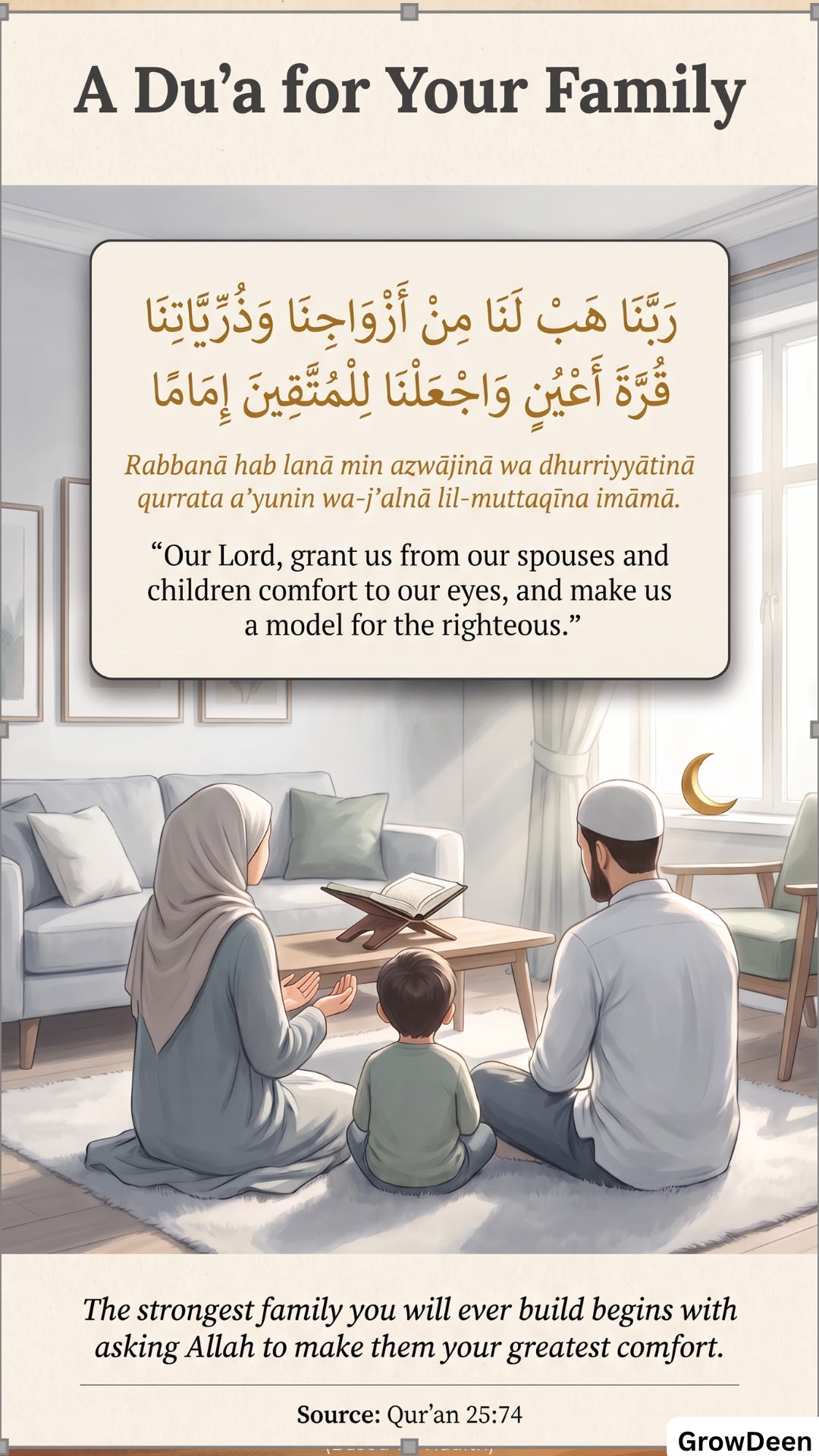
Page 3: “Our Family, Our Intention” Tarbiyah Card — a beautifully designed Islamic family intentions card centred on Qur’an 4:1 in full Arabic with transliteration and translation, plus five Sunnah-rooted family intentions to display in your home as a visible reminder that your ordinary household is a place of worship.
This isn’t a PDF to download and forget. It’s a tool designed to stay visible — in the kitchen, near the prayer mat, on the fridge — where family life actually happens.
This Strong Muslim Family Pack is what every subscriber receives with each article from Muslim Parenting Lab. We cover the complete journey of raising Muslim children — from newborns through early childhood and beyond — all grounded in peer-reviewed research and Islamic wisdom.
Share This With Someone Who Needs It
Think of one person right now: the mother in your community who mentioned her home feels chaotic lately and she doesn’t know where to start, a friend whose WhatsApp messages have been shorter and more tired than usual, a sister who is parenting far from her extended family and carrying more than she should be carrying alone.
This guide could give her something useful. Share it today — not as advice, but as care. Sometimes the most loving thing we can do is pass along something that makes someone’s everyday a little steadier.
Frequently Asked Questions
Q: How do I build family connection when life is genuinely chaotic and we barely have time?
A: Start smaller than feels meaningful. Research shows consistency matters far more than length or structure. [1] Ten minutes at dinner without phones, done five nights a week, builds more genuine connection over a year than a weekly “family meeting” that keeps getting postponed. Pick the smallest sustainable anchor and protect it fiercely.
Q: My child rarely opens up to me — they give one-word answers and seem to shut down when I ask how their day was. What can I do?
A: Try shifting where and how you ask. Research on family communication consistently finds children open up more during side-by-side activity — in the car, cooking together, walking — than face-to-face conversation. [2] The removal of eye contact feels lower-stakes to many children. Also: ask about specific things, not general ones. “Who did you sit with at lunch today?” lands differently than “How was your day?”
Q: How important is extended family connection for Muslim families living in the West, when relatives are overseas?
A: Genuinely important — for both Islamic and developmental reasons. Children with strong extended family connections show better social development and resilience in adversity. [2] And silat al-rahim is commanded regardless of geography. Regular video calls, voice messages your child hears, stories about relatives, care packages sent and received — these keep the bond real for children who may rarely be in the same room as their wider family.
Q: How do I create routine when work schedules are unpredictable and the days feel different every week?
A: Focus on anchoring one part of the day that is within your control, rather than trying to structure everything. For most families, a consistent bedtime sequence — even a simple one of wudu, a brief du’a, and a few Qur’an verses — provides enough predictability for a child to feel secure, even when the rest of the day is variable. One steady anchor is worth more than a detailed routine that collapses under pressure.
Q: Does my parenting really shape my child long-term, or do children mostly turn out how they’re going to turn out anyway?
A: Both nature and environment are real. But decades of longitudinal research — including studies tracking children from infancy to adulthood — show that the quality of early family relationships leaves a measurable, lasting imprint on children’s emotional health, social competence, and confidence. [9][1] Genetics matter. And so does warmth, consistency, and connection. You have more influence than it sometimes feels like.
Q: What does Islam say about parents who feel depleted — who don’t feel warm or patient right now, and feel guilty about it?
A: The Prophet ﷺ said: “Your body has a right over you.” [8] Depletion is not a moral failure. A parent who is genuinely exhausted, isolated, or carrying too much cannot offer what their children need — and recognising this is wisdom, not weakness. Seeking rest, community support, or professional help is part of fulfilling the amanah of parenthood, not a departure from it. If things feel genuinely beyond what you can manage alone, reaching out to a trusted family member, community elder, doctor, or qualified counsellor is the Islamic principle of taking means — and it is entirely consistent with tawakkul.
References
[1] Yoon, S. (2022). Understanding family risk and protective factors that shape child development. Children, 9(9), Article 1344. https://doi.org/10.3390/children9091344
[2] Mullan, K., & Higgins, D. (2014). A safe and supportive family environment for children: Key components and links to child outcomes. Australian Government Department of Social Services. https://aifs.gov.au/sites/default/files/2022-06/op52_safe_families_final_accessible_pdf_6_8_14.pdf
[3] Sahih al-Bukhari, Hadith 5998 — Graded: Sahih — https://sunnah.com/bukhari:5998
[4] Liu, Z., Bian, W., & Bian, Y. (2024). Leadership blossoms in parental warmth: Positive parenting practices shape adolescent leader emergence via intrapersonal and interpersonal mechanisms. Journal of Youth and Adolescence, 53(10), 2266–2286. https://doi.org/10.1007/s10964-024-01983-y
[5] Toumbourou, J.W., Hall, J., Varcoe, J., & Leung, R. (2014). Review of key risk and protective factors for child development and wellbeing (antenatal to age 25). Australian Research Alliance for Children and Young People. https://www.aracy.org.au/resources/review-of-key-risk-and-protective-factors-for-child-development-and-wellbeing/
[6] Sahih al-Bukhari, Hadith 6011 / Sahih Muslim, Hadith 2586 — Graded: Muttafaqun Alayhi (Sahih) — https://sunnah.com/bukhari:6011
[7] Qur’an, Surah An-Nisa, 4:1 — https://quran.com/4/1 — Tafsir Ibn Kathir: https://quran.com/en/an-nisa/1/tafsirs/en-tafisr-ibn-kathir
[8] Sahih al-Bukhari, Hadith 6134 — Graded: Sahih — https://sunnah.com/bukhari:6134
[9] Sroufe, L.A. (2005). Attachment and development: A prospective, longitudinal study from birth to adulthood. Attachment and Human Development, 7(4), 349–367. https://doi.org/10.1080/14616730500365928
[10] Lin, S-Y., Schleider, J.L., & Eaton, N.R. (2021). Family processes and child psychopathology: A between- and within-family/child analysis. Research on Child and Adolescent Psychopathology, 49, 283–295. https://doi.org/10.1007/s10802-020-00749-x
[11] Leung, J.T., & Shek, D.T. (2024). Filial responsibilities and psychological wellbeing among Chinese adolescents in poor single-mother families: Does parental warmth matter? Frontiers in Psychology, 15, Article 1341428. https://doi.org/10.3389/fpsyg.2024.1341428
[12] Amato, P.R., & Fowler, F. (2002). Parenting practices, child adjustment, and family diversity. Journal of Marriage and Family, 64(3), 703–716. https://doi.org/10.1111/j.1741-3737.2002.00703.x
We combine scientific research with Qur’an and authentic Sunnah, and we cite our sources. Even so, this is general guidance and no substitute for a doctor who can examine your child.