


Peer-reviewed research published in Developmental Science found that stranger anxiety in infants peaks between 7 and 12 months — a phase almost every parent misreads as a problem, when it’s actually one of the clearest signs that your child’s emotional world is developing exactly as it should. [1] This guide explains what’s happening, what helps, and what makes it worse — with an Islamic perspective that might shift how you see these hard moments entirely.
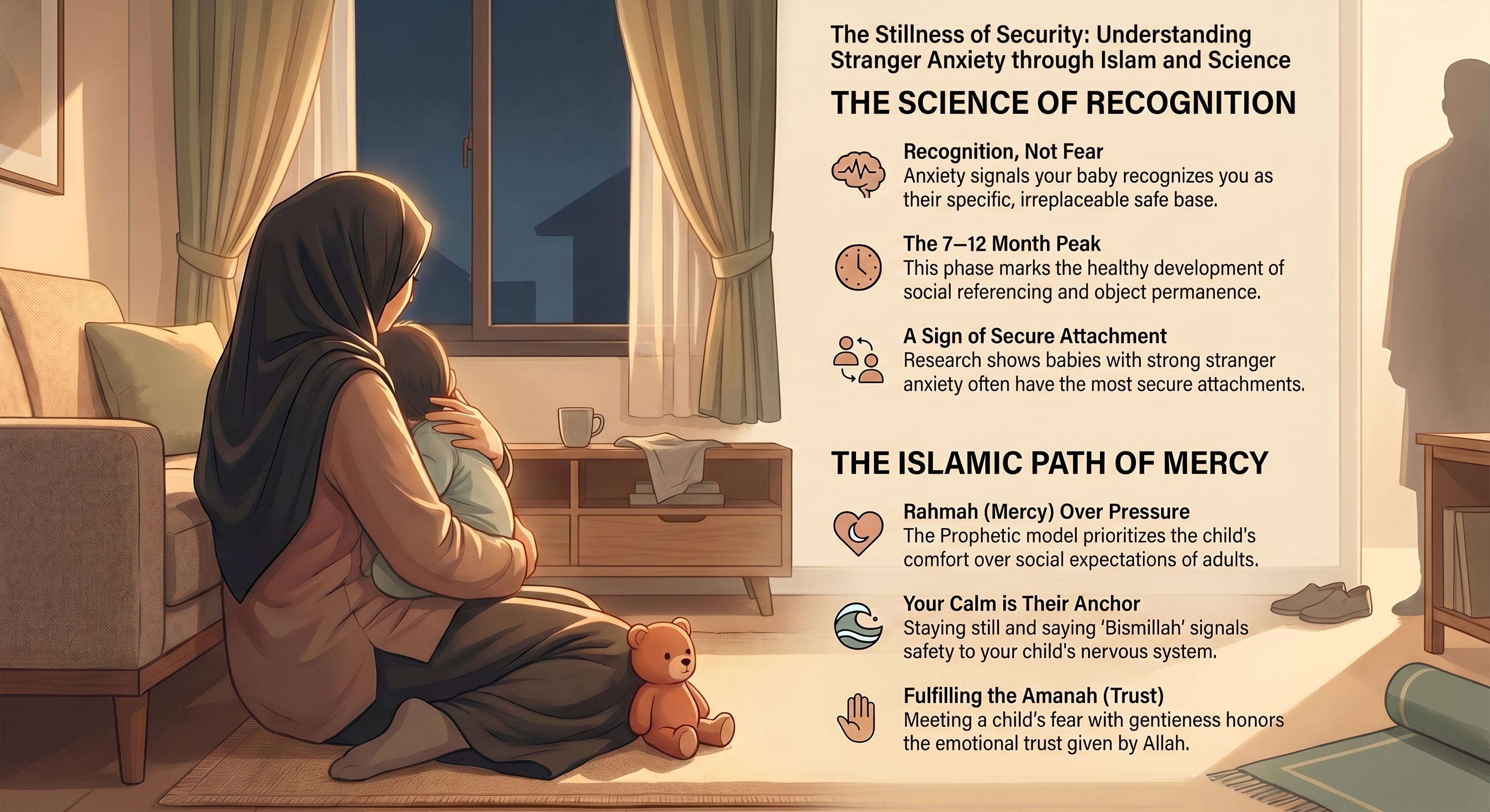
Your mother-in-law reaches for your baby, beaming with love. Your baby takes one look at her — and completely falls apart. Screaming, clinging, face buried in your neck.
You apologise. She looks hurt. You wonder what you’re doing wrong.
Here’s the truth: you’re probably doing everything right.
I know that’s the opposite of what that moment feels like. But when I looked into the research on stranger anxiety — really looked at it — what struck me wasn’t how concerning it is. It was how healthy it actually is.
When I studied the peer-reviewed findings in Developmental Science [1], I learned that the babies most likely to show strong stranger anxiety are often the ones with the most secure attachments. They cry because they know the difference between you and everyone else. That distinction? That’s the whole foundation of emotional development.
You’re not failing. You built something.
Why This Guide Is Different From Generic Parenting Advice
Grounded in peer-reviewed research, not parenting blogs — every recommendation here comes from published developmental science and clinical psychology, not opinion.
Rooted in Islamic wisdom, not just science — we bring Quranic guidance and the prophetic model of parenting to this conversation, because sabr and rahmah aren’t separate from the research. They’re confirmed by it.
Includes a free downloadable companion pack — the Stranger Anxiety Parent’s Companion Pack gives you a printable guide and Islamic anchor card you’ll actually use when things get hard. Download it at the end.
What’s Actually Happening in Your Baby’s Brain (And Why It’s Good News)
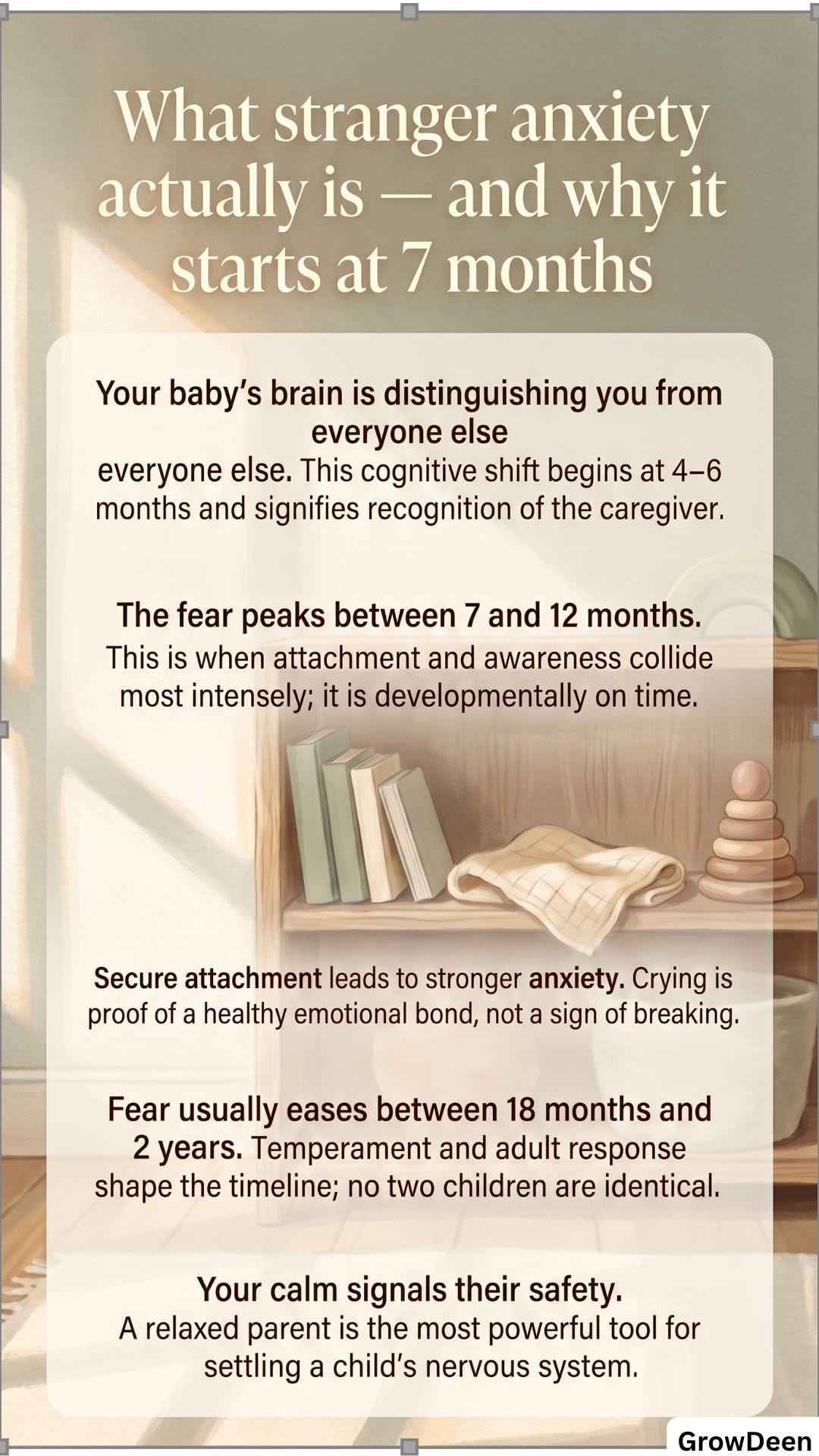
Here’s something most people don’t realize: stranger anxiety isn’t fear of the world. It’s recognition of you.
Between 4 and 6 months, babies develop social referencing — they start reading your face as emotional data. Is Mama calm? Then this is probably okay. Are you tense? Time to worry. Your baby is scanning you constantly, even when you don’t notice [2].
Around the same time, object permanence kicks in. Before this, out of sight really did mean out of mind. Now your baby understands that you are a specific, irreplaceable person — and that the stranger reaching for them is decidedly not you.
That’s the moment stranger anxiety begins.
And here’s the thing that surprised me most when I read Shamir-Essakow et al.’s work on early attachment [3]: babies with less secure attachments often show less stranger anxiety, not more. The fear is a feature, not a bug. It means your child has learned that familiar people are safe — which means their brain is working exactly as it should.
How Long Does It Last — and What Makes It Worse
Stranger anxiety typically eases between 18 months and 2 years [1]. But temperament matters enormously here. Some children move through it in weeks. Others carry a version of it into the preschool years — and that’s within the normal range [5].
What makes it last longer?
Forcing it. Full stop.
When a well-meaning adult grabs a distressed child before the child is ready, or when a parent apologises and tries to override the fear quickly, the message the child receives is: my signals don’t matter. That makes the anxiety dig in, not pass through.
The research is clear on this [3], and the prophetic model confirms it.
But before I get to what actually helps, let me say something first.
I Know This Is a Lot to Hold
There are the developmental stages to understand, the relatives to manage, the social pressure to navigate, the bedtime separations and the daycare drop-offs. Remembering everything in those real moments — when your toddler is clinging and your mother-in-law is waiting — is hard.
That’s exactly why I created the Stranger Anxiety Parent’s Companion Pack — a free 3-page printable guide with a room-by-room response guide, a gradual introduction plan, and an Islamic anchor card for the hard moments. Keep reading to download it at the end of this article.
What Actually Helps: A Practical Guide for Parents
Stay close. Stay calm.
Your nervous system is your child’s first reference point. If you tense up, rush, or apologise for them, they read that as confirmation that something is wrong. Take a breath. Hold them. Let them see that you are not worried.
Introduce people one at a time, at home first.
Home is where your child feels safest. Start there. One person, not a gathering. Ask that person to sit nearby — calm, gentle, not reaching — and let your child observe. The outstretched hands can wait.
Let them bring something familiar.
A much-loved toy or small comfort item does real work. When everything else is unfamiliar, one familiar object in their hand can anchor them enough to look around.
Say Bismillah together before you walk in.
For toddlers with a little language, this simple practice signals: we do this, it is normal, Allah is with us. It’s not just ritual. It’s a calm cue in the body before the unfamiliar begins.
For older children, give honest, simple preparation.
“We’re going to visit Uncle Tariq today. He’s kind. I’ll stay with you.” Short. True. No elaborate promises, no extended goodbyes that linger and signal danger. Brief, warm, consistent.
What the Prophet ﷺ Showed Us About Mercy in the Hard Moments
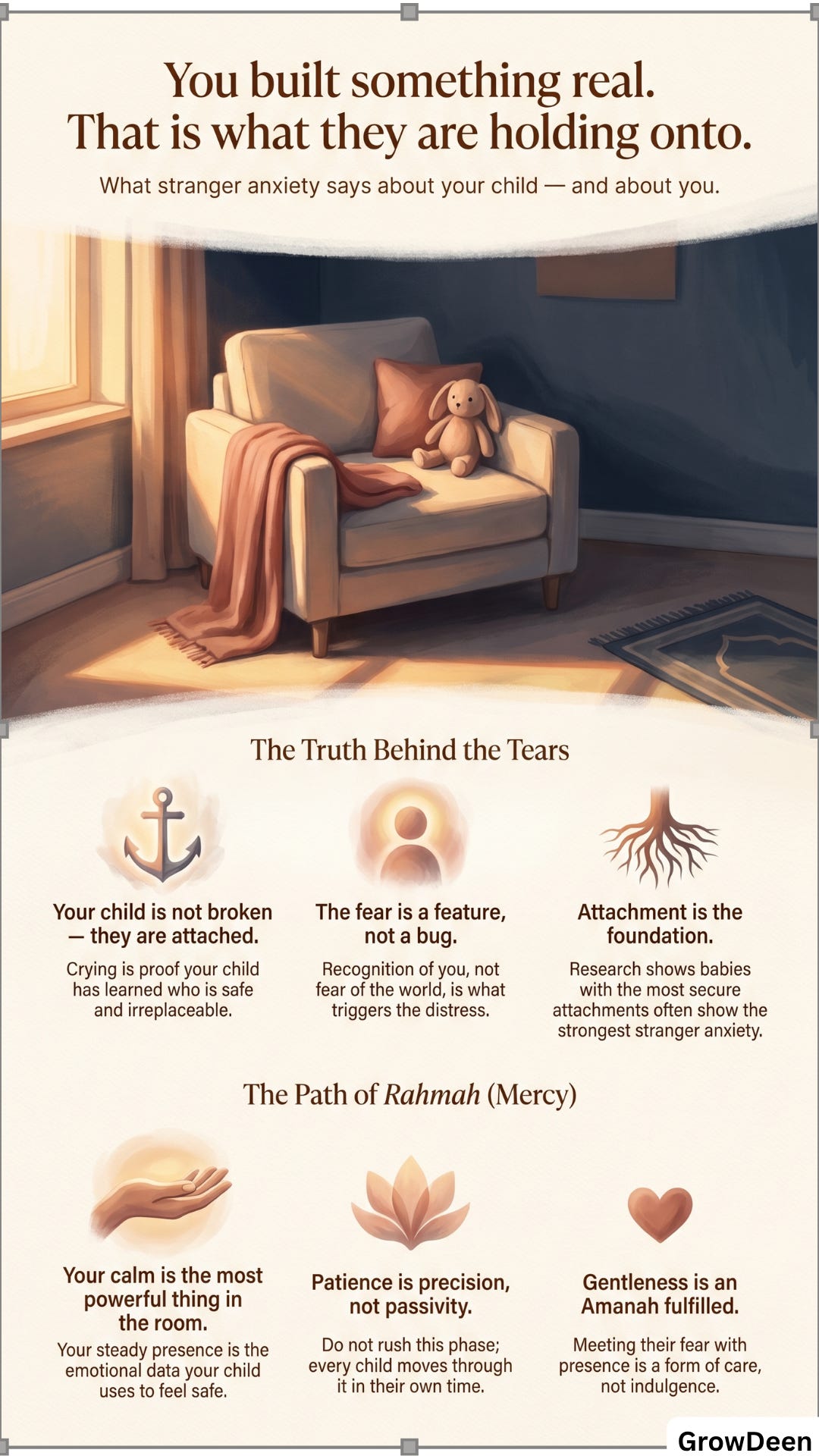
When I reflect on this through an Islamic lens, what strikes me is this: the prophetic model of parenting never required children to override their own signals for the comfort of adults.
The Prophet ﷺ said: “He who does not show mercy to our young ones, nor acknowledge the rights of our elders, is not of us.” [Sunan Abi Dawud 4943 — Sahih] [9]
That hadith always grounds me. Not in the easy moments — in the hard ones. When your baby is screaming and you’re reading the room, wondering whether to comfort or push through. The answer the Prophet ﷺ gave us is mercy. Consistent, patient, attentive mercy.
And when I reflect on the verse “And let those fear Allah who, if they left behind weak offspring, would be concerned for them” [Quran 4:9] [10], I think about what “weak offspring” means in practice. A child who cannot yet regulate their own fear. A child who needs us to be the regulation. According to the scholars’ tafsir of this verse, the call is to be mindful — to treat the children in our care with the concern we would want shown to our own.
What I find beautiful is that the science of secure attachment and the prophetic emphasis on rahmah are pointing in exactly the same direction. Children who are responded to with patience and presence grow into people who can eventually extend that security outward — toward new faces, toward the world. Meeting their fear with gentleness isn’t indulging them. It’s fulfilling the amanah.
When to Get Help
Speak with a doctor or paediatrician if your child’s fear of strangers is:
So intense it doesn’t ease at all, even in completely familiar environments
Not improving by age 2 and actively getting worse
Significantly affecting daily life — childcare attendance, family visits, religious gatherings
Emerging alongside a known family history of anxiety [4]
A professional assessment is not a sign of failure. It’s the same protective instinct that brought you here.
Your Companion Pack Is Waiting
If you’ve read this far, you’re the kind of parent who takes your child’s emotional world seriously — not as a problem to manage, but as a trust to honor. That tells me something beautiful about you.
Inside the Stranger Anxiety Parent’s Companion Pack (one comprehensive PDF, 3 pages):
Page 1: The Gradual Introduction Guide — A step-by-step visual plan for introducing new people to babies and toddlers, from “stranger in the distance” to “comfortable in someone’s arms,” with age-by-age guidance for 0–12 months, 12–24 months, and 2–4 years — designed as a reference card you can keep in your nappy bag or on the nursery wall.
Page 2: Parent Response Cards — What To Say and Do in the Moment — 7 specific scenarios (grandparent visit, new babysitter, doctor’s appointment, extended family gathering, masjid introduction, daycare drop-off, and home playdate) with exactly what to say to your child beforehand, during, and after — so you’re not improvising in the moment when things go sideways.
Page 3: The Islamic Anchor Card — Du’a and Prophetic Practice for Hard Transitions — The authentic du’a for seeking ease in difficulty, with Arabic text, transliteration, and meaning, plus a short guide to the prophetic practice of making dua with your child before entering new spaces — something you can start building into your routine from now, as one of their earliest experiences of turning to Allah when things feel hard.
This isn’t just a PDF to download and forget. It’s a tool designed to stay in the spaces where these moments actually happen — in your bag, on your wall, in your hand at the doctor’s office.
This Companion Pack is what every MPL subscriber receives with each article. We cover the full journey — all backed by research and rooted in the Qur’an and Sunnah.
If you want evidence-based guidance that also speaks to your soul as a Muslim parent, subscribe free below. Future resources will arrive in your inbox before you need them.
Subscribe free for parenting resources backed by both science and Sunnah — guidance so grounded in both worlds that you rarely find it anywhere else. No spam, no clutter, just resources that matter.
Your Micro-Action for Right Now
The next time your child clings to you in front of someone new — don’t apologise for them. Don’t rush them. Just hold them, breathe, and greet the other person warmly yourself. That’s it. One breath, one warm smile from you. Watch what happens.
May Allah grant you sabr in the moments that test it, and make your calm presence a source of safety for the little one in your arms. Ameen.
Share This With Someone Who Needs It
Think of one person right now: the new mother in your family WhatsApp group who’s been asking why her baby cries whenever anyone tries to hold them, the sister who’s dreading the Eid gathering because her toddler spent last year screaming the whole time, the friend who mentioned at the masjid that her mother-in-law thinks something is wrong with her child.
This article could give her the one thing she actually needs right now: the truth that her baby is fine, and she’s doing better than she thinks.
Share it with her today — not as advice, but as company.
Frequently Asked Questions
Q: When does stranger anxiety start and when does it go away? A: Stranger anxiety typically begins between 5 and 6 months of age, peaks between 7 and 12 months, and usually starts easing around 18 months to 2 years [1]. Every child moves through it differently — temperament, consistency of caregiving, and life circumstances all play a role. For more detail, see “How Long Does It Last” above.
Q: Is stranger anxiety a sign that something is wrong with my child? A: No — and this is the thing I most want you to hear. Research shows that babies with strong stranger anxiety are often those with the most secure attachments [3]. The fear itself is a sign of healthy emotional development, not a problem. See “What’s Actually Happening in Your Baby’s Brain” above.
Q: Why does my baby cry even when I’m right there? A: Your presence helps enormously, but it doesn’t always stop the distress — because the fear isn’t about you leaving, it’s about the unfamiliar person being present. Your job in that moment is to stay calm, stay close, and let your child use you as a safe base while they process the new face. Don’t hand them over until they’re ready.
Q: Should I force my child to let relatives hold them? A: Gently, no. Forcing physical contact with someone a child is frightened of overrides their sense of bodily safety and tends to make the anxiety last longer, not pass sooner [3]. Ask relatives to sit nearby, speak gently, and wait — let your child approach in their own time. Most children get there, but they need to feel the choice is theirs.
Q: My child is 3 and still terrified of new people. Is that normal? A: For some children, especially those with naturally cautious temperaments, stranger wariness extends into the preschool years [5]. If it’s gradually improving and isn’t severely affecting daily life, this is within the range of normal. If it’s intensifying, not improving, or affecting major daily activities, speak with a doctor or paediatrician — early support is far easier than waiting.
Q: How do I prepare my child for the Eid gathering or extended family visit? A: Start simple preparation a day or two before — name the people they’ll see, keep the description short and positive, and make a dua together before you walk in. On the day, arrive early before crowds build, keep your child close initially, and resist the urge to immediately pass them around. Let them observe first. Give them a familiar toy. And don’t apologise for them — your confidence signals safety. For the full scenario guide, download the Companion Pack above.
References
[1] Booker, R.J., Buss, K.A., Lemery-Chalfant, K., Akson, N., Davidson, R.J., & Hill Goldsmith, H. (2013). The development of stranger fear in infancy and toddlerhood: Normative development, individual differences, antecedents, and outcomes. Developmental Science, 16, 864–878. https://doi.org/10.1111/desc.12058
[2] Leppanen, J., & Nelson, C. (2012). Early development of fear processing. Current Directions in Psychological Science, 21(3), 200–204. https://doi.org/10.1177/0963721411435841
[3] Shamir-Essakow, G., Ungerer, J.A., & Rapee, R.M. (2005). Attachment, behavioral inhibition, and anxiety in preschool children. Journal of Abnormal Child Psychology, 33, 131–143. https://doi.org/10.1007/s10802-005-1822-2
[4] Lavallee, K., Herren, C., Blatter-Meunier, J., Adornetto, C., In-Albon, T., & Schneider, S. (2011). Early predictors of separation anxiety disorder: Early stranger anxiety, parental pathology and prenatal factors. Psychopathology, 44(6), 354–361. https://doi.org/10.1159/000326629
[5] Bayer, J., Sanson, A., & Hemphill, S. (2006). Parent influences on early childhood internalizing difficulties. Journal of Applied Developmental Psychology, 27(6), 542–559. https://doi.org/10.1016/j.appdev.2006.08.002
[6] Ainsworth, M.D.S., Blehar, M.C., Waters, E., & Wall, S. (1978). Patterns of Attachment: A Psychological Study of the Strange Situation. Lawrence Erlbaum Associates.
[7] Zubler, J.M., Wiggins, L.D., Macias, M.M., et al. (2022). Evidence-informed milestones for developmental surveillance tools. Pediatrics, 149(3), Article e2021052138. https://doi.org/10.1542/peds.2021-052138
[8] Melbourne Children’s Campus Mental Health Strategy Anxiety Guideline Development Group. (2024). Evidence-based clinical practice guideline for anxiety in children and young people (v.1.1). Melbourne Children’s. https://mentalhealth.melbournechildrens.com/media/elwh4zdn/evidence-based-clinical-practice-guideline-for-anxiety-in-children-and-young-people-2023.pdf
[9] Abdullah ibn Amr reported: The Messenger of Allah ﷺ said, “He who does not show mercy to our young ones, nor acknowledge the rights of our elders, is not of us.” Sunan Abi Dawud, 4943. Graded Sahih by Al-Arna’ut.
[10] Quran, Surah An-Nisa 4:9. Translation: Sahih International.