

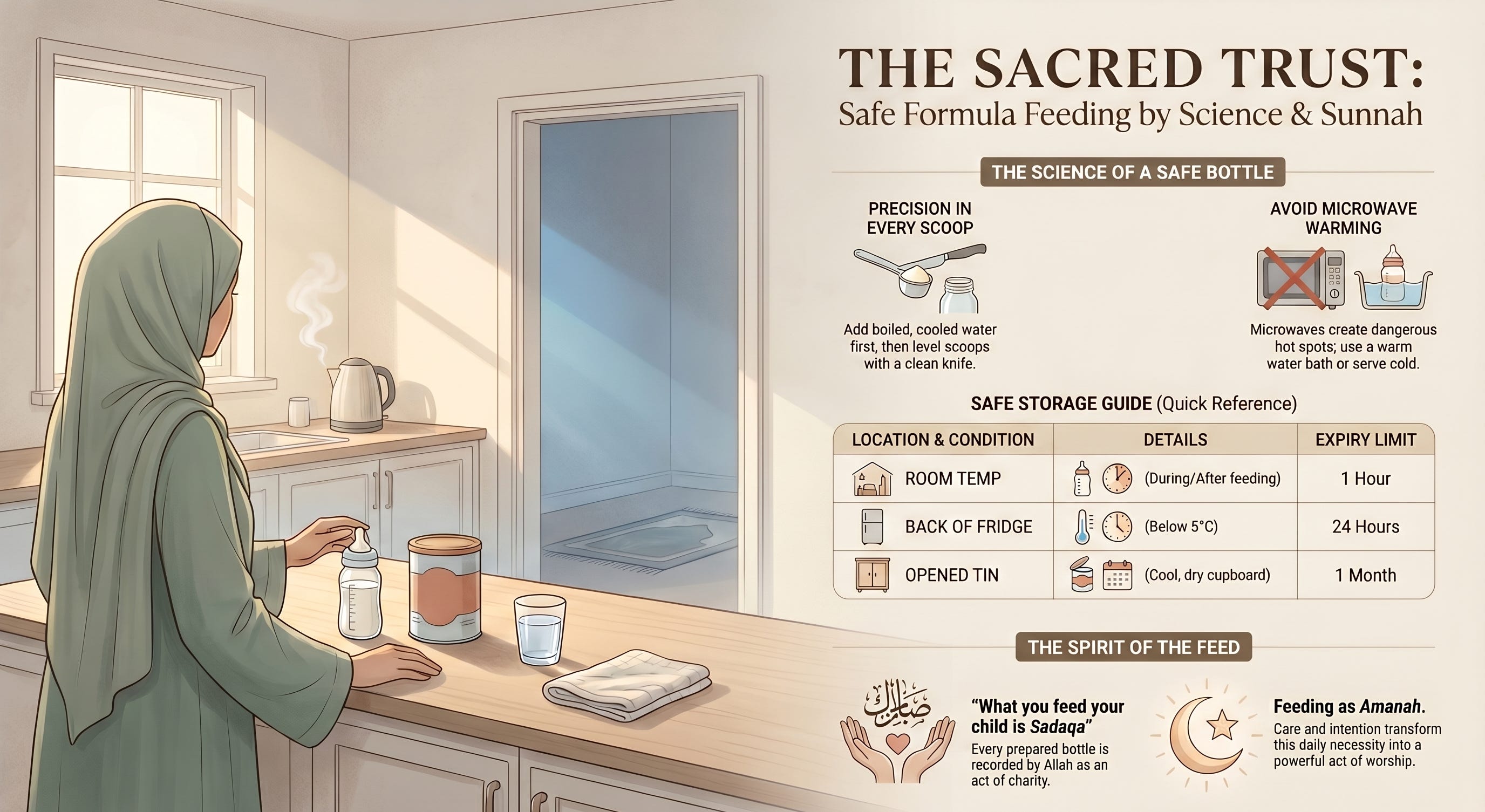
Powdered infant formula is not sterile. The WHO’s 2007 guidelines confirm that it can harbour Cronobacter sakazakii — a pathogen that poses serious risk to babies under 12 months, whose immune systems are still too undeveloped to fight it off. [1] This guide shows you exactly how to prepare, store, and warm formula safely — so every bottle you make is as safe as it is nourishing.
You’ve been awake for three hours. The baby is crying. You’re in the kitchen, one eye closed, reaching for the formula tin.
This is exactly the moment when mistakes happen. Not because you don’t care — but because exhaustion makes it easy to skip a step you’ll tell yourself doesn’t matter that much.
Here’s the thing: it does.
I’m not sharing this to frighten you. I’m sharing it because when I looked at the WHO’s preparation guidelines, one detail kept standing out — powdered formula is not sterile, and under-12-month immune systems genuinely cannot fight off the bacteria that can grow in it when it’s prepared incorrectly. [1] You are the last line of defence before that bottle reaches your baby. And you can do this right, even at 3 AM. Let me show you how.
Why This Guide Is Different From Generic Formula Advice
Built on WHO, AAP, and CDC guidance — every preparation step comes from the most current public health and paediatric guidelines, not parenting forums or brand websites. [1, 2, 3]
Islamic perspective woven in — because feeding your baby isn’t just a task, it’s an amanah (sacred trust), and the Prophet ﷺ called it sadaqa. This guide honours both the science and the spiritual weight of what you’re doing.
Comes with a free Safe Formula Feeding Pack — a printable 3-page guide to keep on your phone or inside your kitchen cupboard, so the checklist is always where you need it.
Why Formula Preparation Actually Matters
Most parents assume formula preparation is straightforward. It mostly is. But there are a few specific points — the ones WHO and AAP researchers flagged when they studied formula-related infant illness — where errors consistently happen. [1, 2]
Here’s what actually matters, and why:
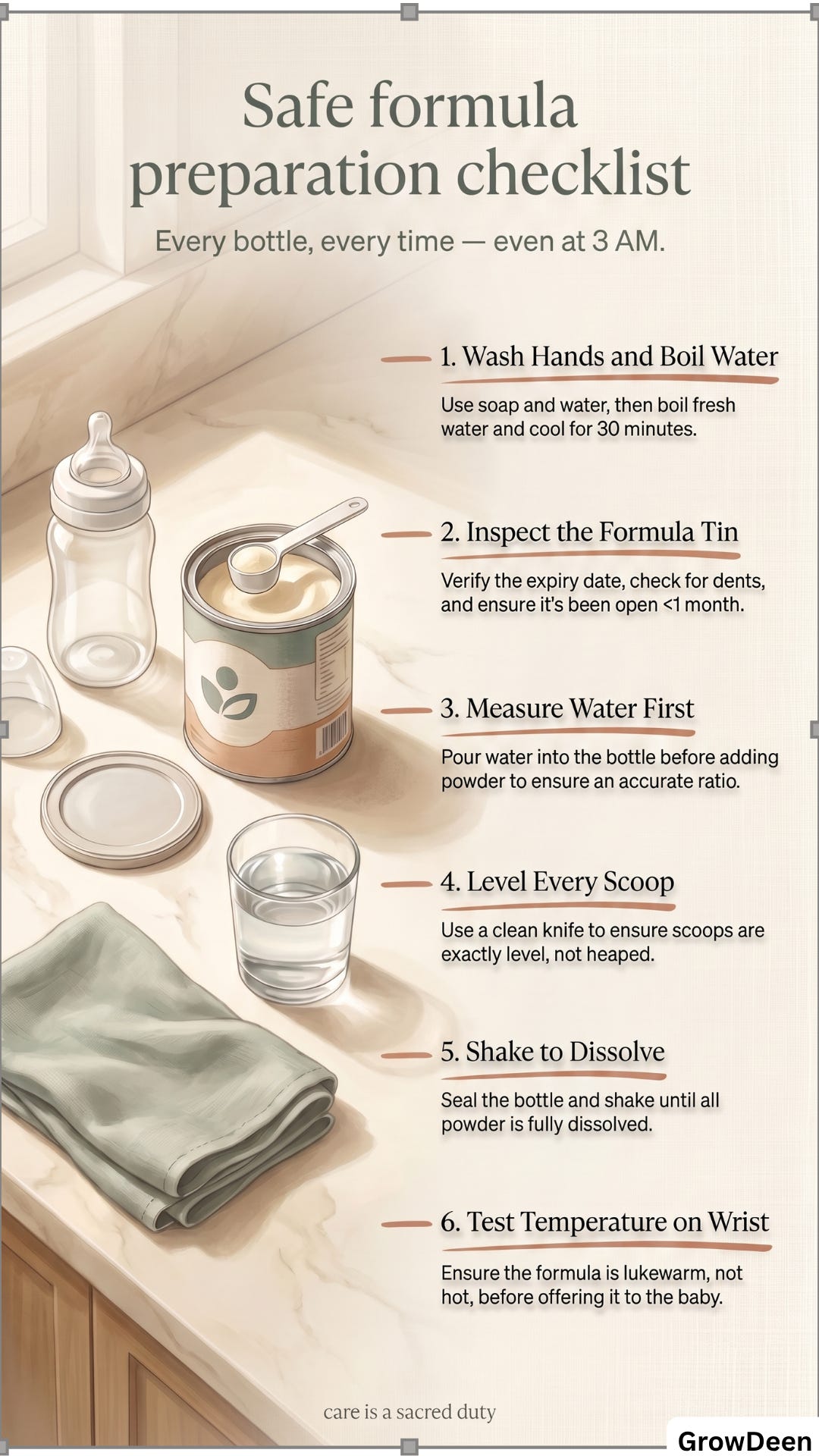
Water temperature is step one. Boil fresh water and let it cool to lukewarm — approximately body temperature. For babies under two months, premature babies, and any baby with a weakened immune system, boiled water isn’t optional. [3] The pathogen risk is too high. This usually takes about 30 minutes. Cover the kettle and don’t walk away and forget it.
The measurements are not flexible. This is the one I want you to really hear. Formula that is too dilute can cause water intoxication — a dangerous electrolyte imbalance that can be life-threatening in infants. Formula that is too concentrated strains young kidneys. [3] Level each scoop with a clean knife. Do not estimate. Not tonight, not any night.
Water goes in first, then powder. Always. This makes mixing easier and ensures the ratio is accurate. [2]
Shake, don’t stir. Seal the bottle and shake until the powder has fully dissolved. Then test the temperature on your inner wrist before feeding.
What Happens After the Feed
Leftovers cannot be saved. Full stop.
Once your baby drinks from a bottle, bacteria from their saliva enter the formula. At room temperature, those bacteria multiply quickly. [1] Discard whatever remains within one hour of the feed beginning — not one hour of when you made the bottle, but one hour from when the feed started.
This feels wasteful. I know. Make smaller amounts and top up if needed.
Storing Formula You’ve Made in Advance
Fresh preparation before every feed is ideal. But if you’re managing night feeds alone, or preparing for a long day out, advance preparation is safe if you follow this exactly:
Put the prepared formula in the fridge — below 5°C — within one hour of making it. [1] Store it at the back of the fridge, not in the door where temperature swings with every opening. Use it within 24 hours.
If you cannot keep it cold — a power cut, long travel, uncertain access to refrigeration — discard it after one hour at room temperature. No exceptions. [1]
Travelling With Formula
The safest option when you’re out is to carry cooled boiled water and formula powder separately, then mix fresh when you need it. Less convenient, yes. But it removes all the storage variables.
If you must travel with pre-made formula, it needs to be icy cold when you leave home. Carry it in an insulated bag with ice packs and use it within two hours of taking it out of the fridge. [2] If it’s been in the bag for less than two hours and you didn’t end up using it, it can go back in the fridge — but must be used within 24 hours of its original preparation time.
Ready-to-feed formula is your best friend for travel, hospital visits, or any situation where mixing isn’t practical. It requires no preparation and removes all these concerns.
A Note on Warming
Cold formula is medically fine. If your baby doesn’t mind it, there’s no reason to warm it. [2]
If you do want to warm it, stand the sealed bottle in a jug of warm water for no more than 10 minutes. Swirl gently — don’t shake — after warming. Always test on your wrist.
Do not use a microwave. Ever. Microwaves create uneven hot spots that can burn your baby’s mouth even when the bottle feels only slightly warm. [2] This isn’t a maybe — it’s a consistent finding from formula safety research.
I know this feels like a lot to hold in your head, especially at the end of a long day. That’s exactly why I put it into something you can keep with you.
I’ve created a free Safe Formula Feeding Pack — a 3-page printable guide designed to sit inside your kitchen cupboard or on your phone lock screen, so the information is there when you need it without having to search for it. Keep reading to download it at the end — it’s designed to make every bottle a little more confident.
The Sacred Trust of Feeding Your Child
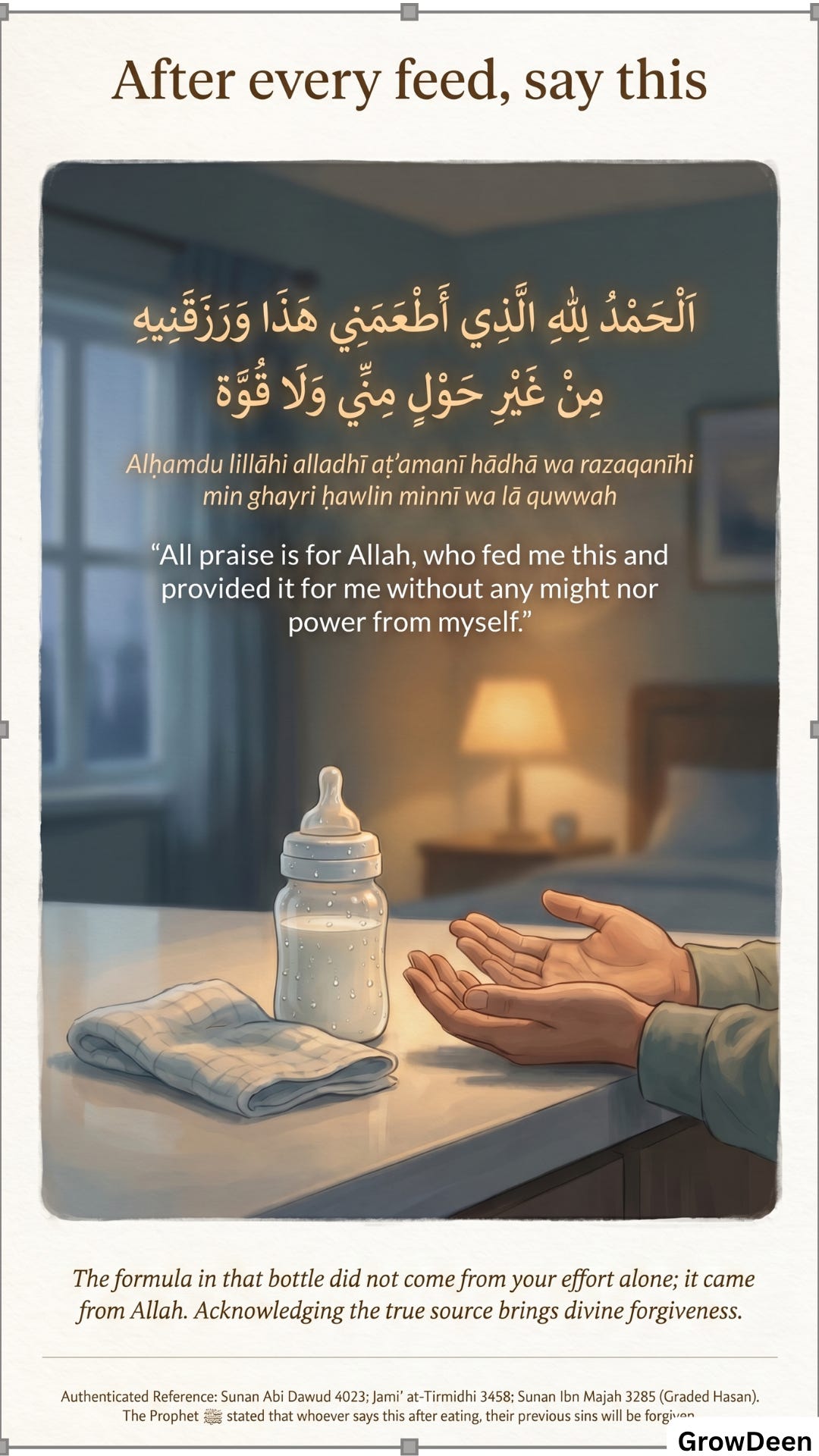
When I first read the hadith in Al-Adab al-Mufrad, I stopped for a moment. The Prophet ﷺ said: “What you feed your child is sadaqa for you.” [Al-Adab al-Mufrad 82, Sahih — Al-Albani] [8]
Sadaqa. Charity. Counted by Allah.
Every bottle you prepare carefully — the boiled water, the levelled scoop, the temperature check on your wrist at 2 AM — is recorded. Not just as effort, but as an act of worship. That changes how you think about it, doesn’t it?
There’s also something I find deeply moving in Surah Al-Qasas. Allah tells us about the mother of Musa (AS), instructing her to nurse him — and when he was separated from her and brought to Fir’awn’s palace, Allah decreed that he would not accept milk from any wet nurse. He would only accept nourishment from the right source, prepared with the right intention. [Quran 28:7] [9] According to Tafsir Ibn Kathir, this was by divine will — Allah orchestrated the nourishment of this infant with care and purpose.
Your baby’s feeding is held in that same divine care. You are part of how Allah provides for them. Every prepared bottle, said with Bismillah, is part of that.
May Allah bless what you feed your child, and make it a source of health, strength, and barakah.
Your Free Safe Formula Feeding Pack
If you’ve read this far, you’re the kind of parent who takes formula preparation seriously — not out of fear, but out of love. That tells me something beautiful about you.
Inside the Safe Formula Feeding Pack (one comprehensive PDF, 3 pages):
Page 1: Formula Problem-Solver Card — A quick-reference troubleshooting guide covering the seven most common formula feeding problems parents face — baby refusing the bottle, formula too hot or too cold, leftover formula questions, travel dilemmas, and more — with a clear one-line answer for each, designed as a laminated card to keep inside a kitchen cupboard or in a nappy bag.
Page 2: Formula Storage & Travel Quick-Reference Chart — A clear, colour-coded guide covering fridge storage windows, travel timelines, discard rules, and ready-to-feed options — so you can check at a glance whether the bottle you made two hours ago is still safe.
Page 3: Feeding as Worship — An Islamic Reminder Card — A single beautiful reminder page built around the Prophet ﷺ’s teaching that feeding your child is sadaqa, with the Arabic text, transliteration, and translation of Al-Adab al-Mufrad 82 — designed to be kept somewhere you’ll see it during feeds, to remind you that this ordinary act is an extraordinary one.
This isn’t just a PDF to download and forget. It’s a tool designed to stay in your kitchen — where you’ll actually use it when you need it most.
This Safe Formula Feeding Pack is what every subscriber receives with each article. At MPL, we cover the full journey of raising Muslim children, all backed by scientific research and rooted in Islamic wisdom.
If you’re a Muslim parent who wants evidence-based guidance AND Islamic perspective in one place, subscribe for free so future resources arrive in your inbox before you need them.
Subscribe free — practical parenting guidance backed by both science and Sunnah. You literally cannot get this combination anywhere else. No spam, no daily emails, just resources that matter.
One Small Action
Before you put this article down, do this one thing: open your formula tin and check the expiry date. Right now. Then check the tin itself — no dents, no rust, no swollen lid.
That’s it. 60 seconds. If anything looks off, it goes in the bin. That’s the check.
May Allah place barakah in every bottle, accept every sleepless feed as sadaqa, and make the care you pour into your baby’s nourishment more rewarded than it feels in the moment.
Share This With Someone Who Needs It
Think of one person right now: your pregnant sister-in-law who keeps saying she’s “probably going to formula feed” but hasn’t looked into preparation guidelines yet. Or the new mother in your WhatsApp group who posted a photo of her formula tin — the opened one she’s had for six weeks.
This article could protect their baby. Share it with them today — not as a correction, but as a gift. Sometimes the most loving thing we can do is pass along knowledge before someone needs it.
Frequently Asked Questions
Q: How long can prepared formula sit out at room temperature?
A: One hour from the start of the feed — not one hour from when you made it. Once your baby drinks from a bottle, bacteria from their saliva enter the milk and multiply fast at room temperature. [1] After that hour, discard whatever’s left. For the full storage rules, see “Storing Formula You’ve Made in Advance” above.
Q: Does it matter if I don’t boil the water for formula?
A: For most healthy, full-term babies over two months, cooled boiled water is the safety standard — but the boiling step is especially critical for babies under two months, premature babies, and any baby with immune system concerns. [3] Unboiled water can carry microbes a young baby’s immune system isn’t ready to handle. The 30-minute wait is worth it.
Q: Can I warm formula in the microwave?
A: No — and this is one I feel strongly about. Microwaves heat unevenly, creating hot spots inside the bottle that can scald your baby’s mouth even when the outside feels barely warm. [2] Use a jug of warm water instead, and always test on your wrist before feeding.
Q: How long can I keep formula in the fridge after making it?
A: Up to 24 hours, if you refrigerated it within one hour of preparation and stored it at below 5°C, at the back of the fridge (not the door). [1] After 24 hours, discard it regardless of whether the baby used it. Label bottles with the time of preparation so you don’t have to guess.
Q: Is it safe to use an opened formula tin that’s been in the cupboard for two months?
A: No. Opened tins of powdered formula should be used within one month of opening, even if the expiry date hasn’t passed. [2] After a month, the powder begins to degrade and the tin is no longer sealed from moisture and air. Mark the opening date on your tin with a marker so you don’t lose track.
Q: Can my baby drink cold formula straight from the fridge?
A: Yes, if they’ll take it — cold formula is nutritionally unchanged and medically safe. [2] Many young babies prefer it slightly warm, but there’s no requirement to heat it. If your baby is happy with cold, it’s one less step and one less risk.
References
[1] World Health Organization (WHO) & Food and Agriculture Organization (FAO). (2007). Safe preparation, storage and handling of powdered infant formula: Guidelines. WHO. https://www.who.int/publications/i/item/9789241595414
[2] National Health and Medical Research Council (NHMRC). (2012). Infant feeding guidelines: Information for health workers. NHMRC. https://www.nhmrc.gov.au/about-us/publications/infant-feeding-guidelines-information-health-workers
[3] American Academy of Pediatrics (AAP). (2026, February). How to safely prepare baby formula with water. HealthyChildren.org. https://www.healthychildren.org/English/ages-stages/baby/formula-feeding/Pages/how-to-safely-prepare-formula-with-water.aspx
[4] Centers for Disease Control and Prevention (CDC) / American Academy of Pediatrics (AAP). (2023). How to prepare and store powdered infant formula. AAP NeoKit. https://publications.aap.org/neokit/white-paper-parent/23728/How-to-Prepare-and-Store-Powdered-Formula-CDC
[5] U.S. Food and Drug Administration (FDA). (2024). Handling infant formula safely: What you need to know. https://www.fda.gov/food/buy-store-serve-safe-food/handling-infant-formula-safely-what-you-need-know
[6] Mayo Clinic. (2024, December). Infant formula: 7 steps to prepare it safely. https://www.mayoclinic.org/healthy-lifestyle/infant-and-toddler-health/in-depth/infant-formula/art-20045791
[7] Global Food Consumers Forum. (2025, January). Ensuring the safety of infant formula: What parents and caregivers need to know. https://www.globalfoodconsumers.org/food-safety/ensuring-the-safety-of-infant-formula/
[8] Al-Adab al-Mufrad (Imam al-Bukhari), Hadith 82. Narrated by Al-Miqdam ibn Ma’dikarib. Graded Sahih by Sheikh Nasir al-Din al-Albani. https://sunnah.com/adab:82
[9] Quran, Surah Al-Qasas 28:7. Translation: Sahih International. Tafsir: Tafsir Ibn Kathir. https://quran.com/en/28:7/tafsirs/en-tafisr-ibn-kathir