

The WHO’s 2023 report found that 39% of children globally consume sugar-sweetened beverages on a daily basis. [1] This guide shows you what to give your child at every age, what to avoid entirely, and how the Prophet’s ﷺ own way of drinking can become one of the most powerful habits you teach.
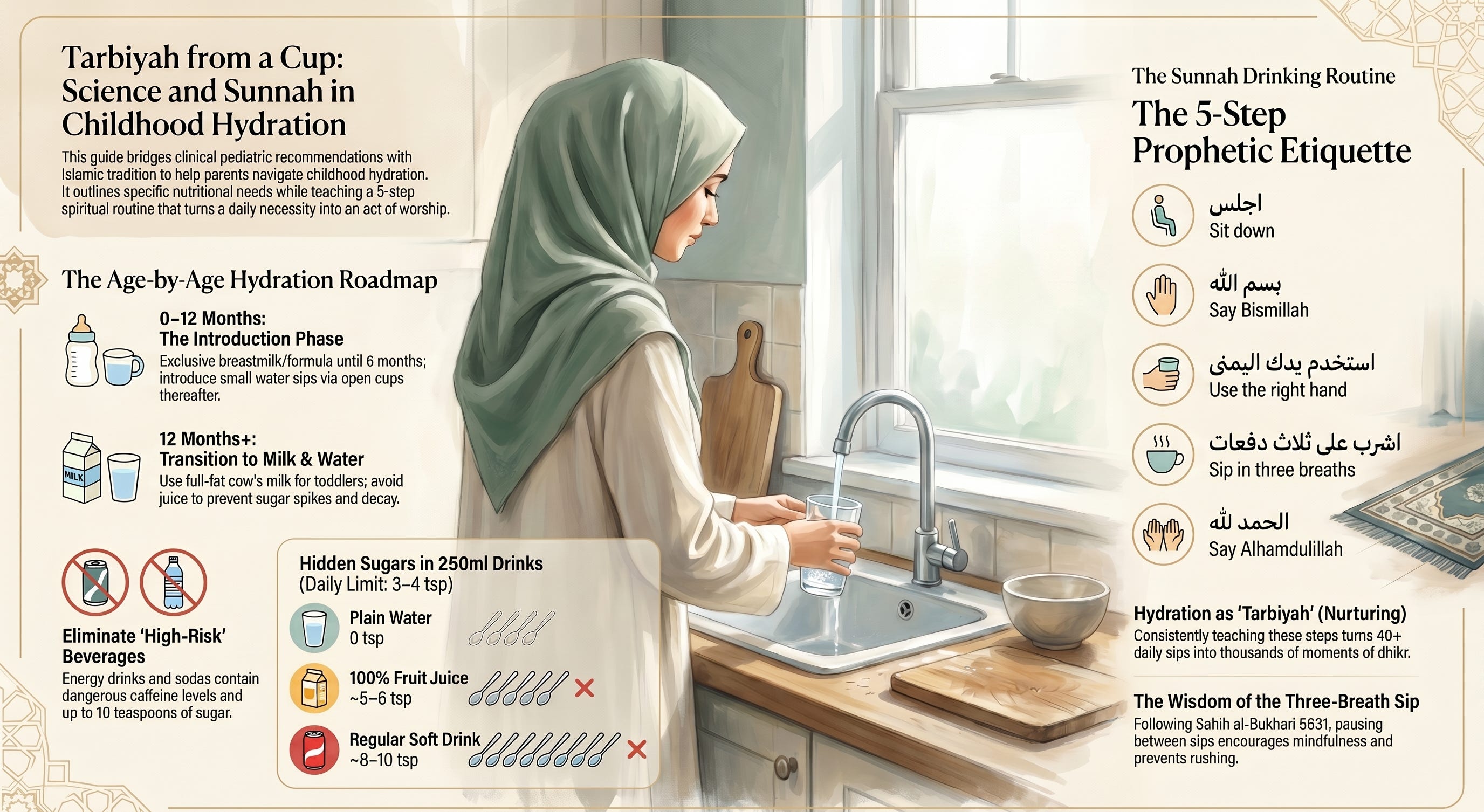
There’s a moment most of us have lived: the well-meaning relative at a family gathering who hands your toddler a cup of something fizzy, smiling — “just a little treat.” And you think: how do I say no without making it awkward?
Here’s the thing: you’re right to hesitate. Not because you’re being fussy. But because what children drink daily — not occasionally, but every single day — shapes their teeth, their weight, their gut, and their relationship with food in ways that compound quietly over years.
I know that sounds heavy. You’re already managing so much. But the good news? The answer here is genuinely simple.
When I looked at the research on childhood sugar consumption, the number that stopped me was this: across 187 countries, 39% of children consume sugar-sweetened beverages daily. [1] Not sometimes. Daily. And the effects — increased obesity risk, dental decay, poor appetite for nutritious food — aren’t theoretical. They show up in paediatric clinics everywhere.
The solution isn’t complicated. It’s water. And then — because you’re raising this child in the light of Islam — it’s also a Sunnah.
Why This Guide Is Different From Generic Nutrition Advice
Every recommendation is pulled from current clinical guidance — including the WHO, the American Academy of Pediatrics, and peer-reviewed paediatric research — not parenting blogs or wellness influencers.
This isn’t just a drink list. It’s tarbiyah. The Prophet ﷺ left us a complete etiquette of drinking that turns a cup of water into an act of remembrance. This guide shows you how to teach it to your children from the earliest age.
You’ll receive the free Healthy Drinks for Children Companion Pack — a 3-page printable with an age-by-age drink guide, a sugar content reference card, and a Sunnah Drinking Routine Card your children can learn and keep.
What to Give at Every Age
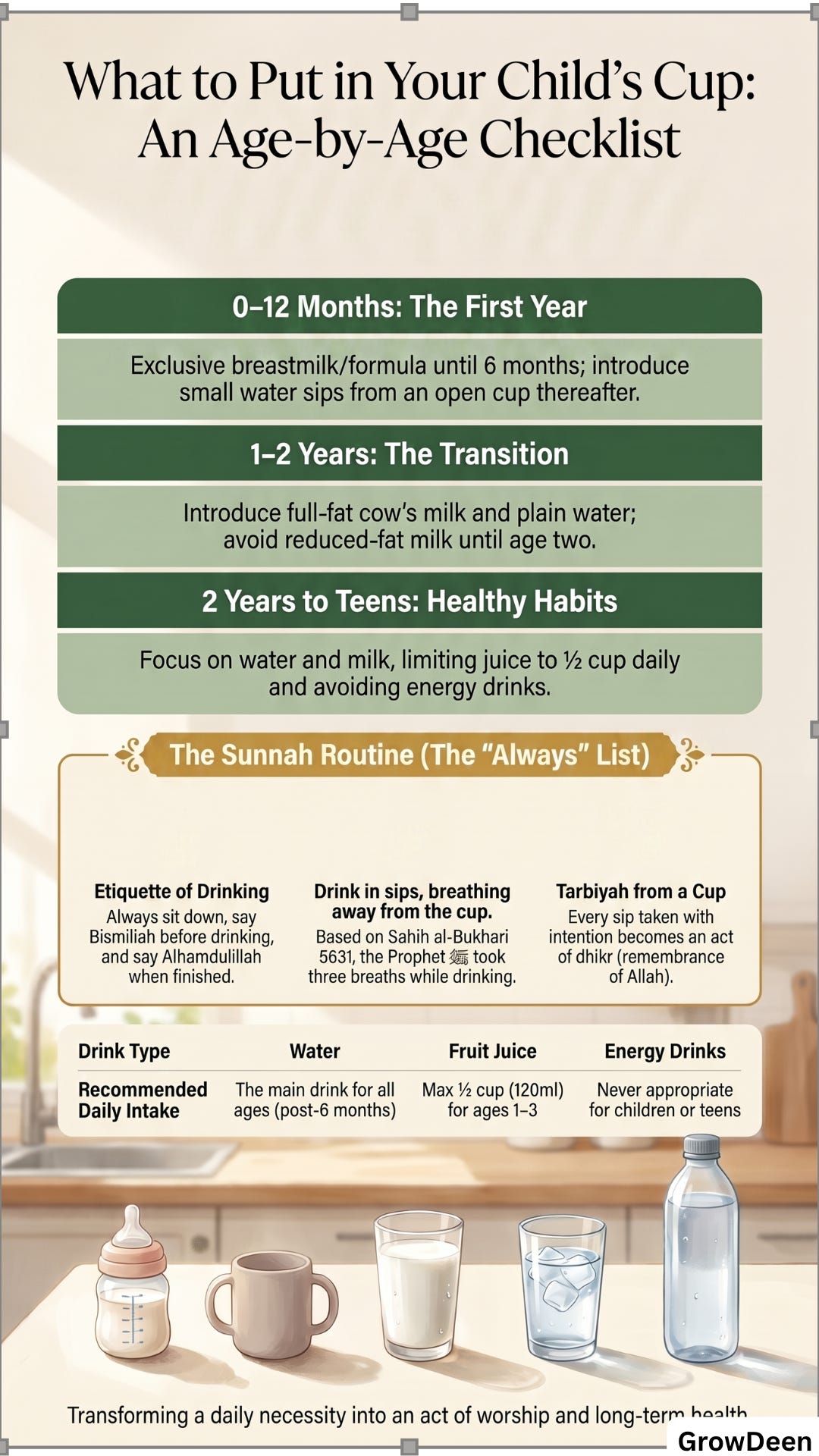
Birth to 6 months. Only breastmilk or infant formula. Full stop. Even water is harmful before six months — a young baby’s kidneys cannot safely handle extra fluid, and even small amounts can reduce milk intake at a stage when every feed matters. [2] The WHO recommends exclusive breastfeeding for the first six months — not as an ideal, but as a medical standard. [1]
6 to 12 months. Breastmilk or formula remains the main drink. You can now introduce small amounts of cooled water from an open cup — not a bottle. The cup matters: learning to drink from one builds the oral motor skills children need for eating, speaking, and swallowing. [3] Water at this stage is just a practice run.
12 months. Full-fat cow’s milk enters the picture, alongside water. Why full-fat? Because toddlers need the energy, fat-soluble vitamins A and D, and the calories for the growth demands of this stage. Reduced-fat milk isn’t appropriate until age two. [2,3]
Age 2 and beyond. Plain water and milk — with reduced-fat milk now fine — remain the best everyday drinks all the way through the teenage years. Everything else is a treat or a risk, depending on what it is.
The Drink Most Parents Think Is Healthy (But Isn’t)
Fruit juice. And I know this one stings, because it feels like you’re giving them fruit.
Here’s what actually happens when juice is made: the fibre is gone, and what’s left is concentrated fructose absorbed rapidly by the body. Your child gets a blood sugar spike, less satiety than they’d get from the whole fruit, and none of the gut benefit. [10]
The American Academy of Pediatrics is clear: no juice at all under 12 months. And from ages 1–3, no more than 120ml per day — that’s about half a small glass. [10]
The better option is always the whole fruit. It takes longer to eat. The fibre slows the sugar. And chewing it actually develops the jaw muscles children need for speech and dentition.
But here’s the thing: if your child already drinks juice daily, you don’t have to announce a ban. Just quietly dilute it — more water, less juice, over a few weeks — and replace the habit with water over time. That’s not failure. That’s parenting with wisdom rather than rules.
What to Keep Out of the House Entirely
Soft drinks and cordials have no nutritional value and significant harm. A single can of cola contains the equivalent of 8–10 teaspoons of sugar — more than a child’s entire daily recommended intake. [11]
Energy drinks are dangerous for children and teenagers. They often contain caffeine equivalent to two to three cups of coffee, along with stimulants that have been linked to heart rhythm disturbances, seizures, and cardiovascular events in young people. [4] Not a “sometimes” drink. Not ever.
Caffeinated drinks — tea, coffee — disrupt sleep, raise anxiety, and affect concentration in developing brains. [12] Older teenagers may encounter these socially; the guidance is to keep consumption rare and low.
I know this is a lot to hold. Which is why I created something to help.
Something to Make This Easier
I know remembering age-specific recommendations when you’re in the middle of a weekly shop isn’t realistic. That’s why I’ve put together the free Healthy Drinks for Children Companion Pack — a printable guide with everything laid out visually, including a sugar reference card you can stick to the fridge and a Sunnah Drinking Routine your child can actually learn. Keep reading to download it at the end of this article.
The Sunnah of Drinking: The Sip Your Child Takes Forty Times a Day
Here’s what I find remarkable: the Prophet ﷺ left us specific guidance on how to drink. Not what to drink. How.
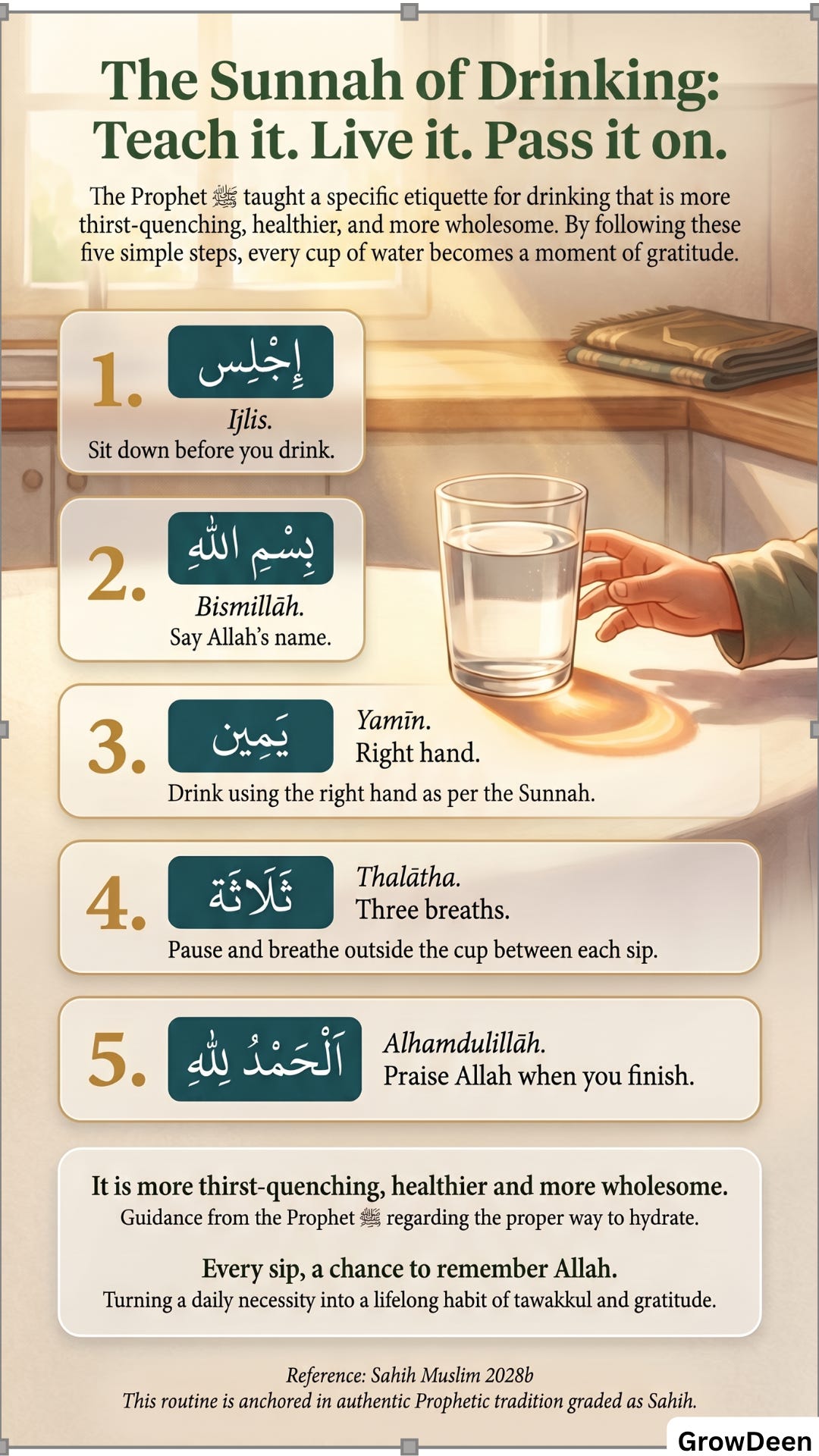
Anas ibn Malik reported that the Prophet ﷺ breathed three times outside the vessel in the course of a drink and said: “It is more thirst-quenching, healthier and more wholesome.” Anas added: so I also breathe three times in the course of a drink. [Sahih Muslim 2028b] [9]
Three breaths. Outside the vessel, not into it. The most honoured human being in history explained the reason himself — it is better for the body. And then his companion adopted the practice and kept it for the rest of his life.
That’s a five-step Sunnah most Muslim families haven’t taught their children. It goes like this:
Sit down. Say Bismillah. Hold the cup in your right hand. Drink in three breathes, breathing outside the cup between each one. Say Alhamdulillah when you finish.
Teaching this to a two-year-old takes three weeks of consistency. But once it’s there, it’s there for life. Every sip of water becomes an act of dhikr. Thousands of daily moments across a childhood become thousands of remembrances of Allah.
That’s tarbiyah from a cup.
Support Muslim Parenting Lab ❤️
Would you like a deed that keeps earning for you after you die? Start one in a few seconds with the button below.
The Prophet ﷺ named ongoing charity and beneficial knowledge among the three things that keep counting after death. (Sahih Muslim 1631)
What the Qur’an Says About Water That Changes Everything
When I came across this verse, I read it differently for a while:
“And We sent down from the sky water in measured amounts, and We lodged it in the earth — and indeed We are able to take it away.” [Qur’an 23:18] [5]
According to Tafsir Ibn Kathir, this verse describes Allah calibrating water precisely — for irrigation, for drinking, for every human need — as one of His innumerable blessings. [5] He causes sweet, fresh water to settle in the earth, Ibn Kathir writes, so that we may “drink it and give it to our livestock.” The mention of drinking is explicit in the classical tafsir.
And then those last words: We are able to take it away. That’s not a threat. It’s an invitation to gratitude. Clean water for your child’s cup isn’t guaranteed. It’s a daily gift.
When your child takes the Bismillah before drinking and the Alhamdulillah after, they’re not just being polite. They’re acknowledging where the water actually comes from.
Your Free Companion Pack
If you’ve read this far, you’re the kind of parent who takes nourishment seriously — not as a rules exercise, but as care. That tells me something.
Inside the Healthy Drinks for Children Companion Pack (one PDF, 3 pages):
Page 1: Age-by-Age Drink Guide — a clear visual reference showing what to give and what to avoid at every stage from birth to the teen years — designed as a laminated card you can keep on the fridge or inside a kitchen cupboard door.
Page 2: Sugar Content Reference Card — a quick-reference card showing how much sugar is in common children’s drinks, from soft drinks to flavoured milk to juice — so you can make decisions in the supermarket aisle in seconds, not after a research rabbit hole.
Page 3: Sunnah Drinking Routine Card — the five-step Islamic etiquette of drinking (sit, Bismillah, right hand, three breathes outside the cup, Alhamdulillah) drawn from Sahih Muslim 2028b, presented as a child-friendly routine card with simple Arabic, transliteration, and English — something small enough for the kitchen, meaningful enough to last a lifetime.
This isn’t just a PDF to download and forget. It’s a tool designed to stay on your fridge — where you’ll actually use it when you need it most.
This Companion Pack is what every subscriber receives with each article. At MPL, we cover the full journey of raising Muslim children — all backed by scientific research and rooted in Islamic wisdom.
One Small Action
Before you close this article — go look at what’s in your child’s cup right now. Or what you’ll put in it at the next meal. If it’s water or milk, say Alhamdulillah. If it’s something else, make that the one thing you quietly change this week. One cup at a time.
May Allah place barakah in every sip your child takes, and make the care you pour into their nourishment more rewarded than it feels in the moment.
Share This With Someone Who Needs It
Think of one person right now: your sister whose toddler still gets juice every morning because “it’s from fruit,” a friend in your WhatsApp group who just asked what drinks are safe for her eight-month-old, or the new mother at the masjid whose mother-in-law keeps offering the baby sweet tea.
This article could make a real difference to that child’s health. Share it with them today — not as a correction, but as a gift. Sometimes the most loving thing we can do is pass along what we’ve learned before someone needs it urgently.
Frequently Asked Questions
Q: When can babies start drinking water?
A: Small amounts of cooled, boiled water can be introduced from six months in an open cup alongside breastmilk or formula. [2] Before six months, babies need only breastmilk or formula — even water can reduce milk intake and strain their immature kidneys. After 12 months, plain tap water is fine without boiling.
Q: Is fruit juice healthy for kids?
A: Not really, no — even 100% fruit juice. The juicing process removes most of the fibre, leaving concentrated fructose that the body absorbs rapidly, similar to a sugary drink. [10] The AAP recommends no juice before 12 months, and a maximum of 120ml per day for toddlers aged 1–3. Whole fruit is almost always the better choice.
Q: What milk should toddlers drink?
A: Full-fat cow’s milk from 12 months until age two — toddlers need the calories and fat-soluble vitamins it provides. [2,3] From age two, reduced-fat milk is appropriate. Plant-based milks are generally not nutritionally equivalent to cow’s milk for young children; speak with your child’s doctor before making them a daily staple.
Q: Are energy drinks safe for teenagers?
A: No. Energy drinks can contain as much caffeine as two to three cups of coffee, plus stimulants like taurine and guarana. They’ve been linked to heart rhythm disturbances, seizures, and cardiovascular events in young people. [4] There is no safe dose for children or teenagers.
Q: How much water does a child need each day?
A: It varies by age, size, and activity level. Roughly: 1 litre per day for toddlers aged 1–3, 1.2 litres for ages 4–8, and 1.4–1.9 litres for older children and teens — more in hot weather or during sport. [8] Most of this can come from food and drinks combined.
Q: What did the Prophet ﷺ teach about how to drink?
A: The Sunnah of drinking includes: sitting down, saying Bismillah before, using the right hand, drinking in two or three sips (not one gulp), breathing away from the cup between sips, and saying Alhamdulillah after. [9] These etiquettes are narrated in Sahih al-Bukhari and are as practical today as they were 1,400 years ago — and they give your child a habit that connects every cup of water to the remembrance of Allah.
References
[1] World Health Organization. (2023). Sugars intake for adults and children: guideline. WHO. https://www.who.int/publications/i/item/9789241549028
[2] National Health and Medical Research Council (NHMRC). (2013). Australian dietary guidelines. NHMRC. https://www.eatforhealth.gov.au/sites/default/files/files/the_guidelines/n55a_australian_dietary_guidelines_summary_book.pdf
[3] Alazmah, A. (2017). Early childhood caries: A review. Journal of Contemporary Dental Practice, 18(8), 732–737. https://doi.org/10.5005/jp-journals-10024-2116
[4] Seifert, S.M., Schaechter, J.L., Hershorin, E.R., & Lipshultz, S.E. (2011). Health effects of energy drinks on children, adolescents, and young adults. Pediatrics, 127(3), 511–528. https://doi.org/10.1542/peds.2009-3592
[5] Qur’an, Surah Al-Mu’minun 23:18 — https://quran.com/23/18 | Tafsir Ibn Kathir: https://quran.com/en/23:20/tafsirs/en-tafisr-ibn-kathir
[6] Singhal, A. (2017). Long-term adverse effects of early growth acceleration or catch-up growth. Annals of Nutrition and Metabolism, 70(3), 236–240.
[7] Farhangi, M.A., Tofigh, A.M., Jahangiri, L., Nikniaz, Z., & Nikniaz, L. (2022). Sugar-sweetened beverages intake and the risk of obesity in children. Pediatric Obesity, 17(8), Article e12914. https://doi.org/10.1111/ijpo.12914
[8] European Food Safety Authority. (2010). Scientific opinion on dietary reference values for water. EFSA Journal, 8(3), 1459.
[9] Sahih al-Bukhari 5631 — Graded: Sahih — https://sunnah.com/bukhari:5631
[10] Heyman, M.B., & Abrams, S.A. (2017). Fruit juice in infants, children, and adolescents: Current recommendations. Pediatrics, 139(6), Article e20170967. https://doi.org/10.1542/peds.2017-0967
[11] Devenish, G., Golley, R., Mukhtar, A., et al. (2019). Free sugars intake, sources and determinants of high consumption among Australian 2-year-olds. Nutrients, 11(1), 161. https://doi.org/10.3390/nu11010161
[12] Wikoff, D., Welsh, B.T., Henderson, R., et al. (2017). Systematic review of the potential adverse effects of caffeine consumption in healthy adults, pregnant women, adolescents, and children. Food and Chemical Toxicology, 109, 585–648.
We combine scientific research with Qur’an and authentic Sunnah, and we cite our sources. Even so, this is general guidance and no substitute for a doctor who can examine your child.