

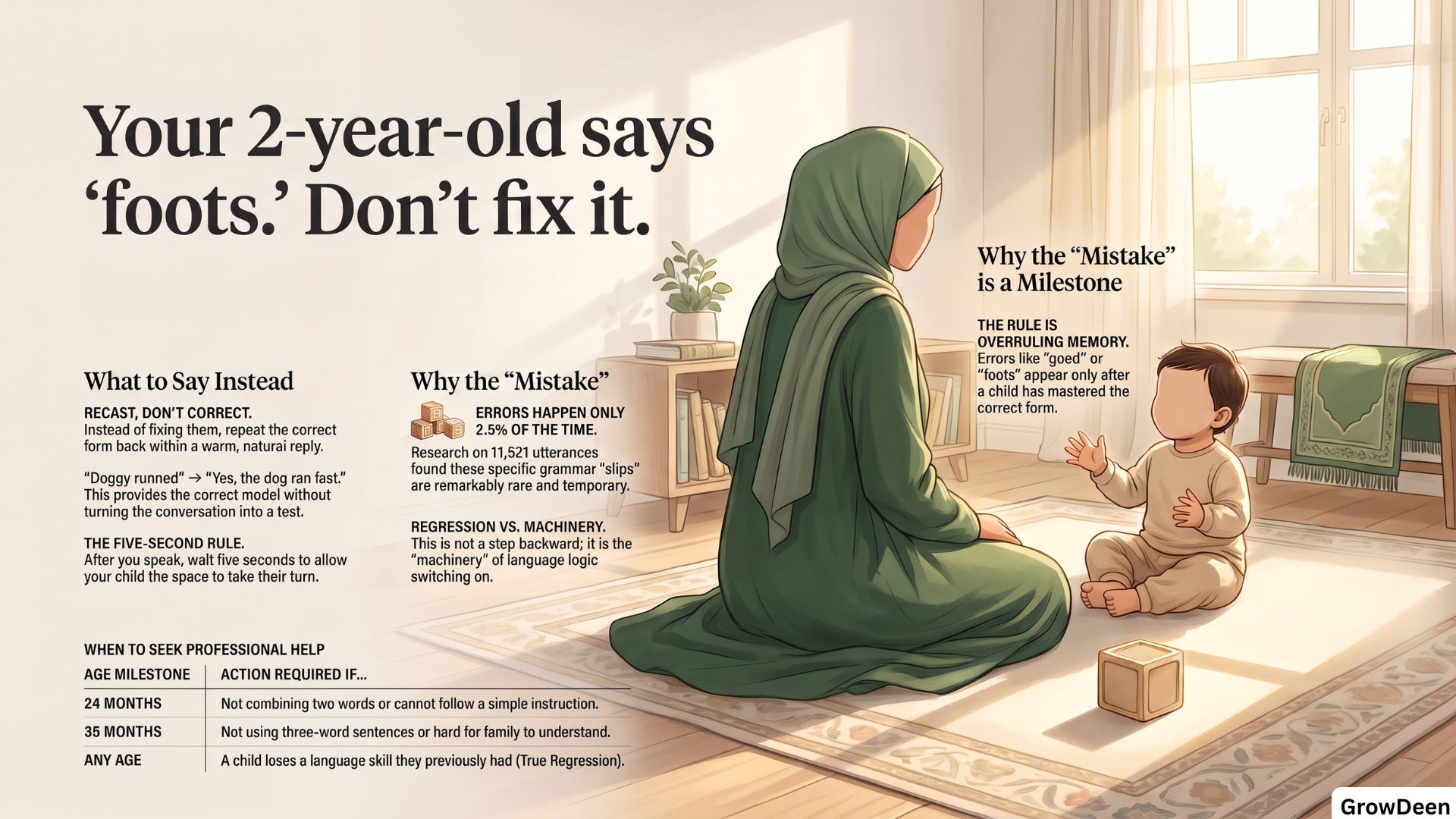
A landmark Society for Research in Child Development monograph analysed 11,521 past-tense utterances from 83 children and found errors like “goed” happen just 2.5% of the time, and only after a child has already mastered the correct form. [1] Here is what to say back instead of correcting.
Your child used to say it right.
“We went to Nani’s.” Clear as anything. You remember it because you told your husband about it.
And now, three weeks later, standing in the hallway with one shoe on: “We goed to Nani’s.”
So you correct her. Gently, because you are a gentle person. “Went, habibti. We went.” She looks at you, says it back, and forty minutes later says “goed” again. And somewhere underneath the tiredness a small cold thought arrives that you would not say out loud to anyone: is she going backwards?
She is not. I want to tell you that before anything else, because I know that thought sits in the chest.
When I went through the Marcus and Pinker monograph, the research team had analysed 11,521 irregular past-tense utterances from 83 children, and two findings stopped me. The first: these errors are rare, a median of just 2.5% of the time. [1] The second is the one that matters to you tonight. An extended period of saying it correctly comes first. The error arrives afterwards. [1]
Read that again. Your daughter got “went” right for weeks. Then her brain worked out the rule. And the rule is now overruling her memory.
That is not regression. That is the machinery switching on.
Why This Guide Is Different
Real numbers, not reassurance. Every claim here is tied to peer-reviewed developmental research or clinical guidance from ASHA, the CDC and WHO, with the specific figures included rather than smoothed into “most children.”
The Islamic layer is not decoration. The Qur’anic parable of the good word and its roots is the actual frame for why this year feels like it is producing nothing, and it is verified through Tafsir Ibn Kathir rather than quoted loosely.
You get the Toddler Grammar Growth Pack free. A printable three-page PDF with the exact reply for eighteen things your child is probably saying wrong right now.
What “Goed” Actually Proves About Your Child’s Brain
Here is what is happening under the hallway floorboards.
English has a rule: to talk about the past, add a sound to the end. Walk becomes walked. Jump becomes jumped. Your child has been swimming in that pattern for two years without anyone teaching it, and somewhere in the last month her brain extracted it.
Then it applied the rule to a verb that refuses to obey.
“Went” was never learned as a rule. It was memorised, one item at a time, the way you memorise a phone number. Now the rule has come online and it is louder than the memory, so it wins. [1]
It happens with plurals too. A separate quantitative analysis of children’s noun plurals found the same shape, with overregularised forms like “foots” and “mans” appearing at a mean rate of 8.5%, always preferring the correct form overall, always following the same curve. [2]
So when your child says “foots,” she is not failing at English. She is doing linguistics.
The mistake is the milestone.
And here is the part that should genuinely change what you do tonight: the research team found no evidence that these errors are unlearned through parental feedback. [1] Children stop saying “goed” because the memory eventually gets strong enough to block the rule, not because someone told them off in a hallway.
Your correction is not the mechanism. It never was.
The Reflex You Cannot Feel Yourself Doing
Let us be honest about the part that is harder to say.
This is not only about your child’s grammar. It is about the flicker of embarrassment when she says “foots” in front of your mother-in-law. It is about hearing yourself correct her for the fourth time in one afternoon and not quite liking the sound of your own voice.
That reflex has a name in this house from now on. Call it the correction reflex: the assumption that a parent’s job is to fix a child’s speech. It feels like teaching. It is the villain of this article, and it does two things you would never choose.
It turns talking into testing. And it fills the silence your child needed.
But here is the thing about that silence. When researchers looked at what actually predicted children’s language ability and the activity in the language regions of their brains, the strongest signal was not how many words the adults said. It was the number of conversational turns, the back-and-forth exchanges where the child says something and an adult answers that thing. The relationship held even after accounting for family income and total adult talk. [3]
A correction is not a turn. It is a full stop with a smile on it.
What to Say Instead (This Takes Four Seconds)
Your child says: “Doggy runned.”
You say: “Yes, the dog ran fast.”
That is it. That is the whole technique. She hears the correct form sitting inside a warm reply about a dog, and nobody has been marked.
Three more, because it helps to see the shape:
“Foots cold.” → “Your feet are cold. Shall we find socks?”
“I holded it.” → “You held it very carefully, mashaAllah.”
“Me go too.” → “You want to come too. Let’s get your shoes.”
Then stop talking. Count to five in your head if you have to, because adults reliably fill the gap before the child can, which deletes the exact turn that mattered. [3]
One more thing worth adding this year, and it is the highest-value habit on this list after the pause. Talk about what is not in the room. What happened yesterday. Why the sky went dark. What we will do after Maghrib. Research tracking the content of parent talk found that this kind of decontextualised language predicted children’s later vocabulary over and above how much a parent talked. [4]
Which is convenient, because your child is about to become fascinated by exactly this.
I know this is a lot to hold in your head at 7pm with dinner on the stove. That is why I put the eighteen most common toddler grammar errors, what each one proves, and the exact sentence to say back, into a free printable called the Toddler Grammar Growth Pack. There is a seven-day turn tracker in there too. Keep reading, it is at the end.
The Islamic Framework for a Child’s First Words: A Word With Roots
There is a feeling that comes somewhere around the fourteenth month of pouring words into a child who mostly grunts back, and it is not despair exactly. It is the quiet suspicion that none of this is landing.
When I sit with the verse where
Allah says, “Do you not see how Allah compares a good word to a good tree? Its root is firm and its branches reach the sky, yielding its fruit in every season by the permission of its Lord” [Qur’an 14:24 to 25] [9], the thing that answers that feeling is the timing.
According to Tafsir Ibn Kathir, Ibn Abbas explained the good word here as the testimony of tawhid, with the firm root describing how that word settles in the heart. Ibn Kathir records from Ad-Dahhak, Sa’id bin Jubayr, ‘Ikrimah and Mujahid that the parable covers a believer’s good statements and good actions, always rising. He then narrates that the Prophet ﷺ identified the tree as the date palm, the one whose leaves do not fall in any season. [9]
A tree with a firm root does not fruit the week you plant it.
And when you catch yourself correcting again, this is the one that steadies me.
The Prophet ﷺ said that when the son of Adam wakes in the morning, all the body parts defer to the tongue and say: fear Allah concerning us, we are only part of you, if you are upright we are upright, and if you are crooked we are crooked. [Jami’ at-Tirmidhi 2407, graded Hasan] [10]
That narration is about a person’s own tongue. But your two-year-old cannot regulate her speech at all yet. She is running on yours.
So before you correct how your child speaks this year, listen to how the house speaks. That is the thing she is actually copying.
Support Muslim Parenting Lab ❤️
Would you like a small amount of yours grown into something enormous? Give what you can spare with the button below.
The Prophet ﷺ said Allah grows a charity the size of a date until it is like a mountain. (Sahih al-Bukhari 1410)
The Words That Already Fit Her Mouth
Now look at what she can already hold.
A two-year-old is working on single words and short pairs. Bismillah is one word. Alhamdulillah is one word. Assalamu alaykum is a fixed unit she can carry whole long before she could ever build it. MashaAllah. SubhanAllah. JazakAllahu khayran.
Every one of those is exactly the size of what her mouth can manage right now.
This is not a religious programme stacked on top of language development. It is the developmental window being used for what it was built for. And because these words attach to moments that repeat five or six times a day, they get the one thing vocabulary actually needs, which is repetition inside something real rather than a drill.
The adab travels with it, mostly caught rather than taught. Letting her finish is turn-taking and it is also manners. Your tone lands before your words do, so a lowered voice does more than a raised one. And if you say you will bring something, bring it, because she is currently deciding what words are for.
“But Nobody Can Understand Her”
Let me give you the numbers, because vague reassurance does not help at a family gathering.
At around twenty-four months, most children have somewhere between fifty and three hundred spoken words, and a boy of two can sit anywhere between 79 and 511 words and still be entirely typical. [5] The spread is enormous and it means very little at this age.
Sounds are still being built. Your child may say b alone and l alone and still not manage them together in “blue.” Sounds like th, r, v, z, sh, ch and f stabilise late, and large reviews of English consonant acquisition put several of them well past the third year for a substantial share of children. [6] So “teef” for “teeth” is where it should be.
And for how much strangers understand, clinicians use a working rule: intelligibility to unfamiliar listeners climbs steadily, sitting near half at two years and around three quarters by three. [7] Your own figure is higher because you have context a stranger does not. If your mother struggles on a video call in a way you never do, that gap is expected.
If your home runs on two languages, count her words across both together or you will undercount badly and frighten yourself for nothing. Bilingualism does not cause delay, and the mixing stage is normal and passes. [11] Keep the home language. Keep the Qur’an recitation in the air. Her ear will never be more flexible than it is right now.
One boundary worth naming: a screen cannot answer her. WHO guidance caps sedentary screen time at one hour a day for two to four year olds, and less is better. [12] Responding is the active ingredient, and screens do not respond. [3]
The One Thing to Ask For Before Anyone Says “Late Talker”
Here is where I want to be direct with you, because this is the part standard milestone lists bury.
Ask for a hearing check first.
Fluid behind the eardrum is common at this age, frequently causes no pain at all, and can produce a mild fluctuating hearing loss that you would never spot from the outside. Clinical guidance singles out children with speech or language concerns as a group needing particular attention for exactly this. [15] Before anyone concludes your child is a late talker, confirm what your child is hearing.
Some numbers to hold the worry steady while you wait for that appointment. Roughly 10% to 20% of two-year-olds meet the criteria for late language emergence, boys are about three times more likely than girls, and prevalence rises to around 23% where there is a family history compared with 12% without. [13,14] Most of these children move into the average range by school age. [14]
Good odds. But odds cannot tell you which group your child is in, which is exactly why an assessment beats a guess.
Speak to a doctor or paediatrician by 24 months if your child is not putting two words together, cannot follow a simple instruction like “pick up your shoe,” or does not copy your words. [16]
By 36 months if your child is not using three-word sentences, does not understand two-part instructions like “get your coat and bring it here,” or is often hard for family and friends to understand. [16]
At any age, ask if your child loses a language skill she previously had. Regression in a skill is different from the “goed” pattern, and it always deserves a conversation rather than a wait.
Taking the means is not a shortfall in tawakkul. Seeking treatment and then relying on Allah is the pattern, not a departure from it.
The Toddler Grammar Growth Pack
If you have read this far, you are the kind of parent who wants to understand what your child is doing rather than just stop it. That tells me something.
Inside the Toddler Grammar Growth Pack (one comprehensive PDF, 3 pages):
Page 1: The Turn Tracker — A seven-day tally grid for counting real back-and-forth turns across three fixed windows of your day, with a simple scoring band so you can see the number move — designed as a fridge sheet you tick with a pen, not an app you forget to open.
Page 2: The Grammar Growth Chart — Eighteen things your two-year-old is probably saying wrong right now, what each one proves about her brain, and the exact sentence to say back — so you never have to invent a reply mid-sentence again.
Page 3: The Planting Page — The Qur’anic parable of the good word and the Prophetic narration on the tongue, in English, alongside a seven-word keepsake log where you date the first time she says Bismillah, Alhamdulillah, Assalamu alaykum and four more — with the Arabic and transliteration for the words she will actually recite.
This is not a PDF to download and forget. Page 2 belongs on the fridge. Page 3 is the one you will still have in ten years.
This pack is what every subscriber receives with each article. Muslim Parenting Lab covers the whole arc of raising children from birth to eight, all of it backed by peer-reviewed research and rooted in authenticated Islamic sources.
Do This Tonight
The next time your child produces a sentence, say one thing back about the sentence. Then say nothing for five seconds.
Count them. It will feel far longer than it is.
That silence is where her next turn goes.
Where This Leaves You
So, the question from the hallway. Why did she say “went” correctly for months and then start saying “goed”?
Because the rule arrived after the memory did. [1] For a while the rule is louder. Then the memory catches up and she stops, on her own, without a single correction from you.
She is not going backwards. The mistake is the milestone.
And the words you are pouring in this year will not show a return this year. That is not a fault in the method. It is what the parable describes: a root that goes down first, and fruit in its own season, by the permission of the One who owns the seasons. [9]
May Allah place barakah in your patience, accept every ordinary word you speak to your child, and let what you are planting take deeper root than you can see from here.
Share This With Someone Who Needs It
Think of one person right now. The sister at the masjid who mentioned, half-laughing and not really laughing, that her son says “goed” and she has started correcting him ten times a day. The cousin who has stopped taking her toddler to family gatherings because nobody can understand him.
Send them this. Not as advice, and not because you know better. Because you remember exactly how that hallway felt, and you would want someone to tell you.
Frequently Asked Questions
Q: Why does my 2-year-old say “goed” instead of “went”?
A: Because her brain has just extracted the rule that English adds a sound to make the past tense, and the rule is temporarily overriding the memorised form. The research is clear that this appears after a period of correct use, not before, and it happens only about 2.5% of the time. [1] It resolves on its own.
Q: Should I correct my toddler’s grammar mistakes?
A: No. Say the correct form back inside a normal reply instead. “Doggy runned” gets “yes, the dog ran fast.” The researchers found no evidence that parental feedback is what unlearns these errors, [1] and correcting turns talking into a test. There is more on this in “The Reflex You Cannot Feel Yourself Doing” above.
Q: How many words should a 2-year-old say?
A: Anywhere from about 50 to 300, and the honest answer is that the range is huge. A two-year-old boy can sit anywhere between 79 and 511 words and still be completely typical. [5] Word count alone is a poor thing to worry about in isolation.
Q: Is it normal that strangers cannot understand my 2-year-old?
A: Yes. Clinicians work with a rough rule that unfamiliar listeners understand about half of what a two-year-old says, rising to roughly three quarters by three years. [7] You understand more because you have context they do not.
Q: When should I worry about my 2 or 3 year old’s speech?
A: By 24 months if she is not combining two words, cannot follow a simple instruction, or does not copy your words. By 36 months if she is not using three-word sentences or is often hard for family to understand. [16] And at any age if she loses a skill she previously had. Ask for a hearing check first, before any other assessment. [15]
Q: Does raising a child bilingual delay their speech?
A: No. Bilingualism does not cause language delay, and the period of mixing the two languages is a normal stage that passes. [11] Count her vocabulary across both languages combined rather than one, or you will undercount and worry unnecessarily.
References
[1] Marcus, G.F., Pinker, S., Ullman, M., Hollander, M., Rosen, T.J., & Xu, F. (1992). Overregularization in language acquisition. Monographs of the Society for Research in Child Development, 57(4, Serial No. 228), 1–182.
[2] Marcus, G.F. (1995). Children’s overregularization of English plurals: a quantitative analysis. Journal of Child Language, 22(2), 447–459.
[3] Romeo, R.R., Leonard, J.A., Robinson, S.T., West, M.R., Mackey, A.P., Rowe, M.L., & Gabrieli, J.D.E. (2018). Beyond the 30-million-word gap: children’s conversational turns relate to language-related brain function. Psychological Science, 29(5), 700–710.
[4] Rowe, M.L. (2012). A longitudinal investigation of the role of quantity and quality of child-directed speech in vocabulary development. Child Development, 83(5), 1762–1774.
[5] Fenson, L., Dale, P.S., Reznick, J.S., Bates, E., Thal, D.J., & Pethick, S.J. (1994). Variability in early communicative development. Monographs of the Society for Research in Child Development, 59(5), 1–173.
[6] Crowe, K., & McLeod, S. (2020). Children’s English consonant acquisition in the United States: a review. American Journal of Speech-Language Pathology, 29(4), 2155–2169.
[7] Flipsen, P. (2006). Measuring the intelligibility of conversational speech in children. Clinical Linguistics & Phonetics, 20(4), 303–312.
[8] American Speech-Language-Hearing Association. Communication milestones: two to three years. https://www.asha.org/public/developmental-milestones/
[9] Qur’an, Surah Ibrahim 14:24–25 — https://quran.com/14/24 · Tafsir Ibn Kathir (Abridged), commentary on 14:24 to 14:26 — https://quran.com/en/14:24/tafsirs/en-tafisr-ibn-kathir
[10] Jami’ at-Tirmidhi 2407, narrated by Abu Sa’eed Al-Khudri — Graded: Hasan (Darussalam) — https://sunnah.com/tirmidhi:2407
[11] Byers-Heinlein, K., & Lew-Williams, C. (2013). Bilingualism in the early years: what the science says. LEARNing Landscapes, 7(1), 95–112.
[12] World Health Organization. (2019). Guidelines on physical activity, sedentary behaviour and sleep for children under 5 years of age. Geneva: WHO.
[13] Zubrick, S.R., Taylor, C.L., Rice, M.L., & Slegers, D.W. (2007). Late language emergence at 24 months: an epidemiological study of prevalence, predictors, and covariates. Journal of Speech, Language, and Hearing Research, 50(6), 1562–1592.
[14] American Speech-Language-Hearing Association. Practice Portal: Late language emergence. https://www.asha.org/practice-portal/clinical-topics/late-language-emergence/
[15] Rosenfeld, R.M., Shin, J.J., Schwartz, S.R., et al. (2016). Clinical practice guideline: otitis media with effusion (update). Otolaryngology–Head and Neck Surgery, 154(1 Suppl), S1–S41.
[16] Centers for Disease Control and Prevention. Learn the Signs. Act Early: developmental milestones at 30 and 36 months. https://www.cdc.gov/ncbddd/actearly/milestones/
We combine scientific research with Qur’an and authentic Sunnah, and we cite our sources. Even so, this is general guidance and no substitute for a doctor who can examine your child.