


A 2022 CDC report found poison center reports of children swallowing melatonin rose 530% in ten years. [1] This guide shows you how to match any sleep remedy to the real reason your child is awake.
Printable. For the next 10pm bottle decision.
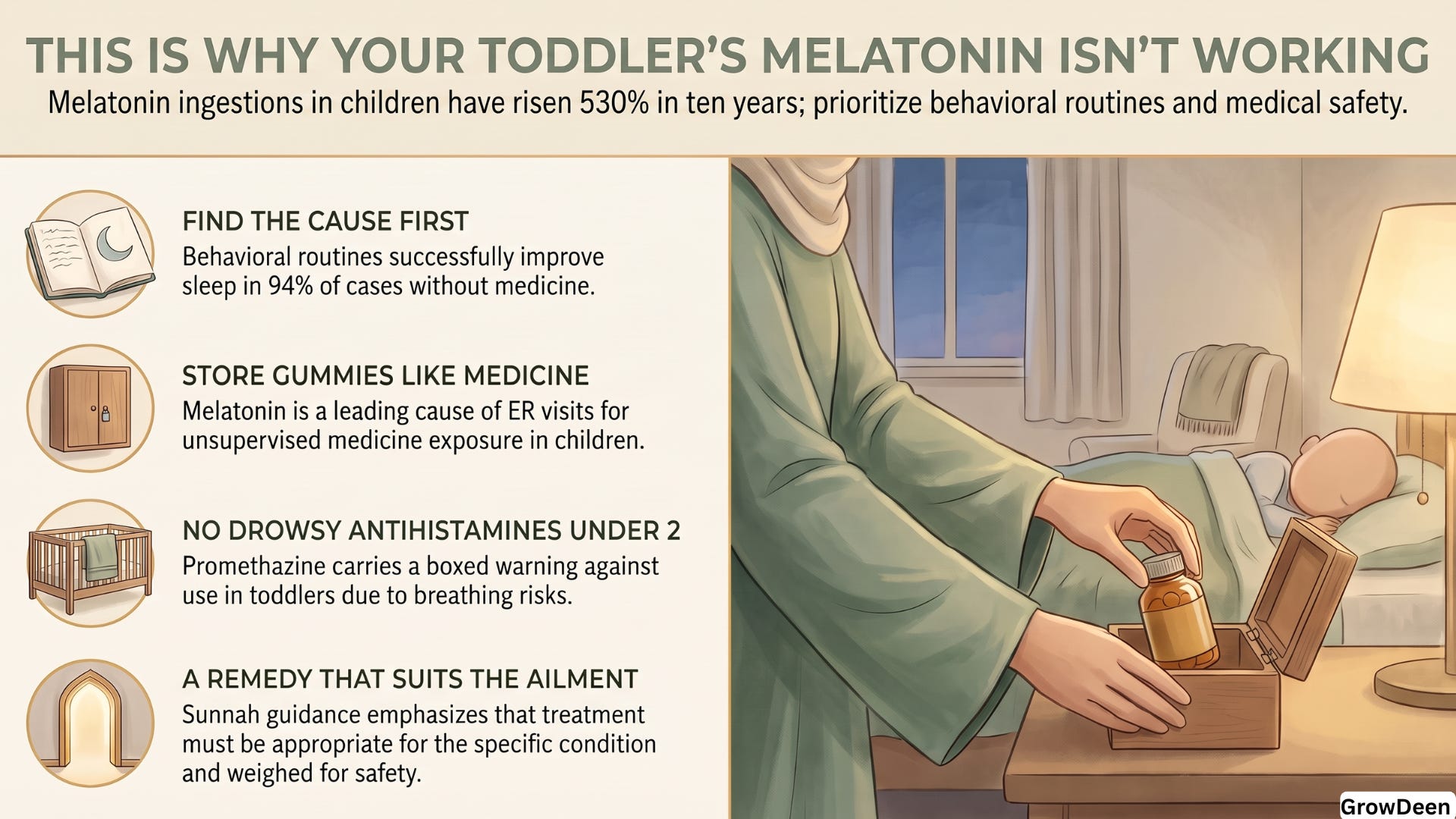
One supplement now heads a worrying list. Melatonin is the leading cause of emergency department visits for unsupervised medicine exposure and overdose among children aged six and under. A 2026 systematic review found prescriptions climbing worldwide, with no long-term safety or effectiveness data for typically developing young children. [2] In the United States, poison centres logged 260,435 reports of children swallowing it between 2012 and 2021, driven mostly by children aged five and under getting into it unsupervised. [1]
The gummy went down at half past seven.
By nine, two-year-old Maryam is standing up in her cot, cheerful and wide awake. Her mother lies on the rug beside it, working out how many hours are left before Fajr. The label promised calm. A cousin in the family group chat had sworn by it.
Nothing about that evening makes her a careless mother. She wanted her daughter to rest, and she reached for something everyone around her treats as harmless. Underneath the tiredness sits a quieter worry that parents rarely say out loud. It’s the fear that needing help at bedtime means failing at something other families seem to manage without trying.
That worry has an accomplice: the assumption that anything sold on the shelf beside the children’s vitamins must be gentle. That assumption is how a small bottle ends up on a kitchen counter within a toddler’s reach, and this guide sets out to take it apart.
Keep one puzzle in mind as you read. Sleep specialists have every prescription within reach, yet for most young children they begin treatment with no medicine at all. Why would they do that?
Why this guide is different
Every figure comes from a named source, including a 2026 JAMA Network Open review, CDC surveillance data and American Academy of Sleep Medicine guidance.
The Islamic guidance rests on what the Prophet ﷺ said about remedies, with each hadith checked on sunnah.com and explained through the scholars who commented on it.
You already have the free Before the Bottle Pack from the top of this page — a printable built to sit beside your medicine shelf.
What is really keeping a young child awake?
Picture the fourth request for water, delivered in the sweetest voice, at the exact moment your own eyes are closing.
Sleep doctors have a name for most of this. Bedtime battles and night wakings in young children usually fall under behavioural insomnia of childhood, which comes in a sleep-onset association type and a limit-setting type. [3] Put simply, some children have learned they can only fall asleep with a particular kind of help, and others have learned that bedtime limits bend if they push.
The puzzle starts to crack open here. An American Academy of Sleep Medicine task force reviewed 52 treatment studies on bedtime problems and night wakings. In 94% of them, behavioural approaches worked. More than 80% of treated children improved in a clinically meaningful way that still held three to six months on. [3] Positive bedtime routines and parent education are among the methods with research behind them, and the benefits reach the parents’ sleep and the family’s daytime life as well. [4]
Sometimes the problem is simply the clock. Paediatric sleep experts, after reviewing 864 studies, set these ranges for a full 24 hours, naps included: [5]
Babies aged 4 to 12 months: 12 to 16 hours
Children aged 1 to 2: 11 to 14 hours
Children aged 3 to 5: 10 to 13 hours
A three-year-old sleeping ten and a half hours a night with no nap sits comfortably inside that range, however short the evening feels to you. Regular sleep within those ranges is linked with better attention, behaviour, learning, memory and emotional regulation. [5] In a US national survey, about 35% of children aged 4 months to 17 years slept less than recommended, rising to about 40% of infants aged 4 to 11 months. Children with a regular bedtime were more likely to get enough. [6]
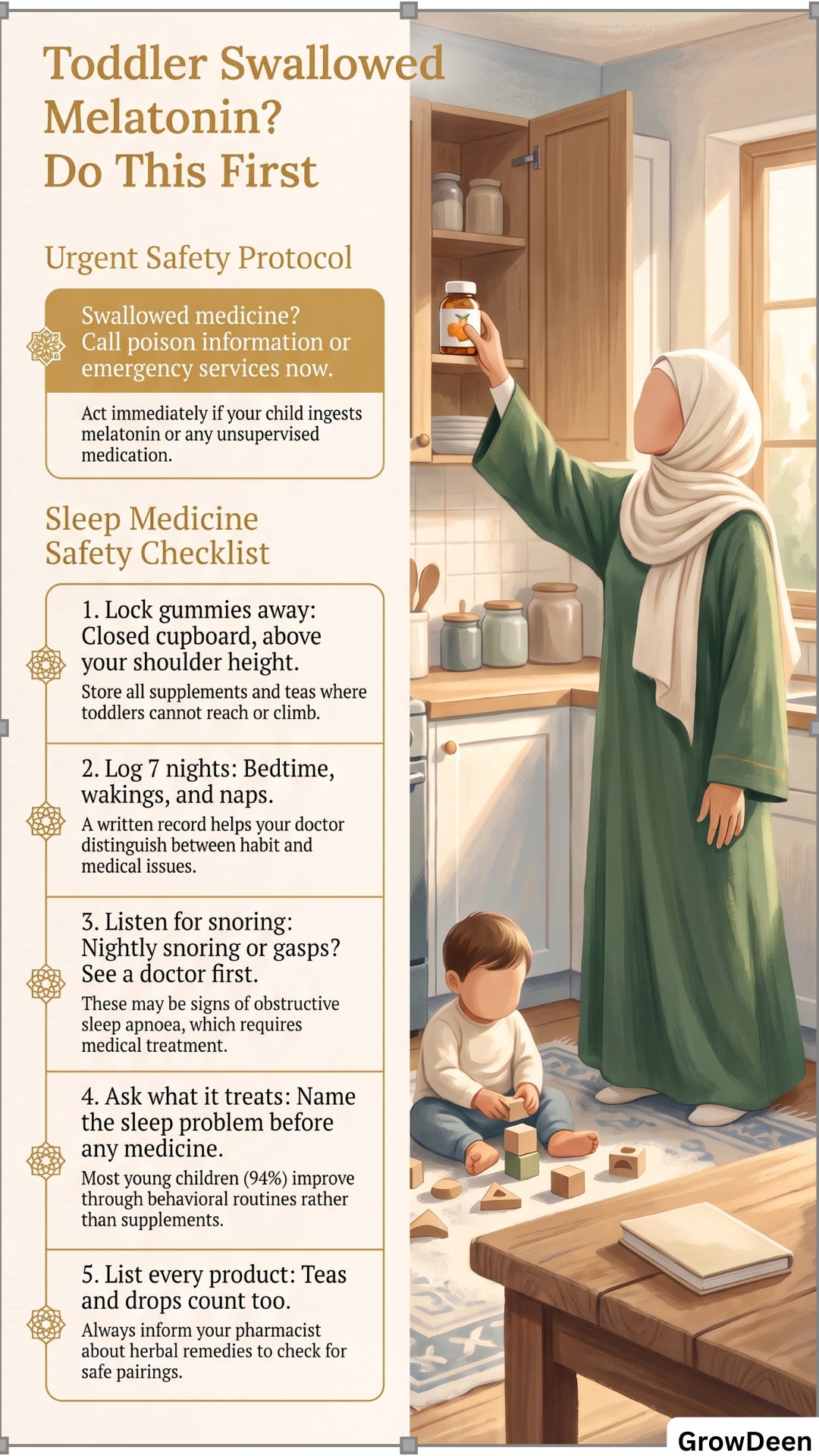
So before anything goes into a basket, spend a week writing down the real nights: the time your child goes to bed, roughly when sleep comes, each waking and how long naps last. That record tells you whether the struggle lives at bedtime or in the small hours, and it hands your doctor something solid.
Could snoring or low iron be the real problem?
The baby monitor crackles with a sound like a tiny motorbike, night after night, and it becomes background noise.
It deserves attention. Obstructive sleep apnoea, where the airway partly closes during sleep, affects an estimated 1% to 5% of children and is frequently missed. Left untreated, it has been linked with behavioural and learning difficulties and with poor growth. [7] The American Academy of Pediatrics asks doctors to screen every child for snoring and to arrange a sleep study for children who snore and show signs of apnoea. [8] In otherwise healthy children with enlarged tonsils and adenoids, removing them is the recommended first treatment. [8] Treatment for a narrowed airway looks nothing like a sleep aid, so mention loud nightly snoring, pauses or gasps to your doctor before any sleep aid is discussed.
Then there’s the child who kicks the duvet off six times a night. Iron deficiency has a recognised role in conditions marked by restlessness, including restless legs syndrome and ADHD. Yet iron status is not routinely checked when these problems come up, and ferritin is the blood marker guidelines cite most. [9] Ask whether an iron test makes sense. Start iron only on the doctor’s advice, because it is a medicine too.
Is melatonin safe for toddlers?
The question usually arrives through someone who loves you. A sister-in-law, maybe, or a mum from the masjid car park.
Melatonin is a hormone your child’s body already makes to regulate the sleep and wake cycle. [1] As a supplement, its clearest evidence is in children with neurodevelopmental conditions such as autism and ADHD. A meta-analysis of randomised trials found it added roughly 48 minutes of total sleep compared with placebo and helped these children fall asleep sooner. [10] The 2026 review of children aged six and under found short-term benefit in specific groups, including faster sleep onset in young autistic children, but no long-term data for typically developing children. [2]
What’s in the bottle depends on where you live. In the United States melatonin is sold as a dietary supplement without the oversight given to medicines. One study found products containing anywhere from less than half to more than four times the amount on the label, with chewables (the form children most often take) varying the most. [11] US sleep specialists suggest looking for the USP Verified mark if it’s used. [11] In the European Union, one prolonged-release prescription form is approved for insomnia in children aged 2 to 18 who have autism or Smith-Magenis syndrome. [12]
And to a toddler, a gummy is a sweet, which is why the shelf it lives on matters as much as the dose.
If a doctor does prescribe it, pin down the details. A US consensus panel of paediatric sleep clinicians advised giving melatonin 30 to 60 minutes before bedtime [12], so your child should already be calm and part way through the routine. Give the exact dose and ask when the plan will be reviewed. Keep the bottle with the medicines, out of sight and reach. [11]
There’s a lot to carry in your head by now, and very little of it comes to mind at ten at night with a toddler rattling the cot bars. That’s why the remedy comparisons and the questions worth asking a doctor are gathered into a free printable called the Before the Bottle Pack. The download button is at the top of this page, and there’s a full description of what’s inside it below.
What about sedating antihistamines and sleeping tablets?
A pharmacist mentions an allergy medicine that “makes them drowsy,” and for a second it sounds like a solution.
Promethazine is one of those drowsy antihistamines, and it has long been given to children as an antihistamine, an anti-nausea medicine and a sedative. [13] In late 2004 a boxed warning was added to its labelling that rules out use in children under 2 and strengthens caution for older children. It followed reports in young patients of breathing depression, over-sedation, agitation and hallucinations. Several of the breathing problems happened when promethazine was given with other medicines that also slow breathing. [13] Its prescribing information adds that some children become stimulated instead of sleepy, with paradoxical reactions including hyperexcitability and nightmares. [14]
Benzodiazepine sleeping tablets carry a different weight. Even at recommended doses they can lead to misuse and addiction. Physical dependence can develop after steady use for several days to weeks, and stopping suddenly can bring on dangerous withdrawal reactions, including seizures. [15] For a young child this is a specialist’s decision with close follow-up.
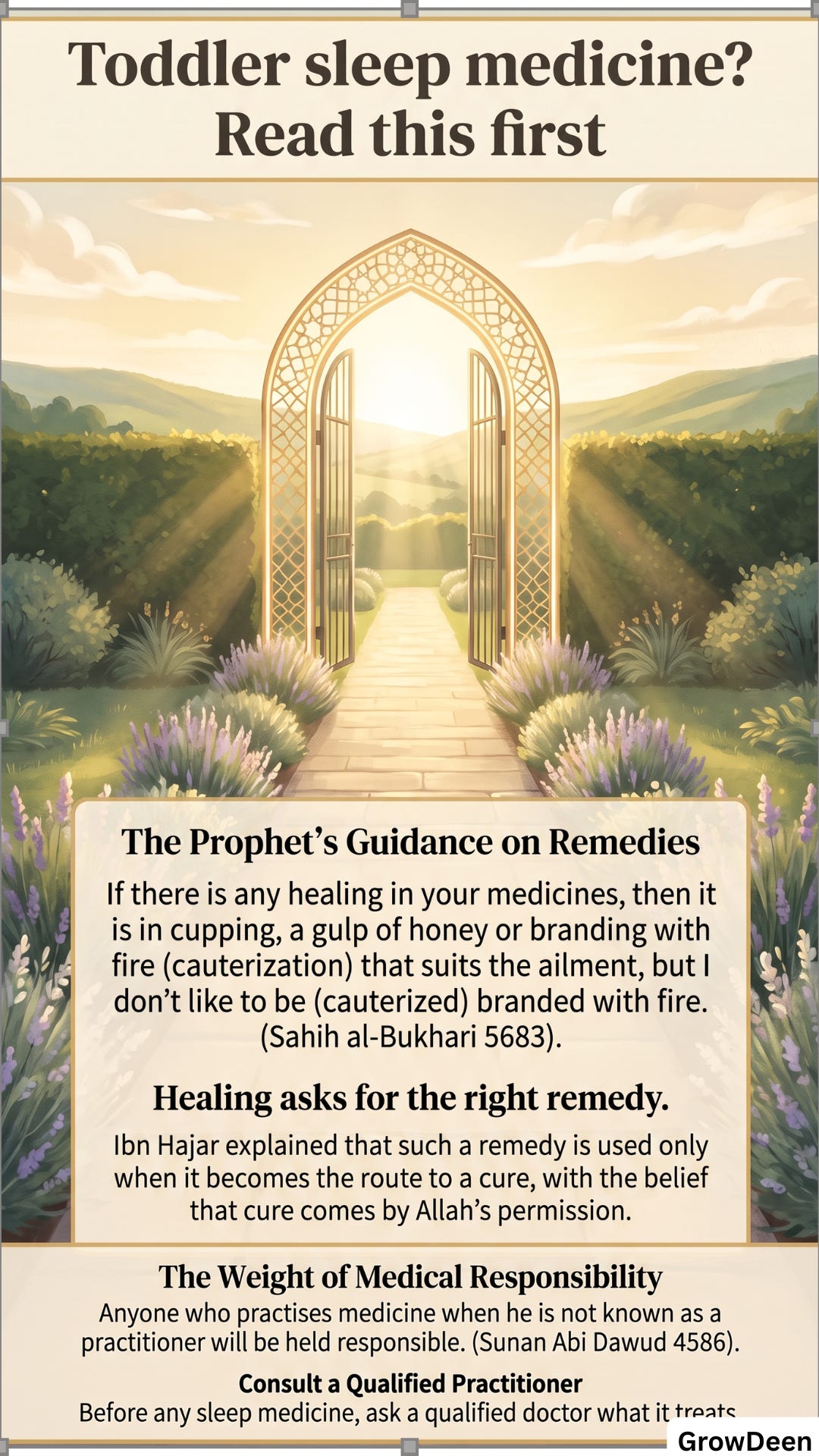
Which brings up the leftover tablets in a grandparent’s bathroom cabinet. The Prophet ﷺ said: “Anyone who practises medicine when he is not known as a practitioner will be held responsible.” [16] Scholars explain this covers an unqualified person who treats a patient. [17] Choosing a drug and a dose for a child is treatment, and that choice belongs with someone who knows medicine. Never give your child a tablet prescribed for anyone else.
Are herbal teas and “natural” drops the gentler choice?
The chamomile tea steeps on the counter, pale gold, smelling of every grandmother’s kitchen.
A systematic review of 14 randomised trials with 1,602 participants compared herbal medicines (valerian, chamomile, kava and wuling) with placebo. It found no significant difference on any sleep measure, and valerian came with more side effects per person than placebo. [18] Most participants were older adults, [18] which leaves almost nothing to go on for a three-year-old.
Home remedies given out of love are not new. Umm Qais bint Mihsan once brought her son to the Prophet ﷺ after pressing on his palate and tonsils with her finger to treat his throat. He said: “Why do you pain your children by pressing their throats! Use Ud Al-Hindi (certain Indian incense) for it cures seven diseases, one of which is pleurisy.” [19] In one answer he named the pain her method caused and pointed her to another remedy.
That leaves a tired parent with two honest questions for any tea, drop or powder: what is it treating, and could it hurt? Name the reason before you reach for the bottle.
Tell your doctor and pharmacist about every product your child takes, teas and drops included. [15]
Don’t combine a herbal product with a sleep medicine unless a doctor has said the pairing is safe.
Check labels for gelatin or alcohol, and ask the pharmacist or manufacturer about their source if that matters to your family. Where a halal question isn’t settled, a trusted scholar can advise on your situation.
What can you do tonight instead?
Tonight is where the answer to the puzzle becomes practical, because the approaches with the strongest evidence fit into a Muslim home’s evening. [4] None of them needs a pharmacy.
Keep wake-up time steady through the week, including weekends and the later nights of Ramadan and Eid, since a regular schedule goes with getting enough sleep. [6]
Give the wind-down a fixed clock time: a bath or wudu, pyjamas, teeth brushed (with a miswak for an older preschooler), then a short story about one of the Prophets.
Lower the lights and play Qur’an recitation softly, or recite a short surah yourself, and keep screens out of that last stretch.
Say a simple du’a together that your child can repeat, and let your voice be the last warm thing they hear.
When you can, lay your child down drowsy but still awake, so the place they fall asleep is the same place they’ll surface at 2 a.m.
Age changes the picture. Babies under 12 months shouldn’t be given any sleep medicine, supplement or herbal product unless a doctor has specifically directed it. Promethazine must never be used before a child’s second birthday. [13] From 1 to 2, toddlers are climbing and opening cupboards, and unsupervised melatonin ingestion is concentrated in children five and under, [1] so lock every gummy away. Between 2 and 5, melatonin’s evidence is strongest in children with neurodevelopmental conditions, [10] and long-term data in typically developing children are still missing. [2] For most preschoolers, a steady routine with limits that hold is where to start. [3]
When does a child’s sleep need a doctor, and when is it urgent?
Your child’s sleep is affecting their mood and daytime behaviour, or wearing the whole family down.
Bedtime struggles or night wakings haven’t eased after a few weeks of consistent changes.
Your child is frightened of bedtime.
Your child snores most nights or seems to stop breathing and gasp in sleep. [8]
Your child’s sleep looks physically restless. [9]
Your child is autistic, has ADHD, developmental delay or another medical condition, and sleeps poorly.
Get urgent help straight away if your child has swallowed melatonin or any medicine not meant for them, especially if they’re unusually drowsy or breathing differently. Call your local poison information service or emergency services.
A few things to steer clear of, too. Never give promethazine or another sedating antihistamine for sleep to a child under 2. [13] Don’t add a second dose because the first “didn’t work,” and don’t share prescriptions between children or between adults and children. Keep gummies off counters and away from anywhere small hands can reach. [1]
How the Sunnah weighs a remedy before it reaches a child
You’re at the pharmacy counter, turning a small bottle over in your hand and weighing it against a long week. The Sunnah speaks to that.
Jabir bin Abdullah heard the Prophet ﷺ say: “If there is any healing in your medicines, then it is in cupping, a gulp of honey or branding with fire (cauterization) that suits the ailment, but I don’t like to be (cauterized) branded with fire.” [20] Cauterization was a known treatment, and the Prophet ﷺ himself applied it to some Companions. [21] Ibn Hajar, bringing the Prophet’s ﷺ dislike together with those cases, concluded that it is neither abandoned altogether nor used freely. It is used when it becomes the route to a cure, with the belief that cure comes by Allah’s permission. [21]
Scholars have also set out when seeking treatment itself becomes discouraged: when it could lead to complications worse than the original complaint. [22]
Hold that beside everything above about melatonin, antihistamines and herbal drops. A remedy has to suit the ailment, with its costs weighed fairly. And the choosing belongs with people who know medicine. [16] For a parent at that counter, those teachings turn a late-night guess into a decision made with knowledge.
So why do sleep specialists start without medicine?
Back to the puzzle from the beginning. For most young children the reason they aren’t sleeping is a learned pattern or a schedule that doesn’t match their sleep needs, and a pill cannot unteach a habit. Behavioural approaches worked in 94% of the studies reviewed, with changes that lasted, [3] and no medicine is approved in the United States for childhood insomnia. [12] When the reason turns out to be medical, like snoring from enlarged tonsils, the fix is a different treatment altogether. [8]
Medicine still has a place, for the children it suits, chosen by a doctor who has looked for the reason first. The shelf beside the vitamins tells you nothing about which child that is.
Name the reason before you reach for the bottle.
Your free Before the Bottle Pack
If you’ve read this far, you’re weighing your child’s sleep with real care, and on a night when you’re this tired, that deserves something practical to hold onto.
Inside the Before the Bottle Pack (one comprehensive PDF, 3 pages):
Page 1: The Sleep Remedy Reality Card: melatonin, sedating antihistamines, sleeping tablets and herbal teas side by side, with what each one is, what the evidence shows, the age rules and the first question to ask, designed as a sturdy reference card you can keep taped inside the medicine cupboard door.
Page 2: The Medicine Shelf and Doctor Visit Sheet: a tick-list of causes to rule out before an appointment, the six questions to ask with space for answers, a table for every product your child takes, a shelf safety check and a box for your local poison information number, so you can walk into the doctor’s office prepared in under 15 minutes.
Page 3: Three Sunnah Reflections for the Medicine Shelf: the Umm Qais narration, the hadith on a remedy that suits the ailment with Ibn Hajar’s explanation, and the hadith on leaving medicine to those who know it, each set as a short card you can read when a remedy decision is in front of you.
This isn’t just a PDF to download and forget. It’s a tool designed to stay in your medicine cupboard, where you’ll actually use it when you need it most.
The Before the Bottle Pack is the kind of resource every subscriber receives alongside each article. Muslim Parenting Lab covers the whole stretch of raising young children, from newborn feeding to preschool behaviour, with research and the Sunnah read side by side.
If you want guidance that holds both, subscribe for free so the next resource arrives in your inbox before you need it.
Subscribe free for parenting resources backed by both science and Sunnah, guidance you won’t find anywhere else, with no spam and no clutter.
One thing to do in the next five minutes
Go to wherever the melatonin and allergy medicines live in your home. If anything is on a counter, a bedside table or in a handbag, move it now into a closed cupboard above your shoulder height. Do it before you forget.
May Allah make the long nights lighter for you, and make whatever remedy you choose a real means of ease for your child.
Share this with someone who needs it
Think of the mother in your family group chat who posted a photo last week of her toddler’s bedtime. Behind the cot, on the bedside table, sat a bottle of gummies. Like Maryam’s mother, she’s tired, and she’s been told those gummies are harmless.
Send this to her today. Keep it gentle, the way you’d want someone to pass it to you.
Frequently asked questions
Q: Is melatonin safe for toddlers? A: There’s no long-term safety or effectiveness data for typically developing children aged six and under, even though prescriptions are rising. [2] Speak with your child’s doctor before trying it, because many sleep problems respond better to changes in routine. [11] For the full picture, see “Is melatonin safe for toddlers?” above.
Q: At what age can a child be prescribed melatonin? A: In the European Union, the approved prescription form is licensed for children aged 2 to 18 with autism or Smith-Magenis syndrome. [12] In the United States no medicine is approved for childhood insomnia, so any use should be guided by a doctor who has checked for other causes first. [12]
Q: Can a child under 2 have an antihistamine to help them sleep? A: Promethazine carries a boxed warning against use in children under 2 because of reports of serious breathing problems. [13] Some children also become agitated instead of sleepy, [14] so don’t use sedating antihistamines for sleep without a doctor’s direction at any age.
Q: What should you do if a child swallows melatonin gummies? A: Call your local poison information service straight away, or emergency services if your child is very drowsy or their breathing seems different. The rise in poison centre reports was driven mostly by children aged five and under getting into melatonin unsupervised, [1] so store every supplement in a closed cupboard out of reach.
Q: How much sleep does a 3-year-old need? A: Children aged 3 to 5 need 10 to 13 hours in every 24 hours, naps included. [5] Naps count toward that total. Keeping a regular bedtime makes it more likely your child gets enough. [6]
Q: Is it allowed in Islam to give a child medicine for sleep? A: Seeking treatment is permitted, and scholars say it becomes discouraged when the treatment could bring complications worse than the original problem. [22] The Sunnah also leaves medicine to those who know it. [16] Let a qualified doctor decide whether a sleep medicine suits your child, and ask a trusted scholar about any ingredient concerns.
Q: When should a child’s sleep problem be seen by a doctor? A: Book an appointment if poor sleep is affecting mood or daytime behaviour, or if routine changes haven’t helped after a few weeks. Snoring most nights, or pausing and gasping in sleep, also needs a doctor’s attention. [8] For the full list, see “When does a child’s sleep need a doctor, and when is it urgent?” above.
This article is general information and does not replace medical advice. Follow your own doctor’s guidance for your child.
References
[1] Lelak, K., Vohra, V., Neuman, M.I., Toce, M.S., & Sethuraman, U. (2022). Pediatric melatonin ingestions, United States, 2012-2021. Morbidity and Mortality Weekly Report, 71(22), 725-729. https://doi.org/10.15585/mmwr.mm7122a1
[2] Kracht, C.L., Bolamperti, G., Breeden, R., Crocker, M., Christifano, D.N., Gibler, R.C., Gyllenborg, G., Johnson, P., Lovell, J., Mathews, L., Onuoha, O., Samaroo, N., Trofimoff, A.S., Weidling, P., & Wallisch, A. (2026). Melatonin use in young children: A systematic review. JAMA Network Open, 9(1), Article e2551958. https://doi.org/10.1001/jamanetworkopen.2025.51958
[3] Mindell, J.A., Kuhn, B., Lewin, D.S., Meltzer, L.J., & Sadeh, A. (2006). Behavioral treatment of bedtime problems and night wakings in infants and young children. Sleep, 29(10), 1263-1276. https://doi.org/10.1093/sleep/29.10.1263
[4] Moore, M., Meltzer, L.J., & Mindell, J.A. (2007). Bedtime problems and night wakings in children. Sleep Medicine Clinics, 2(3), 377-385. https://www.sciencedirect.com/science/article/abs/pii/S1556407X07000574
[5] Paruthi, S., Brooks, L.J., D’Ambrosio, C., Hall, W.A., Kotagal, S., Lloyd, R.M., Malow, B.A., Maski, K., Nichols, C., Quan, S.F., Rosen, C.L., Troester, M.M., & Wise, M.S. (2016). Recommended amount of sleep for pediatric populations: A consensus statement of the American Academy of Sleep Medicine. Journal of Clinical Sleep Medicine, 12(6), 785-786. https://doi.org/10.5664/jcsm.5866
[6] Wheaton, A.G., & Claussen, A.H. (2021). Short sleep duration among infants, children, and adolescents aged 4 months to 17 years, United States, 2016-2018. Morbidity and Mortality Weekly Report, 70(38). https://doi.org/10.15585/mmwr.mm7038a1
[7] Marcus, C.L. (2012). Clinical practice guideline advises on diagnosis, management of childhood obstructive sleep apnea syndrome. AAP News, 33(9), 15. https://doi.org/10.1542/aapnews.2012339-15
[8] Marcus, C.L., Brooks, L.J., Draper, K.A., Gozal, D., Halbower, A.C., et al. (2012). Diagnosis and management of childhood obstructive sleep apnea syndrome (Clinical practice guideline). Pediatrics, 130(3), 576-584. https://publications.aap.org/pediatrics/article/130/3/576/30284/Diagnosis-and-Management-of-Childhood-Obstructive
[9] McWilliams, S., Hill, O., Ipsiroglu, O.S., Clemens, S., Weber, A.M., Chen, M., Connor, J., Felt, B.T., Manconi, M., Mattman, A., Silvestri, R., Simakajornboon, N., Smith, S.M., & Stockler, S. (2024). Iron deficiency and sleep/wake behaviors: A scoping review of clinical practice guidelines. How to overcome the current conundrum? Nutrients, 16(15), Article 2559. https://doi.org/10.3390/nu16152559
[10] Abdelgadir, I.S., Gordon, M.A., & Akobeng, A.K. (2018). Melatonin for the management of sleep problems in children with neurodevelopmental disorders: A systematic review and meta-analysis. Archives of Disease in Childhood, 103(12), 1155-1162. https://doi.org/10.1136/archdischild-2017-314181
[11] American Academy of Sleep Medicine. (2022). Health advisory: Melatonin use in children and adolescents. https://aasm.org/advocacy/position-statements/melatonin-use-in-children-and-adolescents-health-advisory/
[12] Dhir, S., Karim, N., Berka, H., & Shatkin, J. (2024). Pharmacological management of pediatric insomnia. Frontiers in Sleep, 3, Article 1389052. https://doi.org/10.3389/frsle.2024.1389052
[13] Starke, P.R., Weaver, J., & Chowdhury, B.A. (2005). Boxed warning added to promethazine labeling for pediatric use. New England Journal of Medicine, 352(25), 2653. https://doi.org/10.1056/NEJM200506233522522
[14] U.S. Food and Drug Administration. Promethazine hydrochloride oral solution USP: Prescribing information (Adverse reactions: paradoxical reactions). https://www.accessdata.fda.gov/spl/data/a3856e47-6212-4526-ae17-089fe6b44675/a3856e47-6212-4526-ae17-089fe6b44675.xml
[15] U.S. Food and Drug Administration. (2020, September 23). FDA requiring Boxed Warning updated to improve safe use of benzodiazepine drug class. FDA Drug Safety Communication. https://www.fda.gov/drugs/drug-safety-and-availability/fda-requiring-boxed-warning-updated-improve-safe-use-benzodiazepine-drug-class
[16] Sunan Abi Dawud 4586, Book 41 (Types of Blood-Wit), Hadith 93. Narrated by ‘Amr ibn Shu’aib, from his father, from his grandfather. Graded: Hasan (Al-Albani). Abu Dawud noted that only al-Walid transmitted it. https://sunnah.com/abudawud:4586
[17] HadithAnswers. Practising medicine without having knowledge. https://hadithanswers.com/practising-medicine-without-having-knowledge/
[18] Leach, M.J., & Page, A.T. (2015). Herbal medicine for insomnia: A systematic review and meta-analysis. Sleep Medicine Reviews, 24, 1-12. https://doi.org/10.1016/j.smrv.2014.12.003
[19] Sahih al-Bukhari 5713, Book 76 (Medicine), Hadith 30. Narrated by Umm Qais bint Mihsan. Graded: Sahih. https://sunnah.com/bukhari:5713
[20] Sahih al-Bukhari 5683, Book 76 (Medicine), Hadith 6. Narrated by Jabir bin Abdullah. Graded: Sahih. https://sunnah.com/bukhari:5683
[21] Motala, S. (answer), approved by Abasoomar, M. (2023, December 8). Explanation of the narrations prohibiting cauterisation. HadithAnswers. Quoting Ibn Hajar al-Asqalani, Fath al-Bari, vol. 10, pp. 138-139 and 155. https://hadithanswers.com/explanation-of-the-narrations-prohibiting-cauterisation/
[22] Islam Question & Answer. Is it permissible to seek medication? (Answer No. 2148). https://islamqa.info/en/answers/2148