

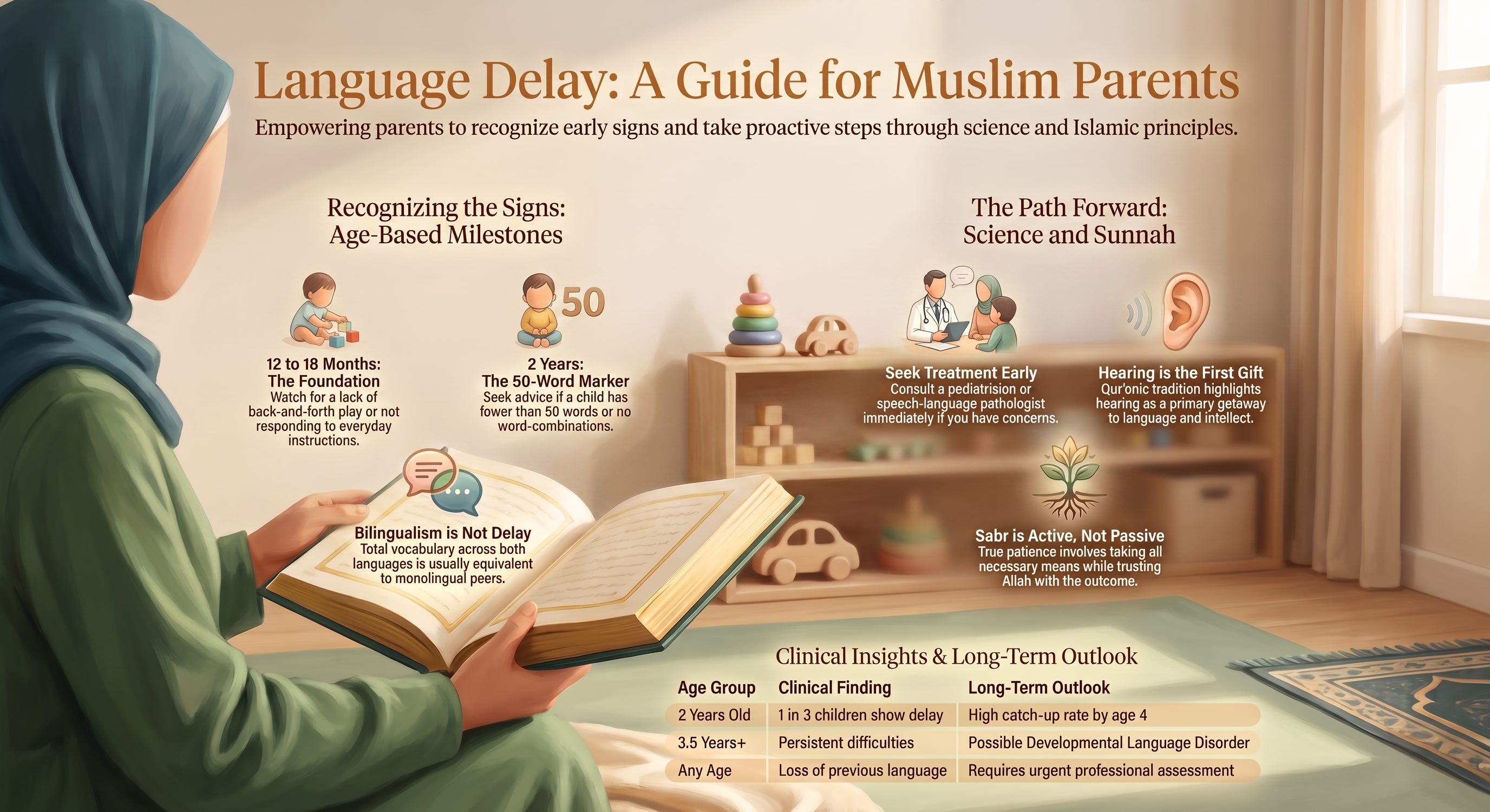
Around 1 in 3 two-year-olds shows signs of language delay and a 2007 study in Pediatrics found that most of these children catch up to their peers entirely by age four. [1] This guide shows you exactly which signs matter, when to act, and why the Prophetic tradition agrees with the science on seeking help early.
You’re sitting on the floor. You’re holding a ball. You say its name, warmly, for what feels like the hundredth time.
And you wait.
That wait — the one where you’re not sure if what you’re feeling is patience or worry — is where a lot of Muslim parents live when they’re navigating language delay. I want you to know something before you read another word: you are not imagining it. And you are not failing.
But there’s something important I need to share with you.
When I looked at the research — specifically a community study tracking over 1,800 children published in Pediatrics — I found that approximately 1 in 3 two-year-olds shows signs of language delay. [1] One in three. That means this is likely happening in your masjid circle, your mother’s group, your family. And yet so many parents sit on their worry quietly, unsure whether to raise it or wait it out.
Here’s what changed my thinking: the science is clear that earlier support produces better outcomes. [2] Not because late talkers can’t catch up — many do — but because the ones who need help benefit most from getting it as soon as possible.
Why This Guide Is Different From Generic Speech Advice
Every sign and milestone here comes from peer-reviewed paediatric research — not parenting forums or well-meaning aunts. [1, 2, 3]
This isn’t just a checklist. It weaves what the science says with what Islamic tradition teaches about seeking help, taking means, and trusting Allah with the outcome.
You’ll leave with a free Language Delay Action Pack — a printable three-page guide with a milestone checklist, a professional pathway card, and an Islamic tarbiyah card — so you’re not left just with information, but with tools you’ll actually use.
What Language Delay Actually Is (and What It Isn’t)
Language delay is when a child is taking significantly longer than expected to understand or use spoken language for their age. [1] It is not a reflection of intelligence. It is not a sign of parenting failure. And it is not the same as a speech disorder, which is about how clearly a child pronounces sounds.
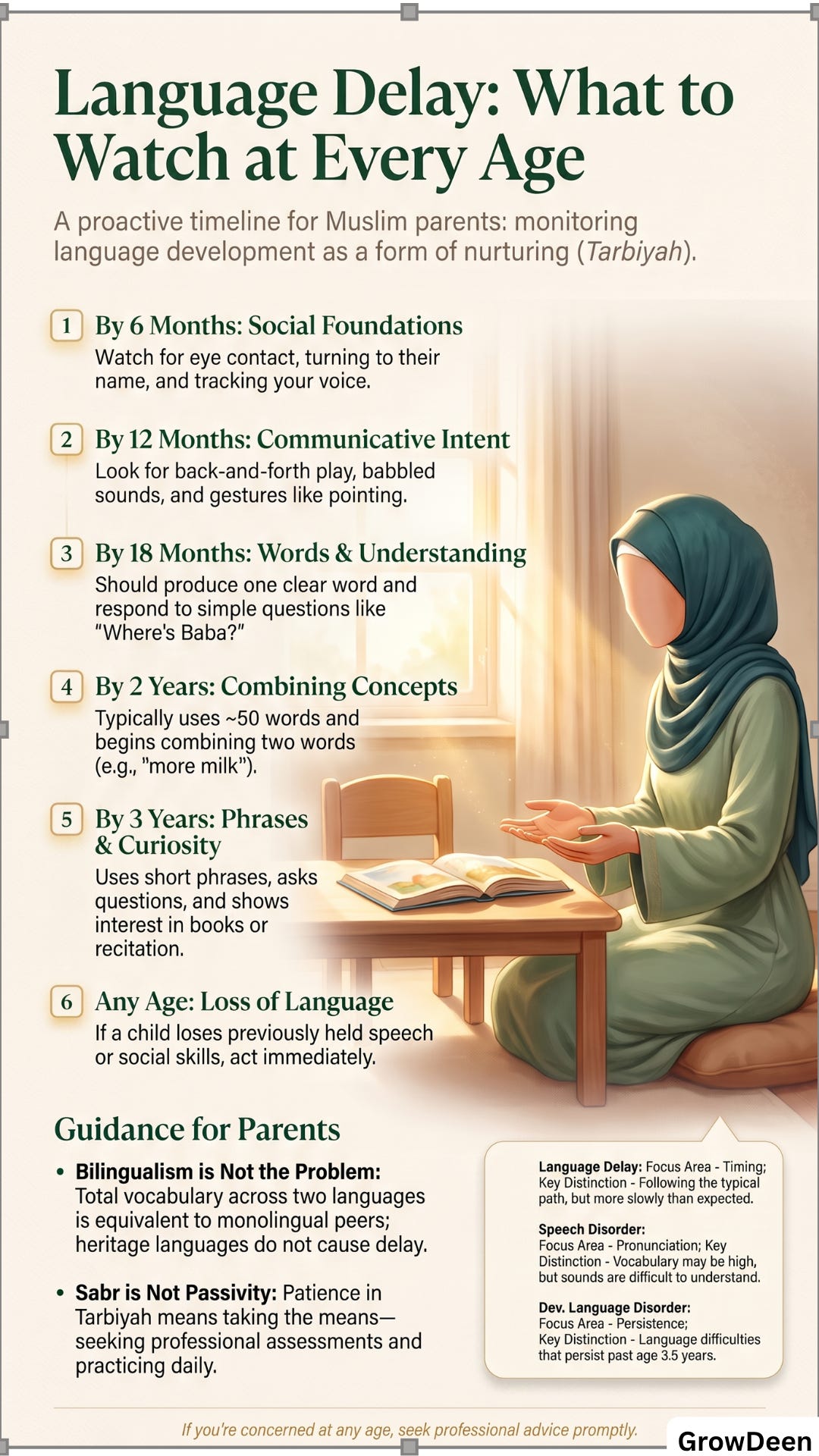
There’s also a third term worth knowing: developmental language disorder. This is diagnosed when language difficulties persist past age three and a half and affect daily life. [2] Many children with language delay do not reach this point — but knowing the distinction helps you have better conversations with professionals.
Here’s what surprised me when I first read the research properly. Most two-year-olds who are considered late talkers do catch up independently by age four. [1] But — and this is important — “most” is not “all.” And the ones who need support benefit enormously from getting it early, while the brain’s language networks are at their most responsive.
The Signs of Language Delay by Age
Children develop language at different rates. But the clinical markers below are the points at which the research says most children have reached a particular stage. If your child is consistently behind, it’s time to seek advice. [1, 3]
By 6 months: Not making eye contact, not turning toward their name, not tracking objects when you mention them. These early social responses are the foundation of language — not just nice-to-have behaviours.
By 12 months: Not engaging in back-and-forth play, not using sounds or gestures to communicate, not signalling wants or needs in any way. A reach, a point, a babble directed at you — these count. Their absence matters.
By 18 months: Not responding to everyday instructions or questions. Not yet producing a single word. If hearing hasn’t been checked and you’re here: check it now. Undetected hearing loss is one of the most common — and most treatable — underlying causes of language delay. [3]
By 2 years: Not having around 50 words. Not combining any two words together. Only repeating what you say rather than generating their own language.
Around 3 years: Not combining words into short phrases or sentences. Not yet asking questions. Showing little interest in stories or Qur’an recitation as shared listening.
From 4 to 5 years and beyond: If difficulties persist without another clear explanation, a developmental language disorder becomes more likely. These children may consistently use short sentences, confuse tenses, or struggle to follow the thread of a story. [2]
At any age: If your child loses language they previously had. This is always urgent.
I know this is a lot to hold — milestones at every age, signs to watch, professionals to consider. That’s exactly why I’ve created the Language Delay Action Pack — a free three-page printable guide with a milestone checklist you can fill in yourself, a professional pathway map so you know who to see first, and an Islamic tarbiyah card for the days when this journey tests your heart. Keep reading to download it at the end of this article.
The Islamic Frame: Hearing Is the First Gift
When I reflect on the verse in Surah Al-Mu’minun — “And it is He Who created for you hearing, sight, and intellect — yet how little you are grateful” [Qur’an 23:78] — I notice that hearing comes first. [7]
Not accidentally. Tafsir Ibn Kathir notes that Allah gives hearing to recognise voices, and that these faculties develop gradually in the human being. Hearing is the gateway to language. A child learns language through the ear long before any word is formed. When that pathway needs support, responding to that need — through professional assessment, through therapy, through patient daily practice — is itself an act of shukr. It says: this gift matters, and I will do what I can to protect it.
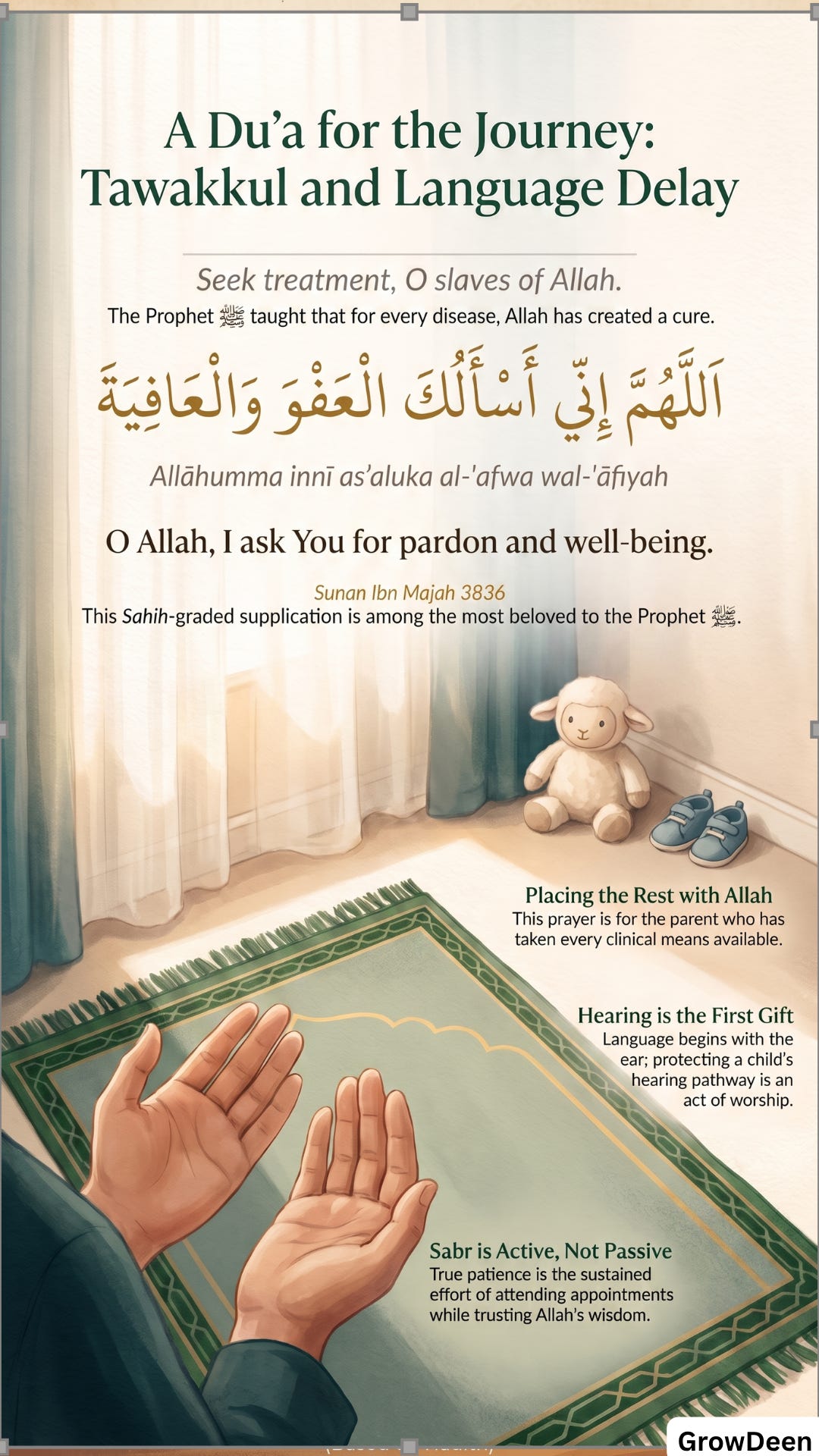
The Prophet ﷺ made the principle explicit. When the Bedouins asked him whether they should seek treatment, he said: “Seek treatment, O slaves of Allah — for Allah does not create any disease but He also creates with it the cure, except for old age.” [Sunan Ibn Majah 3436 — Sahih] [8]
Seeking the appointment. Attending the sessions. Coming home and practising every day. This is tawakkul — not the kind that waits, but the kind that acts fully and then places the outcome in Allah’s hands.
Support Muslim Parenting Lab ❤️
Would you rather give a small amount that never stops than a large one you keep postponing? Set $5 a month with the button below, in a few seconds.
The Prophet ﷺ said the deed most beloved to Allah is the most constant, even if little. (Sahih al-Bukhari 6464)
For Bilingual Muslim Families: You Are Not the Problem
Here’s one of the most important “aha moments” in the research — especially for our community.
Children raised in bilingual homes may appear to have smaller vocabularies in each language compared to monolingual peers. But their total vocabulary across both languages is equivalent. [4] They may reach milestones slightly later in each language. This is not delay. This is normal multilingual development.
By school age, bilingual children read and write in English at the same level as their peers. [1] The cognitive richness of managing two languages is an advantage, not a liability. Speaking your heritage language at home, reading in it, filling the home with Qur’anic Arabic — none of this is harming your child. The science and the tradition agree.
The caveat: if a bilingual child shows language difficulties, those difficulties should appear in both languages, not just one. [4] That’s when professional assessment is needed.
Where to Find Help
If you’re concerned, the path forward is not to wait. It is to seek.
A speech pathologist (also called a speech-language therapist) is the most direct starting point for language concerns. An audiologist should be seen early if there is any doubt about hearing. Your paediatrician can refer, coordinate, and conduct initial assessment.
When you see the professional, be specific. Describe what you observe. Note which milestones your child has and hasn’t reached. Mention your family’s language environment. And if the first professional isn’t concerned but you still are — a second opinion is always appropriate.
Micro-action: Before you keep scrolling, do this one thing. Pull up your contacts app and find your paediatrician’s number. If you’ve been sitting on a worry about your child’s language, make the call today — not next week. I’ll wait.
Sabr Is Not Passivity
One more thing I want to say to the parents who are already in the middle of this journey.
Sabr — patience — is frequently offered as comfort. And it is comfort. But sabr in the Islamic tradition is not the same as passivity. It is the sustained practice of continuing to do what is right and necessary, while trusting in Allah’s wisdom about the outcome.
Attending every appointment. Practising at home when the days are exhausting. Celebrating every single word that emerges — however small, however late. That is sabr. Not folded hands. Active, enduring love.
The Language Delay Action Pack — Your Free Download
If you’ve read this far, you’re the kind of parent who takes your child’s development seriously — not out of anxiety, but out of love. That tells me something beautiful about you.
Inside the Language Delay Action Pack (one comprehensive PDF, 3 pages):
Page 1: Language Milestone Checklist — A clear, age-by-age reference card covering milestones from 6 months to 5 years, with a “next step” column so you know exactly what to do at each stage. Designed to be printed and kept where you’ll actually refer to it — tucked in your child’s health folder or on the fridge.
Page 2: Professional Pathway Map — A simple visual guide to which professional to see first, second, and when, depending on your child’s specific pattern of difficulty. Includes a preparation checklist so your appointment is as productive as possible.
Page 3: The Parent’s Tarbiyah Card — an Islamic du’a for seeking Allah’s ease and well-being during difficulty, with Arabic text, transliteration, and English meaning — paired with a short reflection on what tawakkul and sabr look like for a parent on this journey.
This isn’t just a PDF to download and forget. It’s a companion for the appointments, the waiting rooms, and the quiet evenings when you need a reminder that what you’re doing matters.
Muslim Parenting Lab covers the full journey of raising children in a Western Muslim family — from communication and development to behaviour, sleep, nutrition, and Islamic tarbiyah — all backed by peer-reviewed research and grounded in the Qur’an and Sunnah.
One Last Thing
Think of one person right now: a mother in your circle whose child is noticeably quieter than their peers, but who hasn’t said anything about it yet. A sister whose toddler has a few words and she keeps saying “he’ll get there.” A friend who is asking in WhatsApp groups instead of making an appointment because she’s not sure it’s serious enough.
This article could help them get there sooner. Share it with them today — not as a hint, but as care.
Frequently Asked Questions
Q: At what age should I be worried if my child isn’t talking?
A: Most children have their first single words by around 12–16 months. If your child has no words by 18 months, no two-word combinations by 24 months, or has lost language they previously had at any age — speak to a paediatrician promptly. [1] For the full age-by-age breakdown, see “The Signs of Language Delay by Age” above.
Q: Is it normal for bilingual children to talk later?
A: It’s common for bilingual children to reach milestones slightly later in each individual language — but their total vocabulary across both languages is equivalent to monolingual peers. [4] This is not language delay. If difficulties appear in both languages, however, professional assessment is worth seeking.
Q: My child understands everything but won’t speak — is that still a delay?
A: Yes, it can be. Language delay can affect comprehension (understanding) or production (speaking), or both. A child who understands age-appropriately but has very few words still benefits from professional assessment, as the gap between comprehension and expression is clinically meaningful. [1]
Q: Does speaking a heritage language at home cause language delay?
A: No. Research consistently shows that bilingual children catch up fully in both languages and that maintaining a heritage language at home does not harm English development. [4] The science here is reassuring: your child’s brain is not confused by two languages — it is enriched by them.
Q: What is the difference between language delay and a speech disorder?
A: Language delay is about the timing of language development — a child following the typical developmental path but more slowly. A speech disorder is about pronunciation — a child whose vocabulary and sentence structure may be age-appropriate but whose speech is difficult to understand. The two can occur together, but they are different things. [1, 2]
Q: Will my child just grow out of it without help?
A: Many late talkers — particularly those assessed at age two — do catch up independently by age four. [1] But waiting without seeking professional input means missing the chance to identify the children who genuinely need support during the window when help is most effective. Seeking an assessment is not overreacting. It is responsible tarbiyah.
References
[1] Reilly, S., Wake, M., Bavin, E. L., Prior, M., Williams, J., Bretherton, L., Eadie, P., Barrett, Y., & Ukoumunne, O. C. (2007). Predicting language at age 2 years: A prospective community study. Pediatrics, 120(6), e1441–e1449. https://doi.org/10.1542/peds.2007-0045
[2] Bishop, D. V. M., Snowling, M. J., Thompson, P. A., Greenhalgh, T., & CATALISE-2 consortium. (2017). Phase 2 of CATALISE: A multinational and multidisciplinary Delphi consensus study of problems with language development: Terminology. The Journal of Child Psychology and Psychiatry, 58(10), 1068–1080. https://doi.org/10.1111/jcpp.12721
[3] Zubler, J. M., Wiggins, L. D., Macias, M. M., Whitaker, T. M., Shaw, J. S., Squires, J. K., Pajek, J. A., Wolf, R. B., Slaughter, K. S., Broughton, A. S., Gerndt, K. L., Mlodoch, B. J., & Lipkin, P. H. (2022). Evidence-informed milestones for developmental surveillance tools. Pediatrics, 149(3), Article e2021052138. https://doi.org/10.1542/peds.2021-052138
[4] Levickis, P., Reilly, S., Girolametto, L., Ukoumunne, O. C., & Wake, M. (2014). Maternal behaviors promoting language acquisition in slow-to-talk toddlers: Prospective community-based study. Journal of Developmental & Behavioral Pediatrics, 35(4), 274–281. https://doi.org/10.1097/DBP.0000000000000056
[5] Lipkin, P. H., & Macias, M. (2020). Promoting optimal development: Identifying infants and young children with developmental disorders through developmental surveillance and screening. Pediatrics, 145(1), Article e20193449. https://doi.org/10.1542/peds.2019-3449
[6] Bishop, D. V. M., Snowling, M. J., Thompson, P. A., & Greenhalgh, T. (2016). CATALISE: A multinational and multidisciplinary Delphi consensus study. Identifying language impairments in children. PLOS ONE, 11(12), Article e0168066. https://doi.org/10.1371/journal.pone.0168066
[7] Qur’an 23:78. https://quran.com/23/78 — with reference to Tafsir Ibn Kathir, noting that Allah gives hearing to recognise voices and that these faculties develop gradually in the human being.
[8] Sunan Ibn Majah 3436. Graded: Sahih (Darussalam). https://sunnah.com/ibnmajah:3436