


Reported rates of sleep bruxism in children run from 3.5% to 40.6%. [1] Children who snore have close to three times the odds of grinding. [2]
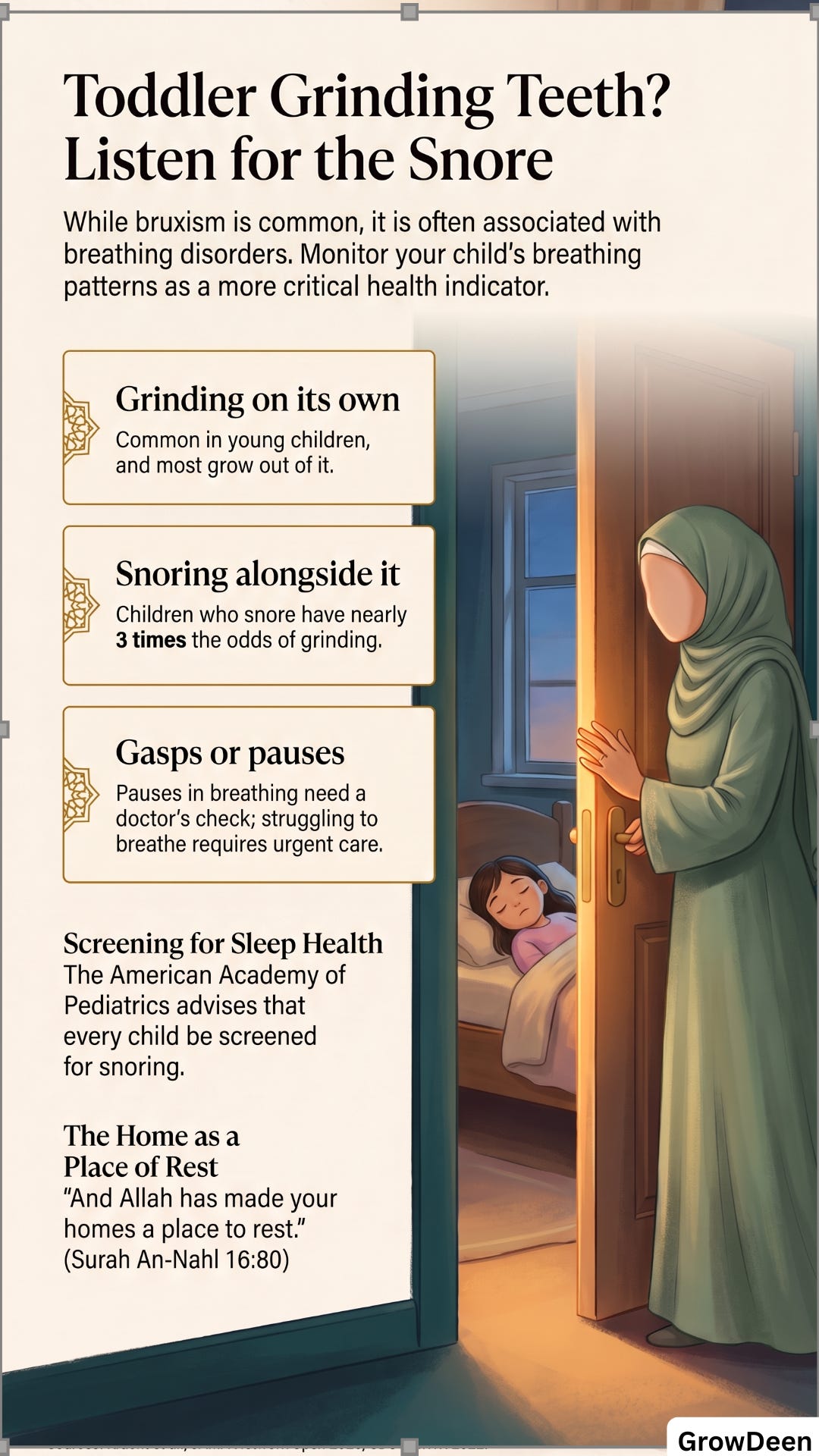
Printable. For the next 11pm door decision.
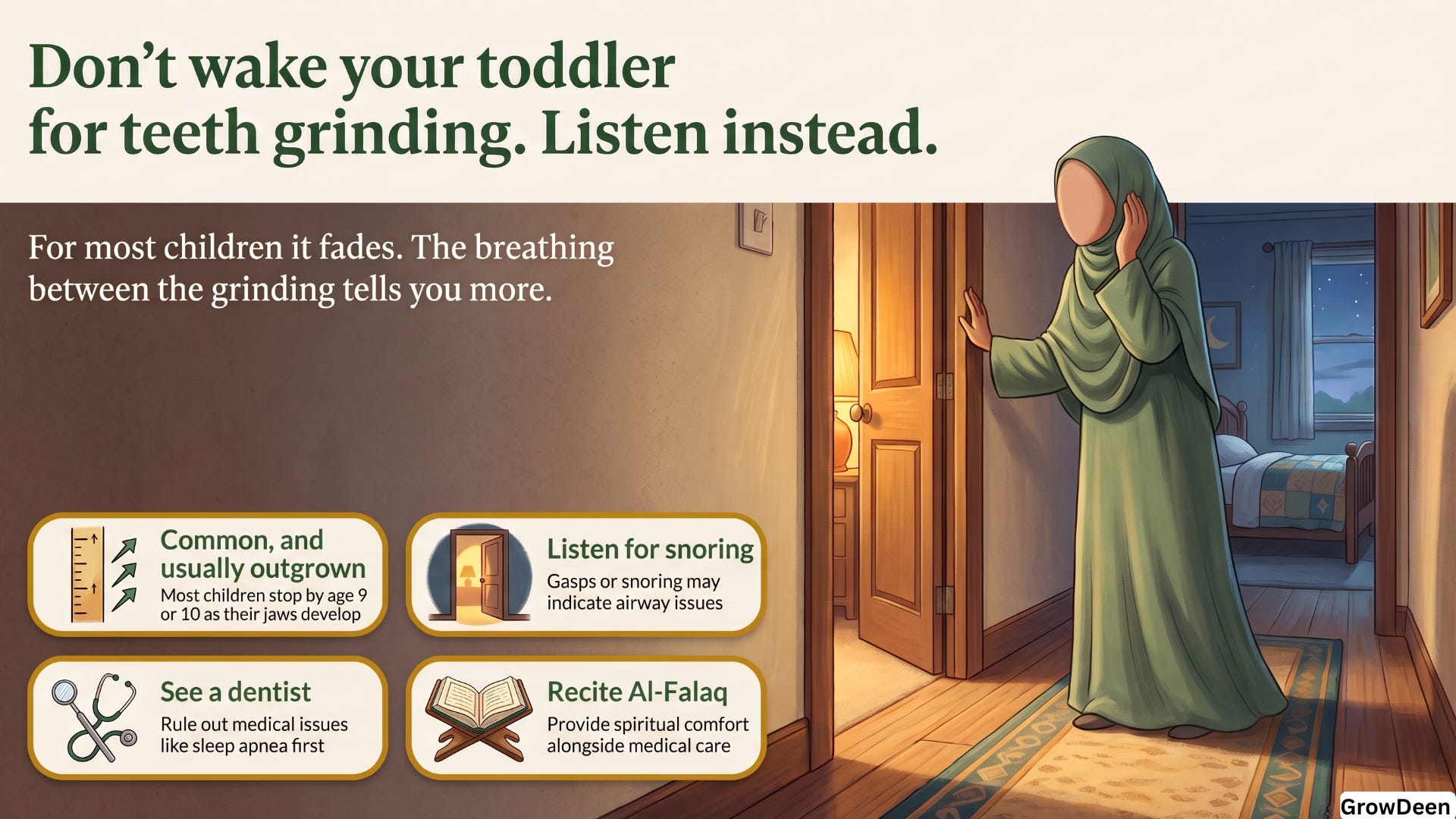
The scraping starts a little after eleven.
You hear it from the landing, a dry, rhythmic grinding, like a pestle working grain against stone. Your first thought is pain. Your second is damage. You push the door open ready to comfort a crying child and find a small face completely at peace, while the jaw below it keeps working as if nothing in the world is wrong.
So you stand there, one hand still on the door, wondering whether to wake them and whether you missed something. Maybe it is the new baby, or the house move. Every one of those worries is a loving one, and very few of them point at the thing that matters most.
Listen again, more carefully this time. Somewhere between the bursts of grinding there may be a soft snore, or a pause that lasts a beat too long before the next breath. A meta-analysis pooling 14 studies of children up to age 12 found that snoring came with 2.86 times the odds of grinding and that short sleep came with 2.56 times the odds. [2] Which raises a question worth carrying through everything that follows: why would a dentist, asked about teeth, want to know whether your child snores?
Why this guide is different
It draws on the 2024 consensus recommendations of the International Association of Paediatric Dentistry and the American Academy of Pediatrics’ sleep guidance, checked against peer-reviewed studies published between 2013 and 2021. [3, 4, 5]
It pairs the medical picture with the Qur’an’s words on the home as a place of rest and with the Sunnah of reciting over a child in discomfort. [6, 7]
You already have the free Bedroom Door Pack from the top of this page — three printable pages built for the nights you are standing in the doorway, starting with a card that sorts every sign by who to call.
Is it normal for a child to grind their teeth in their sleep?
Most parents who ask this have already done the obvious test. They listened at the door, went back to bed, and lay awake wondering whether they heard right. Your ears are a less reliable instrument than you would hope, and that is not your fault.
In a small study of 7 to 11 year olds, overnight recordings found grinding in almost a third of the children, yet what the parents reported did not match what the equipment picked up. [8] The authors concluded that parent report alone cannot reliably detect it. [8] The wide range in the review above, 3.5% to 40.6%, largely reflects how hard grinding is to measure. [1, 9] When examiners in Brazil checked 862 five-year-olds for tooth wear and asked parents about grinding, 36% showed signs of probable grinding. [5]
Clinicians grade their certainty the way you might. A report of grinding sounds makes bruxism “possible.” Visible signs such as worn teeth or tired, tender jaw muscles make it “probable,” and only an overnight sleep study, which is expensive and needs trained specialists, makes it definite. [9] The grinding itself may happen asleep (sleep bruxism) or during the day as clenching (awake bruxism). [9]
For children between roughly three and five, the teeth tell a gentler story than parents expect. Baby teeth are less mineralised than adult teeth, so they wear more easily, and some wear on the chewing surfaces at this age is thought to be a normal part of how the jaws grow. [9] Grinding becomes less common with age, with no real difference between boys and girls, and reviews describe a drop from around nine or ten years, with most children not expected to carry it into adolescence. [1, 4, 9]
So there is no need to wake a grinding child. Let them sleep. Sleep is the thing to protect, and interrupting it helps nobody. [10]
What should you listen for between the scrapes?
Picture the same doorway on a different night. The grinding comes and goes, and in the quiet between bursts you catch it: a snore with a rattle in it, and then a small gasp as breathing starts again after a stretch of nothing. That second sound is the one to write down.
The breathing tells you more than the grinding.
The 14-study meta-analysis linked grinding with snoring, mouth breathing, restless sleep, drooling, sleeping on the stomach and too little sleep. [2] In the Brazilian preschool study, children with breathing problems had a higher prevalence of probable grinding. [5] A study of nearly 500 preschoolers reported an association between grinding and obstructive sleep apnoea, a condition in which the airway repeatedly narrows or closes during sleep. [11] These studies describe associations rather than proof of cause. Even so, together they explain part of that dentist’s question from the doorway.
The American Academy of Pediatrics recommends that all children be screened for snoring, and its guideline notes that untreated obstructive sleep apnoea has been associated with learning and behavioural difficulties. [3] For children diagnosed with sleep apnoea, the same guideline recommends adenotonsillectomy, the removal of the tonsils and adenoids, as the first-line treatment. [3] A child who grinds and also snores most nights or gasps and pauses in sleep needs a doctor’s assessment, and a child who struggles to breathe or whose lips turn blue needs urgent care that same night.
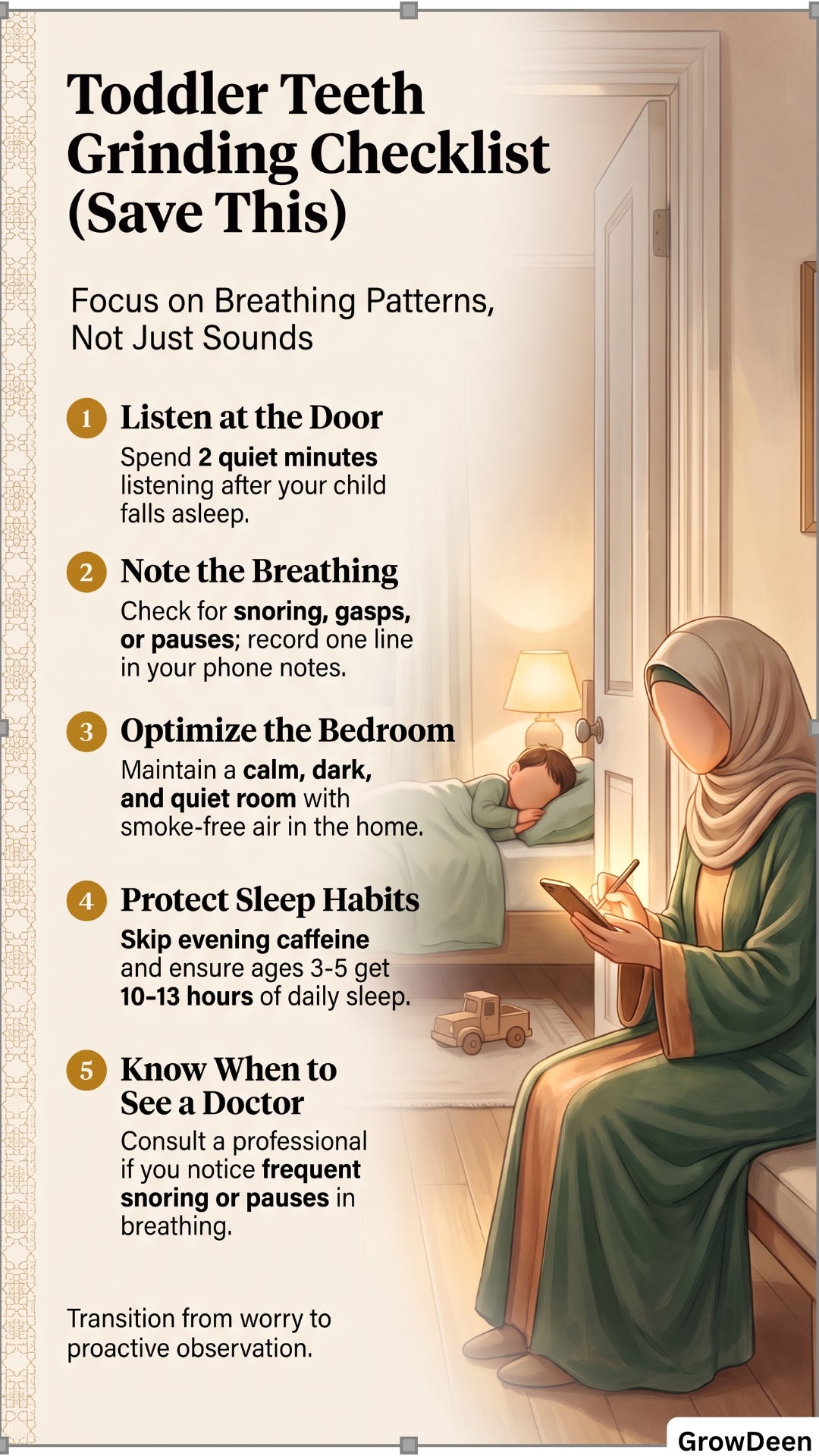
Tonight, before you go to bed yourself, stand at the door for two quiet minutes and listen for the breathing. Then do it again tomorrow. The morning brings a second set of clues, and some of them arrive at the breakfast table.
What does the morning tell you?
Breakfast, and your child is rubbing one side of their jaw. Or they push the plate away and say their tummy hurts, the same complaint as yesterday. It is easy to file these as ordinary grumbles.
In the overnight recording study, children who ground their teeth reported more muscle aches and more stomach aches across a week of daily diaries, and they spent more time awake after first falling asleep. [8] Clinicians also look for morning jaw-muscle pain, headaches, facial pain, clicking, and difficulty opening the mouth wide. [4, 9] Taken one at a time they are small things, and each is worth a note on the fridge and a mention at the next appointment.
The Sunnah also gives a parent something to do with their hands when a child hurts, and it comes a little further on.
Keeping all of this in your head at eleven at night is a lot to ask. That is why this article comes with The Bedroom Door Pack, a free three-page printable whose first page sorts each sign by whether it can wait or needs a professional. The download button is at the top of this page, and there’s a full description of what’s inside it below.
Why does grinding run in some families, and what at home can change?
Somewhere in this reading, a quieter worry may have surfaced. Could this have been passed down? Is it something about the house?
Allah speaks about the place where all of this happens. “And Allah has made your homes a place to rest,” says Surah An-Nahl. [6] Tafsir Ibn Kathir explains that Allah is mentioning His great blessings in giving His servants homes to dwell in and protect themselves with, homes in which they find all kinds of benefit. [6] Tafsir Ma’ariful Qur’an adds that the real purpose of a house is comfort for the body and peace for the heart, and that the people one meets inside a house can drain that peace away. [12]
The Brazilian study found that children whose parents or guardians reported possible grinding themselves had a noticeably higher prevalence, and being an only child was also associated with it. [5] That is information, and it carries no blame. A systematic review of risk factors found a strong association between second-hand smoke and sleep bruxism in children, alongside disturbed sleep. [13] One study summarised in a 2021 review linked noise and light in the bedroom, and sleeping eight hours or less, with grinding. [9]
The research on what to change is modest and honest about its limits. Standard sleep hygiene starts with a quiet, well-ventilated bedroom and a relaxing wind-down before bed. [9] It also means keeping caffeine out of the evening. [9] A small randomised trial with 16 participants, though, found that sleep hygiene and relaxation made no difference to grinding itself. [9] Enough sleep still matters for children’s health, and short sleep is one of the factors tied to grinding, so the routine earns its place for other reasons too. [2, 10]
What that looks like this week:
Keep the bedroom dark and quiet after lights out. [9]
Keep the house and the car completely smoke-free. [13]
Move tea, cola and other caffeinated drinks well away from the evening. [9]
Aim for 11 to 14 hours of sleep in 24 hours for ages one to two, 10 to 13 hours for three to five, and 9 to 12 hours for six to twelve, naps included for the younger groups. [10]
Place babies under one on their back for every sleep, by every caregiver, on a firm, flat surface. [14]
Is stress to blame when a young child grinds their teeth?
Many parents quietly carry this one. The grinding started around the time a sibling arrived, or the family moved, and it feels like evidence that the child is anxious and that home is somehow at fault.
Age changes the answer. The International Association of Paediatric Dentistry found no evidence supporting a link between sleep grinding and psychosocial factors in children younger than five, while a significant association appears between six and 11 years and in adolescence. [4] In the overnight recording study, grinding was no more common in children with generalised anxiety disorder than in those without, and the authors suggested that sensitivity to stress may matter more than anxiety itself. [8] A grinding two-year-old, then, is not a sign of a secretly worried child.
A few other threads are worth knowing. Daytime habits such as biting lips or nails have been discussed as contributors, and reviews suggest clinicians try to reduce them. [9] Grinding, especially during the day, may be more common in children with ADHD, autism, cerebral palsy or Down syndrome, and because reflux has been linked with it, dentists are advised to ask about reflux when they assess tooth wear. [4] The long-repeated idea that crooked teeth cause grinding has not held up well: the IAPD reports that bruxism was not associated with any of the malocclusions evaluated. [4]
Whatever the age, teasing or scolding a child about clenching changes nothing about the jaw and can sour the mood at home. Ma’ariful Qur’an’s warning that the people inside a house can drain its peace away applies to sharp comments about a habit as much as to anything else. [12]
A relative says it is nazar. What does Islamic guidance say?
Sometimes the worry arrives from outside. An aunt hears the grinding during a visit and says, kindly and firmly, that it must be the evil eye, or jinn.
Scholars have been asked this directly. A father wrote to Askimam.org about his son, six and a half, who ground his teeth and slept poorly, after being told the boy might be affected by jinn or magic. The answer, checked and approved by Mufti Ebrahim Desai, affirmed that the effects of jinn and magic are proven in the ahadith, called it incorrect to assume every problem comes from jinn, magic or nazar, and advised the parents to consult the boy’s physician for a diagnosis. [15]
IslamQA, when listing signs that practitioners of ruqyah associate with the evil eye, notes that these signs are not definitive, and the list it quotes from Shaykh ‘Abd al-’Aziz al-Sadhan opens with the condition “if it is not a real sickness.” [16] So book the doctor or dentist first. Ruqyah can sit alongside that appointment, and the next section shows the Sunnah way to do it for a child.
What the Qur’an and Sunnah offer a parent at a grinding child’s bedside
Standing over a child who is grinding, or sitting beside one who says their jaw aches, a parent wants two things at once: to do something useful, and to hand the rest to Allah.
The Qur’an answers the first part through the home itself. “And Allah has made your homes a place to rest.” [6] According to Tafsir Ibn Kathir, this verse counts homes among Allah’s great blessings, places to dwell in and be protected. [6] The dark room and the gentle word at bedtime become ways of honouring that blessing.
The Sunnah answers the second. ‘Aishah reported that during his final illness the Prophet ﷺ recited Surah Al-Falaq and Surah An-Nas and blew over himself, and when the illness grew heavy she recited them, blew over him, and wiped his body with his own hand for its blessing. [7] IslamQA states that when performing ruqyah for children it is mustahabb to recite these two surahs over them and wipe their bodies, or to recite into one’s hands, blow lightly, and wipe over whatever of the body one can reach. [17]
In practice, the appointment for the breathing gets booked, and while you wait for it, Surah Al-Falaq and Surah An-Nas can be recited softly over a sore jaw.
What happens at the dentist’s or doctor’s appointment?
The appointment is where that question from the doorway finally gets its full answer. Breathing disorders are among the suggested risk factors for bruxism, so the IAPD’s recommended assessment includes more than teeth: a history of the complaint and the child’s health, an examination of the jaw muscles and joints and how wide the mouth opens, a close look at the teeth for wear or fractures, and, where needed, an assessment of the upper airway using radiographs after consultation with an ear, nose and throat specialist. [4] The dentist asks about snoring because the answer can change who your child needs to see next.
Management depends on the individual child. The IAPD lists options that may include an occlusal splint, rapid palatal expansion, cognitive behavioural therapy, a proprioceptive approach, or no active treatment at all, and it states there is not enough evidence to support medication for sleep bruxism in children and adolescents. [4] Over-the-counter night guards are a poor shortcut: no specific appliance strategy has been established for children, and appliances could interfere with the growth of the jaw bone. [9] A family dentist who is unsure may refer your child to a paediatric dentist. [4]
Book the dentist if you notice chipped or fractured teeth, sensitivity, wear that seems more than expected (particularly on permanent teeth), jaw pain, clicking, or trouble opening the mouth wide. [4, 9] Book the doctor for snoring on most nights, gasps or pauses in breathing, mouth breathing, daytime behaviour or learning concerns, frequent aches, or a history of reflux. [2, 3, 4, 8] Most children grow out of grinding, and the breathing tells you more than the grinding. [1, 9]
The Bedroom Door Pack
If you have read this far, you are the kind of parent who stands at a bedroom door at eleven at night and wants to understand what you are hearing, instead of just wishing it would stop. That kind of attention is a form of care.
Inside The Bedroom Door Pack (one comprehensive PDF, 3 pages):
Page 1: Doctor, Dentist, or Wait and Watch? The Sorting Card, every sign from this article sorted into the right column, with a clearly marked strip for the signs that need urgent care tonight, designed as a card you can keep on the inside of the bedroom door or on the fridge.
Page 2: The Quiet Room Walk-Through, a tick-box tour of the bedroom, the air, the evening drinks and the sleep hours for your child’s age, with a three-night listening grid for snoring and breathing pauses, so you can finish the whole check in about fifteen minutes and bring the grid to your appointment.
Page 3: Rest, Recitation and a Doctor’s Check, two English reflection cards on Surah An-Nahl 16:80 and ‘Aishah’s recitation of Surah Al-Falaq and Surah An-Nas in Sahih al-Bukhari 5735, plus a short note on scholarly guidance about nazar and medical care, so the page can sit beside your child’s bed for the nights when you want both the means and the du’a in reach.
The pack is built to stay on the bedroom door, where the listening happens.
The Bedroom Door Pack is what every subscriber receives with articles like this one. Muslim Parenting Lab by GrowDeen Education covers newborn sleep and feeding, toddler behaviour and speech, children’s health, and the Sunnah practices that fit each stage, always backed by research and rooted in the Qur’an and Sunnah.
If you want that kind of guidance arriving before you need it, subscribe for free.
Subscribe free for parenting resources backed by both science and Sunnah, guidance you will not find packaged this way anywhere else, with no spam and no clutter, only the resources that matter.
Your five-minute step: open the notes app on your phone and create a note called “Night sounds.” Tonight, after two minutes at the bedroom door, type one line: whether you heard grinding, and whether you heard snoring or pauses between breaths. That is the whole task.
May Allah make every home in your care a place of rest, and grant your children ease in their sleep and health in their bodies.
Share this with the parent who texted you at midnight
Think of one person right now: the cousin who sent a voice note at midnight saying her daughter “sounds like she’s chewing gravel” in her sleep, or the friend at the masjid whose mother-in-law keeps saying the boy has nazar. This article could spare them a week of worry and point them toward the one sound worth listening for. Send it to them today, gently, as the kind of help you would want.
Frequently asked questions
Q: At what age do children stop grinding their teeth?
A: Grinding becomes less common as children grow, with reviews describing a drop from around nine or ten, and most children are not expected to carry it into adolescence. [9] For the full picture, see “Is it normal for a child to grind their teeth in their sleep?” above.
Q: Does teeth grinding damage baby teeth?
A: Some wear on baby teeth between about three and five years is thought to be a normal part of jaw growth, because primary teeth are less mineralised. [9] Ask your dentist to check whether the wear looks typical, and keep a closer eye once permanent teeth arrive. [9]
Q: Can snoring and teeth grinding be connected?
A: Yes. A meta-analysis of 14 studies found that snoring came with 2.86 times the odds of grinding in children, and the American Academy of Pediatrics advises that every child be screened for snoring. [2, 3] See “What should you listen for between the scrapes?” above.
Q: Does a child who grinds their teeth need a night guard?
A: Not automatically. The IAPD recommends deciding case by case, which can include a splint or no treatment at all, and no specific appliance strategy has been established for children, so any guard should come through a dentist. [4, 9]
Q: Is teeth grinding in young children caused by anxiety?
A: For children under five, the IAPD found no evidence linking sleep grinding with psychosocial factors, although a link does appear from about six years onward. [4] See “Is stress to blame when a young child grinds their teeth?” above.
Q: Is it permissible to do ruqyah for a child who grinds their teeth?
A: IslamQA states it is mustahabb, when performing ruqyah for children, to recite Surah Al-Falaq and Surah An-Nas over them and wipe their bodies. [17] Scholars also caution against assuming grinding comes from jinn or nazar, and advise a medical check first. [15, 16]
This article shares general information and does not replace medical advice. Follow your doctor’s or dentist’s guidance for your own child.
References
[1] Manfredini, D., Restrepo, C., Diaz-Serrano, K., Winocur, E., & Lobbezoo, F. (2013). Prevalence of sleep bruxism in children: A systematic review of the literature. Journal of Oral Rehabilitation, 40(8), 631-642. https://doi.org/10.1111/joor.12069
[2] Guo, H., Wang, T., Li, X., Ma, Q., Niu, X., & Qiu, J. (2017). What sleep behaviors are associated with bruxism in children? A systematic review and meta-analysis. Sleep and Breathing, 21(4), 1013-1023. https://doi.org/10.1007/s11325-017-1496-3
[3] Marcus, C. L., Brooks, L. J., Draper, K. A., Gozal, D., Halbower, A. C., Jones, J., et al. (2012). Diagnosis and management of childhood obstructive sleep apnea syndrome (American Academy of Pediatrics clinical practice guideline). Pediatrics, 130(3), 576-584. https://publications.aap.org/pediatrics/article/130/3/576/30284/Diagnosis-and-Management-of-Childhood-Obstructive
[4] International Association of Paediatric Dentistry. (2024). IAPD foundational articles and consensus recommendations: Bruxism. https://iapdworld.org/wp-content/uploads/2025/05/IAPD-Foundational-Articles-and-Consensus-Recommendations_-Bruxism-2024.-http_www.iapdworld.org_2024_02_bruxism.pdf
[5] Ramos, P. F. C., de Lima, M. D. M., de Moura, M. S., Bendo, C. B., Moura, L. F. A. D., & Lima, C. C. B. (2021). Breathing problems, being an only child and having parents with possible sleep bruxism are associated with probable sleep bruxism in preschoolers: A population-based study. Sleep and Breathing, 25(3), 1677-1684. https://doi.org/10.1007/s11325-020-02281-0
[6] Quran, Surah An-Nahl 16:80 (The Clear Quran translation): https://quran.com/16/80. Ibn Kathir, Tafsir Ibn Kathir, commentary on Surah An-Nahl 16:80: https://www.alim.org/quran/tafsir/ibn-kathir/surah/16/80/
[7] Sahih al-Bukhari 5735, Book of Medicine, Chapter: Ar-Ruqa with the Qur’an and the Mu’awwidhat, narrated by ‘Aishah. Graded: Sahih. https://sunnah.com/bukhari:5735
[8] Alfano, C. A., Bower, J. L., & Meers, J. M. (2018). Polysomnography-detected bruxism in children is associated with somatic complaints but not anxiety. Journal of Clinical Sleep Medicine, 14(1), 23-29. https://doi.org/10.5664/jcsm.6872
[9] Bulanda, S., Ilczuk-Rypuła, D., Nitecka-Buchta, A., Nowak, Z., Baron, S., & Postek-Stefańska, L. (2021). Sleep bruxism in children: Etiology, diagnosis, and treatment. A literature review. International Journal of Environmental Research and Public Health, 18(18), Article 9544. https://doi.org/10.3390/ijerph18189544
[10] Paruthi, S., Brooks, L. J., D’Ambrosio, C., Hall, W. A., Kotagal, S., Lloyd, R. M., et al. (2016). Recommended amount of sleep for pediatric populations: A consensus statement of the American Academy of Sleep Medicine. Journal of Clinical Sleep Medicine, 12(6), 785-786. https://doi.org/10.5664/jcsm.5866
[11] Ferreira, N. M. R., Dos Santos, J. F. F., Dos Santos, M. B. F., & Marchini, L. (2015). Sleep bruxism associated with obstructive sleep apnea syndrome in children. Cranio, 33(4), 251-255. https://doi.org/10.1179/2151090314Y.0000000025
[12] Shafi’, M. Ma’ariful Qur’an, commentary on Surah An-Nahl 16:80: https://quran.com/an-nahl/80/tafsirs/en-tafsir-maarif-ul-quran
[13] Castroflorio, T., Bargellini, A., Rossini, G., Cugliari, G., Rainoldi, A., & Deregibus, A. (2015). Risk factors related to sleep bruxism in children: A systematic literature review. Archives of Oral Biology, 60, 1618-1624. https://doi.org/10.1016/j.archoralbio.2015.08.014
[14] Moon, R. Y., Carlin, R. F., Hand, I., Task Force on Sudden Infant Death Syndrome, & Committee on Fetus and Newborn. (2022). Sleep-related infant deaths: Updated 2022 recommendations for reducing infant deaths in the sleep environment. Pediatrics, 150(1), e2022057990. https://doi.org/10.1542/peds.2022-057990
[15] Askimam.org, answer checked and approved by Mufti Ebrahim Desai. (2019). Grinding teeth during sleep. Archived on IslamQA.org: https://islamqa.org/hanafi/askimam/125071/grinding-teeth-during-sleep/
[16] Islam Question & Answer. (2009). What are the signs of the evil eye and jinn possession? Question 125543: https://islamqa.info/en/answers/125543
[17] Islam Question & Answer. (2012). The correct way to perform ruqyah for a small child. Question 104454: https://islamqa.info/en/answers/104454