


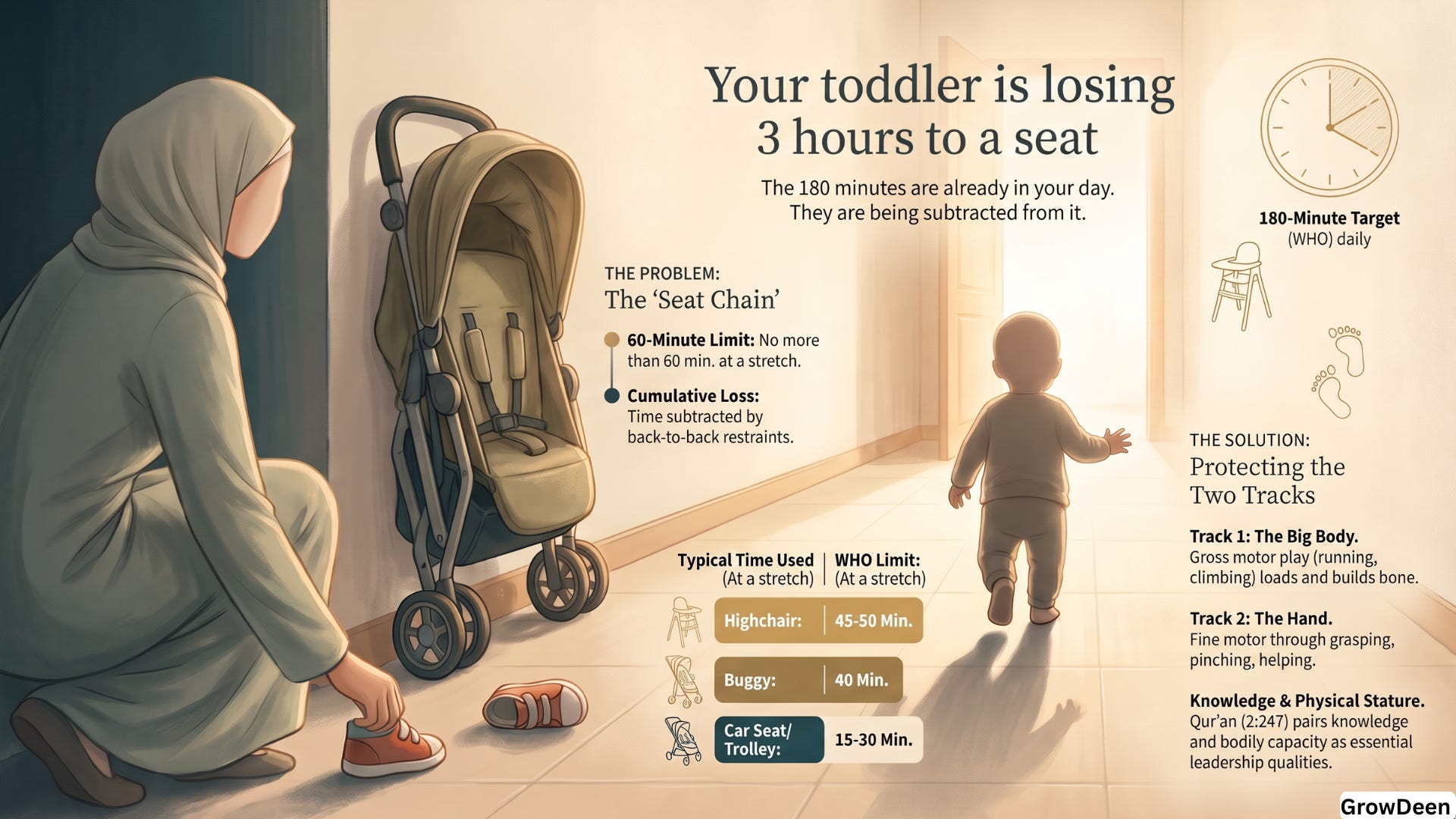
The World Health Organization asks for 180 minutes of daily movement for children aged one to four, and no more than 60 minutes at a stretch in a pram, highchair or car seat [1]. Most families are not short on the first number. They are quietly losing it to the second.
It’s 9:40 in the morning.
Your toddler has been strapped into something since breakfast. Highchair, then buggy, then the trolley seat at the shop, then back into the buggy for the walk home. Nobody did anything wrong. The morning simply happened.
And you have spent most of it feeling like you should be doing more. Sensory bins. A messy play tray. Something structured and enriching that you saw another mother post about.
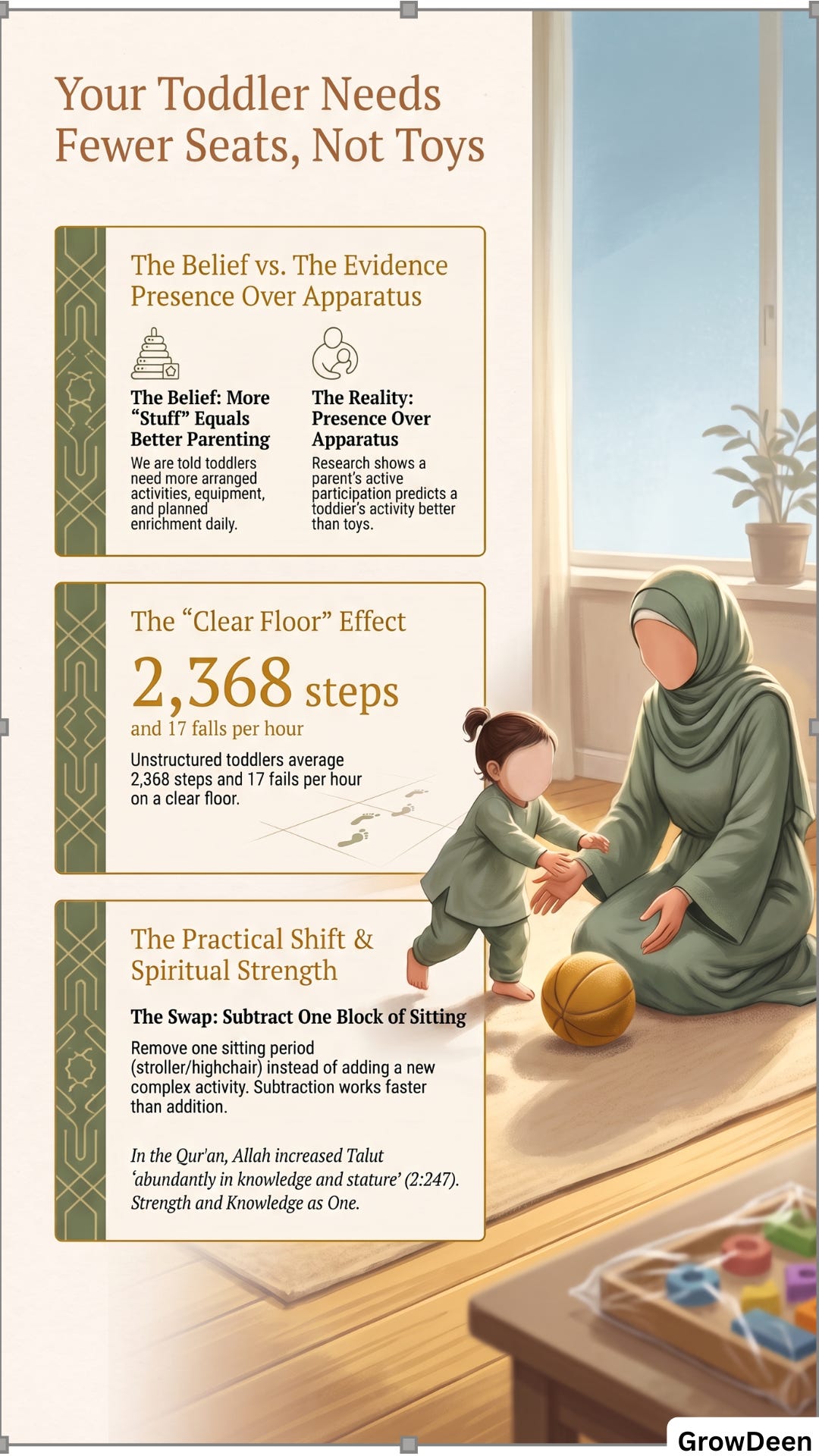
Here’s why that feeling is misdirected. Researchers who filmed twelve-to-nineteen-month-olds during ordinary, unplanned floor play recorded an average of 2,368 steps and 17 falls in a single hour [2]. No activity was set up. No parent led anything. That is simply what a toddler does with an hour and a clear floor.
Which means the movement is already in your child. It gets subtracted from their day, an hour at a time, by things that look like ordinary parenting.
Which raises a question worth carrying through the rest of this: why does a toddler who wants to run all day so often end up moving less than a baby who can barely crawl?
Why this guide is different from generic toddler activity lists
Every number here is traceable. The movement targets come from WHO guidance [1], the step counts from a peer-reviewed observational study [2], and the bone findings from a twelve-month randomised trial [3].
The Islamic frame is structural, not decorative. Allah names knowledge and bodily capacity together in one sentence about the man He chose to lead [10], which changes what a Muslim parent is actually investing in when they clear the floor.
You leave with a tool, not just a mood. The free Movement Balance Pack gives you a two-track daily grid and a sitting audit you can run in one morning.
Where do three hours of toddler movement actually go?
Count a normal Tuesday.
Twenty-five minutes in the highchair at breakfast, because it kept them contained while you got dressed. Forty minutes in the buggy to nursery. Fifteen in the trolley. Thirty in the car. Twenty-five back in the highchair at lunch, then another twenty while you cleared up and answered a message. Half an hour on the sofa with a screen because you needed it.
That is over three hours of a child physically unable to move, and not one of those choices was careless.
WHO guidance asks that under-fives are not restrained for more than sixty minutes at a time [1]. Almost nobody is breaking that rule with a single sitting. It is the chain that does the damage: seat, then seat, then seat, with the transitions themselves spent being carried.
Screens work the same way. Research on toddlers has linked greater screen exposure with more sedentary time across the day, not just during the screen [4]. The hour does not end when the programme does.
Movement isn’t scheduled. It’s protected. That is the whole argument of this article, and it is the opposite of what most activity lists tell you.
How much movement does a toddler really need each day?
Three hours, at any intensity, spread across the day, for ages one to four [1]. From three years onward, some of that should be moderate to vigorous, meaning faster and breathing harder [1].
The phrase “any intensity” is doing a lot of work there, and most parents miss it.
Walking counts. Crawling counts. Pushing a toy across the kitchen counts. Sitting on the floor stacking blocks counts, because the trunk is working and the hands are working. You are not being asked to run a toddler bootcamp. You are being asked not to interrupt.
Add up what a normal, unmanaged day already contains and most families land closer to 180 minutes than they expect. The exception is the day that runs entirely on wheels.
And when researchers looked at what actually predicts how active a toddler is, the answer was not equipment or classes. A consensus statement on family influence found that what parents do with their children predicts activity levels [5], and toddlers with more active parents tend to be more active themselves [6].
Your presence on the floor is the intervention.
I know that is a lot to hold in your head at 7am with a toddler pulling at your leg. That’s why I’ve put together a free Movement Balance Pack: a printable two-track day grid and a one-morning sitting audit that shows you exactly where the hours are going. Keep reading and you can download it at the end.
What are the two tracks of toddler movement?
There are two, they develop separately, and a good day for one can be an empty day for the other.
Track one is the big body. Running, climbing, squatting, carrying, balancing on uneven ground. This is the track that loads bone. In a twelve-month randomised trial, children aged three to five doing thirty minutes of gross motor activity five days a week gained more leg bone mineral content than children of the same age doing fine motor activities for the same amount of time [3]. Running changes the skeleton. Drawing does not.
Track two is the hand. Grasp, pinch, release, the steady moment when a block is set down rather than dropped. Systematic reviews across the early years link higher activity in under-fives with better motor development overall, with no meaningful evidence of harm from more movement in healthy children [7][8].
Here’s why the distinction matters on an ordinary day: a toddler who spends four hours at the park has done almost nothing for their pincer grip, and a toddler who spends a rainy afternoon with playdough and crayons has not loaded a single leg bone.
Both tracks want daily traffic. Neither needs a class.
Ground that is not flat does more for track one than any toy. Grass, sand, gravel, a slope, a low kerb. A smooth floor teaches the ankle one thing; uneven ground forces hundreds of small corrections a minute. Unstructured outdoor settings in early childhood are consistently associated with higher activity levels than indoor ones [9].
For track two, the strongest material in your house is not a toy at all. It is a stack of different-sized tubs to nest and fill, and the four small jobs your toddler can already almost do: pouring their own water, wiping a spill, pushing a cloth across the table, putting shoes on the rack. Their hands get the practice, and something quieter gets absorbed alongside it. Helping the household becomes ordinary. That is adab, arriving without a lecture.
Why do toddlers fall so much, and should you stop it?
Seventeen falls an hour [2].
Read that again as a parent rather than as a statistic, because your instinct is probably to feel slightly ill. Then consider what those seventeen falls are doing. Balance is not installed. It is calibrated, by error, over thousands of repetitions, and a child who is never allowed to get it wrong has nothing to calibrate against.
A systematic review of risky outdoor play found it associated with better physical activity levels and social health in children, and did not find support for the harms most commonly feared [11].
None of which is permission to be careless. Your child’s body is an amanah, and supervision is how you carry it. But a trust is something you protect while it grows, and growth here needs room to wobble.
So draw the line at real danger and leave the rest alone. Check the drop height. Check what is underneath. Check the equipment suits their age and the gate to the road is shut. Then stop narrating every wobble from the kitchen doorway.
But before the practical swaps, there is something in the Qur’an about a child’s body that most parents have never had pointed out to them.
Knowledge and strength: what Allah names together
You already invest in your child’s mind. The Qur’an circle, the letters, the small memorisation you started before they could talk. Nobody has to argue you into that.
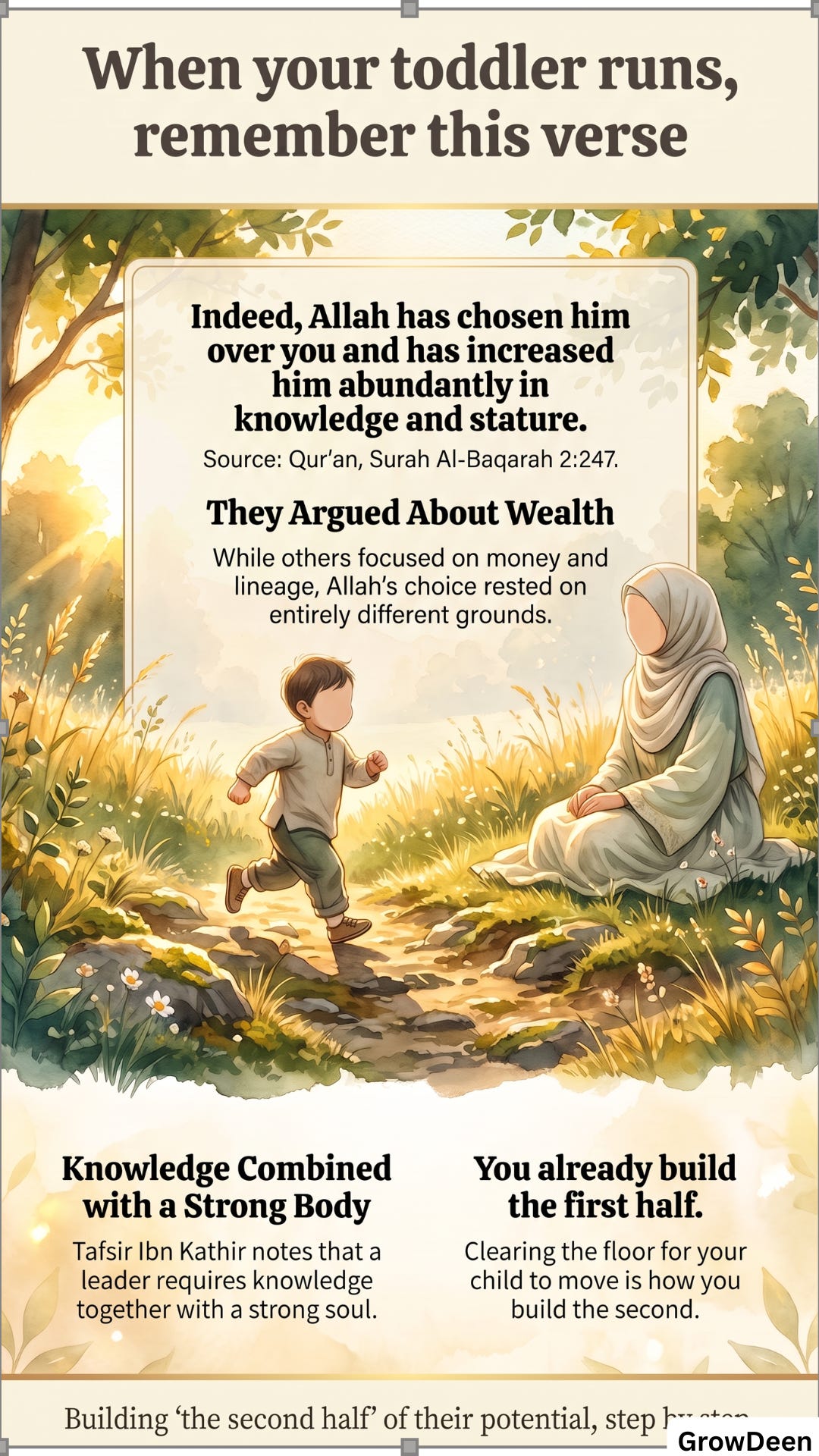
So when the Israelites objected to Talut being made their leader, complaining that he had no wealth and no standing, notice what the answer rested on. Allah says: “Indeed, Allah has chosen him over you and has increased him abundantly in knowledge and stature. And Allah gives His sovereignty to whom He wills.” [Qur’an 2:247] [10]
According to Tafsir Ibn Kathir, that phrase means Talut was more knowledgeable and stronger than they were, and Ibn Kathir adds that a leader should have sufficient knowledge together with a strong soul and body [10]. Knowledge and physical capacity. One sentence. Two halves of the same qualification.
The Prophet ﷺ treated the second half as worth stopping for. Salama bin Al-Akwa reported: “The Prophet ﷺ passed by some persons of the tribe of Aslam practicing archery. Allah’s Messenger ﷺ said, ‘O offspring of Ishmael! Practice archery as your father was a great archer. I am with (on the side of) the son of so-and-so.’ Hearing that, one of the two teams stopped throwing. Allah’s Messenger ﷺ asked them, ‘Why are you not throwing?’ They replied, ‘O Allah’s Messenger ﷺ! How shall we throw when you are with the opposite team?’ He said, ‘Throw, for I am with you all.’” [Sahih al-Bukhari 3373] [12]
He noticed physical practice happening. He encouraged it by name, tying it back to Isma’il عليه السلام. Then, when his own presence on one side quietly discouraged the other, he corrected it so nobody was left out.
The narration concerns grown men practising a skill, and what it shows is how an adult stands beside physical effort. And a child who can squat, climb, carry and balance is a child whose body is being readied for standing through salah, for reaching a low tap to make wudu, for walking the last stretch to the masjid on their own legs.
What should toddler movement look like at one, two and three years?
Children arrive at these at their own pace, and the spread of normal is wide. Use it as a map, not a scorecard [13].
One to two years. Walking steadies, then speeds up. Small objects get picked up between finger and thumb. Both hands are used well and a preference may show, though real handedness settles years later. Stairs are attempted one foot at a time, with a hand held.
Two to three years. A pencil sits in something close to a writing grip. Doorknobs turn. Stairs are climbed with alternating feet, handrail still wanted. A ball is thrown without the whole body toppling after it. Jars get unscrewed, usually the wrong jar.
Around three years. Stillness becomes rare. The walking pattern shifts from the flat-footed, legs-apart style of a new walker into a heel-to-toe stride. Dressing, using a spoon and fork, and drinking from an open cup all come under the child’s own control.
Three swaps you can make tomorrow morning
Three subtractions.
Break the seat chain once. Pick the single longest restraint block in your day and cut it in half. Walk the last two streets. Let them out of the highchair when they finish instead of while you tidy.
Put ten minutes of uneven ground into the day. Grass, a slope, a kerb, the gravel path instead of the pavement. Ten minutes, not an outing.
Sit on the floor once and stay there. Roll a ball back and forth, legs apart, facing each other. It looks like nothing. It is turn-taking, tracking, aim and trunk control at once, and it is the version of this that the research actually points to [5][6].
Say Bismillah at the door on the way out and Alhamdulillah when you get home tired. Two seconds each. Over a year, your child absorbs the habit of wrapping ordinary effort in the name of Allah, long before they can explain why.
And when you’re outside, name what you both see. The sky. Wind in a tree. An ant crossing the path. Rain hitting the window. SubhanAllah, out loud, where they can hear it. The reflex lands years before the understanding does.
When should you talk to a doctor about your toddler’s movement?
Speak with your doctor, paediatrician or child health nurse if your child is not running smoothly by three years, shows little interest in exploring or moving actively [13], shows a marked hand preference before eighteen months, or loses a movement skill they previously had. Also go if something feels wrong and you cannot name it. Parental concern is a reasonable reason to ask.
A referral to a paediatric physiotherapist is not a failure of tawakkul. Seeking treatment is part of the means Allah placed in our hands, and reliance rests on top of the means.
This article is general educational information and does not replace medical advice.
Your free Movement Balance Pack
If you’ve read this far, you’re the kind of parent who takes your child’s body as seriously as their memorisation. That says something about you.
Inside the Movement Balance Pack (one comprehensive PDF, 3 pages):
Page 1: The Two-Track Day Grid. A single-sheet daily grid with gross motor down one column and fine motor down the other, carrying sixteen tick-box prompts drawn from this guide, so you can see at a glance which track your day is starving. Designed as a fridge sheet you can tick with one hand.
Page 2: The Sitting Audit. A one-morning tally sheet for every minute spent in a highchair, buggy, car seat, trolley and screen, with the WHO sixty-minute limit marked on the page and a swap suggested for each block, so you can find your three lost hours in a single morning without changing anything yet.
Page 3: Knowledge and Strength. A reflection card carrying Qur’an 2:247 and Sahih al-Bukhari 3373 with full source references, plus three lines on what each one asks of a parent standing at the edge of a playground. Something to keep where you’ll read it more than once.
This isn’t just a PDF to download and forget. It’s a tool designed to stay on your fridge, where you’ll actually use it on the mornings that get away from you.
The Movement Balance Pack is what every subscriber receives with each article. Muslim Parenting Lab covers the full arc of raising Muslim children from birth through the early school years, all backed by peer-reviewed research and rooted in authenticated Islamic sources.
If you want both evidence-based guidance and Islamic perspective in the same place, subscribe free so future resources land in your inbox before you need them.
Subscribe free for parenting resources backed by both science and Sunnah, guidance so specific you cannot get it anywhere else. No spam, no clutter, just resources that matter.
Before you close this tab
Go and look at where your toddler is sitting right now. If they’re strapped into something and not eating, take them out. That’s it. That’s the practice.
May Allah put barakah in the ordinary, repetitive, unglamorous work of it, and make the effort weigh more on your scale than it feels like in the moment.
Share this with someone who needs it
Think of one person right now: the sister who apologised last week for how much time her toddler spends in the buggy, the cousin who is convinced she needs to buy something before her child can play properly, the friend whose two-year-old is climbing the sofa while she scrolls activity ideas she’ll never set up.
This article could give her back three hours she didn’t know she was losing. Send it to her today. She will hear relief in it.
Frequently Asked Questions
Q: How much physical activity does a 2 year old need per day?
A: Three hours across the day, at any intensity, according to WHO guidance for children aged one to four [1]. That includes walking, crawling, climbing and floor play with blocks, so it accumulates faster than most parents assume.
Q: How long can a toddler stay in a pram or highchair?
A: No more than sixty minutes at a time for under-fives [1]. The problem in most households is rarely one long block; it’s a highchair, then a buggy, then a trolley, then a car seat, back to back.
Q: Is it normal for my toddler to fall over constantly?
A: Completely normal. Twelve-to-nineteen-month-olds averaged 17 falls per hour during ordinary free play in one observational study [2]. The falls are how balance gets calibrated, so long as the drop heights and surfaces are safe.
Q: How much screen time is safe for a toddler?
A: None for under-twos beyond video calls with people they know, and no more than an hour a day for two-to-four-year-olds, with less being better [1]. Research on toddlers links greater screen exposure with more sedentary time overall [4].
Q: What’s the difference between gross motor and fine motor skills in toddlers?
A: Gross motor is the big body: running, climbing, balancing. Fine motor is the hands: grasp, pinch, release. They develop on separate tracks, and only gross motor activity showed the bone mineral gains in a twelve-month randomised trial [3].
Q: Does Islam say anything about physical strength in children?
A: Allah pairs knowledge and bodily stature in one sentence about Talut in Qur’an 2:247, and Tafsir Ibn Kathir reads it as meaning a leader needs sufficient knowledge together with a strong soul and body [10]. The Prophet ﷺ also stopped to encourage a group practising archery and made sure nobody was excluded from it [12].
Q: When should I worry about my toddler’s motor development?
A: If your child is not running smoothly by three years, shows little interest in active exploration, shows a strong hand preference before eighteen months, or loses a skill they previously had [13]. Take it to your doctor or paediatrician rather than waiting it out.
References
[1] World Health Organization. (2019). Guidelines on physical activity, sedentary behaviour and sleep for children under 5 years of age. World Health Organization. https://www.who.int/publications/i/item/9789241550536
[2] Adolph, K.E., Cole, W.G., Komati, M., Garciaguirre, J.S., Badaly, D., Lingeman, J.M., Chan, G.L.Y., & Sotsky, R.B. (2012). How do you learn to walk? Thousands of steps and dozens of falls per day. Psychological Science, 23(11), 1387-1394. https://doi.org/10.1177/0956797612446346
[3] Specker, B., & Binkley, T. (2003). Randomized trial of physical activity and calcium supplementation on bone mineral content in 3- to 5-year-old children. Journal of Bone and Mineral Research, 18(5), 885-892. https://doi.org/10.1359/jbmr.2003.18.5.885
[4] Carson, V., & Kuzik, N. (2017). Demographic correlates of screen time and objectively measured sedentary time and physical activity among toddlers: A cross-sectional study. BMC Public Health, 17(1), Article 187. https://doi.org/10.1186/s12889-017-4125-y
[5] Rhodes, R.E., Guerrero, M.D., Vanderloo, L.M., Barbeau, K., Birken, C.S., Chaput, J-P., Faulkner, G., Janssen, I., Madigan, S., Mâsse, L.C., McHugh, T-L., Perdew, M., Stone, K., Shelley, J., Spinks, N., Tamminen, K.A., Tomasone, J.R., Ward, H., Welsh, F., & Tremblay, M.S. (2020). Development of a consensus statement on the role of the family in the physical activity, sedentary, and sleep behaviours of children and youth. International Journal of Behavioral Nutrition and Physical Activity, 17, Article 74. https://doi.org/10.1186/s12966-020-00973-0
[6] Hnatiuk, J., Salmon, J., Campbell, K.J., Ridgers, N.D., & Hesketh, K.D. (2013). Early childhood predictors of toddlers’ physical activity: Longitudinal findings from the Melbourne InFANT Program. International Journal of Behavioral Nutrition and Physical Activity, 10, Article 123. https://doi.org/10.1186/1479-5868-10-123
[7] Carson, V., Lee, E-Y., Hewitt, L., Jennings, C., Hunter, S., Kuzik, N., Stearns, J.A., Powley Unrau, S., Poitras, V.J., Gray, C., Adamo, K.B., Janssen, I., Okely, A.D., Spence, J.C., Timmons, B.W., Sampson, M., & Tremblay, M.S. (2017). Systematic review of the relationships between physical activity and health indicators in the early years (0-4 years). BMC Public Health, 17(Suppl. 5), Article 854. https://doi.org/10.1186/s12889-017-4860-0
[8] Pate, R.R., Hillman, C., Janz, K.F., Katzmarzyk, P.T., Powell, K.E., Torres, A., & Whitt-Glover, M.C. (2019). Physical activity and health in children younger than 6 years: A systematic review. Medicine & Science in Sports & Exercise, 51(6), 1282-1291. https://doi.org/10.1249/mss.0000000000001940
[9] Vega-Perona, H., Estevan, I., Bernabé-Villodre, M. del M., Segura-Martínez, P., Martínez-Bello, D.A., & Martínez-Bello, V.E. (2024). Correlates of toddlers’ physical activity levels and sedentary behavior during unstructured outdoor play in early childhood education and daycare settings. Perceptual and Motor Skills, 131(1), 39-58. https://doi.org/10.1177/00315125231218027
[10] Qur’an, Surah Al-Baqarah 2:247, with Tafsir Ibn Kathir (abridged). Read in full at https://quran.com/en/al-baqarah/247/tafsirs
[11] Brussoni, M., Gibbons, R., Gray, C., Ishikawa, T., Sandseter, E.B.H., Bienenstock, A., Chabot, G., Fuselli, P., Herrington, S., Janssen, I., Pickett, W., Power, M., Stanger, N., Sampson, M., & Tremblay, M.S. (2015). What is the relationship between risky outdoor play and health in children? A systematic review. International Journal of Environmental Research and Public Health, 12(6), 6423-6454. https://doi.org/10.3390/ijerph120606423
[12] Sahih al-Bukhari 3373. Narrated by Salama bin Al-Akwa. Book 60, Hadith 47. Grade: Sahih. https://sunnah.com/bukhari:3373
[13] Zubler, J.M., Wiggins, L.D., Macias, M.M., Whitaker, T.M., Shaw, J.S., Squires, J.K., Pajek, J.A., Wolf, R.B., Slaughter, K.S., Broughton, A.S., Gerndt, K.L., Mlodoch, B.J., & Lipkin, P.H. (2022). Evidence-informed milestones for developmental surveillance tools. Pediatrics, 149(3), Article e2021052138. https://doi.org/10.1542/peds.2021-052138