


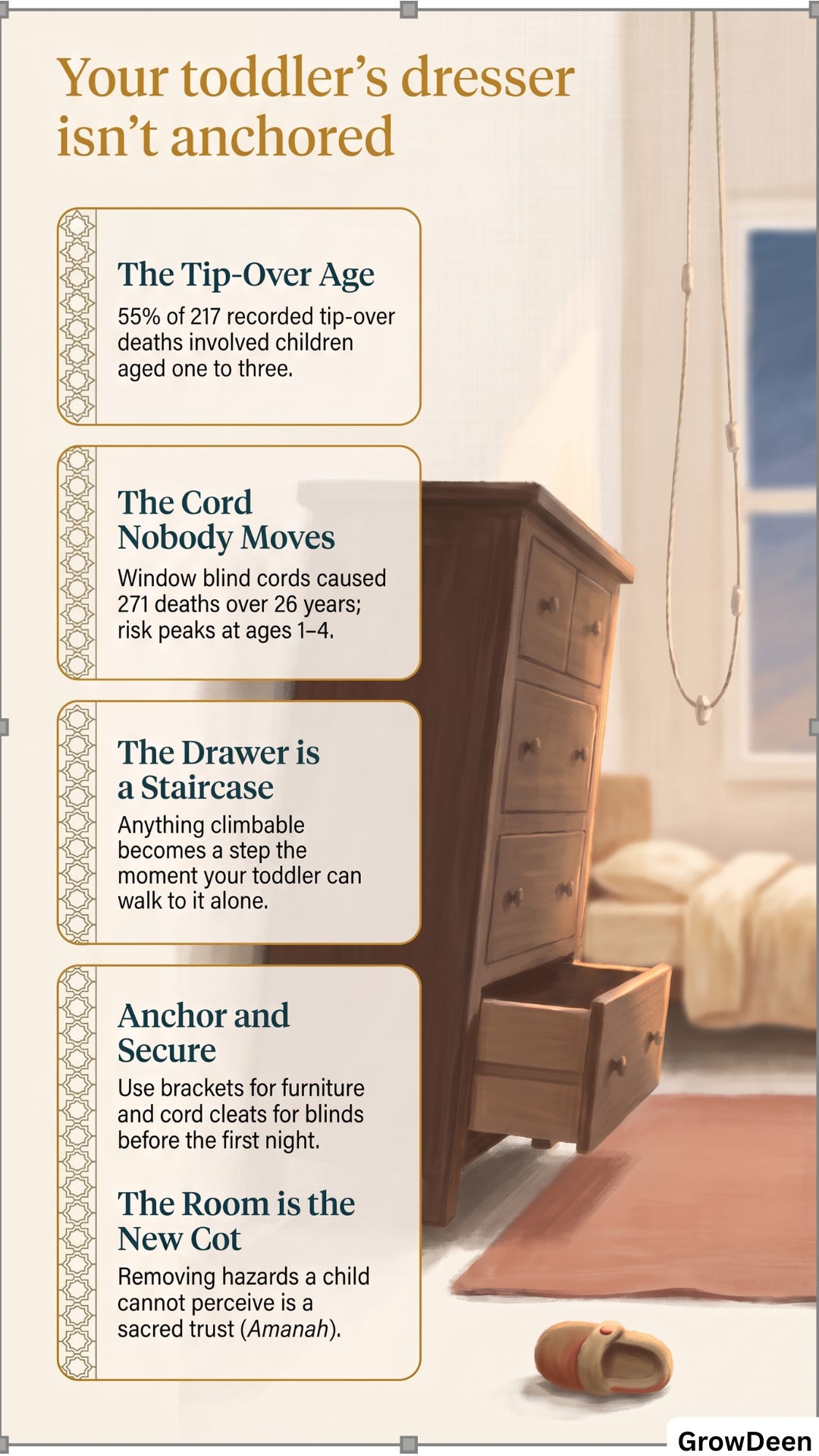
US Consumer Product Safety Commission data shows that 55% of 217 tip-over deaths between 2013 & 2023 involved children aged one to three. [1] That is the age band leaving cots. Here is the sweep to do before the first night.
Print it tonight & apply, before anything happens.
The thud came first.
Then bare feet on the landing. Then a small figure in the doorway at 10:40pm, blanket trailing, grinning like someone who has just solved a puzzle. Nobody taught them to climb. The skill simply arrived one Tuesday, and it does not leave.
Most parents react the same way. They order a bed. Because that is what the internet says, and because a child who can climb out of a cot is clearly telling you something.
You are not wrong to feel that pressure. Every other toddler at playgroup seems to be in a big bed already, and the cot has started to look like something your child has outgrown. Nobody wants to be the family holding their two-year-old back.
Here is the question almost nobody asks first: has the room been made as safe as the cot was? Because the cot was never just furniture. It was containment. The moment it goes, a small person with no sense of risk is loose in a room at 2am while the house sleeps.
And one more question to carry with you, because it is the strange one: why do so many families who make this move at exactly the “right” age end up with worse nights than the ones who waited? The answer is in a study of 1,983 toddlers, and it is not what most people expect.
Why This Guide Is Different From Generic Toddler Bed Advice
Real data, not folklore. Every claim here comes from paediatric research and national injury surveillance: the AAP’s height rule, a 1,983-child sleep study, nineteen years of cot injury data, and twenty-six years of window blind fatality records.
The Islamic frame is structural, not decorative. Removing a hazard your child cannot yet see is part of the amanah of having them. The Qur’an describes the night itself as built for stillness, and that changes what a bedroom is for.
You get the tool, not just the theory. The free Bed Decision Pack gives you a printable readiness gauge, a one-page comparison of the three bed options, and an Islamic reflection card for the hard nights.
The Measurement That Decides It
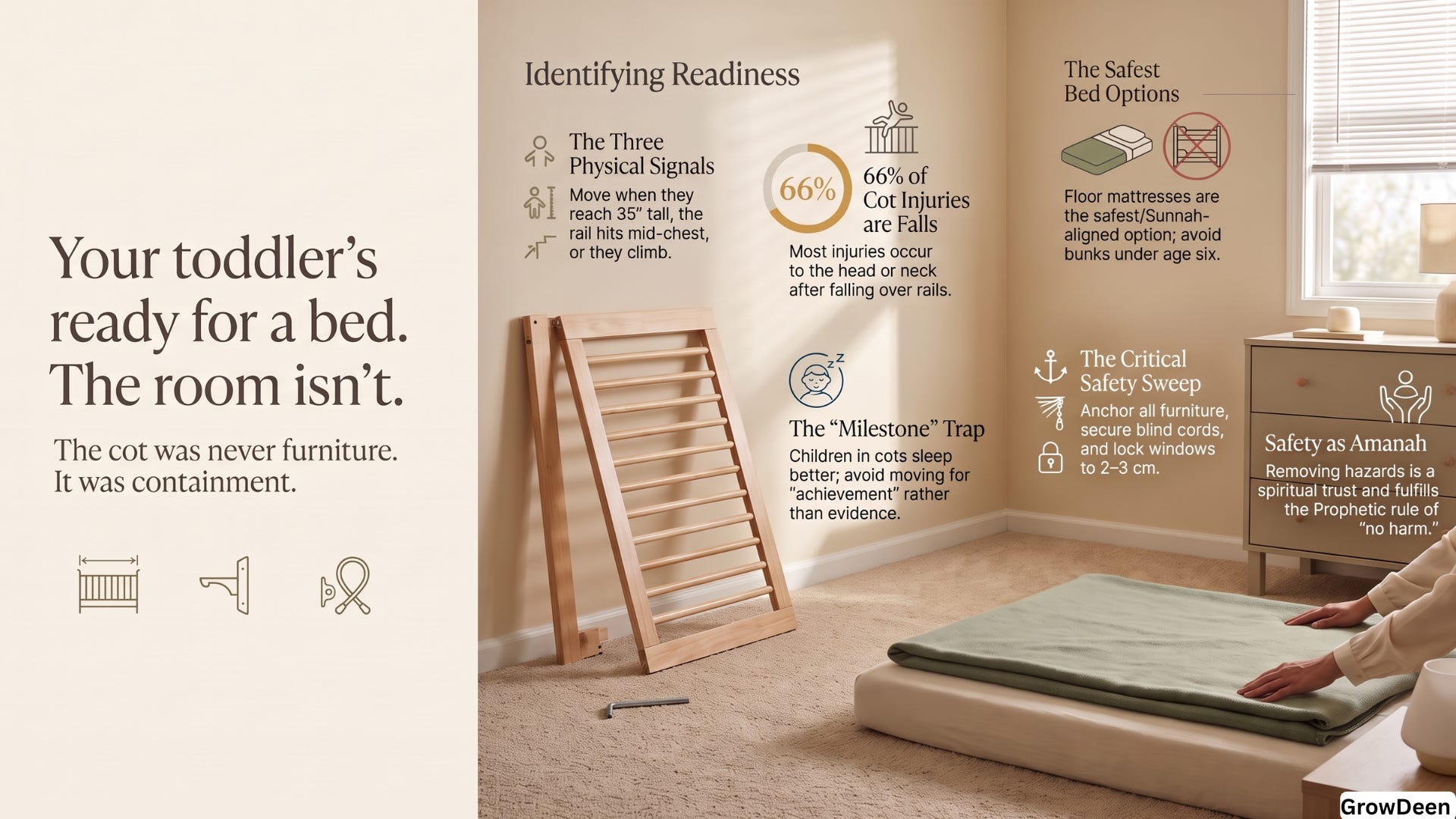
Forget the calendar. There are three physical signals, and any single one of them means the cot has finished its job [3]:
Your child has reached about 35 inches (89 cm) in height.
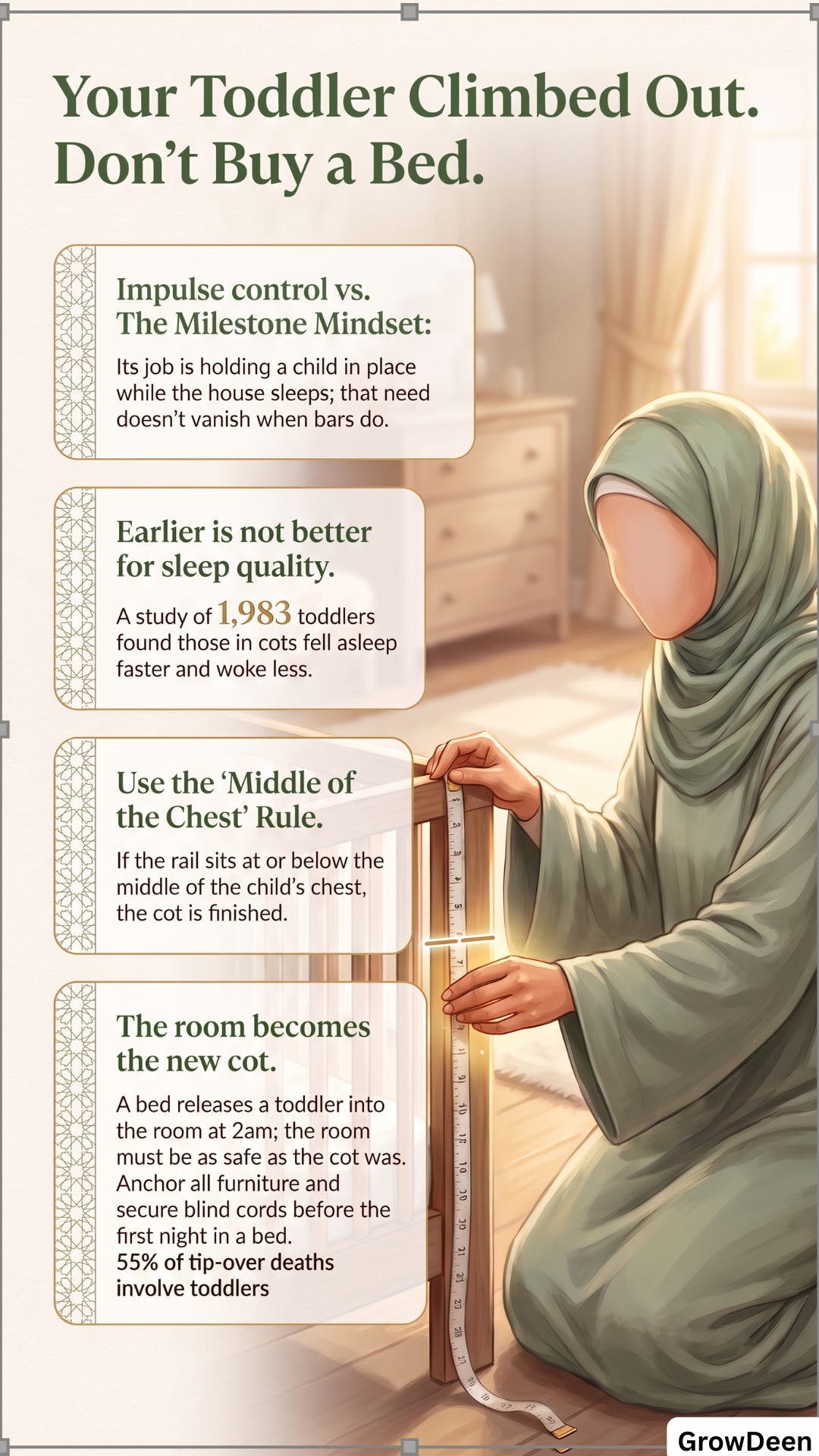
The cot rail sits at or below the middle of their chest when they stand up.
They have climbed out, or tried to.
Nationwide Children’s Hospital puts it plainly: once the rail drops below chest height, getting over it becomes easy, and falls follow [5].
Those falls are not a theoretical worry. Nineteen years of United States emergency department data found an average of 9,561 children under two treated every year for injuries linked to cots, playpens and bassinets. Cots accounted for 83.2% of them. Two thirds, 66.2%, were falls, and the head or neck was the injured area in 40.3% of cases [4].
So before you buy anything, do one thing tonight: stand your child up in the cot and look at where the rail meets their chest. If the mattress can still be lowered a level, lower it. That single adjustment often buys three or four more months.
But if the rail is already below the chest, or a leg has gone over even once, the decision has been made for you. Now the question becomes what kind of move it is, and this is where most families go wrong.
The Study That Explains Why “On Time” Often Goes Badly
Remember that question from the opening? Here is the answer.
Researchers looked at caregiver-reported sleep for 1,983 toddlers aged 18 to 36 months across Australia, Canada, New Zealand, the United Kingdom and the United States. They compared children still in cots against children already in beds, all sleeping in their own rooms.
The cot children won on almost everything: earlier bedtimes, falling asleep faster, fewer night wakings, longer unbroken stretches, more total night sleep, less bedtime resistance, and fewer sleep problems overall [2]. The pattern held in every age band and every country.
Cot use collapsed with age anyway. At 18 to 24 months, 63.4% were still in one. By 30 to 36 months, only 12.6% remained [2].
Here’s why the early movers struggle. A bed with no rail asks a two-year-old to stay put using impulse control that has not arrived yet. That capacity comes closer to three. A child who can get up will get up, and every trip out shortens the night for everybody.
So the villain in this story is not your child, and it is not the cot. It is the milestone mindset: the belief that a big bed is an achievement owed to a child on a schedule. That framing is wrong. Containment decisions get made on evidence.
The room has to be ready, not the child.
Before We Go Further
I know this is turning into a lot to hold in your head at once, especially if the bed is already ordered and arriving Thursday.
That’s why the free Bed Decision Pack exists: a printable readiness gauge you hold against the cot rail, a one-page side-by-side of the three bed options with the fall risk of each, and an Islamic reflection card for the fortnight when nothing is going to plan. Keep reading. You can download it and apply tonight.
There’s one more thing I want to share before the practical part, because it reframes the whole job.
The Stillness Allah Built Into the Night
You know that moment when the room finally goes quiet, and something in your own chest unclenches? That is more than relief. It is recognition.
Allah says: “It is He who made for you the night to rest therein and the day, giving sight. Indeed in that are signs for a people who listen” [12]. The word translated as rest is litaskunu, from a root meaning stillness, settling, coming to rest in a place.
According to Tafsir Ibn Kathir, Allah made the night for His servants to rest in from weariness and exhaustion, and made the day bright and clear so people can seek their livelihood and attend to their needs. He adds that these are signs for those who hear them and take a lesson, signs that can lead a person to recognise the greatness of their Creator and Sustainer [12].
Read that next to what you are about to do in a bedroom, and the two stop looking like separate projects. Dimming the lamp, clearing the bed, anchoring the chest of drawers, keeping the same order every night: all of it is one attempt to hand a child the stillness the night was already made to carry.
And when you stand in a shop deciding between a themed bed frame and a mattress on the floor, hold this next to it. Aisha, may Allah be pleased with her, described what the Prophet Muhammad ﷺ slept on: a leather case stuffed with palm fibre [13]. Plain. Low. Nothing that needed replacing every season.
A mattress on the floor is a perfectly good start for your child. It is the safest option on the list, and it is closer to the Sunnah than anything with a headboard.
Three Beds, and What Each One Costs You
A mattress on the floor. A cot mattress or single mattress laid directly on the floor, away from walls and furniture. Falls disappear as a category, because there is nowhere to fall from. Many children settle faster on the floor in the first fortnight, because the space feels close.
A toddler bed. Roughly the footprint of a cot, low to the ground, often the cot itself converted. You keep the mattress and bedding you own. Low height means low fall force.
A single bed. It lasts for years, which is its real advantage. It also sits higher, so a fall carries more force, and it needs rails from night one. No child under six goes on an upper bunk [11].
Whatever you choose, three things are not optional. Firm mattress, because soft sinking surfaces are a suffocation risk for young children [7]. No gap between rail, frame and mattress that a head, arm or leg can slip into [11]. And the bed positioned away from walls, or pushed flush into a corner with a rail on the open side, so nobody gets wedged [5,7].
Pillows: none in the first year. The AAP is unambiguous that pillows and soft bedding do not belong in an infant’s sleep space [8]. After two, if your child uses one, choose something small and firm that keeps the head level with the spine [11].
And keep the surface clear. Soft toys, cushions, beanbags, heavy quilts: none of it belongs on a young child’s bed [7].
So that’s the bed sorted. Now for the part that keeps children safe, and it has nothing to do with the mattress.
The Room Is the New Cot
Think about what a cot really did. It held a child in one place for eleven hours while nobody watched.
A bed does not do that. A bed releases a toddler into a room at an hour when the whole house is unconscious. Everything in that room now has to survive contact with someone who cannot yet recognise danger. So the room becomes the cot [5].
The principle here is older than any safety standard. The Prophet ﷺ ruled that there should be neither causing of harm nor returning of harm [14]. Scholars built a substantial body of Islamic law on that one sentence, and it reaches all the way down to a chest of drawers nobody ever bracketed to a wall. Removing a hazard your child cannot perceive is not fussiness. It is amanah.
Do this sweep on your hands and knees, at your child’s eye level, before the first night.
Anchor the furniture. Every tall or heavy item, plus anything holding a television. Remember the number from the subtitle: 55% of those 217 tip-over deaths were children aged one to three [1]. Brackets cost very little and take minutes. Then remove what can be climbed: chairs, stools, lidded boxes, low drawers that work like a staircase.
Deal with the blind cords. This one is underweighted almost everywhere. Twenty-six years of US data found an estimated 16,827 children under six treated in emergency departments for window blind injuries, close to two a day. Most were minor. But entanglement, around 12% of cases, accounted for the overwhelming majority of the 271 deaths recorded, and the risk peaks between one and four [6]. This kind of strangulation is silent and fast. Replace corded blinds where you can, fit a retrofit kit where you cannot, wind cords onto wall cleats at least 1.6m up, and move furniture away from windows [6].
Lock the windows so they open only a few centimetres, and check the gap is too narrow to climb through.
Decide the doorway. A safety gate, or a closed door if you can still hear your child. If the door stays open, the rest of the house needs the same treatment, because sooner or later your child will go and inspect it.
Empty the room of poisons and small objects. Medicines, massage and aromatherapy oils, cleaning products, coins, button batteries, small toy parts. Button batteries cause severe internal burns within hours of being swallowed, so treat a suspected swallow as an emergency.
Socket covers on. Heaters and vaporisers out overnight, along with any lamp on a trailing cord that can be pulled over [5].
Twenty minutes on the floor with a pen. That is the whole job. Once it’s done, the nights become the only thing left to solve.
The First Fourteen Nights
The physical move takes an afternoon. The settling takes a fortnight, sometimes longer.
Change one thing only. Same room, same routine, same bedtime, same comfort object. Only the bed is new. A child absorbs one variable far more easily than three.
Let them help. Carrying bedding, choosing between two sets you already approved, watching the furniture shift. A child who had a say tends to defend the outcome.
Go gradually if they need it. The bed can stand made up in the room while your child still sleeps in the cot. Naps in the bed, nights in the cot, for a week or two. Nothing is lost by taking the slow road.
Carry something over. The old blanket. The sheet that smells right. The toy from the corner. Smell and texture do serious work at two years old.
Rehearse one sentence. When they get out, walk them straight back and say the same short line, every single time: “It is time to sleep. I will see you in the morning.” Then leave. No negotiation, no conversation in the dark, no new information.
Expect nights three and four to be the worst. A child tests a boundary hardest just before accepting it, and a parent who gives in on the twelfth trip has taught their child that trip twelve is the one that works. Sabr belongs to you here as much as to them.
And it is completely fine to reverse. If the move came early and the nights have fallen apart, going back to the cot for a few months is a decision, not a defeat. Plenty of families do it and sleep better for it.
One thing worth protecting through all of it: the routine itself. Across studies the effect is dose dependent: the more consistently a bedtime routine is followed, the faster children fall asleep and the less they wake [9]. The benefits reach past sleep into language, behaviour and emotional regulation [10]. Keep the same order every night: quiet time, wudu, the du’a and adhkar your family already says, a short story from the Qur’an or the Seerah, then your child climbing in and pulling up their own covers.
Because the room has to be ready, not the child. Get the room right, keep the order steady, and the fortnight passes.
Your Free Bed Decision Pack
If you’ve read this far, you’re the kind of parent who treats this as a safety decision rather than a milestone to tick off. That tells me something good about you.
Inside the Bed Decision Pack (one comprehensive PDF, 3 pages):
Page 1: Is the Cot Still Doing Its Job? A printable measuring strip you hold against the cot rail, plus a six-question go-or-wait decision tree that ends in a single clear verdict, designed as a quick reference card you can keep folded inside the wardrobe door.
Page 2: Three Beds, One Table A side-by-side comparison of floor mattress, toddler bed and single bed across fall risk, lifespan, what you must fit, and a “choose this if…” line for each, with the exact gap and firmness specs to check, so you can make the decision in the shop in under five minutes.
Page 3: Two Reflections for the First Fortnight Qur’an 10:67 with Arabic, transliteration and translation on the night as a place of stillness, and the harm-removal principle taught by the Prophet ﷺ, each with one concrete action for the parent. Something to hold on night four, when nothing is working.
This isn’t just a PDF to download and forget. It’s a tool designed to live in the bedroom and the wardrobe door, where you’ll actually use it when you need it most.
This Bed Decision Pack is what every subscriber receives with each article. We cover the whole span of raising Muslim children, all backed by scientific research and rooted in Islamic wisdom.
If you’re a Muslim parent who wants both evidence-based guidance and Islamic perspective, subscribe free so future resources arrive in your inbox before you need them.
Subscribe free for parenting resources backed by both science and Sunnah. Guidance so unique you literally can’t get it anywhere else. No spam, no clutter, just resources that matter.
Do This in the Next Five Minutes
Go into your child’s bedroom. Find the tallest piece of furniture in it. Check whether it is bracketed to the wall.
If it isn’t, that’s your Thursday. Order two anti-tip brackets tonight, before you order anything else.
May Allah place barakah in your effort, accept your intention, and make the care you give more protective and more rewarded than it feels in the moment.
Share This With Someone Who Needs It
Think of one person right now: the friend whose toddler climbed out last week and who mentioned the new bed arriving, the sister expecting a baby who’s about to need the cot, the cousin whose child’s bedroom you’ve stood in and noticed the dresser that isn’t fixed to the wall.
This could protect their child. Send it to them today, not as advice-giving but as care. Sometimes the most loving thing we can do is pass on the thing nobody told us in time.
Frequently Asked Questions
Q: What age should a toddler move from a cot to a bed?
A: There’s no fixed age, and that’s good news. Most families move somewhere between two and three, but the AAP points to height and behaviour instead: about 35 inches tall, the rail below chest level, or climbing out [3]. If none of those apply, waiting is the better call, because children in cots sleep measurably better [2].
Q: Is it safe to leave my toddler in a cot until age three?
A: Yes, as long as they aren’t climbing out and haven’t outgrown it by height. In a study of 1,983 toddlers, only 12.6% were still in a cot between 30 and 36 months, but those children fell asleep faster and woke less than the ones in beds [2].
Q: My toddler keeps climbing out of the cot. What should I do?
A: First, lower the mattress to its lowest setting if that option remains. If they’re still getting over the rail, the cot has stopped being safe and it’s time to move, since falls from cot height account for two thirds of cot-related emergency visits [4].
Q: Should I use a toddler bed or a floor mattress?
A: A floor mattress is the safest option because there’s no height to fall from, and many children settle faster on one. A toddler bed is the next safest and lets you keep your existing mattress. Both beat a single bed for a child under three [11].
Q: How do I stop my toddler getting out of bed all night?
A: Walk them back immediately, say one rehearsed sentence, and leave. Every time, without variation. Expect nights three and four to be the hardest. Keep the bedtime routine identical, since consistency is what the research rewards [9].
Q: What do I need to childproof before my toddler sleeps in a bed?
A: Anchor all tall furniture and televisions, replace or secure blind cords above 1.6m, fit window locks, clear medicines and button batteries out of the room, fit socket covers, and remove anything climbable. Blind cord entanglement alone was linked to the majority of 271 child deaths over a twenty-six-year period [6].
Q: Should I move my toddler out of the cot before the new baby arrives?
A: Yes, but not in the same week. Move them either a few months before the birth or a couple of months after, so they don’t connect losing the cot with gaining a sibling. If they’re not ready, borrowing a second cot for a few months is a perfectly reasonable option.
References
[1] United States Consumer Product Safety Commission. (2024). Tip-Over Injuries and Fatalities Report and the Anchor It! campaign. https://www.anchorit.gov
[2] Williamson, A.A., Leichman, E.S., Walters, R.M., & Mindell, J.A. (2019). Caregiver-perceived sleep outcomes in toddlers sleeping in cribs versus beds. Sleep Medicine, 54, 16-21. https://doi.org/10.1016/j.sleep.2018.10.012
[3] American Academy of Pediatrics. Big Kid Beds: When to Switch From a Crib. HealthyChildren.org. https://www.healthychildren.org
[4] Yeh, E.S., Rochette, L.M., McKenzie, L.B., & Smith, G.A. (2011). Injuries associated with cribs, playpens, and bassinets among young children in the US, 1990-2008. Pediatrics, 127(3), 479-486. https://doi.org/10.1542/peds.2010-1537
[5] Dattner, L. Nationwide Children’s Hospital, Center for Injury Research and Policy. Transitioning from Crib to Toddler Bed. https://www.nationwidechildrens.org/family-resources-education/700childrens/2021/12/transitioning-crib-toddler-bed
[6] Onders, B., Kim, E.H., Chounthirath, T., Hodges, N.L., & Smith, G.A. (2018). Pediatric injuries related to window blinds, shades, and cords. Pediatrics, 141(1), e20172359. https://doi.org/10.1542/peds.2017-2359
[7] Nakamura, S., Wind, M., & Danello, M.A. (1999). Review of hazards associated with children placed in adult beds. Archives of Pediatrics and Adolescent Medicine, 153(10), 1019-1023. https://doi.org/10.1001/archpedi.153.10.1019
[8] Moon, R.Y., Carlin, R.F., Hand, I., & AAP Task Force on Sudden Infant Death Syndrome. (2022). Sleep-Related Infant Deaths: Updated 2022 Recommendations. Pediatrics, 150(1), e2022057990. https://doi.org/10.1542/peds.2022-057990
[9] Mindell, J.A., Li, A.M., Sadeh, A., Kwon, R., & Goh, D.Y.T. (2015). Bedtime routines for young children: A dose-dependent association with sleep outcomes. Sleep, 38(5), 717-722. https://doi.org/10.5665/sleep.4662
[10] Mindell, J.A., & Williamson, A.A. (2017). Benefits of a bedtime routine in young children: Sleep, development, and beyond. Sleep Medicine Reviews, 40, 93-108. https://doi.org/10.1016/j.smrv.2017.10.007
[11] Stanford Medicine Children’s Health. Moving Your Toddler From Crib to Bed. https://www.stanfordchildrens.org/en/topic/default?id=moving-your-toddler-from-crib-to-bed-1-4492
[12] Qur’an, Surah Yunus 10:67 — https://quran.com/10/67 · Ibn Kathir, Tafsir Ibn Kathir, Surah Yunus 10:65-67 commentary — https://quran.com/en/10:67/tafsirs/en-tafisr-ibn-kathir
[13] Sahih al-Bukhari 6456, narrated by Aisha رضي الله عنها — Graded: Sahih — https://sunnah.com/bukhari:6456 (also Sahih Muslim 2082b — https://sunnah.com/muslim:2082b)
[14] 40 Hadith an-Nawawi 32, narrated by Abu Sa’id al-Khudri رضي الله عنه — Graded: Hasan (an-Nawawi), related by Ibn Majah and ad-Daraqutni — https://sunnah.com/nawawi40:32