

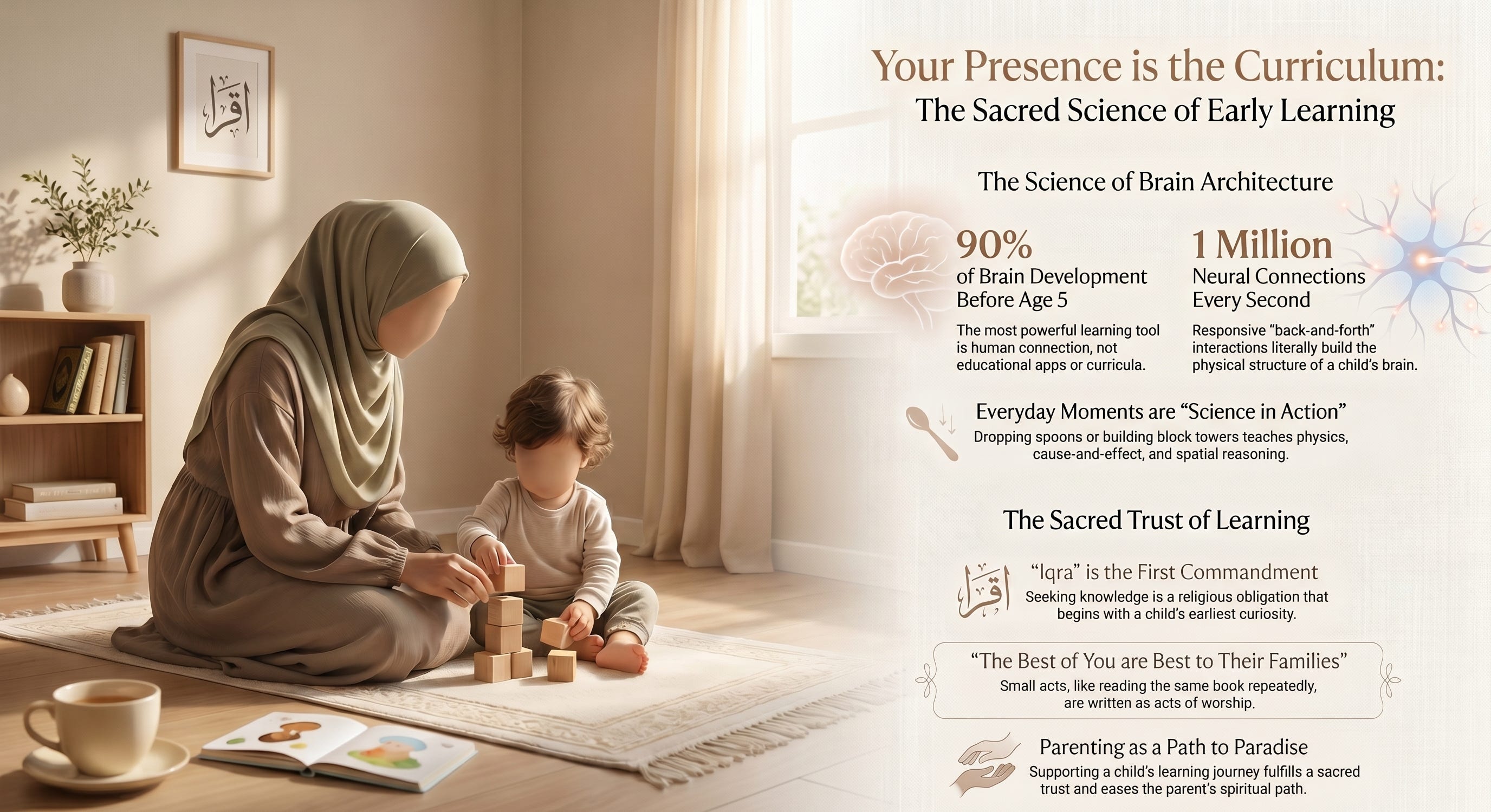
Research from Harvard’s Center on the Developing Child confirms that 90% of brain development happens before age 5 [1] and the most powerful learning tool isn’t an app or curriculum, it’s you.
You’re doing it right now.
Right now, as you read this, you might be second-guessing whether you’re doing enough for your child’s development. Whether the toddler down the street who can count to twenty means your child is falling behind. Whether you should be signing up for more classes, buying more educational toys, doing more structured activities.
But here’s what the research shows: the anxiety itself might be the only thing holding you back.
Because the truth is, your child’s brain is developing faster right now—in these early years before formal schooling—than it ever will again. Harvard’s Center on the Developing Child confirms that nearly 90% of brain development happens before age 5 [1]. Not in kindergarten. Not through flashcards. Through something far simpler.
Something you’re already doing.
Why This Guide Is Different
Research-backed and practical. Every insight here is grounded in neuroscience and developmental psychology from sources like Harvard’s Center on the Developing Child, the LEGO Foundation’s learning-through-play research [12], and Australia’s Early Years Learning Framework [6].
Islamic perspective woven throughout. We connect how children learn to the Quranic command “Iqra” (Read/Learn) as the first revelation [39], and to hadith about seeking knowledge being obligatory [42]—showing that supporting your child’s curiosity is worship.
Comes with a free companion resource. You’ll get the Early Learning Activity Guide (3-page PDF) with age-appropriate activities, a decision flowchart for when to help vs. step back, and authentic Islamic du’as for learning—designed to stay on your fridge where you’ll actually use it.
What Learning Actually Looks Like (Ages 0-5)
Let’s start with what most people get wrong.
When you picture “learning,” you probably imagine a child sitting at a table, focused on a worksheet or educational app. Letters. Numbers. Structured lessons.
But for babies and toddlers, learning doesn’t happen at desks.
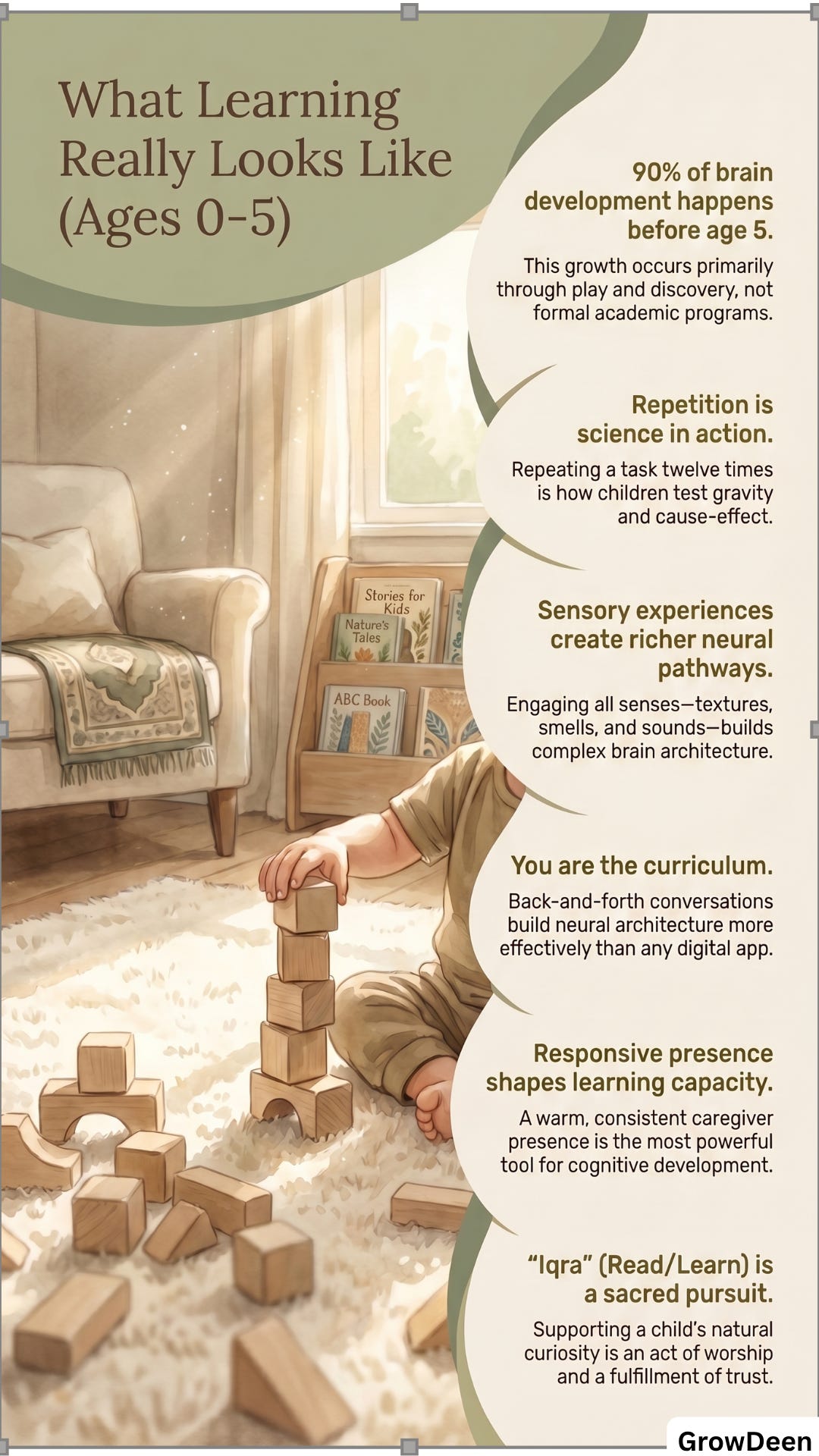
It happens when they track your face across the room, building visual processing skills [8]. When they babble back at you, experimenting with the mechanics of language [9]. When they drop the same spoon off the high chair twelve times in a row, testing gravity and cause-and-effect [10].
That’s not misbehavior. That’s science in action.
Young children learn by observing, listening, touching, tasting, smelling. They learn by asking “why” until you want to scream, because each answer builds another layer of understanding [11]. They learn by playing with water, sand, blocks, cardboard boxes—materials that teach physics and problem-solving better than any screen [12].
They learn by creating. By building towers that fall. By scribbling pictures that make sense only to them. All of it develops spatial reasoning, motor control, and the kind of creative thinking no curriculum can teach [13].
And here’s the part that changes everything: they learn through their senses [14]. The more varied their sensory experiences—textures, sounds, smells, tastes—the richer their neural development becomes.
None of this requires a lesson plan.
The Relationship That Matters More Than Any Toy
Here’s what the research confirms over and over: your relationship with your child shapes their capacity to learn more than any toy, app, or program ever could [5].
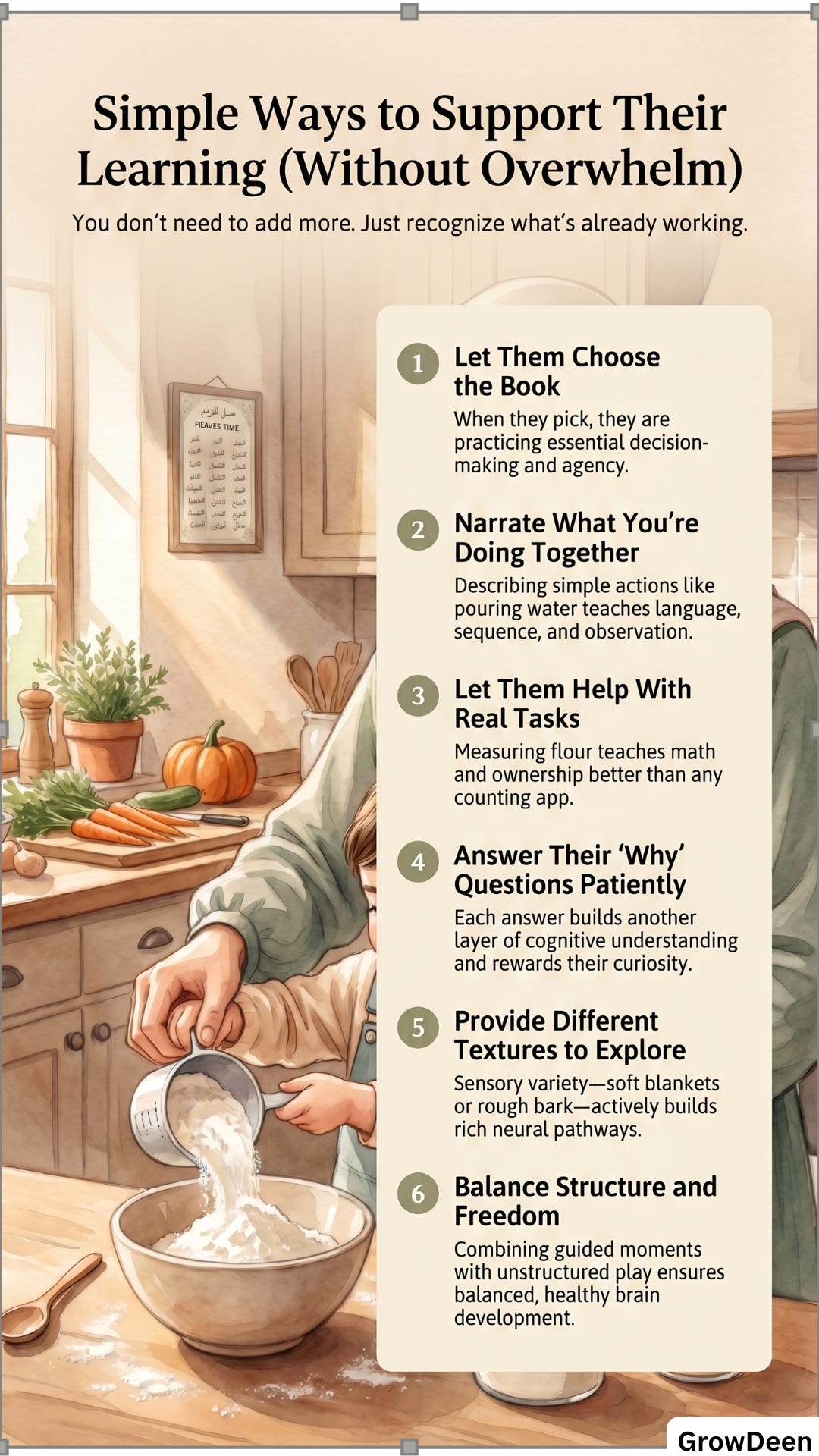
When you respond to their cries, they learn the world is safe. When you smile back at their gaze, they learn connection works. When you narrate what you’re doing together—”We’re pouring water into the cup, watch it fill up”—you’re teaching them language, sequence, observation [6].
These everyday interactions literally build brain architecture [7].
In the first three years of life, children’s brains form more than 1 million new neural connections every second [2]. And the quality of those connections depends heavily on whether a child feels seen, heard, and responded to.
Think about that: over 700 new neural connections forming every second during early childhood [3]. Not through flashcards. Through you responding when they reach for you. Through you naming what they’re pointing at. Through you pausing to watch the bird they noticed.
The back-and-forth of conversation, the responsiveness to their needs, the warmth of your presence—this is what creates the neural foundation for all future learning.
Research confirms it clearly: children who feel emotionally secure develop stronger cognitive abilities than children who don’t, regardless of how many educational programs they attend [5].
You are the curriculum.
If you’ve read this far, you’re the kind of parent who takes your child’s development seriously—not as a problem to “fix,” but as a stage to understand and support with intention. That tells me something about you.
And, hence, at the end of this article, I’ll share the Early Learning Activity Guide (3-page PDF) with age-appropriate activities you can start today, a decision flowchart for when to help vs. step back, and Islamic du’as for seeking knowledge—designed to stay on your fridge where you’ll actually use it.
How to Support Learning Without Overwhelming Yourself
The beautiful thing about understanding how young children learn? You don’t need to orchestrate elaborate activities.
You just need to let them into your life [15].
When you’re reading, let them choose the book. Let them point at pictures. Let them tell you what they see, even if it makes no sense [16].
When they’re playing, let them choose the toys. Let them decide how to use them. This isn’t laziness—it’s teaching decision-making and agency [17].
When you’re cooking, let them help. Let them pour water from one measuring cup to another. Let them select vegetables at the store. Let them measure flour, even though half of it ends up on the floor [18].
This is learning. Real learning.
When children participate in real tasks—not pretend activities designed to teach—they develop ownership, competence, and the satisfaction of contribution [15].
Why Variety Matters (But Not How You Think)
Variety matters, but not because you’re trying to create a Renaissance toddler.
It matters because different types of activities develop different skills, and children need multiple ways to practice what they’re learning [19].
Your child benefits from time outdoors and time inside [20]. Movement activities and quiet activities [21]. Structured moments when you guide them, and unstructured time when they direct themselves [22].
Too much structure kills creativity. Too much freedom creates chaos. The balance is offering both [23].
But here’s what you don’t need: pressure. Comparison. The fear that you’re falling behind some invisible timeline that doesn’t actually exist.
Your Role Isn’t What You Think It Is
Your job isn’t to have all the answers.
It’s to create space where learning can happen [24].
Sometimes that means showing them what to do. Sometimes it means stepping back and letting them struggle through it themselves—because the struggle is where the learning happens.
When your toddler is frustrated trying to fit a shape into a sorter, you don’t need to fix it immediately. You can sit with them, describe what they’re doing—”You’re working hard to fit that circle in”—and let them experience the satisfaction of solving it [25].
Mistakes aren’t failures. They’re feedback. When they knock over a block tower, they’re learning about balance, gravity, structure, and how to rebuild [26].
The praise that matters isn’t “Good job”—it’s “You kept trying even when it was hard” or “You figured out how to make that work” [27]. This teaches them that effort matters more than outcomes, and that struggling is part of the process.
What They’re Actually Learning Right Now
In these years before formal schooling, children are learning far more than letters and numbers.
They’re learning who they are. That they’re loved. That they can trust others. That their feelings matter. That they belong somewhere [28].
They’re learning language—not just words, but conversation. How to take turns. How to listen. How to express what’s inside them [29].
They’re learning about space and place. How big they are relative to furniture. Where their home is. Where the park is. That their actions affect the world—when they water plants, the plants grow [30].
They’re learning about health and movement by watching you. If you choose fruit for a snack, they learn that’s normal. If you go for walks and play actively, they learn that movement is enjoyable, not a chore [31].
They’re building early numeracy through everyday counting—stairs, crackers, toys [32]. Early literacy through reading together, playing with sounds, noticing letters in the world around them.
And when you give them crayons and paper, they’re not just scribbling. They’re developing the fine motor control and hand-eye coordination that will eventually become writing [33].
All of it matters. None of it requires expensive programs.
Support Muslim Parenting Lab ❤️
Think your amount is too small to matter? Give whatever you have with the button below.
The Prophet ﷺ said to shield yourself from the Fire even with half a date. (Sahih al-Bukhari 1417)
The Islamic Perspective on Learning
There’s something profound happening here that transcends neuroscience.
The first word revealed in the Quran wasn’t about prayer or charity. It was “Iqra”—Read. Learn. Seek knowledge [39].
This wasn’t just for the Prophet ﷺ. It was a commandment for all of humanity, establishing knowledge as central to our purpose as believers.
Tafsir scholars explain that Allah elevated humankind above the angels through knowledge—through the pen, through speech, through observation, through wisdom passed down through generations [41]. Learning isn’t separate from worship. It’s integral to it.
The Prophet ﷺ made this explicit: “Seeking knowledge is obligatory upon every Muslim” [42]. Not just adults. Not just scholars. Every believer, from the earliest years.
When you watch your child exploring, experimenting, questioning everything—you’re witnessing their fitrah, the natural disposition Allah placed in every human to seek understanding [44].
And when you create space for that curiosity, when you answer their questions patiently, when you let them try and fail and try again—you’re not just parenting. You’re fulfilling a sacred trust [42].
The Prophet ﷺ taught that whoever seeks knowledge, Allah makes the path to Paradise easy for them [45]. It’s not just acquiring knowledge that’s rewarded—it’s the pursuit itself.
When your child struggles with a puzzle, they’re on that path. When they repeat a word until they get it right, they’re seeking knowledge. When they watch you cook and ask what you’re doing, they’re following that path [46].
There’s blessing in that pursuit, no matter how ordinary it looks.
For the Parent Who Feels Inadequate
If you’re reading this and thinking you’re not doing enough, listen carefully.
You don’t need to be perfect.
You just need to be present.
The Prophet ﷺ said: “The best of you are those who are best to their families” [55]. Being best doesn’t mean being flawless. It means showing up. It means reading the same book ten times because they asked. It means sitting on the floor stacking blocks even though the dishes are waiting.
These small acts aren’t small in the sight of Allah.
Every time you answer a question, you teach them curiosity has value. Every time you let them help—even though it takes longer—you teach them participation matters. Every time you pause to show them something in creation, you teach them to see the world with wonder.
This is the work.
And it’s sacred.
The Early Learning Activity Guide (Free PDF)
If you’ve read this far, you’re the kind of parent who takes your child’s development seriously—not as a problem to “fix,” but as a developmental stage to understand and support with intention. That tells me something beautiful about you.
Inside the Early Learning Activity Guide (one comprehensive PDF, 3 pages):
Page 1: Age-Appropriate Learning Activities — Simple, research-backed activities organized by age (0-12 months, 12-24 months, 2-3 years, 3-5 years) that support brain development through play—designed as a quick-reference card you can keep on your fridge or in your diaper bag.
Page 2: “Should I Help?” Decision Flowchart — A visual troubleshooting guide that helps you decide in the moment: when to step in, when to step back, and when to offer a gentle nudge—so you can support their independence without letting them get frustrated beyond their capacity.
Page 3: Islamic Du’as for Learning — Authentic du’as for seeking knowledge (including “Rabbi zidni ‘ilma” from Quran 20:114), with Arabic text, transliteration, and English meaning, plus guidance on when to recite them with your child—something you can start teaching even now as part of their earliest Islamic foundation.
This isn’t just a PDF to download and forget. It’s a tool designed to stay on your fridge, where you’ll actually use it when you need it most.
This Early Learning Activity Guide is what every subscriber receives with each article. We cover the full journey of raising Muslim children—from newborns through school-age—all backed by scientific research and rooted in Islamic wisdom.
You’ll only hear from us when there’s something valuable to share - no spam, no clutter, just resources that matter.
One Small Action You Can Take Right Now
Before you keep reading, do this: the next time your child asks “why,” pause before answering. Look at them. Notice their face, the curiosity in their eyes, the way they’re waiting to hear what you’ll say.
Then answer. Fully. With your attention on them, not on your phone or the dishes or what’s next.
That’s it. That’s the practice.
You don’t have to change everything at once. But if you can do this—even once today—you’re creating the kind of responsive moment that builds neural connections. You’re showing them their questions matter. You’re teaching them that learning is valued.
Start there.
May Allah place barakah in your effort, make the patience you show more rewarding than it feels in the moment, and let the small acts of care you give every day be written as acts of worship.
Share This Article
Think of one person right now: the exhausted mother at playgroup who keeps apologizing because her child “isn’t talking yet,” your sister who’s spending money she doesn’t have on educational apps, a friend whose anxiety about development is robbing her of enjoying this season.
This article could give them permission to trust themselves. Share it with them today—not as advice-giving, but as reassurance. Sometimes the most loving thing we can do is pass along knowledge that brings peace.
Frequently Asked Questions
Q: At what age should I start educational activities with my baby?
A: You’re already doing them. Every time you make eye contact, talk to your baby, let them explore different textures, or respond to their sounds—that’s educational. Formal “activities” aren’t necessary in the first year; your responsive presence is what builds their brain [7]. For structured activities, wait until they show interest (usually around 12-18 months for very simple activities like stacking).
Q: How much screen time is okay for toddlers?
A: The American Academy of Pediatrics recommends no screen time for children under 18 months (except video chatting) and no more than one hour of high-quality programming for ages 2-5. But here’s what matters more: screens can’t replace the brain-building power of responsive, back-and-forth interaction with you [9]. For more on this, see “The Relationship That Matters More Than Any Toy” above.
Q: My child seems behind other kids their age. Should I be worried?
A: Development has a wide range of normal. Some children walk at 9 months, others at 15 months—both are normal. Some speak in sentences at 18 months, others at 30 months. What matters more than hitting arbitrary milestones on schedule is whether your child is making progress and whether they seem engaged with the world around them [28]. If you’re genuinely concerned, talk to your pediatrician, but resist comparing your child’s timeline to others’.
Q: What’s the best way to teach my toddler to read?
A: Don’t focus on teaching reading before age 4-5. Instead, build the foundation: read together daily, play with language (rhyming, silly sounds), point out letters in the world, and let them see you reading for pleasure [29]. Early literacy isn’t about flashcards—it’s about making reading feel joyful and connected to real life. The mechanics of reading will come when they’re developmentally ready.
Q: How do I know if I’m doing enough for my child’s development?
A: If you’re responding when they need you, talking to them throughout the day, letting them explore safely, reading together, and allowing them to help with everyday tasks—you’re doing enough [6]. The research is clear: children don’t need expensive programs; they need warm, responsive relationships and varied experiences. Trust yourself.
Q: Should I be teaching my child multiple languages from birth?
A: If you speak multiple languages at home naturally, absolutely continue—children’s brains are wired to handle multiple languages simultaneously [9]. But don’t force it if it’s not authentic to your household. A child who feels emotionally connected to one language will learn better than a child exposed to a language spoken without warmth or consistency.
References
[1] National Scientific Council on the Developing Child. (2007). The timing and quality of early experiences combine to shape brain architecture [Working paper No. 5]. Center on the Developing Child, Harvard University.
[2] National Scientific Council on the Developing Child. (2020). Connecting the brain to the rest of the body: Early childhood development and lifelong health are deeply intertwined [Working paper No.15]. Center on the Developing Child, Harvard University.
[3] Center on the Developing Child, Harvard University. (2024). Brain architecture. Retrieved from developingchild.harvard.edu
[5] Thompson, R.A. (2008). Early attachment and later development. In J. Cassidy & P.R. Shaver (Eds.), Handbook of attachment: Theory, research, and clinical applications (pp. 348-365). Guilford Press.
[6] Centre for Community Child Health. (2014). Policy brief: The future of early childhood education and care services in Australia. The Royal Children’s Hospital.
[7] Hirsh-Pasek, K., Golinkoff, R.M., Berk, L.E., & Singer, D. (2010). A mandate for playful learning in preschool: Presenting the evidence. Oxford Scholarship Online.
[8] Skeat, J., Green, J., Wood, P., & Laidlaw, B. (2010). Speech and language in the early years. RCH Education Institute, Murdoch Children’s Research Institute.
[9] Kuhl, P.K. (2010). Brain mechanisms in early language acquisition. Neuron, 67(5), 713-727.
[10] Piaget, J. (1952). The origins of intelligence in children. International Universities Press.
[11] Chouinard, M.M., Harris, P.L., & Maratsos, M.P. (2007). Children’s questions: A mechanism for cognitive development. Monographs of the Society for Research in Child Development, 72(1), 1-112.
[12] Zosh, J.M., Hopkins, E.J., Jensen, H., et al. (2017). Learning through play: A review of the evidence. The LEGO Foundation.
[13] Casey, B.M., Andrews, N., Schindler, H., et al. (2008). The development of spatial skills through interventions involving block building activities. Cognition and Instruction, 26(3), 269-309.
[14] Shams, L., & Seitz, A.R. (2008). Benefits of multisensory learning. Trends in Cognitive Sciences, 12(11), 411-417.
[15] Victorian Department of Education and Training. (2016). Victorian early years learning and development framework. DET.
[16] Mol, S.E., Bus, A.G., de Jong, M.T., & Smeets, D.J.H. (2008). Added value of dialogic parent-child book readings: A meta-analysis. Early Education and Development, 19(1), 7-26.
[17] Weisberg, D.S., Hirsh-Pasek, K., & Golinkoff, R.M. (2013). Guided play: Where curricular goals meet a playful pedagogy. Mind, Brain, and Education, 7(2), 104-112.
[18] Clements, D.H., & Sarama, J. (2011). Early childhood mathematics intervention. Science, 333(6045), 968-970.
[19] Play Wales. (2024). Playing and being well: A review of recent research. Play Wales.
[20] McCurdy, L.E., Winterbottom, K.E., Mehta, S.S., & Roberts, J.R. (2010). Using nature and outdoor activity to improve children’s health. Current Problems in Pediatric and Adolescent Health Care, 40(5), 102-117.
[21] Nutton, G. (2020). Life-long benefits of high quality preschool experiences. In R. Midford et al. (Eds.), Health and education interdependence (pp.109-134). Springer Singapore.
[22] Weisberg, D.S., Kittredge, A.K., Hirsh-Pasek, K., et al. (2015). Making play work for education. Phi Delta Kappan, 96(8), 8-13.
[23] Early Learning: Everyone Benefits. (2017). State of early learning in Australia 2017. Early Childhood Australia.
[24] Vygotsky, L.S. (1978). Mind in society: The development of higher psychological processes. Harvard University Press.
[25] Family TLC. (n.d.). You are your child’s ‘first teacher’. Family TLC.
[26] Dweck, C.S. (2006). Mindset: The new psychology of success. Random House.
[27] Gunderson, E.A., Gripshover, S.J., Romero, C., et al. (2013). Parent praise to 1- to 3-year-olds predicts children’s motivational frameworks 5 years later. Child Development, 84(5), 1526-1541.
[28] Thompson, R.A. (2008). Early attachment and later development. Guilford Press.
[29] Hart, B., & Risley, T.R. (1995). Meaningful differences in the everyday experience of young American children. Paul H. Brookes Publishing.
[30] Sarama, J., & Clements, D.H. (2009). Early childhood mathematics education research. Routledge.
[31] Ward, D.S., Welker, E., Choate, A., et al. (2017). Strength of obesity prevention interventions in early care and education settings. Preventive Medicine, 95(Suppl), S37-S52.
[32] Anders, Y., Rossbach, H.G., Weinert, S., et al. (2012). Home and preschool learning environments and early numeracy skills. Early Childhood Research Quarterly, 27(2), 231-244.
[33] Puranik, C.S., & Lonigan, C.J. (2014). Emergent writing in preschoolers. Reading Research Quarterly, 49(4), 453-467.
[39] The Noble Quran, Surah Al-Alaq (96:1).
[41] Tafsir Ibn Kathir, commentary on Surah Al-Alaq (96:1-5).
[42] Sunan Ibn Majah, Hadith 224. Authenticated by Sheikh Al-Albani.
[44] The Noble Quran, Surah Ar-Rum (30:30).
[45] Sahih Muslim, Hadith 2699.
[46] Principle of seeking knowledge in Islam as established in Quran 96:1-5.
[55] Sunan al-Tirmidhi, Hadith 3895. Graded Hasan.
We combine scientific research with Qur’an and authentic Sunnah, and we cite our sources. Even so, this is general guidance and no substitute for a doctor who can examine your child.