

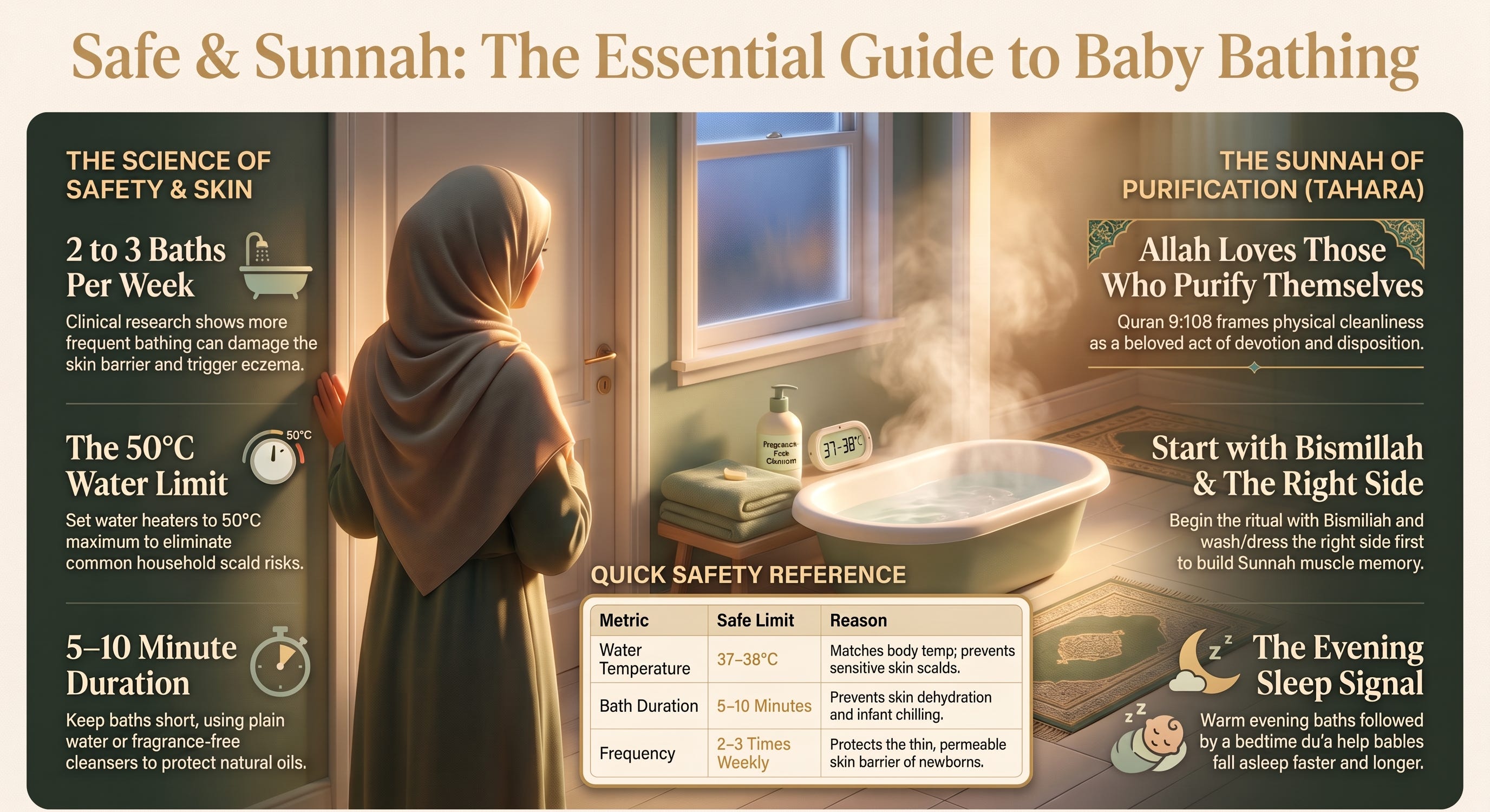
NHS guidance and clinical dermatology research shows that babies bathed more than 3 times per week are at significantly higher risk of dry skin, eczema flares, and damaged skin barrier — yet most parents bathe daily out of habit, not need. [1] This guide gives you the safe, evidence-based approach to baby bathing, paired with the Islamic understanding of why cleanliness is one of Allah’s most loved qualities.
There’s a moment most parents know.
You lower your baby into a few inches of warm water. They still. Their arms float out slightly, their face shifts — somewhere between confused and content. And for a moment, the house is quiet.
It’s ordinary. It’s also one of the most tender rituals of the early months.
Here’s what surprised me when I first studied the research: most of us are probably bathing our babies too often. The NHS and clinical guidelines are clear — 2 to 3 baths a week is all your baby needs. [1] Daily bathing, something parents do out of habit or routine, can actually strip your baby’s skin of the oils that protect it, leaving them vulnerable to dryness and irritation. [6]
But this isn’t just about frequency. It’s about doing it right. The right temperature, the right order, the right level of attention — because bath time is also one of the places where accidents happen fastest. Drowning takes seconds in very shallow water. [3]
And for Muslim parents, there’s a layer beyond the practical: Islam has always understood that cleanliness isn’t just hygiene. It’s something Allah loves. Every time you wash your baby carefully, dry the creases, say Bismillah before the water — you’re doing something that our tradition has always called tahara. Purification. Sacred.
Let me walk you through what the research actually says, and what Islam has always known.
Why This Guide Is Different From Generic Baby Care Advice
Every recommendation comes from current clinical sources — NHS guidelines, the Royal Children’s Hospital, peer-reviewed dermatology research — not parenting blogs or habit-based advice. [1,2,6]
This isn’t just a how-to. It’s rooted in the Islamic concept of tahara (purification), showing how physical care for your baby connects to something Allah has explicitly said He loves. [4,5]
You’ll also get the Safe & Sunnah Bath Time Pack — a free 3-page printable with a bath safety checklist, skin care reference card, and an Islamic tarbiyah card for the bathroom routine. Keep reading to download it at the end.
How Often Does a Baby Actually Need a Bath?
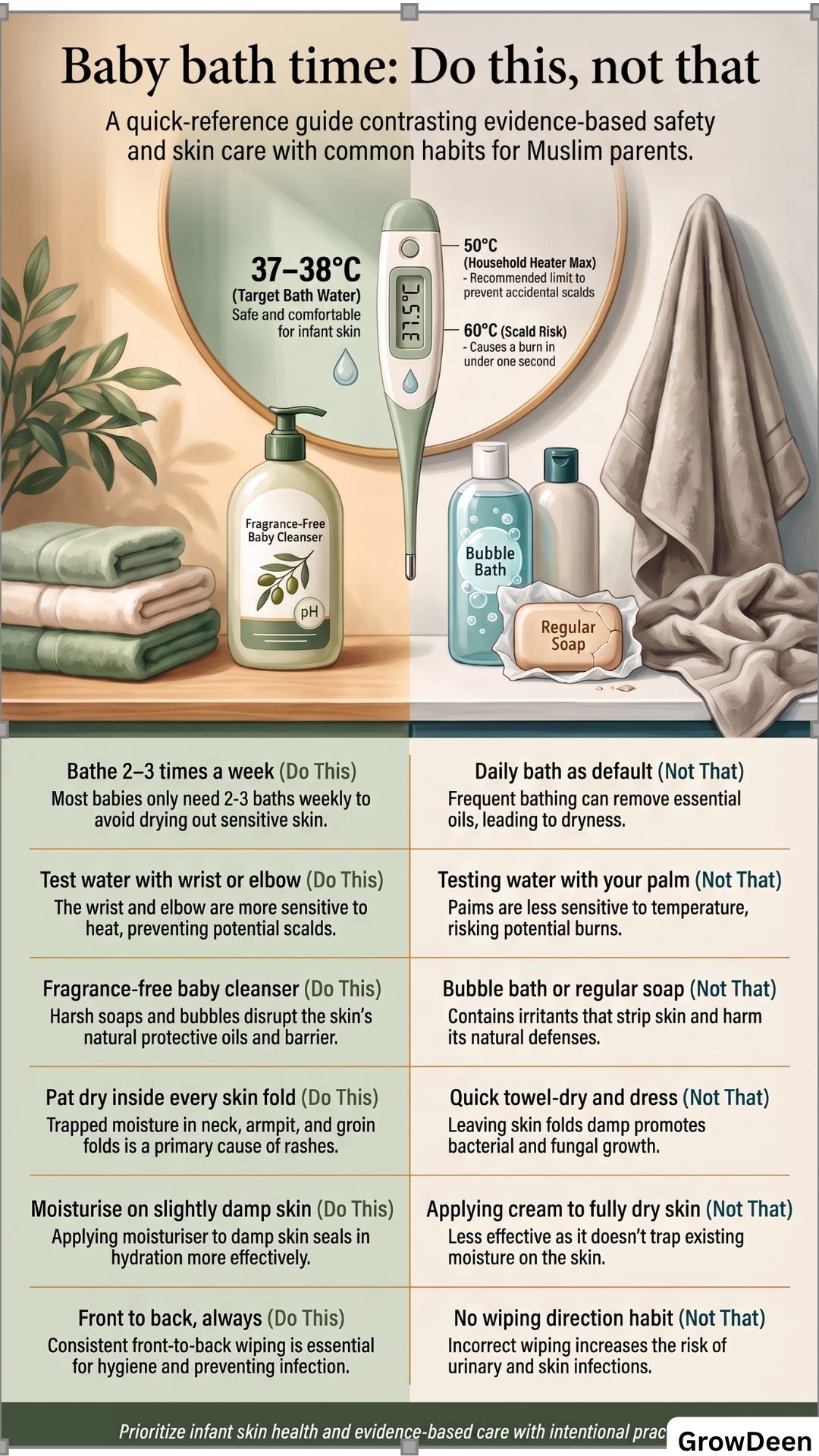
2 to 3 times a week. That’s it. [1,2]
If you’ve been bathing daily, you’re not alone — but the research doesn’t support it. Over-bathing removes the natural oils in your baby’s skin barrier, which is thinner and more permeable than adult skin, and this is exactly what triggers dryness and in susceptible babies, eczema. [6]
Each bath should last 5 to 10 minutes. Shorter for babies with dry or sensitive skin. [2]
If your baby genuinely loves the water and you want to go daily, watch the skin. Any signs of dryness, flaking, or redness? Pull back and moisturise immediately after each bath. [6]
On non-bath days, a “top and tail” wash — face, hands, and nappy area only — is everything they need.
When Should You Give the Bath?
When you’re not about to be interrupted.
Seriously. This matters more than the time of day. A bath you have to abandon because the doorbell rings is a bath that becomes dangerous. [2]
That said, evening baths do have something going for them. A warm bath raises your baby’s body temperature slightly, and when they cool down afterwards, it signals the body to prepare for sleep. Research shows warm baths in the hour or two before bedtime can help babies fall asleep faster and sleep longer. [7] Pair that with a feed and the bedtime du’a, and you have a routine that holds.
Setting Up Bath Time Safely
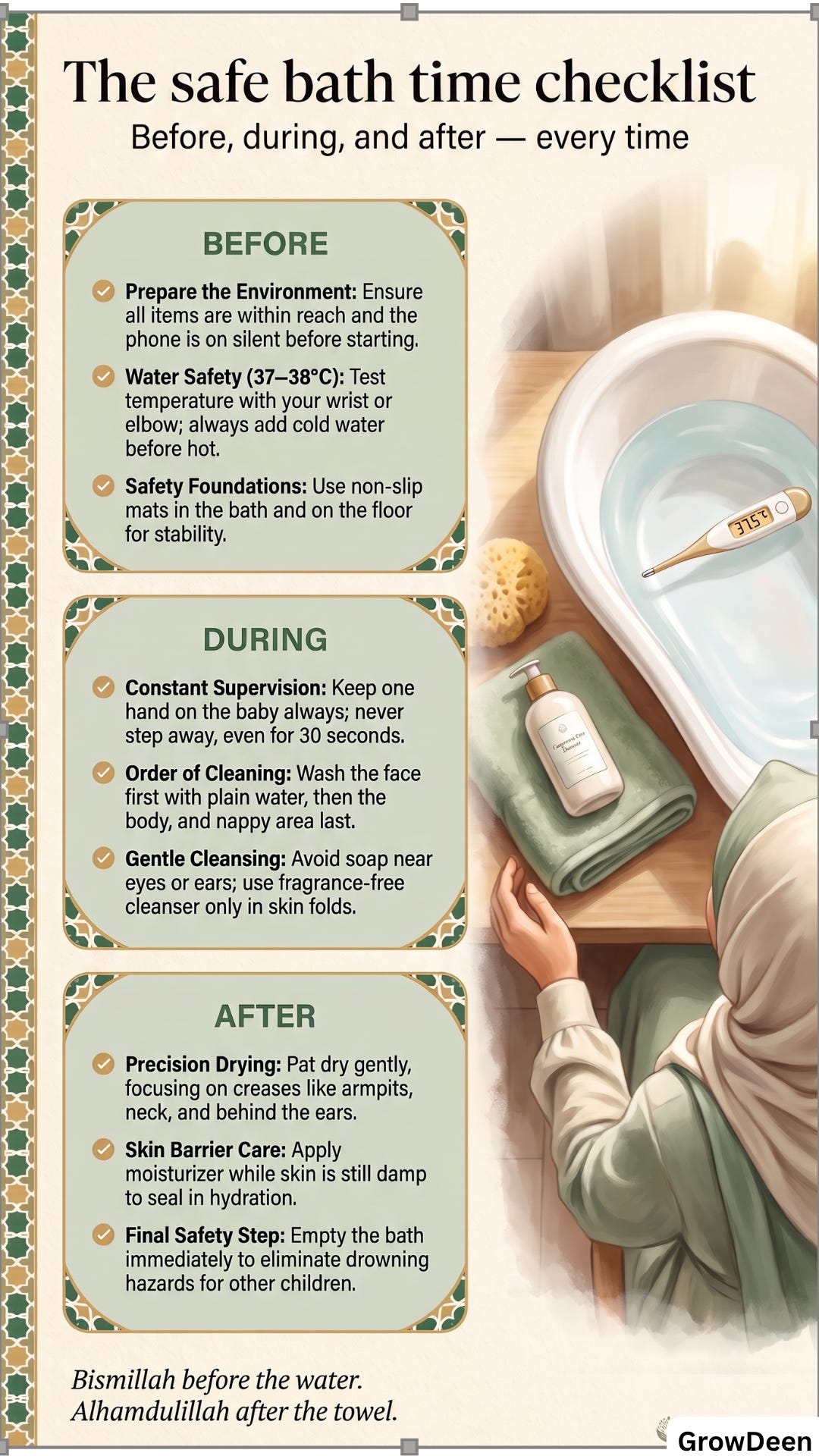
Before the water goes in. Gather everything you’ll need — towel, washcloth, clean nappy, clean clothes, any moisturiser or barrier cream — and put it all within arm’s reach. [2] Once your baby is in the water, you cannot leave to find something. Not even for thirty seconds.
Here’s why that rule matters so much: drowning can happen in seconds, in water no deeper than a few inches. [3] It’s one of the most preventable causes of infant death, and it happens fastest when a parent steps away.
Switch your phone to silent. Take off your watch. Wash your hands.
On water temperature. Aim for 37–38°C. [2] Test with your wrist or elbow, not your hand — both are more sensitive than the palm and will catch heat your hand misses. The water should feel warm, not hot. To your hand, hot bath water can feel manageable. To your baby’s skin, which is significantly more sensitive, it can cause a scald.
One thing most parents don’t know: at 60°C, a scald occurs in under a second. At 54°C, it takes three seconds. The Royal Children’s Hospital recommends setting your home water heater to a maximum of 50°C — not as an extreme precaution, but as a basic one. [3]
I know that sounds like a small thing to check. It takes two minutes. It’s worth doing tonight.
The Bath Itself
Lower your baby in slowly, one hand on them the whole time. If you’re using a full bath, kneel beside it — you need to be able to hold them securely without your back giving out. [2]
Start with the face. Plain water, soft washcloth. Wipe each eye from inner corner outward, fresh section of cloth for each eye. Then the rest of the face. No soap near the eyes. [2]
Move to the neck, then the body. Fragrance-free cleanser in the skin folds if needed — under the chin, armpits, the groin creases. These spots trap moisture and need real attention. Genitals last, front to back. [2]
Skip bubble bath and regular soap. They disrupt the skin’s natural barrier, and that’s usually where nappy rash begins. [6]
Wash hair once or twice a week, at the end of bath time so your baby doesn’t get cold first.
I know this is a lot to carry mentally, especially when you’re already exhausted and bath time arrives at the worst hour.
That’s why I made the Safe & Sunnah Bath Time Pack — a printable, 3-page guide with a pre-bath safety checklist, a baby skin care reference card, and an Islamic tarbiyah card for the bathroom routine. Keep reading to find it at the end of this article.
Support Muslim Parenting Lab ❤️
Is there something in your record you would like wiped? Give any amount today with the button below.
The Prophet ﷺ said charity extinguishes sin as water extinguishes fire. (Jami’ at-Tirmidhi 2616, hasan)
What the Quran Teaches About Cleanliness — and Why Bath Time Matters More Than You Think
When I first came across this verse, it stopped me.
In Surah At-Tawbah, Allah praises the Companions of Masjid Quba’ — not for their scholarship or their bravery, but for something startlingly physical: they washed thoroughly with water. And His response? “...Within it are men who love to purify themselves; and Allah loves those who purify themselves.” [Quran 9:108] [4]
According to Tafsir Ibn Kathir, the Prophet ﷺ asked them directly what their purification involved. They described washing with water after relieving themselves. And he confirmed: “That is it.” That physical, repeated, deliberate act of cleansing — water, consistency, care — is what earned the description mutatahireen. The purifiers. The people Allah loves.
There’s a companion teaching preserved from the scholar Sa’id ibn al-Musayyib that says it more simply: “Allah is pure and He loves purity. He is clean and He loves cleanliness.” [Sunan al-Tirmidhi 2799 — Sahih] [5]
Here’s what strikes me about both of these. The Islamic framing of cleanliness isn’t about ritual alone. It’s about a disposition. A habit. A love of being clean — because Allah loves it. When you wash your baby’s creases carefully, when you dry gently behind their ears, when you say Bismillah before the water — these are small acts. But they sit inside a tradition that calls them beloved.
The research on infant skin care and the Islamic value of tahara are pointing at the same thing. This is what good parenting looks like. [8]
After the Bath
Lift your baby out with both hands and dry them on a towel on the floor wherever possible — the floor has no edges. [2]
Pat dry, never rub. Every crease gets attention: armpits, groin, neck folds, behind the ears. Moisture left in those folds is where rashes begin. [6]
Moisturiser goes on while the skin is still slightly damp — that’s when it seals in best. [6] Barrier cream on the nappy area. No talcum powder — it’s no longer recommended due to inhalation risk. [6]
When dressing, say Bismillah and start from the right side. Right arm, right leg first. It’s a small Sunnah, but done at every dressing from day one, it becomes muscle memory.
Empty the bath as soon as your baby is safe and dressed. Standing water is still a hazard if there are other young children in the house. [3]
The Full Companion Pack
If you’ve read this far, you’re the kind of parent who approaches bath time as something worth getting right — not just for hygiene, but for the safety and the spiritual dimension of it. That tells me something.
Inside the Safe & Sunnah Bath Time Pack (one comprehensive PDF, 3 pages):
Page 1: Bath Time Safety Checklist — A complete pre-bath, during-bath, and after-bath checklist covering temperature, preparation, drowning prevention, and skin care — designed as a laminated-card-style reference you can keep in your bathroom.
Page 2: Baby Skin Care Reference Card — A quick reference covering moisturiser timing, barrier cream guidance, what to use and what to avoid, and signs to bring to your paediatrician — so you can care for your baby’s skin confidently without Googling everything.
Page 3: The Tarbiyah Bathroom Card — The authentic du’a for entering a place of purification, with full Arabic text, transliteration, and English meaning, plus a short tarbiyah note on how even the bathroom is a place of Islamic adab — something you can begin teaching your child from the earliest years.
This isn’t a PDF to download and forget. It’s designed to stay in your bathroom — where bath time actually happens.
Every subscriber to Muslim Parenting Lab receives a companion pack with each article. We cover the full journey of raising Muslim children — from newborn care through school years — all backed by clinical research and rooted in Islamic wisdom.
Your Micro-Action for Tonight
Before you go to bed, check your home water heater temperature. If it’s set above 50°C, that’s a single adjustment that eliminates one of the most common scald risks for young children. [3]
Two minutes. Worth it.
Share This With Someone Who Needs It
Think of one person right now: a new mother in your circle who’s bathing her baby every single night without knowing it might be damaging their skin, a sister whose baby has eczema and who doesn’t know that over-bathing could be making it worse, a friend who’s asked you about baby care and you’ve been meaning to send something actually useful.
This article could make bath time safer and more intentional for them. Share it today — not as advice-giving, but as care. Sometimes the most loving thing we can do is pass along what we’ve learned.
Frequently Asked Questions
Q: How often should I bathe my newborn?
A: 2 to 3 times a week is enough for even the youngest babies. [1,2] Their skin is thinner and more sensitive than an older infant’s, which actually makes over-bathing more damaging at this stage. On the other days, a gentle top-and-tail wash — face, hands, and nappy area — covers everything that genuinely needs cleaning.
Q: What temperature should a baby bath be?
A: 37–38°C is the target range. [2] Test it with your wrist or elbow before your baby goes in — both areas are more sensitive to heat than your palm. The water should feel comfortably warm, not hot.
Q: Can I bathe my baby every day?
A: You can, but the research suggests you don’t need to — and daily bathing increases the risk of dry skin and eczema flares, especially in babies who are already prone to skin sensitivity. [6] If you choose to go daily, keep it short (5 minutes maximum) and moisturise immediately after every bath.
Q: Is it safe to bathe a newborn before the umbilical cord stump falls off?
A: Sponge baths are generally recommended until the stump falls off and the area heals — typically within 1 to 3 weeks. [2] Keep the stump dry; don’t submerge it. Once it’s fully healed, you can begin regular baths normally.
Q: What should I use to wash my baby’s skin?
A: Plain water is usually enough, especially for newborns. If you use a cleanser, choose one specifically formulated for babies — fragrance-free and pH-balanced. [6] Regular soap, bubble baths, and adult cleansers can disrupt the skin’s natural protective barrier and trigger irritation or nappy rash.
Q: How do I know if I’ve set my water heater too hot?
A: Run the hot tap in your bathroom and test it after it’s been running for a minute. If it feels uncomfortably hot on your wrist, it’s likely above 50°C. [3] Most water heaters can be adjusted — check the thermostat on the unit itself, or contact your building manager. 50°C is the recommended maximum for households with young children.
References
[1] New, K. (2019). Evidence-based guidelines for infant bathing. Research Review. https://www.researchreview.co.nz/nz/Clinical-Area/General-Medicine/Dermatology/Educational-Series-Guidelines-for-Infant-Bathing.aspx
[2] National Health Service (NHS). Washing and bathing your baby. NHS. https://www.nhs.uk/baby/caring-for-a-newborn/washing-and-bathing-your-baby/
[3] Royal Life Saving Australia. Bath time safety. https://www.royallifesaving.com.au/stay-safe-active/communities/how-to-keep-children-safe/linked-pages/bathtime-safety
[4] Qur’an, Surah At-Tawbah 9:108. Tafsir Ibn Kathir verified — https://quran.com/9/108
[5] Sunan al-Tirmidhi 2799 — Graded: Sahih (Al-Suyuti) — https://sunnah.com/tirmidhi:2799
[6] The Royal Children’s Hospital (RCH). (2022). Skincare for babies. https://www.rch.org.au/kidsinfo/fact_sheets/Skincare_for_babies/
[7] Maeda, T., Koga, H., Nonaka, T., & Higuchi, S. (2023). Effects of bathing-induced changes in body temperature on sleep. Journal of Physiological Anthropology, 42(1), Article 20. https://doi.org/10.1186/s40101-023-00337-0
[8] Harvard Center on the Developing Child. (2017). Serve and return interaction shapes brain circuitry. https://developingchild.harvard.edu/science/key-concepts/serve-and-return/
[9] Sahih al-Bukhari 258; Sahih Muslim 319 — Beginning ghusl from the right side (Muttafaqun Alayhi) — https://sunnah.com/bukhari:258
[10] ACCC Product Safety. (n.d.). Kids’ toys guide. https://www.productsafety.gov.au/consumers/play-and-exercise-safely/play-with-kids-toys-safely/kids-toys-guide
We combine scientific research with Qur’an and authentic Sunnah, and we cite our sources. Even so, this is general guidance and no substitute for a doctor who can examine your child.