

83.7% of preschoolers had tantrums at least sometimes, but only 8.6% had them every day. [1]
Printable. For the next meltdown on the floor.
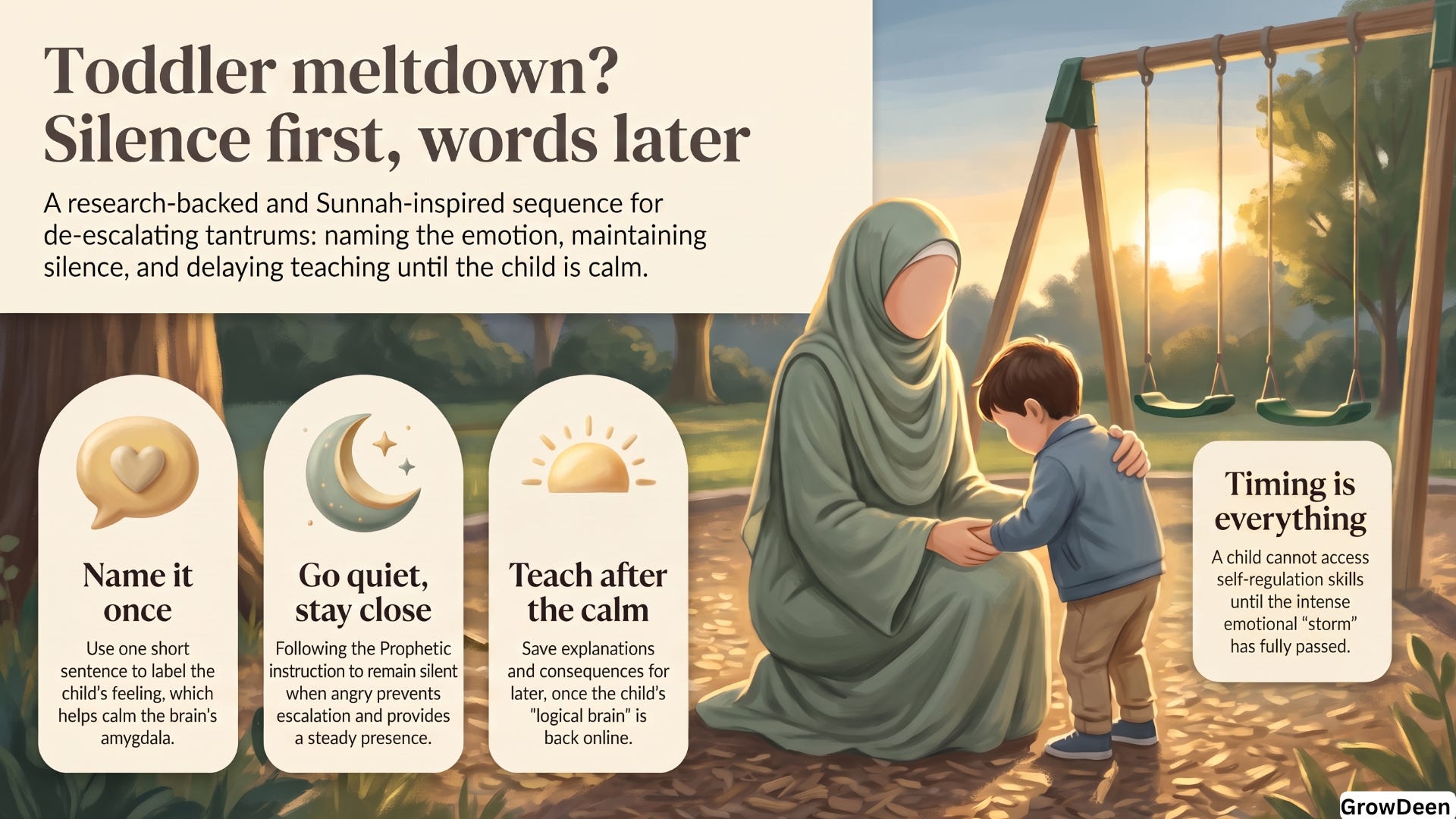
Almost every young child loses it sometimes. When researchers at Northwestern University surveyed the parents of 1,490 preschoolers about the previous month, 83.7% reported tantrums at least occasionally, while only 8.6% described them as a daily event. [1] The milder outbursts tended to follow frustration in predictable situations, and the ones worth a closer look were unpredictable, prolonged or destructive. [1] A separate brain-imaging study found that putting a feeling into a single word calms activity in the amygdala, the part of the brain that raises the alarm. [2]
Mid-meltdown is the worst time to teach anything.
It’s twenty minutes before Maghrib at the park. Your four-year-old has been told it’s time to go home, and he has folded himself onto the woodchips, kicking. You crouch down the way the parenting posts said to. You keep your voice soft, and you explain that the sun is going down, that dinner is waiting, that the swings will still be here tomorrow.
He screams louder.
Two other parents are pretending not to watch. Your face is hot, and under the embarrassment sits a quieter worry you’d never say out loud: what if he never learns to control this, and what if that’s on you? You did everything the usual advice asked of you. That’s exactly what makes it so disorienting.
A lot of parenting advice treats a meltdown as a teaching moment, as if the right explanation, delivered gently enough, will switch the feeling off. It won’t, and the reason has little to do with how well you explain. Which leaves a strange question hanging. Why does the exact sentence that bounced off a screaming child land perfectly an hour later, over a plate of rice? The answer changes what you’ll do in the next meltdown, and it’s waiting near the end of this article.
What makes this approach different
Every step rests on published research you can check, from Northwestern’s 2012 study of 1,490 preschoolers to randomised trials of emotion coaching with young children. [1,3]
The timing comes from the Qur’an and Sunnah as much as from science: silence while anger is high, teaching once it has settled.
You already have the free Quiet First Pack from the top of this page — three printable pages for the fridge and for the conversation after the storm.
Why won’t my child calm down when I explain things?
You’ve probably noticed that the more reasonable you sound, the harder your child pushes back. It feels personal. It almost never is.
The Qur’an describes this same order of events in a prophet. When Prophet Musa (peace be upon him) came back to find his people worshipping a calf, he threw down the Tablets in anger, and he took them up again only once the anger had subsided. [4] That verse gets a closer look further down, because it answers more than it first seems to.
Developmental research explains why the order matters so much for a child. Self-regulation, meaning the ability to hold back an impulse and choose something else, builds slowly across the first four years of life and keeps building after that. [5] A child in the middle of a meltdown is using everything they have just to get through the feeling, and an explanation asks them to reach for a skill that simply isn’t available to them in that moment.
Some very natural responses stretch a meltdown out, even though they feel right at the time:
Lectures, reasoning, or asking “why did you do that?” while the storm is still going.
Shouting back, threatening, or sarcasm.
Brushing the feeling aside with “Stop being a baby” or “It’s only a biscuit.”
Giving in just to stop the noise. A no given for a good reason can stay a no, said kindly.
Reaching for a screen or sweets every time, which can teach a child that feelings are something to be distracted from.
Shutting a very upset young child alone behind a closed door.
If explaining makes things worse, the obvious next question is what to say instead. It’s shorter than most parents expect.
What should I say to a child in the middle of a meltdown?
Your mind goes blank. Or it floods with far too many words at once, and all of them come out sounding like a lecture.
Start by watching instead of talking. The Prophet ﷺ paid close attention to the small emotional signals of the people nearest to him. ‘A’ishah narrated that he said to her, “I know when you are pleased with me or angry with me.” She asked, “Whence do you know that?” He said, “When you are pleased with me, you say, ‘No, by the Lord of Muhammad,’ but when you are angry with me, then you say, ‘No, by the Lord of Abraham.’” She replied, “Yes (you are right), but by Allah, O Allah’s Messenger, I leave nothing but your name.” [6] He had noticed a change of two words in how she spoke. A child’s signals are usually far louder: stiff arms, a jaw set hard, a sudden flop onto the carpet, a back turned to you.
Then say what you see, in one short sentence tied to whatever set it off. “You’re really cross that it’s time to leave.” “You’re sad your tower fell.” In a brain-imaging study, people who named the emotion shown in a face had less amygdala activity than they did on the study’s other tasks. [2] Researchers call the wider habit of noticing, naming and accepting a child’s feelings emotion coaching, [7] and programs that teach it to parents of young children have improved children’s emotional understanding and reduced behaviour problems. [3,8]
After that one sentence, stop talking. Count to five in your head, or say “SubhanAllah” silently a few times. The Prophet ﷺ said, “Teach and make things easy and not difficult. When one of you is angry, he should be silent.” [9] During a meltdown there are usually two angry people in the room, and that instruction covers you as well.
Quiet first. Teach after.
Sometimes the pause is all it takes. A child might sniff, sit up and try a deal: “Can we come back tomorrow?” That’s the start of problem-solving, and it deserves a calm, clear answer either way.
Some children, though, don’t sniff and sit up. They escalate, and that raises a harder question.
Should I stay close or walk away during a tantrum?
The urge to leave the room can be enormous, especially after a small fist has caught your arm or a shoe has flown past your head.
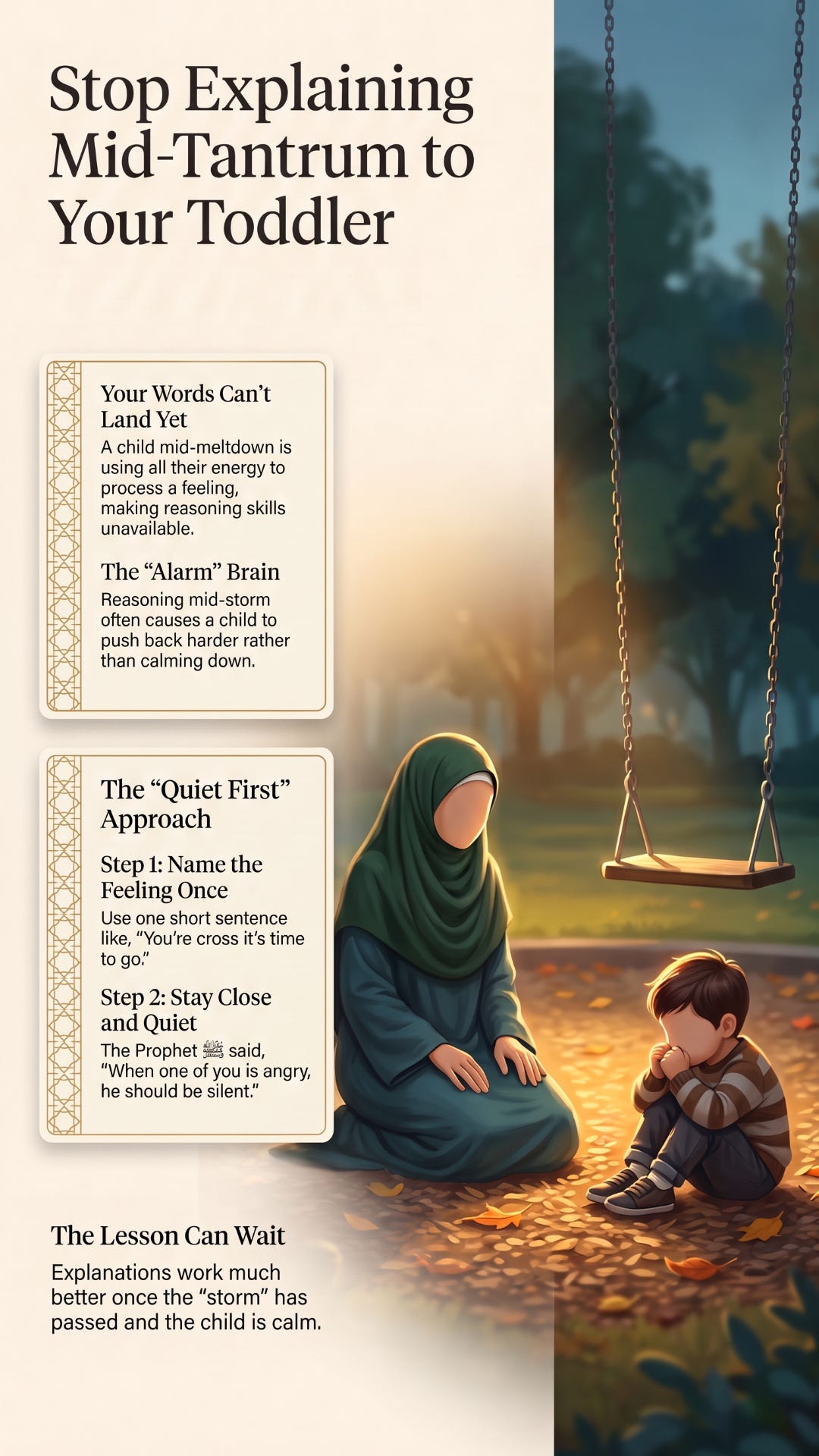
For most young children, staying near while staying quiet works better than either talking or leaving. When the storm keeps going, a few things matter more than anything you could say:
Make sure everyone is safe, siblings included, and move anything sharp or breakable out of reach.
Stay calm and within reach. Your steadiness shows your child that strong feelings can be lived through and that they don’t frighten you.
Name the feeling again if it seems to help: “You’re furious about this.”
Call in your spouse or another adult you trust if you need a break.
Then wait, patiently.
“Use your words” and “Take a deep breath” are tempting things to say, and most young children can’t act on either until the feeling has faded. If being close seems to feed the storm, step back a little, as long as your child stays in sight and safe.
All of this is a lot to hold in your head at twenty to six on a Tuesday, with the rice boiling over.
The download button is at the top of this page, and there’s a full description of what’s inside it below. The Quiet First Pack puts the after-the-storm conversation, a cool-off check for consequences and a short reflection card on anger onto pages you can stick to the fridge. The download button is at the top of this page, and there’s a full description of what’s inside it below.
The Qur’anic verse mentioned earlier deserves its moment first, because it shows this sequence playing out in one of the most intense scenes in the Qur’an.
What the Qur’an shows about letting anger settle before acting
When your child is screaming and your own temper is climbing, the question in your head is usually “How do I make this stop?” The Qur’an answers a slightly different one: what happens once the anger passes.
In Surah al-A’raf, Prophet Musa (peace be upon him) returns to find his people worshipping the calf, throws down the Tablets and takes hold of his brother. [4] A few verses later, Allah says: “And when the anger subsided in Moses, he took up the tablets; and in their inscription was guidance and mercy for those who are fearful of their Lord.” [4] According to Tafsir Ibn Kathir, Musa picked the Tablets back up once his anger had calmed and subsided, the same Tablets he had thrown down out of jealousy for Allah’s sake when he saw the calf. [4] The Arabic verb in the verse, sakata, is the ordinary word for falling silent.
The guidance and mercy were written in those Tablets the whole time. Musa took them up once the anger had gone quiet.
The Prophet ﷺ put the practical side into one short instruction: when one of you is angry, he should be silent. [9] Emotion-coaching research arrives at a similar order from a completely different starting point, which is to name the feeling, let it pass and teach afterward. [3,8] May Allah make our homes places where big feelings are met with patience, by parents and children alike.
When should I deal with the hitting or the rudeness?
Your child has just hit their sister, and every instinct says the consequence has to land right now or it won’t count.
It will count later. It will probably count more. Abu Bakrah once wrote to his son, a judge in Sijistan, “Do not judge between two persons when you are angry, for I heard the Prophet ﷺ saying, ‘A judge should not judge between two persons while he is in an angry mood.’” [10] Some commentators on this hadith extend the same caution to other states that cloud a person’s judgement, such as intense hunger or heavy drowsiness. In these moments the parent is the judge, and a penalty announced mid-shout (”No park for a month!”) is usually far bigger than the offence and quietly dropped the next day, which teaches the child that limits bend.
A 2022 review of 53 studies linked parents’ own emotion regulation to warmer, more supportive parenting and to children’s regulation skills. [11] Once both of you are calm, choose from these depending on what happened:
Offer a different outlet for next time. “When you feel angry, come and squeeze this cushion, and come back when your body feels calm.”
Comfort. “That was frightening, wasn’t it? Come here.” Sometimes a long hug is the whole lesson.
Suggest a better move. “Next time, ask for the car back instead of grabbing it.”
Hold a limit. “I know you were very angry. Hitting your sister is never OK, so we’re staying home from the playground this afternoon.”
This is also the moment to separate the feeling from the behaviour: “Feeling frustrated and disappointed is OK. Shouting at Ummi and kicking the door was not.”
What if I’m the one losing my temper?
Some meltdowns end with two people in tears, and one of them is taller.
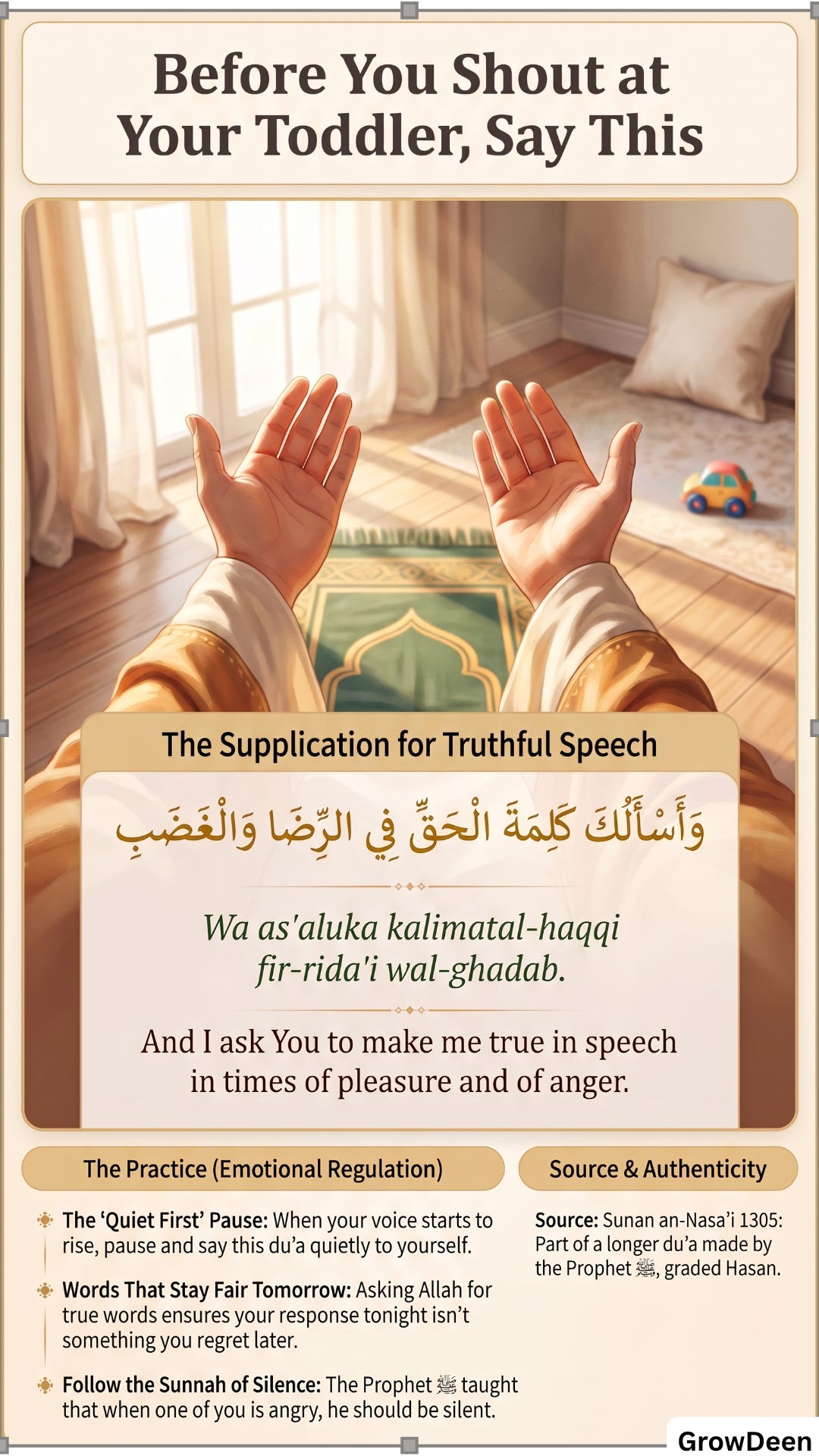
That moment tends to bring a heavy private verdict with it, usually some version of “I’m failing at this.” Research is kinder than that verdict and more useful. A study of mothers and preschoolers found that emotion coaching was linked to calmer children mainly when the mother’s parenting stress was lower, [12] and parents’ own beliefs about emotion shape how their children learn to handle feelings. [7,13] The same 2022 review tied a parent’s emotion regulation to more supportive parenting overall. [11] Your calm is part of the method, which means protecting it counts as parenting.
So guard your sleep where you can, and ask for help before you reach the edge. A man once said, “Would that I had prayed, and got comfort,” and when people objected, he told them he had heard the Messenger of Allah ﷺ say, “O Bilal, call iqamah for prayer: give us comfort by it.” [14] Salah can be that reset in a hard afternoon, a few minutes turned toward Allah while the house settles. On the days you slip and shout, as every parent does, go back once you’re both calm and apologise, because your child learns from that repair as well.
What does calming practice look like at 2, 5 and 8?
Calming skills stick best when they’re practised while nobody is upset. A few habits fit easily into ordinary family life at any age:
A calm corner with a soft cushion, a prayer mat, a few Islamic picture books and a recording of gentle Qur’an recitation. Let your child go there by choice, never as a punishment.
A family body signal. Pick a phrase like “anger alarm,” and whenever anyone says it, everyone sits on the floor and breathes slowly for a minute. Practise it as a game first.
Stories from the Qur’an and Seerah told in your own words, pausing to ask how the people in them might have felt.
Feeling words at the dinner table. “How do you think the shepherd felt when his sheep went missing?”
Praise for effort. “You were so cross, and you went to your cushion. MashaAllah, that was hard to do.”
At 2 to 3, meltdowns come often and words are few. Keep your sentences very short (”You’re cross. Mama’s here.”), keep your child safe, and hold them if they want to be held. Hunger and tiredness sit behind a great many toddler storms, so snacks and naps on schedule prevent quite a few of them.
At 4 to 5, children can learn more precise feeling words: frustrated, jealous, worried, disappointed, left out. With help they can start using the calm corner and the family signal.
At 6 to 8, a calm child can talk through what happened and work out a better plan for next time. They can also begin to try the Prophet’s ﷺ teaching about silence in anger for themselves, [9] which is a big thing to ask of a seven-year-old and deserves praise when it happens.
When is a tantrum more than a normal phase?
Most tantrums, however loud, belong to ordinary development. In the Northwestern study, the milder outbursts clustered around frustration in predictable situations, while the concerning ones were unpredictable, prolonged or destructive, and daily tantrums were the exception at 8.6%. [1]
Speak to your child’s doctor if outbursts are becoming more frequent or more intense, if your child often hurts themselves or others, if meltdowns are affecting nursery, school or friendships, or if you’re finding it hard to cope. The doctor can look for anything underlying and, where needed, refer you on to a child psychologist, a qualified counsellor or a parenting program. Programs built on emotion coaching and on parent-child interaction therapy have good evidence behind them for improving young children’s emotion regulation and behaviour. [3,8,15] Autistic children and children with ADHD often need extra, tailored support with strong feelings and impulse control, and the professionals who know your child can suggest strategies that fit them. None of this replaces medical advice, so follow your own doctor’s guidance.
Why does the same sentence work an hour later?
Back to the park, and the boy on the woodchips.
An hour later he’s at the table, calm, pushing rice around his plate. You say almost exactly what you said at the swings, about the sunset and the dinner waiting at home. He nods. He might even add, “I was really cross.” The words haven’t changed. What changed is that the feeling has passed, and the skills he couldn’t reach at the park are available to him again. [5]
Your explanation was never the problem. Its timing was. The idea that a meltdown is a teaching moment is what made the park so hard, and it’s the one thing worth letting go of.
Quiet first. Teach after. At the park, the dinner table, the car park after Jumu’ah, and every hard afternoon still to come.
If you’ve read this far
You’re a parent who wants to understand these moments, and that says something good about you. The trouble is that the middle of a meltdown is the worst possible time to remember anything you read, so GrowDeen made the key parts of this article into something you can keep where you’ll see it.
Inside The Quiet First Pack (one comprehensive PDF, 3 pages):
Page 1: The After-the-Storm Talk. A four-move conversation card (reconnect, retell, name, plan) with ready-to-say lines for ages 2 to 3, 4 to 5 and 6 to 8, designed as a quick reference card you can keep on the fridge door.
Page 2: The Cool-Off Consequence Sheet. Four quick checks to run before you decide any consequence, plus a fill-in builder with worked examples that link each consequence to what actually happened, so you can settle on a fair, proportionate limit in under ten minutes.
Page 3: Anger Settles First. Four authentic reflection cards: Qur’an 7:154 on Prophet Musa taking up the Tablets once his anger subsided, the Prophet’s ﷺ instruction to be silent when angry, the hadith on not judging while angry, and his words to Bilal about finding comfort in prayer. It’s a page to read for yourself on the hard days, and to share with an older child as a family reminder.
This isn’t just a PDF to download and forget. It’s built to stay on your fridge, where you’ll actually see it the next time a meltdown starts.
The Quiet First Pack is what every subscriber receives with each article. GrowDeen covers the whole early stretch of raising Muslim children, from sleep and feeding to behaviour, big feelings and the first Islamic habits, all backed by scientific research and rooted in the Qur’an and Sunnah.
If you’re a Muslim parent who wants both evidence-based guidance and Islamic perspective, subscribe for free so future resources arrive in your inbox before you need them.
Subscribe free for parenting resources backed by both science and Sunnah, the kind of guidance you won’t find anywhere else. No spam, no clutter, just resources that matter.
One thing to do tonight
Take a sticky note and write the one sentence you’ll use in the next meltdown: “You’re really cross that ______.” Put it on the fridge before bed. When the next storm comes, that sentence is the only thing you need to remember.
May Allah place barakah in your patience, and make the calm you practise in your home easier with every hard afternoon still ahead.
Share this with someone who needs it
Think of one person right now: your sister-in-law whose three-year-old melted down at the last Eid dinner while the whole family offered her advice, or the friend from the masjid who messaged you at nine o’clock asking whether this is normal.
This article could make her next hard afternoon a little lighter. Share it with her today, as support rather than advice.
Frequently Asked Questions
Q: How often do toddlers and preschoolers have tantrums, and when should I worry? A: Tantrums are very common. In a study of 1,490 preschoolers, 83.7% had them at least sometimes and only 8.6% had them daily. [1] The ones worth raising with your doctor are daily, unpredictable, prolonged or destructive. [1] See “When is a tantrum more than a normal phase?” above.
Q: What should I say when my child is having a meltdown? A: One short sentence that names the feeling and links it to the trigger, then silence. “You’re really cross that it’s time to leave” is enough. Naming a feeling calms the brain’s alarm response, [2] and longer explanations can wait until your child is calm.
Q: Should I ignore my child’s tantrum? A: Ignoring the feeling usually backfires, but you don’t need to talk through it either. Stay close, keep everyone safe and stay quiet, so your child knows you’re there without being given anything to argue with.
Q: Is it OK to leave my child alone to calm down? A: A very upset young child is better off with you in sight. If being close seems to make it worse, step back a little, but keep your child where you can see them and know they’re safe.
Q: What does Islam say about handling anger in the moment? A: The Prophet ﷺ said that when one of you is angry, he should be silent, [9] and he taught that a judge should not rule between two people while angry. [10] The Qur’an also describes Prophet Musa (peace be upon him) taking up the Tablets once his anger had subsided. [4] See “What the Qur’an shows about letting anger settle before acting” above.
Q: At what age do tantrums stop? A: There’s no single cut-off. Self-regulation grows gradually through the early years and keeps developing afterward, [5] so most children need less of your help as they get older and gain more words for what they feel. If outbursts stay frequent or intense, talk to your doctor.
References
[1] Wakschlag, L. S., Choi, S. W., Carter, A. S., Hullsiek, H., Burns, J., McCarthy, K., Leibenluft, E., & Briggs-Gowan, M. J. (2012). Defining the developmental parameters of temper loss in early childhood: Implications for developmental psychopathology. Journal of Child Psychology and Psychiatry, 53(11), 1099-1108.
[2] Lieberman, M. D., Eisenberger, N. I., Crockett, M. J., Tom, S. M., Pfeifer, J. H., & Way, B. M. (2007). Putting feelings into words: Affect labeling disrupts amygdala activity in response to affective stimuli. Psychological Science, 18(5), 421-428.
[3] Havighurst, S. S., Wilson, K. R., Harley, A. E., Kehoe, C., Efron, D., & Prior, M. R. (2013). “Tuning in to Kids”: Reducing young children’s behavior problems using an emotion coaching parenting program. Child Psychiatry and Human Development, 44(2), 247-264.
[4] Qur’an, Surah al-A’raf 7:150 and 7:154.
[5] Kochanska, G., Coy, K. C., & Murray, K. T. (2001). The development of self-regulation in the first four years of life. Child Development, 72(4), 1091-1111.
[6] Sahih al-Bukhari 5228, narrated by ‘A’ishah. Graded: Sahih.
[7] Gottman, J. M., Katz, L. F., & Hooven, C. (1996). Parental meta-emotion philosophy and the emotional life of families: Theoretical models and preliminary data. Journal of Family Psychology, 10(3), 243-268.
[8] Havighurst, S. S., Duncombe, M., Frankling, E., Holland, K., Kehoe, C., & Stargatt, R. (2015). An emotion-focused early intervention for children with emerging conduct problems. Journal of Abnormal Child Psychology, 43(4), 749-760.
[9] Al-Adab al-Mufrad 245, narrated by Ibn ‘Abbas. Graded: Sahih (al-Albani). Also in Musnad Ahmad 2136.
[10] Sahih al-Bukhari 7158; Sahih Muslim 1717. Narrated by ‘Abd al-Rahman ibn Abi Bakrah. Graded: Sahih.
[11] Zimmer-Gembeck, M. J., Rudolph, J., Kerin, J., & Bohadana-Brown, G. (2022). Parent emotional regulation: A meta-analytic review of its association with parenting and child adjustment. International Journal of Behavioral Development, 46(1), 63-82.
[12] Wu, Q., Feng, X., Hooper, E. G., Gerhardt, M., Ku, S., & Chan, M. H.-M. (2019). Mother’s emotion coaching and preschooler’s emotionality: Moderation by maternal parenting stress. Journal of Applied Developmental Psychology, 65, 101066.
[13] Hurrell, K. E., Houwing, F. L., & Hudson, J. L. (2016). Parental meta-emotion philosophy and emotion coaching in families of children and adolescents with an anxiety disorder. Journal of Abnormal Child Psychology, 45(3), 569-582.
[14] Sunan Abi Dawud 4985. Graded: Sahih (al-Albani).
[15] Rothenberg, W. A., Weinstein, A., Dandes, E. A., & Jent, J. F. (2019). Improving child emotion regulation: Effects of parent-child interaction-therapy and emotion socialization strategies. Journal of Child and Family Studies, 28(3), 720-731.