

The World Health Organization’s 2020 global report on violence against children found that up to 1 billion children aged 2 to 17 experience physical, sexual, or emotional violence each year, most of it from a caregiver in a moment of lost control. [1] This guide gives you the ten-second plan almost no parenting book teaches, backed by neuroscience and rooted in the mercy of Allah.
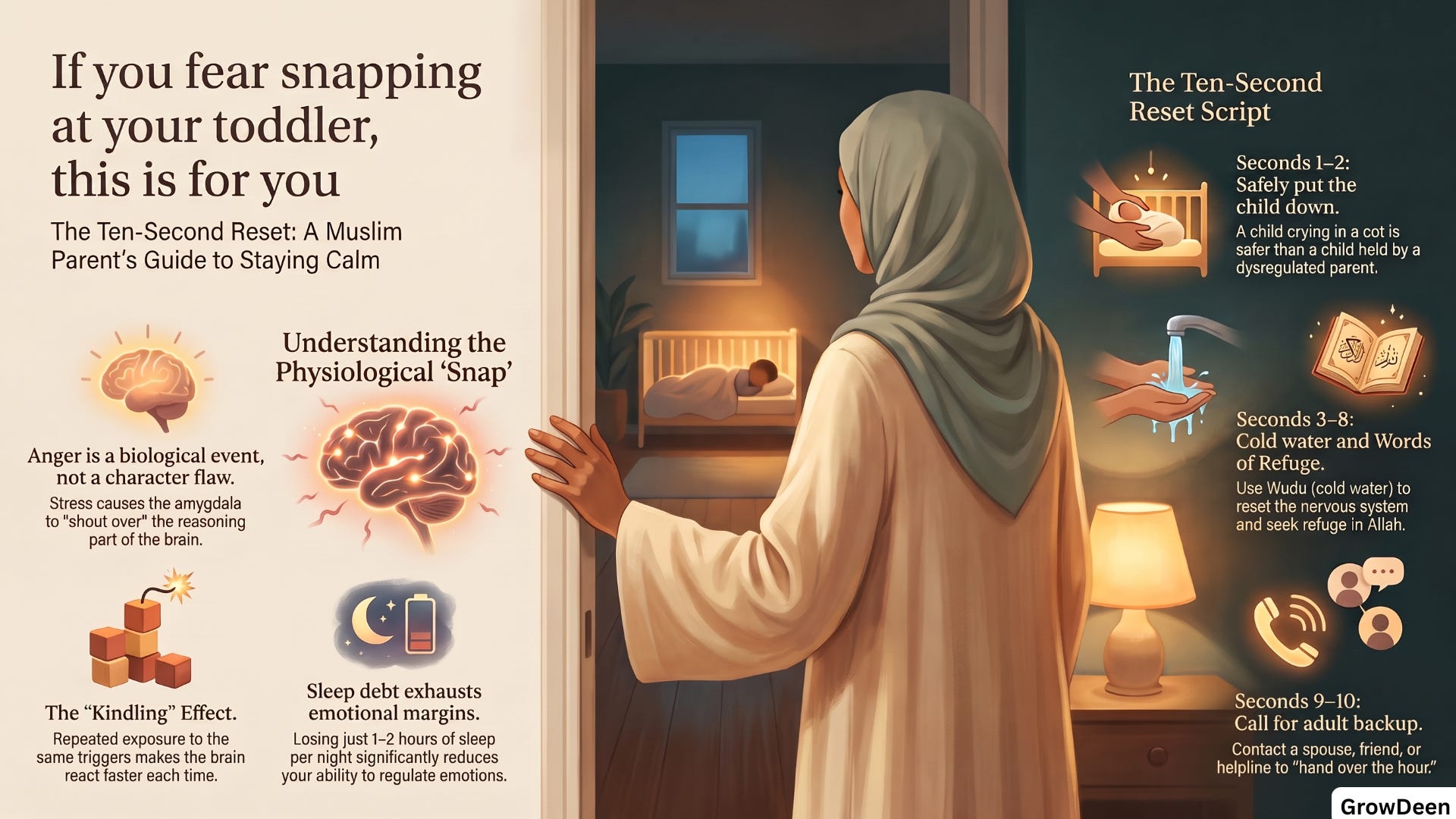
The parents this article is for are already halfway safe.
If you have ever driven home from work rehearsing how you will not shout tonight, this is for you. If you have ever put a crying baby down and stood in the hallway shaking, this is for you. If you have already snapped in a way you cannot take back and cannot sleep for the shame of it, this is especially for you.
Here is why that matters. In a large international review published in The Lancet Public Health, the parents whose children experience the worst long-term outcomes are, overwhelmingly, parents who never worry about what they might do. [2] The parents who worry are the parents who are trying. If you are reading this at 9:47 pm on a Tuesday because today was one of the hard ones, you are not the parent this data is about. Bookmark that thought.
Why This Guide Is Different From Generic Parenting Anger Articles
It treats the ten seconds before you might harm your child as the point that matters, not the hour after. Most articles on “gentle parenting” describe an ideal end-state. This one gives you a physical script for the moment your body is already halfway to a bad decision.
It fuses developmental neuroscience with the Sunnah wisdom on anger. The Prophet ﷺ prescribed sitting down, wudu, and refuge in Allah [3] more than fourteen centuries before modern research began mapping how each of these calms the body. Cold water on the face is the best-documented: it triggers the mammalian dive reflex, which slows the heart rate within seconds via the vagus nerve. Lowering the body and naming the emotion also reduce arousal, through mechanisms emotion-regulation research is still working out. [4] The specifics differ. The convergence is real.
It gives you systems, not sermons. Willpower fails. Sleep, community help, and the right professional support outlast willpower. This guide names them in plain language for the Muslim household.
A Question to Sit With as You Read
Before the practical toolkit, one question. Why does a parent who deeply loves their child sometimes feel a wave of rage sharp enough to frighten them? Bookmark that. What it actually is has been mapped by two separate fields, and neither of those fields will surprise a Muslim reader once they see the shape of the answer. The last section of this article returns to it.
The Anger Is a Physiological Event, Not a Moral Choice
The single most useful thing modern research has done for overwhelmed parents is to stop treating anger like a character flaw.
When a parent under sleep debt hears their toddler’s whine for the fourth hour in a row, the brain does what the brain does when a soldier hears an incoming shell or a first responder walks into a burning room. The amygdala fires. The prefrontal cortex, the part of the brain that considers the child’s inner life and weighs the ten-year consequence of a slap, gets shouted over by an older, faster system that evolved to keep humans alive on the savanna, not to negotiate with a two-year-old about shoes. [4]
The felt experience of this is important to name. It is not I am choosing to hit. It is this is happening to me. That is why the classic advice to “just calm down” is worse than useless. Calm is a downstream state. It is not a switch on the wall.
Two accelerants make this worse in ways every tired parent already knows.
Sleep debt as small as one to two hours per night, sustained over a week, reduces emotion regulation capacity by measurable amounts across large studies. [5] So the parent who says I was fine three months ago and I cannot understand why I am like this now is often describing a nervous system that has simply run out of margin.
The second accelerant is called kindling. Repeated exposure to the same trigger creates a shorter and faster response over time. Same whine. Same room. Same time of day. Each event makes the next one arrive quicker. This is the mechanism behind the pattern many Muslim mothers describe as I was fine, and then suddenly I was not fine. Nothing was actually sudden. The system had been slowly rehearsed by every previous flashpoint. [4]
But here is the part that matters. The same neurobiology means the reverse is trainable. Cold water on the face engages the parasympathetic nervous system through a well-mapped reflex; lowering the body and naming an emotion aloud have their own separate support in the emotion-regulation literature. That is why the ten-second script below is physical actions first, thoughts second. [6]
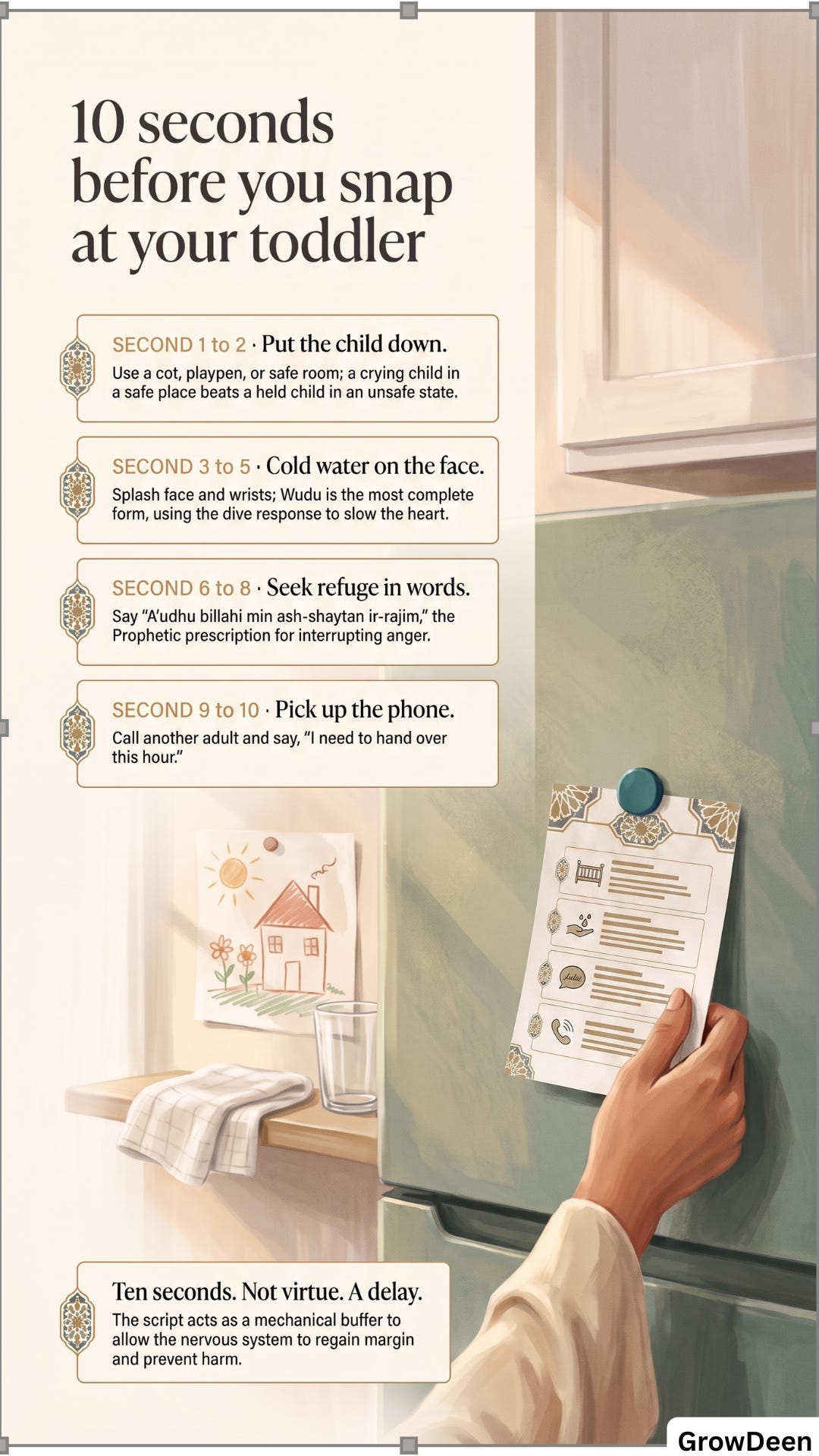
The Ten-Second Reset: Second by Second
The point of this script is a mechanical delay between the anger and any movement toward the child. Not virtue. A delay.
Second 1 to 2: put the child down.
Not gently, not perfectly. Down. On the cot. On the playpen floor. In the doorway of another adult. A child crying in a safe location for two minutes is safer than a child held by a parent whose amygdala is running the show.
Second 3 to 5: cold water on the face.
If wudu can be reached, wudu is the most complete version of this in the Muslim tradition. It combines cold water, deliberate movement, and the intention of standing before Allah. The nervous-system effect is documented. The spiritual weight is obvious. Both act on the same person.
Second 6 to 8: seek refuge in words.
Say A’udhu billahi min ash-shaytan ir-rajim, meaning I seek refuge in Allah from the accursed Shaytan. The Prophet Muhammad ﷺ prescribed this precisely for a companion whose face had turned red with anger. [3] The scholarly reading is that unchecked anger becomes a state Shaytan operates through, and naming that state hands the moment back to the person.
Second 9 to 10: pick up the phone.
Not to the child. To another adult. A spouse, a parent, a sister, a friend, an imam, a parenting helpline in your country. The sentence is I need to hand over this hour. It is amanah in the shape of a phone call.
Everything after second ten is the slower work of rebuilding. Nothing before second ten is optional.
What Harm Actually Does to a Child (In Case You Are Wondering Whether One Slip Really Matters)
This is the harder section. Skim it if you need to. It is here because parents deserve to know what the research actually shows, and because the effort of learning the ten-second reset feels proportionate only when the stakes are clear.
Three findings recur across the strongest longitudinal studies.
Sustained fear elevates cortisol, and elevated cortisol over months and years alters the structure of the child’s hippocampus and amygdala and the connections between them. [7] This is not a metaphor. Biological change, measurable in scans. Children raised in homes with high verbal aggression alone, without any physical hitting at all, show measurable changes in white-matter tracts related to language processing by mid-childhood. [8] Words carve.
Exposure to violence between adults harms children even when the child is not the target. Kids living in homes where one adult regularly threatens or hits another have anxiety, depression, and post-traumatic stress rates approaching those of children directly assaulted. [9] Raised voices in the next room count. The aftermath the child sees the next morning counts.
And the effects extend into adulthood in ways that are now among the most replicated findings in public health. The Adverse Childhood Experiences (ACEs) literature shows a dose-response relationship between the number of adverse experiences and later cardiovascular disease, type 2 diabetes, addiction, depression, and premature death. [2] A parent who reduces their child’s ACE count by even one is affecting a life trajectory measurable at age fifty. That is what is being defended in the ten seconds after the toddler throws the yogurt.
An Aside for Parents Reading This Alone at Night
If you have read this far, you are not looking for permission to give up. You are looking for a way through. That is what the next few pages of this article are for. Somewhere in the drafting of this piece, a downloadable companion emerged that pulls the ten-second script, the weekly self-check, and the du’as parents ask for onto three pages you can actually keep in your kitchen. It is called The Ten-Second Reset Pack, and it appears in full further down. Read on first. The tool is waiting.
The Repair Is Not Optional, and It Is Not the End of You
The research on rupture and repair contains one of the more counterintuitive findings in modern developmental psychology. Children raised by imperfect parents who repair well often show better long-term relational outcomes than children raised by parents who appeared never to rupture at all. [10] The repair itself teaches the child that conflict is survivable. A home without visible rupture teaches the child that conflict is unsurvivable, which is a worse lesson.
Repair has three moving parts.
The parent takes responsibility in words the child can understand. I raised my voice. That was not because you did anything wrong enough for that. I am sorry. The parent does not require the child to comfort them back into calm. And the parent takes a concrete step to make the same rupture less likely tomorrow, whether that step is sleep, food, help, medication, or a therapist’s phone number.
If a line was crossed that caused physical injury or lasting fear, the repair also includes reaching out to a doctor, a counsellor, or emergency services if needed. In the Islamic frame this is not weakness. Tawbah is not only inward turning. It is inward turning plus outward change. Both parts are named in the classical scholarship.
Systems Beat Willpower Every Time
Individual self-control is a scarce resource, and parenting drains it faster than any other job. Structural changes protect the family in ways no single act of self-restraint can.
Sleep is the single largest lever. One uninterrupted stretch of four to five hours a night is associated with substantial improvements in adult emotion regulation. [5] Where at all possible, night duties should be shared with a spouse or family member. This is a preventive intervention, not a luxury.
Predictable routines lower the trigger load. Children under five respond dramatically to consistent wake, meal, and sleep windows. A less dysregulated child means fewer flashpoints for the parent. [11]
Quieter flashpoint windows help. Late afternoons, the hour before iftar in Ramadan, and the pre-bedtime slot are documented pressure points across parenting studies. A calmer household soundscape in those specific windows lowers baseline arousal for everyone.
Community help is the single most underused resource in Muslim households. One afternoon a week with an aunt, an older cousin, a mosque friend, or a trusted neighbour reduces caregiver burnout markers measurably. [12] Ask. This is a legitimate use of the sila-tul-rahim that surrounds you.
Screen for postnatal depression, paternal depression, and burnout. Postnatal depression affects roughly 1 in 5 mothers globally and a rising proportion of fathers. [13] It is highly treatable. A conversation with the family doctor is the entry.
Trauma-informed counselling breaks the generational chain. Parents who were themselves harshly parented carry an increased risk of repeating the pattern. Counselling with a trauma-informed practitioner, ideally one who understands the Muslim family context, is protective for both generations.
Support Muslim Parenting Lab ❤️
Would you like a deed that keeps earning for you after you die? Start one in a few seconds with the button below.
The Prophet ﷺ named ongoing charity and beneficial knowledge among the three things that keep counting after death. (Sahih Muslim 1631)
Professional Help Is the Camel-Tying
There is a persistent misreading in some Muslim communities that professional counselling is either a mark of weak tawakkul or a foreign import. Neither is accurate. In classical scholarship, seeking asbab (the means Allah has made available for the resolution of a problem) is part of tawakkul, not opposed to it.
The Prophet ﷺ told the Bedouin who wanted to leave his camel untied and rely on Allah: Tie your camel and rely on Allah. [14] Getting professional help is the tying. The reliance follows.
The approaches with the strongest evidence base for parents at risk of harming a child include cognitive-behavioural therapy for emotion regulation, parent-child interaction therapy for the relationship itself, and trauma-focused therapy where the parent has their own history of adverse childhood experiences. [15] Anger management programs specifically designed for parents also show real benefit. The family doctor is a reasonable first door if the person does not know where to start.
Culturally competent Muslim mental health services now exist in many countries and continue to expand. Where they are not available locally, a non-Muslim counsellor with good training in cultural humility can still deliver effective care, provided the family sets expectations about religious values at the start.
When Not to Wait
Please do not wait if any of the following are present:
Injury to the child that needs medical attention.
Recurring thoughts about hurting the child or the self.
A partner in the household who is physically violent or threatening.
Alcohol or substance use functioning as the coping mechanism.
Numbness, inability to bond, or inability to function for more than two weeks.
Contact local emergency services if there is immediate risk. Contact a doctor, a qualified counsellor, or a national family violence support line for the next level. These calls are the actions of a serious parent protecting a child, not the actions of a bad parent being found out.
The Sacred Trust of Parental Restraint: What Islam Teaches About Mercy Under Pressure
Return now to the question planted at the top of this article. Why does a parent who deeply loves their child sometimes feel a wave of rage sharp enough to frighten them, and where does the Muslim reader find real shelter in that moment?
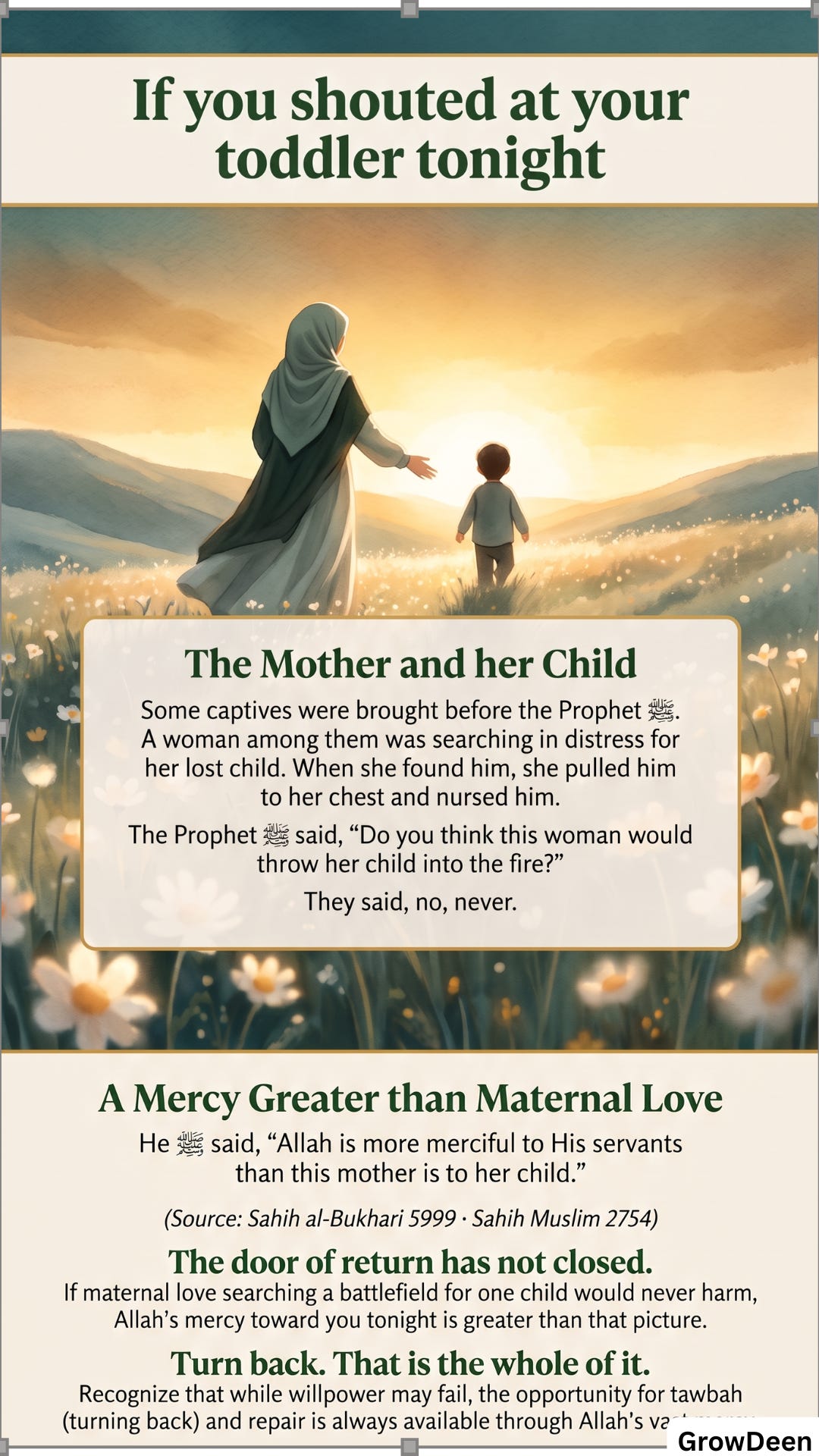
Umar ibn al-Khattab reported that captives were brought to the Prophet Muhammad ﷺ, and among them was a woman searching in distress for her lost child. When she found a small child, she pulled them to her chest and began to nurse them. The Prophet ﷺ asked those around him, Do you think this woman would throw her child into the fire? They said, no, never, not if she could avoid it. He ﷺ said, Allah is more merciful to His servants than this mother is to her child. [16]
Maternal mercy is one of the most instinctive forms of love known to human experience. And the mercy of Allah exceeds even that.
For a parent afraid of what they might do to their child, or grieving something they already have, this narration carries two settling truths. Allah’s door of return has never closed on a parent who is trying. And the same Prophet ﷺ who described this mercy is the one who taught, when angry, to sit down, to make wudu, and to seek refuge in Allah. [3] The mercy is the shelter. The Sunnah is the route.
The Ten-Second Reset Pack (Companion PDF)
If you have read this far, you are the kind of parent who takes the ten seconds before losing it seriously, not because you are broken, but because you know what is at stake. That already tells me something about you.
Inside the Ten-Second Reset Pack (one comprehensive PDF, 3 pages):
Page 1: The Fridge Reset Card. A single-glance visual walking you through the ten-second script in numbered steps (put the child down, cold water, refuge, phone), designed as a printable card you can keep on the fridge, in the nursery, or as a phone lock-screen for the hardest hours of the day.
Page 2: The Weekly Parent Self-Check. A fill-in one-page audit covering your top three triggers this week, your sleep hours, your one adult conversation, your salah, and one repair you made if a rupture happened, so you can course-correct in under ten minutes on a Sunday evening.
Page 3: A Prophetic Reminder for the Parent Who Slipped. The narration of Allah’s mercy exceeding the mercy of the searching mother (Sahih al-Bukhari 5999 / Sahih Muslim 2754), presented in English translation with source reference and a two-line reflection for a parent making tawbah tonight.
This is a tool designed to stay on your fridge or your phone, not a PDF you download and forget, where you will actually reach for it when the third hour of the afternoon has already begun.
The Ten-Second Reset Pack is what every subscriber receives with each article. We cover the full arc of raising Muslim children from newborns to school-age, all backed by peer-reviewed research and rooted in the Sunnah.
Do This In The Next Five Minutes
Open your phone. Add two contacts to a favourites list you will call the next time you feel close to losing control. One should be an adult you can hand the child to for an hour without explaining. The other should be a helpline in your country you have never called before but would call at 2 am. That is it. That is the whole action. Do it now, before you close this tab.
Share This With The Parent You Are Already Thinking Of
Think of one person right now. Maybe the sister you sat next to at the janazah last month, the one whose baby has not slept properly since Ramadan and whose eyes have that specific worn-out shine. Or the cousin whose WhatsApp voice notes have started arriving at 1 am and going a full four minutes without stopping.
This article could put a plan in her hand before the next hard evening. Share it today, not as advice, but as the kind of care one mother offers another when she recognises the tiredness on someone else’s face.
Frequently Asked Questions
Q: Is it normal for a good parent to feel like they might hurt their child?
A: Yes, and it is more common than the parenting industry ever admits. The largest international surveys consistently find that 6 in 10 caregivers of children under 5 use some form of violent discipline in a given month, and many more have felt close to it and pulled back. [17] What separates parents who never harm their children is not the absence of the feeling. It is a plan for the ten seconds after the feeling arrives. For the full plan, see “The Ten-Second Reset” above.
Q: What is the best thing to do in the moment you feel you might snap?
A: Put the child in a safe location, splash cold water on your face (wudu is ideal), say A’udhu billahi min ash-shaytan ir-rajim, and call another adult before you do anything else. [3] These four actions in that order interrupt the amygdala’s threat response fast enough to buy back your prefrontal cortex. [4] Full sequence in the toolkit above.
Q: Is smacking a child ever acceptable in Islam?
A: The strongest position across the classical schools, and the position taken by contemporary global scholarly bodies working on child protection, is that physical hitting of children is discouraged and that the tenderness of the Prophet ﷺ with children is the operative example. Modern research is unusually clear that even mild physical discipline is associated with worse child outcomes across dozens of independent studies. [18] For fiqh questions, speak to a qualified local scholar with knowledge of your specific situation.
Q: What if I have already crossed the line and hurt my child?
A: If there is any physical injury, contact a doctor or emergency services first. Then contact a qualified counsellor or a family violence support line and make tawbah. Islam does not close the door on a parent who is turning back. What matters is the direction you now face, and the concrete step you take to reduce the risk of a repeat. Full guidance on repair is in the “Repair Is Not Optional” section above.
Q: How do I stop myself from repeating the way I was parented?
A: The strongest single intervention is trauma-informed counselling with a practitioner who understands your background. Parents who were harshly parented themselves are at higher risk of repeating the pattern, and specific therapies (CBT, parent-child interaction therapy, trauma-focused therapy) reduce that risk measurably. [15] A conversation with your family doctor is a reasonable first door.
Q: I think I might have postnatal depression. Is it linked to feeling angry with my baby?
A: Yes, and it is more common than most Muslim mothers are told. Postnatal depression affects roughly 1 in 5 mothers globally, and irritability, rage, and detachment are often part of the picture even when tears are not. [13] It is highly treatable. Please contact your doctor or a qualified perinatal mental health service. Seeking treatment is part of the amanah, not a departure from it.
References
[1] World Health Organization. (2020). Global status report on preventing violence against children 2020. WHO Press. https://www.who.int/publications/i/item/9789240004191
[2] Hughes, K., Bellis, M.A., Hardcastle, K.A., Sethi, D., Butchart, A., Mikton, C., Jones, L., & Dunne, M.P. (2017). The effect of multiple adverse childhood experiences on health: A systematic review and meta-analysis. The Lancet Public Health, 2(8), e356 to e366. https://doi.org/10.1016/S2468-2667(17)30118-4
[3] Sahih al-Bukhari 6115 — Graded: Sahih — https://sunnah.com/bukhari:6115
[4] Rutherford, H.J.V., Wallace, N.S., Laurent, H.K., & Mayes, L.C. (2015). Emotion regulation in parenthood. Developmental Review, 36, 1 to 14. https://doi.org/10.1016/j.dr.2014.12.008
[5] Palmer, C.A., & Alfano, C.A. (2017). Sleep and emotion regulation: An organizing, integrative review. Sleep Medicine Reviews, 31, 6 to 16. https://doi.org/10.1016/j.smrv.2015.12.006
[6] Porges, S.W. (2011). The polyvagal theory: Neurophysiological foundations of emotions, attachment, communication, and self-regulation. W.W. Norton.
[7] Teicher, M.H., & Samson, J.A. (2016). Annual research review: Enduring neurobiological effects of childhood abuse and neglect. Journal of Child Psychology and Psychiatry, 57(3), 241 to 266. https://doi.org/10.1111/jcpp.12507
[8] Choi, J., Jeong, B., Rohan, M.L., Polcari, A.M., & Teicher, M.H. (2009). Preliminary evidence for white matter tract abnormalities in young adults exposed to parental verbal abuse. Biological Psychiatry, 65(3), 227 to 234. https://doi.org/10.1016/j.biopsych.2008.06.022
[9] Kitzmann, K.M., Gaylord, N.K., Holt, A.R., & Kenny, E.D. (2003). Child witnesses to domestic violence: A meta-analytic review. Journal of Consulting and Clinical Psychology, 71(2), 339 to 352. https://doi.org/10.1037/0022-006x.71.2.339
[10] Tronick, E., & Gold, C.M. (2020). The power of discord: Why the ups and downs of relationships are the secret to building intimacy, resilience, and trust. Little, Brown Spark.
[11] Kitsaras, G., Goodwin, M., Allan, J., Kelly, M.P., & Pretty, I.A. (2018). Bedtime routines, child wellbeing and development. BMC Public Health, 18, Article 386. https://doi.org/10.1186/s12889-018-5290-3
[12] Luo, Z., Chen, Y., & Epstein, R.A. (2025). Risk factors for child abuse and neglect: Systematic review and meta-analysis. Public Health, 241, 89 to 98. https://doi.org/10.1016/j.puhe.2025.01.028
[13] Woody, C.A., Ferrari, A.J., Siskind, D.J., Whiteford, H.A., & Harris, M.G. (2017). A systematic review and meta-regression of the prevalence and incidence of perinatal depression. Journal of Affective Disorders, 219, 86 to 92. https://doi.org/10.1016/j.jad.2017.05.003
[14] Sunan al-Tirmidhi 2517 — Graded: Hasan — https://sunnah.com/tirmidhi:2517
[15] Chen, M., & Chan, K.L. (2016). Effects of parenting programs on child maltreatment prevention: A meta-analysis. Trauma, Violence, & Abuse, 17(1), 88 to 104. https://doi.org/10.1177/1524838014566718
[16] Sahih al-Bukhari 5999 — Graded: Sahih — https://sunnah.com/bukhari:5999 ; Sahih Muslim 2754 — Graded: Sahih — https://sunnah.com/muslim:2754
[17] UNICEF. (2017). A familiar face: Violence in the lives of children and adolescents. United Nations Children’s Fund. https://data.unicef.org/resources/a-familiar-face/
[18] Gershoff, E.T., & Grogan-Kaylor, A. (2016). Spanking and child outcomes: Old controversies and new meta-analyses. Journal of Family Psychology, 30(4), 453 to 469. https://doi.org/10.1037/fam0000191
We combine scientific research with Qur’an and authentic Sunnah, and we cite our sources. Even so, this is general guidance and no substitute for a doctor who can examine your child.