

New research confirms nearly every child tells a deliberate lie by age 3 [1] and the Prophet ﷺ’s teaching on habitual dishonesty isn’t the fire-and-brimstone warning most parents assume it is.
There’s a hadith many Muslim parents have heard quoted at the wrong moment — usually right after catching a four-year-old mid-fib about who ate the last date. The signs of a hypocrite are three: when he speaks, he lies; when he promises, he breaks it; when he’s trusted, he betrays. [Sahih al-Bukhari 33; Sahih Muslim 59]
It sounds severe. Said to a toddler standing over a broken vase insisting “I didn’t do it,” it sounds almost cruel.
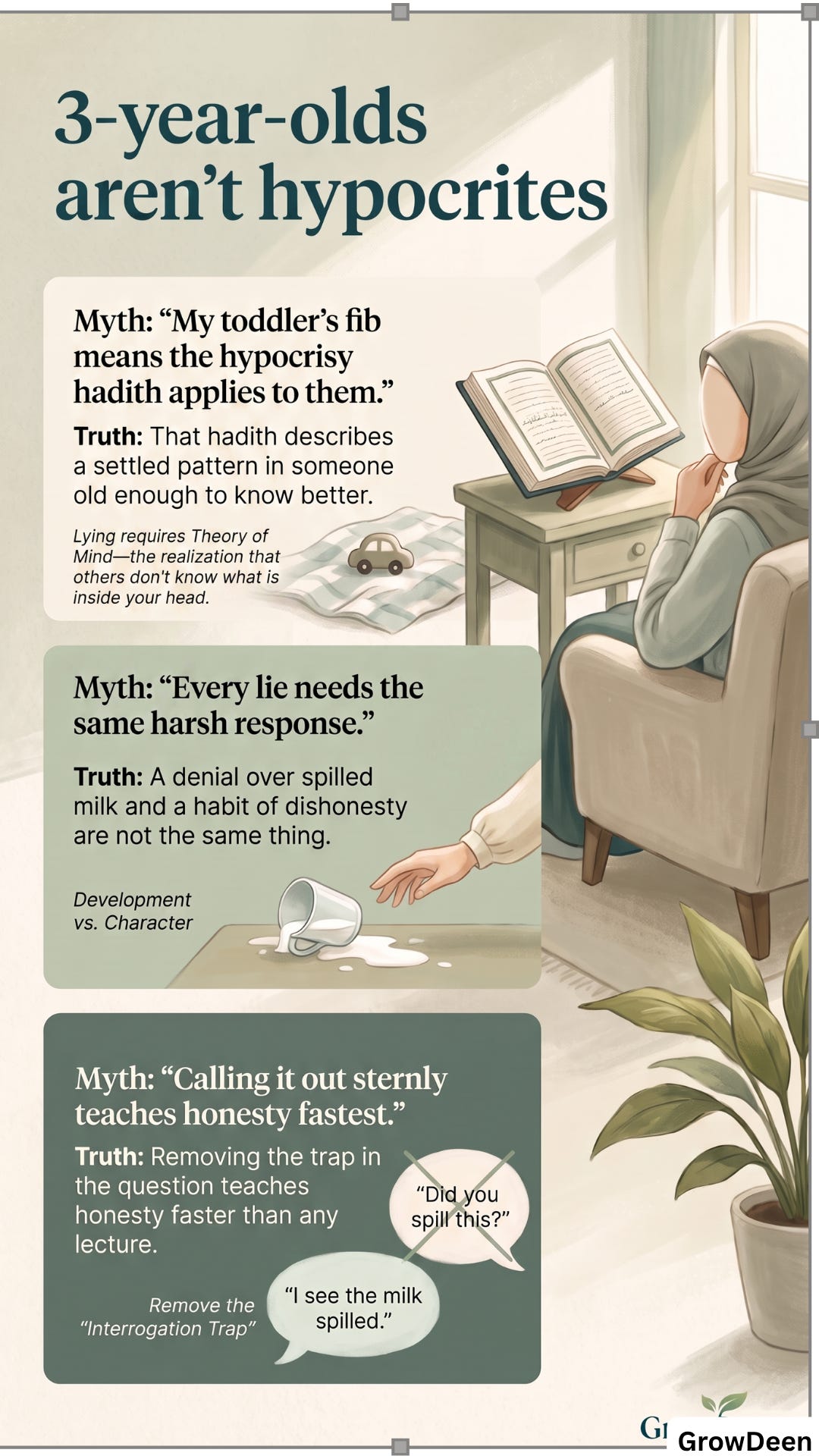
Here’s the thing: that hadith was never about toddlers. It’s about a pattern of character in someone old enough to know better and choosing dishonesty anyway. Confusing the two — treating a developmentally normal fib like evidence of a spiritual defect — is exactly the mistake this guide is going to help you avoid.
Because your child’s first lie isn’t a crisis. It’s a milestone. And what you do in the next five minutes after catching it matters far more than the lie itself.
Why This Guide Is Different
It separates development from character. Most advice treats every child’s lie the same way. This one draws the line psychologists actually draw — between a two-year-old testing a new cognitive skill and a pattern worth real concern.
It’s built on a hadith most parenting content skips entirely. The signs-of-hypocrisy hadith gets weaponized against small children constantly. Here, you’ll see what it’s actually describing — and why that distinction matters for how you respond.
You’ll get a free Truth-Telling Home Companion Pack — a printable phrase-swap card and age-by-age response guide, not just another list of tips to forget by Thursday.
The Question That’s Quietly Teaching Your Child to Lie
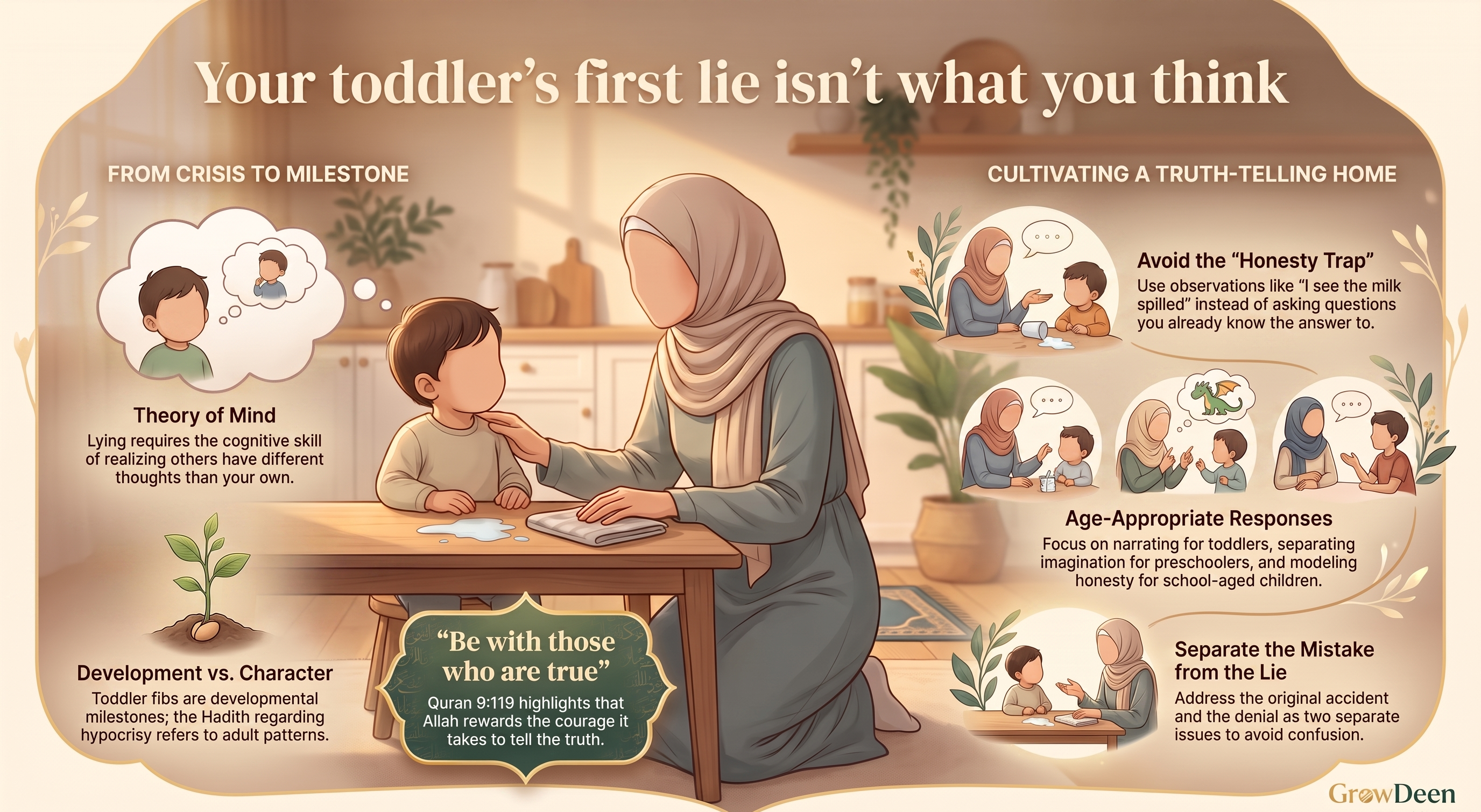
Here’s a scene almost every parent recognizes. The milk is spilled. You already know who did it. You ask anyway: “Did you spill the milk?”
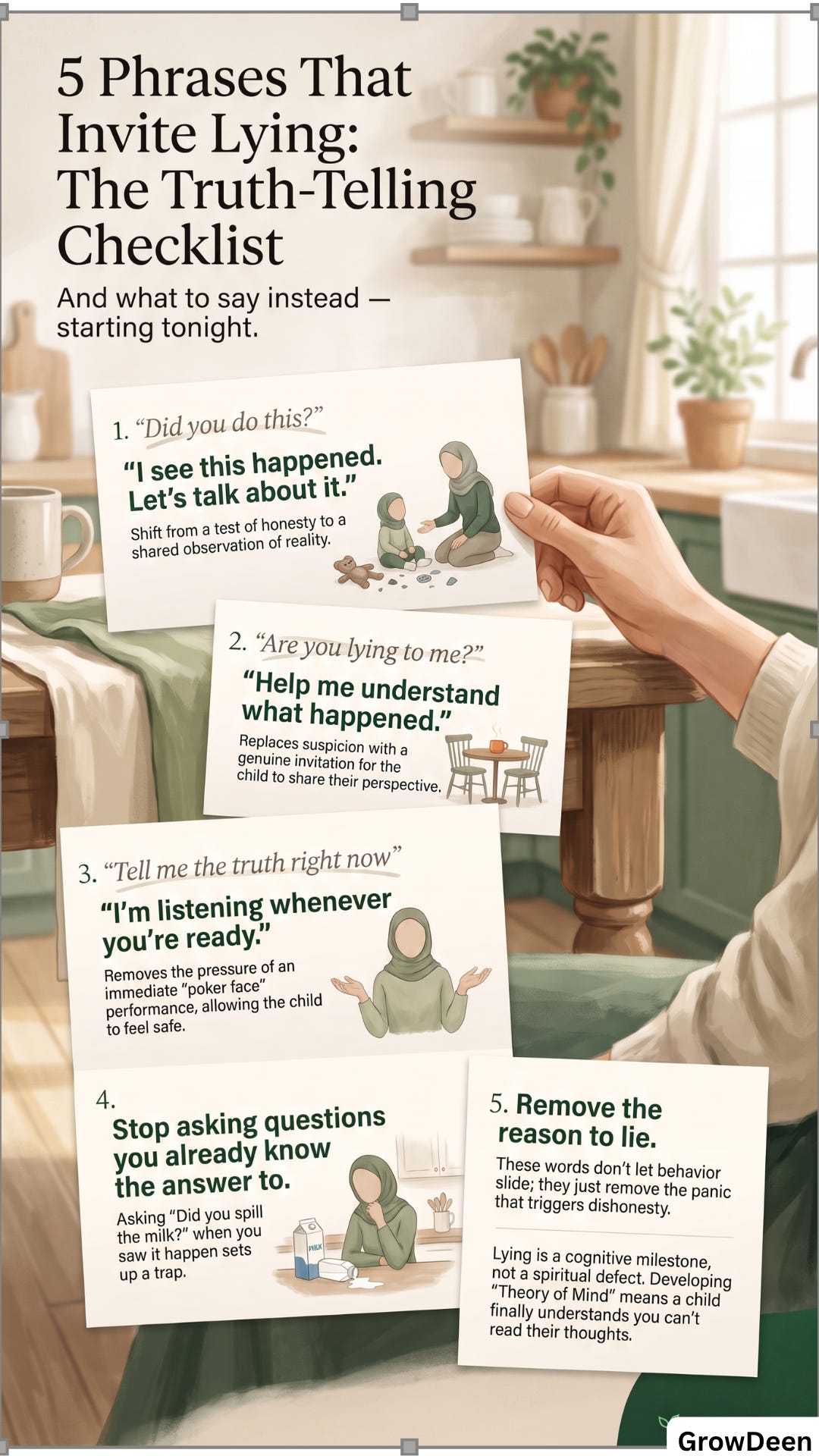
Stop right there. You just handed your child a reason to lie that didn’t need to exist.
That single question — asked from a place of already knowing — sets up a trap disguised as a conversation. The child reads it correctly: this is a test, not a genuine question. And when a small child feels tested, the instinct to protect themselves often wins over the instinct to tell the truth.
Try this instead: “I see the milk spilled. Let’s clean it up together.” Same mess, same outcome, zero invitation to lie.
This single shift — dropping questions you already know the answer to — does more to reduce lying in young children than any punishment ever will. It removes the trap before the child has to decide whether to walk into it.
What’s Actually Happening in Your Child’s Brain
So why do children lie at all, if not out of some early character flaw? The honest answer might surprise you: lying requires a cognitive skill your child didn’t have a year ago, and developing it is a sign things are going right.
Psychologists call it “theory of mind” — the understanding that other people can’t automatically know what’s inside your head. Somewhere around age two to three, that understanding clicks into place [2]. Before it does, a child genuinely can’t grasp that a parent doesn’t already know what happened in the next room. The moment that clicks, the possibility of a deliberate lie appears for the first time.
Here’s the part almost no parent expects: getting good at lying is a separate skill from lying at all, and it develops on its own timeline. Between four and six, children start matching their facial expressions and tone of voice to what they’re saying, which makes their lies noticeably more convincing [3]. Ask one follow-up question at this age, though, and most children fold immediately. The performance shows up years before the poker face does.
By the school years, lies grow more sophisticated simply because vocabulary and social understanding expand [1]. And somewhere in adolescence, a different category appears: the “prosocial” lie — telling a friend you love a gift you don’t, to spare their feelings rather than to gain anything [4]. That’s not the same behavior as denying a broken lamp, developmentally or morally, and it shouldn’t be treated the same way.
I know this is a lot to hold onto while you’re managing bedtime, homework, and everything else on your plate. That’s exactly why I built something for the moments this actually happens — keep reading, it’s waiting for you at the end of this article.
What the Prophet ﷺ Actually Modeled
This is where the hadith from the opening comes back in — but not the way it’s usually used.
The three signs of hypocrisy — habitual lying, broken promises, betrayed trust [Sahih al-Bukhari 33; Sahih Muslim 59, Muttafaqun Alayhi] — describe someone who has made dishonesty their default operating mode. A four-year-old inventing a story about a monster, or panic-denying a spilled cup, is not that person. Reading this hadith onto a small child isn’t just unfair. It misreads what the Prophet ﷺ was actually warning against.
What the Prophet ﷺ did model with children is something gentler and, honestly, more instructive. He warned specifically against dishonesty dressed up as entertainment: “Woe to the one who tells lies to make people laugh. Woe to him! Woe to him!” (Sunan Abi Dawud 4990, graded Hasan). That’s a near-perfect match for one of the most common reasons children lie in the first place — to make a story more exciting, to get a laugh, to hold someone’s attention [1]. Humor stays welcome. Fabrication dressed as humor doesn’t, and that standard is for the adults at the dinner table as much as it is for the child telling tall tales.
There’s one more piece of this worth knowing, because it might be the most beautiful story in the entire Qur’an about the cost — and reward — of truthfulness.
Allah says: “O you who have believed, fear Allah and be with those who are true.” (Qur’an 9:119)
According to Tafsir Ibn Kathir, this verse was revealed specifically about a companion named Ka’b ibn Malik, who missed the Battle of Tabuk with no valid excuse. When the Prophet ﷺ returned and asked the men who’d stayed behind to explain themselves, most gave excuses — some true, some invented — and the Prophet ﷺ accepted them outwardly, leaving their hearts to Allah. Ka’b alone told the plain, unflattering truth: he simply hadn’t gone, and he had no excuse.
That honesty cost him. The Prophet ﷺ imposed fifty days of social isolation on him before Allah revealed these very verses, accepting his repentance and naming his truthfulness specifically. Ka’b later said that of everything in his life, nothing compared to the blessing of having told the truth that day — even knowing what it would cost him going in.
Sit with that for a second. Truthfulness in Islam was never framed as the easy path. It was framed as the path worth choosing anyway, because Allah rewards exactly what it costs you.
Age by Age: What Actually Works
Ages 2–4: Skip the interrogation. Narrate what you see (”I see the wall has crayon on it”) instead of demanding a confession. At this age, gentle invitation beats direct accusation almost every time.
Ages 4–6: This is the embellishment stage — the dragon under the stairs, the wildly exaggerated version of what happened at the park. Separate imagination from deception here. “Tell me more about this dragon” nurtures a healthy skill. Treating every flight of fancy as dishonesty teaches a child to stop sharing their inner world with you.
Ages 6–9: Lies get more specific and harder to catch. This is the age to lean hardest on modeling: “I made a mistake today, so I told my manager and we fixed it together.” Children this age are watching what you do far more than what you say.
Ages 9+: Consequences should separate the original mistake from the lie about it. If your child drew on the wall and then denied it, that’s two issues, not one — address the wall, then address the denial, and don’t let one swallow the other.
I know this is a lot to keep straight in the middle of an actual parenting moment. That’s exactly why I built the Truth-Telling Home Companion Pack — a free printable guide with the phrase swaps and age-by-age responses above, designed to stay on your fridge, not buried in your inbox. You’ll find the download link a little further down.
When It’s Not About a Spilled Glass of Milk
Occasionally a lie isn’t about milk or a broken lamp at all — it’s protecting a secret about being bullied, harmed, or pressured into something a child knows is wrong. This calls for a different response entirely.
Reassure your child clearly that they’ll be safe telling you the truth. Stay calm even if what surfaces is upsetting — a child who sees anger will bury the next secret deeper, not bring it forward faster. If lying clusters with other worrying signs — stealing, cruelty to animals, a real pattern of serious rule-breaking [5] — it’s worth talking to a doctor, paediatrician, psychologist, or trusted counsellor. That isn’t a parenting failure. It’s the same principle Islam asks everywhere else: seek help when it’s needed, as part of honoring the amanah Allah placed in your care.
Your Free Truth-Telling Home Companion Pack
If you’ve read this far, you’re the kind of parent who wants to get the small, everyday moments right — not out of anxiety, but out of real care for who your child is becoming. That says something good about you.
Inside the Truth-Telling Home Companion Pack (one comprehensive PDF, 3 pages):
Page 1: The Honesty Trap Checker — A 60-second decision card walking through “is this a lie, imaginative play, or a trap I accidentally set?” with a clear response for each — designed as a card you can keep on the fridge for the moment it’s actually needed.
Page 2: 7 Phrases That Invite Honesty (And 7 That Invite Lying) — A side-by-side swap card showing exactly which everyday phrases quietly pressure a child toward dishonesty, and what to say instead — so you can shift your language starting tonight.
Page 3: The Ka’b ibn Malik Story Card — An illustrated, read-aloud version of the story behind Qur’an 9:119, written for children ages 5 and up, plus a short reflection for parents on what it means to choose truth even when it costs something.
This isn’t a PDF to download and forget. It’s built to live on your fridge or in your phone, ready for the moment it’s actually needed.
This companion pack is what every subscriber receives with each article. We cover the full journey of raising Muslim children, all backed by research and rooted in Islamic wisdom. If you want both evidence-based guidance and genuine Islamic grounding, subscribe for free so future resources reach you before you need them.
You’ll only hear from us when there’s something worth your time — no spam, no daily noise, just resources that matter.
One Thing to Do Right Now
Before you close this tab: think of one question you routinely ask your child that you already know the answer to. Just one. Tonight, replace it with a statement instead. “I see the milk spilled” instead of “did you spill the milk.” That’s it. That’s the whole practice tonight.
May Allah place barakah in the small, unglamorous moments of raising these children, and make the honesty we model for them heavier on the scale than it ever feels in the moment.
Someone You Know Needs This Today
Think of one person right now: the friend who mentioned her son’s been “making things up” lately and sounded worried about it, the sister at the masjid who admitted she doesn’t know how to respond without overreacting, the parent in your group chat who just posted “is this normal?” about their toddler’s latest tall tale.
This article could ease that worry today. Share it with them — not as advice-giving, but as the kind of support you’d want if you were the one asking.
Frequently Asked Questions
Q: At what age do children start lying?
A: Most children tell their first deliberate lie between ages 2 and 3, once they understand that a parent can’t automatically know what’s in their head. [2] It’s a cognitive milestone, not a warning sign.
Q: Is it normal for a 5-year-old to lie a lot?
A: Yes — ages 4 to 6 are when children get noticeably better at lying, mainly because they start matching their facial expressions to their words. [3] One gentle follow-up question usually gets you the truth at this stage. See “What’s Actually Happening in Your Child’s Brain” above for the full explanation.
Q: Should I punish my child every time they lie?
A: Not the same way every time. Separate the original mistake from the lie about it, and respond to each on its own. Consistency and calm matter more than harsh, blanket punishment. [5]
Q: Is pretend play the same as lying?
A: No. A child insisting a dragon lives under the stairs is playing, not deceiving, especially before age four. Treating imaginative stories as dishonesty can actually make a child less willing to share their inner world with you.
Q: What does Islam say about lying to children?
A: Islam holds honesty to a genuinely high standard — the story of Ka’b ibn Malik in Qur’an 9:119 shows truthfulness being rewarded even when it came at real personal cost. The Prophet ﷺ specifically warned against dishonesty used for entertainment (Sunan Abi Dawud 4990), a caution aimed at parents just as much as children.
Q: When should I be genuinely concerned about my child’s lying?
A: When it’s frequent, persists well past the age a child clearly understands truth from falsehood, and clusters with other behavior concerns like stealing or cruelty to animals. [5] At that point, a conversation with a doctor, paediatrician, or counsellor is a reasonable next step, not an overreaction.
References
[1] Ahern, E.C., Lyon, T.D., & Quas, J.A. (2011). Young children’s emerging ability to make false statements. Developmental Psychology, 47(1), 61-66.
[2] Talwar, V., & Lee, K. (2008). Social and cognitive correlates of children’s lying behavior. Child Development, 79(4), 866-881.
[3] Broomfield, K., Robinson, E., & Robinson, W. (2002). Children’s understanding about white lies. British Journal of Developmental Psychology, 20, 47-65.
[4] Talwar, V., Murphy, S., & Lee, K. (2007). White lie-telling in children for politeness purposes. International Journal of Behavioral Development, 31(1), 1-11.
[5] Gervais, J., Tremblay, R., Desmarais-Gervais, L., & Vitaro, F. (2000). Children’s persistent lying, gender differences, and disruptive behaviours: A longitudinal perspective. International Journal of Behavioural Development, 24(2), 213-221.
[6] Qur’an, Surah At-Tawbah 9:119. According to Tafsir Ibn Kathir, revealed specifically regarding Ka’b ibn Malik’s truthful account of missing the Battle of Tabuk.
[7] Sahih al-Bukhari 33; Sahih Muslim 59 (Muttafaqun Alayhi). The Prophet ﷺ described the signs of a hypocrite as habitual lying, breaking promises, and betraying trust.
[8] Sunan Abi Dawud 4990. Graded Hasan (Al-Arna’ut); classed sound by Al-Albani.