


A 2015 meta-analysis in Nutrition Journal found that children eating predominantly high-GI diets had significantly worse body composition outcomes and measurably reduced cognitive performance compared to children eating low-GI diets. [1] This guide shows you the simple swaps that make a real difference — without overhauling your kitchen.
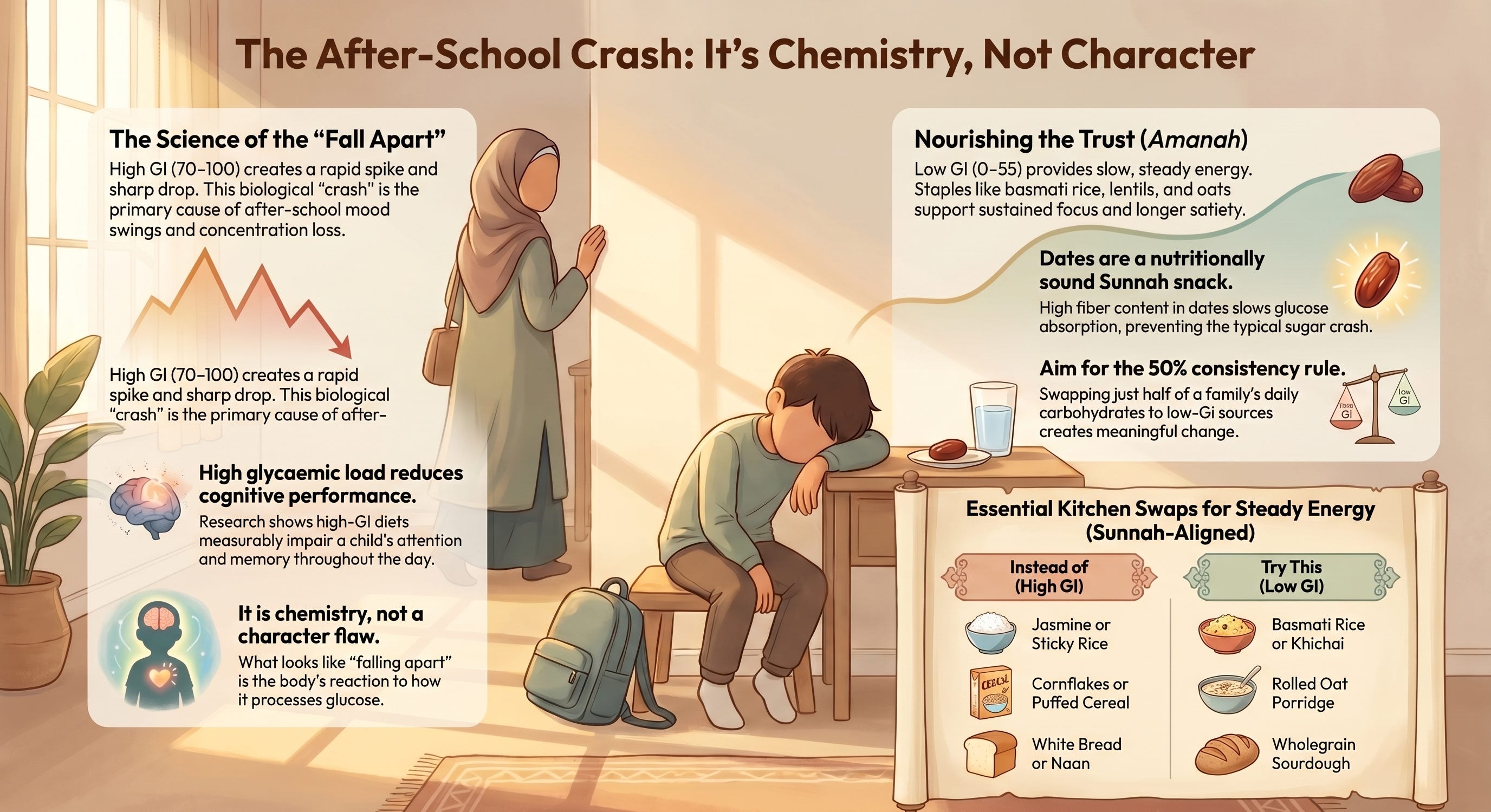
Your child comes home from school and falls apart.
Not tired — fallen apart. Crying over small things. Can’t concentrate on homework. Reaching for biscuits the moment they walk in the door. You wonder what you’re missing.
Here’s what I learned — and it took me longer than I’d like to admit: a lot of what we call mood, focus, and behaviour in children has a direct and measurable connection to how their blood glucose moves through the school day. Not whether they ate. How their body processed what they ate.
When I studied the research on glycaemic index and children’s cognitive performance, one finding stopped me: children whose diets are higher in low-GI foods show better concentration and sustained energy across the day compared to those eating predominantly high-GI foods. [1] This isn’t a subtle difference. Teachers notice it. Parents notice it. And once you understand why, the fix is simpler than you’d expect.
Why This Guide Is Different From Generic Healthy-Eating Advice
Every recommendation here is drawn from peer-reviewed research — including a 2015 meta-analysis [1] and a 2022 cognitive performance study [2] — not opinion or trend-based nutrition advice.
This isn’t just science. It’s science held alongside Islamic guidance on moderation and nourishing the body as an amanah — a trust from Allah — because those two things point in the same direction.
You’ll receive a free Family GI Guide Companion Pack — a printable 3-page PDF with a low-GI food swap chart, a school-week meal planning guide, and an Islamic mealtime du’a card your family can use daily. Keep reading to get it at the end.
What Is the Glycaemic Index — and Why Does It Matter for Your Child?
Here’s what no one explains clearly enough.
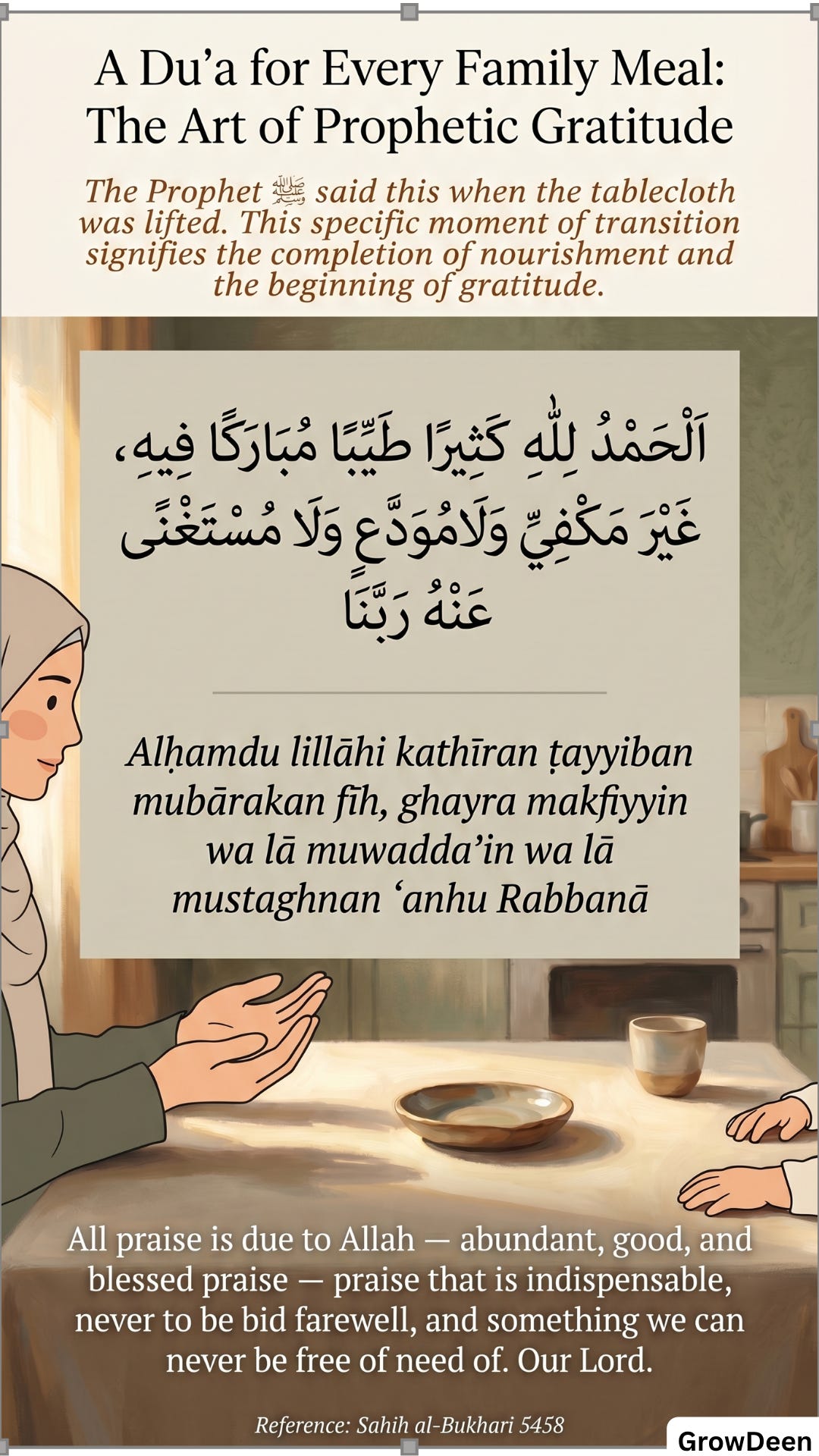
When your child eats carbohydrates — bread, rice, pasta, fruit, cereal, anything — the body breaks them down into glucose and releases it into the bloodstream. That glucose is energy. But different foods release it at very different speeds. [3]
The Glycaemic Index (GI) ranks this on a scale of 0 to 100:
Low GI (0–55): Slow, steady release → sustained energy, longer focus, less hunger
Intermediate GI (56–69): Moderate rise and fall → manageable in context
High GI (70–100): Rapid spike, then sharp drop → the after-school crash you know well
The crash isn’t character. It’s chemistry.
And here’s what surprised me when I dug into the research: it’s not just energy that’s affected. A 2022 meta-analysis in Neuroscience and Biobehavioral Reviews found that glycaemic load has a direct, measurable impact on children’s cognitive performance — specifically attention and memory. [2] So the choice between basmati rice and jasmine rice, between rolled oats and corn flakes, isn’t trivial. It actually changes how your child thinks.
The Low-GI Foods Already in Your Kitchen
You don’t need to start from scratch. Many low-GI staples are already in Muslim households.
These are all low GI:
Basmati rice. Rolled oats. Lentils, chickpeas, and dhal. Pasta. Wholegrain sourdough. Yoghurt. Most fresh fruits. Nuts. And dates — which, despite being sweet, release glucose slowly because of their fibre content. [4] This is part of why the Sunnah practice of breaking fast with dates is so nutritionally sound.
High-fibre foods naturally lower the GI of a meal. So your lentil soup alongside white rice? The fibre in the lentils moderates the rice’s effect. The chickpea curry next to the naan? Same principle. [3] This is why balance matters more than elimination.
High-GI foods to limit — not ban, but limit — include white bread, jasmine and sticky rice, highly processed breakfast cereals, French fries, sugary drinks, and most packaged snacks.
I know this sounds like a lot to hold onto.
That’s exactly why I created the Family GI Guide Companion Pack — a free printable PDF with a clear swap chart for your most common meals, a simple school-week planner, and an Islamic mealtime du’a card. Keep reading to download it at the end of this article.
The Swaps That Actually Work (Without Your Child Noticing)
The goal isn’t perfection. It’s consistency over time.
Research shows that aiming for at least half of your family’s carbohydrate choices to come from lower-GI sources makes a meaningful difference. [1] That’s a proportion, not a standard — which means you have room.
Simple switches:
Jasmine or sticky rice → Basmati rice (or a rice-lentil khichdi) Cornflakes or puffed cereals → Rolled oat porridge with fruit and honey White bread or naan daily → Wholegrain sourdough or dense multigrain bread White potato as staple → Sweet potato, or boiled-then-cooled potato Sugary after-school snack → Fruit, yoghurt, or nuts with a handful of dates
Here’s something most parents don’t realise about portions: the amount of carbohydrate matters as much as the type. A large serving of even a medium-GI food raises blood glucose significantly. Nutritionists call this Glycaemic Load, and research confirms it’s what you actually need to manage day-to-day. [3] Smaller portions of higher-GI foods alongside generous servings of low-GI options keeps things balanced — without banning anything.
And for children in endurance sports, active play, or long school days, low-GI pre-activity foods maintain energy better than high-GI alternatives. [5]
Getting Your Child to Actually Eat These Foods
Here’s the truth: it takes repetition, not pressure.
Research shows children need to encounter a new food between 10 and 15 times before accepting it — and pressure at the table actively backfires. [6] The most effective approach is offering without insisting, staying calm when they refuse, and keeping low-GI foods as the visible, easy-to-reach default.
Model it yourself. Say Bismillah over the oat porridge with genuine enthusiasm. Involve them in stirring the dhal or mashing the sweet potato. Familiarity is built through small, repeated moments — not one educational conversation.
What the Qur’an and Sunnah Teach Us About How We Eat
As Muslim parents, we hold our children’s bodies as an amanah — a trust from Allah ﷻ. How we nourish them is part of that trust.
When I reflect on the verse where Allah says, “O Children of Adam, eat and drink, but do not be excessive. Indeed, He does not love those who commit excess” [Quran 7:31], I find it both generous and precise. Eat freely. But don’t tip into excess. According to Tafsir Ibn Kathir, this verse commands us to take from what Allah has permitted while prohibiting israf — wastefulness and going beyond what is needed. That maps onto this entire conversation: the problem isn’t carbohydrates, it’s choosing carelessly and eating without thought for what the body actually needs. [7]
And then there’s the hadith that grounds me when this all feels theoretical: the Prophet ﷺ said, “A strong believer is better and more lovable to Allah than a weak believer, and there is good in everyone.” [Sahih Muslim 2664] [8] Scholars note that this includes physical strength — because a body that is nourished and healthy can worship more, serve more, carry more. When we give our children steady energy through considered food choices, we’re participating in that vision from the very beginning.
What strikes me is how the Islamic ethos of balance and the science of glycaemic index converge on exactly the same point. Real food. Moderation. Gratitude.
May Allah grant us wisdom in how we nourish the families He has entrusted to us.
Your Family GI Guide Companion Pack
If you’ve read this far, you’re the kind of parent who cares — not just about what’s on the plate, but about what it does to your child’s body and mind. That already says something beautiful about you.
Inside the Family GI Guide Companion Pack (one comprehensive PDF, 3 pages):
Page 1: The Family Low-GI Swap Chart — A quick-reference visual guide showing your most common family staples alongside their lower-GI alternatives, organised by meal type (breakfast, lunch, dinner, snacks) — designed as a laminated card you can keep on your fridge door or kitchen cupboard, so the decision is made before you’re standing tired in front of the pantry.
Page 2: The School-Week Energy Planner — A simple 5-day meal structure guide showing how to distribute low-GI and high-GI foods across breakfast, lunchbox, after-school snack, and dinner for optimal, crash-free energy — built around realistic Muslim family meals like basmati-and-dhal, oat porridge, khichdi, and yoghurt with fruit.
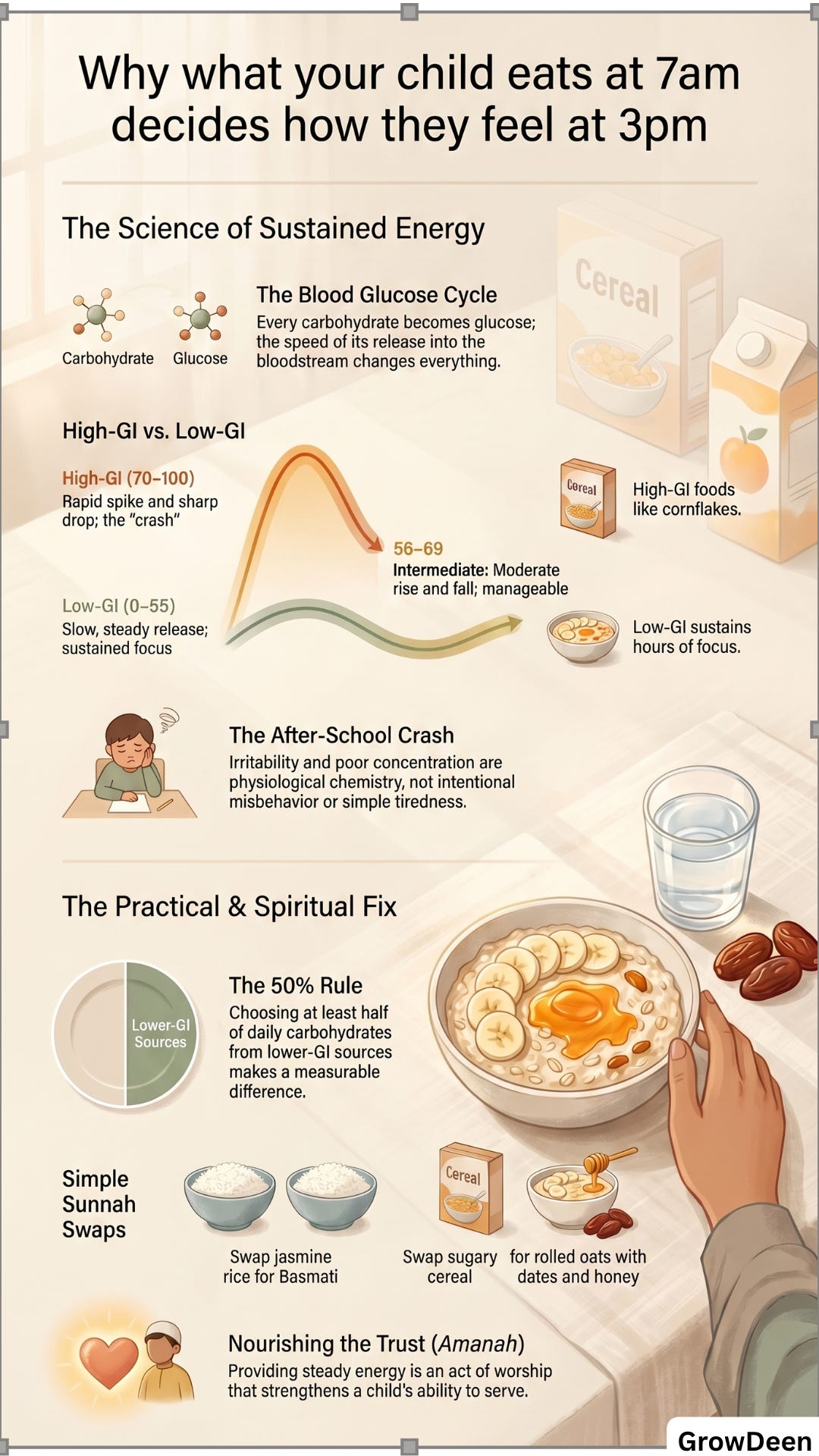
Page 3: The Islamic Mealtime Du’a Card — The authentic du’a “Rabbana atina fi al-dunya hasanatan wa fi al-akhirati hasanatan wa qina adhab al-nar” [Sahih al-Bukhari 6389] [9] — a du’a the Prophet ﷺ loved and taught, asking Allah for goodness in this life and the next — with Arabic text, transliteration, and English meaning. A reminder that every family meal is an opportunity to ask Allah for the fullness of His blessing — in the body we’re nourishing and in the akhirah we’re working toward.
This isn’t just a PDF to download and forget. It’s a tool designed to stay on your fridge — where you’ll actually use it when you’re deciding what to make.
This Family GI Guide Companion Pack is what every subscriber receives with each article. At GrowDeen, we cover the full journey of raising Muslim children — from newborns through school age — all backed by scientific research and rooted in Islamic wisdom.
If you’re a Muslim parent who wants both evidence-based guidance AND Islamic perspective, subscribe for free so future resources arrive in your inbox before you need them.
Subscribe free for parenting resources backed by both science and Sunnah — guidance so specific to Muslim family life, you literally can’t find it anywhere else. No spam, no clutter, just resources that matter.
One Thing to Do Today
Before dinner tonight, look at your family’s usual carbohydrates.
Pick one swap — just one. Maybe it’s making tomorrow’s breakfast oat porridge instead of cornflakes. Maybe it’s adding a cup of lentils to tonight’s rice. Maybe it’s putting a bowl of dates and yoghurt on the counter for after school instead of biscuits.
That’s it. One swap. Start there.
Think of one person right now: the mother in your WhatsApp group whose child comes home from school and seems to emotionally unravel every single afternoon — the one who keeps saying she doesn’t know what’s wrong, they slept enough, they ate breakfast.
This article might be exactly what reframes that for her.
Share it with her today — not as advice, but as companionship. Sometimes the most caring thing we do is pass along something that quietly shifts things.
Frequently Asked Questions
Q: What is the glycaemic index and why does it matter for children? A: The glycaemic index (GI) rates carbohydrate foods from 0–100 based on how quickly they raise blood glucose after eating. Low-GI foods (0–55) release glucose slowly, giving children steady energy and better concentration. High-GI foods cause a quick spike followed by a sharp drop — the crash behind afternoon mood swings and difficulty focusing. [3] For more detail, see “What Is the Glycaemic Index” above.
Q: What are the best low-GI foods for kids? A: The most child-friendly low-GI choices include basmati rice, rolled oats, lentils, chickpeas, pasta, most fresh fruits (apples, pears, berries, bananas), plain yoghurt, wholegrain sourdough bread, sweet potato, and nuts. [1][3] Many of these are already standard in Muslim family cooking, which makes the transition easier than it sounds.
Q: Do I have to cut out high-GI foods completely? A: No — and trying to will likely backfire. High-GI and low-GI foods eaten at the same meal moderate each other’s effect on blood glucose. [3] The practical goal is ensuring that at least half of your family’s carbohydrate choices come from lower-GI options, and that high-GI foods are paired with low-GI ones rather than eaten alone.
Q: Are dates high GI? Can my child eat them? A: Despite their sweetness, dates have a moderate rather than high GI because their natural fibre slows glucose absorption. [4] A small portion — 2 to 3 dates — is a nutritious, Sunnah-rooted snack. Large quantities at once would raise the glycaemic load significantly, so moderate portions are wise.
Q: My child refuses to eat lentils, brown rice, or wholegrains. What do I do? A: Repetition without pressure is the research-backed approach — children typically need 10 to 15 encounters with a new food before accepting it, and forcing the issue tends to increase rejection. [6] Keep offering low-GI options alongside familiar foods, involve children in meal preparation when you can, and model eating them yourself with genuine enthusiasm. The timeline is months, not days — and sabr here is genuinely part of the process.
Q: Is the glycaemic index relevant for children with diabetes? A: Yes, particularly for children with Type 1 or Type 2 diabetes. Low-GI foods slow glucose entry into the bloodstream, making levels easier to manage across the day. [1][3] However, children with any diabetes diagnosis need individualised dietary guidance from their doctor or registered dietitian — this article is general education, not a medical plan.
References
[1] Schwingshackl, L., Hobl, L.P., & Hoffmann, G. (2015). Effects of low glycaemic index/low glycaemic load vs. high glycaemic index/high glycaemic load diets on overweight/obesity and associated risk factors in children and adolescents: A systematic review and meta-analysis. Nutrition Journal, 14, Article 87. https://doi.org/10.1186/s12937-015-0077-1
[2] Gaylor, C.M., Benton, D., Brennan, A., & Young, H.A. (2022). The impact of glycaemic load on cognitive performance: A meta-analysis and guiding principles for future research. Neuroscience and Biobehavioral Reviews, 141, Article 104824. https://doi.org/10.1016/j.neubiorev.2022.104824
[3] Livesey, G., Taylor, R., Livesey, H.F., et al. (2019). Dietary glycemic index and load and the risk of type 2 diabetes: Assessment of causal relations. Nutrients, 11(6), Article e1436. https://doi.org/10.3390/nu11061436
[4] Wong, S.H.S., Sun, F., Chen, Y., Li, C., Zhang, Y., & Huang, W.Y. (2017). Effect of pre-exercise carbohydrate diets with high vs low glycemic index on exercise performance: A meta-analysis. Nutrition Reviews, 75(5), 327–338. https://doi.org/10.1093/nutrit/nux003
[5] Yeung, C.H.C., Kusnadi, D.T.L., Barclay, A.W., Brand-Miller, J.C., & Louie, J.C.Y. (2018). The decreasing trend in dietary glycaemic index and glycaemic load in Australian children and adolescents between 1995 and 2012. Nutrients, 10(9), Article e1312. https://doi.org/10.3390/nu10091312
[6] Nicklaus, S. (2011). Children’s acceptance of new foods at weaning: role of practices of weaning and of food sensory properties. Appetite, 57(3), 812–815. https://doi.org/10.1016/j.appet.2011.05.321
[7] Quran, Surah Al-A’raf 7:31. Tafsir Ibn Kathir commentary on moderation in eating and prohibition of excess.
[8] Sahih Muslim 2664 — Narrated by Abu Hurairah. The Book of Destiny, Hadith 52. https://sunnah.com/muslim:2664
[9] Sahih al-Bukhari 6389 — Du’a: “Rabbana atina fi al-dunya hasanatan wa fi al-akhirati hasanatan wa qina adhab al-nar.” The Book of Du’as. https://sunnah.com/bukhari:6389