

A 2018 meta-analysis of over 20 studies found that up to 65% of children under 7 create imaginary companions and the research on what these children gain is not what most parents expect. [1]
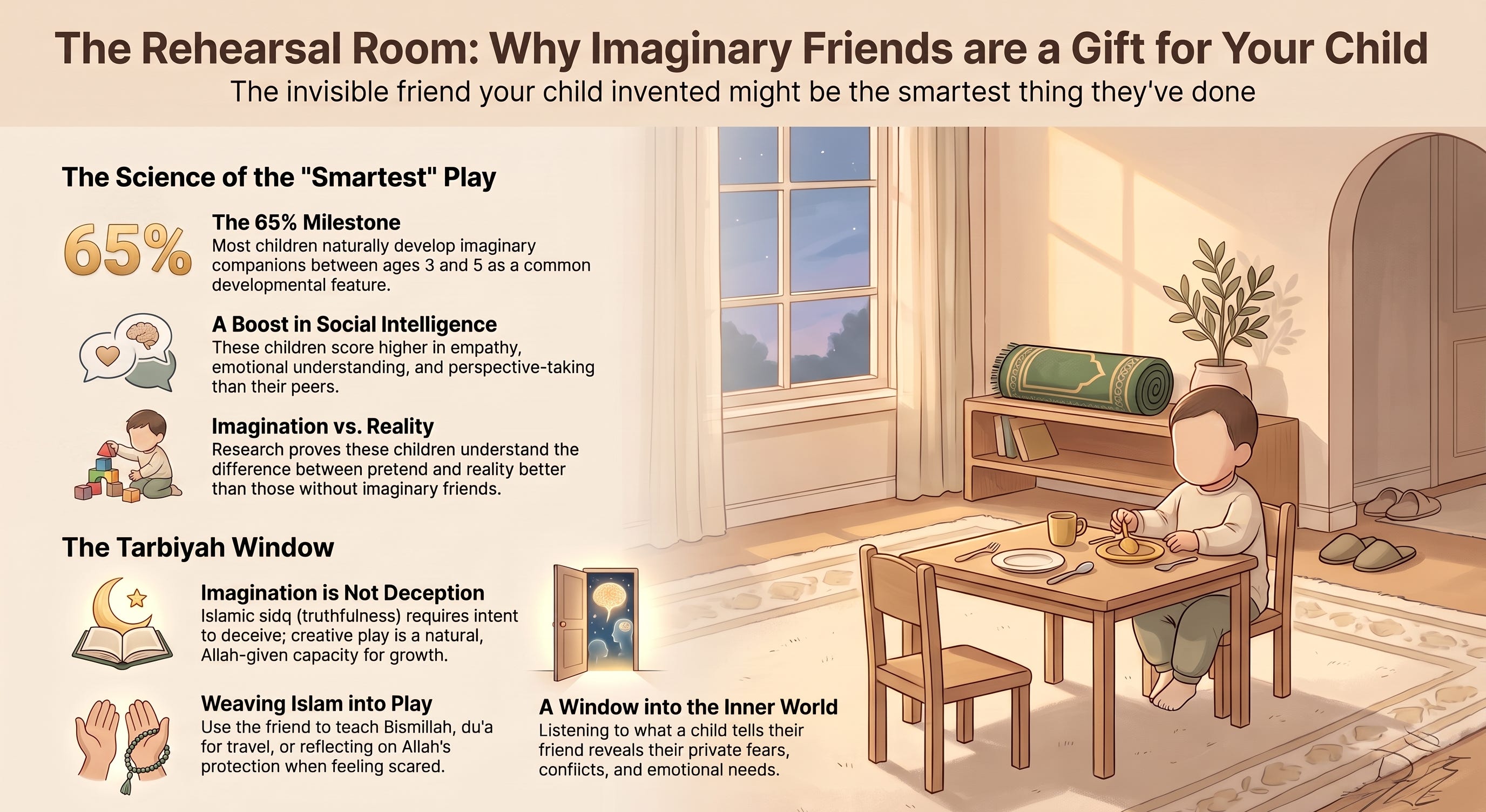
Your child just set a place at the table for someone who isn’t there.
She insists “Noor” wants rice too. She tells you Noor is scared of the dark. She scolds Noor for not sharing.
And somewhere between passing the imaginary plate and wondering whether to play along, a thought crosses your mind that you’re almost embarrassed to admit: Is my child lying to me?
Here’s what stopped me when I first looked at the research: children who create imaginary friends are not the children you’d expect. They are not the withdrawn ones. They are not the lonely ones. They are the ones who score higher on empathy, social confidence, and emotional understanding than their peers who never invent a pretend companion. [4]
So why does it make us so uncomfortable?
But before I answer that, I want to share something about the Islamic dimension of this question that changed how I think about it entirely. We’ll get there.
Why This Guide Is Different From Generic Parenting Advice
Grounded in peer-reviewed developmental research from Merrill-Palmer Quarterly, Social Development, BMC Psychiatry, and the Creativity Research Journal (2014-2023). [1,4,5,7]
Addresses the specific concern Muslim parents carry: whether imaginary play conflicts with truthfulness (sidq), with clear Islamic evidence that it does not.
Includes a free Imaginary Friends Companion Pack — a printable guide with a lying-vs-imagination quick-check card, tarbiyah conversation starters, and an Islamic reflection page you can keep on your fridge.
The Question You’re Actually Asking
Let’s name it, because most articles on this topic skip right past it.
You’re not really asking “what are imaginary friends?” You already know what they are. Your child has one. What you actually want to know is: Should I be worried? And does this conflict with what Islam teaches about honesty?
That second question is the one that sits in your chest. Because you’re raising your child to love Allah, to speak truth, to be a person of sidq. And now your three-year-old is narrating a full conversation with someone who doesn’t exist, and you’re not sure if you should smile or intervene.
Their imagination is their rehearsal room.
That’s the sentence I want you to hold onto for the rest of this article. Because everything the research shows, and everything the Islamic tradition teaches about how children grow, points in the same direction.
What the Research Actually Shows (And Why It Should Reassure You)
Here’s what surprised me most: a meta-analysis spanning over two decades of studies found that up to 65% of children under the age of 7 have or have had an imaginary companion. [1] This is not a quirky outlier behaviour. It is one of the most common features of early childhood.
Children as young as two-and-a-half can start this kind of play. The peak falls between three and five. Most imaginary friends persist for a few months, though some last a year or longer. And nearly all children move on naturally, without any adult intervention, when they are developmentally ready. [1,3]
But here’s the thing. The children who create imaginary companions are not retreating from social life. They are rehearsing for it.
Research has found these children show greater empathy, stronger perspective-taking abilities, and more social confidence than peers who do not create pretend companions. [4] They use richer, more complex language. [1] They show better emotional coping skills. [5] And they understand the difference between what is real and what is pretend at least as well as children who never engage in this kind of play. [7]
That last point matters more than anything for Muslim parents. These children are not confused. They know the friend is not real. They know they are playing.
Is This Lying? What Islam Actually Teaches
This is where the knot in your chest either tightens or releases. Let me help it release.
The Prophet ﷺ said: “Be truthful, for truthfulness leads to righteousness, and righteousness leads to Paradise. A person continues to be truthful and strives to be truthful until he is recorded with Allah as a siddiq.” [Sahih al-Bukhari 6094] [6]
This hadith is unambiguous. Islam takes honesty seriously. Sidq is a character trait that shapes who your child becomes before Allah.
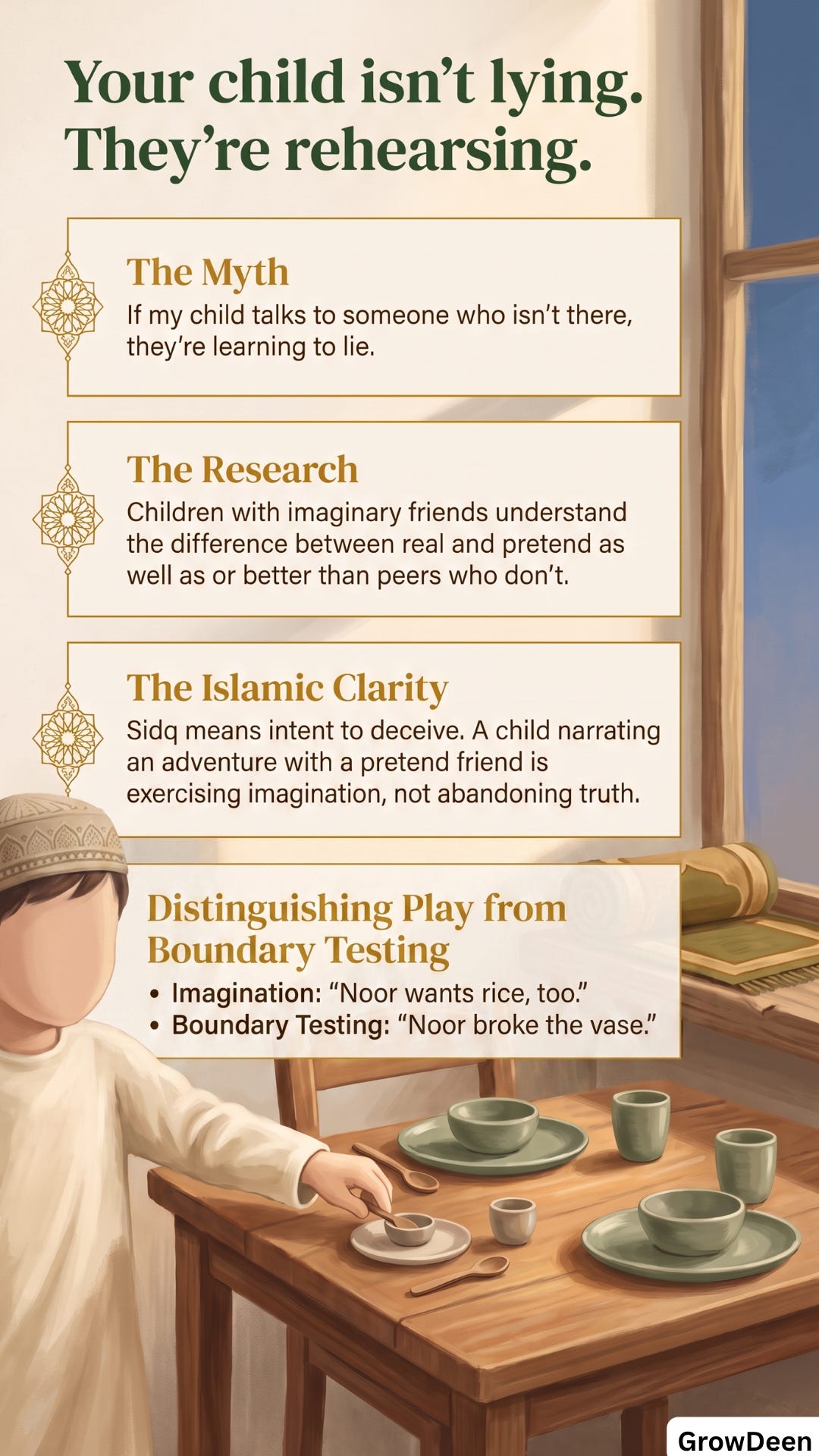
But lying, in both the Islamic and developmental sense, requires intent to deceive. A three-year-old narrating an adventure with “Captain Saalih” is not trying to mislead anyone. She is doing what young minds were created to do: imagining, creating, and rehearsing social and emotional skills in a private, low-stakes space.
Where the line matters is simple. “Noor wants rice too” at the dinner table? That is imagination. “Noor broke the vase, not me” after your child knocked it over? That is boundary-testing, and it calls for calm, clear correction. You can say: “Pretend friends can’t break things. Let’s talk about what happened. In our family, we tell the truth because Allah loves people who are truthful.”
Keep it brief. Keep it warm. That is all it takes.
And when researchers finally tested this question directly, what they found surprised everyone: children engaged in imaginative play showed better understanding of the difference between real and pretend than their peers who did not. [7] Imagination does not blur the lines. It sharpens them.
Their imagination is their rehearsal room. Not a threat to their honesty. A rehearsal room for it.
I know this is a lot to hold in your head, especially when your three-year-old is mid-conversation with an invisible guest and you’re trying to figure out the right response in real time. That’s why I’ve created a free Imaginary Friends Companion Pack — a printable guide with a quick-check card that helps you tell the difference between imagination and dishonesty, plus five ready-made tarbiyah phrases you can use during pretend play. Keep reading to download it at the end of this article.
What to Actually Do (The Practical Part)
So your child has an imaginary friend. You know it’s healthy. You know it’s not lying. Now what?
Accept it without overinvesting. You do not need to pretend the friend is real, but you also do not need to end the game. If your child asks you to set a place at dinner for the friend, redirect: “Why don’t you set a place for them?” You’re acknowledging the play, building your child’s skills, and staying honest all at once. [2]
Listen for what your child is really saying. What your child tells their imaginary friend is often a mirror of their own inner world. If the friend is “scared,” your child might be processing fear. If the friend “won’t share,” your child might be working through a real conflict. These are windows into feelings your child may not bring to you directly.
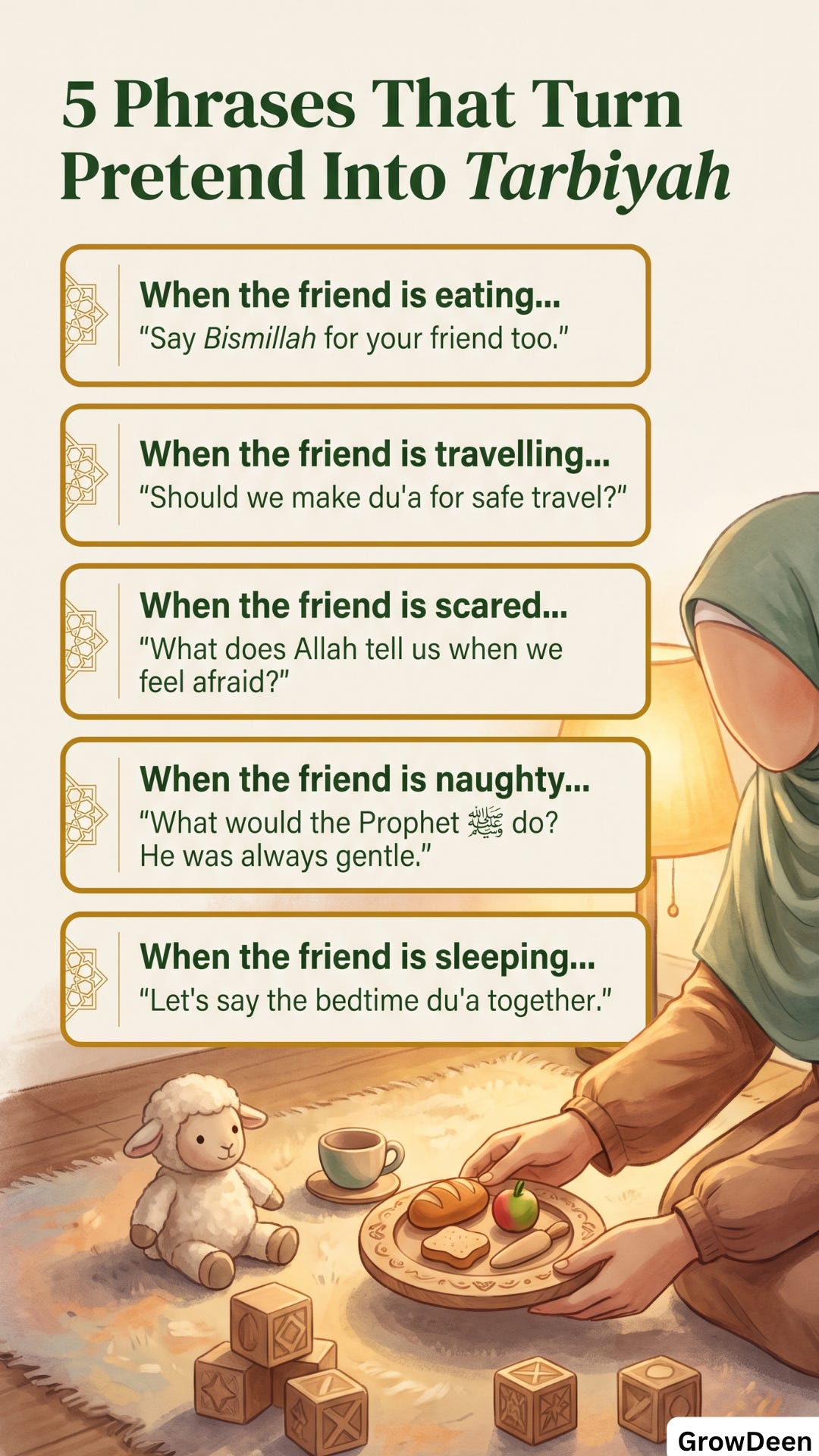
Use it for tarbiyah. Imaginary play opens natural doors for Islamic teaching. If the friend is “eating,” say “Don’t forget to say Bismillah for your friend.” If the friend is “going on a journey,” say “Should we make du’a for safe travel?” If the friend is “feeling scared,” ask “What does Allah tell us when we feel afraid?” These are not forced lessons. They are Islam woven into daily life, which is tarbiyah in its purest form.
Keep real friendships strong. Imaginary friends are healthy, but they should complement, not replace, real peer interaction. Masjid programmes, playgroups, family gatherings, neighbourhood play — make sure these are part of your child’s week. Most children balance both without any prompting. [4]
When You Should Actually Worry
For almost every child, this phase ends on its own. But there are a small number of situations where a paediatrician or child psychologist should be consulted:
The imaginary friend is consistently hostile or frightening to your child. Your child has been through a traumatic event and the friend appears connected to it. Your child genuinely cannot tell the difference between the friend and reality. The friend has completely replaced all real relationships. The behaviour intensifies rather than naturally fading. [5,8]
These scenarios are rare. But noticing them and acting on them is part of fulfilling the amanah of caring for your child’s whole self: body, mind, and heart. [9]
The Sacred Trust of Nurturing Your Child’s Inner World
When your child creates an imaginary friend, they are using a capacity that Allah placed within them. When I reflect on the verse where Allah says, “He is Allah, the Creator (Al-Khaliq), the Originator (Al-Bari’), the Fashioner (Al-Musawwir); to Him belong the most beautiful names” [Qur’an 59:24] [10], I think about what it means that Allah described Himself with three names of creation: the one who determines, the one who brings into being, and the one who gives form. According to Tafsir Ibn Kathir, these three names describe the stages through which Allah brings His creation into existence. The human mind’s ability to imagine, to originate characters and stories, and to give them form and personality is part of how we were made.
The Prophet ﷺ said, “Be truthful, for truthfulness leads to righteousness, and righteousness leads to Paradise.” [Sahih al-Bukhari 6094] [6] This hadith grounds us. But it also clarifies: play is not deception. A child creating a character is exercising imagination, not abandoning truth.
What is beautiful is how the science and the Islamic understanding of childhood point in the same direction. Both say: your child’s inner world is something to honour, not fear. When we guide it with tarbiyah and trust in Allah’s design, we are nurturing a soul.
Your Free Imaginary Friends Companion Pack
If you’ve read this far, you’re the kind of parent who takes your child’s inner world seriously. Not with panic, but with the kind of thoughtful care that says: I want to get this right. That says a lot about you.
Inside the Imaginary Friends Companion Pack (one comprehensive PDF, 3 pages):
Page 1: The Imagination vs. Lying Quick-Check Card — A simple visual decision tree that helps you tell the difference between healthy imaginative play and real boundary-testing in under 30 seconds. Designed as a fridge-ready reference you can glance at when your child says something that makes you wonder.
Page 2: 5 Tarbiyah Conversation Starters for Imaginary Play — Ready-made phrases you can use when your child’s imaginary friend is “eating,” “going somewhere,” “feeling scared,” “getting in trouble,” or “being left out.” Each phrase gently weaves an Islamic moment into the play without interrupting it.
Page 3: Islamic Reflection Card — A reflection on what Allah’s names Al-Khaliq, Al-Bari’, and Al-Musawwir teach us about the creative capacity He placed within every child, with the article’s core reminder: “Their imagination is their rehearsal room.” English translation and source reference included for the Qur’anic verse.
This is not a PDF to download and forget. It is a tool designed to stay on your fridge, where you will actually use it the next time your child introduces you to someone invisible.
This Imaginary Friends Companion Pack is what every subscriber receives with each article. We cover the full journey of raising Muslim children, from newborns to school-age, all backed by scientific research and rooted in Islamic wisdom.
If you’re a Muslim parent who wants both evidence-based guidance and an Islamic perspective you can trust, subscribe for free so future resources arrive in your inbox before you need them.
Subscribe free for parenting resources backed by both science and Sunnah — guidance so unique, you literally can’t get it anywhere else. No spam, no clutter, just resources that matter.
Your One Thing for Tonight
The next time your child talks to their imaginary friend, sit near them and just listen. Don’t correct. Don’t redirect. Just listen to what they tell this friend, because what they say to someone who isn’t there often tells you more about what is happening inside them than anything they would say to you directly. That is your tarbiyah window. Use it.
May Allah place barakah in your effort, accept your intention, and make the care you pour into this child more rewarded than it feels in the moment.
Share This With Someone Who Needs It
Think of one person right now: the mother at the masjid whose daughter was chatting to “her friend” during the potluck, and you saw the worry cross her face. Or your sister who mentioned that her son has started blaming his imaginary friend for everything. Or the friend in your WhatsApp group who asked, half-joking, half-serious: “Is this normal?”
This article could ease their mind. Share it with them today, not as advice-giving, but as reassurance. Sometimes the most loving thing we can do is pass along the clarity that took us too long to find.
Frequently Asked Questions
Q: At what age do children typically get imaginary friends?
A: Children can start as young as two-and-a-half, with the peak falling between three and five years old. [1] Most move on naturally by age seven or so without any adult prompting.
Q: Are imaginary friends a sign of loneliness or social problems?
A: The opposite, actually. Research shows that children with imaginary companions tend to be more social, less shy, and more empathetic than children who don’t create them. [4] It is a sign of healthy emotional and cognitive development, not a warning signal.
Q: Is it haram for my child to have an imaginary friend?
A: There is no Islamic prohibition against children’s imaginative play. The Prophet ﷺ himself permitted and participated in children’s play with warmth and gentleness. The Islamic concern about truthfulness (sidq) applies to deliberate deception, not to creative play, which children understand is pretend. [6,7]
Q: Should I play along with my child’s imaginary friend?
A: You do not need to fully pretend the friend is real, but you also do not need to shut it down. A gentle middle ground works: acknowledge the play, redirect practical tasks back to your child (”Why don’t you set a place for them?”), and use the play as natural openings for Islamic teaching. [2]
Q: What if my child blames their imaginary friend for something they did?
A: This is boundary-testing, not pathological lying. Respond calmly: “Pretend friends can’t break things. Let’s talk about what happened.” Then follow through with whatever is appropriate. It is a natural moment to reinforce honesty gently, not a cause for alarm. [2]
Q: When should I actually be worried about my child’s imaginary friend?
A: Consult a paediatrician or child psychologist if the friend is consistently hostile or frightening, your child cannot distinguish between the friend and reality, the friend has replaced all real relationships, or the behaviour is connected to a traumatic event and is intensifying rather than fading. [5,8] These situations are uncommon.
References
[1] Moriguchi, Y., & Todo, N. (2018). Prevalence of imaginary companions in children: A meta-analysis. Merrill-Palmer Quarterly, 64(4), 459-482. https://doi.org/10.13110/merrpalmquar1982.64.4.0459
[2] Majors, K., & Baines, E. (2017). Children’s play with their imaginary companions: Parent experiences and perceptions. Educational and Child Psychology, 34(3), 37-56. https://doi.org/10.53841/bpsecp.2017.34.3.37
[3] Adams, K. (2023). ‘Imaginary’ friends: The roles of imaginary/invisible companions in the classroom. Education 3-13. https://doi.org/10.1080/03004279.2023.2290666
[4] Armah, A., & Landers-Potts, M. (2021). A review of imaginary companions and their implications for development. Imagination, Cognition and Personality, 41(1), 31-53. https://doi.org/10.1177/0276236621999324
[5] Gleason, T., & Kalpidou, M. (2014). Imaginary companions and young children’s coping and competence. Social Development, 23, 820-839. https://doi.org/10.1111/sode.12078
[6] Sahih al-Bukhari 6094 — Graded: Sahih — https://sunnah.com/bukhari:6094
[7] Taylor, M., Mottweiler, C.M., Naylor, E.R., & Levernier, J.G. (2015). Imaginary worlds in middle childhood: A qualitative study of two pairs of coordinated paracosms. Creativity Research Journal, 27, 167-174. https://doi.org/10.1080/10400419.2015.1030318
[8] Panah, Z.Y., Mahmoodabadi, H.Z., & Dehghani, F. (2023). The role of imaginary companion in the life of only children: A qualitative study. BMC Psychiatry, 23(1), Article 843. https://doi.org/10.1186/s12888-023-05360-0
[9] Qur’an, Surah An-Nisa 4:58 — https://quran.com/4/58
[10] Qur’an 59:24 — Tafsir Ibn Kathir — https://quran.com/59/24