

Most Muslim parents know to check for the halal symbol. But only 300,000 food products globally carry halal certification — leaving millions of everyday products completely unchecked. [1] This guide shows you exactly how to read a food label for both nutritional value and hidden haram ingredients — including the eight additive names that appear on labels without ever spelling out what they actually are.
You’re standing in the supermarket. The packet says “natural.” The halal symbol is there. You put it in the trolley.
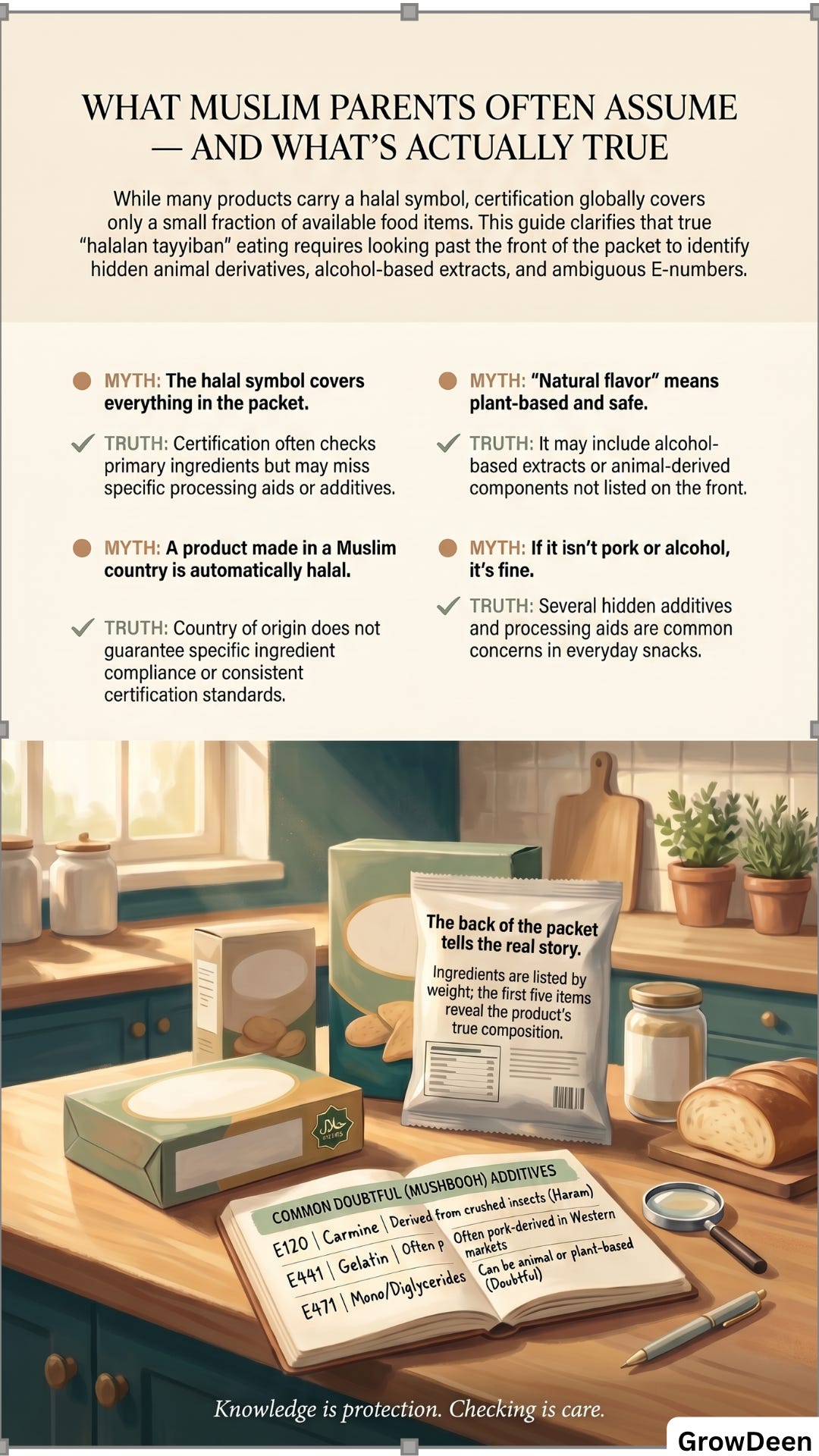
But here’s what nobody told you: certification bodies vary. Ingredients change between production batches. And some of the most commonly consumed haram substances in Muslim households — carmine, pork-derived gelatin, L-cysteine from pig bristles — hide behind technical names that don’t announce themselves.
I’m not saying this to frighten you. I’m saying this because it’s fixable. You don’t need a chemistry degree. You need about forty-five seconds per packet and a few names to look for.
That’s what this guide is.
Why This Guide Is Different From Generic Food Label Advice
It’s built on current research AND Islamic standards — every practical recommendation is backed by food science, and every halal guidance check is drawn from recognised halal certification authorities and scholarly consensus.
It treats halal literacy as a form of worship, not anxiety — because the Qur’an commands us to eat what is halalan tayyiban, lawful and wholesome, and that requires knowledge, not just intention.
You’ll leave with a printable Halalan Tayyiban Shopper’s Pack — a three-page PDF with a hidden-ingredient reference card, a nutritional comparison guide, and an authenticated du’a for protection from what is forbidden.
Start Here: The Ingredient List Tells More Truth Than the Front of the Packet
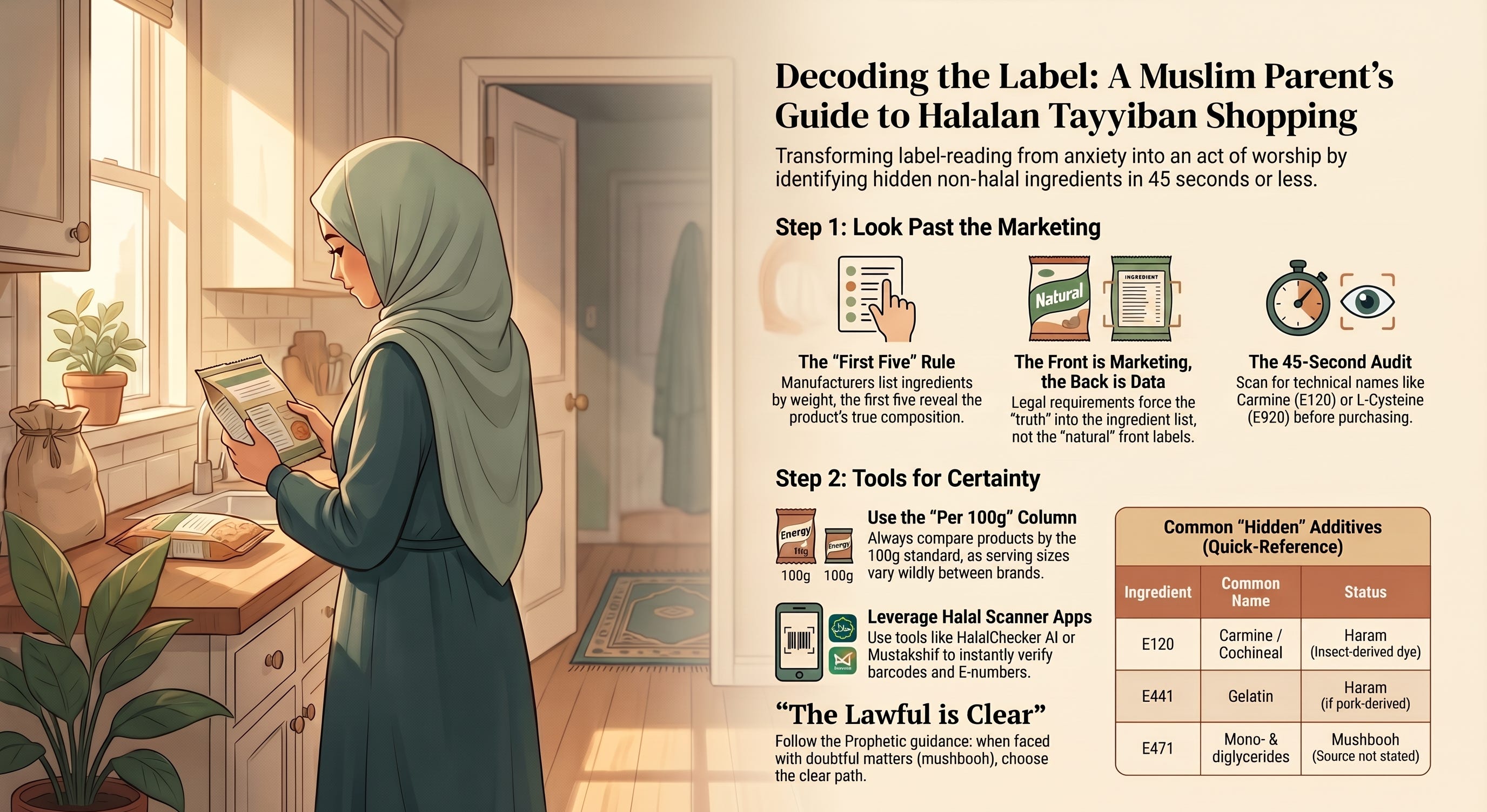
The front of a food packet is marketing. The ingredient list on the back is data.
Here’s the rule worth remembering: ingredients are listed from heaviest to lightest by weight. Whatever comes first makes up the largest proportion of what you’re buying. If a child’s cereal lists sugar before oats, it is — by composition — more sugar than grain. It might say “made with wholesome grains” on the front. The ingredient list tells you the actual story. [2]
Scan the first five ingredients before anything else. That habit alone will change how you shop.
And when an ingredient is featured in the product’s name — “strawberry yoghurt,” “chicken curry” — manufacturers are legally required to declare the exact percentage. This is how you discover that the strawberry yoghurt your child loves contains 3% strawberries. [2]
What the Nutrition Panel Actually Tells You (And What to Compare)
Every packaged product must list energy (kilojoules), protein, total fat, saturated fat, total carbohydrates, sugars, and sodium. [2] Some manufacturers add fibre, calcium, or iron voluntarily — useful when it’s there.
One thing to get right: always use the per 100g column when comparing two products. Serving sizes are set by manufacturers and differ wildly between brands. One “serving” of muesli might be 30g; another brand’s “serving” might be 60g. Per 100g gives you an honest comparison across the same amount. [2]
When in doubt between two similar products, lean toward lower saturated fat, lower sodium, lower added sugars, and higher fibre.
But here’s something most food label guides don’t mention: kilojoules alone don’t tell you much. A handful of raw almonds is higher in kilojoules than a rice cracker and far more nourishing. Source of energy matters as much as quantity — especially for growing children.
Fat, Sugar, and Sodium — And the Names They Hide Behind
This is where label reading becomes genuinely useful, and slightly detective-like.
Fat appears as: beef fat, butter, shortening, coconut oil, palm oil, cream, dripping, lard, vegetable fat, hydrogenated oil, or mono/di/triglycerides. [2]
Sugar appears as: corn syrup, dextrose, fructose, glucose, fruit juice concentrate, lactose, malt, maltose, sorbitol, or xylitol — among others. [2]
Sodium appears as: salt, MSG, baking powder, yeast extract, sodium bicarbonate, sodium nitrate, or stock cubes. [2]
When three or more of these names appear in the first half of the ingredient list, reconsider.
The Halal Reading Every Muslim Parent Needs to Know
This is the part most food label guides skip entirely.
Here’s the thing about halal certification: it matters, and it isn’t enough on its own. As of 2024, only around 300,000 food products globally carry halal certification — a tiny fraction of what’s on supermarket shelves in the UK, Canada, the US, or Australia. [1] The rest? You’re on your own with the ingredient list.
And some of those ingredients won’t announce themselves.
Gelatin is perhaps the most well-known. In Western markets, commercial gelatin is overwhelmingly pork-derived. It hides as “gelling agent,” “stabiliser,” or simply “gelatin” — with no indication of its animal source. [7] You’ll find it in gummies, marshmallows, yoghurt, dessert mixes, and some vitamins.
Carmine / E120 is a red dye that requires the crushing and boiling of approximately 70,000 female insects per kilogram of dye. [8] It appears in red and pink sweets, some yoghurts, fruit drinks, and sauces. The Halal Food Authority classifies it as haram. Look for carmine, cochineal extract, E120, or natural red 4.
E471 (mono- and diglycerides of fatty acids) is an emulsifier that can be derived from plant oils — or from pork fat. The label doesn’t specify. It’s one of the most widely used food additives and one of the most genuinely uncertain. Mushbooh — doubtful. [8]
Natural flavours is a catch-all term that may include alcohol-based extracts, animal-derived components, or something entirely benign. Without certification, you cannot know from the label alone. [6]
L-Cysteine / E920 is a dough conditioner used in commercial bread. A significant proportion of it is sourced from pig bristles or human hair. [7] It may appear as “dough conditioner” and sometimes doesn’t appear at all if used as a processing aid.
Glycerine / Glycerol is a moisture-retention agent that may be derived from animal fat, including pork derivatives. [7] Common in baked goods and confectionery.
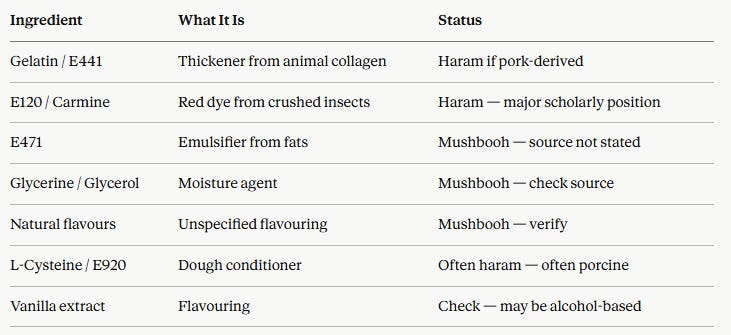
For specific ingredient rulings where scholarly opinion varies, always consult a qualified Islamic scholar or recognized halal certification body in your country.
Halal Scanner Apps: Your Best Tool in the Aisle
You’re not expected to memorise this table. That’s what halal scanner apps are for.
HalalChecker AI scans barcodes, ingredient list photos, and product photos. It uses AI to return a verdict — halal, haram, or mushbooh — with a reason, and it supports multiple schools of Islamic jurisprudence (Hanafi, Shafi’i, Maliki, and Hanbali). Available on iOS and Android. [1]
Mustakshif maintains a scholar-reviewed database of over 2.5 million products, with Islamic utilities built in. Free on iOS and Android. [1]
Verify Halal is fully free, cross-referencing more than 30 certification bodies globally. Endorsed by JAKIM. iOS and Android. [1]
Scan Halal is the North America-focused barcode database. Fully free. [1]
Tayib reads ingredient list text directly via OCR, flags mushbooh ingredients explicitly, and supports offline use. Currently iOS only. [1]
A note: no app replaces a qualified Islamic scholar for genuinely uncertain cases. Manufacturers change formulations without announcement. When something is flagged mushbooh and a clear alternative exists, precaution is the wiser choice.
I know this is a lot to carry into a supermarket. That’s exactly why I’ve created a free Halalan Tayyiban Shopper’s Pack — a printable three-page PDF with a hidden-ingredient quick-reference card, a nutritional comparison guide, and an authenticated du’a for protection from the forbidden. Keep reading to download it at the end of this article — it’s designed to stay in your bag, not sit on your phone.
The Islamic Framework for Mindful Eating: What Halal and Tayyib Really Mean Together
When I sit with this topic — the scanner apps, the E-number tables, the ingredient lists — I keep coming back to two things the Prophet ﷺ said that feel like the whole article in a handful of words.
The first is in the Qur’an. Allah says: “O mankind, eat from whatever is on earth that is lawful and good, and do not follow the footsteps of Satan. Indeed, he is to you a clear enemy.” [Qur’an 2:168] According to Tafsir Ibn Kathir, this is a universal address to all of humanity — not only believers — establishing the principle that what we consume must be both halal (lawful) and tayyib (wholesome, pure, good). Ibn Kathir explains that the warning against Satan’s footsteps refers specifically to the confusion he introduces about what is permitted — making people doubt the lawful, or stumble into the unlawful through ignorance. [3] I find that oddly comforting. The confusion isn’t accidental. But it can be navigated.
The second is the hadith of Al-Nu’man ibn Bashir, who reported that the Prophet ﷺ said: “The lawful is clear and the unlawful is clear, and between the two are doubtful matters which many people do not know. Whoever avoids doubtful matters has absolved their religion and their honour. And whoever falls into doubtful matters falls into the unlawful — like the shepherd who pastures near a sanctuary and is likely to graze within it.” [Sahih al-Bukhari 2051; Sahih Muslim 1599] [4]
This is practical. It doesn’t demand impossible certainty. It points to a habit: when something is genuinely unclear and a verified alternative exists, take the clear path. That’s the scanner app. That’s flipping to the ingredient list. That’s calling the manufacturer to ask. Not paranoia — precaution. And one of the most quietly beautiful things about this deen is that precaution, done with the right intention, is itself an act of worship.
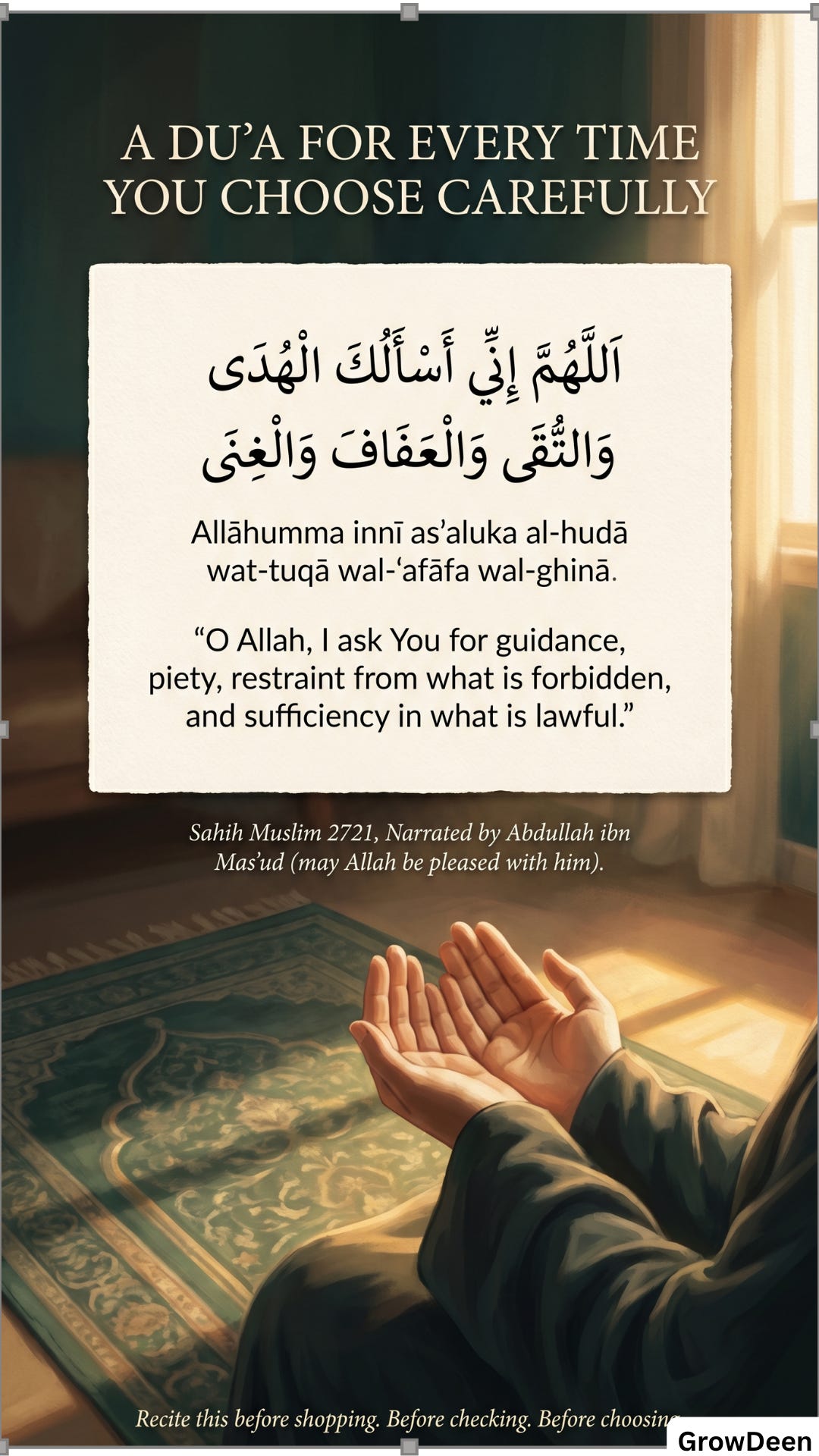
Your Free Halalan Tayyiban Shopper’s Pack
If you’ve read this far, you’re the kind of parent who takes what goes into your family’s food seriously — not as anxiety, but as care. That tells me something beautiful about you.
Inside the Halalan Tayyiban Shopper’s Pack (one comprehensive PDF, 3 pages):
Page 1: Hidden Ingredient Quick-Reference Card — A compact, printable card listing the 12 most common haram and mushbooh food additives by both their common name and E-number, with colour-coded halal status (haram, mushbooh, or requires verification) and a one-line explanation of what each one is and where it hides — designed as a laminated reference to keep in your bag or purse for every supermarket trip.
Page 2: Smart Nutrition Comparison Guide — A side-by-side guide showing how to compare two similar products using the per 100g column, with reference ranges for saturated fat, sodium, sugars, and fibre by age group (toddler, school-age child, adult), plus a checklist of the hidden names for fat, sugar, and sodium — so you can make confident nutritional choices in under one minute at the shelf.
Page 3: A Du’a for Protection from the Forbidden — The du’a the Prophet ﷺ taught asking Allah for guidance, piety, restraint from what is forbidden (‘afafa), and self-sufficiency in what is lawful (ghina): Allāhumma innī as’aluka al-hudā wat-tuqā wal-’afāfa wal-ghinā — with full Arabic text, transliteration, and English meaning — a practice that turns every shopping trip into an act of asking Allah to keep your family far from what is harmful and close to what is pure. [Sahih Muslim 2721] [10]
This isn’t a PDF to download and forget. It’s a tool designed to stay in your bag — where you’ll actually use it when you need it most.
This Halalan Tayyiban Shopper’s Pack is what every subscriber receives with each article. GrowDeen covers the full journey of raising Muslim children — from pregnancy and newborns through to school-age children and beyond — including nutrition, development, behaviour, safety, and the everyday decisions that shape a child’s physical and spiritual health.
If you’re a Muslim parent who wants research-backed guidance rooted in Islamic wisdom, subscribe free so future resources arrive in your inbox before you need them.
Subscribe free for parenting resources backed by both science and Sunnah — guidance so unique, you literally can’t find it anywhere else. No spam, no clutter. Just resources that matter.
Your 5-Minute Action Right Now
This week, pick one product your family uses regularly — a cereal, a yoghurt, a sauce, a snack. Scan it with one of the halal apps above. Then flip it over and find one of the hidden names from the table in this article.
Just one product. One scan. One ingredient name found.
That’s the beginning of the habit. You don’t have to do this for everything in one week. Start with one. The Prophet ﷺ reminded us that the most beloved deeds to Allah are those done consistently, even if small. [Sahih al-Bukhari 6464] [11] This is one of those small, consistent things.
May Allah make our families among those who eat what is truly halalan tayyiban — lawful and wholesome in every sense. May He protect our children from what is harmful without our knowing, and place barakah in every choice we make with sincerity and care. Ameen.
Share This With Someone Who Needs It
Think of one person right now: the sister in your WhatsApp group who sent a message last week asking whether a certain E-number was okay — then bought the product anyway because she didn’t have time to research it. The friend who gives her children the same brands she grew up with, not knowing the formulations have changed. The new Muslim in your community who genuinely doesn’t know that gelatin can be pork-derived or that carmine is made from insects.
This article could help them make one better choice this week. Share it with them — not as correction, but as care. Sometimes the most loving thing we can do is pass along knowledge that protects.
Frequently Asked Questions
Q: What’s the difference between halal certified and halal ingredients?
A: A halal-certified product has been audited by a recognised Islamic organisation confirming it meets halal standards across its entire supply chain — ingredients, processing, and handling. A product with “halal ingredients” may still have cross-contamination risks or use doubtful processing aids. Certification is stronger, but even certified products benefit from a quick ingredient scan for your family’s peace of mind. [5]
Q: Is E471 halal or haram?
A: E471 (mono- and diglycerides of fatty acids) is a mushbooh — doubtful — additive. It can be derived from plant oils (halal) or animal fats, which may include pork derivatives, and the label doesn’t specify the source. [8] When a certified halal alternative exists, choosing it is the more cautious approach. For a definitive ruling for your madhab, consult a qualified Islamic scholar.
Q: What does “may contain traces of” mean on a food label?
A: It means the product is made in a shared facility or on shared equipment with products containing potential allergens. There’s a risk of cross-contamination even if the allergen isn’t an intentional ingredient. [2] This is particularly important for families managing food allergies. This statement is voluntary for manufacturers, so its absence doesn’t guarantee safety.
Q: Are halal scanner apps reliable?
A: They’re a useful starting point, not a definitive ruling authority. The best apps — like HalalChecker AI, Mustakshif, and Verify Halal — use large, scholar-reviewed databases and are updated regularly. [1] But manufacturers change formulations without announcement, and app data can lag. For products flagged as mushbooh, the cautious choice is to verify directly with the manufacturer or consult a local halal authority.
Q: Can a product be vegan and still be haram?
A: Yes. Vegan products may still contain alcohol-based vanilla extract, wine reductions, or other alcohol-derived flavourings. [8] Vegan certification confirms no animal products, but it doesn’t assess alcohol content or other haram substances. Always check the ingredient list even for vegan-labelled products.
Q: What’s the most reliable way to check if a specific additive is halal?
A: The three-step approach that works best: (1) scan with a halal app to get an initial verdict; (2) if flagged as mushbooh or haram, check the manufacturer’s website or contact them directly to ask about the source of that specific additive; (3) for persistent uncertainty, refer to your local halal certification body or a qualified Islamic scholar. For more detail on specific additives, see the Hidden Ingredient Quick-Reference Card in the companion pack above.
Q: How often do manufacturers change their ingredients?
A: More frequently than most consumers realise. Reformulations happen in response to supply chain changes, cost adjustments, or regulatory requirements — and the packaging may continue to carry a halal certification even after a formulation change until the next audit cycle. [4] The habit of scanning with an app and checking the ingredient list, even for familiar products, is genuinely worthwhile.
References
[1] HalalChecker. (2026). 7 Best Halal Food Scanner Apps in 2026 (Tested & Compared). https://www.halalchecker.app/blog/best-halal-food-scanner-apps
[2] Food Standards Australia New Zealand (FSANZ). (2021). Food Standards Code. https://www.foodstandards.gov.au/code/Pages/default.aspx
[3] Qur’an, Surah Al-Baqarah (2:168). Translation: Saheeh International. Tafsir: Ibn Kathir via Quran.com.
[4] Sahih al-Bukhari 2051; Sahih Muslim 1599. Narrated by Al-Nu’man ibn Bashir. https://sunnah.com/bukhari:2051
[5] Halal Food Council USA. (2024). How to Read Halal Food Labels: A Consumer’s Guide. https://halalfoodcouncilusa.com/how-to-read-halal-food-labels-a-consumers-guide/
[6] HalalLens. (2026). Is This Ingredient Halal? Your Complete Guide to Reading Food Labels. https://halallens.no/en/blog/is-this-ingredient-halal-guide
[7] HalalLens. (2026). Hidden Haram Ingredients: A Complete Guide. https://halallens.no/en/blog/hidden-haram-ingredients-a-complete-guide-to-what-muslim-consumers-need-to-know
[8] HalalSpy. (2026). Halal E Numbers: Complete List of Safe and Haram Food Additives. https://halalspy.com/halal-knowledge/ingredients/e-numbers-halal/
[9] Tayib. (2025). The Ultimate Guide to Halal Ingredients & Food Additives. https://tayib.app/blog/the-ultimate-guide-to-halal-ingredients-and-food-additives/
[10] Sahih Muslim 2721. Narrated by Ibn Mas’ud. Allahumma inni as’aluka al-huda wat-tuqa wal-’afafa wal-ghina. https://sunnah.com/muslim:2721
[11] Sahih al-Bukhari 6464. Narrated by Aisha (may Allah be pleased with her). https://sunnah.com/bukhari:6464