

The Prophet ﷺ structured every hour of his day, from waking to sleeping — with intention and remembrance. 50 years of family research confirms this is exactly what children need. This guide brings every one of his 50 authenticated Sunnah habits into your family’s daily life. [1]
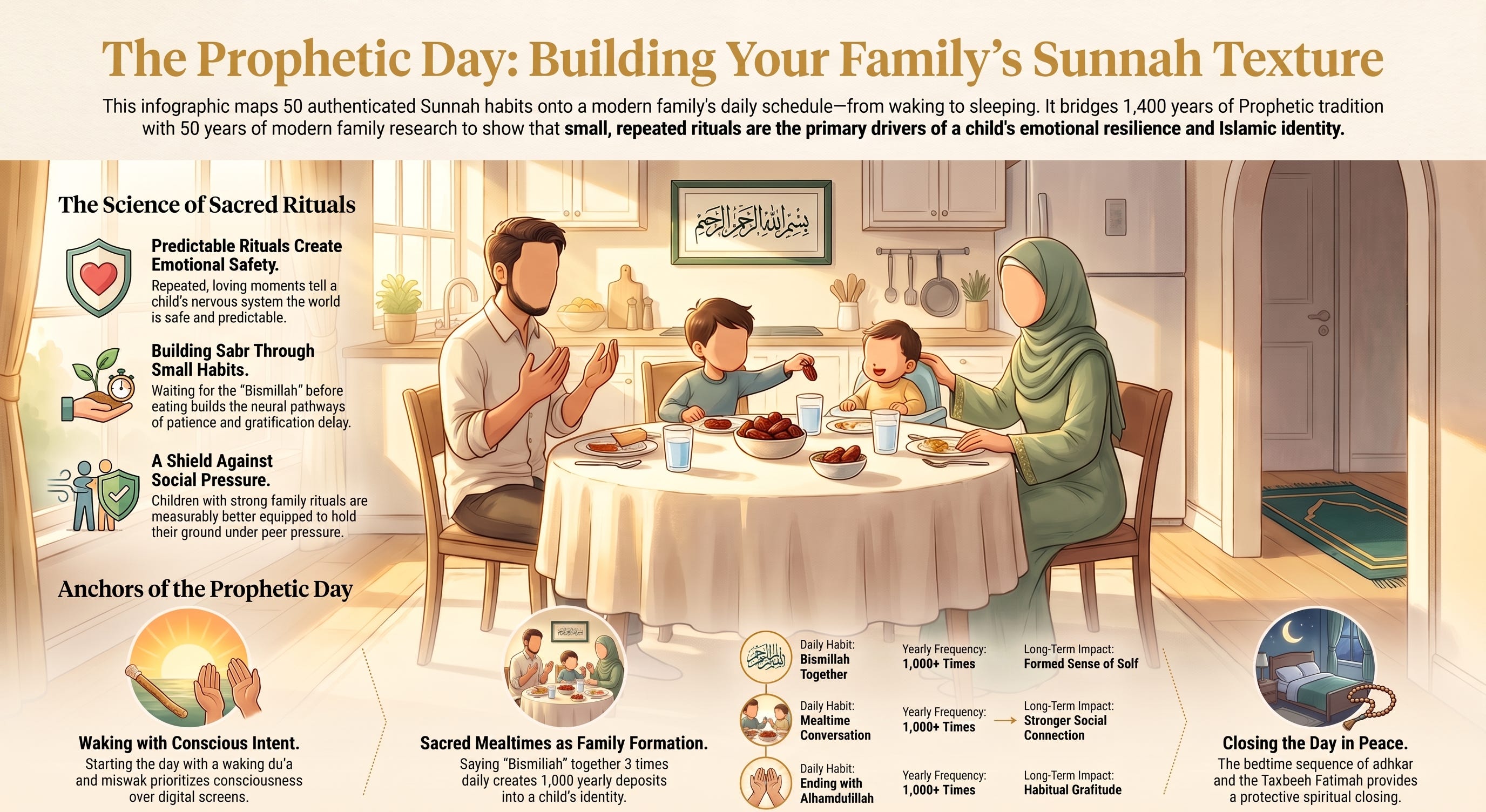
He placed his miswak beside his head every night.
Not beside the bed. Beside his head — so that the moment he opened his eyes in the morning, before anything else, his hand would find it. That was not habit by accident. That was intention by design.
From the moment he woke until the moment he slept, the Prophet ﷺ did not leave his hours to chance. He had a waking du’a, a way of getting dressed, words said before every meal, a greeting at every door, a sequence of remembrance before every prayer, and a complete ritual before his eyes closed each night. He did not separate worship from daily life.
His daily life was worship — structured, gentle, and entirely reproducible in your home.
Why This Guide Is Different From Generic Islamic Parenting Advice
It is built entirely around the Prophet’s ﷺ authenticated daily habits. Every practice in this guide has a verified Sahih or Hasan source. Not a single weak or fabricated narration appears anywhere. These are his actual habits — confirmed, traceable, and available to your family today.
It maps the complete Prophetic day onto your family’s real hours — waking, wudu, Fajr, breakfast, leaving home, Dhuhr, lunch, returning home, Asr, Maghrib, dinner, Isha, and bedtime — so tarbiyah is not a separate project, but the texture of every ordinary moment.
You will receive the free Our Sunnah Day Family Guide — a beautiful 3-page printable with all 50 Sunnah habits as a visual timeline you can display at home, plus a morning and evening daily tracker your family can print and use every single day.
What the Research Actually Found
When I went through the family rituals research — really went through it — what I found was not a parenting trend. It was a 50-year body of evidence pointing to something so consistent, across so many cultures and contexts, that it is almost impossible to dismiss. [1]
Here is what the research showed.
Children’s nervous systems learn safety from predictable daily rituals. A young child’s brain is not yet capable of self-regulating the way an adult’s is. It is asking one question constantly: Is this safe? Rituals — repeated, loving, predictable moments — answer that question reliably. They tell the nervous system: the world is not chaos. You are held. [3] This effect is so powerful that research on families navigating illness, separation, and relocation shows that children who maintained their family rituals through major disruptions were significantly more emotionally protected than those who didn’t. [4]
Family rituals build a stable identity. In Western contexts, Muslim children navigate two worlds simultaneously — the values of home and the culture of the street. Research consistently shows that children with a strong, lived family identity are measurably better equipped to hold their ground under social pressure. [5] They know who they are not because they were told, but because they have lived it thousands of times. The Bismillah said before breakfast on a Tuesday morning is not a small thing. It is a deposit into a child’s sense of self that compounds over years.
Rituals improve children’s ability to delay gratification. This finding surprised me most. Every time a child waits for the Bismillah before eating, stands through the bedtime adhkar before sleep, or holds still for the morning du’a before running out the door — they are building the neural pathways of patience. [7] Sabr not as an instruction, but as a physical habit built in the body through repetition.
Adolescents from ritual-rich families show lower rates of depression and anxiety. The research on teenagers is striking. Young people who experienced family rituals as meaningful — rather than imposed — report significantly stronger social connection, lower depression, and greater resilience. [6] The operative word is meaningful. Rituals done with love and consistency, not rigidity and compulsion.
Fifty years of family science. And what it found, at the centre of everything, was this: small, repeated, loving acts — done together, at the same moments, day after day — shape who a child becomes more than almost anything else. [1]
The Sunnah Already Gave You This Framework
Here is what struck me when I laid the research findings beside the Prophet’s ﷺ daily life.
He was already doing all of it. Every single thing the research identified — the predictable transitions, the shared mealtimes, the consistent opening and closing of the day with remembrance — was present in his daily routine fourteen centuries before the first academic study was published.
He was not following a parenting framework. He was living one. And he left it for us, authenticated and traceable, in the most reliable collections of human testimony ever compiled.
This is not a coincidence. It is confirmation.
The Islamic Framework for a Ritual-Rich Life: Time Is the Trust
When you reflect on Surah Al-’Asr, something clicks into place that no parenting book can quite replicate.
Allah ﷻ swears by time itself — and declares that all of humanity is in loss. Every person. All of us. Except those who believe, do righteous deeds, and counsel one another to truth and patience. [Qur’an 103:1–3] [14]
Ibn Kathir explains that al-’Asr — time — is the very medium in which all human action takes place. [14] Not some special religious time set aside for worship. All time. Every morning. Every mealtime. Every bedtime. Every ordinary Tuesday. The loss being described is not catastrophic failure. It is the quiet hemorrhage of hours lived without intention.
And those who are saved from that loss are, by the surah’s own definition, those who counsel one another — in the home, across the generations, between parents and children — toward truth and patience.
That is what a family’s daily rituals actually are. Not decoration. Not culture. Counsel. The repeated, embodied, loving counsel of a family toward what is true and worth bearing.
The Companions of the Prophet ﷺ understood this. They used to recite Surah Al-’Asr to one another at every parting — as if to say before each farewell: remember what the time is for. [14]
The Prophet ﷺ also supplicated specifically for those who begin their day with purpose:
“O Allah, bless my nation in their early mornings.” [Ibn Majah 2236, Hasan] [9]
That du’a includes your household. It includes the morning when your child meets you at Fajr. It includes the cold winter morning when wudu is hard and the day feels heavy and you make wudu anyway. The barakah of the early morning is a gift the Prophet ﷺ asked Allah to give his entire ummah — and it begins with the very first moment you open your eyes.
Before We Go Further — A Resource Worth Having
I know this is a lot to hold in your mind at once — and we have not even reached the practical section yet. So let me tell you now: I have organised all 50 authenticated Sunnah habits into a beautiful 3-page printable your whole family can follow together. It is called the Our Sunnah Day Family Guide and it is my sincere gift to every family who wants to live closer to the way the Prophet ﷺ lived.
Keep reading to download it at the end of this article. It is designed to go on your fridge and stay there.
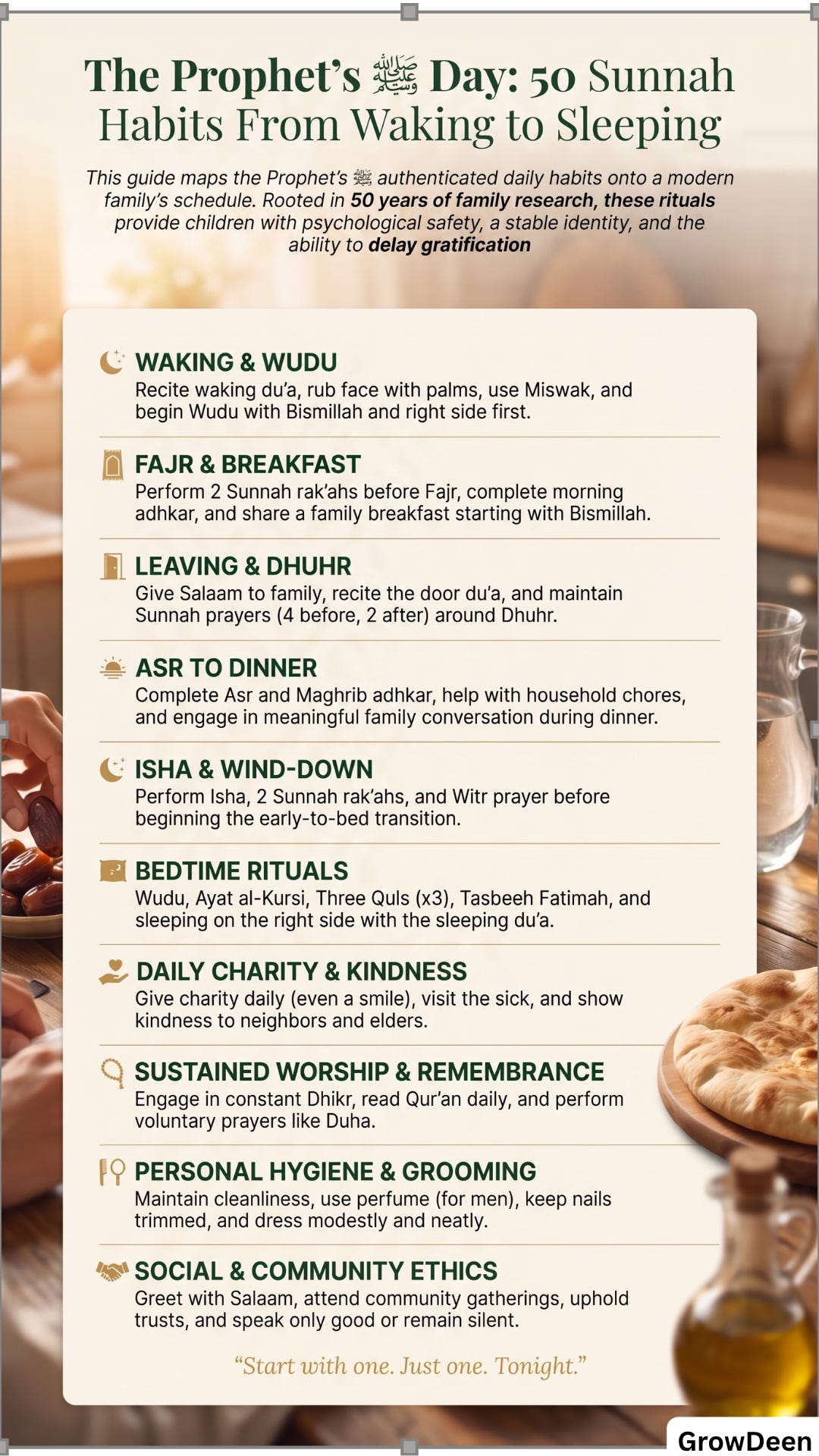
The Complete Sunnah Day: 50 Habits From Waking to Sleeping
Every habit listed here is authenticated — Sahih or Hasan, traceable to its source. Nothing fabricated. Nothing weak. These are his actual practices.
Upon Waking
Say the waking du’a. Sit up and rub the traces of sleep from the face with both palms — he ﷺ did this every morning. Then reach for the miswak. He placed it beside his head each night specifically so it would be the first thing his hand found. [8] Three habits. Zero extra time. The day has begun with consciousness and cleanliness rather than a phone screen.
Wudu
Begin with Bismillah. Always start with the right side — this is a global Sunnah rule that runs through the entire day: right side first in wudu, in getting dressed, in wearing shoes, in eating. One rule, applied everywhere. Say the Shahada after completing wudu.
Fajr
Two sunnah rak’ahs before the obligatory prayer — he ﷺ never abandoned these even while travelling. Then Fajr itself, followed immediately by the morning adhkar. He did not return to sleep after Fajr. The early hours carry a specific barakah he supplicated for by name, [9] and he embodied that supplication through action.
Getting Dressed
Right side first — already established by the global rule. Say the du’a of dressing. A single sentence of gratitude that turns the act of putting on clothes into an act of acknowledgement.
Breakfast
Wash hands. Say Bismillah aloud — together as a family. Sit to eat. Eat from what is nearest. End with Alhamdulillah — together. These five practices happen at every meal. By the end of one year, your child has heard Bismillah before food over one thousand times. That is not instruction. That is formation.
And Salat al-Duha, mid-morning — he ﷺ described it as the prayer of those who often return to Allah.
Leaving Home
Give salaam to whoever is staying. Say the du’a at the door — Bismillahi tawakkaltu ‘ala-llah, la hawla wa la quwwata illa billah — which hands the day, consciously, to Allah. Walk out the right foot first. These take fifteen seconds. Their effect accumulates over a childhood.
Dhuhr
Four sunnah rak’ahs before Dhuhr. Then the obligatory prayer with its adhkar. Then two sunnah rak’ahs after. A brief midday rest (qaylula) when possible — the research on sleep architecture has since confirmed what the Sunnah prescribed. [12]
Returning Home
Say the du’a entering the home. Give salaam. Greet your family warmly — he ﷺ was consistently described as greeting his household with cheerfulness and genuine warmth. [8] Be present. Ask about their day. Sit with them. This moment — the first fifteen minutes after returning home — is one of the most important transition points in a child’s day, and the Sunnah treats it as a threshold that deserves its own du’a and greeting.
Asr
On time. With its adhkar. He ﷺ warned with particular seriousness about the one who misses Asr.
Maghrib
On time. Two sunnah rak’ahs after. Then the evening adhkar — including Ayat al-Kursi and the three Quls (Surah Al-Ikhlas, Al-Falaq, and An-Nas) recited three times each, blowing into the palms and wiping over the body. This is the most important dhikr anchor of the evening. Help with household chores — he ﷺ was known to help with the work of the home. [8]
Dinner
The same five mealtime etiquettes as breakfast. And then — the habit that quietly holds families together across generations — real conversation. How was your day? What made you happy? What was hard? No screens at this table. The Prophet ﷺ taught that the barakah of food is multiplied when families gather together over it. [11]
Isha
On time. Two sunnah rak’ahs after, with its adhkar. Then one to three rak’ahs of Witr — the prayer he never abandoned. Then limit idle talk. He ﷺ disliked lengthy conversation after Isha because people need their rest. Wind the household down. Sleep early — with a conscious intention to wake for Fajr.
Bedtime
The child gives salaam to parents and hugs them — one of the most powerful closing rituals of any day. Make wudu. Dust the bed three times with the edge of a cloth — make this the child’s job, they love the ritual of it. Recite Ayat al-Kursi. Recite the three Quls three times each, blow into cupped palms, wipe over the body from head down. Say the Tasbeeh Fatimah — 33 SubhanAllah, 33 Alhamdulillah, 34 Allahu Akbar — he ﷺ taught this to his daughter Fatimah and said it was better than any worldly assistance. Say the sleeping du’a. Sleep on the right side. Close the doors. Cover the food. Extinguish the lights.
This is not fifty separate efforts. It is one beautiful day. His day. Available to your family. Tonight.
Support Muslim Parenting Lab ❤️
Think your amount is too small to matter? Give whatever you have with the button below.
The Prophet ﷺ said to shield yourself from the Fire even with half a date. (Sahih al-Bukhari 1417)
Every Habit in This Guide Is Something He Actually Did
He woke this way. He ate this way. He greeted his family this way. He closed his eyes this way.
The man described by ‘A’ishah (may Allah be pleased with her) as the most gentle, most present, most genuinely engaged member of his own household [8] — his daily life was the most complete tarbiyah framework ever lived. Not a programme someone designed. A life someone lived.
And it is available to every Muslim family, in every country, in every century. Including yours. Including today.
When Rituals Change — And When to Let Them
Children grow. Schedules shift. What worked beautifully at three will not look the same at thirteen.
Research on families navigating change shows that what protects children is not preserving the exact form of a ritual, but maintaining its relational intention. [13] A bedtime Tasbeeh that a teenager quietly resists in its childhood form might survive as a two-minute private adhkar before sleep. The Friday family dinner that no longer fits the schedule might become a Sunday morning. The form adapts. The thread of connection does not have to break.
Where resistance persists — particularly with adolescents — involve them in shaping what the practice looks like at this stage of their life. Research consistently shows that young people who experienced family rituals as meaningful rather than imposed carry them internally even through years of surface-level resistance. [6] A teenager who helped redesign the Ramadan family routine is far more likely to show up for it at seventeen. Hold the essential. Allow flexibility on the expression.
Download the Our Sunnah Day Family Guide
If you have read this far, I know something about you. You do not just want to know about the Prophet’s ﷺ habits. You want to live closer to them. And you want your children to grow up in a home that carries his light.
Inside the Our Sunnah Day Family Guide (one comprehensive PDF, 3 pages, print-ready):
Page 1: Our Sunnah Day — Visual Timeline — All 50 Sunnah habits laid out as a flowing visual timeline, from the waking du’a to the closing of the doors at night. Every habit appears as a clear numbered icon. A two-column legend at the bottom gives the full habit name for each number. Designed as a fridge or wall display your whole family can see and reference every day. Print once. Display it where your morning begins.
Page 2: My Morning Routine — Daily Tracker — The first 25 habits (waking through to Duha) presented as a clean daily tracker with two tick columns — one for the parent, one for the child. Sections clearly divided by time of day. A date and day field at the top so each copy belongs to one specific day. Print daily, or 7 copies for a week, or 30 for a full month. This is the morning half of the Prophet’s ﷺ day, made into something your family can actually check off and celebrate together.
Page 3: My Evening Routine — Daily Tracker — The second 25 habits (returning home through to the bedtime sequence) in the same daily tracker format, with Deep Teal colouring to visually distinguish it from the morning page. Includes the Prophet’s ﷺ sleeping du’a with its full Arabic text — اللَّهُمَّ بِاسْمِكَ أَمُوتُ وَأَحْيَا — transliteration, meaning, and source (Sahih al-Bukhari 6312) — so your family can say his exact words every single night.
This is not just a PDF to download and forget. It is a daily companion designed to stay in the spaces where your family’s real life actually happens — the kitchen, the bedroom door, the bedside table.
These habits were lived by the most beloved human being who ever walked this earth. He was a husband, a father, a grandfather, a leader — and he structured every single hour of his day around the remembrance of Allah, even while carrying the weight of prophethood. If he made time for every one of these moments, we can find a way to bring even a handful of them into our homes.
Not perfection. Just one habit more than yesterday.
If You Have Read This Far, You Already Love Him ﷺ
The fact that you are still here — reading about his waking habits, his mealtime etiquettes, his bedtime sequence — tells me something about you. You do not just know about the Prophet ﷺ. You love him. And you want your children to grow up in a home that carries his light.
We have one small request.
Somewhere right now, there is a Muslim mother — perhaps a friend of yours, perhaps someone in your WhatsApp group who mentioned just last week that her mornings feel chaotic and she does not know where to begin — who has never seen the Prophet’s ﷺ complete daily life laid out in one place like this. She would hold this tightly if she found it. She would print it and put it on her fridge.
You can reach her in less than five seconds.
Like this article. Restack it. Share it.
That is all. Five seconds of your time — and another family learns how the Prophet ﷺ started his morning. Another child hears Bismillah before their first meal tomorrow. Another household closes its doors and extinguishes its lights the way he taught us to.
Every family that practises even one of these habits because you shared this — that is your sadaqah jariyah. Ongoing. Weightless. Yours.
“The most beloved deeds to Allah are those that are consistent, even if they are small.” (Sahih Bukhari)
Sharing this is consistent with loving him ﷺ. We believe you will. Please like and restack!
Your Micro-Action for Tonight
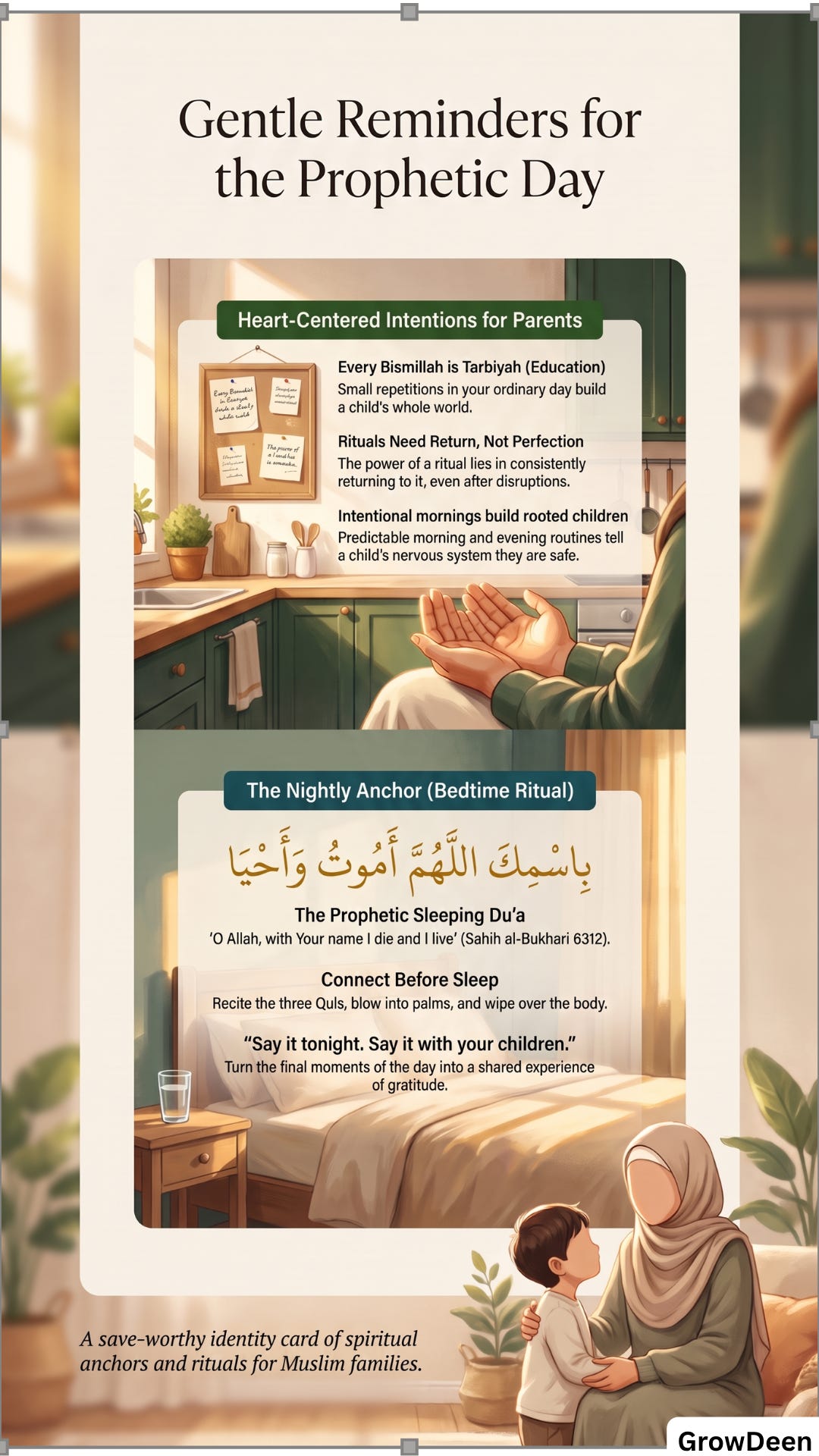
Tonight, before your child closes their eyes, say this with them. These are the exact words the Prophet ﷺ said every single night of his life:
اللَّهُمَّ بِاسْمِكَ أَمُوتُ وَأَحْيَا
Allahumma bismika amutu wa ahya
O Allah, with Your name I die and I live. [Sahih al-Bukhari 6312] [15]
That is your starting point. One sentence. His sentence. In your home. Tonight.
May Allah make your home one that the Prophet ﷺ would recognise. May the sound of Bismillah before breakfast, the quiet of the sleeping du’a at night, and the warmth of salaam at every door become the texture of your children’s earliest memories — woven so deeply that when they are grown and building their own homes, they reach for these habits without knowing why. Because they have simply always been home.
Allahumma salli ‘ala Muhammadin wa ‘ala ali Muhammad.
Share This With Someone Who Loves Him ﷺ Too
Think of one person right now — the mother in your WhatsApp group who said her mornings feel scattered and she does not know where to begin, the friend whose children are getting older and she senses something is slipping, your sister who is trying her best but whose days feel reactive rather than rooted.
This might be exactly what shifts something for her. Forward it today — not as advice, but as love. Sometimes the most caring thing we can do is pass along what helped us see things differently.
Frequently Asked Questions
Q: Is there one single habit of the Prophet ﷺ that is the most impactful place to start for a family with young children?
A: If I had to choose one — Bismillah before every meal, said aloud together as a family. It happens three times every day. By the end of one year, your child has heard it over a thousand times. It costs nothing, takes one second, and connects every act of eating to Allah. The Prophet ﷺ taught it, modelled it, and emphasised gathering together over food. Start there. Everything else can follow.
Q: My children are toddlers under three years old. Which of these 50 habits are genuinely appropriate for them?
A: More than you might expect. Toddlers absorb everything they hear and see, even before they can participate. The waking du’a said aloud by the parent every morning, Bismillah before meals, salaam at every door, and the bedtime sequence of Ayat al-Kursi and the three Quls — all of these are things a toddler hears daily, then begins to babble along with, then one day says completely independently. You are not teaching a habit yet. You are building the sound of home in your child’s earliest memory.
Q: How do I keep the bedtime habits going when my child is overtired and resistant?
A: Keep it short and keep it consistent. On hard nights, one du’a said together is worth more than the full sequence said resentfully. The Prophet ﷺ himself taught that the most beloved deeds to Allah are those that are consistent, even if small. (Sahih Bukhari) A shortened bedtime sequence done every night beats a complete one done occasionally. Start with just the sleeping du’a — his words, every night. Add the rest gradually as the habit takes root.
Q: Does this need to happen perfectly every day for it to work?
A: No — and this might be the most important thing to hold onto. Research on family rituals shows that what matters most is not flawless execution but consistent return. [1] The family that misses a morning and comes back the next day is doing exactly what the Sunnah itself models. Consistency is not perfection. It is the commitment to return to the practice after you have stepped away from it. That return, again and again, is what builds something lasting.
Q: My teenager is starting to resist family practices they used to love. What should I do?
A: This is developmentally expected and does not mean the rituals have failed. Research shows that adolescents who experienced family rituals as meaningful rather than obligatory carry them internally even through years of surface resistance. [6] Involve them in shaping what the practice looks like now. A teenager who helped redesign the Maghrib family routine is far more likely to show up for it willingly at seventeen. Hold the essential elements — the prayers, the adhkar. Allow significant flexibility on the form and timing of everything else.
Q: Is there a specific du’a for the morning that mirrors the sleeping du’a?
A: Yes — and the Prophet ﷺ paired them intentionally. The sleeping du’a (Allahumma bismika amutu wa ahya — Sahih Bukhari 6312) and the waking du’a (Alhamdulillah alladhi ahyana ba’da ma amatana wa ilayhin nushur — Sahih Bukhari 6312) are perfect mirrors of each other. Sleep is a small death. Waking is a small resurrection. Teaching children both — one at night, one in the morning — gives them the complete Prophetic frame for understanding each day as a gift returned, not a guarantee. As the Prophet ﷺ said: whoever wakes up healthy, safe, and with food for the day has been given the whole world. [Ibn Majah 4141, Hasan] [16]
References
[1] Fiese, B.H., Tomcho, T.J., Douglas, M., Josephs, K., Poltrock, S., & Baker, T. (2002). A review of 50 years of research on naturally occurring family routines and rituals: Cause for celebration? Journal of Family Psychology, 16(4), 381–390. https://doi.org/10.1037//0893-3200.16.4.381
[2] Harrist, A.W., Henry, C.S., Liu, C., & Morris, A.S. (2019). Family resilience: The power of rituals and routines in family adaptive systems. In B.H. Fiese et al. (Eds.), APA Handbook of Contemporary Family Psychology (pp. 223–239). American Psychological Association. https://doi.org/10.1037/0000099-013
[3] Denham, S.A. (2003). Relationships between family rituals, family routines, and health. Journal of Family Nursing, 9(3), 305–330. https://doi.org/10.1177/1074840703255447
[4] Crespo, C., Santos, S., Canavarro, M.C., Kielpikowski, M., Pryor, J., & Féres-Carneiro, T. (2013). Family routines and rituals in the context of chronic conditions: A review. International Journal of Psychology, 48(5), 729–746. https://doi.org/10.1080/00207594.2013.806811
[5] Kim, D., & Jahng, K.E. (2019). Children’s self-esteem and problematic smartphone use: The moderating effect of family rituals. Journal of Child and Family Studies, 28(12), 3446–3454. https://doi.org/10.1007/s10826-019-01526-1
[6] Malaquias, S., Crespo, C., & Francisco, R. (2015). How do adolescents benefit from family rituals? Links to social connectedness, depression and anxiety. Journal of Child and Family Studies, 24(10), 3009–3017. https://doi.org/10.1007/s10826-014-0104-4
[7] Rybanska, V., McKay, R., Jong, J., & Whitehouse, H. (2018). Rituals improve children’s ability to delay gratification. Child Development, 89(2), 349–359. https://doi.org/10.1111/cdev.12782
[8] Sahih al-Bukhari 245 — The Prophet ﷺ used the miswak upon awakening from sleep; narrations across Bukhari and Muslim describe his gentle, warm, and present conduct in his household. Graded: Sahih — https://sunnah.com/bukhari:245
[9] Sunan Ibn Majah 2236 — Narrated by Sakhr Al-Ghamidi: The Messenger of Allah ﷺ said: “O Allah, bless my nation in their early mornings.” Graded: Hasan — https://sunnah.com/ibnmajah:2236
[10] Muñiz, E.I., Silver, E.J., & Stein, R.E.K. (2014). Family routines and social-emotional school readiness among preschool-age children. Journal of Developmental & Behavioral Pediatrics, 35(2), 93–99. https://doi.org/10.1097/DBP.0000000000000021
[11] Bao, J., Gudmunson, C.G., Greder, K., & Smith, S.R. (2019). The impact of family rituals and maternal depressive symptoms on child externalizing behaviors. Child & Youth Care Forum, 48(6), 935–953. https://doi.org/10.1007/s10566-019-09512-w
[12] Hobson, N.M., Schroeder, J., Risen, J.L., Xygalatas, D., & Inzlicht, M. (2018). The psychology of rituals: An integrative review. Personality and Social Psychology Review, 22(3), 260–284. https://doi.org/10.1177/1088868317734944
[13] Bakker, W., Karsten, L., & Mulder, C.H. (2015). Family routines and rituals following separation: Continuity and change. Families, Relationships and Societies, 4(3), 365–382. https://doi.org/10.1332/204674314X13891971182856
[14] Qur’an 103:1–3 (Surah Al-’Asr). Tafsir Ibn Kathir: Al-’Asr is the time in which all human actions occur; those saved from loss are those who believe, act rightly, and counsel one another to truth and patience. The Companions used to recite this Surah to one another at every parting. — https://quran.com/103/1
[15] Sahih al-Bukhari 6312 — Narrated by Hudhayfah (ra): The Prophet ﷺ, when he lay down for sleep, would say: “Allahumma bismika amutu wa ahya” — O Allah, with Your name I die and I live. Graded: Sahih — https://sunnah.com/bukhari:6312
[16] Sunan Ibn Majah 4141 — “Whoever among you wakes up physically healthy, feeling safe and secure within himself, with food for the day — it is as if the whole world has been gathered for him.” Graded: Hasan — https://sunnah.com/ibnmajah:4141
[17] Wickrama, T., Merten, M.J., Wickrama, K.A.S., & Terrell, A. (2024). Adolescents’ tsunami exposure and mental health consequences: Protective role of cultural coping strategies. International Journal of Environmental Research and Public Health, 21(6), Article 756. https://doi.org/10.3390/ijerph21060756
We combine scientific research with Qur’an and authentic Sunnah, and we cite our sources. Even so, this is general guidance and no substitute for a doctor who can examine your child.
Barakallahu feek. May Allah reward you with abundant goodness for all your efforts. This is not something that should be taught only to children, it is a reminder that every one of us should live by: every youth, every parent, and every member of our community.
The youth, in particular, need these reminders because, in the rush of worldly affairs, many of us have neglected the beautiful Sunnahs and etiquettes of our beloved Prophet Muhammad ﷺ.
May Allah make us among those who sincerely follow the path of our beloved Prophet Muhammad ﷺ, live lives that are pleasing to Allah ﷻ, and earn the love of Allah ﷻ and His Messenger ﷺ. Amin
May Allah reward you abundantly for the good you are providing to the Ummah. It is truly appreciated. Thank you for all the effort you put into creating such amazing work. May Allah place it in the scale of your good deeds and grant it lasting benefit. Ameen.