

Want your family’s ordinary day to feel closer to the Sunnah?
Our free Sunnah Day Family Guide maps the day from waking to sleeping. It includes a morning and an evening tracker.
AGES 0–8 YEARS · 19 MIN READ
Breakfast is half eaten. One small shoe is missing. Your daughter is calling from the stairs.
By evening there is dinner, a bath and one more story. Then the day is gone.
I love the Prophet ﷺ. So why does our day feel nothing like his?
You are not the only parent who has asked this. Your home may already feel full. You don’t need another demanding program.
This guide brings together scientific research and the Qur’an and authentic Sunnah. You’ll see how the Prophet ﷺ spent his day, and one small moment to start tonight.
The Short Answer
Right for your child? Families with children aged 0–8 who want a day closer to the Sunnah. Autistic or speech-delayed child? Listening counts. Joining can be a touch or a smile.
What’s probably happening: your day is full, and the whole Sunnah day feels too big to start.
Try tonight (2 minutes): sit beside your child at bedtime. Say the Prophet’s ﷺ sleeping words yourself, Bismika Allahumma amutu wa ahya, and invite your child to listen or join in when they are ready.
You’ll know it’s working when: your child starts to expect the words. If you miss a night, come back the next. Coming back is the habit.
Get help if: bedtime is a battle most nights, or your child’s sleep worries you. Start with your child’s doctor or pediatrician.
The rest of this guide explains why, and what to do if it does not work.
How to Read This Guide
3 minutes: The Short Answer above is enough for tonight.
7 minutes: The Short Answer, then Knowledge in Practice and If Things Don’t Go to Plan.
The whole guide: read on for the scientific research, the Qur’an and Sunnah, and the References.
To share: the bold lines and the pull quotes are made to be shared.
To listen: open this guide in the free Substack app and tap Listen.
Inside This Guide
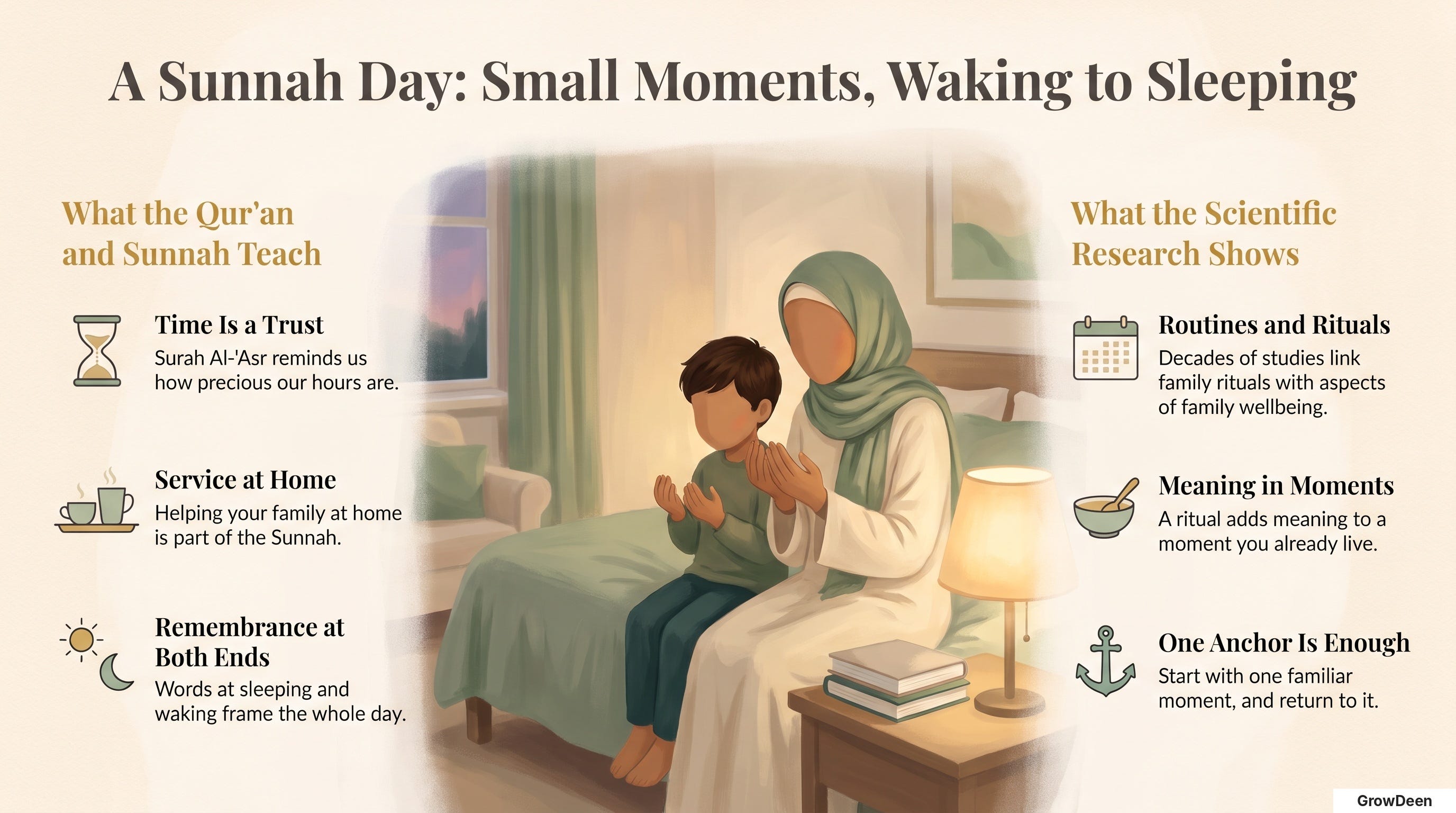
You don't need another demanding program. One familiar moment, repeated, is a beginning.
Myth Check: “It Only Counts If We Do All of It”
What this belief gets right. Wanting to follow the Prophet ﷺ fully is a sign of love. And the full list is beautiful: it shows how much of his ordinary day held remembrance of Allah.
Where it goes wrong. A list of fifty can start to feel like a test you fail every morning. The Companion Pack marks the five obligatory prayers with a dot. The rest are voluntary practices and family habits, offered as a map to choose from.
What helps instead. Begin by noticing one familiar moment. Could a greeting at the door or a bedtime remembrance become a chance for gratitude and good character?
Keep it simple enough to repeat, and make it welcoming. Then notice whether your child begins to recognize the moment.
One intentional moment is a beginning. (Our reflection)
Why This Happens
Why does a whole Sunnah day feel impossible?
Because you are holding all of it at once. A day with young children is a chain of small crossings: waking, eating, leaving, coming home, sleeping.
Each one already asks something of you. Adding a list of fifty on top can feel like one more thing to get wrong.
Where does a small ritual fit?
Look at the crossings you already have. You may say the same greeting at the front door, or sit together for a few minutes after dinner. A bedtime phrase tells a child that the day is drawing to a close.
A ritual adds meaning to a moment you already live, such as a remembrance of Allah or a warm word.
Think of it as an anchor on a boat. You don’t need anchors everywhere. One, set well, steadies the day.
How does it look in different children?
Children show this in different ways. Some love the same words every night. Some join in months later, all at once.
An autistic child may want the exact words, in the exact order, every time; that is a strength here. A bilingual child may say the du’a in Arabic and chat about it in your home language.
A child who has lived through a move or a loss may lean hard on one familiar ending. For them, keep that one anchor steady before adding another.
Consistency is an invitation to connection, not another scorecard for parents.
What the Scientific Research Shows
Scientists distinguish routines, the things families regularly do, from rituals, which also carry shared meaning. A review of 50 years of studies on family routines and rituals found associations between them and aspects of family wellbeing: parenting, children’s adjustment and marital satisfaction. The studies varied in method. [1]
The findings do not prove that any particular religious practice causes a specific outcome in a child.
Who was studied: families across five decades of studies (details in the linked review). None of the three studies here focused on Muslim families. The adolescent study surveyed 248 young people in Portugal; the separation study listened to 35 separated parents in the Netherlands. [2,3]
How strong this is: Suggestive. It is a narrative review that finds a link, not a cause.
A study of adolescents explored how family rituals link to social connectedness, depression and anxiety. [2] A study of families after a separation described both continuity and change in their routines and rituals. [3]
How strong this is: Suggestive. Each is a single study.
What we do not know yet: whether these links hold for young children in Muslim homes, and which parts of a ritual matter most. No study has yet tested this with Muslim families.
That difference matters. Science can help us think about predictability and relationships.
The Sunnah gives Muslim families religious reasons for remembrance and worship, and for kindness. Neither needs to be presented as proof of the other.
What this means for you: a few familiar moments, kept warmly, are worth protecting. You don’t need a perfect schedule to begin.
What the Qur’an and Sunnah Teach
وَٱلْعَصْرِ ١ إِنَّ ٱلْإِنسَـٰنَ لَفِى خُسْرٍ ٢ إِلَّا ٱلَّذِينَ ءَامَنُوا۟ وَعَمِلُوا۟ ٱلصَّـٰلِحَـٰتِ وَتَوَاصَوْا۟ بِٱلْحَقِّ وَتَوَاصَوْا۟ بِٱلصَّبْرِ ٣
By the ˹passage of˺ time! Surely humanity is in ˹grave˺ loss, except those who have faith, do good, and urge each other to the truth, and urge each other to perseverance.
Al-’Asr 103:1–3 · The Clear Quran [4]
Text. Allah swears by time, then names those who are saved from loss. Ibn Kathir explains al-’Asr as “the time in which the movements of the Children of Adam occur, whether good or evil.” He also records a report from at-Tabarani: two Companions would not part until one had recited Surah Al-’Asr to the other. [5]
Our reflection. Time is an amanah (a trust). The surah’s message reaches far beyond household scheduling; it calls us to consider how our time is lived.
For a parent, that can begin in an ordinary room. We do not need to turn every minute into a formal lesson.
We can meet a child with patience and a kind word. We can keep worship and remembrance present in daily life.
We place this surah beside a family’s habits as a spiritual connection. We make no claim that the Qur’an predicts the results of modern family studies.
I used to prepare tooth stick for him and water for his ablution, and Allah would rouse him to the extent He wished during the night. He would use the tooth stick, and perform ablution…
‘A’ishah (may Allah be pleased with her) · Sahih Muslim 746a · sunnah.com [6]
Text. A miswak (a tooth stick) and water for wudu (ablution) were made ready. When he woke in the night, he used the miswak, made wudu and prayed. It is a quiet detail: something ordinary, ready for a moment of worship.
Our reflection. The narration tells us what was prepared and what he did. The idea of designing our own days with care is a reflection we draw from it, not a quotation from the hadith.
That he asked ‘Aisha “What did the Prophet (ﷺ) use to do in his house?” She replied, “He used to keep himself busy serving his family and when it was the time for prayer he would go for it.”
Al-Aswad · Sahih al-Bukhari 676 · sunnah.com [7]
When the Prophet (ﷺ) went to bed, he would say: “Bismika amutu wa ahya.” and when he got up he would say: “Al-hamdu li l-lahil-ladhi ahyana ba’da ma amatana wa ilaihin-nushur.”
Hudhaifa · Sahih al-Bukhari 6312 · sunnah.com [8]
Text. One narration holds both ends of the day: Bismika amutu wa ahya, “In Your name I die and I live,” for lying down, and different words for waking. Another narration of the same words begins “Bismika Allahumma”, and sunnah.com renders it “With Your name, O Allah, I die and I live.” [9] ‘A’ishah also said he “used to remember Allah at all moments.” [10]
Custom. Some items on a family list, such as no screens at the table or washing hands before meals, are good family habits. No specific Sunnah text lies behind them. We label them “family habit” below.
He served his family at home, and when prayer came, he went. Both were part of his day.
The Lab Verdict
The science: a review of decades of studies links family routines and rituals with aspects of family wellbeing, without proving cause. (Suggestive)
The Qur’an and authentic Sunnah: the Prophet ﷺ met waking, eating, coming home and sleeping with remembrance, and he served his family at home.
Where they meet: the science suggests why familiar family moments matter, and the Sunnah fills those moments with remembrance and service. Neither proves the other.
So at home: choose one familiar moment and add remembrance and warmth. Return to it tomorrow.
Knowledge in Practice: One Familiar Moment at a Time
Knowing why small moments matter is half the work. Knowledge bears fruit when it reaches your kitchen table and your child’s bed.
If you can only do one thing, do step 1. It is enough.
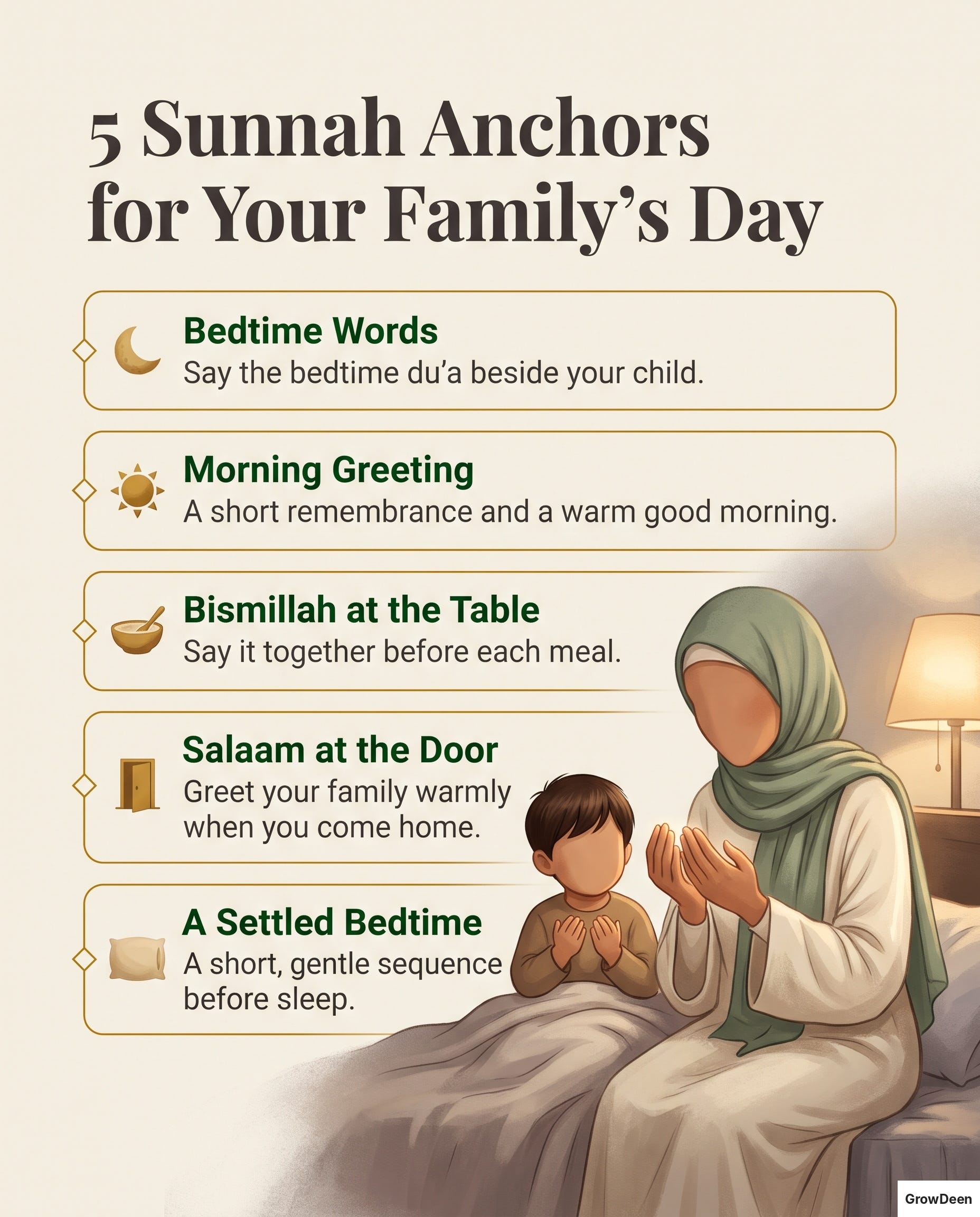
1. Choose one anchor, and start tonight (2 minutes). Pick one moment you already live: waking, a meal, coming home or bedtime. Bedtime is a gentle first choice, because the words are short and the room is quiet.
Say this: “Tonight we’ll say the Prophet’s ﷺ sleeping words together.” (Say it in the language your child knows best.)
Under 3: you say the words; they listen. 3–5: say the first word together, then finish it yourself. 6–8: let them lead, and you follow.
Before you begin, ask yourself one small question: “What would make this moment more mindful of Allah, and kinder to the people beside me?” Start there.
2. Morning: a short greeting or remembrance (1 minute). Begin with a short greeting or remembrance that is familiar to your family, such as the waking words above. [8] Let a young child hear your words without expecting them to recite or understand everything.
Say this: “Alhamdulillah, we woke up. Good morning, my love.”
3. At the table: Bismillah, together (a few seconds, each meal). Say Bismillah before eating. The Prophet ﷺ told a young boy at his table to mention Allah’s name, eat with his right hand and eat from what is nearer. [12]
Make room for unhurried conversation when possible. If breakfast is rushed, another meal may offer the chance.
Instead of: “Quick, eat, we’re late.” Try: “Bismillah. Let’s start together.”
4. Coming home: salaam and a warm welcome (2 minutes). Offer salaam and a warm welcome. Before questions and instructions, let your child know you are pleased to see them.
Instead of: “Did you tidy your room?” Try: “Assalamu alaikum. I’m so happy to see you.”
More lines to choose from:
Under 3: “Salaam, sweetheart. Up you come.” Open your arms and wait.
3–5: “Salaam. Show me the best thing from today.”
6–8: “Wa alaikum assalam. Tell me one good thing and one hard thing.”
Any age: “I missed you. Let me sit with you for a minute.”
5. Toward bedtime: a simple, settled sequence (5 to 10 minutes). Choose a short order you can repeat. The sleeping words are one authentic example. [8,9]
Keep the moment gentle. Place a hand on your own heart and settle beside your child if welcomed. Say the words with attention.
Invite your child to listen, or to join in when they are ready. There is no need to test their memory or hurry them through the words.
The worth of this moment rests on its religious purpose: remembrance of Allah. An easier bedtime, and the warmth and predictability of a shared routine, are a separate parenting matter.
Say this, if your child stops halfway: “That’s okay. I’ll say it, and you can listen.”
These are examples of family practice, and not every detail is an individually authenticated Prophetic habit. Adapt what you ask of your child to their age, and don’t turn voluntary family routines into pressure.
One thing tonight: choose a single anchor you can repeat tomorrow. Notice the relationship it builds, not the number of boxes you tick.
The Whole Sunnah Day: 50 Habits, Waking to Sleeping
This is the full map, numbered as in your Companion Pack. Each item carries its source, and items with no Sunnah text are labeled “family habit”.
Take one at a time.
Waking
1. Say the waking du’a: Alhamdu lillahil-ladhi ahyana ba’da ma amatana wa ilayhin-nushur. [8,9]
2. Rub the sleep from your face with your hands. He ﷺ did this when he woke in the night. [18]
3. Miswak or brush your teeth. He used the miswak when he got up at night. [6,19]
Wudu
4. Say Bismillah before wudu. [20]
5. Say the Shahada after wudu: “I testify that there is no god but Allah and that Muhammad is the servant of Allah and His Messenger.” [21]
6. Right side first, all day. He liked to start from the right in wearing shoes, combing his hair, washing and everything else. [22]
Fajr
7. Two sunnah rak’ahs before Fajr. ‘A’ishah said he never missed them. [23]
8. Fajr at its time, then morning adhkar, such as the master supplication for forgiveness (Sayyid al-Istighfar). [11,24]
Getting dressed
9. The dressing du’a: “Praise be to Allah Who has clothed me with this and provided me with it through no might and power on my part.” [25]
Breakfast
10. Wash hands before eating (family habit, for hygiene).
11. Bismillah before breakfast, together, eating with the right hand. [12]
12. Eat together, sitting, with no screens. Gathering over food and mentioning Allah’s name brings blessing in it. [13] “No screens” is a family habit.
13. Alhamdulillah after eating, together. Allah is pleased with the servant who praises Him for food and drink. [14]
Leaving home
14. Give salaam to your family before you leave. [15]
15. At the door: Bismillahi tawakkaltu ‘ala-llah, la hawla wa la quwwata illa billah, “In the name of Allah, I trust in Allah; there is no might and no power but in Allah.” [26]
Duha and midday
16. Salat al-Duha, the mid-morning prayer, which he called “the prayer of those who are penitent.” [27]
17. Qaylula, a short midday rest, if possible. He took a midday nap on a leather mat at Umm Sulaim’s home. [28]
18. Dhikr and Qur’an recitation. He remembered Allah at all moments. [10]
Lunch
19–22. As at breakfast: wash hands (family habit), Bismillah together, eat together with no screens, Alhamdulillah together. [12,13,14]
Dhuhr
23. Four sunnah rak’ahs before Dhuhr. He never missed them. [23]
24. Dhuhr at its time, with remembrance after the prayer. He used to say “La ilaha illa-l-lahu wahdahu la sharika lah…” at the end of every prayer. [24,29]
25. Two sunnah rak’ahs after Dhuhr. [30]
Coming home, Asr, Maghrib and dinner
26. Mention Allah as you step in: the Prophet ﷺ taught that this keeps Satan from lodging in your home. [38]
27. Salaam and a warm greeting to your family. He taught us to greet “those whom you know and those whom you do not know.” [15]
28. Quality time: be fully present with your children. At home he kept himself busy serving his family. [7]
29. Asr at its time, with remembrance after the prayer. [24,29]
30. Maghrib at its time, then evening adhkar, such as Sayyid al-Istighfar at night. [11,24]
31. Two sunnah rak’ahs after Maghrib. [30]
32. Help with the housework, as a family. [7]
33–36. Dinner, as at breakfast: wash hands (family habit), Bismillah together, eat together with no screens, Alhamdulillah together. [12,13,14]
37. Family conversation: share the day (family habit). How was your day? What made you happy? What was hard?
Isha and bedtime
38. Isha at its time, with remembrance after the prayer. [24,29]
39. Two sunnah rak’ahs after Isha. [30]
40. Witr: he said, “Make witr as your last prayer at night.” [31] The pack suggests one to three rak’ahs.
41. Limit idle talk after Isha. He disliked sleeping before Isha and talking after it. [32]
42. Sleep early, with the intention to wake for Fajr (family habit, in the spirit of [32]).
43. Your child gives you salaam and a warm hug. “The young should greet the old.” [33] The hug is a family habit.
44. Wudu before sleep. [16]
45. Dust the bed three times with the edge of a cloth. [34] Children often love this job.
46. Recite Ayat al-Kursi (Al-Baqarah 2:255). [35]
47. Recite Surah Al-Ikhlas, Al-Falaq and An-Nas into cupped hands, blow, and wipe over the body from the head down. Do it three times. [17]
48. Tasbeeh Fatimah: 33 SubhanAllah, 33 Alhamdulillah, 34 Allahu Akbar. He ﷺ told Fatimah and ‘Ali this was better for them than a servant. [36,39]
49. The sleeping du’a, lying on your right side. [8,9,16]
50. Close the doors, cover food and drinks, and put out the lights. [37]
Make It Work in Your Home
On your own, or a spouse who works away? Choose the one anchor you are always there for. If you work nights, the morning greeting may be yours, and bedtime may belong to another caregiver.
Several children? Give each one a job. One can dust the bed while another starts the Bismillah or gives the salaam at the door.
A grandparent or the other parent isn’t Muslim? Choose anchors anyone can share, such as a warm welcome home or a meal together.
Spouses who practice differently (Starter · Sometimes · Steady)? Agree on one shared moment and leave the rest of the list for later.
No printer, or no spare time? The pack is optional. Write your one anchor on a scrap of paper, or keep it in your head.
Say this to your spouse: “The children run to you at the door. Could you be our salaam at home time? I’ll take the bedtime words.”
Say this to a grandparent of another religion: “In our family, we thank God before we eat. You’re welcome to sit with us while we do.”
The family question: ask your spouse, or the elder in your home, “What words did your family say at bedtime when you were small?”
Try It Seven Times
Choose your one anchor and try it any seven times in the next week or two. Seven is a starting goal and nothing more.
After each time, note one word: how your child responded. Tell us in the comments which moment you chose. We’d love to know.
One moment, remembered and repeated: that is where a Sunnah day begins.
If Things Don’t Go to Plan
If your child resists the words: keep it short. Say the words yourself, and let your child listen. An invitation works better than a test.
If you miss days: come back the next day. Returning after a gap is part of keeping a habit.
If you start doubting yourself: I can’t even manage one habit. What kind of Muslim parent am I? A parent who keeps returning. Allah sees the intention behind every small try.
If you lose your patience at bedtime: it happens to many parents. Sit back down and say, “I’m sorry I was cross. Let’s say our words together.” Repair is part of the lesson.
If the habit stops fitting as your child grows: keep the meaning and let the form change. Parents Also Ask has more on this.
Speak to someone if: bedtime is a battle most nights, or your child’s sleep or behavior worries you. For questions of deen, ask your local imam or a local scholar, and share the details with him.
Who to turn to: your child’s doctor or pediatrician, for sleep or behavior worries.
Support Muslim Parenting Lab ❤️
Think your amount is too small to matter? Give whatever you have with the button below.
The Prophet ﷺ said to shield yourself from the Fire even with half a date. (Sahih al-Bukhari 1417)
Your Companion Pack: Our Sunnah Day Family Guide
Three printable pages for a day you already live. Free to download. Inside:
Our Sunnah Day, Visual Timeline: a numbered overview of fifty worship, remembrance, manners and family-routine entries, with a two-column legend. Print it as a family reference.
My Morning Routine: a date-and-day tracker for items 1–25, waking through Dhuhr, with separate parent and child tick boxes.
My Evening Routine: a second tracker for items 26–50, returning home to bedtime. It includes the sleeping supplication and its source.
The guide works fully without it. Use the pack as a menu: pick what fits.
Parents Also Ask
What are some easy Sunnah habits to start with young children?
Start with the ones a child can hear and copy: Bismillah before eating, salaam when you come home, and the sleeping words at bedtime. The full map of fifty habits is in this guide, but one at a time is enough.
How can a family ritual change as a child grows older without losing its meaning?
Keep the meaning and let the form grow.
A toddler hears the sleeping words. A five-year-old says the first word. A seven-year-old leads.
An older child may help redesign the routine, such as a Ramadan evening or a shared Maghrib.
Studies of families after a separation describe routines and rituals that both continue and change. [3] The meaning to hold on to is remembrance of Allah and closeness to each other.
What did Aisha report about how the Prophet ﷺ spent time at home?
Asked what he did in his house, ‘A’ishah said he kept himself busy serving his family, and went out when it was time for prayer. [7]
She also described a miswak and water for wudu made ready for him. When he woke in the night, he could clean his teeth, make wudu and pray. [6]
Is there a morning du’a that pairs with the sleeping du’a?
Yes. The same narration records the bedtime words, Bismika amutu wa ahya, and different words on waking: Alhamdu lillahil-ladhi ahyana ba’da ma amatana wa ilayhin-nushur. [8]
On sunnah.com, the waking words read this way in English. [9]
“All the Praises are for Allah Who has made us alive after He made us die (sleep) and unto Him is the Resurrection.”
Saying one at night and one in the morning gives the day a gentle frame.
My child is under 3. Which habits make sense now?
The ones your child can hear. Say the waking words aloud, Bismillah at meals, salaam at the door, and the bedtime words.
Your toddler may babble along long before saying them. You are building the sound of home.
Where should we start, with so many habits?
With any one anchor you can keep. Many families start with Bismillah together at one meal a day, or the sleeping words at bedtime. When that feels easy, add the next.
Final Reflection
Dear parent,
You want your children to love the Prophet ﷺ, and you want your home to show it. That longing is itself a sign of love.
If your days have felt rushed, you were doing your best with a full home. Love for the Prophet ﷺ lives in the heart before it shows on a timetable.
You are not behind. You are not failing when a night is missed. You are beginning.
You don’t need fifty habits this week. Choose one moment, and let it be enough. Your intention in every small try is not wasted, in shaa Allah.
A Sunnah day often begins with one small moment, repeated. Tonight, let it be the bedtime words.
A Du’a for This
For you, each morning:
الْحَمْدُ لِلَّهِ الَّذِي أَحْيَانَا بَعْدَ مَا أَمَاتَنَا، وَإِلَيْهِ النُّشُورُ
Alhamdu lillahil-ladhi ahyana ba’da ma amatana wa ilayhin-nushur
“All the Praises are for Allah Who has made us alive after He made us die (sleep) and unto Him is the Resurrection.”
Sahih al-Bukhari 6324 · sunnah.com
With your child, at bedtime:
بِاسْمِكَ اللَّهُمَّ أَمُوتُ وَأَحْيَا
Bismika Allahumma amutu wa ahya
“With Your name, O Allah, I die and I live.”
Sahih al-Bukhari 6324 · sunnah.com
Say it over a baby from the first months. From about age 3, say it together, side by side.
Share the Khayr
If you know a parent whose mornings feel scattered, and who doesn’t know where to begin, send this to them. One familiar moment may be all they need to start.
Tell us in the comments: which one moment will your family begin with? We’d love to know.
Parents Also Read
Parents who read this guide also found these helpful.


References
[1] Fiese, B.H., Tomcho, T.J., Douglas, M., Josephs, K., Poltrock, S., & Baker, T. (2002). A review of 50 years of research on naturally occurring family routines and rituals: Cause for celebration? Journal of Family Psychology, 16(4), 381–390. (US · Suggestive)
[2] Malaquias, S., Crespo, C., & Francisco, R. (2015). How do adolescents benefit from family rituals? Links to social connectedness, depression and anxiety. Journal of Child and Family Studies, 24(10), 3009–3017. (Suggestive)
[3] Bakker, W., Karsten, L., & Mulder, C.H. (2015). Family routines and rituals following separation: Continuity and change. Families, Relationships and Societies, 4(3), 365–382. (Suggestive)
[4] Qur’an, Al-’Asr 103:1–3. Translation: The Clear Quran (Dr Mustafa Khattab).
[5] Tafsir Ibn Kathir on Al-’Asr 103.
[6] Sahih Muslim 746a.
[7] Sahih al-Bukhari 676.
[10] Sahih Muslim 373.
[11] Sahih al-Bukhari 6306.
[12] Sahih al-Bukhari 5376.
[13] Sunan Abi Dawud 3764. Graded: Hasan (Al-Albani).
[14] Sahih Muslim 2734a.
[15] Sahih al-Bukhari 6236.
[16] Sahih al-Bukhari 247.
[17] Sahih al-Bukhari 5017.
[18] Sahih al-Bukhari 183.
[19] Sahih al-Bukhari 245.
[20] Sunan Abi Dawud 101. Graded: Sahih (Al-Albani).
[21] Sahih Muslim 234a.
[22] Sahih al-Bukhari 168.
[23] Sahih al-Bukhari 1182.
[24] Sahih al-Bukhari 527.
[25] Sunan Abi Dawud 4023. Graded: Hasan, without the addition “and later [sins]” (Al-Albani).
[26] Sunan Abi Dawud 5095. Graded: Sahih (Al-Albani).
[27] Sahih Muslim 748a.
[28] Sahih al-Bukhari 6281.
[29] Sahih al-Bukhari 6330.
[30] Sahih al-Bukhari 1180.
[31] Sahih al-Bukhari 998.
[32] Sahih al-Bukhari 568.
[33] Sahih al-Bukhari 6231.
[34] Sahih al-Bukhari 7393.
[35] Sahih al-Bukhari 5010. Also recorded in Tafsir Ibn Kathir on Al-Baqarah 2:255.
[36] Sahih al-Bukhari 6318.
[37] Sahih al-Bukhari 6296.
[38] Sahih Muslim 2018.
[39] Sahih al-Bukhari 5361.
We combine scientific research with Qur’an and authentic Sunnah, and we cite our sources. Even so, this is general guidance and no substitute for a doctor who can examine your child.
Sources & confidence
The hadith in this guide are from Sahih al-Bukhari, Sahih Muslim and Sunan Abi Dawud, with grades given for Abu Dawud. Checked October 2026. Found a source that looks wrong? Email us at info@growdeen.com.
Words in this guide
adhkar (singular dhikr): remembrance of Allah
amanah: a trust
Alhamdulillah: praise be to Allah
Ayat al-Kursi: the Verse of the Throne, Al-Baqarah 2:255
Bismillah: in the name of Allah
deen: the way of life of Islam
du’a (doa): supplication
Duha: the mid-morning prayer
Fajr, Dhuhr, Asr, Maghrib, Isha: the five daily prayers (salah, namaz, solat)
khayr: good
miswak (siwak): a natural tooth stick
qaylula: a short midday rest
rak’ah: one unit of prayer
sadaqah: charity
salaam: the greeting of peace
Tasbeeh Fatimah: the bedtime glorification taught to Fatimah
Witr: the odd-numbered night prayer
wudu: ablution before prayer
Sunnah: the teachings and practice of the Prophet ﷺ.
family ritual: a repeated family moment that carries meaning.
routine: something a family does regularly, at about the same time.
Barakallahu feek. May Allah reward you with abundant goodness for all your efforts. This is not something that should be taught only to children, it is a reminder that every one of us should live by: every youth, every parent, and every member of our community.
The youth, in particular, need these reminders because, in the rush of worldly affairs, many of us have neglected the beautiful Sunnahs and etiquettes of our beloved Prophet Muhammad ﷺ.
May Allah make us among those who sincerely follow the path of our beloved Prophet Muhammad ﷺ, live lives that are pleasing to Allah ﷻ, and earn the love of Allah ﷻ and His Messenger ﷺ. Amin
May Allah reward you abundantly for the good you are providing to the Ummah. It is truly appreciated. Thank you for all the effort you put into creating such amazing work. May Allah place it in the scale of your good deeds and grant it lasting benefit. Ameen.