

According to the MSD Manual (2025) and HealthyChildren.org, separation anxiety typically begins around 8 months and peaks between 10-18 months—meaning the clinginess and crying you’re experiencing is not bad behaviour but a healthy developmental milestone that shows your baby has formed a secure attachment to you. [3][4][49]
It’s 2 AM.
Your baby is crying. Again. Not the hungry cry or the tired cry—the one that means “I know you’re there and I need you right now.”
You pick them up. They calm. You put them down. They cry.
Someone’s voice echoes in your head: “You’re spoiling them.” “They’re manipulating you.” “Let them learn to self-soothe.”
But here’s what I wish someone had told me in those exhausting months: your baby isn’t being difficult. They’re being a baby. And what looks like manipulation is actually brain development happening in real time.
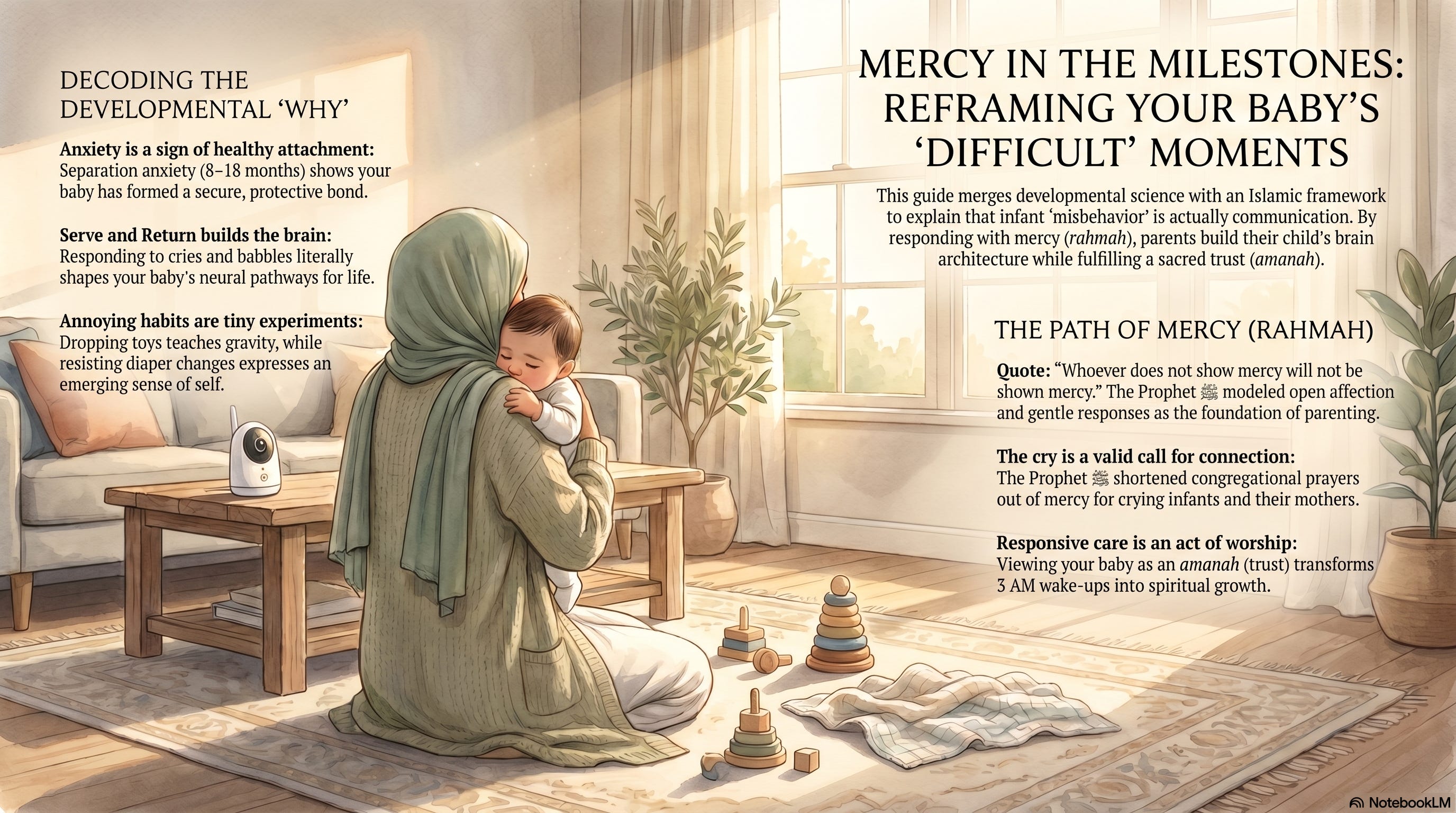
When I studied the research from Harvard’s Center on the Developing Child, one finding changed everything for me: responsive caregiving—those back-and-forth interactions where you respond to your baby’s cues with comfort—literally shapes brain architecture and supports emotional regulation for life. [2]
Your baby’s cries, clinginess, and stranger anxiety aren’t problems to fix. They’re communication you’re learning to understand.
Why This Guide Is Different
Developmental Science + Current Research — Every behaviour pattern is explained through 2024-2025 developmental research from sources like the MSD Manual, HealthyChildren.org, and Harvard’s Center on the Developing Child.
Islamic Framework for Mercy — This isn’t just parenting tips—it’s about understanding your baby’s behaviour through the Prophetic example of mercy and patience, grounded in authentic hadith and Quranic guidance.
Practical Behaviour Decoder Included — You’ll get a free Baby Behaviour Decoder & Response Guide to print and keep in your nursery—not just information, but tools that help you understand what your baby is trying to tell you at 3 AM when you’re too exhausted to remember the article.
Understanding Baby Behaviour Through Developmental Stages
Your baby’s behaviour changes rapidly during the first 18 months because everything is developing at once: brain pathways, sensory processing, memory formation, emotional capacity, physical coordination, and communication skills [1][3].
Many behaviours that worry parents are completely normal developmental responses.
At 4 months, your baby smiles and coos when you talk to them. That’s not just cuteness—that’s the beginning of social reciprocity, the foundation of all future relationships.
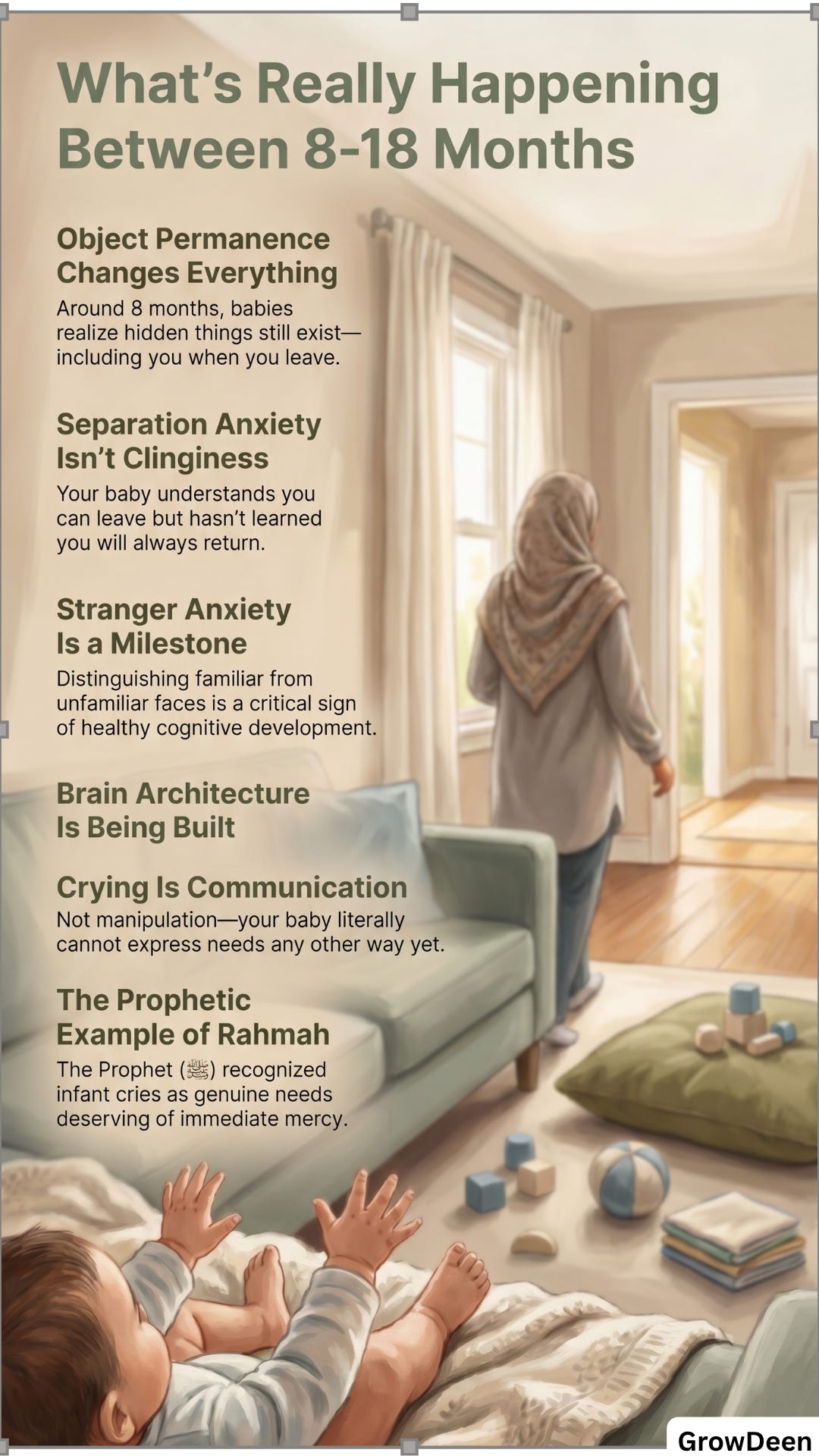
By 7 months, they might cry when a stranger leans in to say hello. You haven’t created an anxious child. You’ve successfully helped your baby develop the ability to distinguish familiar from unfamiliar faces—a critical survival skill.
At 10 months, they drop their spoon from the high chair. Then pick it up. Then drop it again. Annoying? Maybe. But it’s also how they’re learning about gravity, cause and effect, and object permanence.
When your 12-month-old clings to your leg at playgroup, they’re not being shy. They’re using you as a secure base from which to explore—exactly what healthy attachment looks like.
And at 15 months, when they resist the diaper change with surprising strength, they’re not being defiant. They’re expressing early autonomy, testing their growing sense of self.
Here’s what this means: instead of asking “Why is my baby being difficult?” try asking three different questions:
“What is my baby trying to communicate?”
“What developmental skill is emerging here?”
“What does my baby need from me right now?”
How Your Response Shapes Your Baby’s Brain
The relationship between you and your baby is one of the most powerful influences on their development.
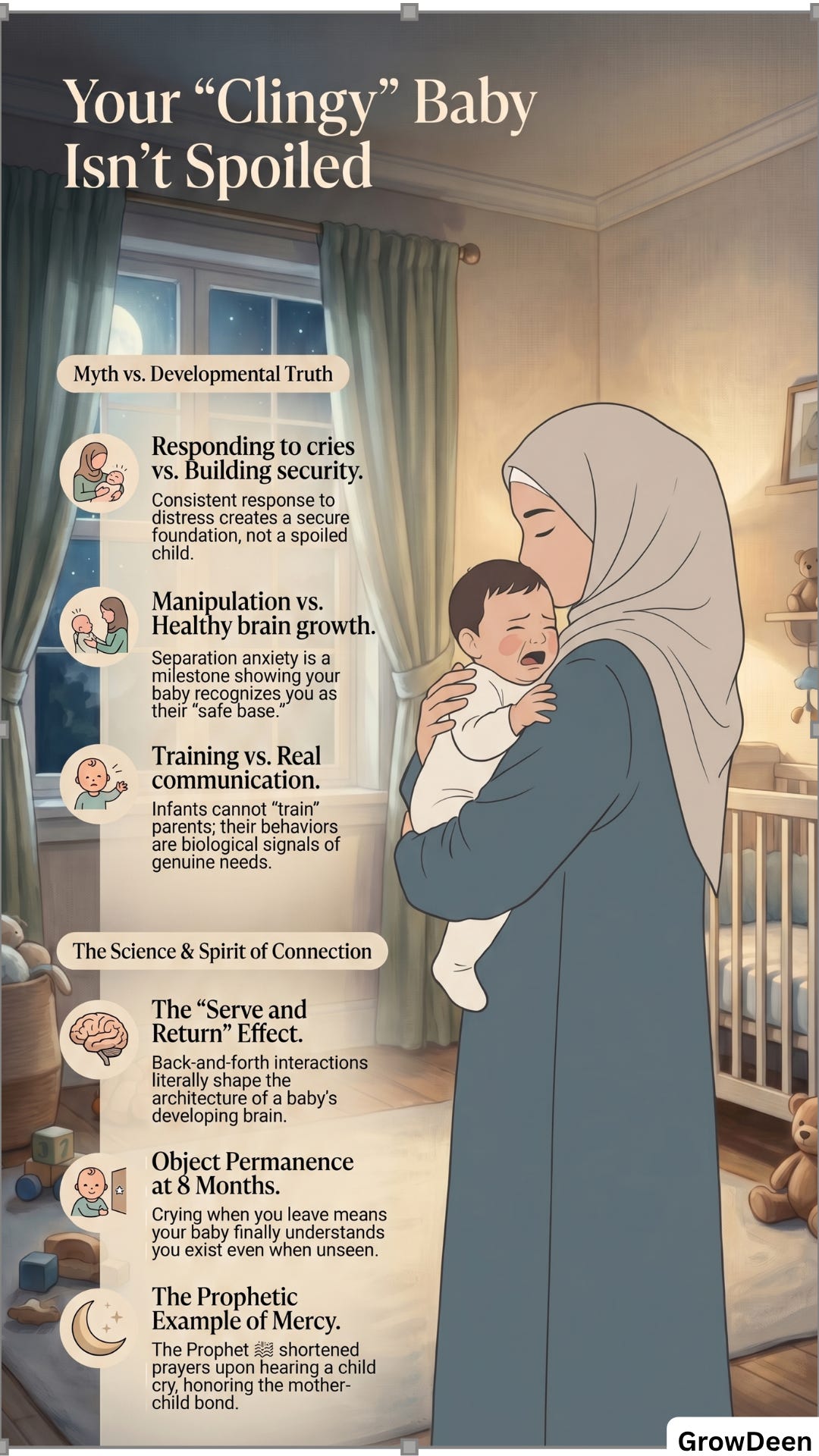
There’s a term for this in neuroscience research: “serve and return.” Your baby “serves”—they cry, babble, point, or reach. You “return”—you respond with comfort, words, eye contact, or action. [2]
This back-and-forth literally builds neural connections. Every time your crying baby is soothed by your presence, every time your babbling baby hears you respond with words, every time your pointing baby sees you name what they’re showing you—their brain is learning:
“My needs matter.”
“Communication works.”
“The world is safe.”
“My parent comes back.”
Here’s the thing: this doesn’t create a spoiled baby. It creates a secure baby. Research shows that babies whose caregivers respond consistently and warmly develop better emotional regulation, stronger social skills, and healthier stress responses later in life. [2]
From an Islamic perspective, this fits beautifully with the concept of rahmah (mercy). Your baby’s need for comfort isn’t manipulation. It’s a trust from Allah—an amanah.
The Prophet ﷺ kissed children and showed open affection. When a man said he had never kissed his ten children, the Prophet ﷺ responded, “Whoever does not show mercy will not be shown mercy.” [Sahih al-Bukhari, Sahih Muslim]
Your patient response to your baby’s cries, your gentle presence during their anxiety, your calm redirection when they explore dangerously—all of this is an act of mercy that Allah sees and honors.
I know this feels like a lot to hold in your mind, especially at 3 AM when you’re running on two hours of sleep. That’s exactly why I created something practical.
Keep reading to download the free Baby Behaviour Decoder & Response Guide at the end of this article—a printable 3-page guide you can keep in your nursery to help you quickly understand what your baby is communicating and how to respond, even when your brain is foggy and your patience is thin.
Why Babies Become Anxious (And Why That’s Actually Healthy)
Around the second half of the first year, many babies begin showing stranger anxiety and separation anxiety.
This is when your previously social baby suddenly cries when grandma holds them. When they cling to you at the park. When they sob as you leave the room.
It feels distressing. For both of you.
But here’s what’s actually happening: your baby has developed the cognitive ability to distinguish between familiar and unfamiliar people. They’ve also begun to understand object permanence—that you continue to exist even when you’re out of sight. [3][4][49]
The problem? They haven’t yet developed the ability to understand when or how you’ll return.
So when you leave, their nervous system interprets it as a threat. Their crying is their way of calling you back to safety.
Separation anxiety commonly begins around 8 months and often intensifies between 10 and 18 months. [4][49] This timing varies by child, but the pattern is nearly universal.
In many cases, this anxiety is not a sign of insecurity. It’s a sign of healthy attachment. Your baby has bonded with you strongly enough to feel distressed when you’re not available. That bond is protective. It’s the foundation they’ll use to eventually explore the world confidently.
How to Respond to Infant Anxiety
When your baby shows fear of strangers or distress at separation, do not shame them, laugh at them, or force them into uncomfortable situations.
Instead:
Stay calm and physically close.
Speak in a gentle, reassuring voice.
Allow new people to approach slowly.
Give your baby time to observe from a safe distance.
Never sneak away when leaving—it erodes trust.
Use short, honest goodbyes: “Mama is going to the kitchen. I’ll be right back.”
Return warmly and predictably every time.
For Muslim families, teaching salaam can be a gentle social bridge. Your baby doesn’t need to be passed around to every guest. They can wave or say salaam from your arms, maintaining their sense of safety while learning social greetings.
Support Muslim Parenting Lab ❤️
Would you rather give a small amount that never stops than a large one you keep postponing? Set a monthly amount you are comfortable with, in a few seconds, using the button below.
The Prophet ﷺ said the deed most beloved to Allah is the most constant, even if little. (Sahih al-Bukhari 6464)
What Baby Behaviour Actually Communicates
Babies don’t misbehave in the adult sense. They explore, test, communicate, and react.
When your baby pulls your hair, they’re not trying to hurt you. They’re learning about cause and effect and don’t yet understand that pulling causes pain.
When they drop food from the high chair repeatedly, they’re conducting a gravity experiment, not being wasteful.
When they cry every time you put them down, they’re not being clingy. They’re communicating a genuine need for closeness and security.
When they reach for the hot stove, they’re not being naughty. They’re driven by curiosity and haven’t yet learned danger.
This is why discipline at this age isn’t about punishment. It’s about teaching safety.
Here’s a simple pattern:
Stop the unsafe action gently but firmly.
Use a short, calm phrase: “No, hot.” “Gentle hands.” “That’s not safe.”
Redirect to something allowed.
Praise gentle behaviour when it happens.
Your baby learns from your tone, your consistency, and your calm presence. Yelling frightens them without teaching the lesson. Gentle firmness teaches both the boundary and that you’re a safe person even when saying no.
The Prophetic Example of Responding to Baby Cries
One of the most beautiful demonstrations of the Prophet Muhammad ﷺ’s understanding of infant behaviour comes from prayer.
Anas ibn Malik narrated:
The Prophet ﷺ said, “Whenever I start the prayer I intend to prolong it, but on hearing the cries of a child, I cut short the prayer because I know that the cries of the child will incite its mother’s passions.” [Sahih al-Bukhari 710, Sahih Muslim 470]
Think about what this teaches.
The Prophet ﷺ recognized infant crying as genuine communication—not manipulation or bad behaviour. He understood that a mother’s instinct to respond to her baby’s cry is natural and strong. He valued that maternal bond so highly that he shortened worship to honor it.
This tells us:
Infant crying is real need, not misbehaviour.
A parent’s emotional response to their baby’s distress is valid and recognized.
Even during acts of worship, mercy toward struggling parents takes priority.
Children are also described in the Qur’an as both a blessing and a test:
“And know that your wealth and your children are but a trial, and that with Allah is a great reward.” [Qur’an 8:28]
The “test” isn’t about whether you can ignore your baby’s cries or force them into independence too early. The test is about how you respond. Will you meet their needs with patience and mercy? Will you see their behaviour as communication rather than defiance? Will you honor the amanah (trust) by providing secure, responsive care?
When you soothe your crying baby instead of getting frustrated, when you offer comfort during separation anxiety instead of forcing them to “get over it,” when you respond with calm instead of anger—you’re passing the test. You’re embodying rahmah.
When to Seek Professional Advice
Most infant behaviour changes are normal, but there are times when consulting a healthcare provider is appropriate.
Seek advice if your baby:
Does not smile socially by expected milestone ages
Does not respond to sound or familiar voices
Shows very limited eye contact consistently
Loses skills they previously demonstrated
Has extreme, inconsolable crying that can’t be soothed
Shows feeding difficulties or poor weight gain
Appears unusually floppy or stiff in muscle tone
Does not show interest in people or their surroundings
Exhibits sudden behaviour changes along with fever, vomiting, breathing difficulty, or signs of illness
Milestone timelines vary naturally between babies, but tracking development helps you notice if extra support might be needed [1].
Trust your instinct. If something feels wrong, ask. You know your baby better than anyone.
Your Free Baby Behaviour Decoder & Response Guide
If you’ve read this far, you’re the kind of parent who wants to understand your baby deeply—not just manage their behaviour, but truly connect with what they’re experiencing. That tells me something beautiful about you.
I know that remembering developmental stages and appropriate responses is hard when you’re exhausted, touched-out, and questioning whether you’re doing anything right. That’s exactly why I created something practical for you!
Inside the Baby Behaviour Decoder & Response Guide (one comprehensive PDF, 3 pages):
Page 1: Age-by-Age Behaviour Quick Reference — A visual chart showing normal behaviours from 3-18 months, what they mean developmentally, and how to respond—designed as a laminated card you can keep in your nursery, by the changing table, or saved on your phone for midnight Googling moments.
Page 2: “Why Is My Baby Crying?” Troubleshooting Flowchart — A decision tree that walks you through the most common causes of infant distress (hunger, tiredness, overstimulation, discomfort, fear, need for closeness) with specific signs to look for and immediate responses to try—so you can move through the possibilities systematically when your brain is foggy and your baby won’t stop crying.
Page 3: Duas for Exhausted Parents — Three authentic, short supplications you can say when you’re overwhelmed, frustrated, or worried you’re failing—including the du’a for patience, the du’a for protection, and a reminder that your effort is seen by Allah even when it feels like nothing is working.
This guide is designed to stay with you in the spaces where baby behaviour actually happens—at 2 AM, during meltdowns, in moments of self-doubt.
One Small Action You Can Take Today
Here’s something you can do right now that will help you understand your baby better:
Spend 5 minutes just observing.
Pick a time when your baby is awake and alert. Sit nearby without trying to entertain them or redirect them. Just watch.
What do they look at? How do they move their hands? What sounds do they make? When do they turn to you? When do they turn away?
You’re not looking for problems. You’re learning their language.
Most parents spend so much time doing—feeding, changing, soothing, cleaning—that they rarely just observe. But observation is how you start to see patterns. That eye rub before the cry. That quiet moment before overstimulation hits. That reaching gesture that means “hold me.”
Five minutes of watching teaches you more than five hours of advice.
If You Found This Helpful, Pass It On
Think of a parent in your life—maybe someone with a new baby who’s Googling “is this normal” at 2 AM, or a friend whose toddler is going through a clingy phase and they’re doubting themselves.
Forward them this article. Not because they’re doing it wrong, but because understanding baby behaviour changes everything.
When you know that clinging means secure attachment, that crying means communication, that anxiety means development—it shifts from “my baby is difficult” to “my baby is exactly where they should be.”
That shift is relief. And every parent deserves it.
What GrowDeen Covers (And Why It Might Help)
GrowDeen focuses on the real challenges Muslim families face across the full journey—from the baby years, toddlerhood, childhood, and into the teen years.
If that sounds useful, you can follow along. Articles arrive when there’s something meaningful to share, just when the research and Islamic wisdom come together in a way that actually helps.
No spam, no overwhelm - just guidance when it matters.
FAQ: Common Questions About Baby Behaviour
Q: My 9-month-old cries whenever I leave the room. Am I doing something wrong?
No. Separation anxiety typically begins around 8 months and peaks between 10-18 months. [4][49] Your baby’s distress when you leave shows they’ve formed a healthy attachment to you and now understand you can go away—but they haven’t yet developed the concept that you always come back. Respond with short, honest goodbyes (”Mama is going to the kitchen, I’ll be right back”), and always return when you say you will. This teaches them that separation is temporary and you’re trustworthy.
Q: When should I start disciplining my baby?
Discipline for babies isn’t about punishment—it’s about teaching safety. Around 6-12 months, you can start setting simple boundaries with calm, consistent redirection. If they reach for something dangerous, say “No, hot” or “That’s not safe,” then physically move them or remove the object. Use gentle hands to show them how to touch softly instead of hitting or pulling hair. They won’t understand long explanations, but they will learn from your calm tone and consistent responses over time.
Q: Is stranger anxiety a sign that my baby is too attached to me?
No. Stranger anxiety (wariness around unfamiliar people) is a normal developmental milestone that shows your baby can now distinguish between familiar and unfamiliar faces—a critical survival skill. [3][52] It usually emerges around 8-9 months. Let your baby stay close to you while observing new people from a safe distance. Don’t force them to be held by others. They’ll warm up in their own time as they develop more cognitive understanding and confidence.
Q: My baby keeps dropping toys from the high chair. Is this a behaviour problem?
No—this is a learning experiment. Around 10-12 months, babies discover cause and effect and object permanence. Dropping toys repeatedly teaches them about gravity (”It always goes down!”), about sounds (”Different toys make different noises!”), and about your behaviour (”Will Mama pick it up again?”). It’s not misbehaviour. It’s cognitive development. You can put fewer toys on the tray or use toys with suction cups, but understand that the behaviour itself is normal and temporary.
Q: How do I know if my baby’s crying is “normal” or something I should worry about?
Normal crying gradually decreases after the first few months, responds to soothing (even if it takes time), and has identifiable patterns (hungry, tired, overstimulated, uncomfortable). Seek medical advice if crying is extreme and inconsolable despite all efforts, comes with fever or other illness signs, sounds unusually high-pitched or weak, or if your baby is difficult to wake, refuses to feed, or seems limp or unusually stiff. Trust your instinct—if something feels wrong, call your healthcare provider.
Q: Will responding quickly to my baby’s cries spoil them?
No. Research from Harvard’s Center on the Developing Child shows that responsive caregiving in infancy—when caregivers consistently respond to babies’ cues with appropriate comfort and care—actually supports healthy brain development, emotional regulation, and social skills. [2] Babies can’t be “spoiled” in the first year. They’re building the foundation of secure attachment and learning whether the world is safe and their needs will be met. Your prompt, warm response is teaching, not spoiling.
References
[1] Centers for Disease Control and Prevention. CDC’s Developmental Milestones. https://www.cdc.gov/ncbddd/actearly/milestones/index.html
[2] Center on the Developing Child at Harvard University. Serve and Return. https://developingchild.harvard.edu/science/key-concepts/serve-and-return/
[3] American Academy of Pediatrics / HealthyChildren.org. Emotional and Social Development: 8 to 12 Months. https://www.healthychildren.org/English/ages-stages/baby/Pages/Emotional-and-Social-Development-8-12-Months.aspx
[4] MSD Manual Consumer Version. Separation Anxiety and Stranger Anxiety. https://www.msdmanuals.com/home/children-s-health-issues/symptoms-in-infants-and-children/separation-anxiety-and-stranger-anxiety
[5] Cleveland Clinic. Separation Anxiety in Babies. https://my.clevelandclinic.org/health/articles/separation-anxiety-in-babies
[6] Sahih al-Bukhari and Sahih Muslim. The Prophet ﷺ kissed Hasan ibn Ali and said, “Whoever does not show mercy will not be shown mercy.”
[7] Marotz, L. R., and Allen, K. E. (2016). Developmental Profiles: Pre-Birth Through Adolescence. Cengage Learning.
[8] Sharma, A., and Cockerill, H. (2014). From Birth to Five Years: Practical Developmental Examination. Routledge.
[9] Sharma, A., Cockerill, H., and Sanctuary, L. (2023). From Birth to Five Years: Children’s Developmental Progress. Routledge.
[10] Sahih al-Bukhari 710 and Sahih Muslim 470. The Prophet ﷺ said, “Whenever I start the prayer I intend to prolong it, but on hearing the cries of a child, I cut short the prayer because I know that the cries of the child will incite its mother’s passions.”
[11] Qur’an 8:28. “And know that your wealth and your children are but a trial, and that with Allah is a great reward.”
[12] Sunan al-Tirmidhi (graded Sahih). “He is not of us who does not have mercy on our young children, nor honor our elders.”
[49] MSD Manual Professional Edition. Separation Anxiety and Stranger Anxiety (Reviewed March 2025, Modified April 2025). https://www.msdmanuals.com/professional/pediatrics/symptoms-in-infants-and-children/separation-anxiety-and-stranger-anxiety
[52] Merck Manual Consumer Version. Separation Anxiety and Stranger Anxiety. https://www.merckmanuals.com/home/children-s-health-issues/symptoms-in-infants-and-children/separation-anxiety-and-stranger-anxiety
We combine scientific research with Qur’an and authentic Sunnah, and we cite our sources. Even so, this is general guidance and no substitute for a doctor who can examine your child.