


According to a 2021 study in JAMA, approximately 4% of young children develop separation anxiety disorder — but the far more common experience, the normal developmental phase that peaks between 14 and 18 months, is a sign your child has formed a deep, healthy attachment to you. [1][4] This guide shows you the goodbye strategy that actually works — rooted in both developmental science and Islamic wisdom.
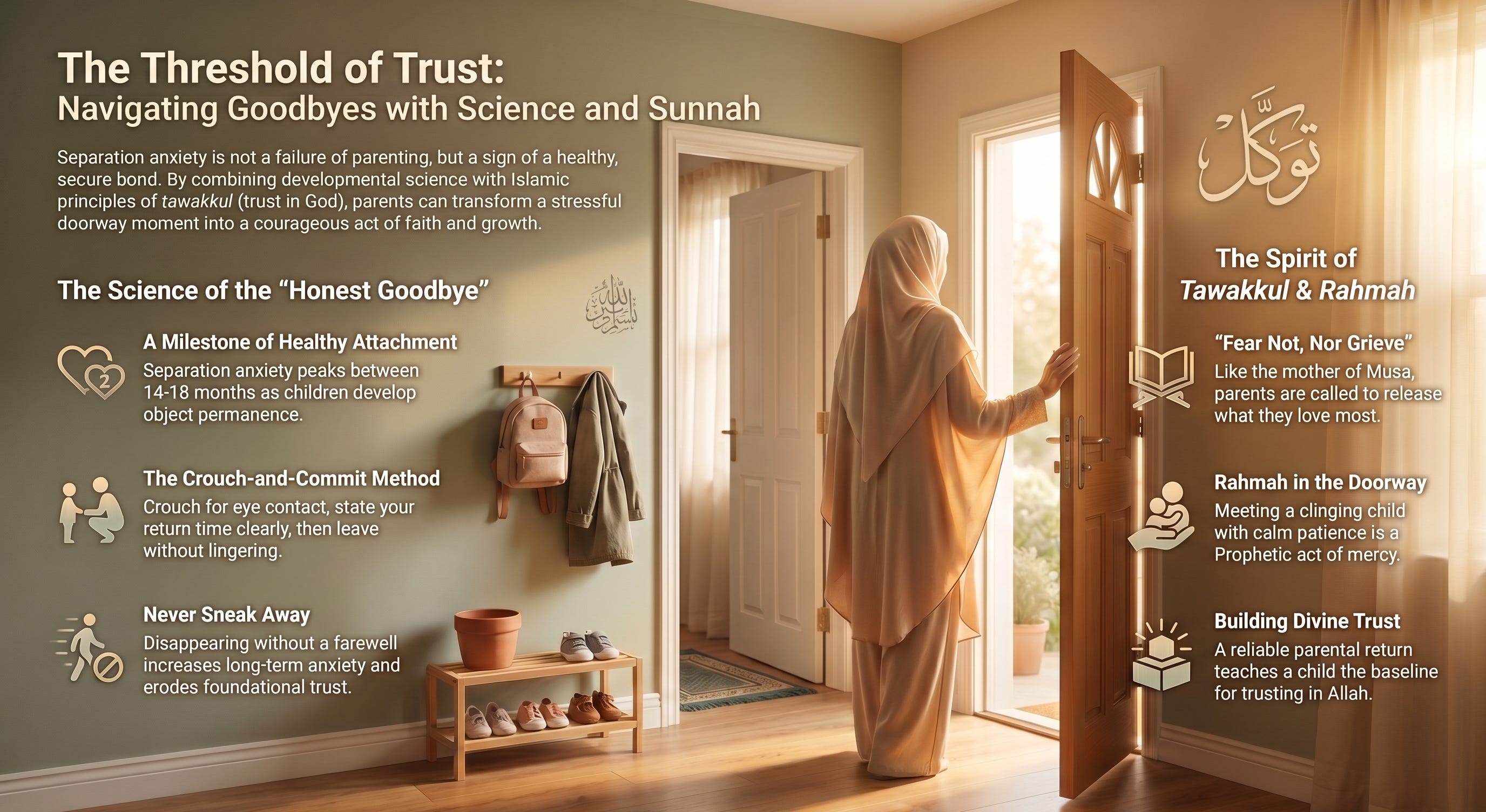
The door is right there.
You’ve got your bag. You’ve kissed their head. And now your toddler has both arms around your leg, eyes red, face crumpling in real, gulping tears.
You don’t know whether to peel them off and go or stay another five minutes. Someone told you to “just leave quickly.” Someone else said never sneak away. Your own chest is tight.
Here’s what I want you to know before you do anything: that reaction — those tears, that grip — is not a failure of parenting. It’s evidence that your child formed exactly the bond they were supposed to form with you.
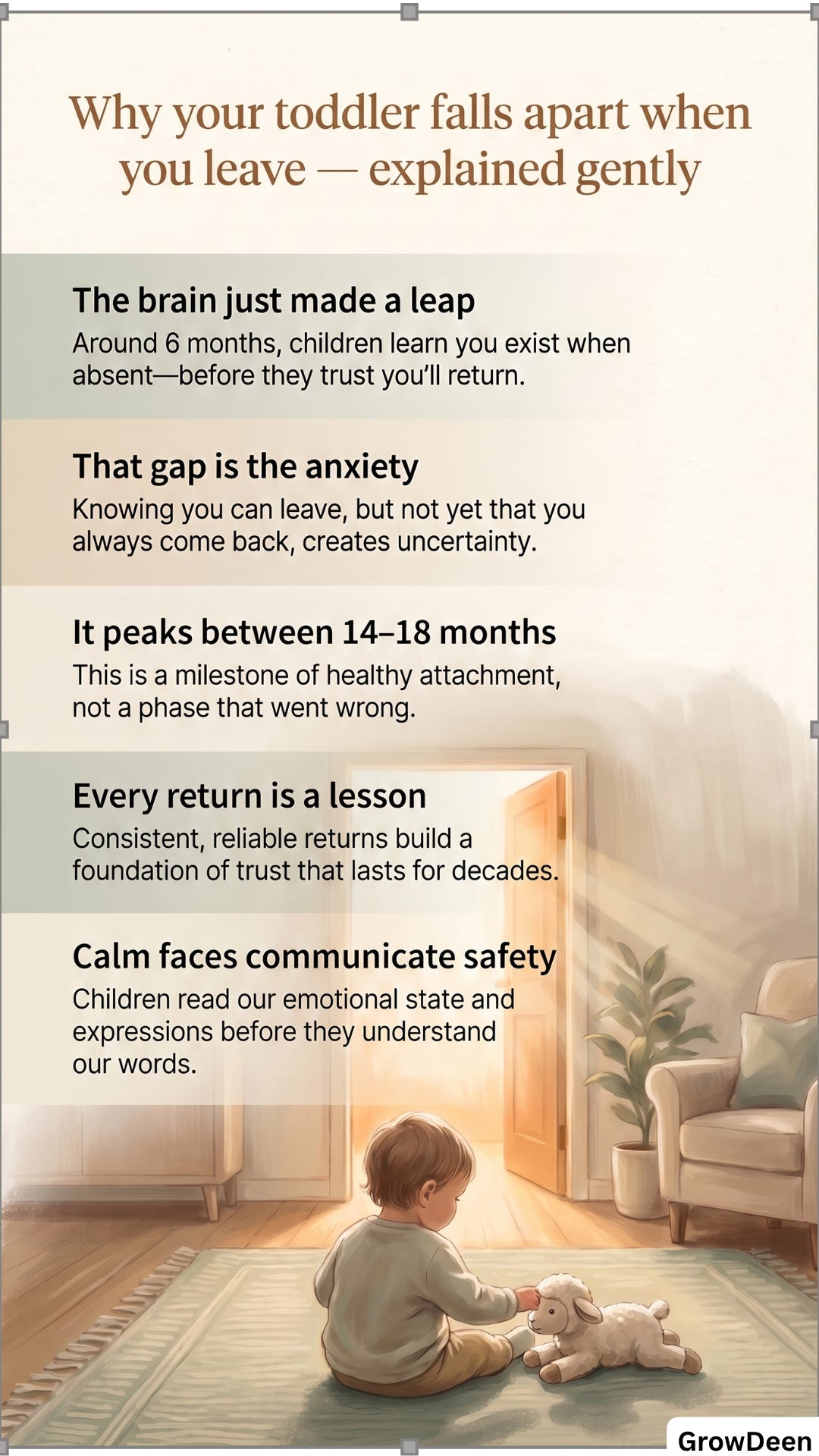
When I studied the developmental research from the Journal of Child Psychology and Psychiatry [1], I kept coming back to one thing: separation anxiety isn’t a disorder that happens to some children. It’s a normal milestone that happens to almost all of them, typically starting around 6 to 7 months and peaking hard between 14 and 18 months. [1] The distress at the door isn’t a sign something went wrong. It’s a sign their brain is working exactly as it should.
But knowing that doesn’t make the doorway any easier. So let’s talk about what actually helps.
Why This Guide Is Different From Generic Parenting Advice
Scientific research, not reassurance platitudes. Every strategy here is drawn from peer-reviewed developmental science [1][3][4][5] — not “it worked for me” advice from a parenting forum.
Islamic wisdom woven in, not tagged on. You’ll find Qur’anic anchors and Prophetic guidance that connect this developmental challenge to your tarbiyah — because raising a child who feels safe enough to let go is one of the deepest acts of Islamic parenting.
A free companion pack included. The Confident Goodbye Companion Pack — a printable 3-page PDF — gives you a visual goodbye routine card, an age-by-age what-to-expect guide, and a du’a card for those hard drop-off moments.
What’s Actually Happening in Your Child’s Brain
Here’s the thing most people don’t explain: your child’s distress when you leave is directly tied to a cognitive leap their brain just made.
Around 6 months, babies start developing object permanence — the understanding that things still exist even when they’re out of sight. [5] Before this, when you left the room, you simply... ceased. Now, their brain knows you’re somewhere. It just can’t hold the reassurance that you’re coming back.
The gap between knowing you’re gone and trusting you’ll return — that’s where separation anxiety lives. [1][5]
And here’s something that stopped me cold when I read it: every time you come back, you’re not just relieving their distress. You’re teaching them something that shapes how they will trust other people — and Allah — for the rest of their life. [3] The foundation of secure attachment is built one reliable return at a time.
Now, does that make it easier in the moment? Not always. But it changes what the moment means.
The ONE Strategy That Changes Everything: The Honest Goodbye
I know you’ve heard conflicting advice. Leave fast. Stay longer. Distract them. Wait until they’re engaged. Some of this advice is genuinely helpful — but it all hinges on one non-negotiable:
Never disappear without saying goodbye.
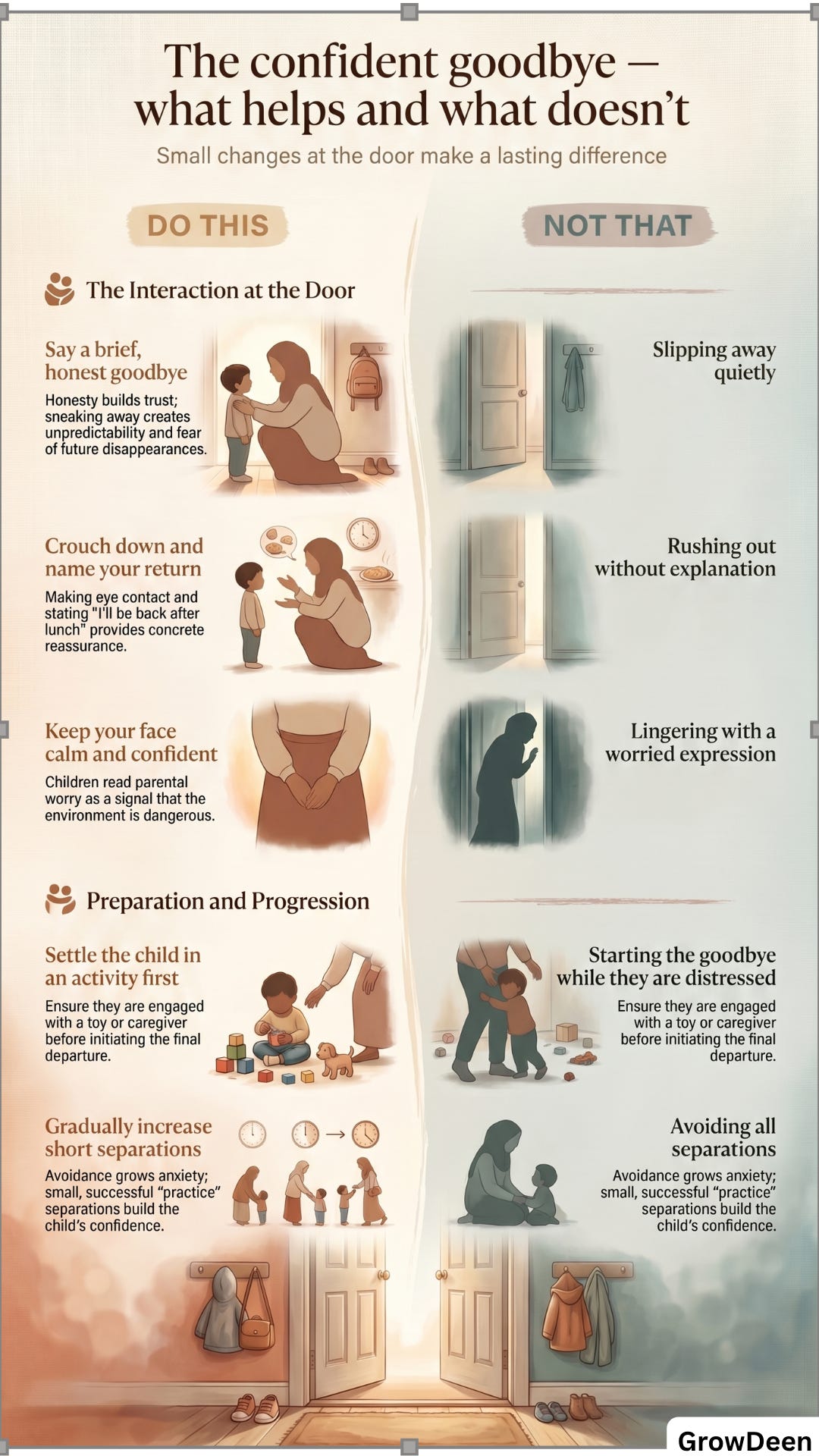
When I studied the research on this [3], it kept surfacing: children whose parents slipped away quietly without a farewell developed more severe separation anxiety over time, not less. Because now they can’t trust that you’ll be there when they look up. The unpredictability is the problem.
What works instead is a goodbye that is brief, warm, honest, and consistent. Every single time.
Here’s what that looks like in practice:
Before you leave: Settle your child in something engaging — a toy, a book, a trusted adult’s arms. Don’t try to have your goodbye while they’re already distressed and reaching for you.
The goodbye itself: Crouch down. Make eye contact. “I’m going now. I’ll be back after lunch.” Say it warmly, not sadly. Then go. Don’t linger. Don’t peek back around the door.
Your face matters enormously. Children read our emotional state with startling accuracy. [3] If your face communicates guilt or worry as you leave, their nervous system reads that as confirmation that the situation is dangerous. Take a breath before you open the door. You can cry in the car — but your calm face is the most powerful thing you can give them in that moment.
Islamic Anchors That Make Separations Gentler
I know it’s a lot to hold — the goodbye routine, staying calm, remembering to check in with caregivers. That’s exactly why I created the Confident Goodbye Companion Pack with a printable routine card you can keep wherever drop-offs happen. Keep reading — it’s at the end.
But here’s what moved me most in researching this article, and I want to share it before we get there.
When I reflect on the verse where Allah says to the mother of Musa, “Fear not, nor grieve. Verily, We shall bring him back to you” [Quran 28:7] [9], I think about how she was asked to release the child she loved most, into the most frightening of circumstances — and to trust. According to Tafsir Ibn Kathir, this verse was Allah’s direct reassurance to a mother whose heart was breaking from fear of separation. The tafsir notes that her ability to act despite her fear was itself a sign of divine favour and profound tawakkul.
That story doesn’t explain away our children’s tears. But it holds something real for us as parents: the fear of letting go is ancient and entirely human. And Allah meets us in it.
The Prophet ﷺ showed us how to meet our children in it too. He said, “Those who do not show mercy to our young ones are not from us.” [Sunan Abi Dawud 4943 — Sahih] [10] Meeting a crying, clinging child with patience and presence isn’t weakness. It’s rahmah. It’s prophetic.
What strikes me is that developmental research and Islamic wisdom are saying the same thing in different languages: children who are met with consistent, merciful responsiveness develop the inner security to eventually, confidently, let go. Not despite being held close — because of it.
When to Seek Professional Support
Most separation anxiety resolves naturally. But speak with your child’s doctor if they: persistently refuse school or childcare [4], experience ongoing physical symptoms like stomach aches tied specifically to separations, or show intense, worsening anxiety for four or more weeks without improvement. [4] A referral to a child psychologist is not a failure — it’s fulfilling the amanah of their care.
Your Confident Goodbye Companion Pack
If you’ve read this far, you’re the kind of parent who doesn’t just want to survive drop-off — you want to understand it and approach it well. That tells me something beautiful about you.
Inside the Confident Goodbye Companion Pack (one comprehensive PDF, 3 pages):
Page 1: The Confident Goodbye Routine Card — A step-by-step visual card showing exactly what to do before, during, and after a separation — from settling your child to what to say, how long the goodbye should last, and how to handle the moment when they cry anyway. Designed as a laminated card to keep in your car, your bag, or by the front door — where goodbyes actually happen.
Page 2: What to Expect Age by Age (6 months – 8 years) — A clean, printable reference guide showing what separation anxiety typically looks like at each stage, what helps at each age, and the specific warning signs that suggest it’s time to seek professional support. So you can stop Googling “is this normal” at 11 PM and have the answer on your wall.
Page 3: The Goodbye Du’a Card — An authentic, verified du’a for protection [11] in Arabic, transliteration, and English meaning — designed to become part of your goodbye routine. Plus: a brief prophetic practice for parents in those hard drop-off moments, so you can leave the building with your heart settled, not just your feet moving.
This isn’t just a PDF to download and forget. It’s a tool designed to stay wherever your hardest goodbyes happen — where you’ll actually reach for it when you need it.
This Companion Pack is what every subscriber receives with each article. At Muslim Parenting Lab, we cover the full arc of raising Muslim children all backed by research and rooted in the Qur’an and Sunnah.
If you’re a Muslim parent who wants evidence-based guidance that doesn’t ask you to leave your belief at the door, subscribe free so future resources arrive before you need them.
Subscribe free — parenting resources backed by both science and Sunnah, guidance you genuinely cannot find anywhere else combined this way. No spam. No daily emails. Just resources that matter.
Your Micro-Action for Today
The next time you say goodbye to your child, try this: crouch down to their eye level, make eye contact, say something specific and true — “I’m going to work. I’ll pick you up after your nap.” Then go. Don’t linger. Don’t peek back. Notice what happens — to them, and to you. That’s the practice. One goodbye at a time.
Share This With Someone Who Needs It
Think of one person right now: a mother at the masjid who mentioned in passing that drop-off is breaking her heart every morning, a sister whose toddler won’t let her out of the room, a friend whose WhatsApp message at 7 AM said “he cried for 20 minutes after I left and I cried the whole drive to work.”
This article could ease something real for them. Share it today — not as advice, but as company. Sometimes the most loving thing we can do is say, “I read something that made me think of you.”
Frequently Asked Questions
Q: At what age does separation anxiety peak, and when does it get better?
A: Separation anxiety typically begins around 6 to 7 months and peaks most intensely between 14 and 18 months. [1] For most children, it eases gradually through the preschool years as their language, trust, and understanding of time develop. A brief return of mild anxiety at school entry is common and usually short-lived.
Q: Should I stay until my child stops crying, or is it okay to leave when they’re upset?
A: Staying until they’re calm sounds kind, but it can actually delay the adjustment — children learn faster when they experience that the distress passes even after you’ve gone. [3] A warm, brief, consistent goodbye followed by a confident exit is more effective than a prolonged farewell. Your caregiver will almost always report that the crying stops within minutes.
Q: Is it bad to sneak away without saying goodbye to avoid the tears?
A: It feels kinder in the moment, but research consistently shows it makes separation anxiety worse over time. [3] When children look up and find you gone without warning, the unpredictability increases fear and can make them more clingy and watchful going forward. A brief, honest goodbye — even through tears — builds trust.
Q: How is normal separation anxiety different from separation anxiety disorder?
A: Normal separation anxiety is a developmental phase that eases over months. Separation anxiety disorder is when the distress is significantly more intense than other children the same age, has lasted at least four weeks, and is interfering with your child’s daily life — like refusing school, inability to sleep alone, or persistent physical complaints before separations. [4] About 4% of preschool and school-age children develop the disorder. [4] A doctor or child psychologist can assess and support your child if you’re concerned.
Q: What can I do at home to help with separation anxiety between drop-offs?
A: Short, predictable separations at home build confidence over time — start by stepping into another room briefly while a trusted adult stays with your child, then gradually increase. [3] Islamic anchors like saying Bismillah together before you leave a room, reciting Ayat al-Kursi at bedtime, and telling stories of the Prophets also create calm, familiar rhythms that help children feel safe. See the full practical guide above.
Q: When should I see a doctor about my child’s separation anxiety?
A: Talk to your child’s doctor if the anxiety is significantly more intense than other children their age, has lasted four or more weeks without improving, is causing persistent school refusal or physical symptoms like stomach aches, or is significantly disrupting your family’s daily life. [4] A referral to a child psychologist for cognitive-behavioural support is often highly effective. Seeking help is part of the amanah — not a failure.
References
[1] Battaglia, M., Touchette, É., Garon-Carrier, G., Dionne, G., Côté, S.M., Vitaro, F., Tremblay, R.E., & Boivin, M. (2016). Distinct trajectories of separation anxiety in the preschool years. Journal of Child Psychology and Psychiatry, 57(1), 39–46. https://doi.org/10.1111/jcpp.12424
[2] Schiele, M.A., & Domschke, K. (2021). Separation anxiety disorder. Nervenarzt, 92, 426–432. https://doi.org/10.1007/s00115-020-01037-1
[3] Feriante, J., Torrico, T.J., & Bernstein, B. (2023). Separation anxiety disorder. In StatPearls. StatPearls Publishing. https://www.ncbi.nlm.nih.gov/books/NBK560793
[4] Patel, A.K., & Bryant, B. (2021). Separation anxiety disorder. JAMA, 326(18), Article 1880. https://doi.org/10.1001/jama.2021.17269
[5] Feigon, S.A., Waldman, I.D., Levy, F., & Hay, D.A. (2001). Genetic and environmental influences on separation anxiety disorder symptoms. Behavior Genetics, 31, 403–411. https://doi.org/10.1023/a:1012738304233
[6] Cartwright-Hatton, S., McNicol, K., & Doubleday, E. (2006). Anxiety in a neglected population: Prevalence of anxiety disorders in pre-adolescent children. Clinical Psychology Review, 26(7), 817–833. https://doi.org/10.1016/j.cpr.2005.12.002
[7] Ehrenreich, J.T., et al. (cited in: Separation anxiety disorder. Wikipedia, citing school refusal prevalence data — approximately 75% of children with SAD exhibit school refusal behavior).
[8] Quran 17:82 — “And We send down from the Quran that which is a healing and a mercy for the believers.”
[9] Quran 28:7 — “Fear not, nor grieve. Verily, We shall bring him back to you.” | Tafsir Ibn Kathir, Surah Al-Qasas 28:7.
[10] Sunan Abi Dawud, Hadith 4943 — “Those who do not show mercy to our young ones are not from us.” Graded Sahih by Al-Albani and Al-Arna’ut. https://sunnah.com/abudawud/43/171
[11] Du’a for protection of children: “U’eedhukuma bikalimatillahit-tammati min kulli shaytanin wa hammatin wa min kulli ‘aynin lammah” — narrated in Sahih al-Bukhari 3371, that the Prophet ﷺ used to seek Allah’s protection for Hasan and Husayn using these words.
Not a parent yet, but saving this for when I am. It changed how I think about separation anxiety entirely. Thank you