

Research shows 27% of children with low self-esteem develop anxiety disorders by adolescence, yet over-praised children can develop narcissistic traits. [1] This guide reveals the Islamic middle path—dignity without arrogance—backed by developmental science.
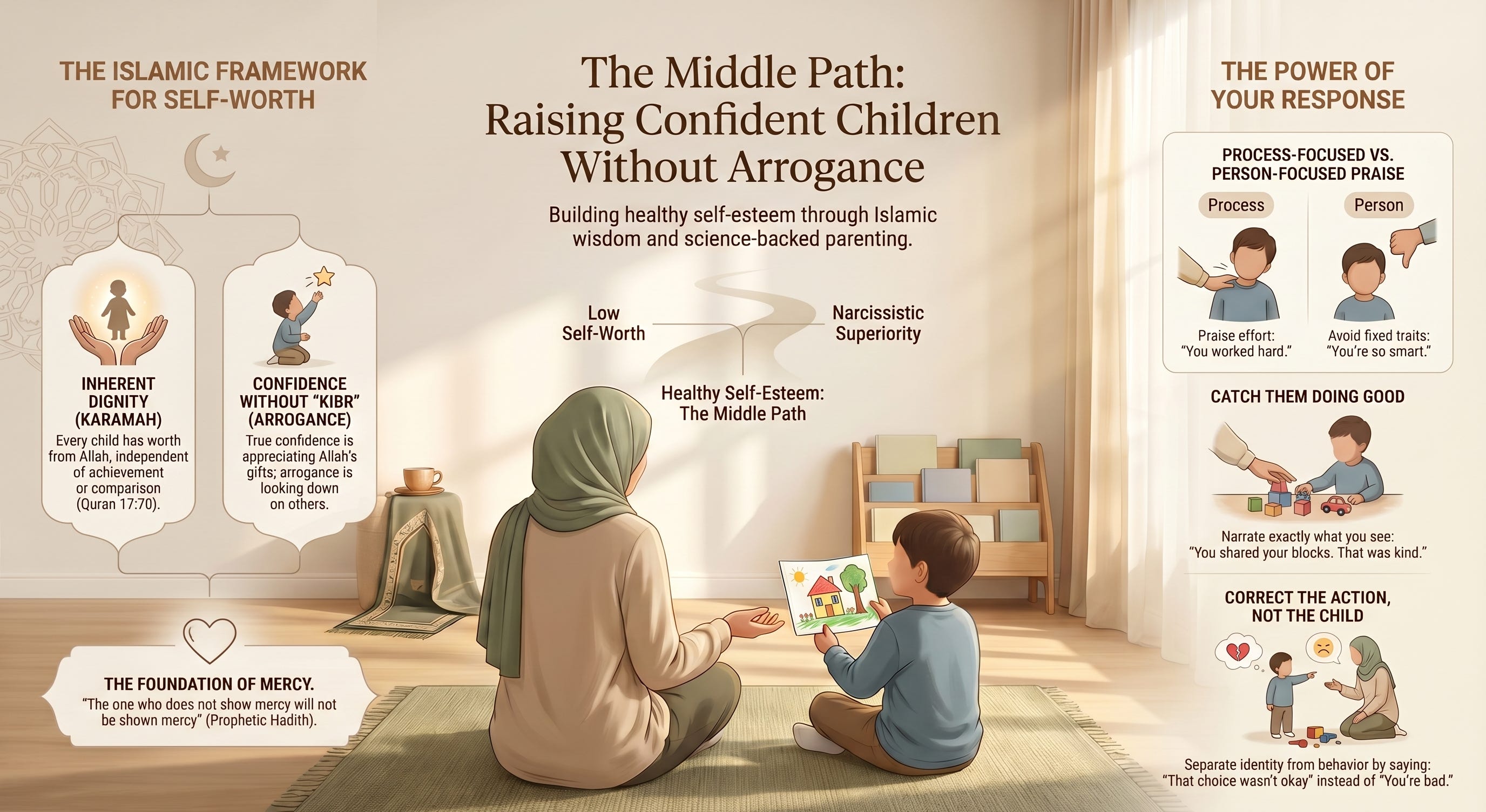
Someone told you to praise your child more. Someone else warned that too much praise creates entitlement. The parenting books say “build their self-esteem,” but no one explains what that actually means—or how to do it without accidentally raising a child who thinks they’re better than everyone else.
Here’s what I need you to know: healthy self-esteem is not the same as narcissism. And Islam gave us the framework for this balance 1,400 years before modern psychology caught up.
Research shows that parent-child relationship quality and how parents respond to their children’s performance significantly influence children’s sense of worth. [2] But here’s the part that matters most: it’s not about telling your child they’re “the best.” It’s about creating an environment where they feel loved, capable, and humble all at once.
Why This Guide Is Different
Research-Backed and Current: Every recommendation draws from peer-reviewed studies published 2019-2025, including CDC parenting guidance, developmental psychology research, and authentic Islamic sources verified through Tafsir Ibn Kathir.
Islamic Framework, Not Add-On: This isn’t general self-esteem advice with Islamic quotes sprinkled in. It’s built on the Quranic concept of inherent human dignity (Quran 17:70) balanced with prophetic warnings against arrogance—a framework that prevents both worthlessness and superiority.
Practical and Immediate: You’ll know exactly what to say when your child loses, what to praise when they succeed, and how to correct without crushing—starting tonight.
What Self-Esteem Actually Means (And Doesn’t Mean)
Self-esteem is not telling your four-year-old they’re “the best artist in the world” when they scribble on paper.
It’s your toddler bringing you a broken toy and knowing you’ll help them fix it, not yell at them for breaking it. It’s your six-year-old losing a race and still feeling loved. It’s your eight-year-old making a mistake and believing they can try again.
Healthy self-esteem means a child feels:
Loved unconditionally
Capable of learning
Valuable as a person
Able to recover from difficulty
But here’s the thing: scholars warn that misguided self-esteem can transform into narcissism—a sense of superiority, entitlement, and arrogance. [3] In Islamic language, that’s kibr. And the Prophet ﷺ taught that no one with even a mustard seed’s weight of arrogance will enter Paradise. [4]
So the question isn’t just “How do I build my child’s self-esteem?” It’s “How do I raise a child who feels valuable without feeling superior?”
The Foundation: Your Warmth Matters More Than Your Words
Before you worry about what to say, focus on how you treat your child.
Research shows that warm, responsive relationships between parents and children build the foundation for healthy self-worth. [5] Responsive back-and-forth interaction—answering when they call, noticing when they’re upset, showing affection—helps build brain architecture and supports emotional wellbeing. [6]
For a toddler, this looks like responding when they cry, naming their feelings, hugging them after a fall.
For a preschooler, this looks like listening to their rambling story about preschool even when you’re tired.
For a school-age child, this looks like putting your phone down when they want to tell you about their day.
The Prophet ﷺ kissed his grandchildren. When a man said he had ten children and never kissed any of them, the Prophet ﷺ said, “The one who does not show mercy will not be shown mercy.” [7]
Affection is not weakness. Mercy helps children grow.
The Right Kind of Praise
Not all praise builds healthy self-esteem.
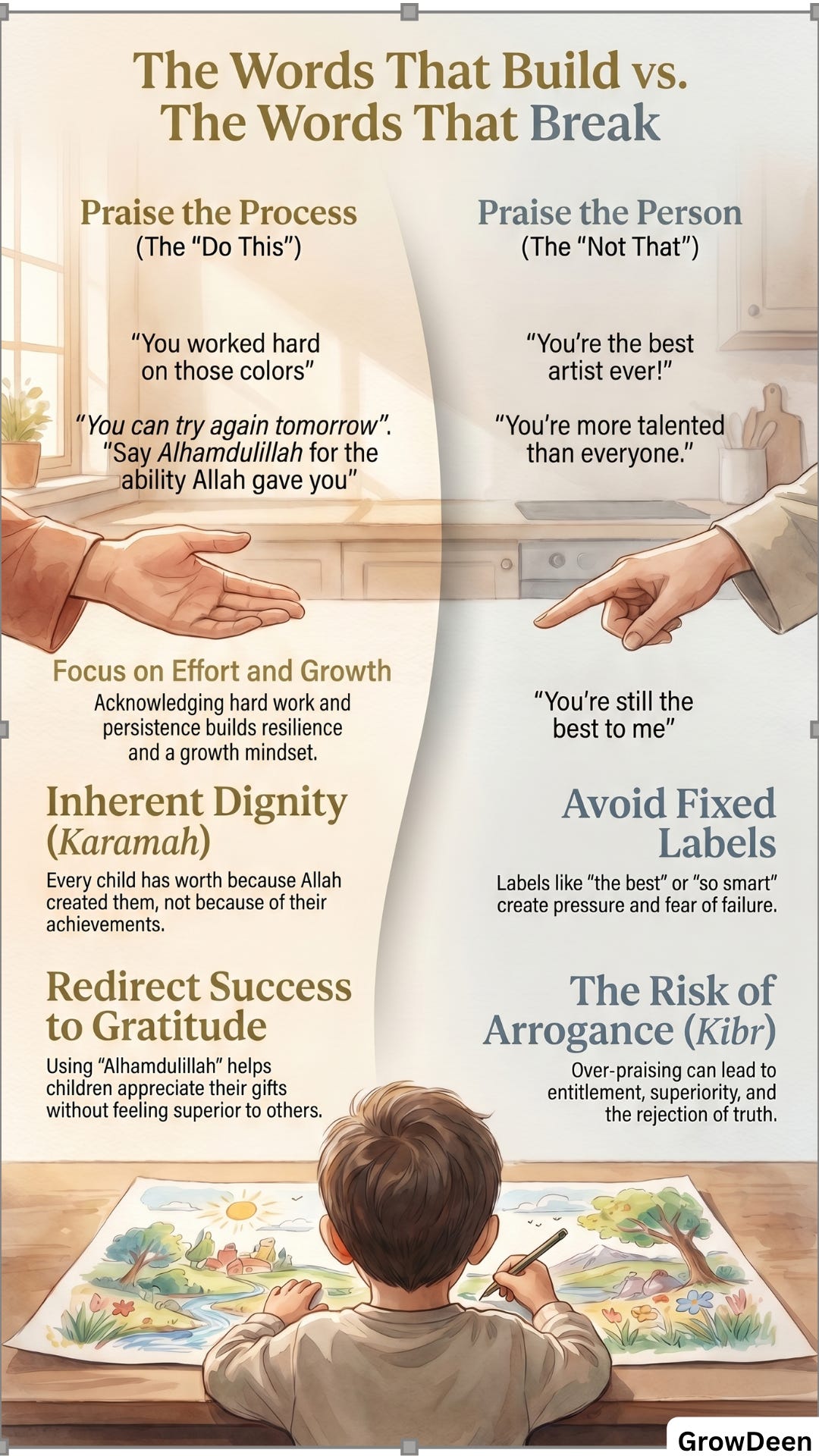
Over-the-top praise—”You’re amazing at everything!”—creates pressure. Person-focused praise—”You’re so smart!”—can make children afraid of making mistakes because mistakes might mean they’re not smart anymore.
Process-focused praise is healthier. [3] It sounds like:
“You kept trying even when it was hard.” “You were honest.” “You asked for help instead of giving up.” “You practiced and I can see the improvement.” “You were brave to try something new.”
CDC guidance recommends specific praise that helps children understand which behaviors are positive. [8] Islamic parenting aligns beautifully with this. Praise the effort, the character, the patience—not just the outcome.
When your child wins, don’t say, “You’re better than everyone else.” Say, “MashaAllah, you worked hard for that. Say Alhamdulillah.”
When your child loses, don’t say, “You’re still the best.” Say, “You can be happy for them and still keep trying. That’s what strong people do.”
This builds the belief that growth is possible—and protects them from arrogance.
Islamic Self-Esteem: Dignity, Not Ego
Islam gives children two truths that work together:
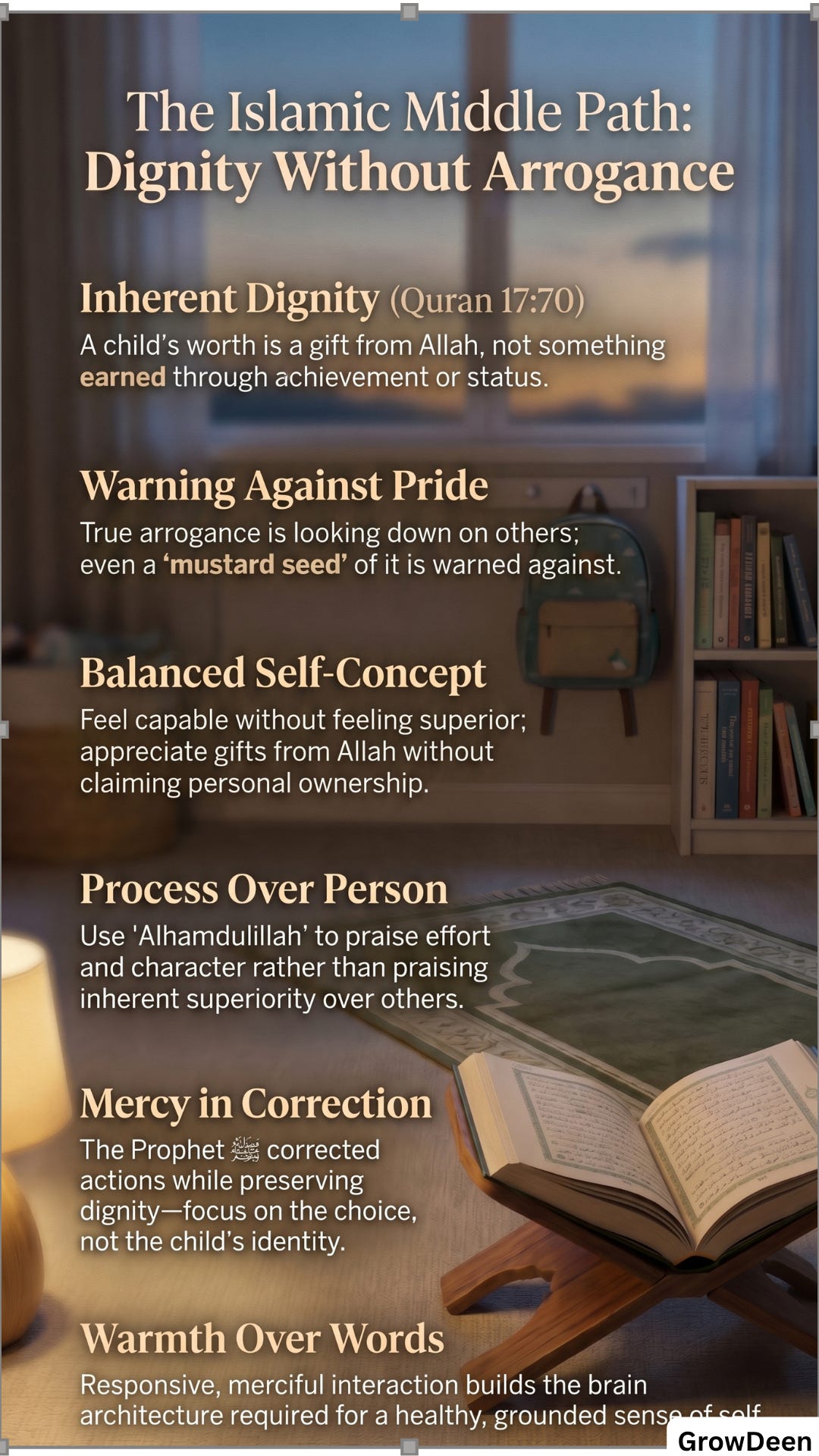
First truth: You have dignity. Allah says He has honored the children of Adam. [9] According to Tafsir Ibn Kathir, this means every child is created with inherent worth—not because of achievement, beauty, or status, but because Allah created them in the best form and granted them intellect, speech, and purpose.
Second truth: You are not superior. The Prophet ﷺ taught that arrogance is rejecting truth and looking down on people. [4] A child can appreciate their own gifts without thinking those gifts make them better than others.
So a Muslim parent can say: “Allah gave you a strong mind. Use it to learn.” “Allah gave you a kind heart. Use it to help others.” “Allah helped you succeed. Say Alhamdulillah and stay humble.”
This is the middle path—dignity without arrogance, confidence without superiority.
Small Responsibilities Build Real Confidence
Children feel capable when they’re trusted with real tasks.
Putting spoons on the table. Watering a plant. Carrying the prayer mat. Matching socks. Helping pack a bag.
These aren’t chores to keep them busy. They’re messages that say: “You are useful. You can contribute. Your effort matters.”
CDC guidance recommends encouraging independence and letting children help with simple tasks as part of healthy development. [10]
In a Muslim home, responsibilities connect to service: “Helping your family is a good deed.” “Allah loves when we use our hands to do good things.” “JazakAllah khair for helping.”
I know remembering all of this when you’re managing daily life feels overwhelming. That’s why I’ve created a free Building Dignity Without Arrogance: Practical Parenting Guide—a 3-page printable with specific phrases for praise and correction, age-by-age guidance, and du’as for patience when parenting tests you. Keep reading to download it at the end of this article—it’s designed to stay on your fridge or bathroom mirror, not buried in a drawer.
The Islamic Perspective: Between Worthlessness and Superiority
Allah declares in Surah Al-Isra: “And We have certainly honored the children of Adam and carried them on the land and sea and provided for them of the good things and preferred them over much of what We have created, with [definite] preference.” [9]
This verse gives every child a foundation for self-worth that doesn’t depend on being “better than” someone else. Their worth comes from Allah, not from comparison.
But the Prophet ﷺ also taught: “He is not one of us who does not show mercy to our young and respect our elders.” [11] Children should be raised to value others, not to look down on them.
And when a companion worried that liking nice clothes might be arrogance, the Prophet ﷺ clarified: “Indeed, Allah is Beautiful and loves beauty. Arrogance is rejecting the truth and looking down on people.” [4]
Taking care of yourself, appreciating what Allah gave you, feeling confident—none of that is arrogance. Arrogance is thinking you’re better than others or rejecting truth out of pride.
Correcting Without Crushing
Children need correction. But there’s a difference between “You made a bad choice” and “You are bad.”
Avoid: “You’re so lazy.” “Why can’t you be like your sister?” “You always mess things up.”
Use: “That choice wasn’t okay. Let’s fix it.” “You can do better than that. Let’s try again.” “Allah loves when we tell the truth.” “Making mistakes doesn’t make you a bad person. It makes you human.”
This separates the child’s identity from the behavior. The behavior may be wrong, but the child is still loved.
When to Seek Extra Help
If your child often says they’re worthless, avoids most challenges, becomes extremely distressed by small mistakes, shows ongoing sadness, is being bullied, has sudden behavior changes, or seems unable to enjoy normal activities—talk to a doctor, therapist, or school counselor.
Support is not failure. It’s part of fulfilling the trust Allah gave you.
Your Building Dignity Without Arrogance: Practical Parenting Guide
If you’ve read this far, you’re the kind of parent who takes emotional health seriously—not as a luxury, but as essential to raising strong, humble believers. That tells me something beautiful about you & that’s why we prepared a companion pack for you!
Inside the Building Dignity Without Arrogance: Practical Parenting Guide (one comprehensive PDF, 3 pages):
Page 1: What to Say (and Not Say) Quick Reference Card — Two columns showing harmful vs. helpful phrases for common parenting moments: when your child wins, loses, makes a mistake, compares themselves to others, receives a compliment, or gets corrected. With specific scripts like “Say Alhamdulillah and thank the people who helped you” instead of “You’re the best!” Designed as a laminated card you can keep on your fridge or bathroom mirror—somewhere you’ll see it when you need it most, not buried in a drawer.
Page 2: Age-by-Age Dignity-Building Actions — Specific, actionable ways to build self-worth from toddlerhood through age 8, organized by developmental stage (1-2 years, 3-4 years, 5-6 years, 7-8 years). Includes what responsibilities to give, how to respond to comparison, and what phrases build confidence without arrogance. So you always know what’s developmentally appropriate and effective—no more guessing whether you’re expecting too much or too little.
Page 3: Du’as for the Struggling Parent — Authentic supplications for patience when your child is testing you, for wisdom when you don’t know what to say, and for Allah’s protection over your children’s hearts and character. With Arabic text, transliteration, and English meaning. Plus a gentle reminder of Quran 66:6—protecting your family includes protecting their emotional wellbeing and spiritual formation. This connects your daily parenting struggles to deeper spiritual awareness.
This isn’t just a PDF to download and forget. It’s a tool designed to stay where you’ll actually see it when you need it most—on your fridge, your bathroom mirror, or tucked in your planner.
This Building Dignity Without Arrogance: Practical Parenting Guide is what every subscriber receives with each article. We cover the full journey of raising Muslim children—from infancy through adolescence, from sleep to character to Islamic practice—all backed by research and rooted in wisdom.
If you’re a Muslim parent who wants both evidence-based guidance AND Islamic perspective, subscribe for free so future resources arrive in your inbox before you need them.
Subscribe free for parenting resources backed by both science and Sunnah—guidance so unique, you literally can’t get it anywhere else. No spam, no clutter, just resources that matter.
One Small Action You Can Take Right Now
Tonight, catch your child doing one thing right. Not something big—just one small thing. Sharing a toy. Using kind words. Trying hard at something difficult.
Then say exactly what you saw: “You shared your blocks with your brother even though you were playing with them. That was kind.”
That’s it. That’s the practice. Specific, warm, true.
May Allah grant you patience in parenting, wisdom in correction, and barakah in raising children who know their worth comes from Him—confident without arrogance, humble without worthlessness.
Share This With Someone Who Needs It
Think of one person right now: the exhausted mother at the masjid whose child melts down over every small thing, your sister who’s constantly comparing her children to their cousins, a friend whose WhatsApp messages reveal she’s either over-praising or harshly criticizing with no middle ground.
This article could shift how she sees her child. Share it with her today—not as advice-giving, but as companionship. Sometimes the most loving thing we can do is share what helped us find balance.
Frequently Asked Questions
How do I build my child’s self-esteem without accidentally creating narcissism?
Focus on process, not person. Instead of “You’re so smart,” say “You worked hard on that.” Instead of “You’re the best,” say “You tried your best and that’s what matters.” Praise effort, character, and improvement—not superiority. Teach gratitude (Alhamdulillah) alongside achievement. Balance dignity (”Allah created you with purpose”) with humility (”We’re not better than others”). This builds confidence rooted in growth and gratitude, not comparison.
What’s the difference between healthy self-esteem and arrogance in Islam?
Healthy self-esteem means knowing you have worth because Allah created you with dignity (Quran 17:70), while arrogance (kibr) means thinking you’re better than others or rejecting truth out of pride. The Prophet ﷺ clarified that liking nice things or taking care of yourself isn’t arrogance—arrogance is looking down on people and rejecting what’s right. Teach your child: “Allah gave you gifts, use them well and say Alhamdulillah. But you’re not better than anyone else.”
How do I respond when my child compares themselves to others?
Redirect comparison toward personal growth: “You don’t need to be better than her. You just need to be better than you were yesterday.” Acknowledge their feelings first: “I hear that you wish you were as fast as Ahmed. How does that feel?” Then reframe: “Allah gives everyone different strengths. What are you good at?” Teach that success isn’t zero-sum—other people’s achievements don’t reduce your worth.
Should I let my child fail to build resilience?
Yes, but with support. Let them struggle with age-appropriate challenges—tying shoes, solving a puzzle, navigating a friendship conflict. Don’t rescue immediately. But stay near. Say: “This is hard. You can do hard things. I’m here if you need help.” When they fail, normalize it: “Everybody makes mistakes. What did you learn? What will you try next time?” Failure with support builds resilience. Failure with shame builds fear.
How do I correct my child’s behavior without damaging their self-esteem?
Separate the child from the behavior. Say “That choice wasn’t okay” not “You’re bad.” Use “We use gentle hands” not “Why are you so mean?” After correction, reconnect: “You made a mistake. Let’s fix it. I still love you.” This teaches that mistakes don’t destroy worth—they’re part of learning. The Prophet ﷺ corrected with gentleness, and so should we.
What do I do if my child says “I’m stupid” or “I’m bad at everything”?
First, validate the feeling without agreeing: “It sounds like you’re feeling really frustrated right now.” Then challenge the thought gently: “You’re not stupid. You’re learning. Everyone struggles with things at first.” Remind them of past growth: “Remember when you couldn’t ride a bike? Now you can. Your brain works the same way with math.” If this happens often, consider whether they’re getting too much person-focused praise (”You’re so smart”) that makes mistakes feel like identity failures.
How young is too young to start building healthy self-esteem?
Start from birth. Babies build self-worth through responsive caregiving—when they cry, you come; when they smile, you smile back. Toddlers build it through small responsibilities (”Can you bring me the spoon?”) and safe choices (”Red cup or blue cup?”). Preschoolers build it through effort-based praise and belonging. It’s never too early to respond warmly, give age-appropriate tasks, and show unconditional love.
References
[1] Li, W., Tan, F., Zhou, Z., Xue, Y., Gu, C., and Xu, X. (2022). Parents’ response to children’s performance and children’s self-esteem: Parent-child relationship and friendship quality as mediators. International Journal of Environmental Research and Public Health, 19(10), Article 6012. https://doi.org/10.3390/ijerph19106012
[2] Brummelman, E., and Sedikides, C. (2020). Raising children with high self-esteem but not narcissism. Child Development Perspectives, 14(2), 83–89. https://doi.org/10.1111/cdep.12362
[3] Center on the Developing Child at Harvard University. Serve and Return. Responsive back-and-forth exchanges with caring adults support brain architecture, early language, social skills, and emotional development.
[4] Centers for Disease Control and Prevention. Tips for Praise, Imitation, and Description. CDC explains that specific praise helps children understand which behaviors are positive and worth repeating.
[5] Lum, J. J., and Phares, V. (2005). Assessing the emotional availability of parents. Journal of Psychopathology and Behavioral Assessment, 27, 211–226. https://doi.org/10.1007/s10862-005-0637-3
[6] Centers for Disease Control and Prevention. Positive Parenting Tips: Preschoolers 3–5 Years Old. CDC recommends encouraging children’s independence, reading to children, letting them help with simple chores, and using clear consistent discipline.
[7] Al-Adab Al-Mufrad 91. The Prophet ﷺ kissed Hasan ibn Ali and taught that the one who does not show mercy will not be shown mercy. Also narrated in Sahih Muslim 2318a and Sahih Bukhari 5997.
[8] Qur’an, Surah At-Tahrim 66:6. Allah commands believers to protect themselves and their families.
[9] Qur’an, Surah Al-Isra 17:70. Allah mentions honoring the children of Adam. Tafsir Ibn Kathir explains that Allah has honored humanity by creating them in the best form, granting them intellect, speech, the ability to walk upright, and dominion over much of creation.
[10] Sahih Muslim 91c. The Prophet ﷺ taught that no one who has the weight of a mustard seed of pride (kibr) in his heart will enter Paradise, and clarified that arrogance is rejecting the truth and looking down on people.
[11] Sunan At-Tirmidhi 1920, Sunan Abu Dawud 4943, Al-Adab Al-Mufrad 363. The Prophet ﷺ said, “He is not one of us who does not show mercy to our young and respect our elders.” Graded Sahih by At-Tirmidhi, Abu Dawud, and multiple scholars.
It is a very detailed and complete article, may it reach those who need to read it, and may Allah reward you for your dedication in helping.