

Harvard’s Center on the Developing Child found that in the first years of life, babies build more than 1 million neural connections per second and the single biggest driver of that development is you. [2]
Why This Guide Is Different
Every recommendation comes from peer-reviewed sources — Harvard, the CDC, WHO 2023, and Ainsworth’s landmark attachment research — translated out of academic language and into what it actually means for your daily life with your baby. [2, 3, 7, 10]
This isn’t just developmental science — it’s Islamic developmental science. You’ll find out what Allah said about the love between parent and child, and why your baby’s clinginess is connected to divine design.
You’ll get the Baby’s 6–7 Month Guide: From Cling to Confident companion pack — a three-page printable with a milestone spotter, a goodbye toolkit for managing separation tears, and a rahmah reflection card to carry you through the hard days.
That title might have surprised you. But here’s the thing:
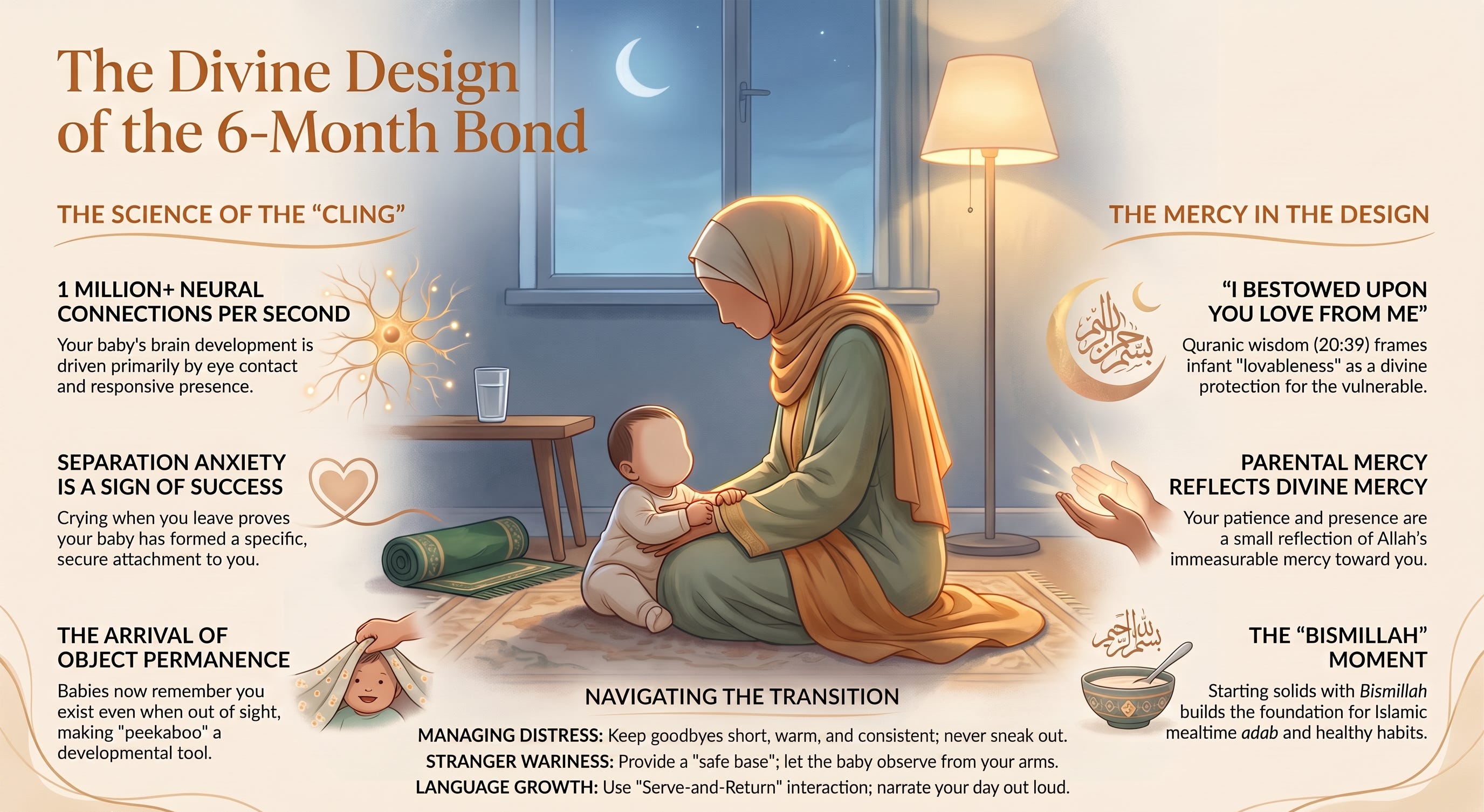
When your 6-month-old cries the moment you leave the room, that’s not a sign something has gone wrong. It’s a sign something has gone very right.
At this age, your baby now knows you. Not just as warmth and comfort in a general sense. As you. They have bonded to you specifically, and when that bond is stretched — when you hand them to a grandparent they haven’t seen in a week, when you step into the next room, when someone they don’t recognise leans in with a friendly smile — they respond the only way they currently can.
They cry.
And that cry is the evidence of everything you’ve been building since day one.
This is the stage parents find both tender and exhausting. The same baby who makes your heart ache with love is also the one who won’t let you put them down. I want to walk you through what’s actually happening at 6–7 months — the development, the attachment science, and the Islamic wisdom underneath it all — because when you understand it, it changes how you respond. And that response matters more than you know.
What’s Happening in Your Baby’s Brain Right Now
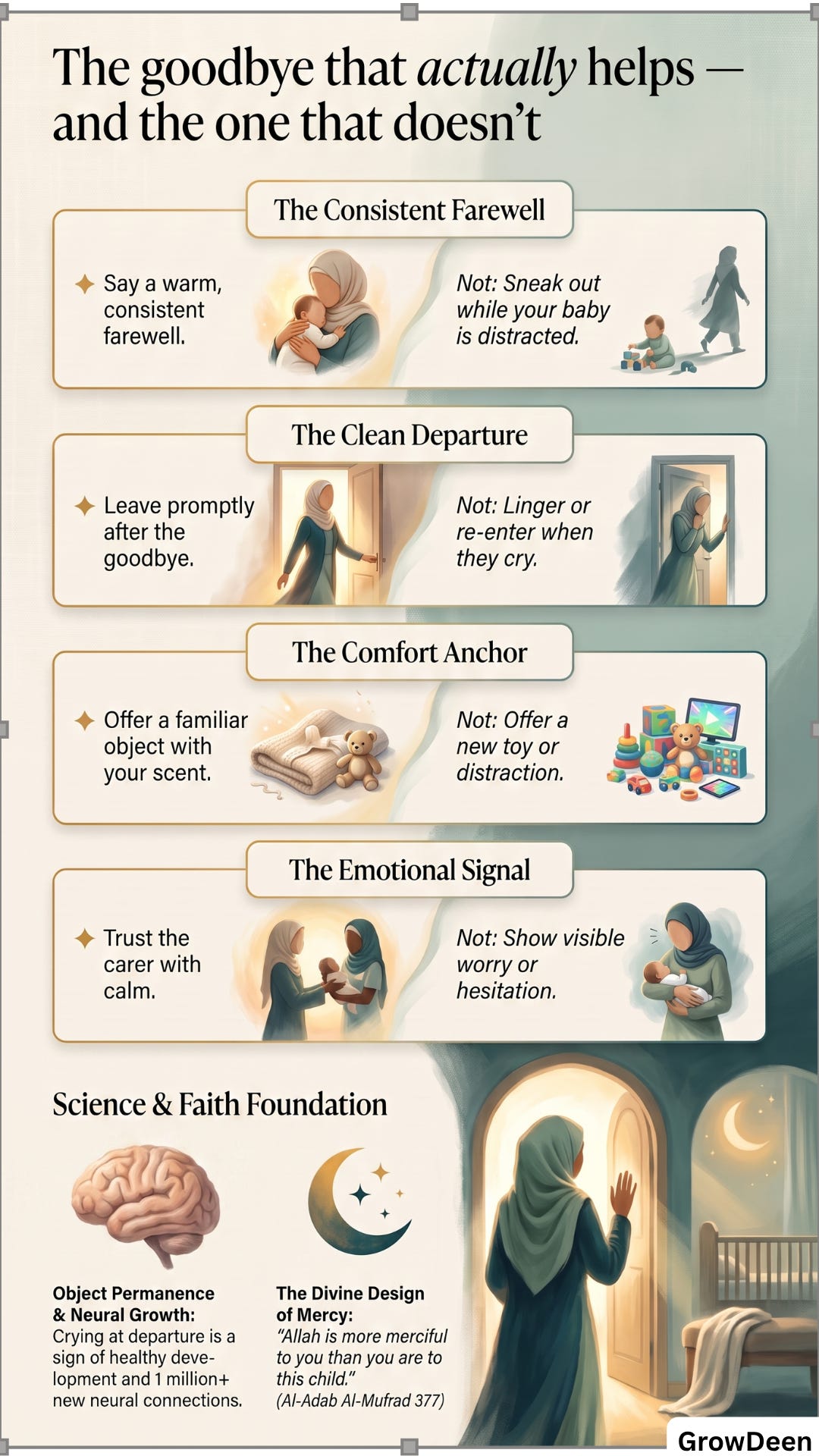
The numbers from the Harvard Center on the Developing Child stop me every time I read them. [2] Over 1 million neural connections forming every single second in the early years. Not from educational toys or apps — from you. From eye contact and conversation and the simple act of being present and responsive.
Your baby is in the middle of that explosion right now.
Between 6 and 7 months, memory is consolidating. Your baby recognises familiar faces and objects. They remember that things exist even when they can’t see them — a skill called object permanence that arrives around now and changes everything. [3, 5] That’s why peekaboo suddenly gets a huge reaction. They’re not just entertained; they’re testing their new understanding of the world.
Their emotional radar is sharper too. They read your face for information. If you look uncertain, they hesitate. If you smile, they proceed with confidence. [3] You are, right now, their emotional GPS — and what you convey matters.
Here’s what I want you to hold onto from this section: your baby isn’t randomly developing. Every milestone you’re seeing — the sitting, the rolling, the reaching, the babbling — is the visible result of weeks of invisible neural preparation. The conversations you’ve had, the Qur’an playing in the background, the times you got down on the floor and watched them together — all of that went in. These milestones are coming out.
Why Your Baby Clings, Cries, and Won’t Go to Strangers (And Why That’s a Good Sign)
This is the part I most want to get right with you, because I know how hard it can feel when your baby wails the second you hand them to their doting grandmother.
Separation anxiety and stranger wariness typically begin around 6–8 months, peak between 10 and 18 months, and gradually ease as a child builds language and the cognitive ability to understand that you will return. [3, 8] They are not signs of insecurity. They are not signs of a “clingy” or “difficult” baby. According to Ainsworth’s foundational research on attachment — one of the most replicated findings in developmental psychology — these responses are hallmarks of secure attachment. [7]
Your baby cries when you leave because they trust that their world has a centre. That centre is you.
What helps:
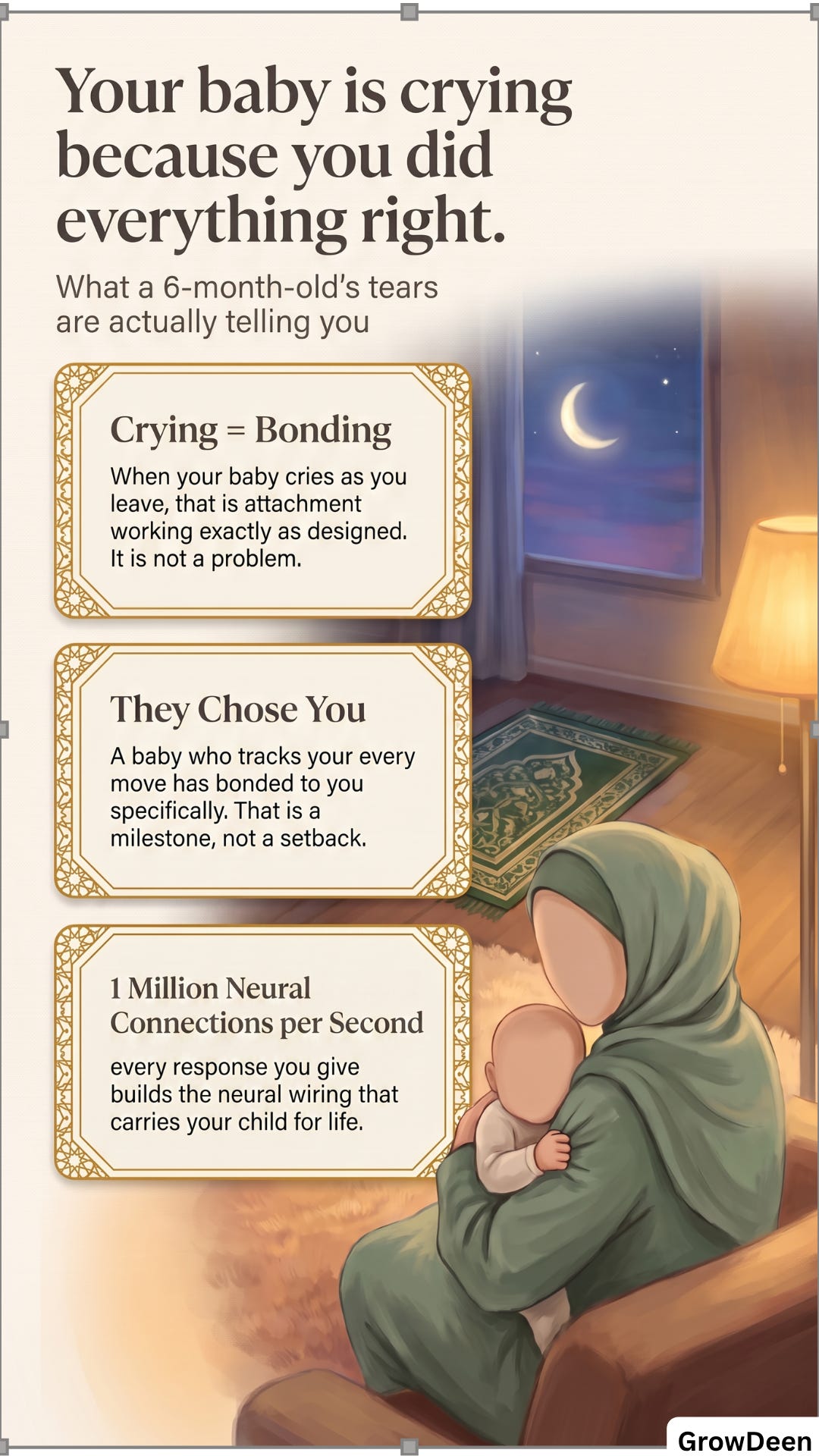
Keep goodbyes short, warm, and consistent. Never sneak out — babies adjust faster when the goodbye is predictable. [8]
A familiar object (cloth, soft toy) that smells like you can help bridge the gap.
Routine creates security. The morning adhkar in the same order, the same gentle words before sleep, the same Qur’anic recitation at bedtime — these give your baby a scaffold that travels with them.
What doesn’t help: sneaking out to avoid the tears. It feels kinder. It usually makes things harder, because your baby can no longer predict when you might disappear.
Talking, Babbling, and the Serve-and-Return That Shapes a Brain
Your baby’s babbling has entered a new phase. You’ll hear consonant-vowel combinations now — “ba-ba,” “da-da,” “ma-ma” — not directed at anyone as names yet, but practised with something that looks like enjoyment. [9]
More importantly: your baby is taking turns.
Sound, pause, wait, sound again. This is the earliest form of conversation, and it’s built through one thing: your responsiveness. When you respond to their sound with a sound of your own, a sentence, a smile — that’s a serve-and-return interaction, and it directly builds the neural architecture for language and communication. [2]
The single most powerful thing you can do for your baby’s language development costs nothing. Talk to them. Narrate your day. Name what you see. Ask questions, even without expecting answers. And where a background playlist might once have been the default, Qur’an recitation is better — not just Islamically, but because a home bathed in the words of Allah is giving your baby’s earliest listening experience the most blessed of sounds.
I know this is a lot to hold in your head, especially when you’re managing feeds, nap windows, and a baby who now refuses to be put down for longer than 90 seconds. That’s why I’ve put together a free Baby’s 6–7 Month Guide: From Cling to Confident — a printable companion pack with a milestone spotter, a goodbye toolkit for separation anxiety moments, and a rahmah reflection card to ground you on the hard days. Keep reading to find it at the end of this article.
The Islamic Framework for Infant Attachment: What Allah Designed Into Your Baby
When I reflect on what makes a 6-month-old so fundamentally, irresistibly lovable — there’s a verse I keep returning to.
In Surah Ta-Ha, Allah speaks to Musa (AS) and reminds him: “And I bestowed upon you love from Me, that you would be brought up under My eye.” [Qur’an 20:39] According to Tafsir Ibn Kathir, the phrase “I made your enemy love you” refers to Allah actively placing love into the hearts of all who encountered the infant Musa — including Pharaoh — as a form of divine protection for a child who couldn’t yet speak, walk, or defend himself. [4]
Your baby’s lovableness is not accidental. It is a design feature.
Allah built it into them so that the people around them — you, their grandparents, their carers — would want to protect, nurture, and hold them even before they can ask. That irresistible pull you feel when you pick them up is Allah’s mercy working through your hands.
And here’s how the Prophet ﷺ put it into proportion for us. A man came to him holding his child, embracing them. The Prophet ﷺ asked: “Do you show mercy to this child?” The man said yes. And the Prophet ﷺ said: “Allah is more merciful to you than you are to this child. He is the Most Merciful of the merciful.” [Al-Adab Al-Mufrad 377 — graded Sahih by al-Albani] [6]
The mercy you show your baby — the picking up, the patience, the choosing presence when you’re empty — is a reflection, however small, of Allah’s own mercy toward you. And His is immeasurably greater.
What strikes me every time is how Islamic wisdom and developmental science point toward the same truth from different directions. Responsive, warm, consistent care isn’t just good parenting. It’s how Allah designed attachment to work — and how the Prophet ﷺ lived it out with the children around him.
Starting Solid Foods: The Bismillah Moment
Around 6 months, iron stores that your baby was born with begin to deplete — making iron-rich solid foods an early nutritional priority. [10] The WHO recommends continuing breastfeeding alongside complementary foods, introduced when your baby shows readiness: sitting with minimal support, good head control, and genuine interest in what’s on your plate. [10]
Begin every feeding with Bismillah. Not as a formality — as a real intention. This is how a Muslim meets food, and it’s the first lesson your baby receives in Islamic mealtime adab. When they turn their head, close their mouth, or push food back — stop. Responsive feeding in infancy builds healthier eating patterns that carry into childhood. [10]
Your baby can also begin learning to sip from a cup at this stage, with supervision. Start small. Start slow. And say Bismillah together.
Your Baby’s 6–7 Month Guide: From Cling to Confident
If you’ve read this far, you’re the kind of parent who takes their baby’s development seriously — not as a checklist to complete, but as something you genuinely want to understand. That tells me something beautiful about you.
Inside the Baby’s 6–7 Month Guide: From Cling to Confident (one comprehensive PDF, 3 pages):
Page 1: Your 6–7 Month Milestone Spotter — a quick-scan visual reference card organised by five developmental domains (movement, communication, social, cognitive, sensory) with age-specific indicators and simple “what to try” prompts for each. Designed as a card you can keep on the fridge or your phone.
Page 2: Your Goodbye Toolkit — a five-step consistent goodbye ritual that helps your baby adjust faster, plus attachment play ideas and stranger wariness reassurance cues — so when the separation tears hit, you have an actual plan rather than winging it at 7 AM.
Page 3: The Rahmah Reminder Card — the authentic narration from Al-Adab Al-Mufrad 377, in Arabic, transliteration, and English: “Allah is more merciful to you than you are to this child.” With a short reflection for the moments when you’re running low — a reminder to carry into the feeds, the night wakings, and the goodbyes.
This isn’t a PDF to download and forget. It’s a card for the fridge, the bedside table, the place where the hard moments actually happen.
This is what every subscriber receives with each article. We cover the full journey of raising Muslim children — newborn through school-age — all backed by developmental research and rooted in Islamic wisdom.
If you’re a Muslim parent who wants both evidence-based guidance AND Islamic perspective, subscribe for free so future resources reach you before you need them.
Subscribe free for parenting resources backed by both science and Sunnah — guidance so unique, you literally can’t find it anywhere else. No spam, no clutter, just resources that matter.
Your Micro-Action for Today
Tonight — or at the very next meal — say Bismillah before the first bite or the first spoon. Out loud, deliberately, in front of your baby.
They can’t understand yet. But they are listening. And the habit you build now will become the foundation they learn from later. It takes two seconds. Start tonight.
Share This With Someone Who Needs It
Think of one person right now — the new mother at the masjid who mentioned last week that her baby has suddenly started screaming whenever she passes them to the grandmother. Or the sister in your WhatsApp group who wrote “my baby won’t let me put them down anymore, is something wrong?” And didn’t know what to say.
This article could reassure them. Share it today — not because you’re being pushy, but because you care. Sometimes the most loving thing we do is pass along the thing that helped us breathe a little easier.
Frequently Asked Questions
Q: Is it normal for a 6-month-old to cry every time I leave the room?
A: Yes — completely normal, and actually a healthy sign. Around 6–8 months, most babies go through a phase of separation anxiety as they develop a specific bond with their primary caregivers. [3, 8] It typically peaks between 10–18 months and eases as language and cognitive understanding develop. The key is keeping your goodbye consistent and warm — never sneaking out.
Q: When should I start solid foods with my baby?
A: Around 6 months is the general guidance from the WHO, with three readiness signs to look for: sitting with minimal support, good head and neck control, and showing real interest in food — watching your plate, opening their mouth when food is offered. [10] Start with soft, iron-rich foods and always begin with Bismillah.
Q: Why does my baby get scared of strangers now when they were fine before?
A: This is stranger wariness, and it’s one of the most normal and healthy developments at 6–7 months. [3] It shows that your baby has formed a specific, secure attachment to familiar people — you — and now registers the difference between known and unknown faces. It usually eases through the toddler years as they build language, memory, and trust.
Q: My baby isn’t crawling yet at 7 months. Should I be worried?
A: Not necessarily — crawling timelines vary considerably between babies, and some skip it entirely and move straight to pulling to stand and cruising. [3, 5] What’s worth checking is whether your baby is rolling in both directions, bearing weight on their legs when held upright, and reaching for objects. If you have any concerns, speak with your paediatrician.
Q: How do I help my baby with separation anxiety without making it worse?
A: The most research-backed approach is a short, consistent, warm goodbye — every time, the same way. [8] Don’t sneak out (it increases anxiety long-term), don’t prolong the goodbye (it increases distress), and do come back when you said you would (it builds trust). Predictability is the antidote to anxiety.
Q: Is babbling at 6–7 months normal, even if it’s not real words yet?
A: Absolutely. Consonant-vowel combinations like “ba-ba” and “da-da” are exactly what’s expected at this age — not yet directed as names, but practised sounds your baby is exploring. [9] The key sign to watch for is whether your baby responds to their name and turns toward sounds. If those are absent at 7 months, mention it to your paediatrician.
References
[1] Ainsworth, M.D.S., Blehar, M.C., Waters, E., & Wall, S. (1978). Patterns of attachment: A psychological study of the strange situation. Erlbaum.
[2] Center on the Developing Child at Harvard University. (2017, updated 2021). Three principles to improve outcomes for children and families. https://developingchild.harvard.edu/resources/report/three-principles-to-improve-outcomes-for-children-and-families/
[3] Centers for Disease Control and Prevention (CDC). (2023). Important milestones: Your baby by nine months. https://www.cdc.gov/ncbddd/actearly/milestones/milestones-9mo.html
[4] Qur’an 20:39 — Surah Ta-Ha, Ayah 39. Tafsir Ibn Kathir: https://quran.com/20/39
[5] Onigbanjo, M.T., & Feigelman, S. (2024). The first year. In R. Kliegman & J.W. St Geme III (Eds), Nelson Textbook of Pediatrics (22nd edn, pp. 151–156). Elsevier.
[6] Al-Adab Al-Mufrad 377 — Narrated by Abu Hurairah. Graded: Sahih (al-Albani). https://sunnah.com/adab:377
[7] Kliegman, R.M., & Marcdante, K.J. (2019). Nelson Essentials of Pediatrics (8th edn). Elsevier.
[8] National Health and Medical Research Council (NHMRC). (2012, updated 2015). Infant Feeding Guidelines: Information for health workers. https://www.nhmrc.gov.au/about-us/publications/infant-feeding-guidelines-information-health-workers
[9] Zubler, J.M., Wiggins, L.D., Macias, M.M., Whitaker, T.M., Shaw, J.S., Squires, J.K., et al. (2022). Evidence-informed milestones for developmental surveillance tools. Pediatrics, 149(3), Article e2021052138. https://doi.org/10.1542/peds.2021-052138
[10] World Health Organization. (2023). Infant and young child feeding. https://www.who.int/news-room/fact-sheets/detail/infant-and-young-child-feeding