

Research shows 84% of parents identify persistent pestering as one of their top sources of daily conflict with young children [1]. This guide shows you why your response matters more than your answer, and how Islamic principles of patience and contentment turn these daily battles into your most powerful parenting moments.
Your four-year-old wants chocolate biscuits. You have said no twice. The third ask is louder. The fourth comes with tears. A stranger glances over.
You know what you want to say. You know what you should say. The gap between those two things, right there in the cereal aisle, feels enormous.
Here is what nobody tells you about this moment: it is not a failure. It is one of the most important pieces of character education your child will ever receive. Not a word of it will come from a textbook or a weekend class. It will come from how you handle the next thirty seconds.
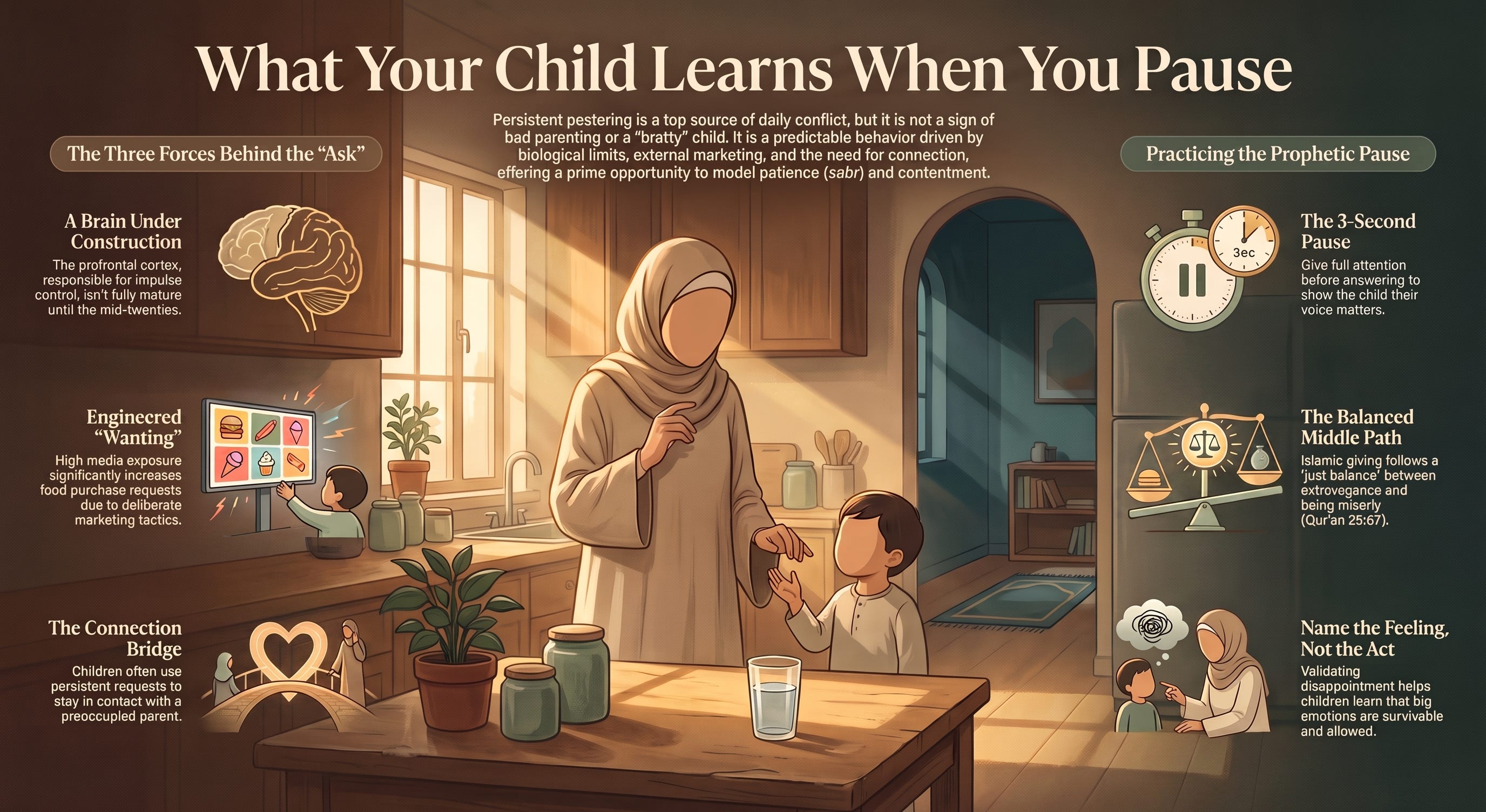
When I studied the research on children’s purchase requests, one finding changed how I understood these situations entirely: a child’s persistent asking is not random, not bratty, and not a reflection of your parenting. It is a predictable, measurable behavioural pattern shaped by three forces operating at the same time [1]. And once you understand those three forces, everything about how you respond gets clearer.
What makes this guide different from generic parenting advice
Backed by developmental research. Recommendations draw on peer-reviewed studies and guidance from the AAP (2018) and the Harvard Center on the Developing Child [1,2,7].
Rooted in Islamic principles. This is about building sabr, shukr, and adab through the daily exchanges that shape your child’s character.
Comes with a free printable companion pack. The Patient Response Companion Pack: a 3-page PDF with a request decision map, a pre-outing planner, and an Islamic reflection card.
The first force: a brain that is still under construction
When your toddler screams because you will not buy the toy, or your five-year-old asks the same question for the ninth time, it feels personal. It is not.
The prefrontal cortex, the part of the brain responsible for impulse control, planning, and the ability to stop yourself from doing something you want to do, is among the very last brain regions to reach maturity. It continues developing through adolescence and is not fully formed until the mid-twenties [7]. A three-year-old who cannot stop asking after hearing no is not choosing to defy you. They are bumping against biological limits their body has not outgrown yet.
This changes the picture completely. You are not dealing with a character problem. You are witnessing a developmental stage.
A toddler at 18 months who points and cries when they cannot have something is not manipulating you. Their vocabulary is tiny, their emotional regulation is nearly nonexistent, and the gap between what they want and what they can cope with is vast. The only thing that helps is your calm presence, your acknowledgement of the feeling, and the passage of time. Comforting a toddler through that storm does not teach them to cry harder next time. It teaches them that big feelings end and that you are still there when they do [2].
By four or five, a child’s vocabulary has expanded enough that they will try to use words to change what happens. They negotiate, argue, try different angles. This is not disobedience. It is the healthy, slightly exhausting result of a child discovering that language is a tool of influence. What they need from you at this stage is not less talking but clearer signals: warm explanations, brief reasons, and a consistent line between what is negotiable and what is not.
By six, seven, eight, a child can follow complex reasoning, understand delayed consequences, and manage disappointment without falling apart, most of the time. They will occasionally present genuinely persuasive arguments, and when they do, reconsidering is not weakness. It is modelling that good communication works. But when the answer stays no, they are developmentally ready to hear a clear reason and accept it.
The second force: a world designed to make children want more
Here is something that shifted my perspective: a 2023 study published in Pediatric Obesity found that children with higher audiovisual media exposure made significantly more food purchase requests to their parents [9]. The product displays at child eye level, the in-app promotions, the packaging with cartoon characters: none of it is accidental. It is deliberately engineered to create wanting in the minds of children who do not yet have the cognitive tools to recognise what is happening to them.
Your child is not greedy. They are responding exactly the way the marketing was designed to make them respond.
This is an area where Islamic guardianship is not abstract theology. It is a practical daily responsibility. Protecting a child’s heart and mind (hifz al-qalb) includes being intentional about what influences reach them [10]. Limiting exposure to unnecessary advertising, choosing media carefully, and for older children, beginning to name what advertising is and what it is trying to do are all concrete, research-supported acts of guardianship that reduce pestering at its source.
I know this is a lot to hold in your head, especially during a shopping trip with a tired child pulling at your arm. That is why I created the Patient Response Companion Pack, a free 3-page PDF with a visual decision map for handling requests, a pre-outing planner, and an Islamic reflection card. Keep reading to download it at the end.
The third force: a relationship testing its own boundaries
Sometimes the asking is not about the thing at all. A child who feels disconnected from a preoccupied parent may use persistent requesting as a way to stay in contact. If pestering tends to spike when you have been distracted, the honest question is: does my child need what they are asking for, or do they need me?
Spending quality time with your child and giving them genuine warmth and attention can reduce pestering more effectively than any strategy, because it removes the underlying cause. A child who feels connected does not need to use requests as a bridge.
What Islam teaches about wanting, giving, and the space between
The Qur’an describes the servants of the Most Merciful and includes among their qualities that “when they spend, they are neither extravagant nor miserly, but hold a just balance between those extremes” [Qur’an 25:67] [3]. According to Tafsir Ibn Kathir, this describes believers who follow a measured middle path in giving: neither reckless overindulgence that spoils, nor tight-fisted withholding that hardens.
Every time you respond to your child’s request, you are spending. Spending attention, spending patience, spending money, spending emotional energy. The Islamic ideal is not unlimited yeses and not reflexive nos. It is the warm, deliberate middle, where your child feels both loved and held.
The Prophet ﷺ also addressed the root of discontentment directly: “Look at those who are beneath you and do not look at those who are above you, for it is more suitable that you should not consider as less the blessings of Allah” [Sahih Muslim 2963] [13]. This hadith identifies the mechanism that drives wanting: upward comparison. Children absorb this habit from advertising, from peers, from what they see parents doing with material things. A home where Alhamdulillah is said with sincerity, where gratitude is visible and natural rather than performed, is a home where wanting finds its healthy level without anyone delivering a lecture.
What this looks like in your living room, your car, and aisle seven
Understanding the three forces is useful. But what do you actually do when your child asks for the fourteenth time?
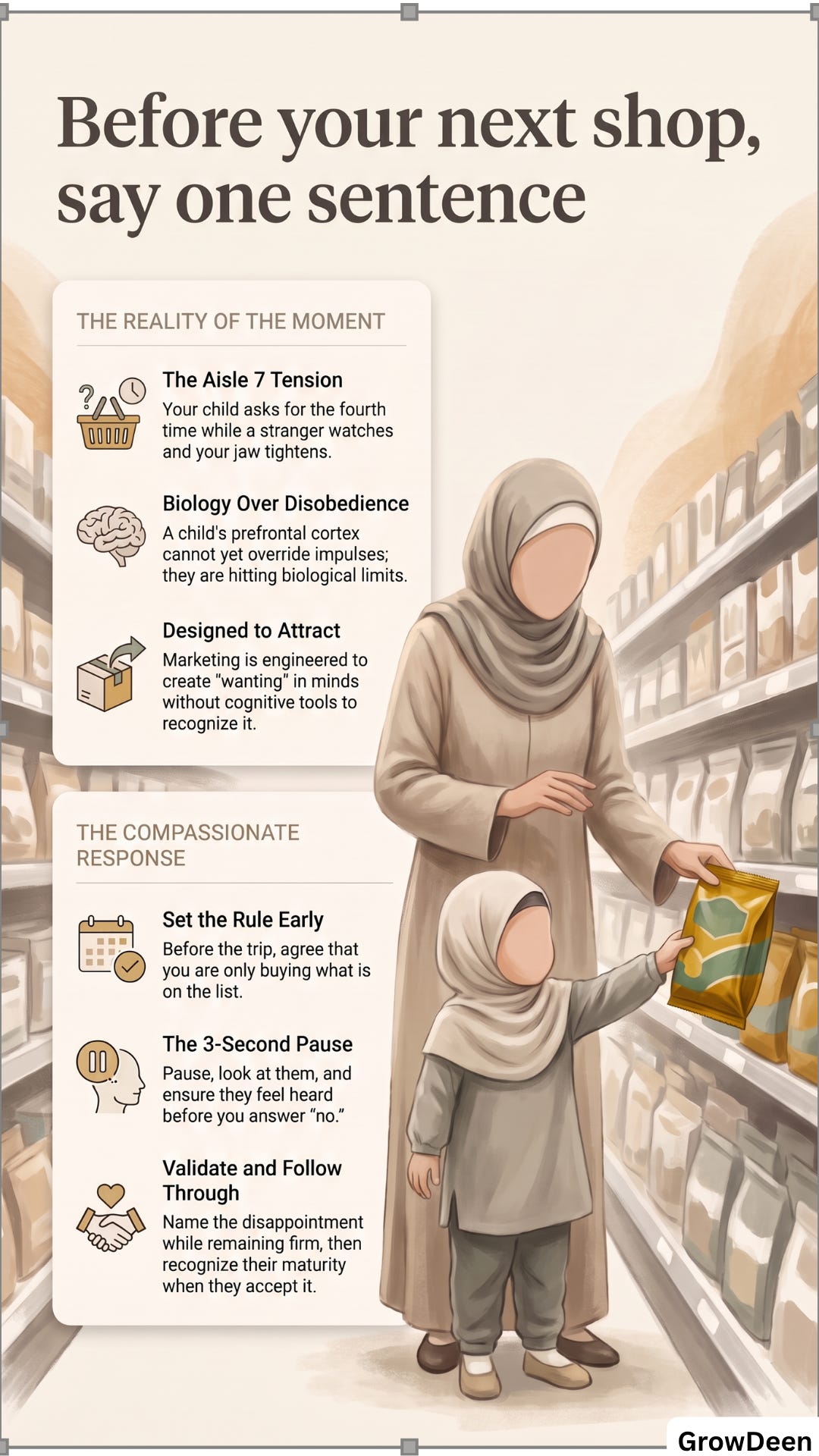
Before the situation starts, set the terms. Research shows that children whose parents establish clear, brief expectations before an outing make significantly fewer unplanned requests [1]. “We are buying what is on the list. No extras today. If you follow through, we stop at the park.” One minute of preparation at the front door saves twenty minutes of conflict in the shop.
When a request arrives, pause for three seconds before you answer. Look at your child. Let them see you thinking. The Prophet ﷺ was known for turning his whole body toward the person speaking, giving full attention [5]. That small pause tells your child their voice matters, and it gives you the space to respond rather than react. Most childhood escalation starts not from hearing no but from feeling invisible [4].
When you can say yes, notice how they asked. “Thank you for asking so calmly.” That one sentence reinforces the exact behaviour you want repeated [6].
When the answer is no, keep your explanation to one sentence. “We are not buying that today because we came for groceries.” Then name what they feel, not what they did: “I can see you are disappointed.” The Prophet ﷺ wept openly and said, “The eye weeps and the heart grieves, but we do not say anything except what pleases our Lord” [8]. Emotions were never the enemy in Islam. Teaching your child that disappointment is real, allowed, and survivable is among the most important emotional groundwork you can do.
When they accept it gracefully, that deserves recognition. “That was really mature. I know it was not what you wanted.” This builds the internal satisfaction system that will, over time, replace the need for external reward [2].
When the asking does not stop, stop engaging with the request. Not with your child, with the request. Stay physically present. Do not repeat your reasons. Do not argue back. When the pestering finally stops, notice it immediately: “Thank you for accepting my answer. I know that was hard.” Your calm during that stretch is the most important thing in the room. When you stay regulated, your child’s nervous system has a live model of the self-control they are learning [12]. When you lose composure, their brain shifts into fight-or-flight and the lesson is lost.
If you are close to snapping, step away for one breath. Ask Allah for patience. Then re-engage. That is not failure. That is the exact skill you are modelling.
Your free companion pack is ready
If you have read this far, you are not the kind of parent who gives in to keep the peace. You want to understand and respond with intention.
Inside the Patient Response Companion Pack (one comprehensive PDF, 3 pages):
Page 1: The Request Response Decision Map — A visual flowchart walking you from “your child asked for something” to the right response, with specific phrases at every step. Designed as a laminated card for the fridge or your bag.
Page 2: The Pre-Outing Expectation Planner — A fill-in template to complete before shopping trips or outings. Spaces for where you are going, the rule about asking, and the reward for following through. Walk in prepared, not reactive.
Page 3: The Contentment Reflection Card — Two Islamic reflections: Qur’an 25:67 on balanced responding, and the Prophet’s ﷺ hadith on contentment (Muslim 2963). English translations and sources. A quiet reminder for difficult moments.
This is not a PDF to download and forget. It is a tool designed to stay on your fridge or in your bag, right where you need it.
This Patient Response Companion Pack is what every subscriber receives with each article. We cover the full journey of raising Muslim children from infancy to age 8, backed by research and rooted in Islamic wisdom.
If you are a Muslim parent who wants both evidence-based guidance and Islamic perspective, subscribe for free so future resources arrive in your inbox before you need them.
Subscribe free for parenting resources backed by both science and Sunnah, guidance so unique you cannot get it anywhere else. No spam, no clutter, just resources that matter.
Your micro-action for right now
Before the next request arrives, decide on one ground rule for your household. Say it out loud to your child today. “In our family, we ask once, with kind words, and we accept the answer.” That is it. One rule. Start there.
May Allah grant you patience in the small moments and the quiet confidence that every measured response is tarbiyah.
Share this with someone who needs it
Think of one person right now: the mother at the masjid whose shopping trips have become a battlefield. The friend whose messages mention giving in “just to make it stop.” The sister who is losing her patience nightly.
This could change how they see those moments. Share it today, not as advice, but as support.
Frequently Asked Questions
Q: Is pestering normal, or is my child badly behaved?
A: Completely normal. The brain region responsible for impulse control will not be fully mature for years [7]. Your child is practising a skill they have not mastered yet.
Q: How do I say no without feeling guilty?
A: A child who never hears no never learns to manage disappointment. Saying no with a brief reason and genuine empathy is one of the most loving things you can do [2].
Q: What if my child throws a tantrum after I say no?
A: Stay close, stay calm, wait. Comforting them through it does not reward the tantrum. It teaches them that big feelings end [2].
Q: Does Islam allow saying no to children?
A: Yes. The Qur’an describes balanced giving as a quality of the righteous [3]. Saying no with warmth and a clear reason is wisdom, not harshness.
Q: How do I reduce asking during shopping trips?
A: Set expectations before you leave. Research shows this single step significantly reduces unplanned requests [1]. The companion pack includes a ready-made Pre-Outing Planner for exactly this.
Q: When should I be concerned about pestering behaviour?
A: If frustration tolerance seems unusually low across all settings despite your consistent approach, speak with a paediatrician or child psychologist. Some children have underlying challenges that benefit from early support.
References
[1] Christino, J.M.M., et al. (2020). Children’s pester power, packaging and unhealthy food preference. Young Consumers, 21(1), 35-55.
[2] Siegler, R.S., et al. (2024). Emotional development. In How Children Develop (7th edn). Macmillan Learning.
[3] Qur’an, Surah Al-Furqan 25:67 — https://quran.com/25/67
[4] McDevitt, T.M., et al. (2020). Child Development and Education (2nd edn). Pearson Australia.
[5] Cortini, M., et al. (2021). How power is pester power? TPM, 28(1), 37-46.
[6] Swindle, T., et al. (2020). Pester power. J Nutr Educ Behav, 52(8), 801-807.
[7] Harvard Center on the Developing Child (2020). Executive Function & Self-Regulation.
[8] Sahih al-Bukhari 1303 — Graded: Sahih — https://sunnah.com/bukhari:1303
[9] Binder, A., & Matthes, J. (2023). Pediatric Obesity, 18(6), e13018.
[10] McCarthy, C.M., et al. (2022). Obesity Reviews, 23(6), e13441.
[11] AAP (2018). Effective discipline. Pediatrics, 142(6), e20183112.
[12] Siegel, D.J., & Bryson, T.P. (2012). The Whole-Brain Child. Bantam Books.
[13] Sahih Muslim 2963 — Graded: Sahih — https://sunnah.com/muslim:2963