

Early childhood tooth decay is the single most prevalent chronic disease in children globally and almost all of it is preventable. [1] The AAPD’s 2024 guidelines recommend dental care begins the day the first tooth appears, not at age two or three. This guide shows you exactly what to do, starting tonight.
There’s a moment — easy to miss if you’re not looking — when you lift your baby’s lip during a nappy change and catch a faint glint of white pushing through the gum.
Tiny. Almost nothing.
And yet everything starts there.
That first tooth isn’t just a milestone to photograph. It’s the beginning of a dental health story that, if started right, protects your child for decades. And if started wrong — or not started at all — can lead to a two-year-old sitting in a dentist’s chair with decay that didn’t have to happen.
You’re already doing so much right. You’re reading this. That matters.
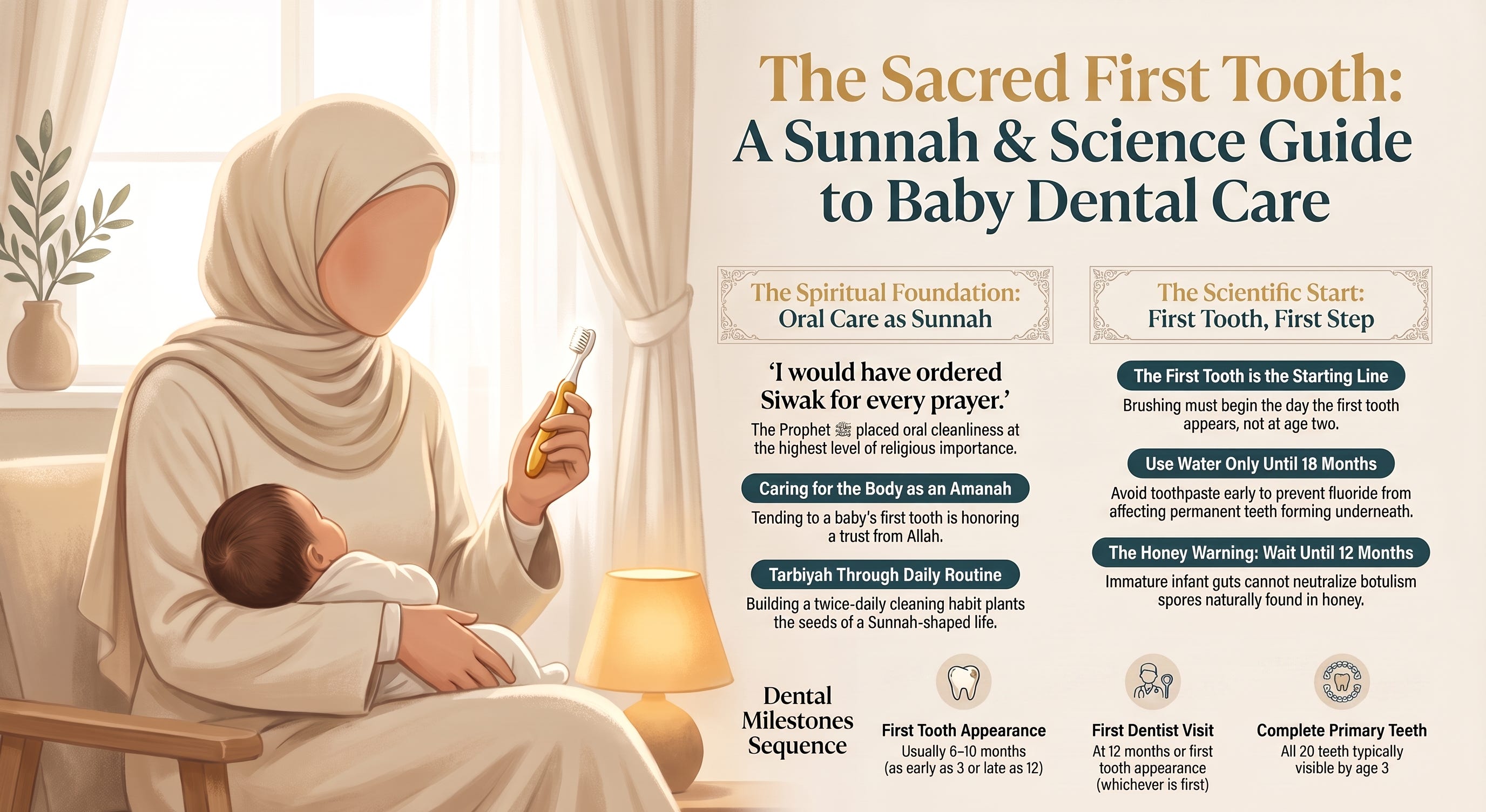
Here’s what I want you to know before we go any further: the Prophet ﷺ placed such importance on oral cleanliness that he said he would have made tooth-cleaning obligatory were it not for the hardship on his followers. [3] If that’s where the Sunnah places the mouth — at that level of care — then tending to your baby’s first tooth with intention is not just routine hygiene. It’s part of honouring what Allah has entrusted to you.
Why This Guide Is Different From Generic Baby Health Advice
Every recommendation draws from current peer-reviewed dental research and AAPD 2024 clinical guidelines — not parenting blogs or recycled tips.
The Islamic dimension is woven through the science, not added at the end — because the Sunnah and the evidence point in the same direction on oral care, and that connection deserves to be shown.
You’ll get a free Your Baby’s First Teeth Companion Pack — a printable three-page guide with a tooth eruption timeline, a dental do’s and don’ts card, and a Sunnah-rooted reflection card you can keep somewhere you’ll actually see it.
When Do Baby Teeth Appear?
Most babies start teething between 6 and 10 months. But 3 months is also normal. So is 12 months. Some babies are even born with a tooth already through — a small number, but it happens.
The order tends to follow a pattern: lower front teeth usually first, upper front teeth next, then first molars, canines, and finally second molars. [4] Most children have all 20 primary teeth in place by around age three.
Here’s something worth pausing on: all 20 teeth are already there, inside your baby’s gums, from before birth. They formed while your baby was still growing in the womb. This sequence — this perfectly timed unfolding — is part of how Allah designed the human body. The teeth are waiting. Your baby’s body knows exactly what to do.
What Teething Actually Does — And What It Doesn’t
Teething is when a tooth pushes through the gum tissue and becomes visible. For some babies, this process is almost imperceptible. For others, it brings genuine gum soreness, increased drooling, and a strong urge to bite and gnaw on things.
But here’s what teething does not reliably cause: fever, diarrhoea, or significant illness.
These symptoms appear in babies at teething age partly because babies this age are also encountering viruses and minor infections for the first time. It’s easy to attribute everything to teething. The research doesn’t support that link. [5] If your baby has a fever — a real fever, not just warmth from crying — that needs a doctor’s assessment. Attributing it to teething and waiting can delay care that’s genuinely needed.
Soothing a Teething Baby: What Actually Helps
When your baby seems uncomfortable and you suspect teeth are coming through, there are several practical things to try — and one to avoid.
Gentle gum massage. Wash your hands thoroughly, then use the pad of a clean fingertip to massage your baby’s gum in small circular motions where the tooth is working through. The counter-pressure often eases the discomfort. And the closeness helps too — your presence, your calm voice, your touch. These things matter to a baby in pain.
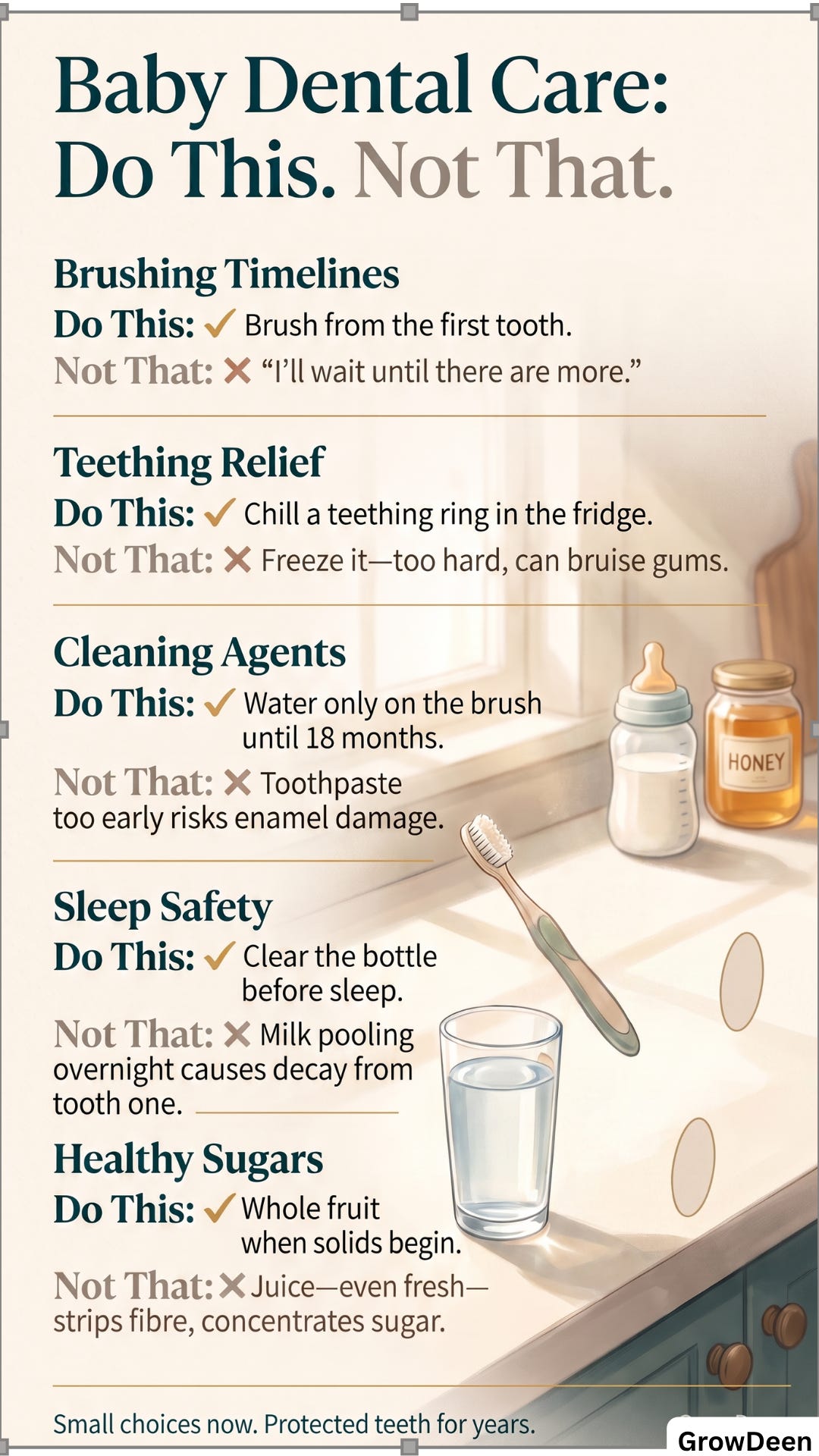
Something cool to bite on. A chilled (not frozen) teething ring is one of the most effective options. Put it in the fridge, not the freezer — frozen objects are too hard and can bruise delicate gum tissue. A clean, damp muslin cloth cooled in the fridge works just as well.
Softer foods. If your baby has started solids, offering mushier textures during heavy teething periods makes mealtimes less difficult. Less chewing needed means less gum pressure.
Firm, sugar-free objects to gnaw. Some parents find a sugar-free rusk helpful. If you use one, choose carefully — check the label and avoid anything with added sugars.
What to avoid: teething gels. Most current health guidance advises against them. The evidence that they relieve pain is weak. More importantly, some teething gels contain salicylate compounds — related to aspirin — that have caused poisoning in infants when applied repeatedly or in excess. [7] A small mouth, repeated applications, a baby who drools and swallows — it becomes impossible to control the dose. Use safer options instead.
If your baby remains in clear distress despite all of this, or if you’re concerned something else is happening, speak with a paediatrician. Teething is not always the explanation — it pays to check.
The First Tooth Appears: Begin Now
The moment a tooth appears, dental care begins. Not eventually. Now.
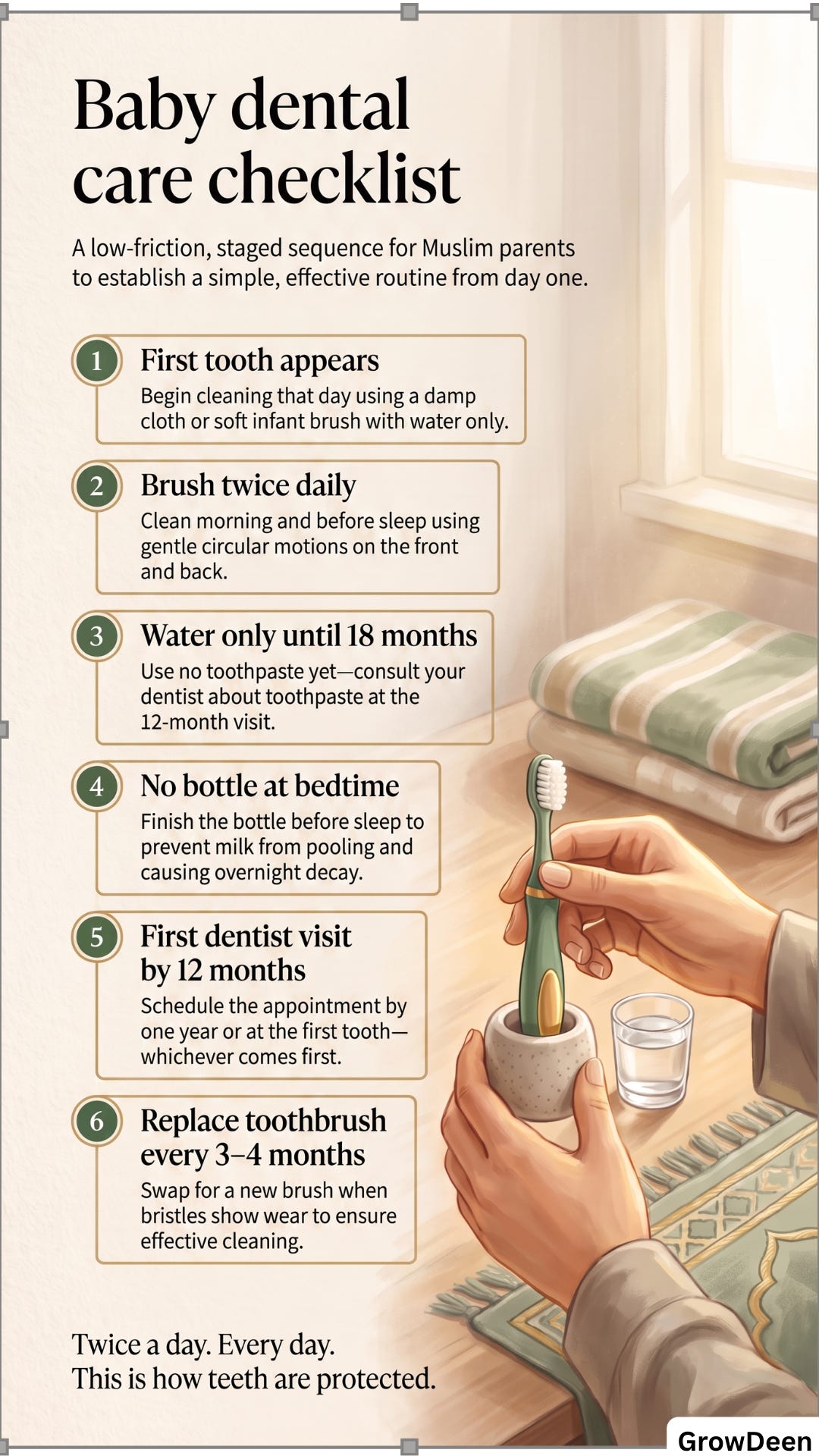
Use a soft infant toothbrush designed for children under two. If your baby resists the brush, a small piece of clean damp gauze or a damp face cloth works well too — wipe the front and back of each tooth gently and run along the gum line. [8]
Water only on the brush until 18 months. There is no benefit from toothpaste at this stage, and excess fluoride in the early months can affect the permanent teeth still forming underneath. [9] After 18 months, ask your dentist whether and when to introduce a low-fluoride toothpaste appropriate for your child.
How to position your baby: Sit on the floor or bed with your baby’s head resting in your lap, facing you. Cup their chin gently with one hand. Lift the lip. Small, soft circular motions across the front and back of each tooth and along the gum line. Twice a day. Every day.
Some babies accept this immediately. Others resist strongly — and if that’s yours, you are not alone. The resistance doesn’t mean you stop. It means you adapt. Let your baby hold a spare toothbrush to chew while you clean. Recite Qur’an softly during the process. Keep your voice calm and your manner matter-of-fact. Within a few weeks of patient consistency, most babies accept this as simply part of life.
After each brushing session, rinse the brush under running water and store it upright to air-dry. Replace it every three to four months, or sooner if the bristles show visible wear. [10] Worn bristles clean less effectively and can irritate the gum line.
Diet and Feeding: The Part Most Parents Underestimate
What your baby eats — and how they’re fed — has a direct and significant bearing on whether their teeth decay. Early childhood caries doesn’t happen by chance. It has clear, identifiable causes, and most of them come back to diet and feeding habits. [2]
Breastmilk or formula until around 6 months, with small sips of water introduced alongside solids. No juice — not even fresh-squeezed, not even diluted. When fruit is pressed into juice, the fibre is stripped away and what remains is concentrated fructose that creates an acid environment in a baby’s mouth, the same way sugary drinks do. [10] Whole fruit is entirely different. Juice is not fruit. Sugary drinks, soft drinks, and sweetened liquids have no place in a baby’s diet at any point in the first year.
Never put your baby to bed with a bottle of milk. This is one of the clearest and most consistent causes of severe early childhood tooth decay. When a baby falls asleep feeding, milk pools around the teeth. Saliva production drops during sleep, removing the natural protection the mouth normally provides. The lactose in milk feeds bacteria that produce acid — and that acid erodes enamel from the first tooth onward. [2] This applies to formula and breastmilk. If your baby feeds at the breast to sleep and then naturally detaches, that’s different. But any habit that leaves milk sitting around the teeth through the night is one to change early.
A careful note on honey. In Surah An-Nahl, Allah describes what comes from the bee’s belly as “a drink of varying colours, in which there is healing for people.” [Qur’an 16:69] [11] Honey is a blessed food, praised in both the Qur’an and the Sunnah.
And yet — honey is not safe for babies under 12 months. This is not a contradiction. It is a reminder that what is healing for a mature body requires wisdom in its application to a developing one.
The danger is infant botulism — a serious illness caused by bacterial spores (Clostridium botulinum) that can be naturally present in honey. An infant’s immature gut cannot neutralise these spores the way an adult’s can. The spores germinate and produce a toxin that causes muscle weakness, feeding difficulties, and in severe cases, respiratory failure. [12] The risk applies to every variety of honey — raw, manuka, local, organic — and it extends to dipping a pacifier or dummy in honey to soothe teething pain. Don’t.
Once your child passes their first year, honey can be introduced and enjoyed freely. Until then, the wisdom is in waiting.
On dummies and pacifiers: if your baby uses one, never dip it in any sweet liquid, food, or honey. And never “clean” a dummy by putting it in your own mouth — this transfers bacteria directly to your baby’s, including the bacteria most associated with tooth decay. [8]
Support Muslim Parenting Lab ❤️
Would you like a small amount of yours grown into something enormous? Give what you can spare with the button below.
The Prophet ﷺ said Allah grows a charity the size of a date until it is like a mountain. (Sahih al-Bukhari 1410)
I Know This Is a Lot — Here’s Something That Makes It Easier
This is already a lot to carry in your head alongside everything else that comes with a baby in the house.
That’s exactly why I made the Your Baby’s First Teeth Companion Pack — a printable three-page guide with a tooth eruption timeline, a dental do’s and don’ts card, and a Sunnah-rooted reflection card designed to stay somewhere visible. Keep reading to download it at the end of this article.
The Islamic Framework for Your Baby’s Oral Care: The Sunnah Knew
When I reflect on the hadith where the Prophet ﷺ said, “If I had not found it hard for my followers, I would have ordered them to clean their teeth with Siwak for every prayer” [Sahih al-Bukhari 887] [3], I think about what that tells us about the status of the mouth in Islam.
He didn’t make it obligatory — out of mercy for his ummah. But the wish was there. The value was there. Scholars describe the siwak as one of the most emphasised of the confirmed Sunnahs — not a minor afterthought, but a consistently reinforced practice across the Prophet’s life ﷺ.
When we carry that emphasis to our babies — cleaning the first tooth the day it appears, building a twice-daily routine before our child can even walk — we are planting something real. The tarbiyah of the body. The beginning of a life shaped by Sunnah, in the smallest, most ordinary acts.
And from the Qur’an: Allah tells us that from the bee comes “a drink of varying colours, in which there is healing for people.” [Qur’an 16:69] [11] According to Tafsir Ibn Kathir, this refers to honey and its healing properties — one of the blessed provisions woven into creation. The verse says healing for people. And Islamic wisdom has always understood that benefit must be matched to the person and their stage of life — which is why, for now, we wait.
Caring for your baby’s teeth is not a chore. It is intention, love, and amanah in daily practice. May Allah put barakah in every quiet, tired moment you show up for it.
The First Dentist Visit: Most Parents Wait Too Long
Your baby should see a dentist at around 12 months, or when the first tooth appears — whichever comes first. [1]
I know. Earlier than you expected.
But this first visit is not about treatment. It’s about orientation. A baseline check. A chance for your baby to sit in a dental chair before there’s ever anything wrong — so it becomes familiar, unremarkable, just part of life. Children who have positive early dental experiences are significantly more likely to attend regularly as they grow. [1]
After the first visit, your dentist will advise on frequency — typically every 6 to 12 months, adjusted for your child’s specific needs and risk profile.
Go to a dentist or paediatrician promptly if:
You notice white, brown, or black spots on any tooth
Gums bleed consistently when you clean the teeth
There’s visible swelling or inflammation in the gum
Your baby has a fever or seems genuinely unwell during what you think is teething
The first tooth hasn’t appeared by 18 months
Anything about your baby’s mouth, teeth, or feeding feels wrong
Trust your instinct. You know your baby. If something doesn’t feel right, seek assessment.
Your Baby’s First Teeth Companion Pack
If you’ve read this far, you’re the kind of parent who takes this seriously — not out of anxiety, but out of love. That tells me something about you.
Inside the Your Baby’s First Teeth Companion Pack (one PDF, 3 pages):
Page 1: Baby Tooth Eruption Timeline & Care Milestones — A clear visual showing when each group of teeth typically arrives, from lower incisors through to second molars, paired with the action to take at each stage: when to start brushing, when to book the first dentist visit, when to ask about toothpaste. Designed as a reference card for your fridge or baby bag — so you’re never wondering “is this normal?” again.
Page 2: Dental Do’s and Don’ts — Quick Reference Card — A two-column card covering exactly what to do and what to avoid across brushing, teething, diet, and feeding — including the honey warning, the juice warning, and the bottle-at-bedtime risk that parents most commonly miss. Formatted for scanning in 30 seconds, designed for your bathroom mirror or changing table.
Page 3: The Miswak Reflection — Oral Care as Sunnah — A display card featuring the full text and translation of the hadith where the Prophet ﷺ expressed his wish for siwak before every prayer, with a short reflection connecting this to the daily act of cleaning your baby’s first teeth. Not a memorisation exercise — a reminder that this ordinary act carries weight in Islam, and you are already doing something the Prophet ﷺ valued deeply.
This isn’t a PDF to download and forget. It’s a tool built to stay where dental care actually happens.
This Your Baby’s First Teeth Companion Pack is what every subscriber receives with each article. Muslim Parenting Lab covers the full journey of raising Muslim children — from newborn health and infant milestones through to toddler behaviour and school-age development — all backed by research and rooted in Islamic wisdom.
Tonight’s Micro-Action
Go and look at your baby’s mouth right now. Actually look.
If there’s a tooth — any tooth, even just a sliver of white — and you haven’t brushed it today, do it tonight. Wet a soft infant brush or a small piece of gauze. Take two minutes. Be gentle.
That’s it. That’s where it starts.
Share This With Someone Who Needs It
Think of one person right now: the mother in your WhatsApp group who mentioned her baby’s first tooth appeared last week and has no idea dental care starts immediately — or the sister whose baby is approaching 6 months and has been planning to “start thinking about teeth later” — or the friend who’s been dipping her baby’s dummy in honey to soothe teething pain because nobody told her what that actually risks.
This article could protect their child.
Share it with them today — not as advice, but as care. Sometimes the most loving thing we can do is pass on what we wish someone had told us sooner.
Frequently Asked Questions
Q: When should I start brushing my baby’s teeth?
A: The day the first tooth appears — not “when there are enough teeth to bother with.” One tooth is enough. Use a soft infant toothbrush and plain water, twice daily, from that first tooth onward. [1] For more detail, see “The First Tooth Appears: Begin Now” above.
Q: Is it normal for my baby to have no teeth at 12 months?
A: It can be within the normal range — the typical window for the first tooth is 6 to 12 months, with some healthy babies arriving at the later end. But at 18 months with no tooth visible, it’s worth a dental check. [4] If you’re worried at any point, see a paediatrician — your concern is always worth raising.
Q: Do baby teeth really matter if they’re going to fall out anyway?
A: They matter enormously. Baby teeth hold space in the jaw for permanent teeth — when they’re lost too early from decay, surrounding teeth drift and crowd the space permanent teeth need. Early decay is also genuinely painful, affects a child’s ability to eat and speak clearly, and can require treatment under general anaesthesia in young children. [1,2] The stakes are higher than most people realise.
Q: Can I use teething gel on my baby’s gums?
A: Most current guidance advises against it. The evidence that teething gels actually relieve pain is limited, and some contain salicylate compounds related to aspirin that have caused poisoning in infants. [7] A chilled teething ring and gentle gum massage are safer, and for most babies, just as effective. For more, see “Soothing a Teething Baby” above.
Q: My baby won’t let me brush their teeth — what do I do?
A: You keep going — patiently. Let your baby hold a spare brush to chew while you clean. Keep the process calm, brief, and consistent. Recite something softly. Try different positions. Most babies come around within a few weeks of the routine being firmly established. [8] If resistance is extreme and ongoing, mention it at your next dental or paediatric visit.
Q: Why can’t I give honey to my baby before 12 months, even though the Qur’an describes it as healing?
A: Honey is indeed blessed — but the Qur’anic verse describes it as healing for people, and Islamic wisdom has always understood that benefit must be matched to the person and their stage of development. Honey can naturally contain bacterial spores (Clostridium botulinum) that an infant’s immature gut cannot neutralise, leading to a serious condition called infant botulism. [12] The same risk applies to dipping a dummy in honey. After the first year, honey is safe and can be enjoyed. Until then, the wisdom is in waiting.
References
[1] American Academy of Pediatric Dentistry (AAPD). (2024). Periodicity of examination, preventive dental services, anticipatory guidance/counselling, and oral treatment for infants, children, and adolescents. The Reference Manual of Pediatric Dentistry (pp. 293–305). AAPD. https://www.aapd.org/globalassets/media/policies_guidelines/bp_periodicity.pdf
[2] Tinanoff, N., Baez, R.J., Diaz Guillory, C., Donly, K.J., Feldens, C.A., McGrath, C., Phantumvanit, P., Pitts, N.B., Seow, W.K., Sharkov, N., Songpaisan, Y., & Twetman, S. (2019). Early childhood caries epidemiology, aetiology, risk assessment, societal burden, management, education, and policy: Global perspective. International Journal of Paediatric Dentistry, 29(3), 238–248. https://doi.org/10.1111/ipd.12484
[3] Sahih al-Bukhari 887. Narrated Abu Hurairah: Allah’s Messenger ﷺ said, “If I had not found it hard for my followers or the people, I would have ordered them to clean their teeth with Siwak for every prayer.” Graded: Sahih. https://sunnah.com/bukhari:887
[4] Gussy, M., Rosie, A., Carpenter, L., Virgo-Milton, M., Calache, H., Dashper, S., Leong, P., de Silva, A., de Livera, A., Simpson, J., & Waters, E. (2015). Natural history of dental caries in very young Australian children. International Journal of Paediatric Dentistry, 26(3), 173–183. https://doi.org/10.1111/ipd.12169
[5] Monaghan, N. (2019). Teething products may be harmful to health. British Dental Journal, 227, 485–487. https://doi.org/10.1038/s41415-019-0715-7
[6] Christian, P., & Evans, C. (2024). Infancy, childhood, and adolescence. In C. Geissler & H. Powers (Eds.), Human nutrition (14th edn, Chapter 14). Oxford University Press.
[7] Williams, G.D., Kirk, E.P., Wilson, C.J., Meadows, C.A., & Chan, B.S. (2011). Salicylate intoxication from teething gel in infancy. The Medical Journal of Australia, 194(3), 146–148. https://doi.org/10.5694/j.1326-5377.2011.tb04201.x
[8] Welti, R., Chinotti, M., Walsh, O., Arcus, M., Asgari, J., Phillips, K., Wallace, J., Do, L., Moynihan, P., & Silva, M. (2023). Oral health messages for Australia: A national consensus statement. Australian Dental Journal, 68(4), 247–254. https://doi.org/10.1111/adj.12973
[9] Do, L.G., & Australian Research Centre for Population Oral Health. (2019). Guidelines for use of fluorides in Australia: Update 2019. Australian Dental Journal, 65(1), 30–38. https://doi.org/10.1111/adj.12742
[10] American Academy of Pediatric Dentistry (AAPD). (2020). Policy on early childhood caries (ECC): Classifications, consequences, and preventive strategies. The Reference Manual of Pediatric Dentistry (pp. 79–81). AAPD.
[11] Qur’an 16:69 — Surah An-Nahl. “From their bellies comes forth liquid of varying colours, in which there is healing for people.” Verified through Tafsir Ibn Kathir: honey identified as healing for diseases, part of Allah’s design in creation. https://quran.com/16/69
[12] Pitts, N.B., Zero, D.T., Marsh, P.D., Ekstrand, K., Weintraub, J.A., Ramos-Gomez, F., Tagami, J., Twetman, S., Tsakos, G., & Ismail, A. (2017). Dental caries. Nature Reviews Disease Primers, 3, Article 17030. https://doi.org/10.1038/nrdp.2017.30
[13] Peres, K.G., Chaffee, B.W., Feldens, C.A., Flores-Mir, C., Moynihan, P., & Rugg-Gunn, A. (2018). Breastfeeding and oral health: Evidence and methodological challenges. Journal of Dental Research, 97(3), 251–258. https://doi.org/10.1177/0022034517738925
We combine scientific research with Qur’an and authentic Sunnah, and we cite our sources. Even so, this is general guidance and no substitute for a doctor who can examine your child.