

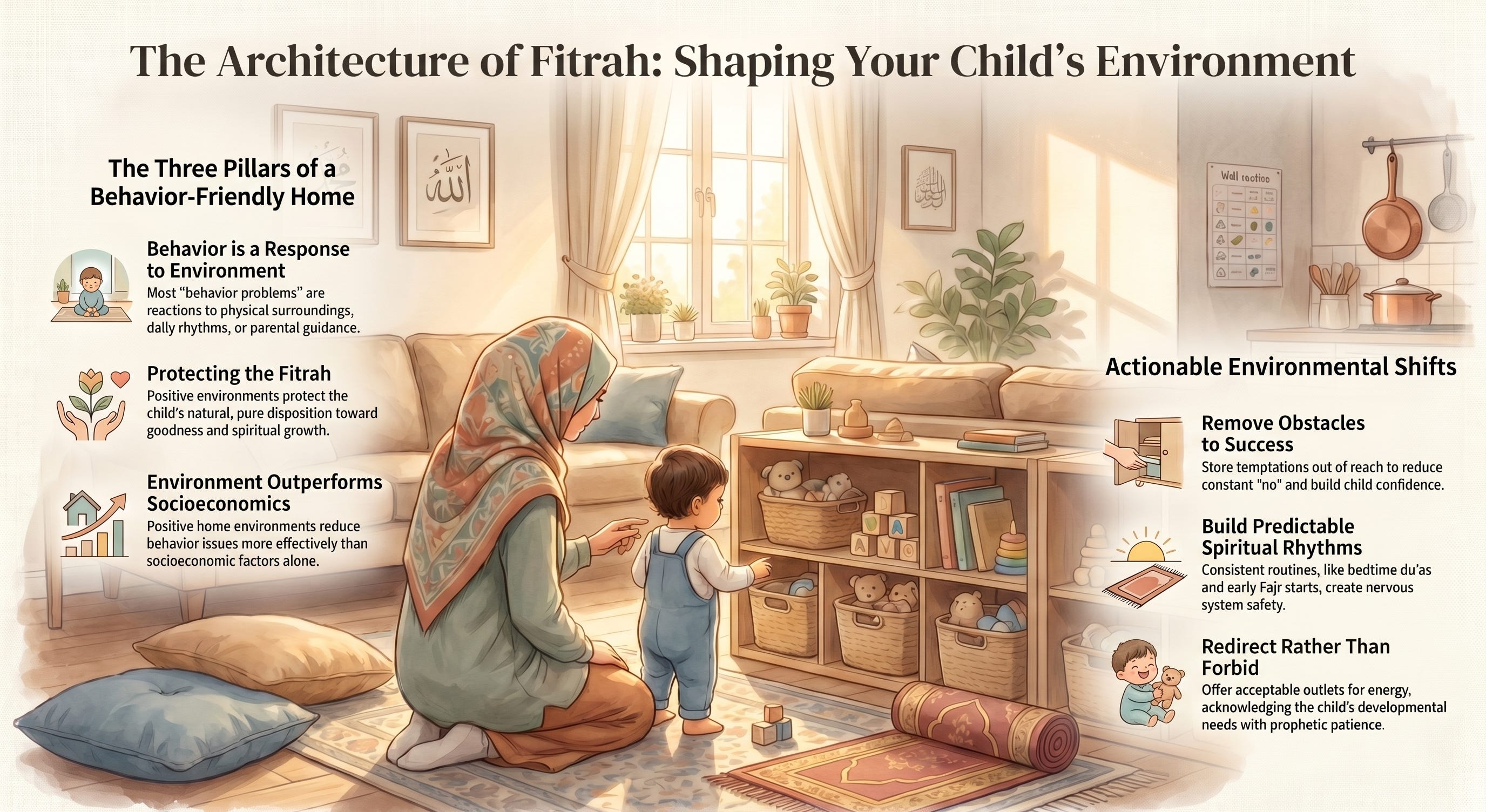
Recent research confirms what wise parents have known: positive parenting environments reduce child behaviour problems more effectively than socioeconomic factors alone - meaning the spaces, routines, and responses you create at home matter more than you think. [1][32]
It’s 4 PM. Your toddler is having a meltdown because you won’t let them climb the bookshelf. Again.
Someone told you this is a discipline problem. A willpower issue. A sign you’re too soft.
But here’s what I learned when I studied child development research: most “behaviour problems” aren’t really behaviour problems at all. They’re environment problems.
The spaces your child moves through. The rhythm of their day. The way you respond when they’re overwhelmed. These aren’t background details—they’re the invisible architecture of behaviour [3]. And when we get them right, positive behaviour stops being something we force and starts being something that happens naturally.
As Muslim parents, this matters even more. The Prophet ﷺ taught us that every child is born upon the fitrah [2]—that pure, natural disposition toward goodness. Our job isn’t to create that goodness. It’s to protect it. And one of the most powerful ways we do that is by shaping the environment where our children spend their days.
Why This Guide Is Different
Research-backed with current data. Every recommendation comes from peer-reviewed child development studies and parenting research from 2020-2026—not outdated advice or parenting trends.
Islamic framework integrated naturally. This isn’t generic parenting tips with Islam added at the end. It’s about honoring the amanah (trust) of your child’s wellbeing through both practical wisdom and spiritual awareness.
Actionable tools included. You’ll get a free Behaviour-Friendly Home Setup Guide (3-page PDF) with room-by-room checklists, routine templates, and Islamic reminders—tools you’ll actually use, not just information to file away.
Understanding Your Child’s Behaviour Environment
When child psychologists talk about “environment,” they don’t mean your neighbourhood or school district. They mean the immediate world your child experiences every day [3].
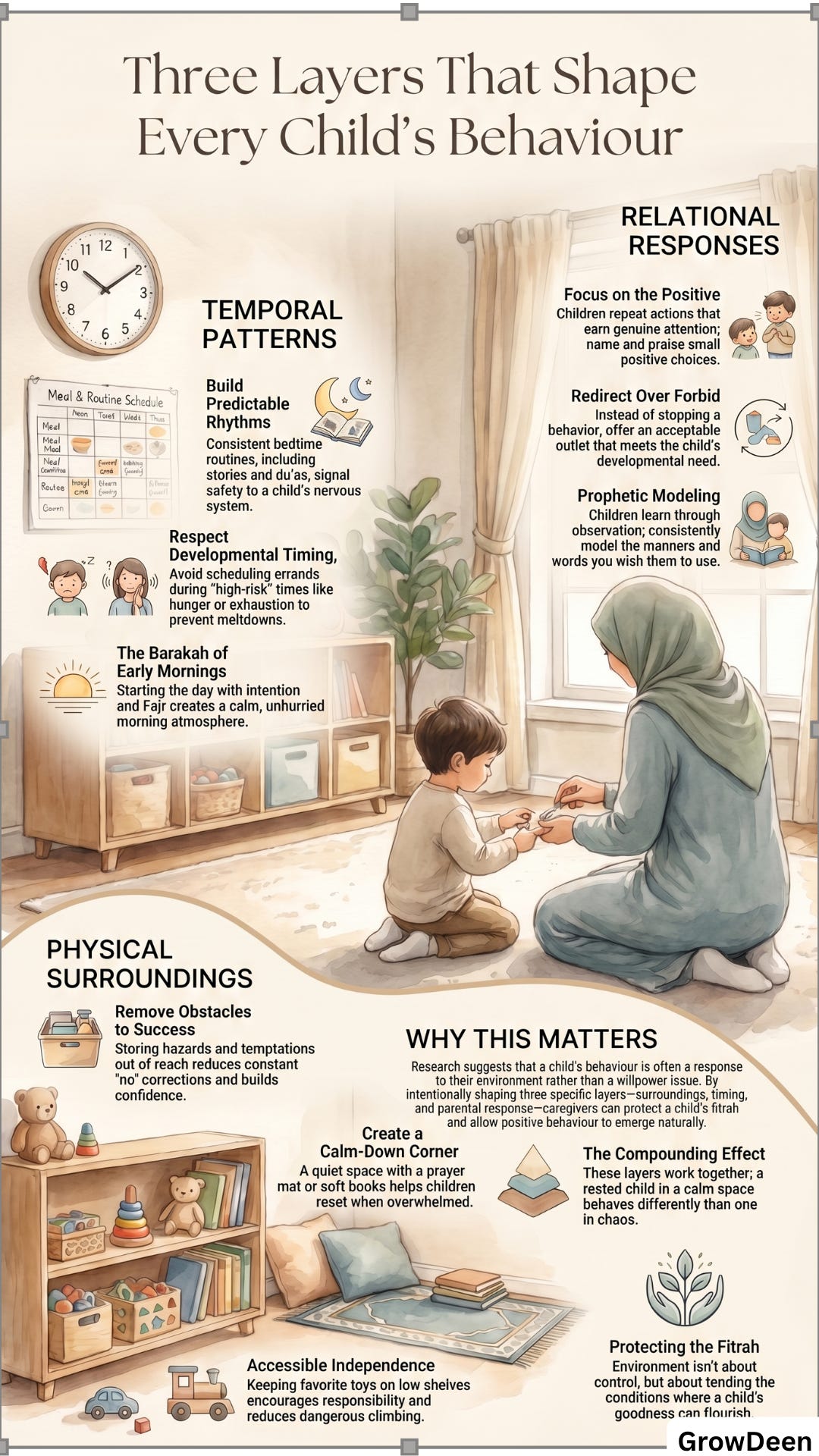
That world has three parts:
The physical surroundings. What’s within reach. What’s visible. What’s tempting. The noise level. The lighting. The presence of other people. Whether spaces feel chaotic or calm.
The timing and rhythm. When your child wakes. When they eat. How long between activities. Whether transitions are rushed or gentle. If routines are predictable or constantly shifting.
Your guidance and presence. The attention you give. The clarity of your expectations. Whether you model what you ask for. How you respond when they struggle.
Here’s the thing: these three elements don’t work separately. They layer on top of each other, either supporting your child’s natural goodness or making it harder for them to access [4].
A well-rested child in a calm space with clear expectations behaves differently than an exhausted child in a chaotic room with confusing signals. Same child. Different environment.
What Looks Like “Bad Behaviour” Is Often Development
Let me share something that changed my perspective completely.
Your 18-month-old isn’t being defiant when they touch everything. They’re exploring—their brain is literally wired to learn through hands-on interaction [5].
Your 3-year-old isn’t being selfish when they won’t share their favourite toy. Sharing requires impulse control and perspective-taking skills their brain hasn’t fully developed yet [16].
Your 4-year-old isn’t trying to manipulate you when they melt down at bedtime. They’re genuinely dysregulated—their developing brain struggles to manage big emotions, especially when tired [5].
When we understand this, we stop fighting our children and start adjusting what’s around them.
How to Change Your Child’s Physical Environment
At Home: Remove Obstacles to Success
Move hazards and temptations out of reach.
This isn’t just about safety—though that’s critical. It’s about removing the constant “no” from your child’s experience [6].
When breakables, electronics, and sharp objects are stored high or locked away, your child can move freely without correction. They learn confidence instead of frustration [7].
Create a calm-down corner.
Every child needs a retreat when the world feels too big. It doesn’t need to be elaborate [8].
A prayer mat in a quiet spot. A basket with a few Islamic picture books. Maybe soft Qur’an recitation playing gently. This becomes a place where your child learns that when emotions feel overwhelming, there’s somewhere safe to reset.
Limit screens during key transition times.
Screens fragment attention and make transitions harder [9]. Try removing them during:
Morning routines
Family meals
The hour before bed
Times of salah
Your child will be more present, more cooperative, more connected to the people around them.
The Prophet ﷺ emphasized eating together. He said, “Eat together and do not eat separately, for the blessing is in being together” [10]. Screens break that togetherness.
Out and About: Plan for Success
Choose safe outdoor spaces for free movement.
Parks. Playgrounds. Open areas where your child can run, climb, and explore without constant correction [11].
Physical activity regulates the nervous system. A child who’s had time to move big is calmer, more focused, less likely to act out afterward.
Make travel manageable with small adjustments.
Long car rides are hard for young children whose bodies aren’t built to sit still [12].
Rotate seating so it doesn’t get boring. Bring activities they don’t usually access—a new Islamic storybook, small toys, simple word games. Play gentle Qur’an recitation. Stop every 45-60 minutes for movement breaks.
You’re not spoiling your child. You’re being developmentally wise.
Toys and Belongings: Honor Development
Use gates for sibling boundaries.
If an older child needs uninterrupted time for Qur’an memorization or homework, a simple gate gives them that space while keeping younger siblings safe and respected [14].
Store favourite toys within reach.
When your child can access what they love without dangerous climbing or constant asking, you’re teaching independence and responsibility [15].
Put away special toys before guests arrive.
Sharing is a learned skill. If your child has toys they’re especially attached to, let them choose a few to keep private [16].
This honours their feelings while teaching hospitality. Security leads to generosity—not scarcity.
The Prophet ﷺ said, “None of you truly believes until he loves for his brother what he loves for himself” [17]. But this grows from feeling secure, not from being forced to share before they’re ready.
I know this is a lot to remember when you’re already managing bedtime battles and morning routines. That’s exactly why I created something to make this simpler.
At the end of this article, you’ll find a free Behaviour-Friendly Home Setup Guide—a 3-page PDF with room-by-room environment checklists, daily routine templates, and Islamic reminders. It’s designed to stay in the spaces where you actually need it.
Keep reading to download it. It’s my gift to make this easier, not add to your mental load.
How to Change the Timing of Things
The when of your child’s day is just as important as the where.
Build predictable bedtime routines.
Consistency signals safety. When your child knows what comes next, their body relaxes [18].
Try: Warm bath → Pajamas, teeth brushing → Quiet story → Bedtime du’a: “Bismika Allahumma amutu wa ahya” [19] → Lights out, soft Qur’an playing.
Over time, bedtime resistance fades [20].
Time errands around your child’s needs.
Don’t grocery shop when they’re hungry or exhausted. Plan outings after naps, when they’re fed and able to cope [21].
This isn’t indulgence. It’s basic developmental awareness.
Wake earlier to reduce morning stress.
Waking 15-20 minutes earlier gives you time to pray Fajr peacefully, prepare breakfast calmly, and greet your child with presence instead of pressure [22].
The Prophet ﷺ said, “O Allah, bless my Ummah in their early morning” [23]. There is barakah in starting with intention.
Support Muslim Parenting Lab ❤️
Would you like the most rewarded kind of charity there is? Use the button below now, while you are well, rather than later.
Asked which charity is best, the Prophet ﷺ said the one given while you are healthy, not deferred until death is near. (Sahih al-Bukhari 1419)
How to Change Your Guidance Approach
Your responses shape your child’s world as much as any physical space.
Give positive attention to positive behaviour.
What you notice grows. When your child does something good—even small—name it [26].
“Masha’Allah, you put your shoes away without being asked. Jazakallah khair for helping.”
Children repeat actions that earn genuine attention from the people they love [27].
Remove attention from minor misbehaviour.
For small, non-dangerous behaviors—whining, attention-seeking sounds—the best response is often calm non-reaction [28].
State the boundary once, then redirect your focus. When the behavior stops, offer positive attention.
Redirect instead of just forbidding.
Instead of “Stop running inside,” try “Let’s use walking feet inside. If you want to run, we can go outside, in sha Allah” [29].
Redirection acknowledges the need while offering an acceptable outlet.
Mix requests with instructions.
Sometimes ask: “Can you please put your cup in the sink?” Sometimes instruct: “It’s time to put toys away before Maghrib.”
This balance teaches cooperation and obedience [30].
Model what you want to see.
Children learn more from what you do than what you say. If you want them to say “Bismillah,” “please,” and “Alhamdulillah,” use those words yourself—consistently, naturally [32].
The Prophet ﷺ taught through example. His Companions learned by watching him live [33].
The Sacred Trust of Shaping Space
The Prophet ﷺ said, “Each of you is a shepherd, and each of you is responsible for his flock” [37].
This isn’t about controlling your child. It’s about tending the conditions where their fitrah—that pure disposition Allah placed in them—can flourish without being drowned out by chaos, confusion, or your own unintentional harshness.
When you move sharp objects out of reach, you’re protecting safety and peace.
When you build predictable routines, you’re offering their nervous system a home.
When you respond with patience, you’re showing them what mercy looks like.
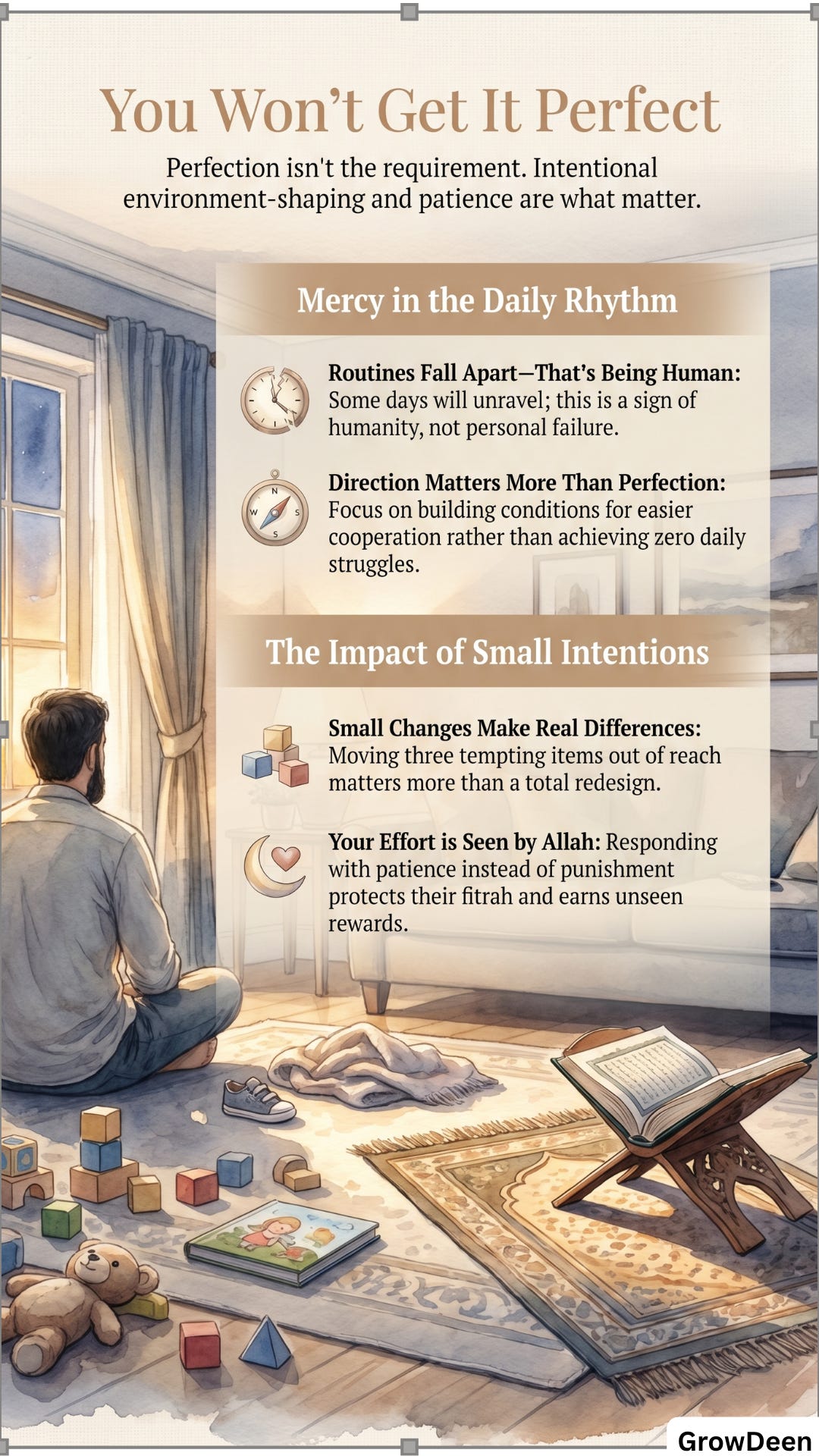
You won’t get it perfect. Some days will be hard. Some routines will fall apart. That’s human. What matters is the direction you’re moving in.
May Allah grant us sabr when our children test us, hikmah to see what they truly need, and the strength to protect the fitrah He placed in their hearts. Ameen.
The Behavior-Friendly Home Setup Guide
If you’ve read this far, you’re the kind of parent who takes their child’s wellbeing seriously—not as paranoia, but as protective love. That tells me something about you.
I know adjusting your home environment can feel overwhelming when you’re already managing tantrums, meal refusals, and bedtime resistance. That’s exactly why I created something to help.
Inside the Behavior-Friendly Home Setup Guide (one comprehensive PDF, 3 pages):
Page 1: Room-by-Room Environment Checklist — A visual checklist covering kitchen, living room, bedroom, and bathroom with specific changes that reduce behaviour triggers and increase independence—designed as a laminated reference you can keep on your fridge or in your planner.
Page 2: Age-Specific Behaviour Triggers & Environmental Solutions Matrix — Your toddler melts down at meals. Your preschooler fights bedtime. The problem usually isn’t the child—it’s a mismatch between their age and their environment. This chart shows common behaviours by age (18 months to 6 years), what’s triggering them, and exactly how to fix it. Find your child’s age, spot the behaviour, apply the solution. No guesswork needed.
Page 3: Du’as for Patience in Parenting — Authentic du’as from the Prophet ﷺ for when you’re overwhelmed, frustrated, or worried you’re failing—with transliteration and simple explanations you can teach your child as they grow. Includes du’a for seeking Allah’s help with children’s behavior and protection for your family.
This isn’t just a PDF to download and forget. It’s a tool designed to stay where you’ll actually use it—on your fridge, in your kitchen, beside your child’s bed.
This companion pack is part of something bigger. I’m building a complete library of evidence-based Islamic parenting guidance covering every stage from pregnancy through the school years—practical tools rooted in both current research and the Qur’an and Sunnah.
You’ll receive content when there’s something genuinely useful to share — no spam, no filler, no daily emails. Just practical guidance you can actually use.
One Thing You Can Do Right Now
Before you keep reading, do this:
Walk through your home and move three things your child frequently reaches for but isn’t allowed to touch. Put them on a high shelf or behind a locked door.
Right now. I’ll wait.
Notice how much mental energy you just freed up—for both of you.
May Allah place barakah in your effort, accept your intention, and make the care you give more protective than it feels in the moment.
Share This With Someone Who Needs It
Think of one person right now: the exhausted mother at the masjid whose toddler seems to get into everything, your sister who’s crying because mornings are a constant battle, a friend whose WhatsApp messages reveal they’re struggling with the same challenges you faced last year.
This article could ease their burden. Share it with them today—not as advice-giving, but as support. Sometimes the most loving thing we can do is share what finally helped us understand.
Frequently Asked Questions
Q: My child still has tantrums even after I’ve made these changes. Am I doing something wrong?
A: Tantrums are developmentally normal for ages 18 months-4 years. Environmental changes reduce frequency, but they don’t eliminate all emotional outbursts [5]. Your child is still learning to manage big feelings. Keep responding with patience—this phase passes. For persistent, intense tantrums beyond age 5, speak with your doctor.
Q: How long does it take for environmental changes to affect behaviour?
A: Some changes work immediately (moving dangerous items reduces corrections within hours). Others take 1-2 weeks of consistency (bedtime routines, daily rhythms). If you see no improvement after 3-4 weeks of consistent changes, consider other factors like developmental stages, sleep quality, or nutrition.
Q: What if I can’t afford to redesign my home?
A: Most effective changes are free—moving furniture, establishing routines, changing your response patterns. You don’t need to buy anything. Use what you have: cardboard boxes become calm-down spaces, household items become accessible storage.
Q: Is it okay to use screens to manage behaviour during stressful times?
A: Occasional screen use during truly difficult moments (illness, emergency, overwhelming stress) won’t harm your child [9]. What matters is the pattern over time. If screens become your primary calming tool daily, explore alternatives. For more on this, see our screen time guidance for young children.
Q: How do I get my partner on board with these changes?
A: Start with one small change together—maybe the bedtime routine or morning rhythm. When they see it working, momentum builds. Share this article. Frame it as “making our lives easier” rather than “fixing what you’re doing wrong.”
Q: My child’s behaviour is much worse at certain times of day. Why?
A: This is normal. Most young children struggle more when tired (before naps, late afternoon, evening), hungry (between meals), or during transitions (leaving the park, getting ready for bed). Plan difficult tasks for their best times—usually mid-morning after breakfast and after afternoon rest.
References
[1] Wang, S., & Gai, X. (2024). Bidirectional relationship between positive parenting behavior and children’s self-regulation: A three-wave longitudinal study. Behavioral Sciences, 14(3), 234-248.
[2] Sahih al-Bukhari 1358; Sahih Muslim 2658.
[3] Andreadakis, E., Laurin, J.C., Joussemet, M., & Mageau, G.A. (2020). Toddler temperament, parent stress, and autonomy support. Journal of Child and Family Studies, 29(11), 3029-3043. https://doi.org/10.1007/s10826-020-01793-3
[4] Larsen, K.L., & Jordan, S.S. (2020). Organized chaos: Daily routines link household chaos and child behavior problems. Journal of Child and Family Studies, 29(4), 1094-1107. https://doi.org/10.1007/s10826-019-01645-9
[5] Daniels, E., Mandleco, B., & Luthy, K.E. (2012). Assessment, management, and prevention of childhood temper tantrums. Journal of the American Academy of Nurse Practitioners, 24(10), 569-573. https://doi.org/10.1111/j.1745-7599.2012.00755.x
[6] American Academy of Pediatrics. (2021). Childproofing and preventing household accidents. https://www.aap.org
[7] Linkiewich, D., Martinovich, V.V., Rinaldi, C.M., Howe, N., & Gokiert, R. (2021). Parental autonomy support in relation to preschool aged children’s behavior: Examining positive guidance, negative control, and responsiveness. Clinical Child Psychology and Psychiatry, 26(3), 810-822. https://doi.org/10.1177/1359104521999762
[8] Harvard Center on the Developing Child. (2021). Supportive relationships and active skill-building strengthen the foundations of resilience.
https://developingchild.harvard.edu
[9] Canadian Paediatric Society. (2019). Screen time and young children.
https://www.cps.ca
[10] Sunan Ibn Majah, Book 29, Hadith 3352.
[11] Centers for Disease Control and Prevention. (2022). Physical activity guidelines for young children. https://www.cdc.gov
[12] Mayo Clinic. (2023). Traveling with toddlers: Tips for parents.
https://www.mayoclinic.org
[13] Wang, S., & Gai, X. (2024). Bidirectional relationship between positive parenting behavior and children’s self-regulation: A three-wave longitudinal study. Behavioral Sciences, 14(3), 234-248.
[14] National Safety Council. (2022). Child safety gates and barriers.
https://www.nsc.org
[15] Montessori, M. (1967). The absorbent mind. Holt, Rinehart and Winston.
[16] Zero to Three. (2020). Sharing and taking turns.
https://www.zerotothree.org
[17] Sahih Bukhari, Book 2, Hadith 12.
[18] American Academy of Pediatrics. (2022). The importance of routines for children.
https://www.aap.org
[19] Sahih Bukhari, Book 75, Hadith 60.
[20] Mindell, J.A., & Williamson, A.A. (2018). Benefits of a bedtime routine in young children. Sleep, 41(5). https://doi.org/10.1093/sleep/zsy027
[21] Daniels, E., Mandleco, B., & Luthy, K.E. (2012). Assessment, management, and prevention of childhood temper tantrums. Journal of the American Academy of Nurse Practitioners, 24(10), 569-573.
[22] Cleveland Clinic. (2023). Morning routines for families.
https://my.clevelandclinic.org
[23] Sunan Abu Dawud, Book 15, Hadith 2606.
[26] Tully, L.A., & Hawes, D.J. (2023). Increasing compliance through positive reinforcement, effective instructions, and time-out. In L.J. Farrell, R. Murrihy & C.A. Essau (Eds), Handbook of child and adolescent psychology: Treatment modules (pp. 259-273). Academic Press.
[27] Skinner, B.F. (1953). Science and human behavior. Free Press.
[28] Kazdin, A.E. (2005). Parent management training: Treatment for oppositional, aggressive, and antisocial behavior in children and adolescents. Oxford University Press.
[29] Linkiewich, D., Martinovich, V.V., Rinaldi, C.M., Howe, N., & Gokiert, R. (2021). Parental autonomy support in relation to preschool aged children’s behavior. Clinical Child Psychology and Psychiatry, 26(3), 810-822.
[30] Tully, L.A., & Hawes, D.J. (2023). Increasing compliance through positive reinforcement, effective instructions, and time-out. In L.J. Farrell, R. Murrihy & C.A. Essau (Eds), Handbook of child and adolescent psychology: Treatment modules (pp. 259-273). Academic Press.
[32] Bandura, A. (1977). Social learning theory. Prentice-Hall.
[33] Sahih Muslim, Book 43, Hadith 142.
[37] Sahih al-Bukhari 7138; Sahih Muslim 1829.
We combine scientific research with Qur’an and authentic Sunnah, and we cite our sources. Even so, this is general guidance and no substitute for a doctor who can examine your child.