


The number that changes everything: According to the American Academy of Pediatrics, 1 in 3 girls and 1 in 20 boys will experience sexual abuse or assault by age 17. [1] AAP physicians are direct about why this matters this early: children who feel a sense of control over their own bodies are measurably less likely to become targets and far more likely to tell someone if something does happen. [1]
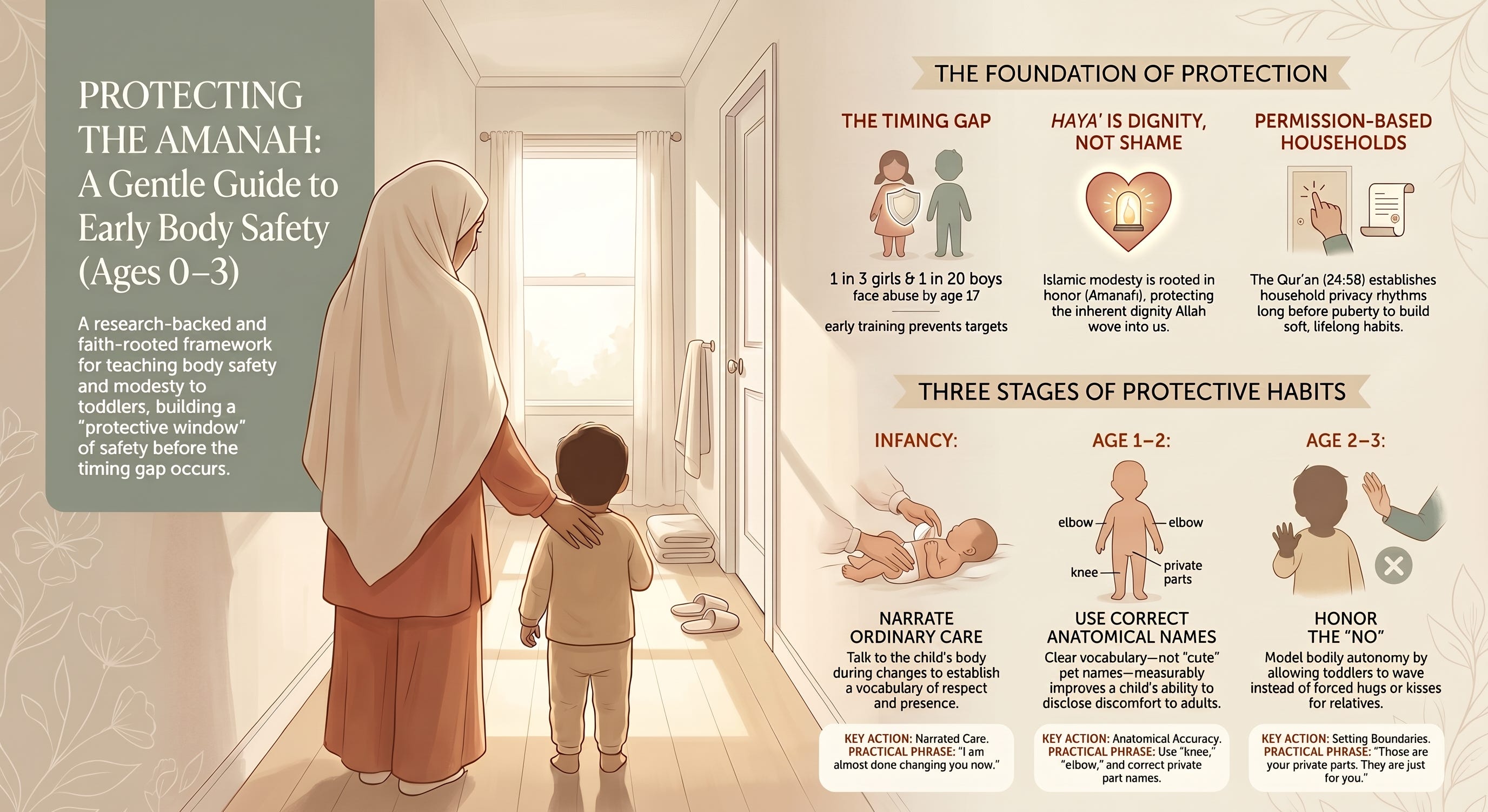
Most parents teach a toddler to say please, to wash their hands, to look both ways before crossing a street. Far fewer teach them something just as protective, just as early: that their own body belongs to them, and that they’re allowed to say no to an unwanted touch — even from someone they love.
If that made you a little uneasy, that’s completely normal, and it doesn’t mean anything is wrong with you. Many of us grew up in homes where bodies, privacy, and touch simply weren’t discussed out loud, and approaching it now, with our own children, can feel like wading into water with no map.
Here’s the question worth sitting with for a moment, though: if we don’t teach our children this, gently and at the right age, who or what ends up filling that silence instead? Staying quiet doesn’t protect a child from confusion about their own body — it just leaves that space open for someone or something else to define it for them, and not always safely. The real choice isn’t between discussing this and staying neutral. It’s between guiding our children ourselves, with care, or leaving that ground open to misguidance.
That timing gap is exactly what’s costing us. Most families don’t start these conversations until preschool, well past the age when the foundational habits could already be in place. This guide walks through how to build that foundation between birth and age three, using pediatric research alongside the privacy and modesty Islam has asked of parents for fourteen centuries.
Why This Guide Is Different
1. Backed by research spanning pediatrics and child-safety science, not opinion. Every recommendation here comes from the American Academy of Pediatrics, the CDC, and peer-reviewed child-safety studies [1][3][4][5] — not general “talk to your kids” advice. We looked specifically at the research on why correct body-part vocabulary measurably improves a child’s ability to disclose discomfort, not just the fact that it does [4][5].
2. An Islamic framework that was never borrowed — it was already there. This isn’t science with a Qur’anic quote added afterward. Islam built early privacy and modesty training into family life, instructing households to teach even young children to seek permission and understand covering long before puberty makes it formally required [Qur’an 24:58; 7:26]. We show you exactly where that framework and the pediatric research land in the same place.
3. A companion pack designed to be used, not just downloaded. You’ll get The Little Amanah Companion Pack — an age-by-age script card with exact phrases, a simple visual guide for who’s allowed to help with private-area care, and a haya’ reflection card — built for the actual moments that come up, not abstract advice you’ll forget by Thursday.
Why the First Three Years Matter More Than You’d Guess
Children who grow up knowing the correct names for their body parts, and who understand early that their body belongs to them, are measurably harder to target — and far more likely to speak up if something does go wrong [2][6]. Researchers studying disclosure interviews found something specific: children who could accurately name body parts gave clearer, more usable accounts when something concerning happened, which mattered both for their own safety and for how seriously adults around them took it [4]. A separate review of what actually helps children come forward found that clarity and an established habit of open conversation, not fear-based warnings, were the strongest predictors of a child telling someone [5].
The CDC frames this plainly: childhood sexual abuse is preventable, and prevention is mainly the work of the adults building a safe, stable environment — not a burden placed on the child [3]. None of this requires fear. It requires consistency, started early.
Building the Habit, Stage by Stage
Infancy. A newborn understands no words yet, but she registers tone and rhythm constantly. Narrate ordinary care moments — “almost done changing you” — not because she needs the information yet, but because you’re building a vocabulary you’ll need fluent later, and starting a pattern of talking to her body instead of just handling it.
One to two years. Language arrives, and correct anatomical names fold naturally into bath time alongside “knee” and “elbow.” Skip the cute substitute words — they only add a translation step later, at the exact moment translation helps least [6]. This is also the age to model, not yet teach, that affection is offered, not owed. When a toddler pulls back from a hug, a parent can say lightly, “She’s not feeling huggy today — wave instead?” A child has just watched her “no” get honored.
Two to three years. More words, often blunter questions. Introduce, without ceremony, that some parts of the body are private — the parts covered by clothing — language that lines up directly with how the Qur’an frames it: Allah gave human beings clothing specifically to cover their private parts, in addition to its role as adornment [Qur’an 7:26]. A simple recurring line does most of the work: “Those are your private parts. They’re just for you.” If curiosity shows up, match your tone to the moment the way you would for “that’s hot, don’t touch” — matter-of-fact, not alarmed.
What Tends to Undermine This
Forced affection is the most common one. Every time a child’s “no” to a hug gets overridden so a relative isn’t disappointed, the child absorbs a quiet, contradictory lesson. Pet names for private parts feel gentler and cause real confusion later. And a sharp or shocked reaction to body curiosity teaches the opposite of haya’ — it teaches shame, when haya’ is rooted in honor, not fright.
Worth knowing: Islam doesn’t treat this as a one-time toddler lesson, either. The same logic of age-appropriate privacy training continues as children grow — by around age ten, traditional Islamic guidance has parents giving each child their own separate sleeping space [Sunan Abi Dawud 495], the same principle you’re starting now, just maturing alongside your child.
I know this is a lot to hold onto while you’re also managing diaper changes, meals, and a toddler who never stops moving. That’s why I created The Little Amanah Companion Pack — a script card with exact phrases for each age, a simple visual guide for who’s allowed to help with private-area care, and a haya’ reflection card you can keep nearby. Keep reading to download it at the end — it’s built for the moments this actually comes up, not just for reading once and forgetting.
The Sacred Trust Of A Child’s Body — What Islam Teaches About Privacy And Honour?
Every child placed in our care arrives as an amanah — a trust we did not create and do not fully own. That trust extends to something as ordinary as how we speak to a toddler about her own skin.
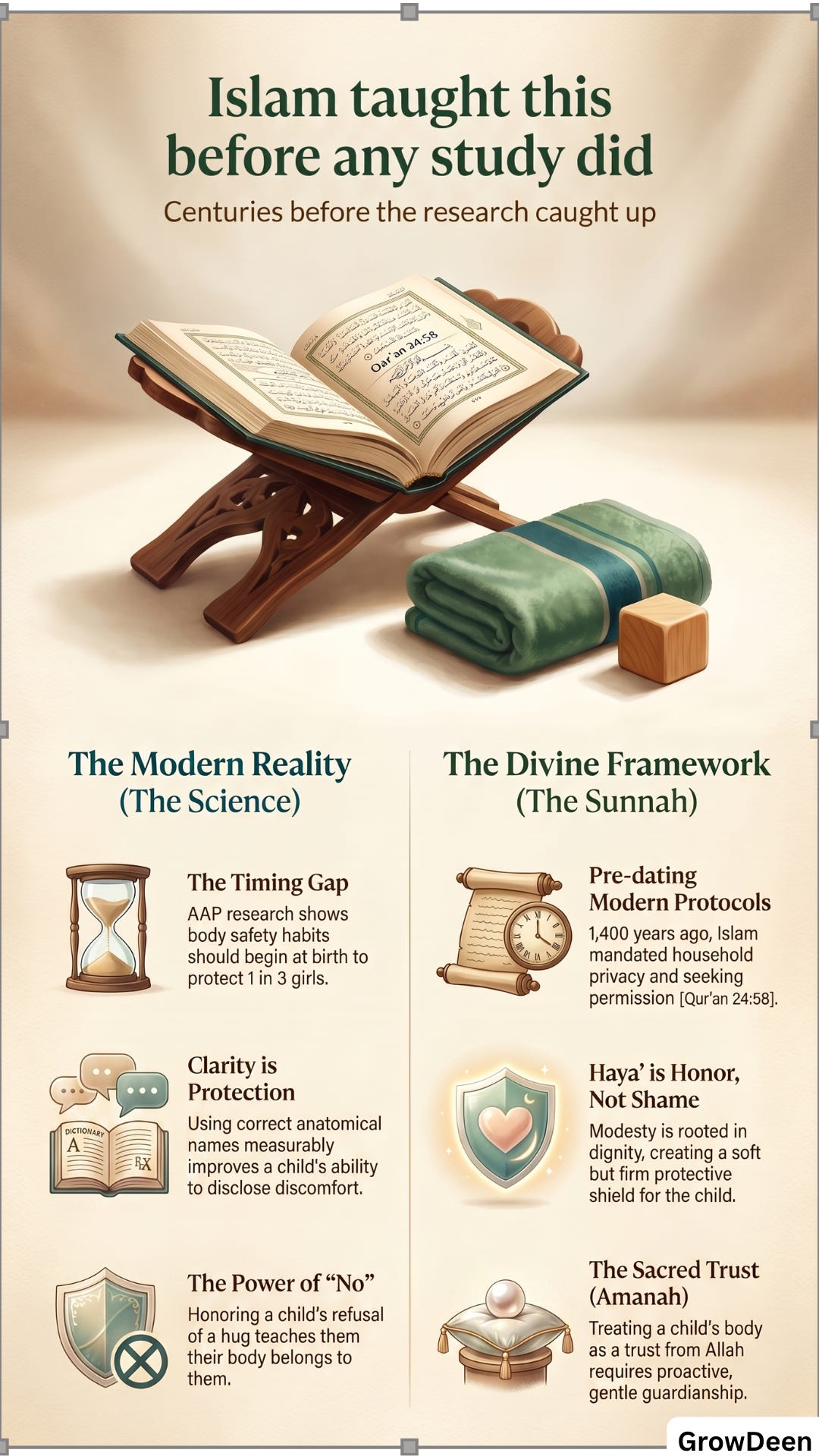
When I read the verse in Surah An-Nur where Allah instructs households to train even children below puberty to ask permission before entering certain private spaces at three set times of day [Qur’an 24:58], I’m struck by how unhurried it is. According to Tafsir Ibn Kathir, the instruction exists because a parent might be resting or undressed during those hours — and it builds a household rhythm of privacy a child is trained into well before puberty makes it required. Allah didn’t wait for the “right age.” He built the habit in early, while the lesson could stay soft.
That same softness runs through something the Prophet ﷺ once said. He passed a man rebuking his brother for being “too” shy, and corrected him: leave him, for haya’ — modesty — is part of faith [Sahih al-Bukhari 9; Sahih Muslim 36]. Haya’ here isn’t shame. It’s the dignity Allah wove into us — the same dignity we protect when we teach a two-year-old that certain parts of her body are simply, quietly, hers.
What’s striking is how closely this lines up with where pediatric research has landed centuries later: clarity protects, shame doesn’t [1][2]. Islam reached the same conclusion long ago, in the language of mercy rather than statistics. May Allah make us gentle enough to teach this without fear, and wise enough to start early.
Your Companion Pack
If you’ve read this far, you’re the kind of parent who takes this seriously — not as paranoia, but as protective love. That tells me something beautiful about you.
Inside The Little Amanah Companion Pack (one comprehensive PDF, 3 pages):
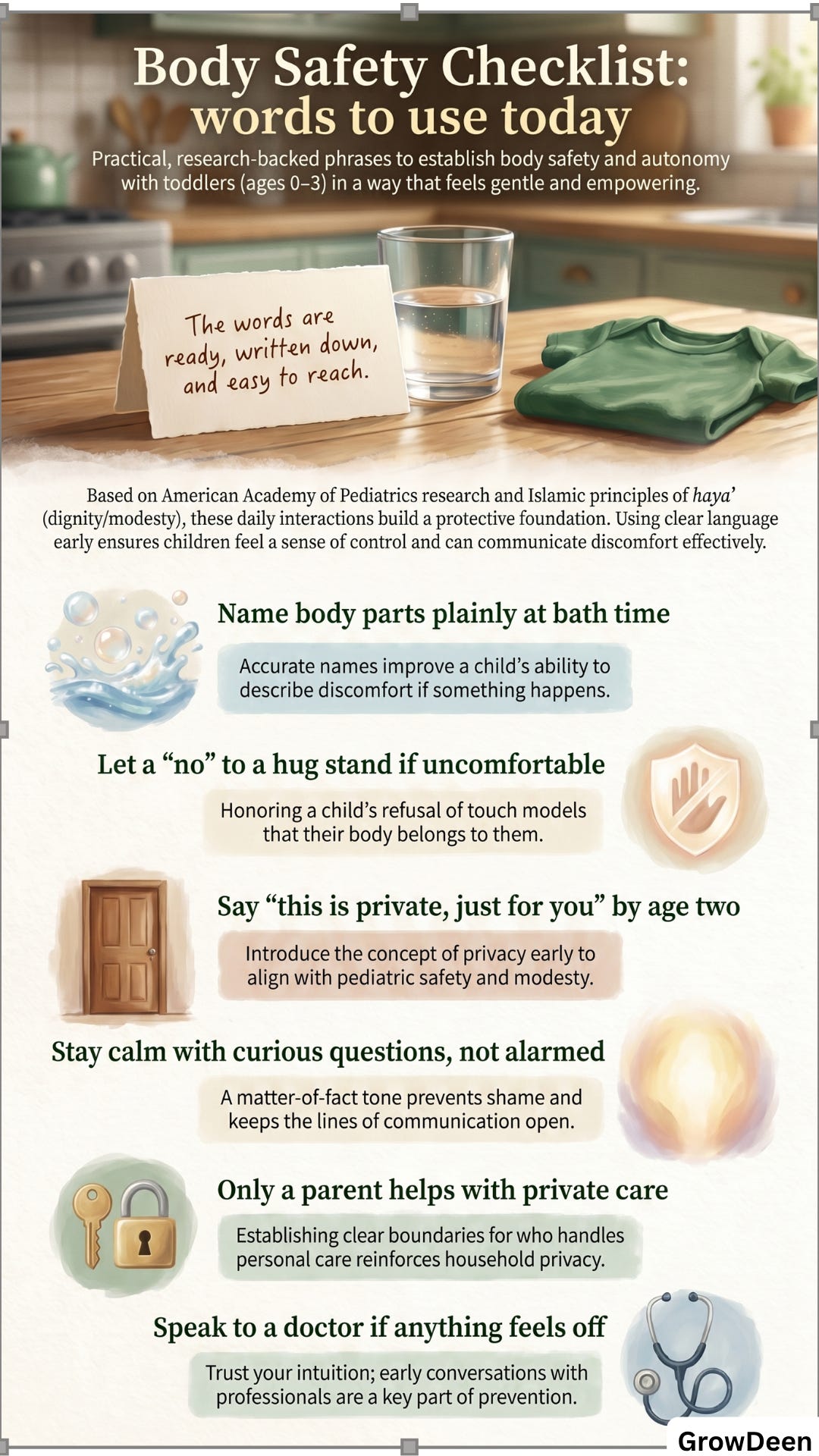
Page 1: Age-by-Age Body Safety Script Card — the exact phrases for infancy, toddlerhood, and the two-to-three stage from this guide, laid out so you never have to fumble for words mid-diaper-change — designed as a card you can keep near the changing table.
Page 2: The “Who Helps With What” Visual Guide — a simple icon-based reference (no figures, fully modest) showing who’s allowed to help with private-area care and that affection is always a choice, so you can teach this even to a child too young for full sentences.
Page 3: A Haya’ Reflection Card — the full hadith on modesty being part of faith [Sahih al-Bukhari 9; Sahih Muslim 36], with Arabic, transliteration, and a short reflection — something to anchor you spiritually before these conversations, not just a checklist.
This isn’t a PDF to download and forget. It’s built to stay in your bathroom or on your fridge — where you’ll actually reach for it.
This companion pack is what every subscriber receives with each article. We cover the full journey of raising Muslim children, all backed by research and rooted in Islamic wisdom. If you want both evidence-based guidance and Islamic perspective, subscribe for free so future resources arrive before you need them.
You’ll only hear from us when there’s something worth sharing — no spam, no daily emails, just resources that matter.
One Small Action You Can Take Right Now
Next time you change or bathe your child today, say the correct name for the body part out loud, once, in your normal voice. That’s it. That’s the start.
May Allah place barakah in your effort, accept your intention, and make the care you give more protective than it feels in this moment.
Share This With Someone Who Needs It
Think of one person right now: a new mother in your family still figuring out the basics, a sister whose toddler just started asking blunt questions in front of guests, a friend at the masjid who’s mentioned feeling lost on this exact topic.
This article could give them a place to start. Share it with them today — not because you’re being preachy, but because you care. Sometimes the most loving thing we can do is pass along guidance before it’s urgently needed.
Frequently Asked Questions
Q: What age should I start talking to my child about body safety?
A: Earlier than most parents assume — pediatric guidance points to toddlerhood, not preschool, as the right starting point, since the habit is easier to build before a child has anywhere to unlearn [1][6]. See “Building the Habit, Stage by Stage” above for exact wording by age.
Q: Is it normal for toddlers to touch themselves or be curious about other children’s bodies?
A: Yes — this is ordinary developmental curiosity, not a concern on its own. A calm, matter-of-fact redirection works better than alarm or scolding.
Q: What words should I use for private body parts?
A: Correct anatomical names, not pet names or placeholders. Research on disclosure shows clear, accurate vocabulary makes a real difference if a child ever needs to describe something [4][6].
Q: My relative gets upset when my toddler won’t hug them. What do I say?
A: Something light and firm: “She’s not feeling huggy today — maybe a wave?” The AAP explicitly supports letting children decline affection, even from grandparents, as part of teaching bodily autonomy [1].
Q: What should I do if something my child says or does worries me?
A: Don’t talk yourself out of the unease. Mention it to your child’s doctor or a qualified child-development professional. An early conversation costs almost nothing; waiting can cost a great deal.
Q: Does Islam actually say anything specific about this, or is it just general modesty?
A: It’s specific. The Qur’an instructs households to train children below puberty in asking permission and privacy [Qur’an 24:58], and separately describes clothing as given specifically to cover private parts [Qur’an 7:26] — both centuries before modern child-safety research reached similar conclusions.
Q: How is this different from just telling my child “don’t let anyone touch you”?
A: That single warning doesn’t give a child the vocabulary, the sense of ownership over their body, or the practiced habit of saying no — all three of which research and Islamic guidance both treat as the real protective factors, not the warning itself [1][2][5].
References
[1] American Academy of Pediatrics. (2023). 10 tips for parents to teach children about body safety and boundaries. AAP. https://www.aap.org/en/news-room/news-releases/health--safety-tips/10-tips-for-parents-to-teach-children-about-body-safety-and-boundaries/
[2] Bravehearts Foundation. (2025). Identifying body parts and personal safety education (Briefing Paper). Bravehearts. https://bravehearts.org.au/wp-content/uploads/2025/11/Identifying-Body-Parts-and-Personal-Safety-Education_Briefing-Paper.pdf
[3] Centers for Disease Control and Prevention. (2025). About child sexual abuse. CDC, Child Abuse and Neglect Prevention. https://www.cdc.gov/child-abuse-neglect/about/about-child-sexual-abuse.html
[4] Burrows, K. S., Bearman, M., Dion, J., & Powell, M. B. (2017). Children’s use of sexual body part terms in witness interviews about sexual abuse. Child Abuse & Neglect, 65, 226–235.
[5] Brennan, E., & McElvaney, R. (2020). What helps children tell? A qualitative meta-analysis of child sexual abuse disclosure. Child Abuse Review, 29(2), 97–113.
[6] Children’s Advocacy Centers of Pennsylvania. (2024). Teaching kids accurate names for their body parts can help keep them safe. https://penncac.org/teaching-kids-accurate-names-for-their-body-parts-can-help-keep-them-safe-heres-how/
[7] Qur’an, Surah An-Nur 24:58.
[8] Qur’an, Surah Al-A’raf 7:26.
[9] Sahih al-Bukhari 9; Sahih Muslim 36.
[10] Sunan Abi Dawud 495 (graded Hasan).