

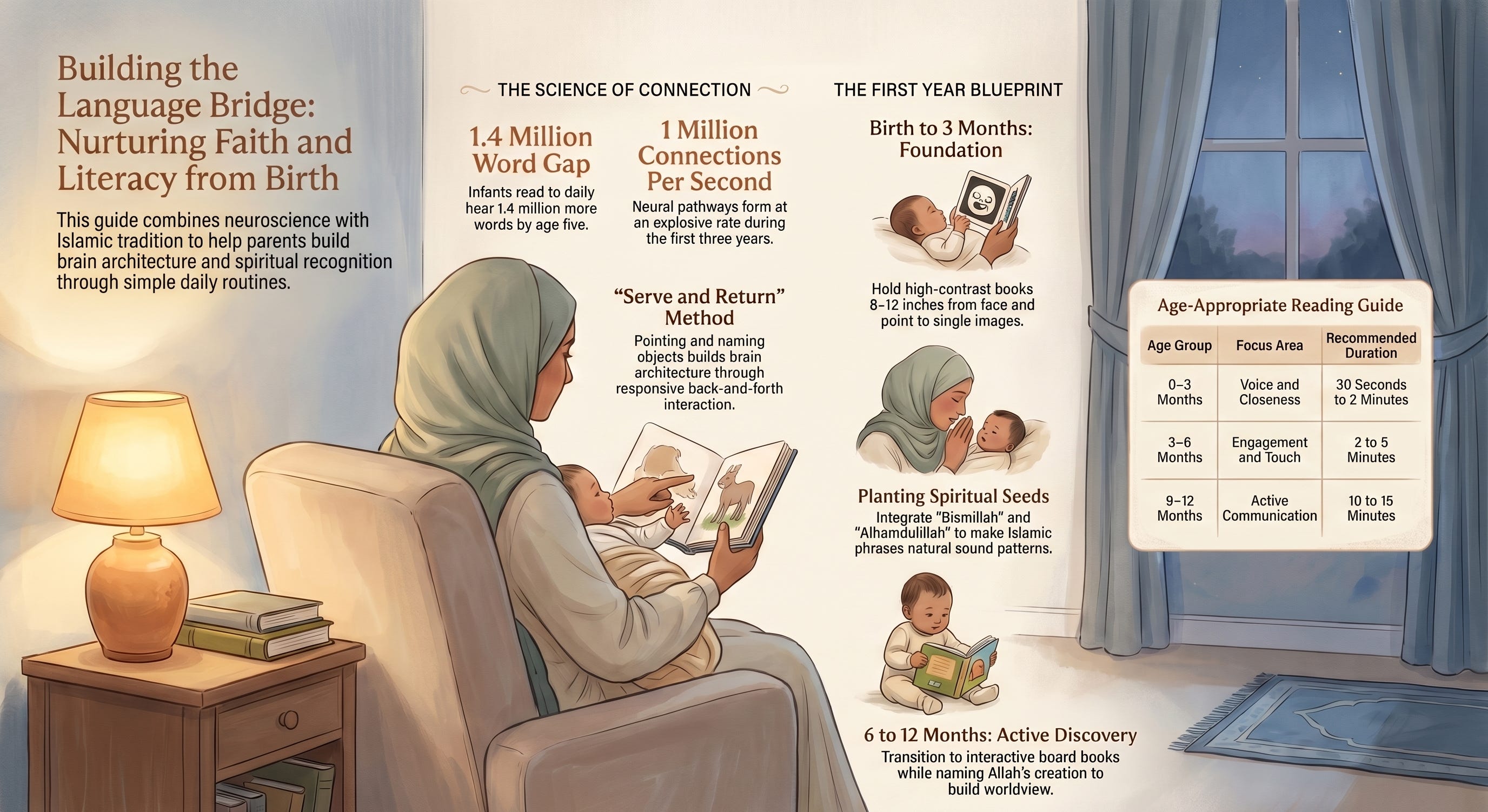
Researchers at Ohio State University discovered that children read to daily from infancy hear approximately 1.4 million more words by age 5 than those rarely read to - creating what linguists call a “language bridge” that shapes vocabulary, comprehension, and school readiness for years to come [5]. This guide shows you how to build that bridge from day one, with board books, Islamic words, and the most powerful tool you already have: your voice.
What Your Newborn Can’t See (And What They’re Absorbing Anyway)
Your baby is five days old.
They can’t focus beyond eight inches from their face. They can’t understand a single word. They don’t know what a book is, what reading means, or why you’re holding this colorful rectangle near them.
But here’s what’s happening that you can’t see:
Every time you speak, their brain is mapping sound patterns. Every time you pause, they’re learning rhythm. Every time you repeat a phrase—”Bismillah, sweet baby”—neural pathways are forming that will shape how they process language for the rest of their life.
This is why the American Academy of Pediatrics’ 2024 policy statement explicitly recommends reading aloud to babies starting at birth—not because newborns understand stories, but because the act of shared reading strengthens parent-child attachment, stimulates developing brain circuitry, and exposes infants to language-rich interaction during the most explosive period of neural growth they’ll ever experience [2].
For Muslim parents, this creates something profound: the chance to make “Allah,” “Bismillah,” and “Alhamdulillah” some of the first sound patterns your baby’s brain learns to recognize. Not through drills or flashcards, but through the warmth of your lap, the softness of your voice, and the repetition of simple moments that feel like nothing but mean everything.
Why This Guide Is Different
Built on neuroscience and attachment research. Every stage is informed by current understanding of infant brain development, serve-and-return interaction patterns, and the specific ways babies process language during their first year—not generic advice, but age-specific guidance grounded in how baby brains actually work.
Designed for the spiritual dimension you can’t ignore. Most infant literacy guides treat language development as purely cognitive. This guide acknowledges what Muslim parents know instinctively: when you hold your baby and say “Allah made you,” you’re doing something that matters beyond vocabulary—you’re planting the earliest seeds of tawakkul, gratitude, and recognition of the Creator.
Actionable tools that eliminate decision fatigue. You’ll receive the First Year Reading Blueprint—a month-by-month visual guide showing exactly which types of books work at each stage, how long to read, what to say, and how to weave Islamic language naturally into every interaction, designed to stay on your changing table where you’ll actually use it.
The Neuroscience of Why Even One Minute Matters
Here’s what researchers have discovered about infant brain development:
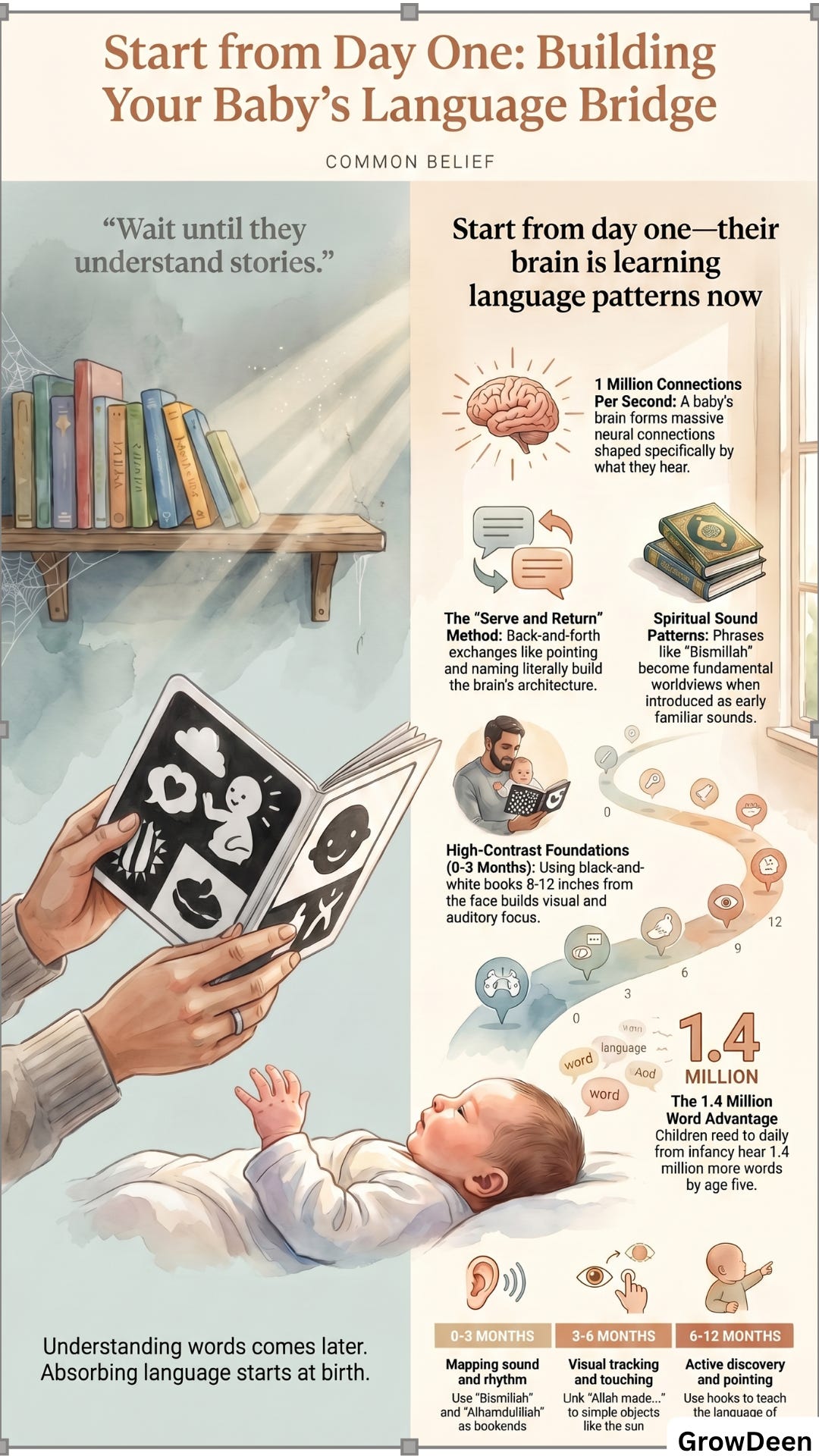
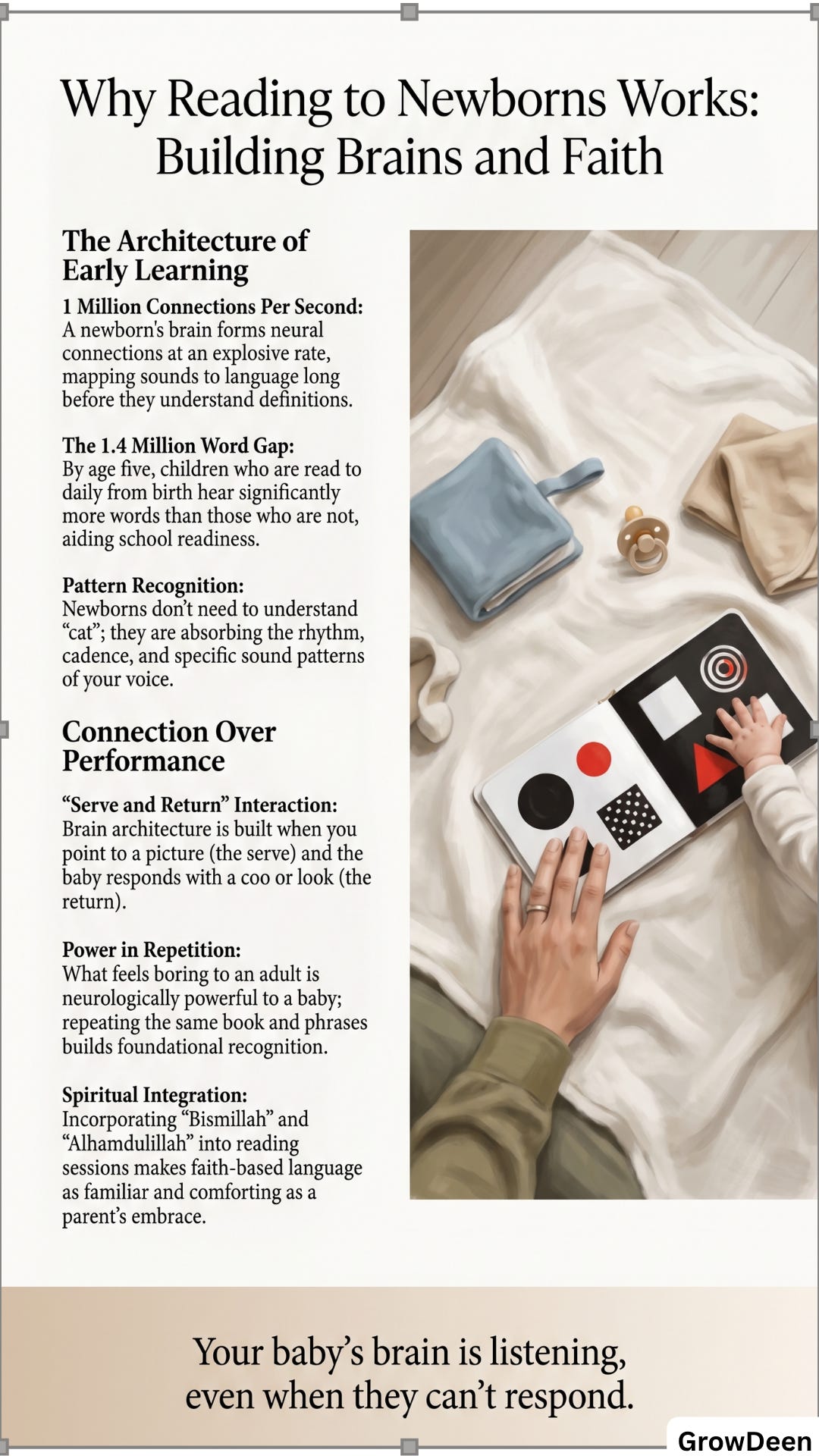
During the first three years of life, a baby’s brain forms approximately one million neural connections every second [15]. These connections aren’t random—they’re shaped by experience. By what babies hear. What they see. What they touch. And critically, by the back-and-forth exchanges they have with caring adults.
Harvard’s Center on the Developing Child calls this “serve and return”—you serve (you point to a picture and say “Look, a bird”), baby returns (they coo or look at you), you serve back (you smile and say “Yes! Allah made that bird”) [3]. This seemingly simple interaction is literally building brain architecture.
Here’s the remarkable part: when you read to your baby, even if they’re three weeks old, you’re creating optimal conditions for this serve-and-return process. The book gives you something to point at. The pictures give your baby something to track with their eyes. The rhythm of your voice creates predictable patterns. And your baby’s brain is absorbing all of it.
The Logan study that found the 1.4-million-word language bridge wasn’t just counting words—it was documenting exposure [5]. Babies who hear rich, varied vocabulary during book reading sessions are building mental dictionaries long before they can speak their first word. They’re learning that sounds have meaning, that certain syllables go together, that communication flows back and forth.
And when those sounds include “Bismillah,” “Alhamdulillah,” and “SubhanAllah”? You’re not just building a vocabulary. You’re building a worldview.
What Reading Actually Looks Like in the First Year
Birth to 3 Months: The Foundation Stage
At this age, your baby can’t hold a book, turn pages, or even focus on pictures clearly. Reading is purely about voice, closeness, and routine.
What works: Hold your baby in your arms. Choose a board book with high-contrast images (black and white works beautifully). Hold it about 8-12 inches from baby’s face. Speak slowly. Point to one image. Say one simple sentence.
Islamic integration: Begin every book with “Bismillah, we begin.” End with “Alhamdulillah, we finish.” Point to a baby’s face in a picture and say, “Allah made you.” Point to a sun and say, “Allah made the sun.” At this stage, you’re introducing Islamic words as sound patterns—they’ll become meaningful later.
Duration: 30 seconds to 2 minutes. When baby turns away or fusses, you’re done. Don’t force it.
3 to 6 Months: The Engagement Stage
Now your baby is more alert. They’re starting to reach for things, track moving objects with their eyes, and respond to your tone of voice.
What works: Choose books with large, simple images and bright colors. Let your baby touch the pages—they’re learning that books are physical objects worth exploring. Name what you see: “Cat.” “Moon.” “Baby.” Repeat words often.
Islamic integration: When you point to food, add “Bismillah before eating.” When you point to the sky, add “Allah made the sky so beautiful.” When your baby smiles at a picture, respond: “Alhamdulillah, you’re so happy!” You’re linking Islamic phrases to emotions and experiences.
Duration: 2-5 minutes. Your baby may grab the book, pat it, or try to mouth it. All of this is normal exploration.
6 to 9 Months: The Discovery Stage
This is when everything changes. Your baby now wants to do things with books—flip pages (usually several at once), bang them on the floor, chew corners, and occasionally pay attention to pictures.
What works: Invest in indestructible board books and cloth books. Let your baby lead—if they want to flip through rapidly, follow their pace. If they stop at one page for a minute, stay there and describe everything you see. Name textures: “This page is bumpy.” “This one is smooth.”
Islamic integration: When your baby touches water in a picture, say “Water comes from rain. Allah sends the rain.” When they pat an animal, say “Allah made so many different animals—cats, birds, fish.” When they babble at you, respond: “Yes! You’re talking to me, masha’Allah!”
Duration: 5-10 minutes, but it might be interrupted constantly. That’s fine. The goal is exploration, not completion.
9 to 12 Months: The Communication Stage
Your baby is now actively trying to communicate. They might point, make sounds that approximate words, bring books to you, and show clear preferences for certain books.
What works: Ask questions even though they can’t answer yet: “Where’s the ball?” “Can you find the baby?” Wait for them to point or look. When they do, celebrate: “You found it!” Let them choose between two books. Reread favorites endlessly—repetition is how they learn.
Islamic integration: Ask “Where is the masjid?” and point when they look. Say “Who made this beautiful tree?” and answer yourself: “Allah did!” When your baby brings you a book, receive it with enthusiasm: “Bismillah! Let’s read together!” You’re teaching that Islamic words are part of joyful moments.
A study on preverbal infant reading found that caregiver questions and infant engagement during reading at 10 months significantly predicted language skills at 18 months [4]—meaning these early “conversations” around books have lasting effects.
Duration: 10-15 minutes, often spread across multiple short sessions throughout the day.
A Practical Daily Reading Rhythm
You don’t need elaborate schedules. You need sustainable patterns.
Morning (2 minutes): While baby sits in high chair after breakfast, show them one board book. Point to one thing and name it. Add one Islamic word: “Apple. We say Bismillah before eating.”
Mid-morning (3 minutes): During tummy time or play time, place a cloth book near baby. Let them explore it. Narrate what they’re doing: “You’re touching the soft page. This one has a bird on it—Allah made birds.”
After afternoon nap (5 minutes): Sit on the floor together. Read one simple book slowly. Ask questions: “Where’s the baby? There they are!” End with “Alhamdulillah for our book.”
Bedtime (5-7 minutes): This is your anchor routine. Dim lights. Hold baby close. Read one calm book with gentle pictures. Recite a short surah (Al-Ikhlas or Al-Falaq). Say bedtime du’a. The Qur’an teaches that “in the remembrance of Allah do hearts find rest” [7]—your baby may not understand these words yet, but they’ll feel the peace in your voice, the calm in your body, and the safety of this predictable routine.
This totals about 15-20 minutes of reading spread across the day. That’s manageable. That’s sustainable. And according to the research, that’s enough to make a profound difference.
If you’ve read this far, I know what you’re thinking: “This sounds wonderful, but I need something I can look at when I’m exhausted at 3 AM and can’t remember what comes next.”
I built something for that exact moment—the First Year Reading Blueprint. It’s a one-page visual guide showing month-by-month exactly what to do, which books to use, and how to make Islamic language feel natural instead of forced. You’ll find it at the end of this article, designed to print and keep on your nursery wall or photograph for your phone’s home screen.
Support Muslim Parenting Lab ❤️
Would you like a small amount of yours grown into something enormous? Give what you can spare with the button below.
The Prophet ﷺ said Allah grows a charity the size of a date until it is like a mountain. (Sahih al-Bukhari 1410)
The Hidden Power of Simple Repetition
Here’s something that surprises parents: babies don’t get bored the way adults do.
When you read the same book for the twentieth time this week, you might feel like you’re losing your mind. But your baby? They’re in heaven.
Repetition is how babies learn. Each time they hear the same story, they’re:
Anticipating what comes next (building memory)
Noticing details they missed before (developing attention)
Recognizing familiar words (building vocabulary)
Feeling the safety of predictability (emotional security)
One longitudinal study tracked children from infancy through age 4 and found that the quality and quantity of shared reading in early infancy predicted vocabulary four years later [16]—meaning what you read to your 6-month-old is still shaping their language when they’re in preschool.
So when your baby hands you the same book for the fifth time today, receive it as a gift. They’re asking for exactly what their brain needs.
And when that frequently-repeated book includes Islamic words? Those words are becoming fundamental—as familiar as “mama” and “milk,” as comforting as your embrace, as automatic as breathing.
What the Qur’an Teaches About Language as a Divine Gift
The Qur’an presents language itself as one of Allah’s remarkable signs and gifts to humanity.
Allah says: “And He taught Adam the names—all of them” (Quran 2:31) [17].
Tafsir Ibn Kathir explains that this verse demonstrates that Allah honored human beings by granting them the ability to name and identify things—a capacity that distinguished Adam عليه السلام and his descendants from the angels. Language isn’t incidental to human dignity; it’s central to it.
When you sit with your baby and teach them words—”cat,” “moon,” “water”—you’re participating in this divine gift. You’re helping them develop the very capacity that makes them human.
And when you include “Allah,” “Bismillah,” “Alhamdulillah”—you’re doing something even more beautiful. You’re helping them develop the language of gratitude, the vocabulary of recognition, the words they’ll need to call upon their Creator throughout their entire life.
The Prophet ﷺ said, “The best among you are those who learn the Qur’an and teach it” [8]. For babies, “teaching” doesn’t mean formal instruction. It means making Qur’anic words and Islamic phrases part of the linguistic environment they’re growing up in—so that when they’re old enough to understand, these words don’t feel foreign or formal but familiar and beloved.
Choosing Books That Actually Work
For babies 0-6 months: High-contrast board books (black/white/red), simple face photos, touch-and-feel texture books. Islamic options: crinkle cloth books with Islamic phrases, black-and-white board books showing mosques or crescents.
For babies 6-12 months: Sturdy board books with everyday objects (food, animals, family), interactive books (lift-flap, slide, touch), books with real photos vs illustrations. Islamic options: board books about Allah’s creation, simple books about Bismillah/Alhamdulillah, Islamic routine books (wudu, salah) for parent-led reading.
What to prioritize:
Durability (babies will chew, throw, and drop these books)
Simple images (too much visual clutter overwhelms infants)
Real-world relevance (babies learn faster from familiar objects)
Appropriate sizing (small hands need books they can actually hold)
Islamic book recommendations:
“I Say Bismillah” crinkle cloth book (0-12 months) [11]
“Allah Knows All About Me” board book by Learning Roots [10]
“Baby’s First Qur’an Stories” board book by Goodword [12]
“My Touch and Feel Alif Baa Taa” sensory book by Learning Roots [14]
These aren’t paid recommendations—they’re books that combine developmental appropriateness with Islamic content without being preachy or overwhelming.
When Your Baby Seems Completely Uninterested
Some babies lie still and stare at pages for minutes.
Some babies grab books and immediately try to eat them.
Some babies look at one page then crawl away.
Some babies seem utterly indifferent to the whole enterprise.
All of this is normal. All of this is still valuable.
The baby who crawls away after 10 seconds still heard your voice for those 10 seconds. The baby who chews the book is still learning that books are safe, interesting objects. The baby who seems indifferent may surprise you three months from now by pointing to that same book and babbling with excitement.
Don’t force it. Don’t make it a battle. Don’t turn reading into stress.
If your baby consistently resists, try:
Different times of day (some babies are more receptive after naps)
Different locations (sometimes a change of scenery helps)
Different book types (try cloth books if board books aren’t working)
Shorter sessions (even 30 seconds counts)
Following their lead (let them hold the book, let them control the pace)
The goal is not perfect compliance. The goal is building positive associations so that books = comfort, reading = love, and your voice = safety.
THE FIRST YEAR READING BLUEPRINT
If you’ve read this far, you understand why reading to your baby from birth matters. Now you need how to actually do it consistently without overthinking every session.
I created the First Year Reading Blueprint because understanding the research and implementing it daily are two completely different challenges.
Inside this comprehensive 3-page PDF:
Page 1: Month-by-Month Reading Guide — A visual timeline showing exactly what your baby can do at each month (0-3, 3-6, 6-9, 9-12) and what types of reading work best at each stage, with specific examples of how to use Islamic words naturally (”At 2 months, say ‘Allah made your eyes’ while pointing to baby’s face; at 8 months, ask ‘Where is the moon?’ and celebrate when baby looks”). Designed as a single-page reference you can glance at quickly when you can’t remember if your 5-month-old is ready for lift-flap books yet.
Page 2: First Islamic Book Library Starter List — A curated collection of 12 specific board books organized by developmental stage, showing exactly which Islamic books work for which ages and why (Example: “I Say Bismillah crinkle book—0-6 months—high contrast sensory design, introduces first Islamic phrase, washable, perfect for tummy time”). Includes where to find these books (Learning Roots, Goodword, Riwaya, Amazon) and approximate prices so you can build a starter library without buying books your baby can’t use yet.
Page 3: Daily Reading Tracker with Islamic Integration — A simple weekly tracker showing four daily reading moments (morning, midday, afternoon, bedtime) with space to check off each session and note which book you read. Includes a sidebar with “Islamic Phrase of the Week” that changes weekly—one phrase to focus on incorporating naturally into all your reading sessions that week (Week 1: Bismillah, Week 2: Alhamdulillah, Week 3: Allah made...). This eliminates the decision fatigue of “what Islamic word should I use today?” and helps you build vocabulary systematically.
This isn’t theory you’ll read once and forget. It’s a reference tool designed to stay visible—on your nursery wall, on your fridge, photographed on your phone—so that when you’re holding your crying baby at midnight and can’t think straight, you can glance at it and know exactly what to do next.
This First Year Reading Blueprint is what every subscriber receives with articles I publish. We cover the complete journey of Muslim parenting—from pregnancy through school age—all grounded in research and Islamic wisdom.
You’ll only hear from us when there’s something worth your time—no daily emails, no spam, just practical tools that actually help.
One Thing You Can Do in the Next Five Minutes
Before you click away from this article: Find one book in your house. Any book with a picture. Open it to any page. Take a photo of that page with your phone.
Tonight, when you’re holding your baby before bed, pull up that photo. Point to one thing in the picture. Say its name. Add one word: “Bismillah” or “Allah made this.”
That’s it.
No pressure to do it perfectly. No need to read the whole book. Just one page, one word, one moment of connection.
Because that’s how this begins—not with a perfect library or a flawless routine, but with one parent willing to try one small thing.
May Allah make your lap a place of safety for your child, your voice a source of comfort, and these small daily moments of reading a means of building love for His words. May He grant your child a tongue that remembers Him, a heart that loves His Book, and a life illuminated by beneficial knowledge.
Share This with Someone Who Needs It
Think of one person right now: that exhausted friend who texts you at 2 AM asking “Is my baby behind?” or “Should I be doing more?”, your cousin who just had her first baby and seems overwhelmed by all the parenting advice coming at her, your sister-in-law who keeps asking you how to “make my baby smart.”
This article could remove some of that pressure and replace it with something actually doable. Share it today—not as more advice to pile on, but as permission to start small. Sometimes the kindest thing we can do is show someone that 2 minutes a day is enough.
Frequently Asked Questions
Q: Is my baby too young to benefit from reading?
A: No baby is too young. Even newborns benefit from hearing your voice, experiencing closeness, and being exposed to language patterns. The AAP explicitly recommends starting at birth [2]. Your baby won’t “understand” the story, but their brain is actively building neural pathways with every word they hear. Think of it as language exposure, not comprehension training.
Q: What if I’m not reading in my native language—should I still try?
A: Absolutely read in the language you feel most comfortable in. Research on multilingual families shows that the emotional warmth and natural communication patterns matter more than which specific language you’re using [18]. If you’re more expressive and comfortable in Urdu, read in Urdu. If English feels natural, use English. Your comfort creates better interaction, which is what actually drives language development.
Q: My baby seems more interested in chewing the book than looking at it—is this normal?
A: Completely normal, especially from 5-10 months when babies explore everything through their mouths. This is actually a developmental stage called “oral exploration”—your baby is learning about texture, taste, and how objects work by mouthing them. Choose washable board books and cloth books, let them explore, and don’t worry about it. They’re still learning that books are interesting objects worth paying attention to.
Q: How many books do I actually need?
A: For the first year, 5-8 sturdy books are enough. Babies benefit more from hearing the same book repeatedly than from having variety. The repetition helps them internalize vocabulary and story structure. Start with 2-3 board books with everyday objects, 1-2 Islamic board books, and 1-2 cloth or touch-and-feel books. You can rotate new books in as your baby grows.
Q: Should I be concerned if my baby doesn’t point to pictures when I ask questions?
A: Not yet. Pointing typically emerges around 9-12 months, and even then, some babies are slower to start. If you ask “Where’s the cat?” and your 8-month-old doesn’t respond, that’s developmentally normal. Keep asking anyway—the questions are building comprehension even before your baby can demonstrate it through pointing. If your baby isn’t pointing or responding to simple questions by 15-18 months, mention it at your pediatric checkup.
Q: Can reading replace talking to my baby throughout the day?
A: No—reading supplements conversation but doesn’t replace it. Babies need both. During reading, you’re introducing vocabulary and story structure. During everyday conversation (narrating diaper changes, describing what you’re cooking, responding to coos), you’re building social communication and back-and-forth exchange patterns. Both matter. Both build different aspects of language.
References
[1] Raising Children Network. Reading with babies from birth. Source article provided for adaptation.
[2] American Academy of Pediatrics. (2024). Literacy Promotion: An Essential Component of Primary Care Pediatric Practice. Policy statement. The AAP recommends shared reading beginning at birth, emphasizing benefits for relationships, brain development, and language-rich interaction.
[3] Center on the Developing Child at Harvard University. Serve and Return: Interaction Shapes Brain Circuitry. Responsive caregiver-child interaction builds healthy brain architecture and supports language, social, and cognitive development.
[4] Muhinyi, A., and Rowe, M. L. (2019). Shared reading with preverbal infants and later language development. Journal of Applied Developmental Psychology, 64, 101053.
[5] Logan, J. A. R., Justice, L. M., Yumuş, M., and Chaparro-Moreno, L. J. (2019). When Children Are Not Read to at Home: The Million Word Gap. Journal of Developmental and Behavioral Pediatrics, 40(5), 383-386.
[6] Qur’an, Surah Al-ʿAlaq 96:1–5. The opening revealed verses begin with the command to read or recite in the name of the Lord who created.
[7] Qur’an, Surah Ar-Raʿd 13:28. The Qur’an states that hearts find comfort in the remembrance of Allah.
[8] Sahih al-Bukhari 5027. The Prophet ﷺ said that the best among the Muslims are those who learn the Qur’an and teach it.
[9] Sahih Muslim 2699a. The hadith mentions the virtue of gathering to recite and study the Book of Allah.
[10] Learning Roots. Allah Knows All About Me. Islamic board book for young children.
[11] Riwaya. I Say Bismillah – Sunnah Foods Crinkle Cloth Book. Islamic sensory cloth book for babies 0–12 months.
[12] Goodword Books. Baby’s First Qur’an Stories. Board book introducing young children to Qur’an stories.
[13] Goodword Books. Board Books – Qur’an and Seerah Stories. Collection including Baby’s First Prophet Muhammad Stories.
[14] Learning Roots. Islamic Books for Babies: Baby Bundle. First Islamic library collection.
[15] Center on the Developing Child at Harvard University. Brain Architecture. In the first three years, babies’ brains form approximately 1 million neural connections per second.
[16] Cates, C., et al. (2017). Early Reading Matters: Long-term Impacts of Shared Bookreading with Infants and Toddlers on Language and Literacy Outcomes. Pediatric Academic Societies Meeting. AAP News.
[17] Qur’an, Surah Al-Baqarah 2:31. Allah taught Adam the names of all things, demonstrating the divine gift of language.
[18] Grøver, V., Rydland, V., Gustafsson, J. E., and Snow, C. E. (2020). Shared Book Reading in Preschool Supports Bilingual Children’s Second Language Learning. Child Development. Content-rich shared reading supports vocabulary and grammar development across languages.
We combine scientific research with Qur’an and authentic Sunnah, and we cite our sources. Even so, this is general guidance and no substitute for a doctor who can examine your child.