

Research shows children who engage in home-based numeracy activities score 15-20% higher in early math assessments [1]. This guide reveals how prayer mats, dates, and wudu routines are already teaching your child to count—no worksheets required.
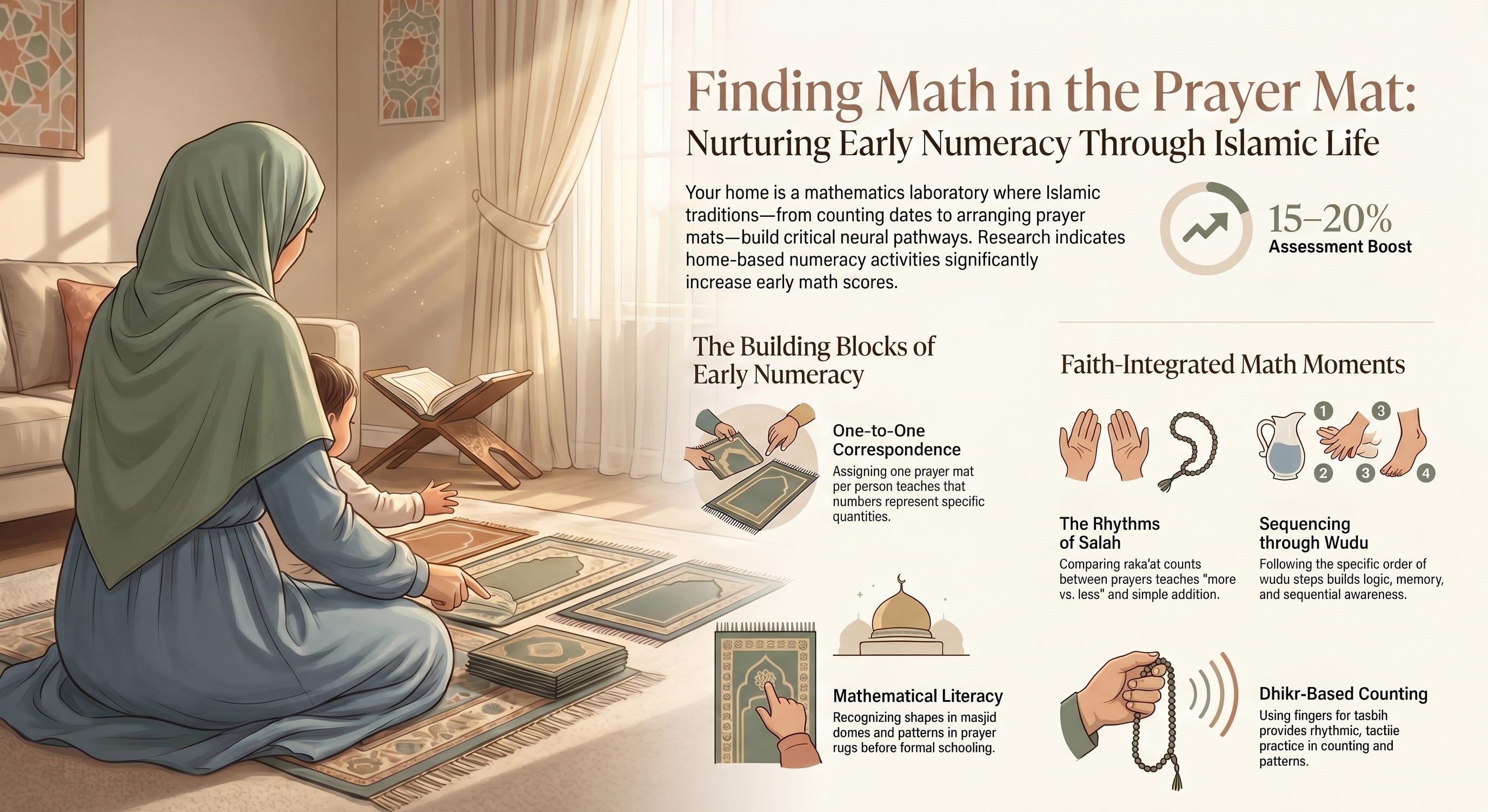
When my daughter was two, I watched her line up four prayer mats across our living room floor. “Mama, Baba, me, Yusuf,” she said, pointing to each one.
I didn’t realize it then, but she was learning one-to-one correspondence—a foundational math concept educators spend weeks teaching in preschool.
Your home is already a mathematics laboratory. Every time your toddler sorts dates from crackers, notices the crescent moon’s changing shape, or asks “how many rakaʿat in Maghrib?”—they’re building the neural pathways that will carry them through algebra and beyond.
You don’t need expensive Montessori materials or formal lessons. The
research is clear: children learn mathematical thinking most deeply when it’s embedded in meaningful, everyday experiences [2]. And what could be more meaningful than the rhythms of Islamic family life?
Why This Guide Is Different
Research-Backed and Current: Every recommendation draws from peer-reviewed studies published between 2009-2022, including work from the National Research Council, Harvard’s Center on the Developing Child, and the OECD’s early childhood research.
Islam Integrated, Not Added: This isn’t math activities with Islamic stickers slapped on. This shows you how Islamic practice—from salah to Ramadan to sadaqah—naturally develops the same skills educators deliberately teach, honoring the amanah of your child’s intellectual development.
Actionable Tools Included: You’ll receive the free Islamic Numeracy Activity Pack—a 3-page PDF with age-specific activities, a troubleshooting guide for resistant learners, and authentic du’as for seeking knowledge—designed to stay on your refrigerator where you’ll actually use it.
What Early Numeracy Actually Means
Early numeracy is your child’s ability to recognize, understand, and use mathematical concepts in daily life—well before they enter a classroom [3].
Think of it as mathematical literacy. Just as you build language by talking, reading stories, and naming objects, you build numeracy by counting steps, sorting socks, and comparing sizes.
The foundational skills include:
Counting and number sense — Recognizing that “three” is both a word and a quantity, understanding that numbers represent amounts
Sorting and classifying — Grouping objects by color, size, or type (dates vs. crackers, big prayer mats vs. small ones)
Comparing quantities — Understanding more/less, bigger/smaller, heavier/lighter
Shape and spatial awareness — Recognizing circles, squares, rectangles in masjid domes and prayer rugs
Patterns — Noticing and creating sequences (star, moon, star, moon)
Measurement — Using informal units to measure (how many cups of water for wudu?)
Order and sequence — Understanding first, next, last (the order of wudu steps)
Early addition and subtraction — Concrete experiences of “adding one more date” or “taking two miswaks away”
But here’s what surprised me when I studied the research: the National Research Council found that many children’s mathematical potential goes unrealized simply because they lack opportunities to learn through everyday life [4].
Not because they’re not capable. Because no one showed their parents that daily routines were already teaching math.
Why Islamic Routines Are Uniquely Powerful for Learning
Children don’t learn math from worksheets at age three. They learn from lived experiences that feel meaningful.
When math disconnects from life, it becomes abstract and intimidating. When math connects to family, worship, food, and love—it becomes alive.
Consider these everyday moments:
“How many prayer mats for our family?” (One-to-one correspondence)
“How many dates for iftar?” (Counting with purpose)
“Which Qur’an is bigger?” (Size comparison)
“If we had four miswaks and Baba used one, how many remain?” (Subtraction through narrative)
“Let’s say Alhamdulillah three times.” (Rhythmic counting paired with remembrance)
Each moment teaches a mathematical concept while simultaneously teaching that Islam is not confined to formal lessons. Islam is the fabric of home life.
Research on home mathematics environments confirms this: children whose parents engage them in informal numeracy activities—counting, sorting, comparing—during daily routines show significantly stronger mathematical development than children who only encounter numbers in formal instruction [5].
Your Islamic home is already providing this rich learning environment. You just need to recognize and nurture it intentionally.
Creating Rhythm Without Music
Many early childhood resources recommend songs and music for teaching counting and patterns. Muslim families can achieve the same rhythmic learning using different tools:
Call and response counting — You say “One,” your child says “Two,” you say “Three”
Storytelling with repetition — “One bird thanked Allah. Two birds thanked Allah. Three birds thanked Allah.”
Gentle recitation — Short surahs like Al-Ikhlas or Al-Falaq create patterns through sound
Dhikr-based counting — Counting fingers while saying SubhanAllah, Alhamdulillah, Allahu Akbar
Calm narration — Describing actions step-by-step: “First sock, second sock. One shoe, two shoes.”
The Qur’an reminds us that hearts find rest in the remembrance of Allah [6]. The rhythm and repetition young children need for learning can come from dhikr and recitation rather than background music.
Babies: Birth to Twelve Months
Your baby is not “doing math” yet. But they’re building the foundation.
They’re noticing patterns in your voice. Tracking objects as they move. Responding to the rhythm of daily routines. Experiencing quantity through repeated actions (one spoonful, another spoonful, and another).
What parents can do:
Narrate with numbers: “One sock, two socks. Bismillah, one bite for you.”
Use tone variation: Deep voice for “big blanket,” soft voice for “small blanket.” Slower cadence for “heavy,” quicker for “light.”
Point out quantities: “Baba has one prayer mat. Mama has one prayer mat. That’s two prayer mats.”
Create routine patterns: “Adhan called. First wudu, then salah.” “First we change you, then we wash hands.”
These moments build language, attention, and early concept understanding [7]. Your warm, responsive interaction is the most powerful learning tool available [8].
Quick reference examples:
Counting kisses: “One kiss for your forehead, one for your hand. May Allah bless you.”
Finger awareness: “Allah gave you one finger, two fingers, three fingers.”
Before sleep: “One blanket, one pillow, one du’a before sleep.”
Date plate: “Look, one date. Now two dates.”
Toddlers: One to Three Years
Toddlers learn through their bodies: touching, moving, stacking, sorting, carrying, pouring.
At this age, numeracy should feel like natural play, never like pressure.
Counting in Islamic Routines
Prayer mats: “We need three mats. One for Baba, one for Mama, one for you.”
Miswaks: “Four miswaks on the shelf. Baba took one. Count what’s left.”
Dates: “Two dates on this plate, two dates on that plate. How many altogether?”
Wudu items: “One towel for you, one for Baba.”
Shoes: “Two shoes make one pair. Where’s the other shoe?”
Books: “Let’s stack the small book on top of the big book.”
Sadaqah: “Put one coin in the box. Now another. How many did we give?”
(Use large child-safe tokens instead of actual coins to prevent choking.)
Sorting and Matching
Toddlers naturally enjoy categorizing:
Sort prayer caps by color
Match socks for Jumu’ah
Separate big prayer mats from small ones
Sort dates and crackers into different bowls
Match each family member with one cup for iftar
You’re teaching: “These are the same. These are different. This one is bigger. This one is softer.”
Shape Learning
Point out shapes naturally:
“The plate is a circle.”
“The window is a rectangle.”
“The prayer mat has a rectangle shape.”
“The masjid dome looks round.”
“The moon is a crescent.”
You’re not teaching a lesson. You’re naming the world.
Position Words
Use home objects to teach spatial language [9]:
“The prayer mat is under the chair.”
“The Qur’an is on the shelf.”
“The miswak is beside the cup.”
“The sadaqah box is near the door.”
“Your shoes are inside the basket.”
Words like over, under, beside, near, far, inside, outside, first, next, last—these are mathematical vocabulary.
I know this is a lot to remember, especially when you’re managing meals, naps, and the inevitable spilled milk. That’s why I’ve created a free Islamic Numeracy Activity Pack—a printable guide with age-specific activities, a decision flowchart for when your child seems disinterested, and authentic du’as for knowledge. Keep reading to download it at the end of this article—it’s designed to stay on your refrigerator where you’ll actually use it.
Preschoolers: Three to Five Years
Preschoolers can begin solving small problems, comparing quantities, creating patterns, and understanding simple addition and subtraction in concrete ways.
Salah-Based Numeracy
Use salah gently—never turning worship into a test.
“Fajr fard has two rakaʿat.”
“Maghrib fard has three rakaʿat.”
“Dhuhr has four. Asr has four. Isha has four.”
Then ask:
“Which prayer has fewer rakaʿat, Fajr or Maghrib?”
“Which has more, Maghrib or Isha?”
“How many fard prayers do we pray each day?”
The Prophet ﷺ taught that Allah obligated five prayers during the day and night [10].
You can introduce simple addition:
“Fajr has two Sunnah rakaʿat, then two fard. Two and two make four.”
Keep it simple. Follow what your family teaches according to trusted scholarship.
Dhikr-Based Counting
Dhikr naturally supports counting practice:
For young children:
“Let’s say Alhamdulillah three times.”
“Say SubhanAllah five times.”
“Count on your fingers while saying Allahu Akbar.”
For older preschoolers, you can introduce authentic adhkar counts when appropriate. Sahih Muslim mentions saying SubhanAllah thirty-three times, Alhamdulillah thirty-three times, and Allahu Akbar thirty-three times after prayer [11].
The aim is gentle exposure, not burden.
Wudu Sequencing
Wudu naturally teaches order:
“First we roll up sleeves.”
“Next we turn on water.”
“Then we wash hands.”
“Last we dry with the towel.”
Ask: “What comes first? What comes next? What do we do last?”
This builds mathematical order, memory, and routine awareness.
Ramadan Numeracy
Ramadan overflows with math moments:
Count dates for iftar
Count cups at the table
Count days on a Ramadan calendar
Compare full and empty glasses
Measure flour for simple baking
Sort Eid cards into piles
Add one sticker to the calendar daily
Ask:
“We had five dates. You ate one. How many left?”
“Four people at iftar. One cup each. How many cups needed?”
“Two families coming. One has three people, one has four. How many guests total?”
Support Muslim Parenting Lab ❤️
Is there something in your record you would like wiped? Give any amount today with the button below.
The Prophet ﷺ said charity extinguishes sin as water extinguishes fire. (Jami’ at-Tirmidhi 2616, hasan)
Eid Preparation
Eid preparation involves counting, sorting, measuring, matching, comparing:
Count gift bags
Match one gift tag to one gift
Sort Eid clothes by family member
Compare long and short ribbons
Make patterns with decorations (star, moon, star, moon)
Ask: “We have six gift bags and four children. Do we have enough?”
Sadaqah Numeracy
Sadaqah teaches both math and generosity:
“We have five coins. Put two in the box. How many left?”
“If we add one more, how many inside?”
Connect it to character: “Allah loves generosity. We give because Allah gave to us. We count, but we don’t show off.”
Masjid Visits
On the way to masjid:
Count steps from car to door
Count shoes on the rack
Look for shapes in windows and carpets
Notice rows
Compare near and far
Ask: “Which row is first? Are we near the door or far? How many lamps?”
Book-Based Learning
Use books respectfully:
Count bookmarks (not the mushaf as a toy)
Compare Qur’an sizes
Count pages in Islamic picture books
Sort books by size
Arrange books from shortest to tallest
Reading and conversation support early learning [12]. Responsive back-and-forth conversation strengthens developing brains and communication skills.
Fifteen Ready-to-Use Activities
1. Prayer Mat Matching
Place three or four mats on the floor.
Ask: “How many mats? Which is biggest? Give one to Baba. Put the small one beside the big one.”
Skills: counting, comparing, one-to-one matching, position words
2. Miswak Subtraction
Place four miswaks on a tray.
“Four miswaks. Baba takes one. Your brother takes one. How many left?”
Skills: subtraction, counting, problem-solving
The Prophet ﷺ encouraged siwak use and said if it weren’t difficult for his ummah, he would have ordered it for every prayer [13].
3. Dates for Iftar
Put dates on a plate.
“Four people. One date each. How many dates needed?”
“If we add two guests, how many more dates?”
Skills: counting, addition, one-to-one correspondence
4. Sadaqah Jar
Use large tokens for younger children.
“Put one token in. Now another. How many given?”
“If we give one daily for three days, how many total?”
Skills: counting, addition, sequence, generosity
5. Rakaʿat Blocks
Use blocks to represent fard rakaʿat:
Fajr: 2 blocks | Maghrib: 3 blocks | Dhuhr: 4 | Asr: 4 | Isha: 4
“Which tower is taller? Which prayer has fewer rakaʿat?”
Skills: counting, comparing, visual quantity
6. Adhkar Fingers
Hold up fingers while saying dhikr.
“Alhamdulillah, one. Alhamdulillah, two. Alhamdulillah, three.”
Skills: counting, finger awareness, calm repetition
7. Wudu Water Pouring
Use small cup and bowl for supervised play (not actual wudu instruction).
“Is the cup full or empty? Can you pour half? Which bowl has more?”
Skills: measuring, comparing, more/less
8. Islamic Month Calendar
Use simple visual calendar.
“How many days passed? How many stickers on the calendar? How many days until Eid?”
Skills: time awareness, counting, anticipation
9. Crescent Moon Spotting
Look outside or use picture cards.
“Is the moon full or crescent? Which picture shows the smaller moon?”
Skills: shape recognition, observation, comparison
10. Masjid Shape Hunt
Use photo or illustration of a masjid.
“Find a circle. Find a rectangle. Which tower is taller? How many windows?”
Skills: geometry, counting, visual scanning
11. Family Iftar Table
Let your child help set the table.
“Mama needs one plate. Baba needs one. You need one. How many total?”
Skills: one-to-one correspondence, counting, responsibility
12. Eid Gift Pattern
Arrange cards or safe objects: moon, star, moon, star.
“What comes next?”
Skills: pattern recognition, prediction, logical thinking
13. Bookmark Sorting
Use child-safe bookmarks.
“Put all blue ones here. Long ones there. Which pile has more?”
Skills: sorting, comparing, classification
14. Jumu’ah Clothing Order
Lay out clothing items.
“What goes on first? What comes next? Which item is longer?”
Skills: sequencing, comparing, routine
15. Shoe Pairs
Gather family shoes before leaving for masjid.
“How many shoes total? How many pairs? Who has bigger shoes?”
Skills: pairs, counting by twos later, comparing size
What to Avoid
Don’t turn numeracy into pressure.
Don’t force worksheets too early.
Don’t compare your child to others.
Don’t use Qur’an, salah, or dhikr as stressful tests.
Don’t give small objects to babies or toddlers without constant supervision.
Don’t make Islamic learning feel heavy or joyless.
Children learn best when interested [14]. Honor their curiosity while gently surrounding them with Islamic meaning.
A Simple Daily Routine
Morning: Count socks, shoes, breakfast items, family members. “How many spoons? Which cup is bigger? Let’s say Alhamdulillah three times.”
Before/After Salah: Count prayer mats. Compare sizes. Gently count rakaʿat blocks (age-appropriate).
Meal Time: Count dates, grapes, plates. Talk about half, whole, more, less, empty, full.
Play Time: Stack blocks like masjid towers. Sort Islamic cards by shape or color. Create moon and star patterns. Count toy animals from Islamic stories.
Bedtime: Count pillows and blankets. Read an Islamic story with numbers woven in. Say a gentle du’a. Use calm repetition instead of music.
The Islamic Perspective: Recognizing Allah’s Order in Creation
Early numeracy is not merely a developmental milestone. It’s also a doorway to recognizing one of Allah’s greatest signs: the order, pattern, balance, and measure woven throughout creation.
The Qur’an repeatedly draws our attention to the precision and harmony in the natural world. Allah says:
“Had there been within them [the heavens and earth] gods besides Allah, they both would have been ruined. So exalted is Allah, Lord of the Throne, above what they describe.” [15]
According to Tafsir Ibn Kathir, this verse establishes a profound argument: the universe functions with perfect order, proportion, balance, and coordination. If there had been multiple gods with conflicting wills, the heavens and earth would have fallen into chaos [16]. The fact that the cosmos operates smoothly—celestial bodies moving in precise orbits, seasons returning in cycles, life unfolding according to natural laws—is itself proof of One All-Powerful Creator governing everything with wisdom and knowledge.
When a young child learns to count prayer mats, sort dates by size, notice the crescent moon’s changing shape, or recognize patterns in a prayer rug, they’re beginning to perceive this divine order embedded in creation.
The Qur’an was the first revelation to introduce complex mathematical concepts to the Prophet ﷺ, including intricate inheritance laws requiring calculation and proportion [17]. The very first word revealed was “Iqra” (Read), establishing seeking knowledge as a fundamental Islamic value [18].
The Prophet ﷺ emphasized learning’s importance: “Seeking knowledge is an obligation upon every Muslim.” [19] This hadith, authenticated by Sheikh Al-Albani, applies to both boys and girls, men and women—encompassing all beneficial knowledge, including understanding numbers, patterns, and the natural world.
The Prophet ﷺ also taught mercy with young children: “He is not one of us who does not have mercy on our young ones and does not respect our elders.” [20] This authentic hadith reminds us that teaching young children should be done with tenderness, patience, and joy—never harshness, pressure, or unrealistic expectations.
When we teach numeracy through everyday Islamic life, we’re not simply preparing children for school. We’re inviting them to notice Allah’s signs, to see that creation is purposeful and orderly, and to recognize that seeking knowledge and observing the world with curiosity are forms of ibadah when done with the right intention.
A Final Thought
You don’t need to become a mathematics teacher to raise a child who notices and understands numbers.
You only need to slow down enough to recognize the mathematics already living inside your home.
There is math in the prayer mat.
Math in the dates on the iftar plate.
Math in the phases of the moon.
Math in the rows at the masjid.
Math in the sadaqah box.
Math in the miswaks on the shelf.
Math in the family gathered around the table.
Math in the order and rhythm of the day.
And when your child learns numbers through Islamic routines, something deeper unfolds. They don’t only learn “how many” or “which is bigger.” They begin to understand that life has order, worship has rhythm, Allah’s creation has measure and balance, and the Muslim home is a place where learning, love, and remembrance grow together.
Get Your Free Islamic Numeracy Activity Pack
If you’ve read this far, you’re the kind of parent who takes your child’s learning seriously—not as pressure, but as protective nurturing. That tells me something beautiful about you.
I’ve created something to make this journey easier.
Inside the Islamic Numeracy Activity Pack (one comprehensive PDF, 3 pages):
Page 1: Age-Specific Activity Cards — 15 ready-to-use numeracy activities organized by age (0-12 months, 1-3 years, 3-5 years), each with clear skill objectives and materials needed—designed as a refrigerator reference you can glance at when you’re thinking “what should we do today?”
Page 2: “My Child Won’t Engage” Decision Flowchart — A troubleshooting guide for when your child resists counting activities, seems uninterested in numbers, or simply wants to do something else—so you can adapt your approach in under 2 minutes without frustration.
Page 3: Du’as for Seeking Knowledge — Authentic du’as parents can make for their children’s learning, plus a simple morning routine incorporating “Rabbi zidni ‘ilma” (My Lord, increase me in knowledge)—something you can start teaching even now as part of your family’s Islamic foundation.
This isn’t just a PDF to download and forget. It’s a tool designed to stay on your refrigerator—where you’ll actually use it when you need it most.
This Islamic Numeracy Activity Pack is what every subscriber receives with each article. We cover the full journey of raising Muslim children—from newborns to school-age—all backed by scientific research and rooted in Islamic wisdom.
You’ll only hear from us when there’s something valuable to share—no spam, no clutter, just resources that matter.
One Small Action
Before you close this tab, do this: the next time you’re getting ready for salah with your child—whether that’s tonight or tomorrow morning—count the prayer mats out loud together.
That’s it. That’s the practice.
You don’t have to implement everything at once. Start with one moment. Let it become natural. Then add another.
May Allah place barakah in your effort, make the learning you nurture more joyful and fruitful than it feels in the moment, and raise your children to see His signs in the world around them.
Share This Guide
Think of one person right now: a new mother in your family whose toddler is just starting to notice numbers, a friend who feels overwhelmed by early education pressure and thinks she needs expensive curriculum, a sister at the masjid who homeschools and is looking for Islamic-integrated learning resources.
This article could ease their burden. Share it with them today—not as advice-giving, but as support. Sometimes the most loving thing we can do is share what helped us see our homes differently.
Frequently Asked Questions
Q: At what age should I start teaching my child numbers?
A: You’re already teaching numbers from birth through daily routines—counting socks, naming objects, establishing patterns. Formal “teaching” isn’t necessary before age three. Instead, narrate with numbers naturally: “One spoon for you, one for your brother.” For more detail on age-specific approaches, see the age breakdowns above.
Q: My toddler can count to ten but doesn’t understand what the numbers mean. Is this normal?
A: Completely normal. Rote counting (reciting “one, two, three”) develops before number sense (understanding that “three” represents a specific quantity). Keep connecting numbers to real objects: “Let’s count three dates together. One date, two dates, three dates.” Understanding follows memorization with time and practice.
Q: Is it okay to use Islamic activities for math learning, or should I keep them separate?
A: Islamic routines are ideal for math learning because they’re meaningful, repeated daily, and emotionally significant to your child. Research shows children learn best when concepts connect to their lived experiences [21]. Using salah, Ramadan, and family routines for numeracy helps your child see Islam as integrated into all of life, not compartmentalized.
Q: What if my child seems uninterested in counting or numbers?
A: Follow their interests. If they love stacking blocks, count blocks. If they love running, count steps. If they love pouring water, count cups. Never force it. Mathematical thinking develops through play, movement, and exploration—not through drills. The troubleshooting flowchart in the Activity Pack will help you adapt when resistance appears.
Q: Should I be worried if my child isn’t counting by age two?
A: No. Children develop at different rates. Some count reliably at 18 months, others at three years. Both are completely normal. What matters is exposure to numeracy-rich experiences—which you’re already providing through daily routines. If you have specific developmental concerns, consult your pediatrician, but wide variation in early counting is expected.
Q: How can I teach my child to count in Arabic as well as English?
A: Use the same approach with both languages. Count prayer mats in Arabic: “Wahid, ithnayn, thalatha.” Count dates in English: “One, two, three.” Children’s brains are wired for multilingual learning—switching between languages strengthens cognitive flexibility. Start with numbers 1-10 in both languages and use whichever feels natural in the moment.
References
[1] Anders, Y., Rossbach, H.G., Weinert, S., et al. (2012). Home and preschool learning environments and early numeracy skills. Early Childhood Research Quarterly, 27(2), 231-244.
[2] National Research Council. (2009). Mathematics Learning in Early Childhood: Paths Toward Excellence and Equity. National Academies Press.
[3] Australian Government Department of Education. (2022). Belonging, Being and Becoming: The Early Years Learning Framework for Australia V2.0.
[4] National Research Council. (2009). Mathematics Learning in Early Childhood: Paths Toward Excellence and Equity. National Academies Press. Early mathematics supports children’s current and future educational success, and children benefit from opportunities to learn mathematics through everyday experiences.
[5] Zippert, E.L., and Rittle-Johnson, B. (2020). The home math environment: More than numeracy. Early Childhood Research Quarterly, 50, 4-15.
[6] Qur’an, Surah Ar-Raʿd 13:28.
[7] Hart, B., and Risley, T.R. (1995). Meaningful differences in the everyday experience of young American children. Paul H. Brookes Publishing.
[8] Center on the Developing Child at Harvard University. Serve and Return. Responsive back and forth interaction between a child and caregiver supports brain architecture, communication, social skills, and later cognitive development.
[9] Anders, Y., Rossbach, H.G., Weinert, S., et al. (2012). Home and preschool learning environments and early numeracy skills. Early Childhood Research Quarterly, 27(2), 231-244.
[10] Sahih Muslim 11a. The Prophet ﷺ taught that there are five prayers during the day and night obligated by Allah.
[11] Sahih Muslim 597a. The hadith mentions saying SubhanAllah, Alhamdulillah, and Allahu Akbar thirty-three times after prayer.
[12] Vygotsky, L.S. (1978). Mind in society: The development of higher psychological processes. Harvard University Press.
[13] Sahih al-Bukhari 887. The Prophet ﷺ encouraged the use of siwak for prayer.
[14] Weisberg, D.S., Hirsh-Pasek, K., and Golinkoff, R.M. (2013). Guided play: Where curricular goals meet a playful pedagogy. Mind, Brain, and Education, 7(2), 104-112.
[15] Qur’an, Surah Al-Anbiya 21:22.
[16] Tafsir Ibn Kathir on Surah Al-Anbiya 21:22. Ibn Kathir explains that the system of the whole universe functions according to universal law with proper proportion, balance, harmony, and coordination—clear proof of One All-Powerful Manager governing the universe.
[17] Review of Religions. (2022). Muslim Contributions to Mathematics and Astronomy: Al-Khwarizmi. Mathematics was introduced into Muslim culture through the Qur’an where complex rules of inheritance are outlined.
[18] Qur’an, Surah Al-Alaq 96:1.
[19] Sunan Ibn Majah 224. Authenticated by Sheikh Al-Albani in Sahih Sunan Ibn Majah.
[20] Sunan Abu Dawood 4943. Graded Sahih by Shu’ayb Al-Arna’ut.
[21] OECD. (2018). Engaging Young Children: Lessons from Research about Quality in Early Childhood Education and Care. OECD Publishing.
We combine scientific research with Qur’an and authentic Sunnah, and we cite our sources. Even so, this is general guidance and no substitute for a doctor who can examine your child.