

A study in Pediatrics found that roughly 60% of breastfeeding mothers stop earlier than they had planned — most without a clear weaning strategy. [1] This guide walks you through the gentle approach that protects both your baby and your body.
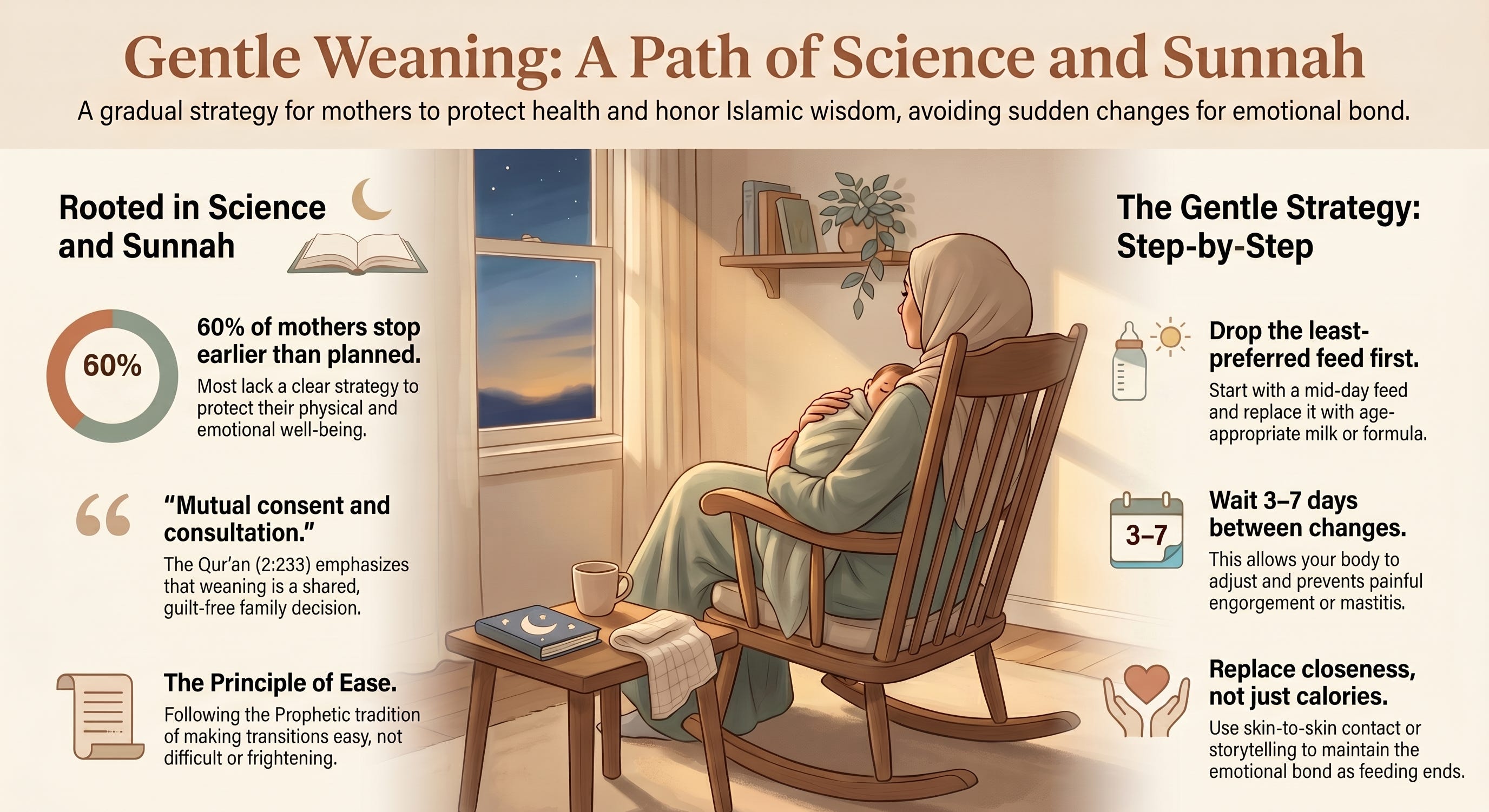
3 AM. Your baby is tucked against your chest, almost asleep. The house is quiet. And somewhere in the back of your mind, a thought lands: this won’t last forever.
For some mothers, that thought brings relief. For others, it brings a grief they weren’t expecting. Most of us feel both at the same time, and that is completely okay.
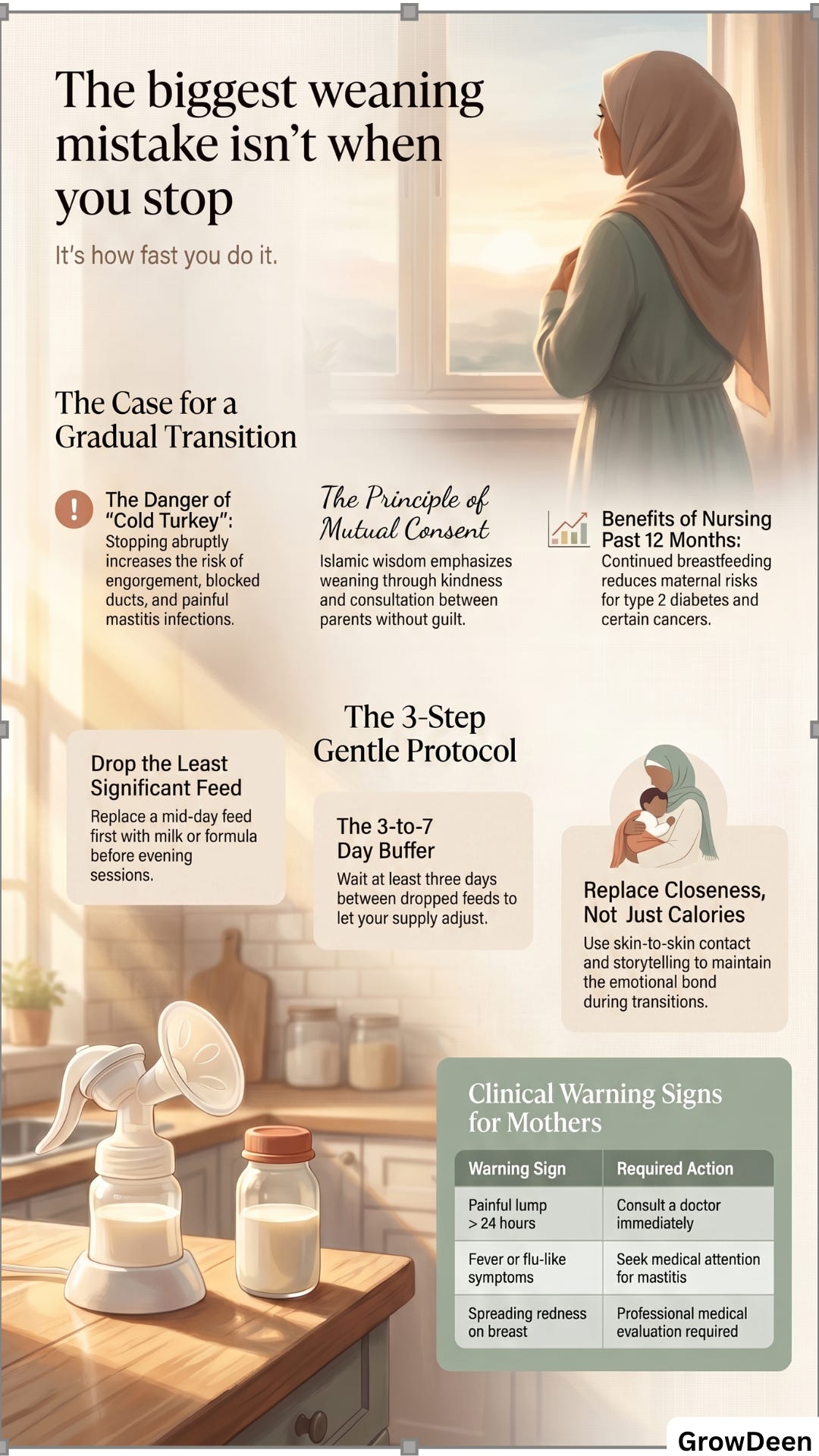
But here’s the thing nobody warns you about: the biggest mistake mothers make with weaning isn’t starting too early or too late — it’s stopping too fast. When I looked at the research on abrupt weaning, the consequences were striking. Stopping suddenly increases your risk of engorgement, blocked ducts, and mastitis — a painful breast tissue inflammation that can escalate to infection. [6] And for your baby, a sudden stop means losing comfort and routine without time to adjust.
The good news? Almost all of that is preventable. And it starts with understanding one principle: go gently.
Why This Guide Is Different From Generic Weaning Advice
Research-backed, not opinion-based. Every recommendation comes from the AAP’s 2022 policy statement, the WHO, and clinical lactation research — not parenting forums. [1][2][3]
Islamic wisdom woven in naturally. The Qur’an addresses both breastfeeding duration and the decision to wean directly — with a framework built on consultation, kindness, and zero guilt. [8]
A free companion pack you’ll actually use. You’ll get a printable Gentle Weaning Companion Pack — with age-based feeding guides, body-care reminders, and a du’a for ease — designed to stay on your fridge, not in a forgotten folder.
When Is the Right Time to Start Weaning?
There is no single right age. What matters is reading your family’s needs honestly.
The AAP and WHO both recommend exclusive breastfeeding for the first six months, continued breastfeeding with solid foods for two years or beyond. [1][2] Research confirms that nursing past 12 months continues to reduce the mother’s risk of type 2 diabetes, breast cancer, and ovarian cancer. [1]
But the Qur’an also makes something clear: “And if they both desire weaning through mutual consent and consultation, there is no blame upon either of them” (2:233). [8] If your family decides to wean before two years — thoughtfully, together — there is no guilt in that.
How to Wean Gently: The Step-by-Step That Actually Works
Drop the feed your baby cares about least. Usually a mid-morning or mid-afternoon one. Replace it with expressed milk, formula (under 12 months), or cow’s milk in a cup (over 12 months). [4]
Wait at least 3–7 days before dropping the next one. Lactation experts recommend at minimum three days between drops to let your body adjust. [5] Rushing this is where engorgement and mastitis start.
Replace closeness, not just calories. Your baby associated breastfeeding with safety, not just food. Hold them skin-to-skin. Read together. Recite gentle adhkar in quiet moments. The warmth hasn’t disappeared — it has changed shape.
Express for comfort only. If your breasts feel full between dropped feeds, express just enough to relieve pressure. Not more. Emptying signals your body to keep producing — which defeats the purpose. [5]
Here’s something that surprised me: night feeds are often the last to go, and that’s fine. There is no medical reason to rush dropping them if they still work for you. [4]
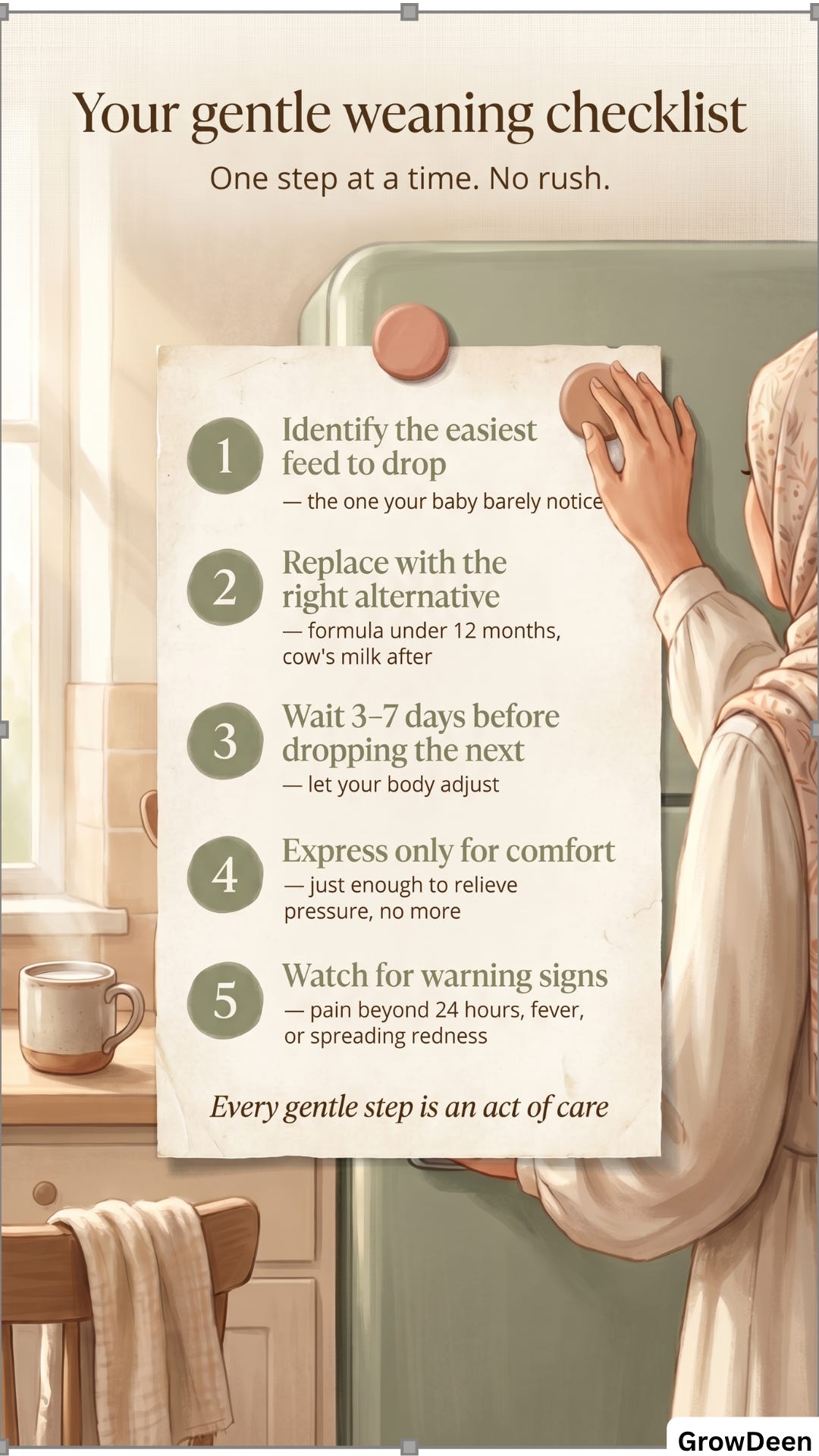
I know this is a lot to hold in your head, especially when you’re already running on broken sleep. That’s why I created a free Gentle Weaning Companion Pack — a printable guide with age-based feeding charts, body-care reminders, and a du’a for ease. Keep reading to download it at the end — it’s designed to stay on your fridge, where you’ll actually need it.
What Happens to Your Body When You Wean?
Your breasts will adjust — but they need time. Lumpy or tender areas for 5–10 days after stopping are normal.
See your doctor promptly if a lump is painful for more than 24 hours, you develop a fever or flu-like symptoms, or you notice spreading redness. These are signs of mastitis. [6] And if you already have mastitis, wait until it resolves before starting the weaning process.
Your hormones will shift. Prolactin and oxytocin levels drop, and many mothers feel a wave of sadness after the final feed — even mothers who were ready. This is partly hormonal. It passes. Be gentle with yourself. [7]
Your cycle may return. Some women ovulate within weeks of reducing feeds. If you’ve relied on breastfeeding for contraception, talk to your doctor — once any of the three conditions for Lactational Amenorrhea change, you may need another method. [7]
Support Muslim Parenting Lab ❤️
Would you like a deed that keeps earning for you after you die? Start one in a few seconds with the button below.
The Prophet ﷺ named ongoing charity and beneficial knowledge among the three things that keep counting after death. (Sahih Muslim 1631)
The Sacred Trust of Weaning: What the Qur’an Teaches About Gentle Transitions
In Surah At-Talaq, Allah says: “And if they breastfeed for you, then give them their payment and consult together in kindness.” [Qur’an 65:6] [8]
According to Tafsir Ibn Kathir, this verse establishes that feeding decisions — including the decision to wean — must be navigated through mutual consultation conducted with kindness, not through force or guilt. [8]
And the Prophet ﷺ said: “Make things easy and do not make them difficult. Calm people and do not frighten them away.” [Sahih al-Bukhari 6125, Sahih Muslim 1734] [9]
When I think about weaning, I hear that hadith differently. Go gently. Do not rush. Do not let anyone — including yourself — turn this into something harder than it needs to be. The Sunnah and the science point in the same direction.
Your Gentle Weaning Companion Pack
If you’ve read this far, you’re the kind of mother who takes this transition seriously — not as a chore to get through, but as a chapter that deserves care. That tells me something beautiful about you.
Inside the Gentle Weaning Companion Pack (one comprehensive PDF, 3 pages):
Page 1: Age-Based Weaning & Feeding Replacement Guide — A visual chart showing exactly what to replace breastfeeds with at every age (under 6 months, 6–12 months, 12–24 months), including cup vs. bottle guidance and which feeds to drop first — designed as a reference card you can keep on your fridge or in your phone.
Page 2: Body Care & Warning Signs Quick Reference — A one-page guide covering engorgement relief techniques, the 5 warning signs of mastitis that need medical attention, when to express and how much, and a hormonal changes timeline — so you know exactly what’s normal and what’s not during the weaning process.
Page 3: Du’a for Ease During Life Transitions — An authenticated du’a for seeking ease, with Arabic text, transliteration, and English meaning, plus guidance on when to recite it — designed to be a spiritual anchor during this transition, connecting your daily parenting to your relationship with Allah.
This isn’t just a PDF to download and forget. It’s designed to stay on your fridge, in your nursery, or on your phone — where you’ll actually reach for it when you need it most.
This Gentle Weaning Companion Pack is what every subscriber receives with each article. We cover the full journey of raising Muslim children — from newborns through school age — all backed by scientific research and rooted in Islamic wisdom.
If you’re a Muslim parent who wants both evidence-based guidance AND Islamic perspective, subscribe for free so future resources arrive in your inbox before you need them.
Subscribe free for parenting resources backed by both science and Sunnah — guidance so unique, you literally can’t get it anywhere else. No spam, no clutter, just resources that matter.
One Small Action
Tonight or tomorrow morning, sit with your partner and identify the one breastfeed your baby seems least attached to. Just name it. You don’t have to drop it yet. But naming it is the first step — and you’ve already done the hardest part, which is learning how.
May Allah make this transition easy for you and your little one, and reward every feed you ever gave. Ameen.
Share This With Someone Who Needs It
Think of one person right now: the new mother in your family who’s been quietly wondering when to start weaning, a friend whose baby just turned one and hasn’t talked about how she feels about stopping, or your sister who texted you at midnight asking whether it’s okay to drop the night feed.
This article could ease her worry. Share it with her today — not as advice-giving, but as support. Sometimes the most loving thing we can do is pass along knowledge that makes a hard transition gentler.
Frequently Asked Questions
Q: How long does weaning usually take? A: For most mothers, gradually weaning from exclusive breastfeeding takes two to three weeks when dropping one feed at a time with a few days in between. [5] Some families take longer, and that’s perfectly fine — there is no deadline.
Q: Can I stop breastfeeding cold turkey? A: It’s strongly discouraged. Abrupt weaning significantly increases your risk of engorgement and mastitis. [6] Gradual weaning — dropping one feed at a time — is safer for both your body and your baby’s adjustment.
Q: What should I replace breastmilk with when weaning? A: Under 12 months, replace with infant formula — cow’s milk should not be used as a main drink before age one. After 12 months, full-fat cow’s milk is fine. Toddler formula is not necessary for healthy children eating a varied diet. [4] For more detail, see “How to Wean Gently” above.
Q: Is it normal to feel sad after weaning? A: Very normal. Many mothers feel a wave of sadness or loss after the final feed, even when they were ready to stop. This is partly hormonal — prolactin and oxytocin levels drop when breastfeeding ends. [7] The feeling usually passes within a few weeks. Be gentle with yourself.
Q: Does Islam require breastfeeding for two full years? A: The Qur’an recommends two years “for whoever wishes to complete the nursing period” (2:233), but the same verse explicitly permits parents to wean earlier by mutual consent, stating “there is no blame upon either of them.” [8] It is recommended, not obligatory, and thoughtful early weaning carries no guilt.
Q: How do I wean a toddler who doesn’t want to stop? A: Go slowly and replace the comfort, not just the calories. Change routines at usual feeding times — go outside, read together, start an activity. Shorten feeds before eliminating them. Many toddlers gradually lose interest when given alternatives. Replace the closeness with Qur’an recitation at bedtime, storytelling, or quiet cuddles with a favourite book.
References
[1] Meek, J.Y., Noble, L., & Section on Breastfeeding. (2022). Policy Statement: Breastfeeding and the Use of Human Milk. Pediatrics, 150(1), e2022057988. https://doi.org/10.1542/peds.2022-057988
[2] World Health Organization (WHO). (2023). Breastfeeding. https://www.who.int/health-topics/breastfeeding
[3] Childstats.gov. (2024). America’s Children: Breastfeeding. Federal Interagency Forum on Child and Family Statistics. https://www.childstats.gov/americaschildren/breastfeeding.asp
[4] National Health and Medical Research Council (NHMRC). (2012, updated 2015). Infant Feeding Guidelines: Information for Health Workers. https://www.nhmrc.gov.au/about-us/publications/infant-feeding-guidelines-information-health-workers
[5] Mohrbacher, N. (2020). Breastfeeding Answers: A Guide to Helping Families (2nd ed.). Nancy Mohrbacher Solutions, Inc.
[6] Amir, L.H., & The Academy of Breastfeeding Medicine Protocol Committee. (2014). ABM Clinical Protocol #4: Mastitis, Revised March 2014. Breastfeeding Medicine, 9(5), 239–243. https://doi.org/10.1089/bfm.2014.9984
[7] Berens, P., Labbok, M., & The Academy of Breastfeeding Medicine. (2015). ABM Clinical Protocol #13: Contraception During Breastfeeding, Revised 2015. Breastfeeding Medicine, 10(1), 1–10. https://doi.org/10.1089/bfm.2015.9999
[8] Qur’an, Surah Al-Baqarah 2:233; Surah At-Talaq 65:6. Tafsir: Ibn Kathir.
[9] Anas ibn Malik reported: The Prophet ﷺ said, “Make things easy for the people, and do not make it difficult for them, and make them calm (with glad tidings) and do not repulse them.” Sahih al-Bukhari 6125, Sahih Muslim 1734. Graded: Muttafaqun Alayhi. Verified via Sunnah.com.
[10] Australian Breastfeeding Association (ABA). (2023). Weaning. https://www.breastfeeding.asn.au/resources/weaning
We combine scientific research with Qur’an and authentic Sunnah, and we cite our sources. Even so, this is general guidance and no substitute for a doctor who can examine your child.