


34.4% of children had sleep terrors at 18 months, dropping to 5.3% by age 13. [1]
Printable. For the next twelve-minute scream.
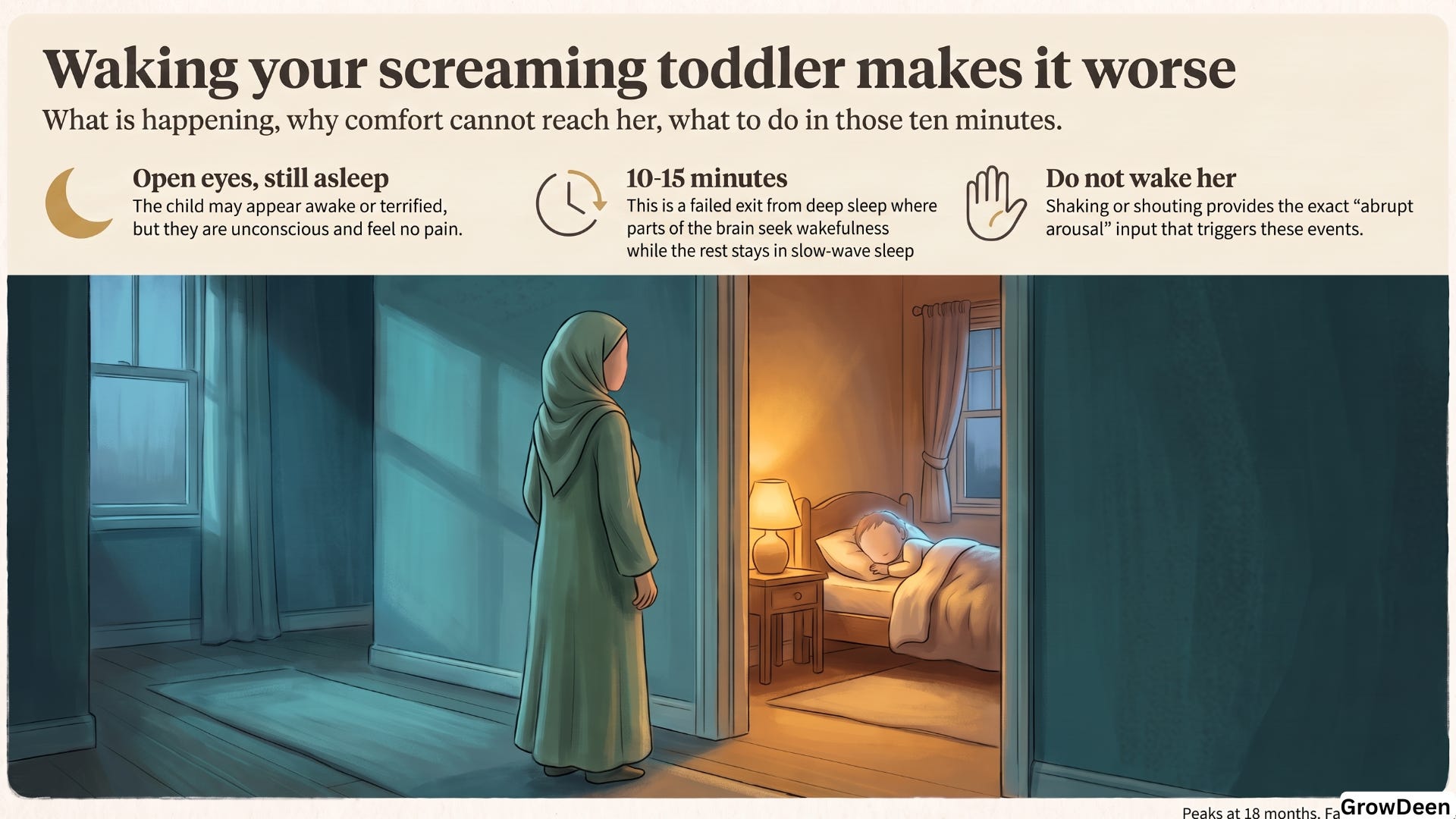
The scream is not a normal cry.
It is sharper, and it comes from a child who was asleep eleven minutes ago. By the time you reach the doorway she is sitting up with her eyes wide open, sweating, breathing fast, and she is looking straight through you. You say her name. Nothing. You reach for her and she pushes your hands away like you are a stranger.
You are not going to forget this for a while.
And you are going to want to wake her, because every instinct you have says a frightened child needs to be pulled out of whatever this is. That instinct is the one thing working against you tonight. Sleep researchers have shown that forced arousals out of deep sleep, especially in someone already short on sleep, are what bring these episodes on in the first place. [5]
By morning she will remember none of it. Not the screaming, not the sweat, not whether you came.
Hold on to that last part, because it answers a question you will be turning over at breakfast: how does a child scream like that for twelve minutes and wake up cheerful? The answer is at the end of this article, and it changes what you do at 11pm tonight.
Why this guide is different from the usual night terror advice
Every claim carries a source. Prevalence figures come from a 1,940-child JAMA Pediatrics cohort [1], the trigger evidence from a Stanford sleep clinic study of 84 children [4], and the arousal mechanism from a Neurology sleep-laboratory protocol [5].
The Sunnah is the routine, not a footnote. The Prophetic bedtime sequence is not decoration bolted onto a sleep-hygiene list. It is the sequence, and it happens to match what paediatric sleep clinics teach.
You already have the free Night Terror Field Card from the top of this page — a free printable pack, including the four-way identifier that tells you whether what you just watched needs a doctor or needs nothing at all.
The first question: is she in pain?
No. And the reason is worth two minutes of your time, because it is what lets you stand there calmly instead of panicking.
Children do not drop into one flat state of sleep. They descend through stages, and the deepest non-REM sleep of the entire night is packed into the first third of it. A night terror is a failed exit from that depth. Part of the brain starts climbing toward wakefulness while the rest stays down in slow-wave sleep, and the body’s alarm system switches on with nobody conscious at the controls. [2][6]
Once you know that, everything frightening in front of you sorts itself into two piles.
The racing heart, the fast breathing, the sweat, the flushed face: that is the alarm response firing. The open eyes, the thrashing, the climbing out of bed, the speech that makes no sense: that is a motor system running without a driver. [2] Neither pile contains pain. Neither pile contains fear as your child would experience fear awake, because experience requires a conscious child, and there is not one in the room.
Most episodes run ten to fifteen minutes. Some run longer. They rarely come twice in the same night. [2][6]
Here is the part nobody warns you about: the person who suffers during a night terror is you.
The second question: should I wake her?
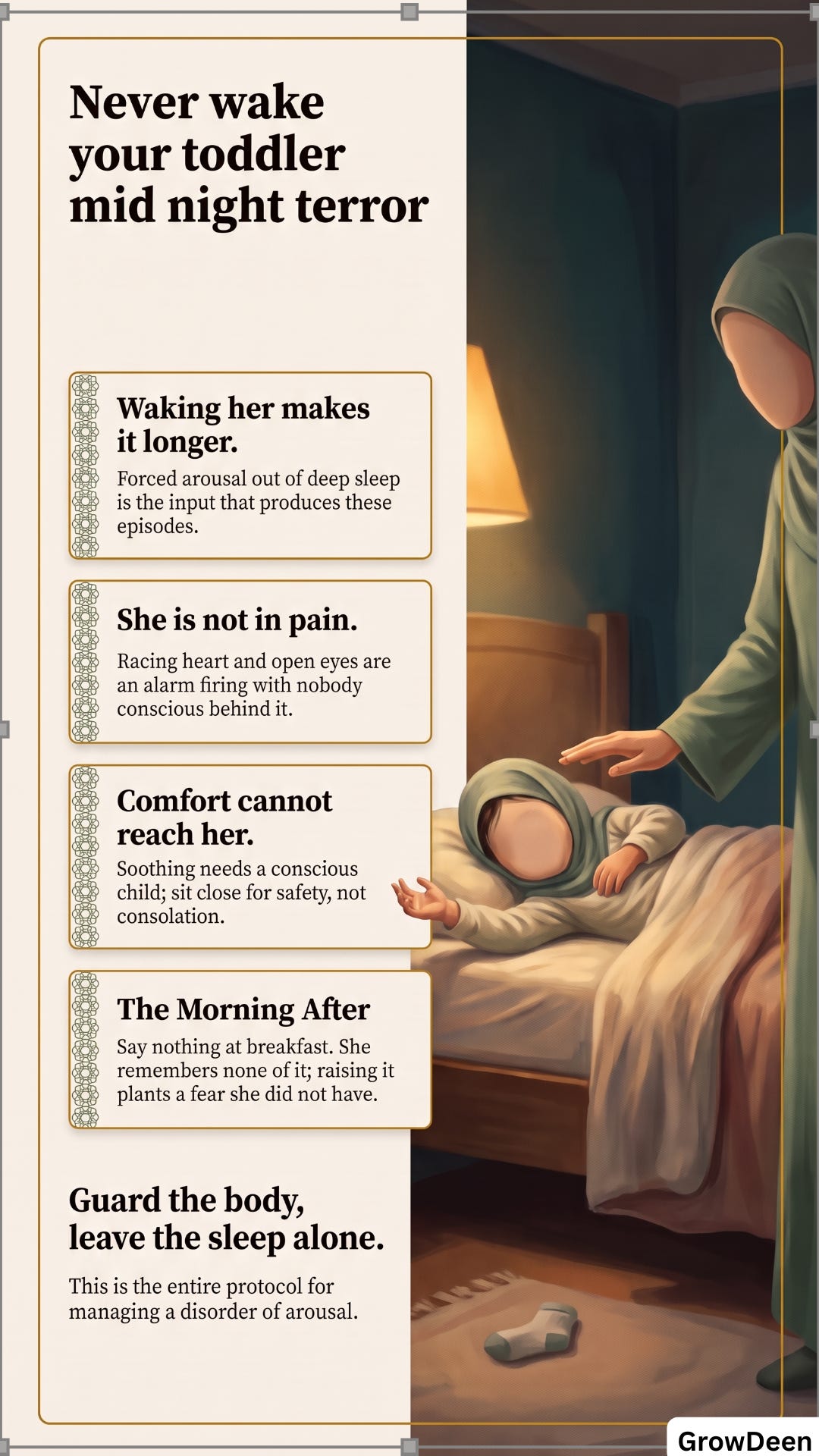
No, and this is the whole article compressed into one word.
A child hauled out of slow-wave sleep mid-episode surfaces confused, disoriented, and frightened for real this time, with no idea why the house is upset. Then she has to be settled from scratch. Left alone, the arousal resolves faster and leaves nothing behind. [3]
Here’s why: abrupt arousal out of deep sleep is the input that produces these events. In a sleep-laboratory protocol published in Neurology, researchers exposed sleepwalkers to auditory stimuli at set sleep stages, both during normal sleep and during recovery sleep after twenty-five hours without sleep. Forced arousals out of slow-wave sleep, stacked on top of sleep deprivation, brought on episodes in people predisposed to them. [5] That work was done in adults, and the same paper notes that earlier attempts to provoke episodes this way in children gave mixed results. [5] The mechanism still points one direction: shaking a child, shouting her name, running a cold cloth over her face is supplying exactly the input you are trying to stop.
So what do you actually do with your hands for ten minutes?
Sit close and stay quiet. You are there for safety, not for comfort, because comfort cannot reach a child who is not conscious to receive it. A running commentary of reassurance only adds noise.
Clear the path instead of blocking it. If she is out of bed and moving, steer her away from the cot rail, the stair head, the glass, the radiator. Do not hold her down. Physical restraint during a disorder of arousal is one of the recognised ways somebody ends up hurt.
Wait, then tuck her in. Once the movement stops, most children lie down and slide back into ordinary sleep within about a minute.
Say nothing in the morning. There is no memory to process, and raising it installs a fear in a child who had none. A child who becomes wary of bedtime sleeps worse, which raises the odds of the next episode. That is the loop worth refusing to start.
Guard the body. Leave the sleep alone.
That sentence is the entire protocol, and it is worth putting somewhere you will see it at 11pm.
The third question: why is this happening to my child?
Because of one of three things, almost always. And here is where you stop being a spectator, because two of the three are inside your control.
She is short on sleep. An overtired child spends more time in slow-wave sleep and arouses out of it more roughly. In an otherwise well child this is the most common driver and the most fixable one. [4][7]
She is unwell. Fever, infection, pain, and certain medicines all raise the odds. [6] A cluster of terrors during a feverish week is a cluster with a cause, and it usually leaves when the illness does.
She is not breathing well in her sleep. This is the one that gets missed for years. When a Stanford sleep clinic assessed 84 prepubertal children with repeated sleep terrors and sleepwalking, 61% had a second sleep disorder, and 49 of them had sleep-disordered breathing. Not one of the 36 comparison children had any parasomnia at all. When the breathing was treated, the episodes went away. In the small group whose surgery was declined, the episodes carried on. [4] If your child snores most nights, breathes through her mouth, or has a history of ear and throat trouble, that belongs in a doctor’s ear rather than in a parenting forum.
There is a fourth factor you cannot change, and knowing it helps anyway. Family history matters enormously. In the Quebec cohort, sleepwalking rose from 22.5% in children with no parental history to 47.4% where one parent had sleepwalked and 61.5% where both had, and parental history also predicted whether a child’s sleep terrors would persist. [1] Ask your mother. Ask his mother. Somebody at the next family gathering did this too, and the room will relax considerably when that comes out.
The hours, and the sequence that fills them
Since sleep debt is the main lever, the real work happens in the evening, not in the corridor at midnight.
Sleep need is not a matter of opinion. The American Academy of Sleep Medicine, in recommendations the American Academy of Pediatrics has endorsed, advises 11 to 14 hours per 24 hours including naps for ages one to two, 10 to 13 hours including naps for ages three to five, and 9 to 12 hours for ages six to twelve. [8] Households that solve their terror problem usually solve it right here, by moving bedtime earlier and holding it.
Around the hours, five things carry weight:
Hold bedtime and waking time steady, weekends included. Slow-wave sleep is most stable when its timing is predictable.
Keep the last hour low, dim, and repetitive. The same order every night teaches the body what is coming.
Watch the nap transition. A nap dropped early, or dropped suddenly, builds the exact debt that produces episodes.
Treat over-excitement after maghrib as a cost with a delayed invoice.
Put the diary by the bed. You will need it for the next section.
Now, about that sequence. If you are a Muslim parent, you do not have to invent one, and this is the part that tends to surprise people who thought Islamic bedtime practice and sleep science were separate conversations.
The Prophet ﷺ told al-Bara ibn Azib that on coming to bed he should perform wudu as he would for prayer, lie on his right side, and entrust himself to Allah in words. [14] He ﷺ taught that the bed be dusted off first. [15] Aishah described him ﷺ cupping his hands each night, reciting Surah al-Ikhlas, al-Falaq and an-Nas into them, blowing lightly, then wiping over his head, face and the front of his body, three times. [16] It is reported in Sahih al-Bukhari that whoever recites Ayat al-Kursi on going to bed has a guardian from Allah with them until morning. [17] And the last words of his ﷺ day were short enough for a three-year-old: with Your name, O Allah, I die and I live. [19]
Read that as a bedtime routine and look at what it is doing. A fixed order of events. Water on the face and hands. A physical settling into position. A quiet recitation. Lights out. Any paediatric sleep clinic in the world teaches that shape, and a Muslim family already has it, with the advantage that every step is worship and none of it expires when the child turns twelve.
The Night Terror Field Card, and why you will want it by the bed
Nobody remembers a differential diagnosis at 11:40pm with a screaming child in front of them. That is the honest problem with everything above.
So there is a free printable for it: the Night Terror Field Card, three pages, built for the corridor rather than the coffee table. It has the four-way identifier that separates a night terror from a nightmare, a confusional arousal, and the pattern that needs a doctor, plus a seven-night tracker for finding your child’s clock. The download button is at the top of this page, and there’s a full description of what’s inside it below.
There is one more thing worth sharing before the practical steps, and it comes from an unexpected place in the Qur’an.
What the Qur’an shows about a sleeper who looks awake
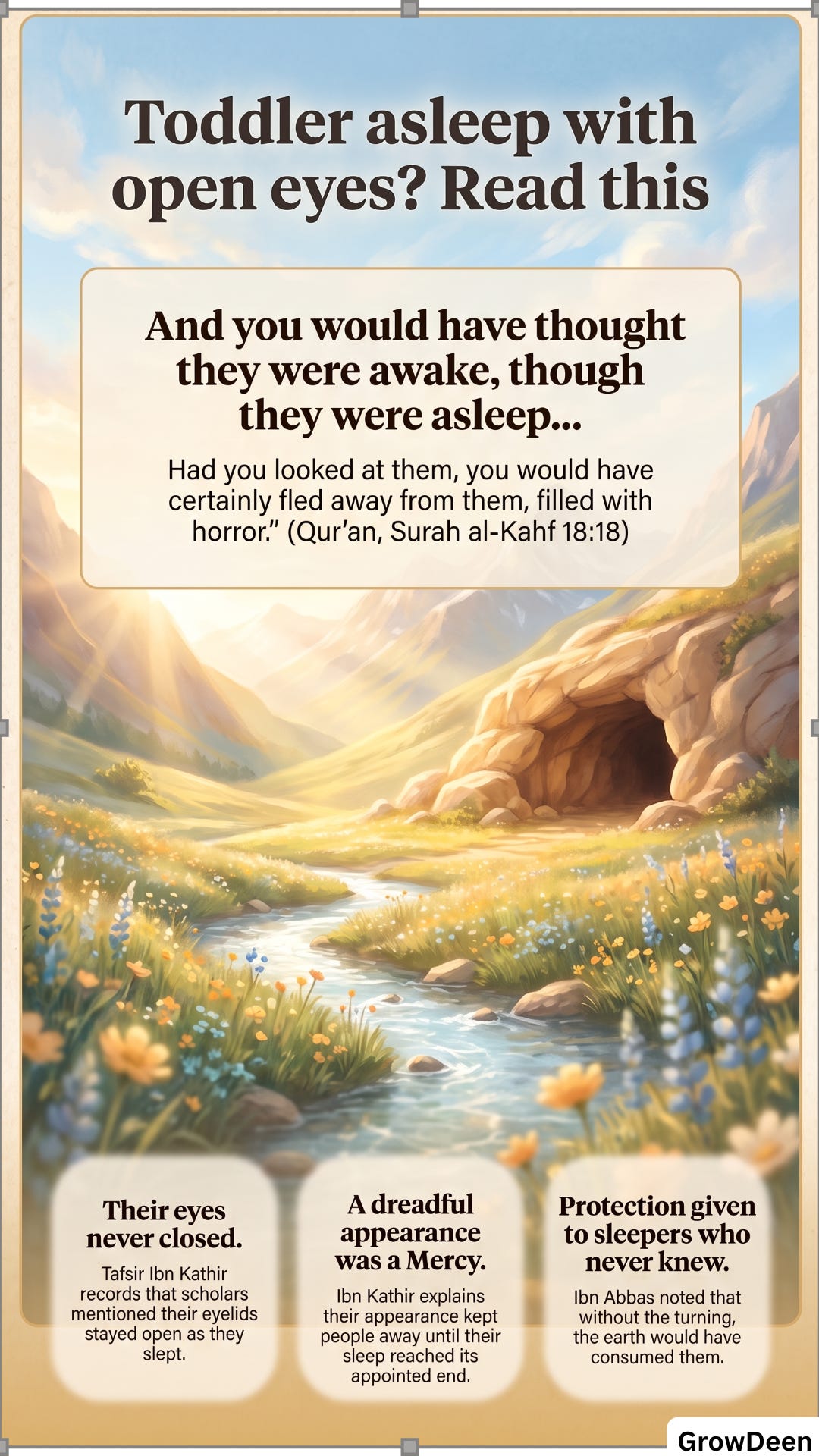
Surah al-Kahf carries a description few parents expect. Allah says of the sleepers in the cave: “And you would have thought they were awake, though they were asleep. We turned them over, to the right and left, while their dog stretched his forelegs at the entrance. Had you looked at them, you would have certainly fled away from them, filled with horror.” [13]
According to Tafsir Ibn Kathir, scholars mentioned that their eyelids did not close while they slept, and Ibn Kathir explains the closing words to mean that Allah made them appear dreadful so nobody who looked could come near them, until their sleep ended at its appointed time as Allah willed, with wisdom and great mercy in that. The tafsir also records Ibn Abbas saying that without the turning, the earth would have consumed them. [13]
Ibn Kathir is not discussing children or parasomnias. The overlap is still hard to miss: open eyes on a sleeper, an appearance frightening enough to drive an onlooker away, a sleep ending at its appointed moment rather than by intervention, and protective care given to bodies with no idea it was happening.
That last detail belongs at your child’s bedroom door. While she is inside something she will never remember, you move the furniture, keep your voice down, and ask Allah for a child who cannot ask for herself. She receives all of it without knowing. Guard the body, leave the sleep alone, and leave the rest with the One who never sleeps.
The fourth question: is this something serious?
Usually not. Occasionally yes, and the difference is learnable in about ninety seconds.
Parents are normally handed a two-way choice between night terrors and nightmares. There are four presentations worth telling apart, and one of them changes what you do next.
Night terror. First third of the night, out of deep sleep. Not awake, even with eyes open. Screaming, sweating, may leave the bed. No memory. Ten to fifteen minutes, rarely twice a night, no fixed script. Keep her safe, do not wake her. [2][3]
Nightmare. Second half of the night, out of light dreaming sleep. Awake, distressed, and wanting you. Often remembers it in detail. Comfort works here, because there is somebody home to comfort. [2]
Confusional arousal. First part of the night, also out of deep sleep, but the picture is muddled rather than terrified: whimpering, slow, resistant to being handled. Little or no memory. Same response as a night terror. [6]
Nocturnal seizure. This is the one to learn. Events are brief, often only seconds. They repeat several times in a single night and again on other nights. The movements look stiff or dystonic and near-identical every time. Onset is more typical from around ten to twenty years old and it persists into adulthood rather than fading. [11][12]
The features that point away from an ordinary parasomnia are stereotypy, brevity, high frequency in one night, repetition across nights, and later onset with persistence. [11] Where doubt remains, video EEG during sleep settles it, and the treatments for the two conditions are not the same. [12] None of this is cause for alarm about a toddler who screams for twelve minutes once a fortnight and grows out of it. It is a reason to describe what you saw accurately when you do sit down with a doctor.
For a nightmare, the Sunnah gives you both words and an action. The Prophet ﷺ taught that a good dream is from Allah and a bad dream is from Shaytan, and that whoever sees something he dislikes should seek refuge with Allah from Shaytan and spit dryly to his left, after which it will not harm him. [21] With a small child it becomes short and physical: hold her, seek refuge out loud, help her turn over, and do not retell the dream back to her.
The one protocol with evidence behind it
If episodes are frequent and cluster around the same time, there is a method that has actually been studied.
Keep a diary for five to seven nights and note the clock time of each episode. Once a pattern shows, wake her briefly about fifteen to thirty minutes before the usual time, just enough to rouse and mumble, then let her resettle. Continue nightly for two to four weeks, then stop.
Reviews of behavioural paediatric sleep treatment identified scheduled awakening as the only intervention for sleep terrors and sleepwalking with enough evidence behind it to be called promising. [9] A later review calls it an evidence-based option for frequent or severe episodes while noting that it is demanding for parents to keep up. [10] It does not suit every family and it does not work for every child. Raise it with your doctor before you start, particularly if episodes are frequent, injurious, or come with snoring.
The room that forgives it
A child who leaves her bed during episodes needs a house that tolerates it. Fit a gate at the stair head. Lock external doors and windows and move the keys out of reach. Clear the floor beside the bed. Move the bed away from glass, hard edges and radiators. Bunk beds mean she sleeps on the bottom one. A bell on the handle is not paranoid for a child who wanders regularly.
The Sunnah lands in a similar place from another direction. The Prophet ﷺ instructed that when night falls children be kept close, that the doors of the house be shut with the name of Allah mentioned, that vessels be covered and water containers tied, and that lamps be put out before sleep. [22] Part of that concerns what the eye does not see. Part of it, as the wording about a mouse dragging a wick and burning down a household makes plain, is ordinary household safety. That last round of the house before bed is Prophetic habit long before it is modern childproofing, and it removes most of what a wandering child could reach.
When to book the appointment, and what to bring
Taking a child to a doctor is Islamic practice in its own right. The Prophet ﷺ said that Allah has created no disease without also creating its treatment. [23] Means are taken and the outcome is left with Allah, which is what tawakkul has always meant.
Book an appointment if she snores habitually, mouth-breathes at night, pauses in her breathing, or sleeps unusually restlessly [4]; if episodes are frequent, violent, or have run for many months; if the movements are stiff, seconds long, repetitive and identical [11][12]; if episodes start for the first time in an older child or persist well past puberty [11]; or if she is sleepy, irritable, or struggling to concentrate by day.
Take notes with you. Two weeks of dates, bedtimes, waking times, episode times, durations and what the movements looked like will tell a clinician more than anything you can reconstruct across a desk. Thirty seconds of phone video, taken without waking her, is better still.
Your free Night Terror Field Card
If you have read this far, you are the kind of parent who wanted to understand this rather than just survive it. That says something about you, and it is the reason this pack exists.
Inside the Night Terror Field Card (one comprehensive PDF, 3 pages):
Page 1: What You Are Looking At. The four-way night-event identifier laid out as a single decision card covering night terrors, nightmares, confusional arousals and the seizure pattern, with a red-flag strip along the bottom, designed as a laminated card you can keep taped inside the airing cupboard door or on the back of the bedroom door where you will actually be standing.
Page 2: The Fifteen-Minute Window. A seven-night episode tracker with a built-in window calculator that turns your logged times into the exact minute to try a scheduled awakening, plus a 28-night protocol grid to tick off, so you can walk into a doctor’s appointment with real data instead of an apology.
Page 3: The Sleeper Who Looked Awake. An Islamic reflection card built on Surah al-Kahf 18:18 and Tafsir Ibn Kathir, written for the parent standing in a doorway at midnight, with three short lines to read while you wait out an episode and one for the morning after.
This isn’t just a PDF to download and forget. It’s a tool designed to stay on the back of a bedroom door, where you’ll actually use it when you need it most.
This Night Terror Field Card is what every subscriber receives with each article. Muslim Parenting Lab covers the full arc of raising Muslim children, from newborn sleep and feeding through behaviour, speech, schooling and the teenage years, all backed by peer-reviewed research and rooted in the Qur’an and Sunnah.
If you want both evidence-based guidance and Islamic perspective in one place, subscribe for free so the next resource reaches you before you need it at midnight.
Subscribe free for parenting resources backed by both science and Sunnah, guidance so specific you cannot get it anywhere else. No spam, no clutter, just resources that matter.
Before you close this tab
Do one thing tonight, and it takes four minutes. Walk into your child’s room and kneel down to her height. Look at what is within reach of a body that might move while asleep: the bedside lamp cable, the glass frame, the radiator, the gap at the stair head. Move two things. That is it.
Then, about that question from the opening. She wakes up cheerful and remembers nothing because she was never awake. The alarm fired, ran its course, and switched off with nobody there to record it. The night terror happened to her body. It happened to your memory.
May Allah place barakah in the hours you guard, accept the du’a you make over a sleeping child, and make your care more protective and more rewarded than it feels at midnight.
Share this with someone who is awake right now
Think of one person: the cousin who mentioned her two-year-old screams every night around ten and she has started dreading it, the friend whose WhatsApp voice notes at 11pm are getting shorter, the sister-in-law who has been shaking her son awake for months because nobody told her not to.
This article could give her back a night. Send it to her today, not as advice, but as company. Sometimes the most useful thing is knowing the frightening thing in front of you is safe.
Frequently asked questions
Q: Should you wake a child having a night terror?
A: No. Waking her mid-episode leaves her confused and frightened for real, and then you have two problems instead of one. Forced arousal out of deep sleep is also part of what triggers these events in the first place. [5] Stay close, keep her safe, and wait it out.
Q: What age do night terrors start and stop?
A: They peak early, at around 18 months, where 34.4% of children in a 1,940-child cohort had them, falling to 13.4% by age five and 5.3% by age thirteen. [1] Most children are finished with them before puberty. [6] If they start for the first time in an older child, or carry on past puberty, get a medical opinion. [11]
Q: What is the difference between a night terror and a nightmare?
A: Timing and consciousness. A night terror happens in the first third of the night, your child stays asleep throughout even with her eyes open, and she remembers nothing. A nightmare happens in the second half, she wakes up, and she can usually tell you about it. [2] Comfort helps with one and cannot reach the other. The four-way identifier above covers the two other things that look similar.
Q: Can night terrors be a sign of something serious?
A: Occasionally. The pattern to watch is stiff or repetitive movements lasting only seconds, several times in one night, looking near-identical every time, with onset in an older child rather than a toddler. [11][12] The other one worth checking is breathing: in a study of 84 children with repeated terrors, 49 had sleep-disordered breathing, and treating it resolved the episodes. [4]
Q: How do I stop night terrors from happening?
A: Start with sleep hours, because sleep debt is the main driver. [4][7] Get her to the recommended 11 to 14 hours for ages one to two, or 10 to 13 for ages three to five, and hold bedtime steady across weekends. [8] If episodes cluster at the same clock time, ask your doctor about scheduled awakening, which is the one behavioural method with evidence behind it. [9][10]
Q: Is there a du’a to say when a child is frightened at night?
A: Yes. The Prophet ﷺ taught words of refuge for someone frightened during sleep, seeking refuge in the perfect words of Allah from His anger and punishment, from the evil of His creatures and from the promptings of the devils. [20] For a child too young to memorise it, say it over her. Recitation is what the Sunnah prescribes here, rather than anything worn, hung, or tied on the body. [18]
Q: Do night terrors mean my child is anxious or traumatised?
A: Not by themselves. Sleep terrors are a disorder of arousal out of deep sleep, and the strongest predictors in the research are age, family history, sleep debt and disrupted breathing rather than daytime distress. [1][4] Settling on anxiety as the explanation is the most common reason a breathing problem goes unchecked for years.
References
[1] Petit, D., Pennestri, M-H., Paquet, J., Desautels, A., Zadra, A., Vitaro, F., Tremblay, R.E., Boivin, M., & Montplaisir, J. (2015). Childhood sleepwalking and sleep terrors: A longitudinal study of prevalence and familial aggregation. JAMA Pediatrics, 169(7), 653-658.
[2] Maski, K., & Owens, J.A. (2016). Insomnia, parasomnias, and narcolepsy in children: Clinical features, diagnosis, and management. The Lancet Neurology, 15(11), 1170-1181.
[3] Moreno, M.A. (2015). Sleep terrors and sleepwalking: Common parasomnias of childhood. JAMA Pediatrics, 169(7), 704.
[4] Guilleminault, C., Palombini, L., Pelayo, R., & Chervin, R.D. (2003). Sleepwalking and sleep terrors in prepubertal children: What triggers them? Pediatrics, 111(1), e17-e25.
[5] Pilon, M., Montplaisir, J., & Zadra, A. (2008). Precipitating factors of somnambulism: Impact of sleep deprivation and forced arousals. Neurology, 70(24), 2284-2290.
[6] Kotagal, S. (2008). Parasomnias of childhood. Current Opinion in Pediatrics, 20(6), 659-665.
[7] Mindell, J.A., & Owens, J.A. (2015). A clinical guide to pediatric sleep: Diagnosis and management of sleep problems (3rd ed.). Wolters Kluwer.
[8] Paruthi, S., Brooks, L.J., D’Ambrosio, C., Hall, W.A., Kotagal, S., Lloyd, R.M., et al. (2016). Recommended amount of sleep for pediatric populations: A consensus statement of the American Academy of Sleep Medicine. Journal of Clinical Sleep Medicine, 12(6), 785-786. Endorsed by the American Academy of Pediatrics.
[9] Kuhn, B.R., & Elliott, A.J. (2003). Treatment efficacy in behavioral pediatric sleep medicine. Journal of Psychosomatic Research, 54(6), 587-597.
[10] Simon, S.L., & Byars, K.C. (2016). Behavioral treatments for non-rapid eye movement parasomnias in children. Current Sleep Medicine Reports, 2, 152-157.
[11] Zucconi, M., & Ferini-Strambi, L. (2000). NREM parasomnias: Arousal disorders and differentiation from nocturnal frontal lobe epilepsy. Clinical Neurophysiology, 111(Suppl 2), S129-S135.
[12] Derry, C. (2012). Nocturnal frontal lobe epilepsy vs parasomnias. Current Treatment Options in Neurology, 14(5), 451-463.
[13] Qur’an, Surah Al-Kahf 18:18. Link:
[14] Sahih al-Bukhari 247, narrated by al-Bara ibn Azib. Graded: Sahih. Link:
[15] Sahih al-Bukhari 6320. Graded: Sahih. Link:
[16] Sahih al-Bukhari 5017, narrated by Aishah. Graded: Sahih. Link:
[17] Sahih al-Bukhari 2311, reported from Abu Hurayrah. Graded: Sahih. Link:
[18] Sahih al-Bukhari 3371, narrated by Ibn Abbas. Graded: Sahih. Link:
[19] Sahih al-Bukhari 6324, narrated by Hudhayfah ibn al-Yaman. Graded: Sahih. Link:
[20] Jami’ at-Tirmidhi 3528, narrated from Amr ibn Shu’ayb. Graded: Hasan. Link:
[21] Sahih al-Bukhari 6986, narrated by Abu Qatadah. Graded: Sahih. Link:
[22] Sahih al-Bukhari 3280, narrated by Jabir ibn Abdullah. Graded: Sahih. Link:
[23] Sahih al-Bukhari 5678, narrated by Abu Hurayrah. Graded: Sahih. Link:
This article is general information for parents and does not replace medical advice. Follow your doctor’s guidance for your own child.