

Preschoolers ask roughly 76 information-seeking questions an hour. [1] And most four year olds, left alone with a toy they were told not to touch, will peek and then deny it. [2]
Three pages. Fridge-ready. Nothing to sign up for.
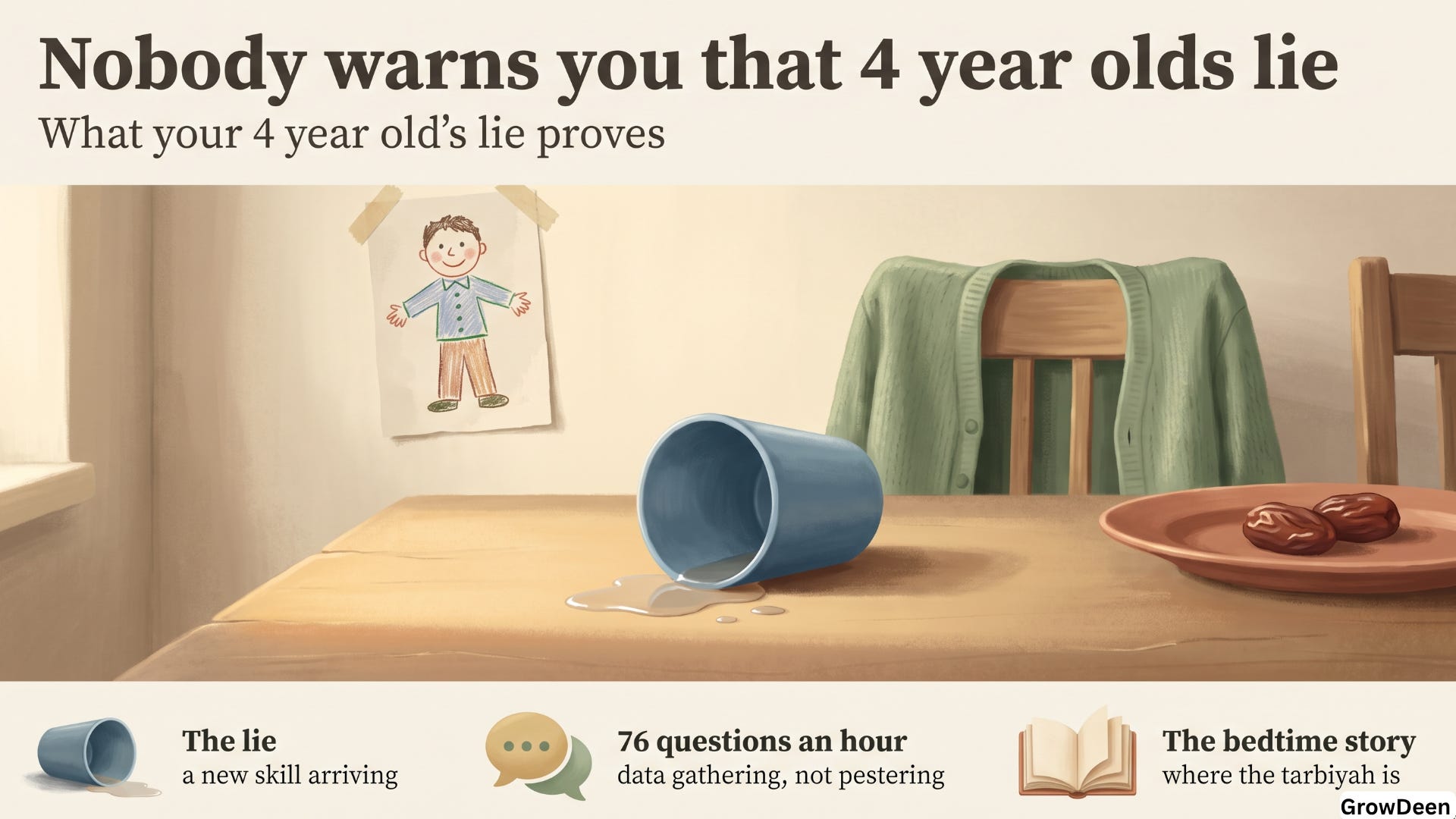
Your four year old just lied to your face.
Not a clever lie. A terrible one, told while standing beside the broken thing, with the evidence still in their hand. You asked once. They said no. You asked again and the story changed, and some cold little part of you thought: where did this come from?
You have raised this child carefully. You say Bismillah at the table and Alhamdulillah after. You have never let them watch anything with music in it. And here they are at four, inventing a version of events, and you are standing in your own kitchen wondering what you missed.
Here is the question to carry through the rest of this article, because the answer changes how you handle the next three years: why is the behaviour that frightens parents most at this age the same behaviour researchers use to measure how well a child's brain is developing?
What makes this guide different
Every claim here is tied to a named source and year, from the CDC's milestone tables to Talwar and Lee's 2008 study in Child Development on what lying actually requires of a child's brain. [2][3][4]
This decodes behaviour instead of listing worries, and it rests on the Islamic principle that a child who does not yet carry accountability is in a season of teaching.
You already have the free Worry Decoder Kit from the top of this page, so the scripts and the warning-sign list are in your hand while you read.
Why does my four year old suddenly lie?
Start with the thing that worries you most, because it is the clearest example of the pattern this whole article runs on.
Researchers test this with something called the temptation resistance paradigm. A child is left alone in a room with a toy and told not to look. Most children over four look. Most then say they did not. [2]
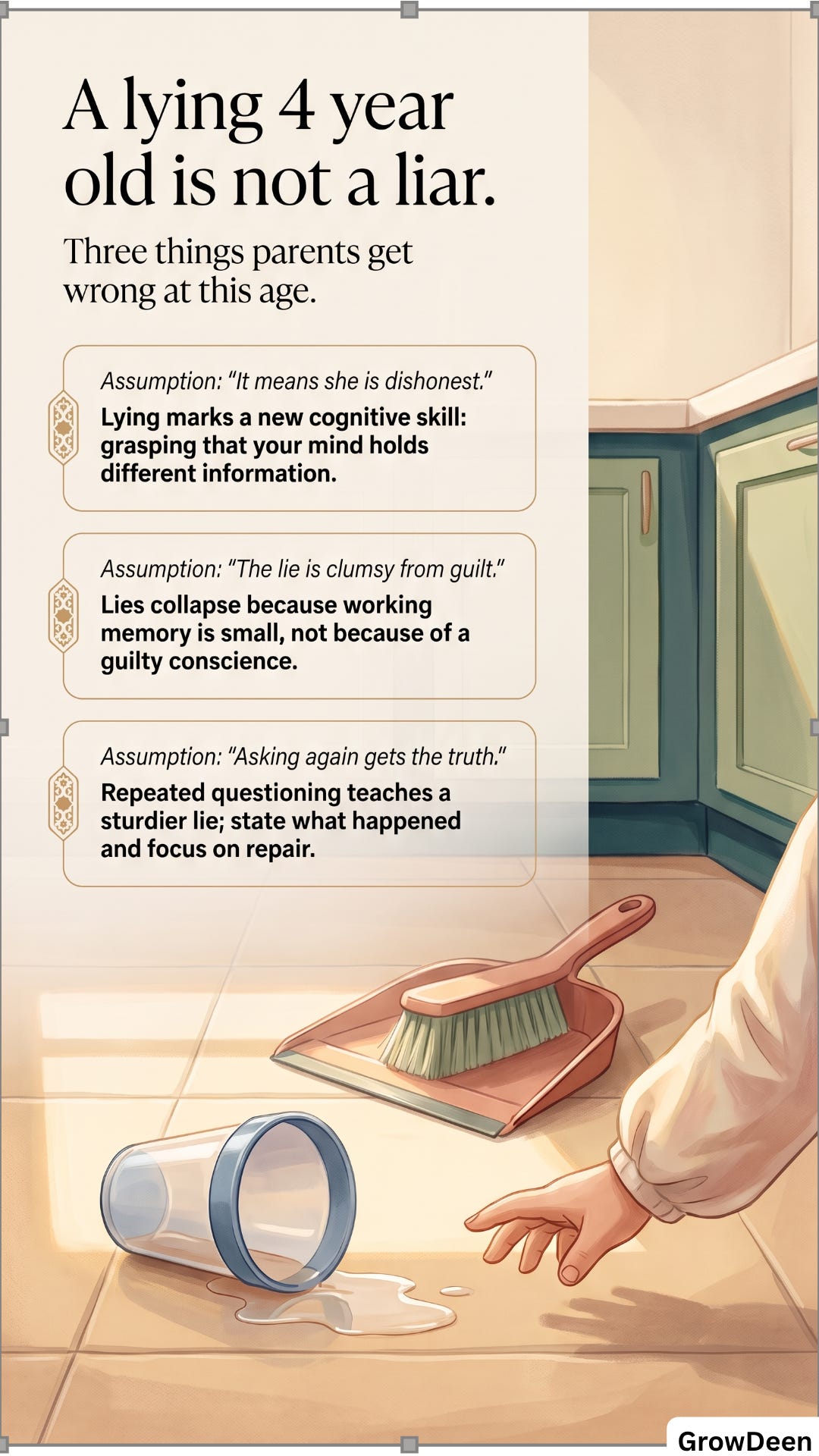
What makes the finding useful is what predicts it. Whether a child lies, and whether they can hold the lie together under questioning, tracks their scores on inhibitory control, working memory, and false-belief understanding. [2][5] In plainer language: your child could not lie to you until they worked out that your mind contains different things from theirs. That is a developmental achievement. It usually arrives somewhere around four, and it arrives whether or not anyone taught it.
They are also very bad at it. The lie falls apart inside two follow-up questions, because holding a false account steady while the true one keeps surfacing takes more working memory than a four year old has. [5] That clumsiness is not a sign of a guilty conscience. It is a sign of a new skill being used badly for the first time.
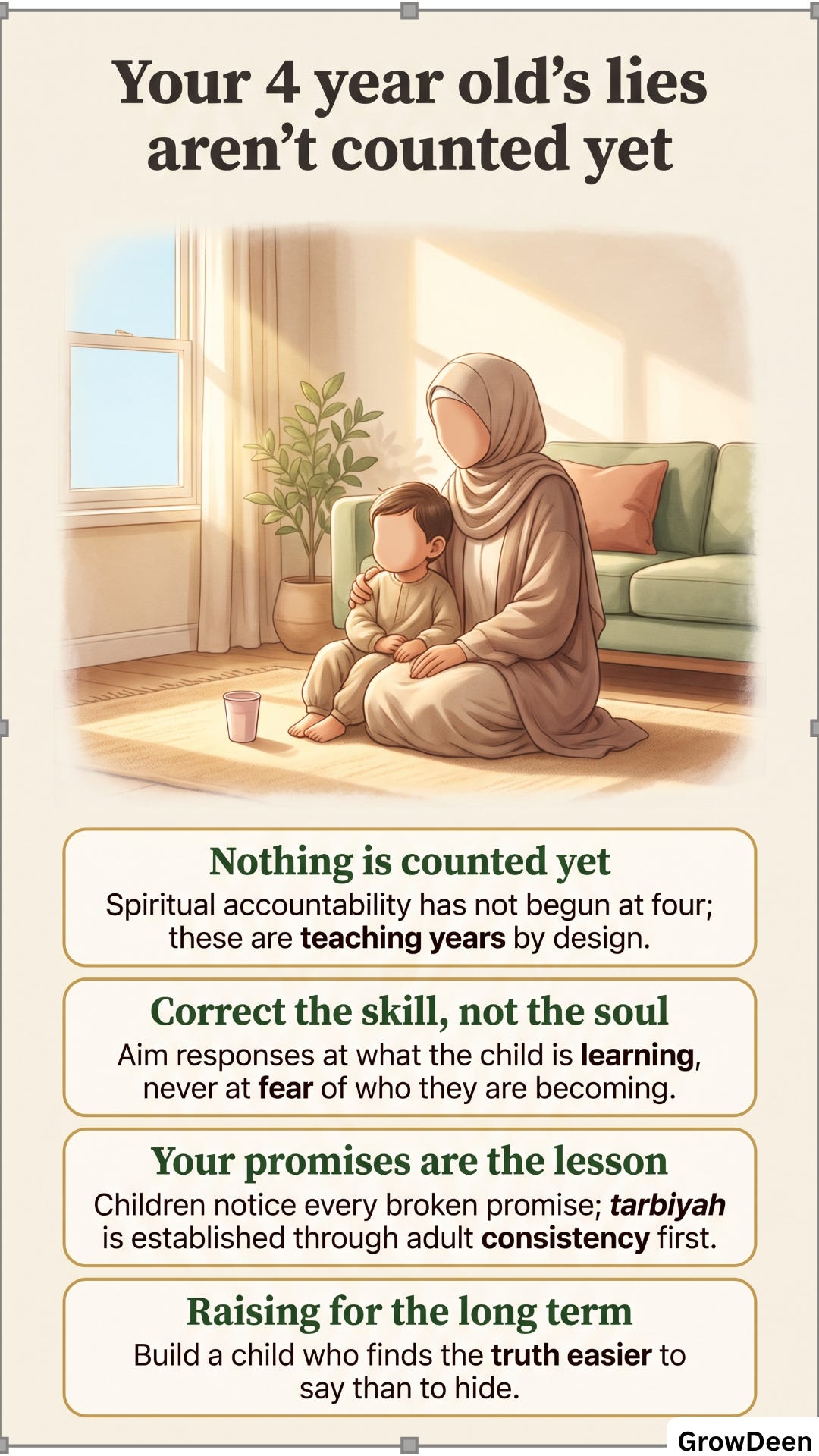
None of which makes lying acceptable. It changes what the response should be.
A child who gets interrogated and shamed learns one thing reliably: lie better next time. A child who is given a short, low-cost route back to the truth learns something different, which is that honesty is survivable in this house.
So, practically. Ask less. If you watched it happen, skip the question entirely and describe what you saw: "The cup is broken. Let's clean it up together." Thank your child out loud when they own something difficult, by name and by the specific thing. And watch your own small deceptions, because a four year old is now equipped to notice every one of them.
Islam takes truthfulness seriously enough that it is worth saying plainly: a child this age is not yet held to account. These years belong to teaching. What you are building shows up at fifteen, when your child finds it easier to tell you a hard thing than to hide it.
Why is my child talking to someone who isn't there?
The same pattern, wearing a different costume.
Around this age children start inventing: a friend who sits in the spare chair, a shop where the currency is dried chickpeas, an ambulance arriving at speed to treat a bear with a damaged foot. Some parents find the imaginary companion unsettling. A few worry it shades into dishonesty.
It does not. Pretend play is one of the better-studied inputs into early language, flexible thinking and emotional regulation, and the American Academy of Pediatrics treats it as serious developmental work rather than a reward for finishing the serious things first. [6][7] Children also use play to handle difficult material from a safe distance. A child who tells a teddy not to be frightened of the doctor is coaching themselves, out loud, in the third person.
What they are not doing is losing track of reality. By four they are actively sorting out where imagination ends, and the sorting is the point. [3][8]
The useful adult habit here is smaller than most parents expect. Ten minutes a day, where your child assigns you a role and you play it properly, in character, for the full ten minutes. Not supervising. Not on your phone at the edge of the rug. Playing. That beats an hour of being in the same room.
And when the invisible friend gets blamed for the broken cup, you have left the territory of imagination and arrived back at the previous section. Treat it the same way.
This is a lot to hold in your head while you are also making dinner. That is why the free Worry Decoder Kit exists: a translation card that puts each of these behaviours next to what it actually means and the one line to say in the moment. The download button is at the top of this page, and there's a full description of what's inside it below.
Why does my child ask the same question nine times?
Because they are not satisfied with the answer, and they have no social inhibition about saying so.
Michelle Chouinard's analysis of recorded parent and child conversation put preschoolers at an average of 76 information-seeking questions an hour. [1] The detail that matters more than the number is this: when a parent gives a thin or evasive answer, the child asks again, and keeps asking, until they get something usable. [1] That is the behaviour of someone gathering data, not someone filling silence.
Which reframes the question hour. You are not being pestered. You are being consulted.
Language is moving faster now than it will again for years. At four your child is running five and six word sentences and is understandable to you all of the time. By five the sentences stretch past nine words, the pronunciation sharpens, and a three-part instruction becomes workable: put the doll down, get the ball from under the chair, put it in the box. [3][4][9]
And they tell stories. Beginning, middle, a great deal of middle, ending. This is the single richest opening Muslim parents have, because the Prophetic stories are built for exactly this appetite. Yunus and the whale. Ibrahim and the stars. Yusuf and his brothers. A story told aloud by you, Qur'an recitation at a fixed hour of the day, an Islamic picture book at bedtime: these build vocabulary and attention in a way no screen reliably matches, and they attach the new words to something worth remembering.
Why is my child suddenly curious about bodies?
This one arrives without warning and sends a lot of Muslim parents straight to shame, which is the one tool guaranteed to work against them.
Around four and five, children notice bodies, their own and other people's, and may ask direct questions or want to look. They also start expressing and recognising gender through what they choose to wear and how they describe themselves. [3][4] Paediatric guidance is consistent that this curiosity belongs to ordinary childhood development. [10]
Haya is not installed by fright. It is cultivated, slowly, and at this age it is mostly physical and unglamorous. Changing clothes with the door closed. Knocking before going in. Naming private parts calmly and saying plainly that nobody looks at them or touches them except a parent helping or a doctor with a parent present. Noticing out loud, warmly, when your child covers themselves without being asked.
That last one does more than the other three combined, because it is the only one that attaches a good feeling to the behaviour.
If something about your child's behaviour still worries you, speak to a doctor or paediatrician rather than carrying it on your own.
So what actually builds all of this?
Less than you fear, and it is mostly conversation.
The Harvard Center on the Developing Child describes the mechanism as serve and return: the child does something, you respond, they respond to your response. [11][12] The connections strengthen because they got used, in company. The part adults skip is the waiting. A child points at a beetle. You look at the beetle, say something about the beetle, then stop talking long enough for them to say the next thing.
Beyond that, four things carry most of the weight at this age.
Give one real job. Carrying the dates to the table. Filling the jug for wudu. Four year olds want responsibility considerably more than they want help, and the instinct to do it faster yourself trades a minute of your time for a piece of their competence.
Get outside daily. The World Health Organization asks three and four year olds for at least 180 minutes of movement a day, sixty of it moderate to vigorous, with sedentary screen time held to an hour or less. [13] The number sounds impossible until you count what a preschooler does when nobody stops them. Let them climb something that looks slightly too high while you stand within reach.
Look into preschool where circumstances allow. A play-based setting supplies what a home cannot easily manufacture: peers who are not siblings, an adult who is not emotionally entangled with them, and daily practice at waiting, sharing, and recovering from small social defeats.
And let salah become familiar long before it becomes required. A child can learn where the prayer mat lives, what cold water feels like running down the arms, and that the adults in this house stop what they are doing when the adhan is called. Familiarity first. Everything after that is easier.
Support Muslim Parenting Lab ❤️
Worried that giving will leave you with less? Give an amount you will not feel, with the button below.
The Prophet ﷺ said charity does not decrease wealth. (Sahih Muslim 2588)
Why Allah answered a request for stories
Storytelling gets treated as the soft part of the day, the bit that happens once the real learning is finished. The Qur'an itself suggests otherwise.
Ibn Kathir, recording a report of Ibn Jarir at-Tabari on the authority of Ibn 'Abbas, relates that the companions said to the Prophet ﷺ: why not narrate to us stories? This verse came down in response: "We relate to you, [O Muhammad], the best of stories in what We have revealed to you of this Qur'an although you were, before it, among the unaware." [14] What followed was the longest sustained narrative in the Qur'an.
A request for story was not redirected toward something more serious. It was answered with revelation.
Commenting on the same phrase where it recurs in Surah al-Qasas, Ibn Kathir explains it to mean that Allah relates events as they really were, as though the listener were present and watching them happen. [14] That is the exact appetite your four year old brings to you at bedtime. The wish to be inside something and see it.
So the twentieth retelling of Yusuf and his brothers, mangled and interrupted and full of questions about the well, is where the tarbiyah is already happening. The researchers calling narrative the engine of early literacy, and the Qur'an choosing story as the vehicle for guidance, arrived at the same place from opposite directions.
When the worry is not a milestone
Everything above says the same thing: the behaviour that worries you is usually the milestone. But not always, and a guide that never draws the line is useless.
You know your child better than any chart does. Speak to a doctor or child health professional if you notice any of the following. [3][4][9][15]
At four years: trouble seeing or hearing; sentences shorter than four words; no account of their day; cannot follow a two-part instruction such as putting the doll down and picking up the ball; does not know any colours; does not pretend during play; still has tantrums over very small things, or clings and cries when you leave, well beyond what is usual for them; shows no sign of comforting somebody who is hurt or sad; seems frightened, anxious or sad much of the time; trips often, struggles to hold a pencil or crayon, cannot draw a circle or a cross, or finds eating, dressing or toileting difficult.
At five years: trouble seeing or hearing; cannot follow a multi-step instruction; cannot hold a conversation, meaning the turn-taking of talking, listening and replying; does not play with other children, or plays very aggressively; shows no empathy; seems afraid, unhappy or sad much of the time; cannot stay with a single activity for more than a few minutes; does not pretend during play; is clumsy, struggles with small objects, cannot draw a circle or a square, or finds eating, dressing or toileting difficult.
See a professional if your child loses a skill they previously had.
Development follows a similar order in most children while arriving at different speeds, so the question is rarely whether your child is behind a chart. It is whether something has stalled or gone backwards. An opinion costs very little and occasionally changes a great deal.
Here's the answer to the question planted at the top. Lying frightens parents because it looks like a moral failure, and it interests researchers because it is the clearest external proof that a four year old can now hold two versions of reality at once. Same behaviour. Two readings. Yours is the one that decides what your child learns from it.
The behaviour that worries you is the milestone.
The Worry Decoder Kit
If you have read this far, you are the kind of parent who wants to understand what your child is doing before deciding how to respond. That instinct is the whole thing.
Inside the Worry Decoder Kit (one comprehensive PDF, 3 pages):
Page 1: The Worry Translator. Six behaviours that alarm parents at four and five, set beside what each one actually signals developmentally and the exact sentence to say in the moment. Designed as a laminated reference card you can keep on the fridge or inside a kitchen cupboard door.
Page 2: The Four and Five Year Check. Every warning sign from the CDC and Sheridan milestone guidance, laid out as tick boxes split by age, with the lost-skill rule at the bottom. Fill it in over ten quiet minutes and walk into an appointment with something specific in hand.
Page 3: Why Allah Chose a Story. The verse Allah revealed when the companions asked the Prophet ﷺ for stories, with Ibn Kathir's explanation of what it means, plus a five-step Prophetic storytelling routine for bedtime that needs no book and no preparation.
This isn't just a PDF to download and forget. It's a tool designed to stay on your fridge, where you'll actually use it when you need it most.
This Worry Decoder Kit is what every subscriber receives with each article. We cover the full arc of raising Muslim children, from newborns to school age, all backed by research and rooted in Islamic guidance.
Before you close this tab
Pick one story tonight. Yunus in the whale is the shortest. Tell it badly, in your own words, with the lights off. Let your child interrupt nine times. That is the whole exercise.
May Allah place barakah in your effort and make the care you give more protective and more rewarded than it feels in the moment.
Share this with someone who needs it
Think of one person right now: the sister at the masjid who told you her four year old has started lying and she doesn't know what she's done wrong, a cousin whose preschooler has an invisible friend she's quietly worried about, a friend who answers the same question eleven times a day and is running out of patience.
This article could change what they do tonight. Send it to them today. Sometimes the kindest thing you can do for another parent is tell them the frightening thing is normal.
Frequently asked questions
Q: Is it normal for a 4 year old to lie?
A: Yes, and it usually starts right around four. Research using the temptation resistance task found most children over four will peek at a forbidden toy and then deny it, and whether they lie tracks their inhibitory control and false-belief understanding rather than their character. [2][5] For what to do in the moment, see "Why does my four year old suddenly lie?" above.
Q: Should I worry about my child's imaginary friend?
A: No. Imaginary companions are common at this age and sit inside normal pretend play, which research links to language, flexible thinking and emotional regulation. [6][7] The one time to step in is when the invisible friend starts getting blamed for things, because that is a separate conversation about honesty.
Q: How many words should a 5 year old say in a sentence?
A: By five, most children are using sentences of around nine words or more and can follow multi-step instructions. [3][9] At four, five or six words is typical and you should be able to understand everything they say.
Q: How much physical activity does a 4 year old need?
A: The WHO asks for at least 180 minutes of movement a day for three and four year olds, with at least sixty minutes of it moderate to vigorous, and screen time held to an hour or less. [13] Most of that happens on its own if you get them outside and stop intervening.
Q: What should I do when my child is curious about private parts?
A: Answer calmly and briefly, use correct names, and give the rule instead of a reaction: nobody looks at or touches these except a parent helping or a doctor with a parent present. Paediatric guidance treats this curiosity as a normal part of early development. [10] Shame teaches secrecy, which is the opposite of what protects a child.
Q: When should I see a doctor about my 4 year old's development?
A: Book an appointment if your child does not pretend during play, cannot follow a two-part instruction, does not know any colours, shows no sign of comforting someone upset, or has lost a skill they previously had. [3][15] The full list for both ages is in "When the worry is not a milestone" above, and on page 2 of the free kit.
References
[1] Chouinard, M.M. (2007). Children's questions: A mechanism for cognitive development. Monographs of the Society for Research in Child Development, 72(1), 1-112.
[2] Talwar, V., & Lee, K. (2008). Social and cognitive correlates of children's lying behavior: Conceptual understanding of lying, executive functioning, and false beliefs. Child Development, 79(4), 866-881.
[3] Centers for Disease Control and Prevention. Important milestones: Your child by four years.
[4] Centers for Disease Control and Prevention. Important milestones: Your child by five years.
[5] Leduc, K., Williams, S., Gomez-Garibello, C., & Talwar, V. (2017). The contributions of mental state understanding and executive functioning to preschool-aged children's emerging lie-telling. British Journal of Developmental Psychology, 35(2), 288-302.
[6] Yogman, M., Garner, A., Hutchinson, J., Hirsh-Pasek, K., Michnick Golinkoff, R., et al. (2018). The power of play: A pediatric role in enhancing development in young children. Pediatrics, 142(3), e20182058.
[7] Skolnick Weisberg, D. (2015). Pretend play. WIREs Cognitive Science, 6(3), 249-261.
[8] Taylor, M., Sachet, A.B., Maring, B.L., & Mannering, A.M. (2013). The assessment of elaborated role-play in young children: Invisible friends, personified objects, and pretend identities. Social Development, 22(1), 75-93.
[9] Sharma, A., Cockerill, H., & Sanctuary, L. (2022). Mary Sheridan's from birth to five years: Children's developmental progress (5th edn). Routledge.
[10] American Academy of Pediatrics, HealthyChildren.org. Sexual behaviors in young children: What's normal, what's not.
[11] National Scientific Council on the Developing Child (2004). Young children develop in an environment of relationships: Working paper No. 1. Center on the Developing Child at Harvard University.
[12] Center on the Developing Child at Harvard University (2017, updated 2021). Three principles to improve outcomes for children and families.
[13] World Health Organization (2019). Guidelines on physical activity, sedentary behaviour and sleep for children under 5 years of age.
[14] Qur'an, Surah Yusuf 12:3 — with Tafsir Ibn Kathir on Surah Yusuf 12:1-3 and on Surah al-Qasas 28:3. Source
[15] Zubler, J.M., Wiggins, L.D., Macias, M.M., et al. (2022). Evidence-informed milestones for developmental surveillance tools. Pediatrics, 149(3), e2021052138.