

Doubling a preschooler’s serving raised lunch intake by 25%, and the children never noticed the plate had changed (Fisher, Rolls and Birch, 2003). [1] Two table habits change that tonight.
A printable pack you can fill in with a pen while the kettle boils - free!
The plate came back empty.
Not because your four year old was hungry. Because you put more on it than you did last Tuesday, and something in a small child stops counting once the plate becomes the measure.
Now flip it. Last week the same child pushed away half a bowl of the same food, and you heard yourself doing the thing you swore you would stop doing. Three more spoons. No fruit until that’s finished. Then the quiet afterwards, the plate scraped into the bin, the low hum of having handled it badly again.
Here is the strange part. Both nights, your child’s appetite was doing roughly what it always does. What changed was you, and neither time did it have anything to do with what you said.
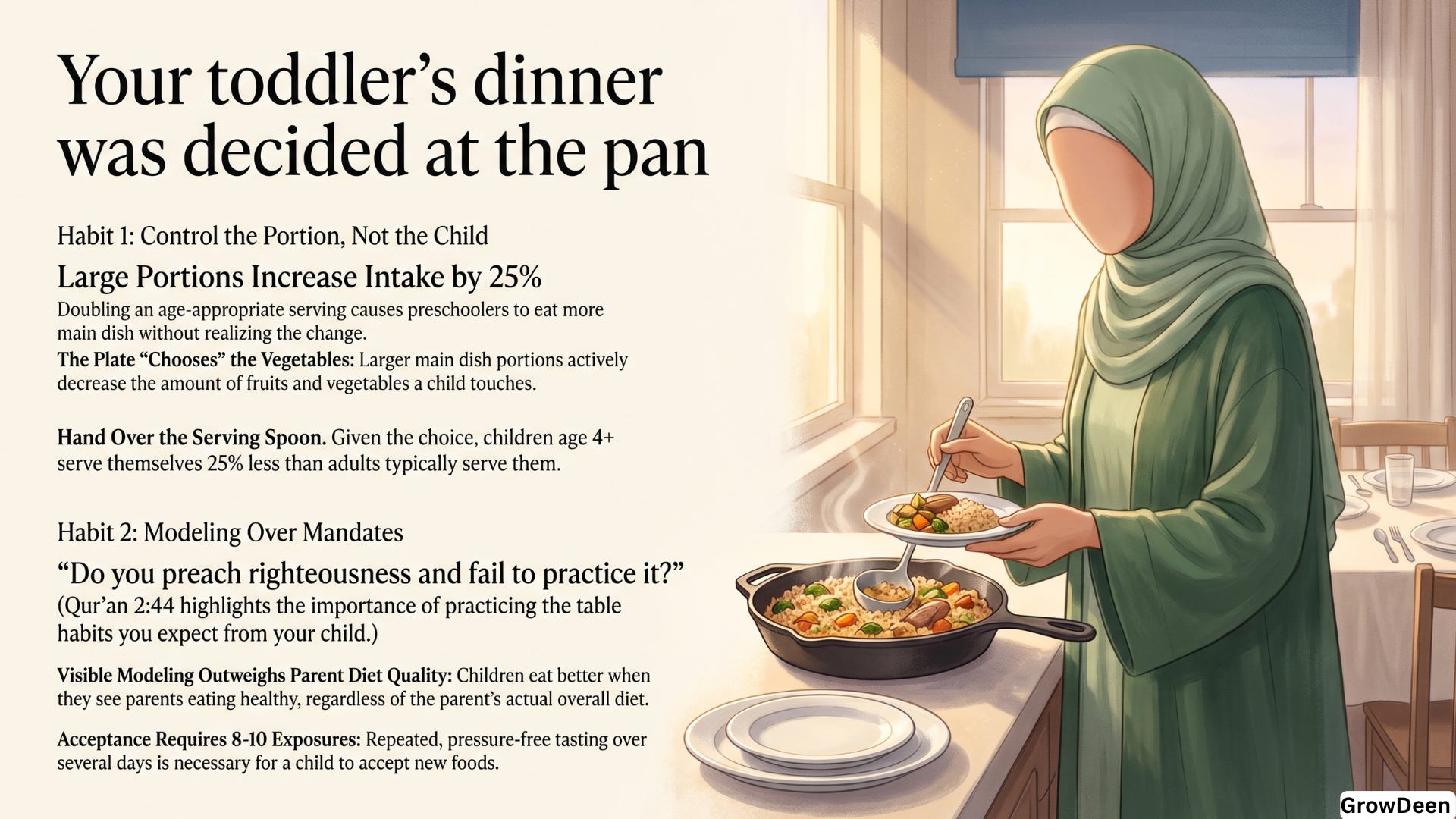
When researchers doubled an age-appropriate serving of a main dish for preschoolers, the children ate 25% more of it and took in 15% more energy at that meal, and observation showed they were largely unaware the portion had changed at all. [1] Nobody told them to eat more. Nobody made them hungrier.
So here is the question worth carrying through the rest of this article: if your child’s intake shifted by a quarter without a single word from you, what exactly have all those words been doing?
Why this guide is different from generic healthy eating advice
Every claim here comes from peer-reviewed feeding research, most of it from the same Penn State and Baylor teams who ran the portion-size experiments, plus current CDC and NHS guidance. [1][2][3][4][8][9][11]
The Islamic frame is not decoration. The Qur’an addresses the exact failure this article is about, which is telling other people to do what you are not doing, and Tafsir Ibn Kathir treats it directly. [12]
You will get a free Watched Table Companion Pack to print and keep on the fridge, so the two habits survive a bad evening when your memory will not.
Why your child ate more without being hungrier
Picture the moment you serve dinner. You are tired, you want it eaten, so you put down a decent amount. Generous feels kind. Generous feels like the opposite of stingy.
That instinct is the one the research keeps catching out.
In the study above, the increase came entirely from bigger bites of the main dish, and the children did not compensate by eating less of anything else at the table. [1] When the same children were handed the serving spoon and allowed to serve themselves, they took 25% less than the large portion an adult had given them. [1]
Read that again. Given the choice, a preschooler served themselves a quarter less food than an adult decided they needed.
There is a second finding that matters more for the vegetables you keep putting on the plate and keep scraping off it. When researchers ran a range of entrée portions with three to six year olds, increasing the main dish pushed up how much of the entrée the children ate and pushed down how much of the fruit and vegetables served alongside it they touched. [2] The bigger the pasta, the less the green beans. The plate was doing the choosing.
So the first habit is small and boring and it works: put down less than you think, and let your child ask for more. A second helping given on request is not the same experience as a large plate placed in front of a child at the start.
The age when the plate starts to win
This does not arrive on day one. It has a turn.
In one experiment, doubling a serving raised intake in five year olds and left three year olds unaffected. [3] The younger children were still steering by what their own body told them. Somewhere around four or five, the outside of the plate starts to overrule the inside of the child, and it never fully stops.
That gives you a window. If your child is under four, protect the internal signal by staying out of the way. If they are past it, the serving spoon becomes the tool, and handing it to them is the single easiest thing on this page.
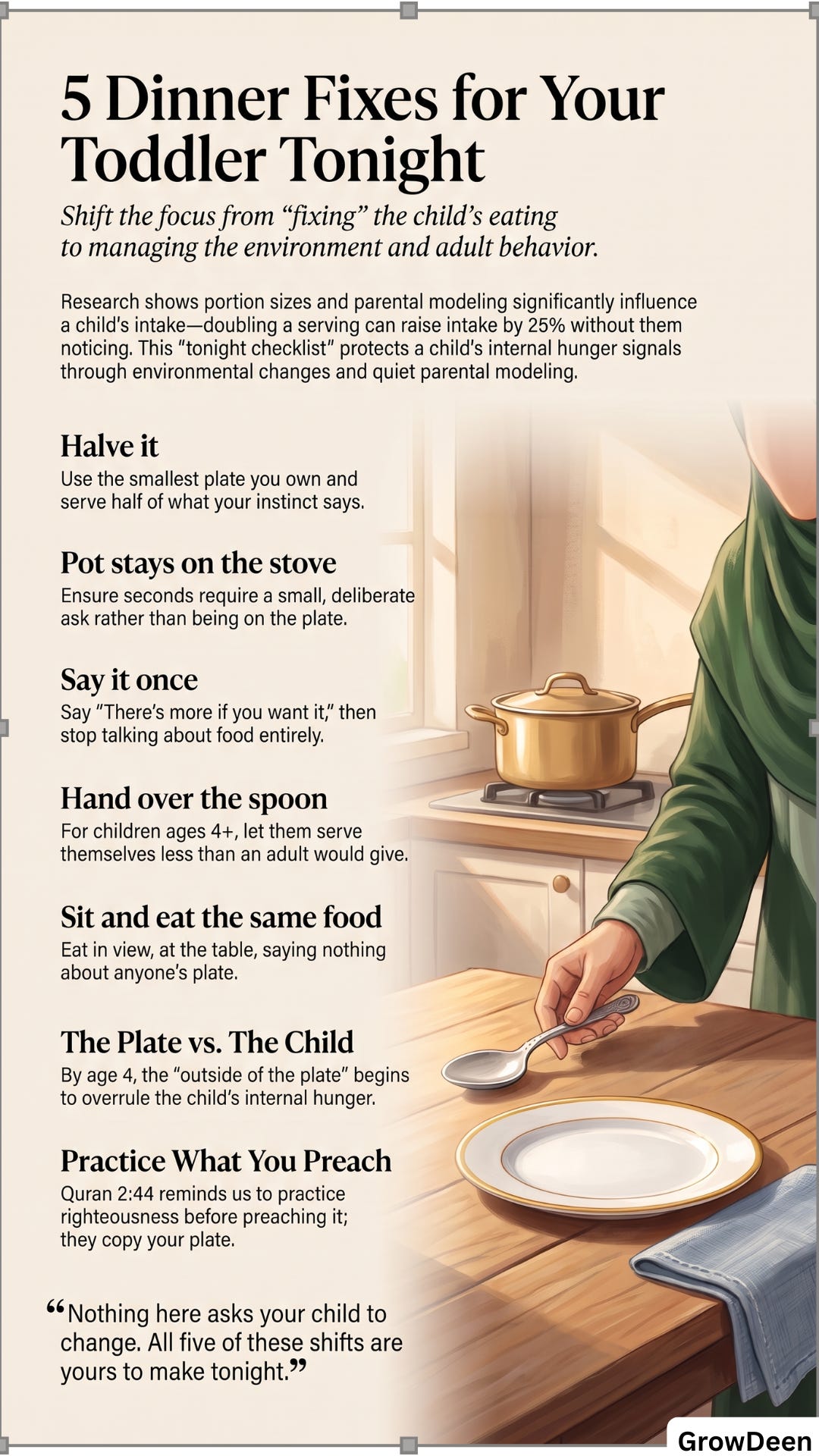
Something for the fridge, before you forget all of this
None of this is complicated. It is just hard to remember at 6:15pm with a hungry child and a pan that needs draining.
That’s why there’s a free Watched Table Companion Pack, a printable set built for the fridge door rather than the bookmarks folder. The download button is at the top of this page, and there’s a full description of what’s inside it below.
What the Qur’an says about telling children what you are not doing
You have said it. Every parent has. “Eat your vegetables,” delivered across a table where your own vegetables are sitting untouched, and something in you knows the sentence has no weight even as it leaves your mouth.
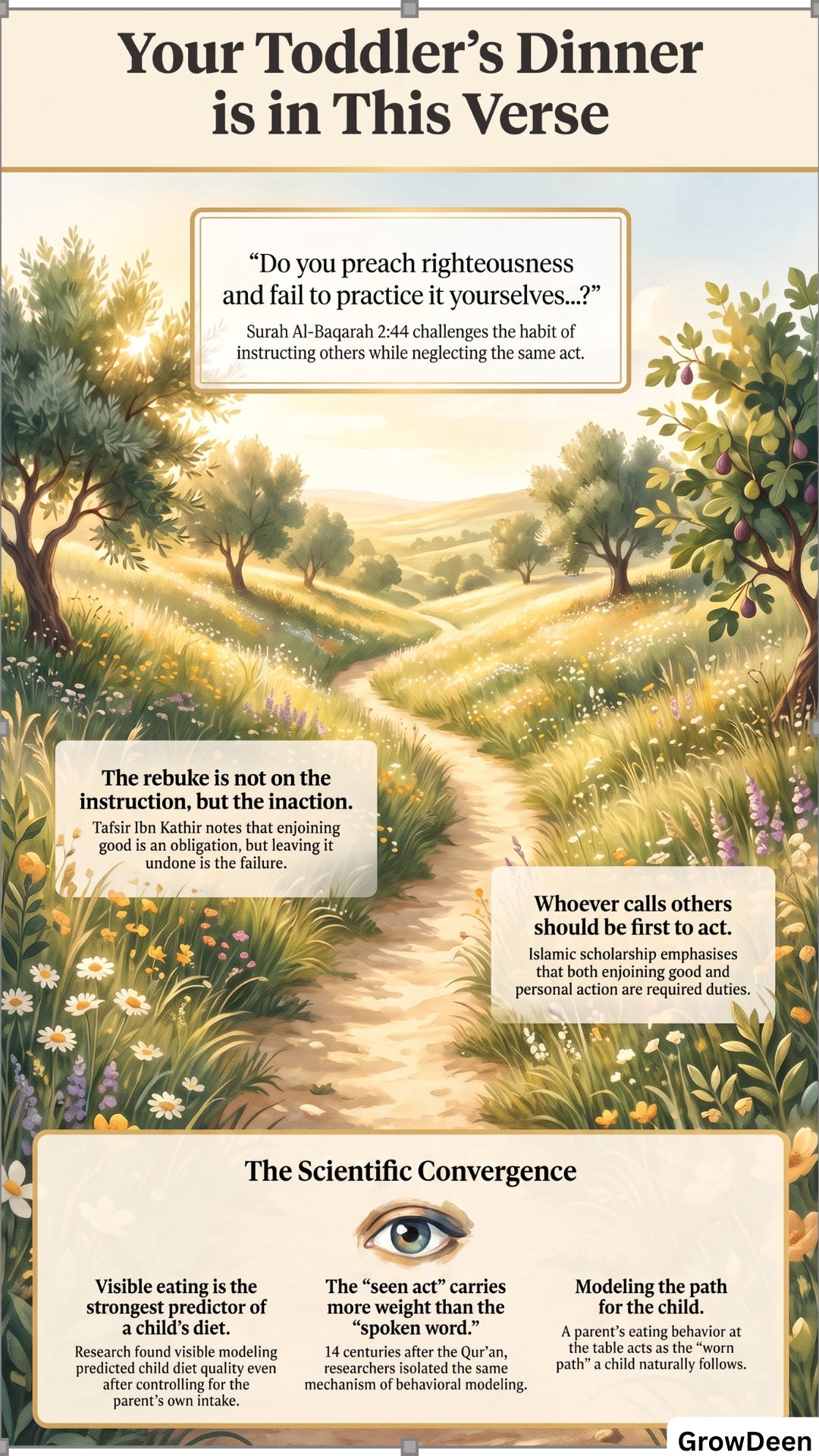
Allah says: “Do you preach righteousness and fail to practice it yourselves, although you read the Scripture? Do you not understand?” [Qur’an 2:44] [12]
According to Tafsir Ibn Kathir, this passage condemns commanding others to righteousness while neglecting it in yourself. He is careful with the boundary. Allah is not criticising them for enjoining good, because enjoining good is itself an obligation. Ibn Kathir relays the ruling that whoever commands people to righteousness should be among the first to act on it, and concludes that both are required, and neither one excuses the absence of the other. [12]
Which means the instruction to your child is not the problem. Saying it while your own plate contradicts you is.
The Prophet ﷺ taught the manners of the table by holding them himself. Abu Juhayfah reported that the Messenger of Allah ﷺ said, “I do not take my meals while leaning.” [Sahih al-Bukhari 5398] [13] Al-Bukhari placed it in his Book of Foods, in a chapter on eating posture. Notice the wording. It is a description of his own practice at his own meal, and the household adab followed from what he did.
They copy your plate, not your instructions.
The research says the same thing, and it is more specific than you’d expect
One study pulled apart two things parents usually treat as the same: whether the parent visibly modelled healthy eating in front of the child, and what the parent’s own diet quality actually was. Visible modelling predicted better child diet quality even after the parent’s own intake was accounted for, and children of high-modelling parents ate well regardless of how well that parent themselves ate. [4]
The seen act carried the weight. Eating the salad standing at the counter while the children eat at the table does nothing. Eating it at the table, where they can see you, does.
And it runs the other way too. If the adults groan about the lentils on Monday, the four year old will groan about the lentils by Thursday, and no one taught them to.
So what does this actually look like at 6pm on a Tuesday?
Serve less than feels right. Half of what your instinct says, on a smaller plate, with the pot still on the stove.
Say “there’s more if you want it” once, at the start, and then stop talking about the food entirely.
Hand over the serving spoon if your child is four or older. Children given the spoon serve themselves smaller amounts than adults give them. [7] Let them build their own plate, even badly.
Sit down and eat the same thing they are eating, in view, without commentary on anyone’s plate including your own.
Say Bismillah out loud where they can hear it, and Alhamdulillah at the end, whatever got eaten in between.
That’s the whole practice. Two habits, both of them yours, neither of them a sentence directed at your child.
Two things that quietly undo all of it
Trading sweets for vegetables. It raises the standing of the sweet and lowers the standing of the vegetable, which is why NHS services advise against food as a reward and suggest a sticker or extra play instead. [11] Praise the trying and leave the finishing alone.
Cooking a substitute meal after a refusal. A child who learns that refusal opens a menu has every reason to keep refusing, and it removes the repeated, low-pressure exposure that acceptance actually needs.
On that last point, be patient far past the point where patience feels reasonable. The CDC notes a young child may need eight to ten exposures before they will even try something unfamiliar [8], and a systematic review of the evidence found that repeated, pressure-free tasting across eight to ten days or more raises acceptance in infants and toddlers. [9] The courgette your child rejected on Monday was not a failure. It was exposure four of eleven.
Sabr is the operating principle here, and it is the least visible work you will do all week.
When to stop troubleshooting and call a doctor
Speak to a doctor, paediatrician or dietitian if you notice weight loss, growth that has slowed or flattened, or refusal of whole food groups continuing for several weeks. The same applies if there is pain, vomiting, gagging or difficulty swallowing at meals, or if your child accepts only a very small number of foods and becomes distressed by unfamiliar textures. Persistent tiredness or paleness is worth a professional opinion too.
This article does not replace medical advice. Follow your doctor’s guidance for your own child.
The Watched Table Companion Pack
If you have read this far, you are the kind of parent who keeps looking for a better way instead of settling for the evening you had last night. That says something about you.
Inside the Watched Table Companion Pack (one comprehensive PDF, 3 pages):
Page 1: The Seven-Day Watched Table Log. A tracker that records what your child saw you eat at each meal, rather than what your child ate. Seven days, three meal columns, one tick box per adult. Designed as a fridge-door log you can fill in with a pen while the kettle boils.
Page 2: The First-Serving Reset Card. The serve-small-then-offer-seconds routine written as five steps, with the age turn marked so you know whether your child is still steering by their own hunger or by the plate. So you can change one habit tonight, in under fifteen minutes.
Page 3: The Parent’s Plate Card. Qur’an 2:44 with Ibn Kathir’s reading of it, alongside the narration of the Prophet ﷺ describing his own eating posture, set out as a short table-side reminder about modelling rather than instructing. Something to keep where you can see it at the moment you are most tempted to say “three more spoons.”
This isn’t just a PDF to download and forget. It’s a tool designed to stay on your fridge, where you’ll actually use it when you need it most.
This Watched Table Companion Pack is what every subscriber receives with each article. We cover the whole span of raising Muslim children, all backed by scientific research and rooted in Islamic wisdom.
If you’re a Muslim parent who wants both evidence-based guidance and Islamic perspective, subscribe free so future resources arrive in your inbox before you need them.
Subscribe free for parenting resources backed by both science and Sunnah. No spam, no clutter, just resources that matter.
Do this before dinner tonight
Go to your cupboard and take out the smallest plate you own. That’s your child’s plate this evening. Serve half of what your instinct says, put the pot back on the stove, and say the words “there’s more if you want it” exactly once.
That’s it. That’s the whole experiment.
May Allah place barakah in the food you set down, accept the patience it costs you, and make the table a place your children remember as peaceful.
Share this with someone who needs it
Think of one person right now: the sister who told you her three year old “eats nothing,” the friend whose evenings end with a scraped plate and a knot in her stomach, the cousin who is still doing the three-more-spoons negotiation every single night because nobody has told her there is another way.
Send this to her today. Not as advice, and not as a correction, but because you both know that evening and she does not have to keep having it.
Frequently Asked Questions
Q: How much should a 3 year old actually eat at a meal?
A: Less than you think, and it changes daily. Your job is what goes on the plate and when, and your child’s job is how much of it goes down. Serve a small portion and offer seconds, because children this age served larger portions eat more of the main dish and less of the vegetables beside it. [2] More on this in “Why your child ate more without being hungrier” above.
Q: Should I make my child finish their plate?
A: No. Clean-plate rules tie meal size to the plate rather than to fullness, and the research shows the plate is already the stronger signal by around age five. [3] Let the plate be small instead, and let your child decide when they’re done.
Q: How many times do I have to offer a food before my child will eat it?
A: The CDC’s guidance is eight to ten exposures before a young child will even try something unfamiliar [8], and reviewed evidence supports repeated pressure-free tasting over eight to ten days or more. [9] For some children it takes considerably longer, and that’s still normal.
Q: Is it okay to use dessert as a reward for eating vegetables?
A: It backfires. Trading a sweet for a vegetable raises the value of the sweet and lowers the value of the vegetable, which is why NHS services recommend a non-food reward like a sticker or extra play. [11] Praise the trying rather than the finishing.
Q: What is the division of responsibility in feeding?
A: The adult decides what food is offered, when it’s offered and where the child eats it. The child decides whether to eat and how much. It’s treated as best practice by the American Academy of Pediatrics and the Academy of Nutrition and Dietetics. [5][6]
Q: Do family meals really make a difference, or is that just something people say?
A: An umbrella review of forty one systematic reviews found that more frequent family meals protect children and adolescents against poorer diet quality, obesity and poorer wellbeing. [10] The Sunnah already points families toward the shared meal, so this is one of those places where the research and the guidance land in the same spot.
Q: My child eats well at nursery and badly at home. Why?
A: Usually because nursery serves small standard portions, adults eat alongside the children, and nobody comments on individual plates. All three of those are things you can copy at home this week, and none of them require your child to change anything.
References
[1] Fisher, J.O., Rolls, B.J., & Birch, L.L. (2003). Children’s bite size and intake of an entrée are greater with large portions than with age-appropriate or self-selected portions. The American Journal of Clinical Nutrition, 77(5), 1164-1170. https://pmc.ncbi.nlm.nih.gov/articles/PMC2530925/
[2] Savage, J.S., Fisher, J.O., Marini, M., & Birch, L.L. (2012). Serving smaller age-appropriate entrée portions to children aged 3-5 y increases fruit and vegetable intake and reduces energy density and energy intake at lunch. The American Journal of Clinical Nutrition, 95(2), 335-341. https://doi.org/10.3945/ajcn.111.017848
[3] Rolls, B.J., Engell, D., & Birch, L.L. (2000). Serving portion size influences 5-year-old but not 3-year-old children’s food intakes. Journal of the American Dietetic Association, 100(2), 232-234. https://doi.org/10.1016/S0002-8223(00)00070-5
[4] Vaughn, A.E., Martin, C.L., & Ward, D.S. (2018). What matters most, what parents model or what parents eat? Appetite, 126, 102-107. https://pmc.ncbi.nlm.nih.gov/articles/PMC5971159/
[5] Ellyn Satter Institute. The Satter Division of Responsibility in Feeding. https://www.ellynsatterinstitute.org/how-to-feed/division-of-responsibility/
[6] Loth, K.A., et al. A qualitative exploration into the parent-child feeding relationship: how parents of preschoolers divide the responsibilities of feeding with their children. Journal of Nutrition Education and Behavior. https://pmc.ncbi.nlm.nih.gov/articles/PMC6062462/
[7] Savage, J.S., Haisfield, L., Fisher, J.O., Marini, M., & Birch, L.L. (2012). Do children eat less at meals when allowed to serve themselves? The American Journal of Clinical Nutrition, 96(1), 36-43. https://doi.org/10.3945/ajcn.112.035261
[8] Centers for Disease Control and Prevention. Picky Eaters and What to Do. Infant and Toddler Nutrition. https://www.cdc.gov/infant-toddler-nutrition/foods-and-drinks/picky-eaters.html
[9] U.S. Department of Agriculture, Nutrition Evidence Systematic Review. Repeated Exposure to Foods and Early Food Acceptance: A Systematic Review. https://www.ncbi.nlm.nih.gov/books/NBK582166/
[10] Snuggs, S., & Harvey, K. (2023). Family mealtimes: a systematic umbrella review of characteristics, correlates, outcomes and interventions. Nutrients, 15(13), 2841. https://doi.org/10.3390/nu15132841
[11] Kingston and Richmond NHS Foundation Trust. Selective eating in children. https://www.kingstonandrichmond.nhs.uk/patients-and-families/patient-leaflets/selective-eating-children
[12] Qur’an, Surah Al-Baqarah 2:44, https://quran.com/2/44, with Tafsir Ibn Kathir, https://quran.com/en/2:44/tafsirs/en-tafisr-ibn-kathir
[13] Sahih al-Bukhari 5398, Narrated by Abu Juhaifa, Graded: Sahih, https://sunnah.com/bukhari:5398