

The 2016 global rickets consensus found that 400 IU of vitamin D daily prevents rickets in 97% of infants, yet the sunlight most families rely on delivers almost nothing for four to six months of the year above 37 degrees latitude. [1] This guide shows you which door to use when the sun closes, and why using it is not a failure.
You did everything right.
Milk at breakfast. Yoghurt in the lunchbox. Sardines on toast, even though only one of your children will eat them. Cheese cubes handed over at four in the afternoon because someone is always hungry at four in the afternoon.
And your five year old still says her legs ache at bedtime.
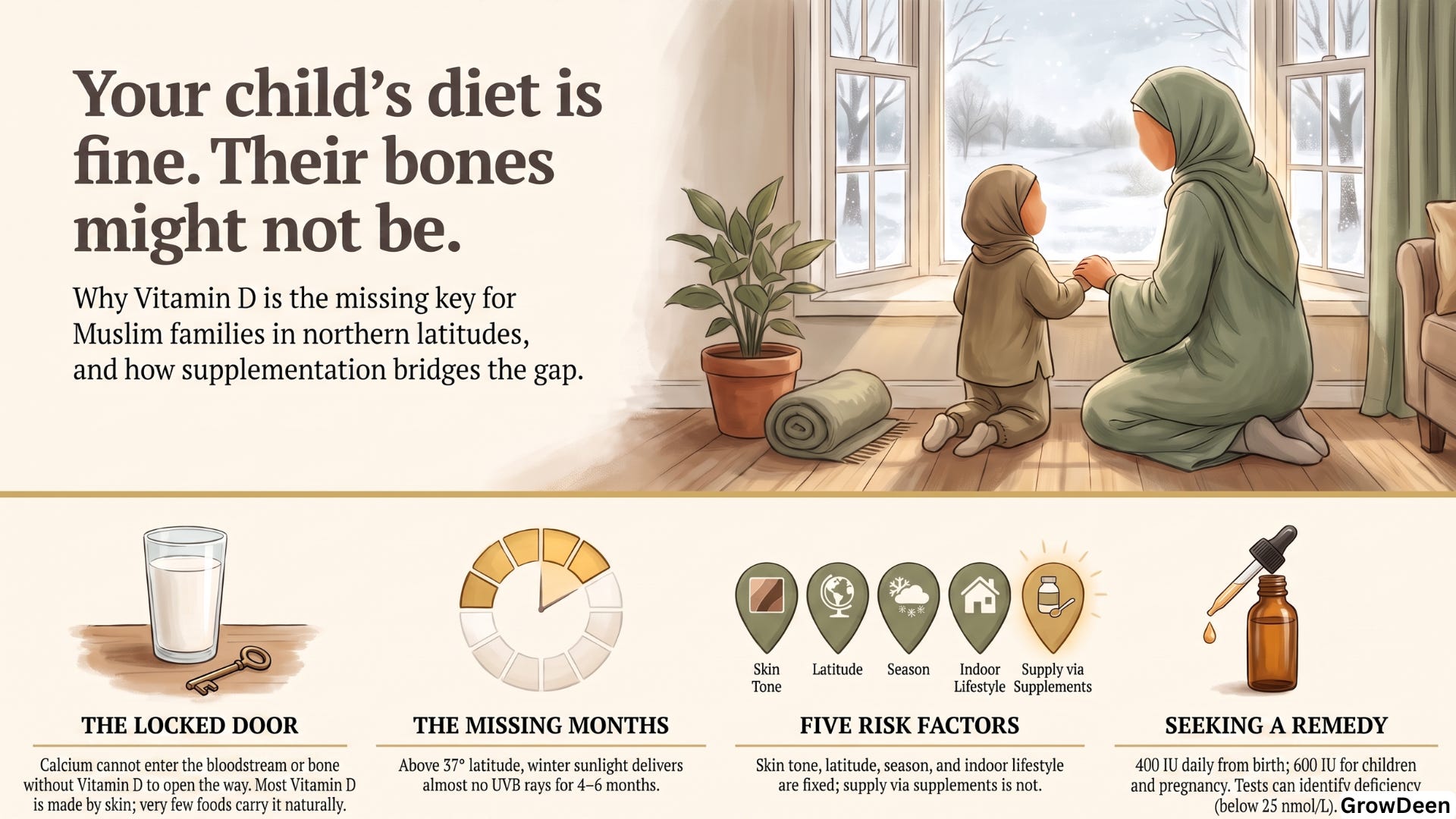
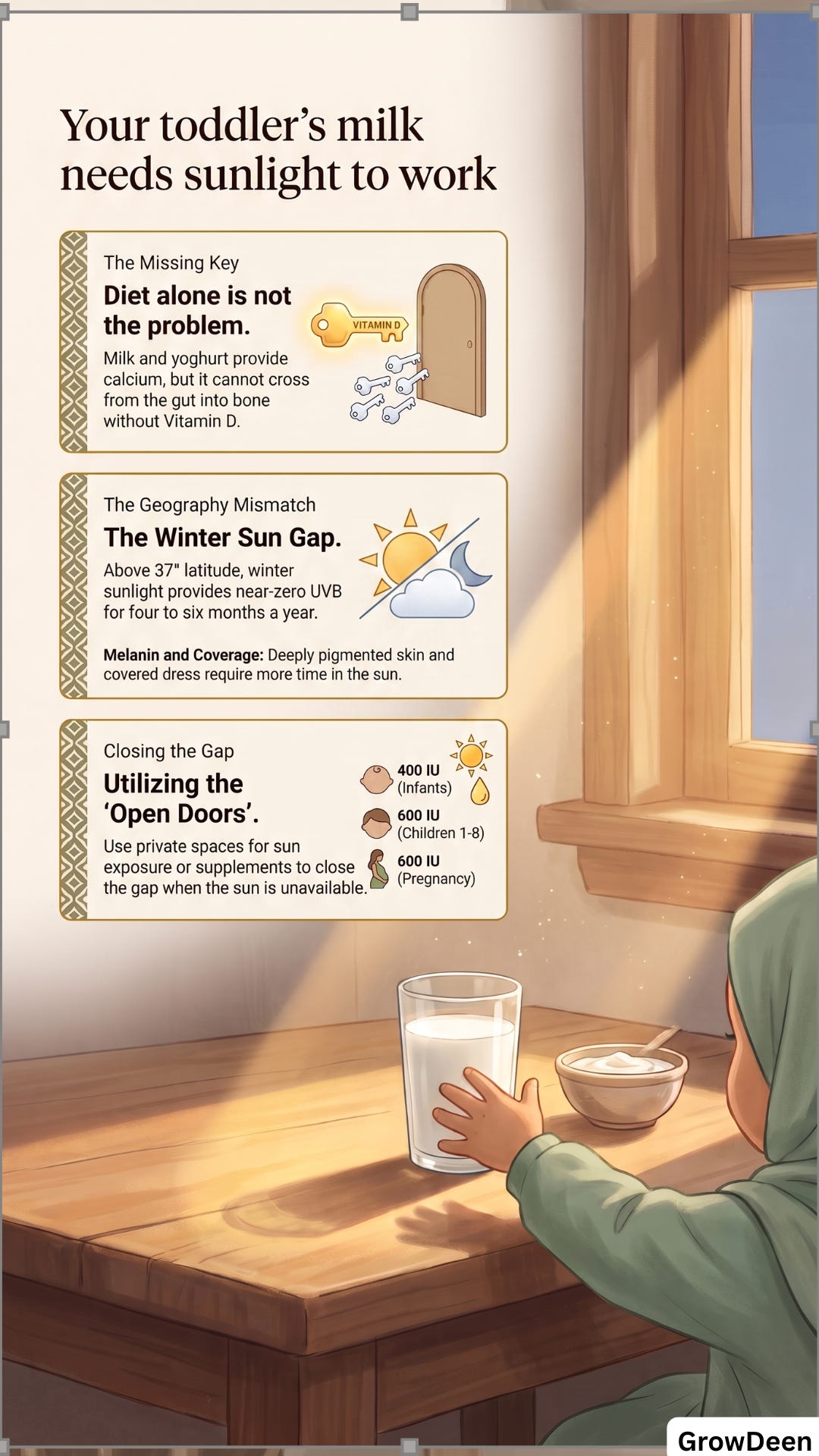
Here is what makes this so disorienting: the calcium was never the problem. Calcium cannot cross from the gut into the blood on its own. It needs vitamin D to open the way, and it needs vitamin D again to be fixed into bone once it arrives. [1][3] Without that, a fridge full of dairy changes very little. The calcium turns up at the door. Nobody lets it in.
So here is the question worth carrying through the rest of this article, because the answer is not what most parents expect. Rickets, a disease we filed away with black-and-white photographs, is being diagnosed again in some of the wealthiest countries on earth. [1][5] Not in famine. Not in poverty. In warm houses with full fridges.
Why?
Why This Guide Is Different
Current clinical consensus, not blog advice. Every recommendation here traces to the 2016 global rickets consensus, the American Academy of Pediatrics, the ESPGHAN nutrition committee, or a 2017 BMJ meta-analysis. [1][2][5][7]
Written for families the standard advice ignores. Most vitamin D guidance quietly assumes light skin, short sleeves and a temperate summer. This one starts from where Muslim families actually live.
You get The Sunlight Window Pack free. A three-page printable that tells you which months your location can supply vitamin D and which months it cannot, so you stop guessing.
Why Food Will Never Solve This On Its Own
Think about how strange this nutrient is for a moment.
Almost every other vitamin your child needs is sitting in the fruit bowl. Vitamin D is not. Only a handful of foods carry it naturally: oily fish like salmon, sardines, mackerel and herring, plus egg yolks, liver, and mushrooms that were grown under ultraviolet light rather than in the dark. [5] That is the whole list.
Everything else on the shelf that claims vitamin D has had it added at the factory. Fortified cereals, fortified milks, some spreads. Useful, and worth choosing deliberately once you have actually read a label. But fortification rules differ so sharply between countries and between brands that two boxes side by side on the same shelf can be completely different. [5]
Vitamin D is also not really a vitamin. It behaves like a hormone. Skin makes it, the liver converts it, then the kidneys convert it again, and only after that third step does it start working. [3] Three organs in sequence, before a single calcium molecule moves.
Which brings us to the actual source.
The Calendar Problem Nobody Warns You About
Your skin makes vitamin D when ultraviolet B light lands on it directly.
Not through a window, because glass filters out exactly that wavelength. Not under sunscreen, which is doing its job by blocking those rays. And not through most clothing. [3]
Now here is the part that reframes everything.
Above roughly 37 degrees of latitude, which includes Manchester, Berlin, Toronto, Minneapolis and everywhere further north, the winter sun sits too low in the sky for meaningful UVB to reach the ground at all. [3] Your child could stand outside in a British January from sunrise to sunset and produce close to nothing. Not less. Close to nothing.
That is four to six months a year when sunlight is simply not an available source, no matter how much of it your family gets.
Add melanin to the picture. Melanin is a natural sunscreen, and it is beautiful engineering for a body living under an equatorial sun. Move that same body several thousand miles north and it becomes a bottleneck. A child with deeply pigmented skin needs substantially longer outdoors than a fair-skinned child to make the same amount. [1][3]
So read the risk factors the consensus documents list, and read them as a group rather than one at a time: deeply pigmented skin, northern latitude, mostly indoor days, covered dress, and long breastfeeding by a mother who may be low herself. [1][5]
Count how many describe your household.
That is the answer to the question I planted earlier. Rickets is returning in wealthy countries because the populations most affected are the ones whose bodies were calibrated for a different sky. It is not a nutrition failure. It is a geography mismatch, and it landed on migrant and minority families first.
I know that is a lot to hold onto while you are also doing school runs and finding someone’s other shoe. That is exactly why I put together The Sunlight Window Pack, a printable that tells you, month by month, whether your location can actually supply vitamin D, and what to do in the months it cannot. Keep reading and you can download it at the end.
The Question Muslim Mothers Are Afraid To Ask
Let me name something directly, because I think a lot of women read articles like this and feel a small defensive knot forming.
Covered dress reduces vitamin D synthesis. That is physics, and no article gets to pretend otherwise.
But watch what happens next in most health writing. “Covered skin” appears on a risk-factor list beside smoking and poor diet, with no comment, and a Muslim mother reads it and quietly absorbs the message that obeying Allah has cost her child something.
I want to be clear with you. That framing is wrong, and it is wrong on the medicine as well as the deen.
Here is why: covered skin is one variable among five, and it is nowhere near the one with the most give in it. Latitude and season you cannot change at all. Skin tone you cannot change. What you can change is what you do in the months the sun is available, and whether you use the second source Allah made available for the months it is not.
And there is more room than families realise:
Face and hands still count. They are uncovered most of the day. Regular outdoor time with the face and hands exposed produces real synthesis, and in sunnier months it produces a great deal.
Private space changes the whole calculation. A garden. An enclosed courtyard. A screened balcony. A women-only session at the park. In these spaces the question of covering does not arise at all, and a mother or an older daughter can sit in the sun freely. For many households this is the single highest-yield change available, and it costs nothing but the decision to go outside.
Supplements are ordinary. Every formula-fed baby on earth already receives supplemental vitamin D, because the manufacturer put it in the tin. No one calls that a failure.
Sit with that last one, because it is where the real obstacle lives. The idea that a nutrient only counts when it arrives by sunbeam is not from our deen. It is cultural residue, and it quietly stops good mothers from doing the easiest protective thing available to them.
Support Muslim Parenting Lab ❤️
Would you like a small amount of yours grown into something enormous? Give what you can spare with the button below.
The Prophet ﷺ said Allah grows a charity the size of a date until it is like a mountain. (Sahih al-Bukhari 1410)
The Lamp Allah Hung, and the Door He Left Open
Surah An-Naba lists Allah’s provisions one after another as evidence: the earth spread out, mountains as pegs, sleep for rest, night as a covering, seven strong heavens above. Then this:
“And We have made (therein) a shining lamp.”
[Qur’an, Surah An-Naba 78:13] [9]
According to Tafsir Ibn Kathir, the shining lamp here is the radiant sun, whose light glows for all the people of the earth. [9]
Notice the word Allah chose. A lamp. Not decoration. A lamp is hung deliberately, by Someone who knows exactly who will be standing underneath it. The passage then moves from that lamp to rain, and from rain to grain and gardens, describing one connected system of provision. Your child’s bones sit inside it.
Now, what about the months the lamp cannot reach you?
The Prophet ﷺ said, as Jabir reported: “There is a remedy for every malady, and when the remedy is applied to the disease it is cured with the permission of Allah, the Exalted and Glorious.” [Sahih Muslim 2204] [10] The chapter heading Imam Muslim placed above it says, in effect, that every disease has a remedy and that seeking treatment is recommended.
So the blood test is not a small betrayal of tawakkul, and neither is the bottle in the cupboard. They are among the means Allah put within your reach. Reaching for them is what tawakkul asks of you before you leave the rest with Him.
Sunlight is one door. Allah left others open.
How Much Vitamin D Does A Child Actually Need?
These are the numbers the major consensus documents agree on. If your doctor knows your child and says something different, that instruction outranks this article.
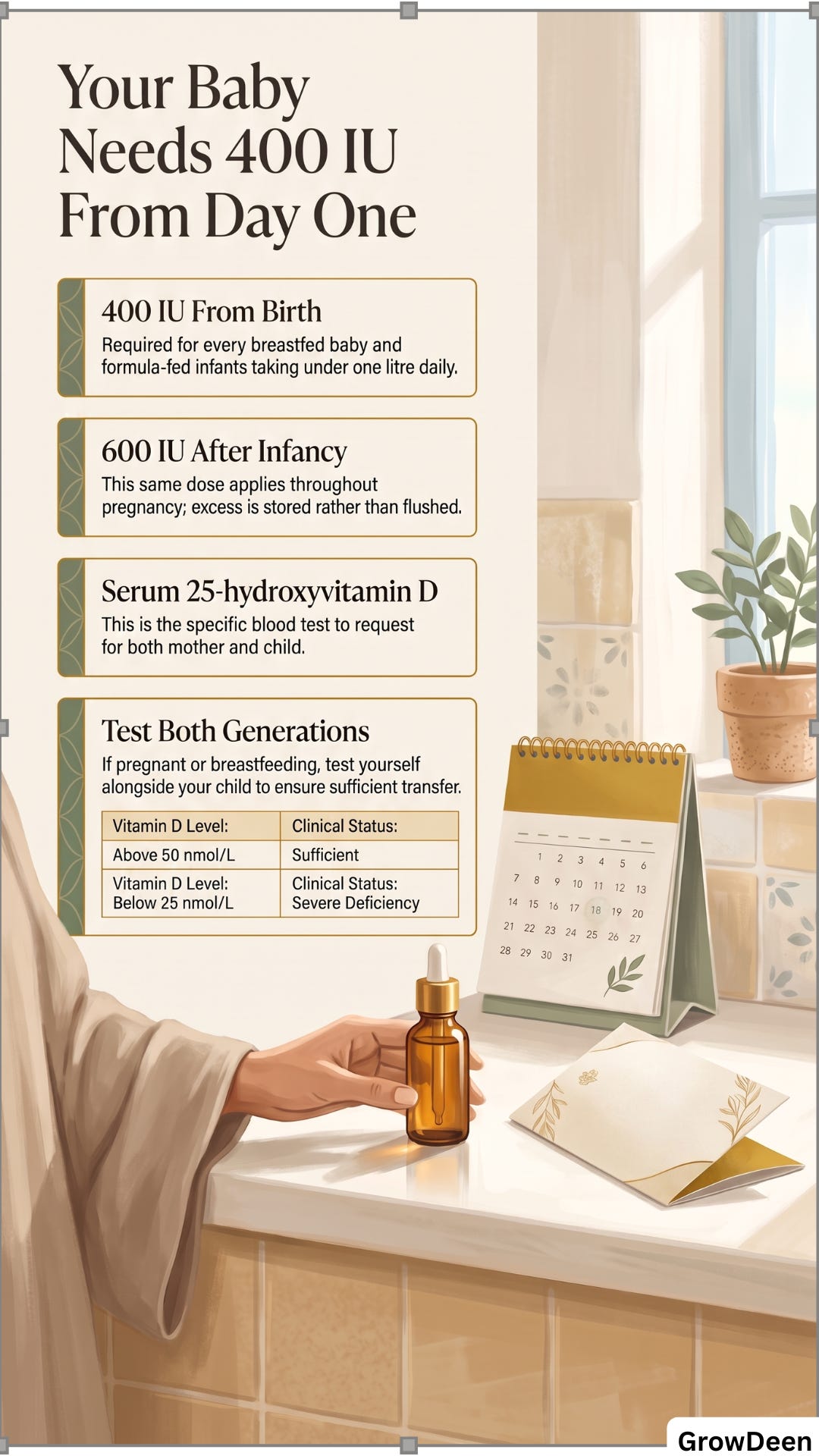
Infants: 400 IU daily, from soon after birth. This covers breastfed babies and formula-fed babies not yet taking around a litre of formula a day. The evidence here is unusually settled: 400 IU prevents rickets, and it kept blood levels in the sufficient range in 97% of infants across twelve months. Trials at 800 and 1200 IU gave no extra benefit to bone density, and 1600 IU raised toxicity concerns. [1][2][6]
Children beyond infancy, and pregnancy: 600 IU daily. [1][6]
Now the caution, and please do not skim it. Vitamin D is fat soluble, so the body stores what it does not use instead of flushing it. Too much pushes blood calcium up, which can damage kidneys, blood vessels, heart and bone. Use the dose on the label. Use the dropper that came with that specific bottle. And tell your doctor before you stack a multivitamin on top of a single-nutrient drop. [1][6][8]
One more thing worth knowing, because parents ask. Does vitamin D do anything beyond bones? A 2017 BMJ meta-analysis of individual participant data found supplementation reduced acute respiratory infections, with the benefit concentrated in people who started out deficient and who dosed daily or weekly rather than in occasional large doses. Across everyone studied, about 33 people needed supplementing to prevent one infection. [7]
That is a real effect and a modest one. Correcting a genuine deficiency may do a little more for your child than protect her skeleton. It is not an immune booster for a child whose levels are already fine, and claims beyond this run ahead of the evidence. [5]
When Should You Ask For A Blood Test?
Stop estimating and measure. The test is serum 25-hydroxyvitamin D, and it is one blood draw.
Above 50 nmol/L is sufficient. Below 25 nmol/L is severe deficiency. The band between is insufficiency. [1]
Ask for it if your child has deeply pigmented skin and lives far from the equator, spends most waking hours indoors, keeps most skin covered outdoors, has been breastfed a long time while your own level is untested, eats a vegan or very narrow diet, was born prematurely, takes a long-term medicine, or has a condition affecting absorption or conversion such as coeliac disease, cystic fibrosis, liver disease or kidney disease. [1][5]
Mild deficiency is often managed with more outdoor time and dietary attention. Severe deficiency is treated with supplementation, sometimes daily over weeks or months, sometimes as a single large dose, depending on your clinician’s judgement. [1]
If you are pregnant or breastfeeding and any of those describe you, ask for your own test too. A mother who is low cannot pass on what she does not have, and breastmilk starts low regardless. [1][2] One needle answers for two bodies.
And on tanning beds, since somebody always asks: no. They cause skin cancer and no responsible body recommends them for this. [4]
What This Looks Like On A Tuesday
The families who manage this well did not find spare hours. They attached it to something already happening.
The house is awake after Fajr anyway. Ten minutes in the garden, on the balcony, or standing at an open door while the kettle boils. No scheduling required.
The school run and the walk to the masjid are outdoor time that already exists in your day. Leaving the car behind converts it.
In strong sun, protect properly: shade, a hat, covering clothes, sunglasses, sunscreen on exposed skin, and real care in the hours around midday. Babies under six months should be kept out of direct sunlight entirely, and for them the answer is the supplement rather than the sun. [2][4]
And the teaching that costs nothing. Tell your four year old, while she is standing in it, that Allah put this light in the sky and her legs are using it right now to grow strong. She will hold onto that far longer than any instruction about drops.
Get The Sunlight Window Pack
If you have read this far, you are the kind of mother who would rather know than assume. That tells me something good about you.
Inside The Sunlight Window Pack (one comprehensive PDF, 3 pages):
Page 1: Your Family’s Vitamin D Risk Profile. A tick-box card covering all nine clinical and lifestyle risk factors, with a simple scoring band that tells you whether to watch, act, or book the blood test. Designed as a card you can photograph and keep on your phone for the next appointment.
Page 2: The Sunlight Window Planner. A month-by-month wheel for three latitude bands showing exactly which months your location can supply vitamin D and which months it cannot, paired with the daily anchor points that convert existing routine into outdoor time, so you can stop guessing about winter in under two minutes.
Page 3: The Lamp and the Remedy Reflection Card. Qur’an 78:13 with the Ibn Kathir commentary on the sun as Allah’s shining lamp, alongside Sahih Muslim 2204 on seeking treatment, plus the exact words to say to a young child when you take them outside so the habit carries meaning and not just vitamin D.
This one is built to live on your fridge and in your camera roll, where you will actually reach for it rather than forget it.
The Sunlight Window Pack is what every subscriber receives with each article. Muslim Parenting Lab covers the full arc of raising Muslim children from birth to eight, every piece backed by current research and rooted in the Qur’an and Sunnah.
Do This In The Next Five Minutes
Open your kitchen cupboard and find the vitamin D bottle. If there is one, check the strength on the label against the numbers above. If there is no bottle, put it on the shopping list right now, before you close this page.
May Allah place barakah in your effort, strengthen the small bodies in your care, and make what you do for them heavier on your scales than it feels in the moment.
Share This With Someone Who Needs It
Think of one person right now. The sister at the masjid whose toddler is still not walking and who has started to sound worried about it. Your cousin in Toronto who had her baby in November. The friend who breastfed for two years and has never once had her own levels checked.
This article could change something in their child’s bones. Send it to them today, not as advice, but as care. Sometimes the most loving thing we can do is pass on the one fact nobody told us either.
Frequently Asked Questions
Q: Can my child get enough vitamin D from food alone?
A: Almost certainly not. Only oily fish, egg yolks, liver and UV-grown mushrooms carry it naturally, and fortified products vary hugely by country and brand. [5] Food raises the floor, and it was never designed to close a real gap on its own.
Q: How much sunlight does my child need each day?
A: There is no honest universal number, and anyone giving you one is guessing. It shifts with skin tone, latitude, season, hour, cloud and how much skin is uncovered. Short and frequent beats long and occasional, and production plateaus, so extra exposure past that point only adds skin damage. [4]
Q: Does my baby need vitamin D drops if I am breastfeeding?
A: Yes. Breastmilk is superior nutrition in nearly every other respect and is low in vitamin D, which is exactly why the 400 IU daily recommendation for breastfed infants exists. [1][2] It is not a criticism of breastfeeding.
Q: Is it safe to give my child vitamin D every day?
A: At the recommended doses, yes, and it is the whole point. What is not safe is doubling up. Vitamin D is stored rather than flushed, so excess raises blood calcium and can damage kidneys, blood vessels, heart and bone. Check with your doctor before combining a multivitamin with a separate drop. [1][6][8]
Q: Can you get enough vitamin D through a window?
A: No. Glass filters out the UVB wavelength that triggers synthesis, so a sunny windowsill produces nothing. [3] It has to be direct light outdoors.
Q: Does wearing hijab cause vitamin D deficiency?
A: Covered dress reduces synthesis, and so do winter, latitude, melanin and indoor living. Covering is one variable among several and far from the most changeable one. Face and hands, private outdoor space, and supplementation together close the gap without touching what Allah has commanded. See “The Question Muslim Mothers Are Afraid To Ask” above.
Q: What are the signs of vitamin D deficiency in children?
A: Severe deficiency shows as bowed legs, thickened wrists or ankles, delayed walking, muscle weakness, aching limbs, or a fracture from a minor knock, and in infants can cause seizures. [1] Milder deficiency is quiet: tiredness, leg pain at bedtime, a milestone slightly late. Each has innocent explanations, which is why a blood test settles it.
References
[1] Munns, C.F., Shaw, N., Kiely, M., Specker, B.L., Thacher, T.D., Ozono, K., et al. (2016). Global consensus recommendations on prevention and management of nutritional rickets. Journal of Clinical Endocrinology and Metabolism, 101(2), 394-415. https://doi.org/10.1210/jc.2015-2175
[2] Wagner, C.L., & Greer, F.R.; American Academy of Pediatrics Section on Breastfeeding and Committee on Nutrition. (2008). Prevention of rickets and vitamin D deficiency in infants, children, and adolescents. Pediatrics, 122(5), 1142. https://publications.aap.org/pediatrics/article/122/5/1142
[3] Holick, M.F. (2007). Vitamin D deficiency. New England Journal of Medicine, 357(3), 266-281.
[4] Balk, S.J.; American Academy of Pediatrics Council on Environmental Health and Section on Dermatology. (2011). Ultraviolet radiation: A hazard to children and adolescents. Pediatrics, 127(3).
[5] Braegger, C., Campoy, C., Colomb, V., Decsi, T., Domellof, M., Fewtrell, M., et al.; ESPGHAN Committee on Nutrition. (2013). Vitamin D in the healthy European paediatric population. Journal of Pediatric Gastroenterology and Nutrition, 56(6), 692-701.
[6] Institute of Medicine. (2011). Dietary Reference Intakes for Calcium and Vitamin D. Washington, DC: National Academies Press.
[7] Martineau, A.R., Jolliffe, D.A., Hooper, R.L., Greenberg, L., Aloia, J.F., Bergman, P., et al. (2017). Vitamin D supplementation to prevent acute respiratory tract infections: systematic review and meta-analysis of individual participant data. BMJ, 356, i6583. https://doi.org/10.1136/bmj.i6583
[8] Mayo Clinic. (2024). Vitamin D for babies: Are supplements needed? https://www.mayoclinic.org/healthy-lifestyle/infant-and-toddler-health/expert-answers/vitamin-d-for-babies/faq-20058161
[9] Qur’an, Surah An-Naba 78:13. https://quran.com/78/13. Tafsir Ibn Kathir on 78:13, the shining lamp as the radiant sun whose light glows for all the people of the earth. https://quran.com/en/78/13/tafsirs/en-tafisr-ibn-kathir
[10] Sahih Muslim 2204, Book 39 (The Book of Greetings), Hadith 95, narrated by Jabir. Graded: Sahih. https://sunnah.com/muslim:2204
We combine scientific research with Qur’an and authentic Sunnah, and we cite our sources. Even so, this is general guidance and no substitute for a doctor who can examine your child.