

A 20-year study tracking 753 kindergartners found that children who scored higher on sharing and cooperation were significantly more likely to graduate college and hold stable employment by age 25. [1] The skill that predicts your child’s future is not reading. It is generosity.
She asked three times.
“Can Zayd have a turn with the car?”
Your three-year-old looked at you, looked at his friend, looked at the car in his hand. Then he turned away and kept playing. And somewhere between the third request and the meltdown that followed, you felt that familiar knot. The one that says: Am I raising a selfish child?
You’re not. And the research on what actually builds sharing in children points somewhere most parents are not looking.
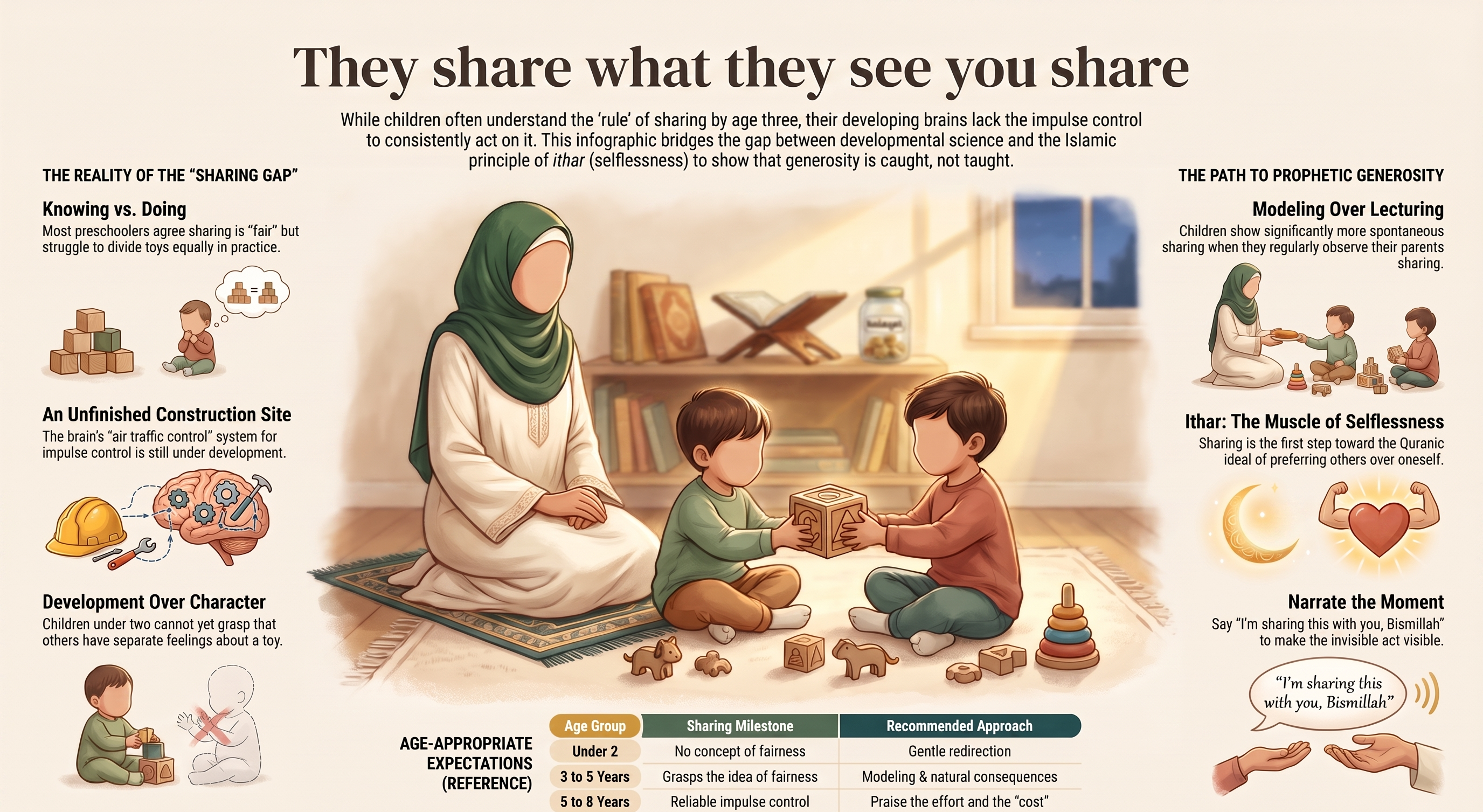
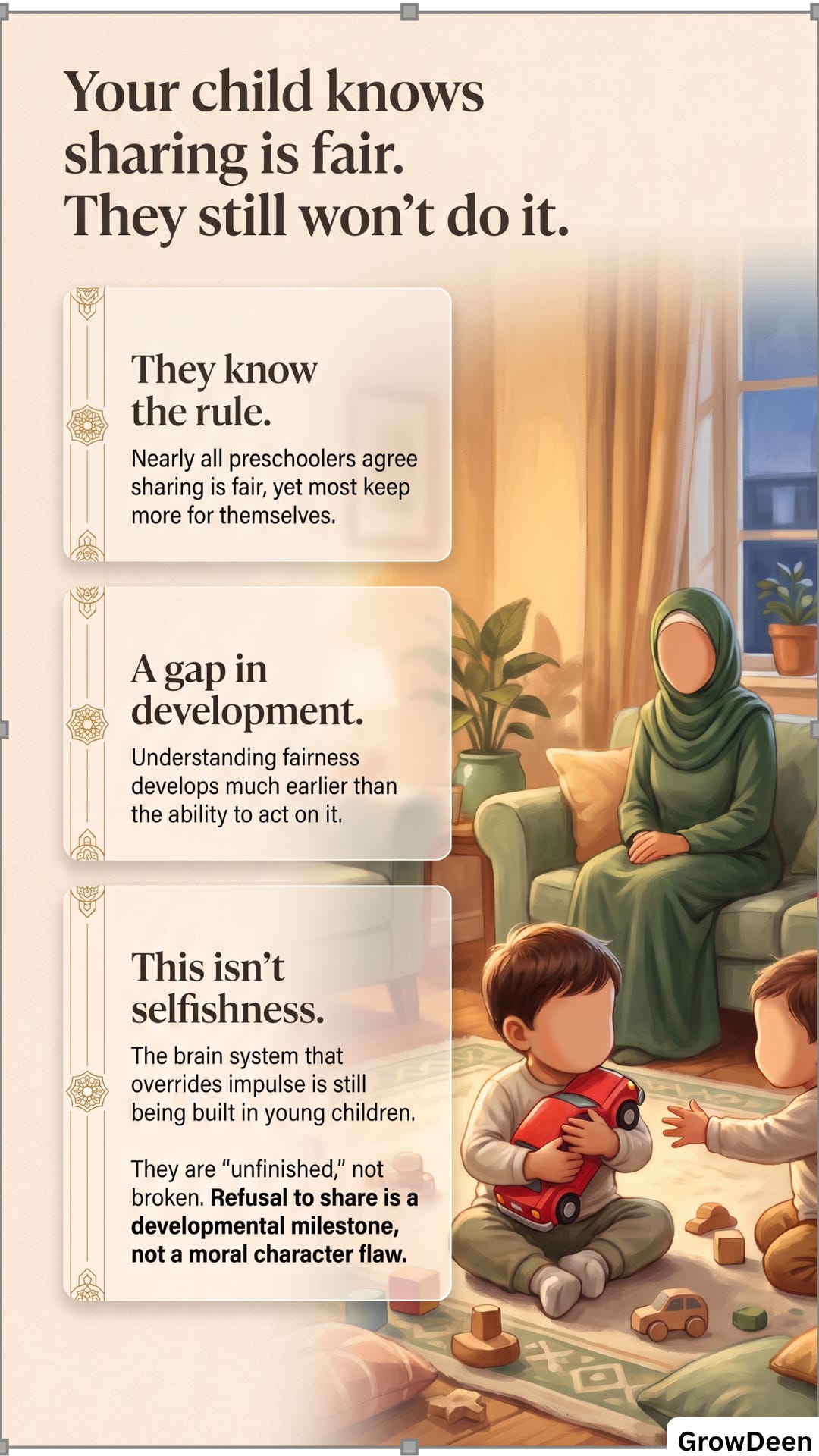
When researchers at Harvard and Yale studied how young children learn to share, they found something that unsettled the standard advice: preschoolers who said sharing was “fair” still chose to keep more for themselves when given a real choice. [2] They knew the rule. They believed in the rule. They just could not follow it yet, because the part of the brain responsible for overriding impulse is still under construction at this age. [4]
Here is what that means for you.
Your child is not selfish. Their brain is unfinished. And the single most powerful thing you can do about it has nothing to do with lectures, consequences, or time-outs. It is to let them watch you share. Every day. Without being asked.
What Makes This Guide Different
You get the developmental science behind sharing from peer-reviewed research (American Journal of Public Health, PLOS ONE, Harvard, 2011-2022), with specific findings that change how you see your child’s behaviour. [1][2][4]
You get the Islamic framework for generosity (ithar) rooted in the Qur’an and authenticated hadith, including what Allah promises those who give, so your child’s character is built on something deeper than social pressure. [6][7][8]
You get a free Sharing & Generosity Companion Pack (3-page PDF) with a phrase-swap card, an age-by-age coaching guide, and a Qur’anic rewards reflection card you can keep on your fridge.
The Myth That Keeps Parents Stuck
Here is the villain in this story, and it is not your child.
It is the belief that a toddler or preschooler who will not hand over a toy is making a moral choice. That belief turns every playdate into a test, every refusal into evidence, and every parent into a referee who feels like they are losing.
The truth is quieter and much kinder.
Children under two do not yet understand that another child has separate feelings about that toy. [3] Their world is immediate. They see it, they want it, they reach. By three, they start to grasp the idea of fairness, but grasping an idea and acting on it are two different skills running on two different neural systems. [2][4] The system for understanding develops first. The system for doing follows later.
This is not a character flaw. It is a construction schedule.
But here is what most parents do not realise.
That 20-year longitudinal study did not just track sharing as a classroom behaviour. The researchers found that prosocial skills in kindergarten, including sharing, helping, and cooperating, predicted adult outcomes more reliably than academic test scores. [1] Children who learned to share well did not just make better friends. They built better lives.
So the question is not whether sharing matters. It is how children actually learn it.
What Actually Works (And Why Lectures Don’t)
They share what they see you share. Children whose parents regularly model sharing behaviours, from splitting food at the table to giving something to a neighbour, show significantly more spontaneous sharing by age three. [5][9] The narration matters more than the correction. When you say “I’m going to share my apple with you, Bismillah,” that thirty-second moment teaches more than ten minutes of “you need to share.”
They share what they see you share. That sentence is worth reading twice, because it is the whole article in seven words.
Praise the effort, not the outcome. “You let Maryam use the red crayon even though it’s your favourite” is more powerful than “good sharing,” because it names what the act cost the child. [3][5] That is what stays.
Let them keep some things. When children are allowed to put away a few precious toys before a playdate, they are more willing to share the rest. [3] Respecting the boundary builds the trust that makes generosity possible.
And this is the part that surprised me.
For children under three, consequences for not sharing do not work. They create confusion, not learning. [3] Gentle redirection and simple narration are what works. After three, a brief natural consequence connected to the specific toy, removing it for a short pause and then giving both children another chance, teaches without punishing. [3][9]
When was the last time your child watched you give something to someone without being asked?
I know this is a lot to hold in your head, especially in the middle of a playdate when two children are pulling the same toy in opposite directions. That is exactly why I created the free Sharing & Generosity Companion Pack, a 3-page printable PDF with coaching phrases, age-specific strategies, and a Qur’anic rewards reflection card. Keep reading to find it at the end.
What Allah Promises Those Who Give
You have watched your child refuse to hand over a toy for the fourth time today, and you are wondering whether anything you are doing is working.
This is exactly where the Qur’an meets you. Not with a lecture, but with a promise.
Allah describes the reward of those who give in a way that even a young child can picture:
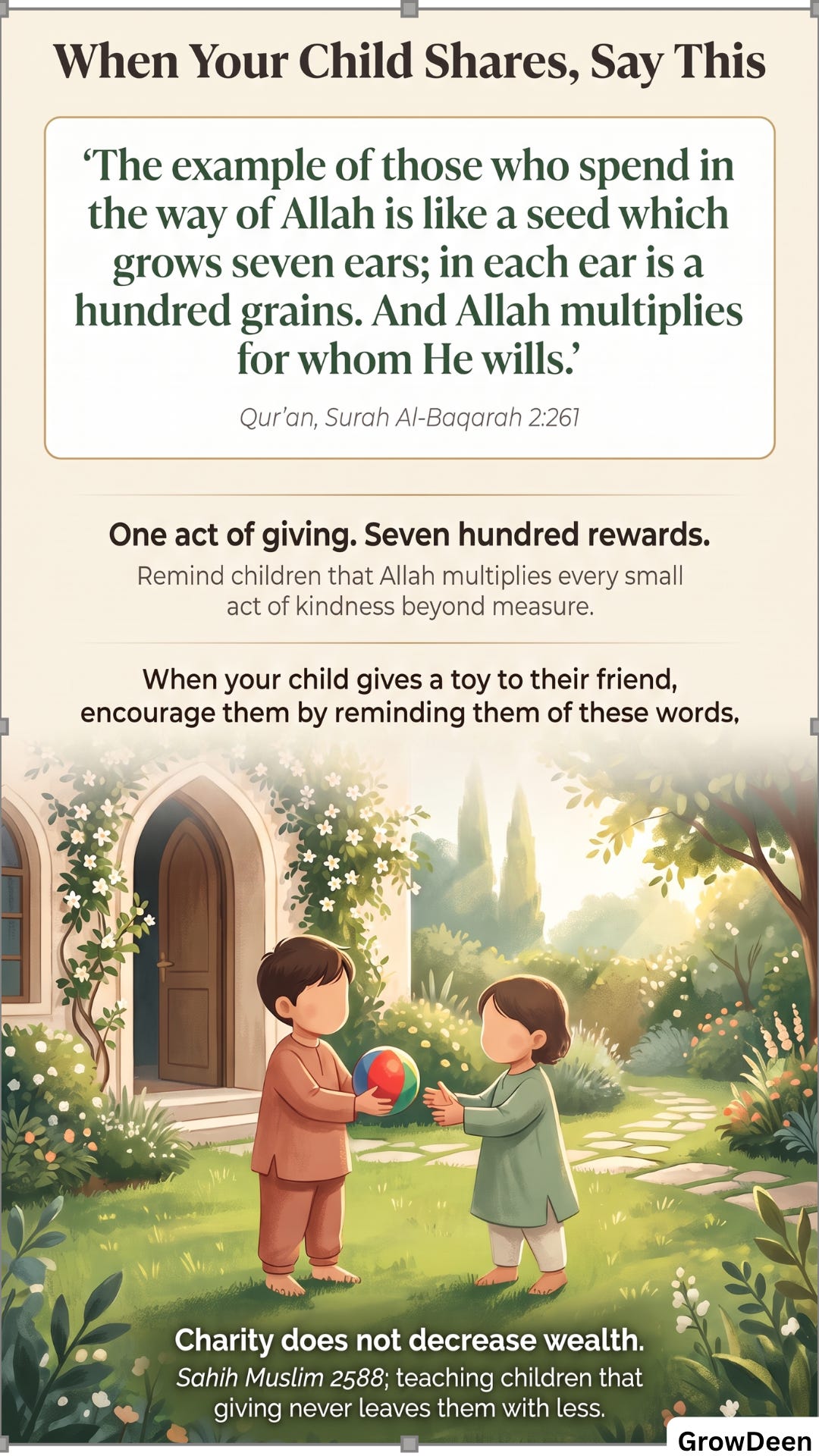
“The example of those who spend their wealth in the way of Allah is like a seed which grows seven ears; in each ear is a hundred grains. And Allah multiplies for whom He wills.” [Qur’an 2:261] [6]
According to Tafsir Ibn Kathir, this verse establishes that Allah does not merely reward generosity. He multiplies it. One act of giving becomes seven hundred, and even more for those whose intention is sincere. Ibn Kathir notes that this multiplication applies to all forms of spending in Allah’s cause, and the seed imagery teaches that what appears small in the moment grows beyond anything the giver imagined.
For a child, this is enormously powerful. You shared one toy, and Allah counted it as seven hundred. The maths of generosity in Islam does not work like the maths of the playground. You do not lose when you give. You gain in ways you cannot yet see.
The Prophet ﷺ made this even more direct: “Charity does not decrease wealth.” [Sahih Muslim 2588] [7]
And when the Qur’an describes the highest level of generosity, ithar, it points to the Ansar of Madinah, who gave the arriving Muhajirun “preference over themselves, even though they were in need” [Qur’an 59:9] [8]. According to Ibn Kathir, they divided their property in half for people they had only just met. A child handing over a favourite toy is not ithar in its fullest sense. But it is the same muscle, learning to flex.
The Prophet ﷺ also taught fairness between children directly. When a father gave a gift to only one of his children, the Prophet ﷺ refused to witness it and said: “Fear Allah, and be just among your children.” [Sahih al-Bukhari 2587; Sahih Muslim 1623] [10]
What I find grounding is how the Islamic promise and the developmental research point in the same direction: children learn to give when they see giving modelled with consistency, when the environment feels safe enough to take the risk of letting go, and when the act of sharing is honoured rather than forced.
Your Sharing & Generosity Companion Pack
If you have read this far, you are the kind of parent who does not just want their child to share for appearances. You want them to share because it is who they are becoming. That tells me something about you.
Inside the Sharing & Generosity Companion Pack (one comprehensive PDF, 3 pages):
Page 1: The Sharing Phrase Swap Card — Seven common phrases parents say during sharing conflicts (”You have to share!”) paired with research-backed alternatives that actually work (”Can you find a toy for your friend to play with?”). Designed as a fridge card you can glance at mid-playdate.
Page 2: Age-by-Age Sharing Coaching Card — What sharing looks like at under 2, 3-5, and 5-8, what to expect, what helps, and what does not work at each stage. One-page, scannable, colour-coded by age band. Designed for your kitchen wall or phone.
Page 3: The Qur’anic Rewards of Giving — A Family Reflection Card — A reflection card built around Qur’an 2:261 (the seed that becomes 700 grains), with the full Arabic text, transliteration, English translation, and source reference, plus three simple weekly family generosity practices rooted in the Sunnah. Designed for children and parents to read together.
This is not just a PDF to download and forget. It is designed to stay on your fridge, where sharing actually happens.
This Sharing & Generosity Companion Pack is what every subscriber receives with each article. We cover the full journey of raising Muslim children, from newborns to school age, all backed by scientific research and rooted in Islamic wisdom.
If you are a Muslim parent who wants both evidence-based guidance and Islamic perspective, subscribe for free so future resources land in your inbox before you need them.
Subscribe free for parenting resources backed by both science and Sunnah, guidance so unique you literally cannot get it anywhere else. No spam, no clutter, just resources that matter.
Your 5-Minute Action
The next time you eat with your child, before you take your first bite, share something from your plate. Say Bismillah. Say, “Here, this piece is for you.” Let them see it happen without being asked to do it back.
That is the practice. One meal at a time.
May Allah place barakah in your patience, accept your effort, and multiply the reward for every small act of generosity your child learns from watching you.
Share This With Someone Who Needs It
Think of one person right now: the mother at the masjid who pulled you aside last week because her toddler will not share at Islamic school. The friend whose playdate stories always end with “and then he melted down.” The sister-in-law who keeps saying her child is “going through a selfish phase.”
This article could change how they see their child. Share it with them today, not as advice-giving, but as support. Sometimes the most loving thing we can do is help someone see that their child is not broken.
Frequently Asked Questions
Q: At what age should a child be able to share?
A: Most children begin to understand sharing around age three, but reliably following through develops closer to five or six. [2][4] If your two-year-old will not share, that is completely normal brain development, not a character issue.
Q: Is it OK to let my child keep some toys for themselves?
A: Absolutely. Letting your child put away a few special items before a playdate actually reduces conflict and makes them more willing to share the rest. [3] It shows them you respect their feelings.
Q: How do I teach sharing in Islam?
A: Islam frames sharing through generosity (karam), fairness (’adl), and selflessness (ithar). The Qur’an promises that Allah multiplies the reward for those who give [6], and the Prophet ﷺ taught that charity does not decrease wealth. [7] Start with simple family habits: sharing food at the table, giving gifts, and making sadaqah together.
Q: Should I punish my child for not sharing?
A: For children under three, consequences for not sharing are not effective and can cause confusion. [3] For older children, a brief natural consequence like removing the disputed toy for a short pause, then trying again, teaches without punishing.
Q: Why does my child share at school but not at home?
A: Children often share more easily in structured settings where rules are clear and an adult is mediating. At home, the emotional stakes are higher because the toys are theirs and the relationships are closer. This is normal. Keep modelling and coaching, and it will carry over. [5][9]
Q: How can I help my child share with siblings specifically?
A: Fairness between siblings is the foundation. The Prophet ﷺ instructed parents to treat their children justly. [10] Use turn-taking systems, praise specific sharing moments, and avoid comparing children. “You let your brother go first, and that was really generous of you” goes further than “Why can’t you share like your sister does?”
References
[1] Jones, D.E., Greenberg, M., & Crowley, M. (2015). Early social-emotional functioning and public health: The relationship between kindergarten social competence and future wellness. American Journal of Public Health, 105(11), 2283-2290. https://doi.org/10.2105/AJPH.2015.302630
[2] Smith, C.E., Blake, P.R., & Harris, P.L. (2013). I should but I won’t: Why young children endorse norms of fair sharing but do not follow them. PLOS ONE, 8(3), Article e59510. https://doi.org/10.1371/journal.pone.0059510
[3] Brogle, B., Jiron, A., & Giacomini, J. (2013). How to help your child learn to share. Technical Assistance Center on Social Emotional Intervention for Young Children (TACSEI).
[4] Center on the Developing Child at Harvard University. (2011). Building the brain’s “air traffic control” system: How early experiences shape the development of executive function. Working Paper No. 11.
[5] Ferreira, T., Cadima, J., Matias, M., Vieira, M., Leal, T., & Matos, P. (2016). Preschool children’s prosocial behavior: The role of mother-child, father-child and teacher-child relationships. Journal of Child and Family Studies, 25(6), 1829-1839. https://doi.org/10.1007/s10826-016-0369-x
[6] Qur’an, Surah Al-Baqarah 2:261 — https://quran.com/2/261
[7] Sahih Muslim 2588 — Graded: Sahih — https://sunnah.com/muslim:2588
[8] Qur’an, Surah Al-Hashr 59:9 — https://quran.com/59/9
[9] Santrock, J.W., Deater-Deckard, K.D., Lansford, J.E., & Deater-Deckard, K. (2021). Child development (15th edn). McGraw-Hill Education.
[10] Sahih al-Bukhari 2587; Sahih Muslim 1623 — Graded: Sahih (Muttafaqun Alayhi) — https://sunnah.com/bukhari:2587
[11] Spataro, P., Calabrò, M., & Longobardi, E. (2022). Prosocial behaviour mediates the relation between empathy & aggression in primary school children. European Journal of Developmental Psychology, 17(5), 727-745.https://doi.org/10.1080/17405629.2020.1731467
[12] Broadhead, P. (2004). Early years play and learning: Developing social skills and cooperation. Routledge Falmer.