

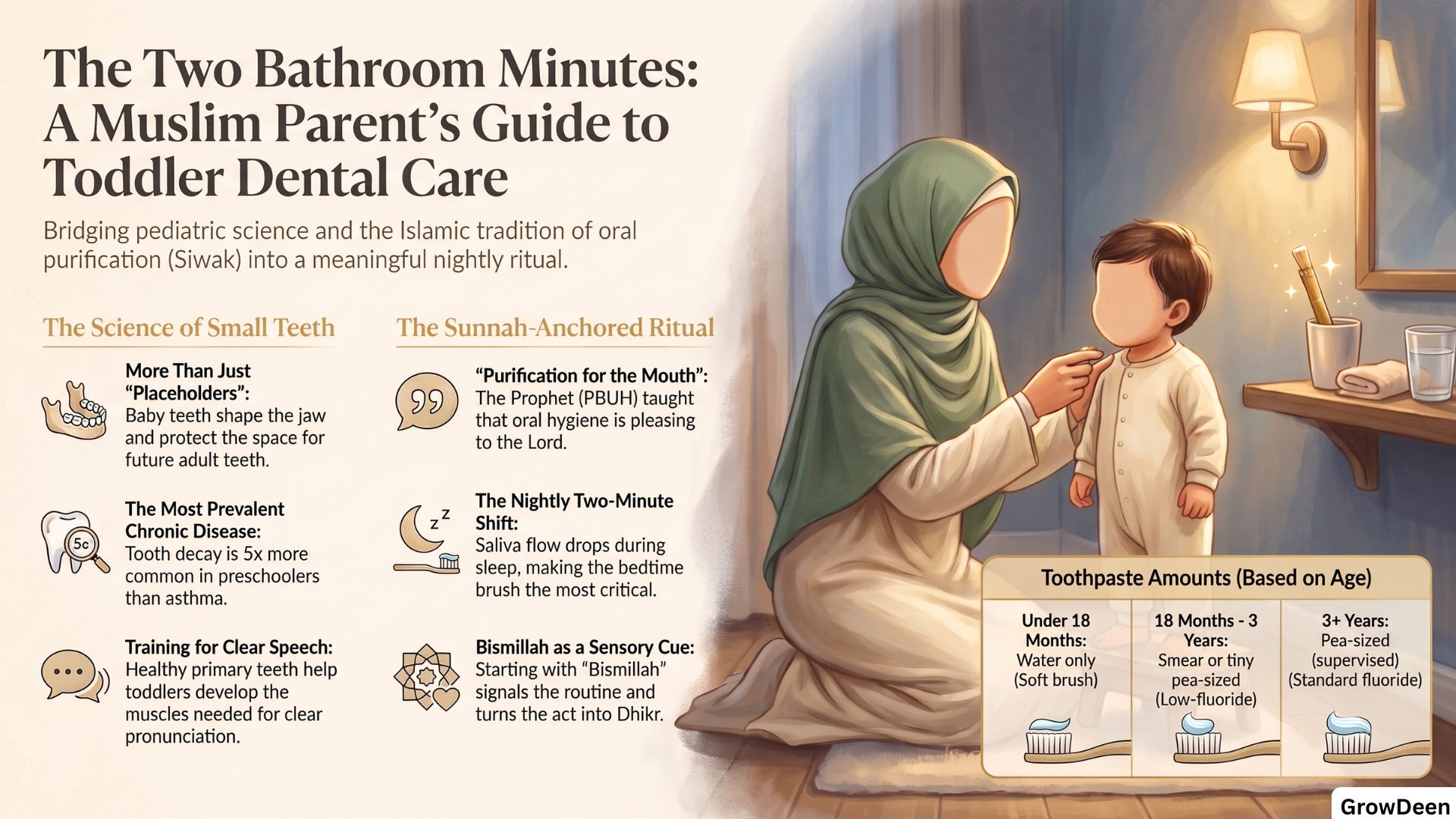
Early childhood tooth decay is now around five times more common than asthma in preschool children and the AAPD’s 2020 report calls it the single most prevalent chronic disease of early childhood. [1] This guide shows Muslim parents exactly how to protect toddler teeth from twelve months to three years, and how a two-minute nightly ritual becomes a small act of worship.
The bathroom clock says 8:47pm.
Your toddler is horizontal on the bath mat, arms folded, mouth clamped shut. The toothbrush is in your hand. There is toothpaste on the mirror. There may be toothpaste in your hair. Somewhere in the middle of this, you are trying to remember whether the dentist said pea-sized or smear-sized, and whether it was fluoride or non-fluoride.
You are not doing anything wrong. Toddler tooth brushing is genuinely hard, and most parents quietly wonder if the two minutes even matter. So let me start with the part almost no one tells Muslim parents plainly.
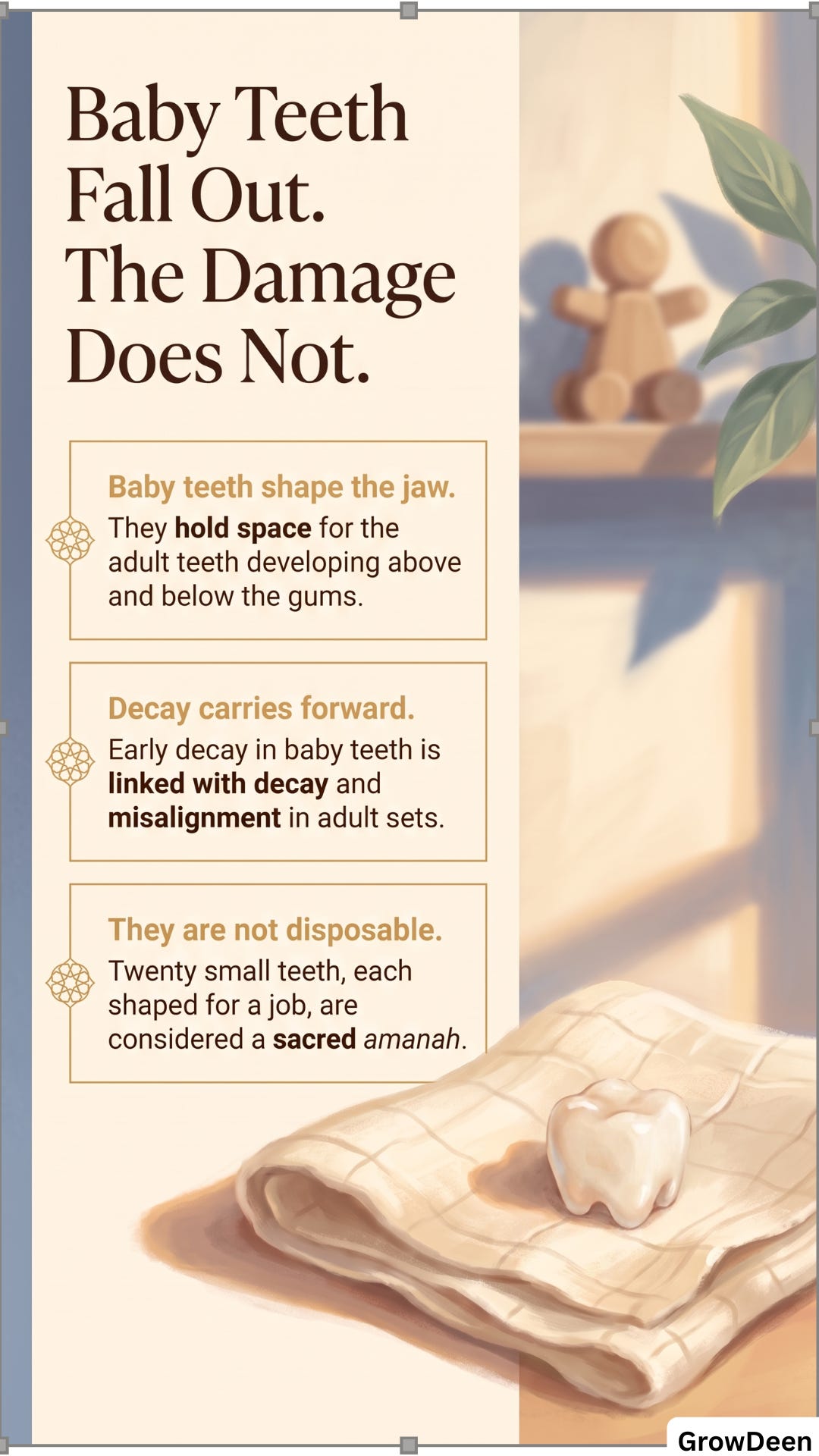
The two minutes matter more than almost anything else you will do for your child’s mouth in the next twenty years. When I looked at the AAPD’s 2020 report on early childhood caries, one line stopped me: tooth decay is now around five times more common than asthma in preschool children, and it is called the most prevalent chronic disease of early childhood. [1] Baby teeth are not just placeholders. They shape the jaw, protect the space for adult teeth, and quietly train the muscles your child needs for clear speech. [1, 2]
And the Sunnah has been quietly pointing at this small nightly ritual for fourteen hundred years.
Why This Guide Is Different
Peer-reviewed dental science with citations. Every claim is grounded in AAPD 2020 and 2024 guidance, Cochrane systematic reviews on fluoride, and the leading paediatric dentistry journals. [1, 2, 3, 4]
Sunnah-rooted, not just science. The Prophet ﷺ built oral cleanliness into a believer’s daily life. This guide weaves that Sunnah into the bathroom sink at 8:47pm, not into an isolated religious sidebar.
The Toddler Dental Care Pack, free with this article. A three-page printable pack with a brushing tracker, a sugar and drink traffic-light guide, and a Sunnah reflection card. Designed to stay on your bathroom mirror where you actually need it.
What Is Happening Inside Your Toddler’s Mouth Right Now
Somewhere between soft cheeks and a first pair of proper shoes, twenty small teeth are quietly making their way through the gums. First teeth usually appear between six and ten months. By the time your toddler completes their third year, they usually have all twenty. [1]
The lower front teeth come first for most children. Then the upper front teeth. Then the first molars slide in for early chewing. The pointed canines fill in the gaps. And finally the second molars, usually deep into the second or third year, close out the set. [1, 2]
Here is what most parents miss. Every one of those teeth has a job. The molars decide how well your child chews solid food. The front teeth decide how clearly they will pronounce their first Bismillahs. The whole set is holding space, silently, for the adult teeth developing above and below the gums.
Late teething can be genuinely rough. Extra drooling, gum rubbing, fingers permanently in the mouth, disturbed sleep, mild fussiness. That is all normal. What is not teething is a real fever, ongoing diarrhoea, vomiting, or a properly unwell child. Those deserve a proper check with your paediatrician. Do not let anyone brush that off as “just teeth.” [1, 7]
A small Islamic reflection on all of this. Each tooth arrives on time, in its right place, shaped for its exact task. Naming that out loud to your toddler in the simplest words — “Alhamdulillah, look at your beautiful teeth from Allah” — plants a very early habit of gratitude for the body itself.
The Two-Minute Ritual That Actually Works
Everyone tells you toddlers need their teeth brushed twice a day. Fewer people tell you how to do it without ending up on the bathroom floor.
The single most important minute is the night one. During sleep, saliva flow drops. The mouth becomes a friendlier place for the bacteria that produce enamel-eroding acid overnight. [2, 6, 8] That last brush before bed is what carries your toddler through the long night ahead. Skip it, and every sugar exposure of the day is sitting on the teeth for eight hours with almost nothing to wash it away.
Here is the position most paediatric dentists teach:
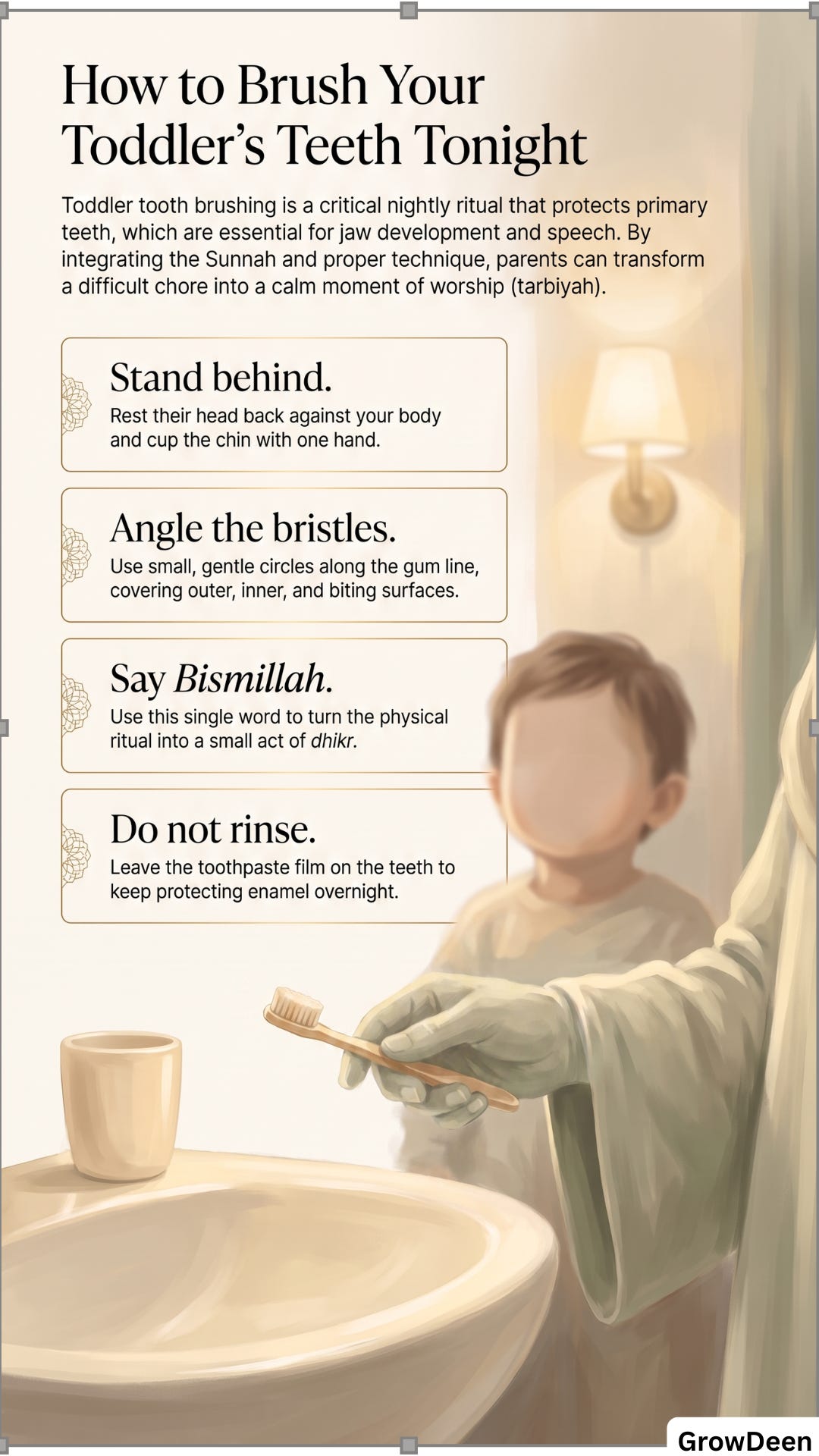
Stand or sit behind your toddler with their head resting back against your body.
Cup their chin gently in one hand.
Angle the bristles slightly towards the gum line. For a manual brush, small gentle circles. For an electric brush, slide it slowly tooth by tooth and let the brush do the work.
Cover everything: outer surfaces facing the cheek, inner surfaces facing the tongue, the biting surfaces of the molars, along the gum line, and a soft sweep of the tongue.
Let them have a first go on their own if they want to. Then take the brush back and finish properly. Full adult supervision is needed until around age eight, when their fine motor skills are actually up to the job.
And what about the fight? Because there is often a fight.
Ideas that quietly work:
Bismillah as the opening cue. Say it together as you pick up the brush. It settles the moment. It signals brushing has begun. It turns the whole scene into a small act of dhikr.
Rhythmic spoken words, no music. A soft sing-song rhythm of phrases like “top teeth, bottom teeth, all around, keep them clean” holds attention without any tune. Your voice is the tool.
The train. Slide the brush across from one side to the other saying “chugga chugga chugga.” Toddlers love the sound and the motion.
Toy first. Let them brush the teeth of a soft toy before you brush theirs.
Two brushes. Give them one to hold and chew while you use a second brush for the actual clean.
Warm praise. A gentle “Masha Allah, you sat so beautifully” carries more long-term weight than any threat.
On a truly impossible night, wipe the teeth with a clean damp cloth. Anything is better than nothing.
Before You Keep Reading
I know this is a lot to remember, especially at 8:47pm with a squirmy toddler and a tired body. That is why I have made The Toddler Dental Care Pack — one free printable PDF with a brushing habit tracker for your bathroom mirror, a full sugar and drink traffic-light guide for your fridge, and a Sunnah reflection card. Keep reading, it is at the end. It is designed to make this ritual easier, not add to your mental load.
What the Prophet ﷺ Showed Us About a Clean Mouth
Picture the bathroom sink at 8:47pm in a completely different light. It is not just a chore. It is the modern shape of a Sunnah the Prophet ﷺ carried with him every day.
Aisha (RA) narrated that the Prophet ﷺ said, “Siwak is a means of purification for the mouth and is pleasing to the Lord.” [5] Before humanity understood plaque, bacteria, or the science of enamel, the Sunnah placed a fresh, clean mouth at the centre of a believer’s daily life.
When you kneel behind your toddler with a small toothbrush in your hand, whispering Bismillah, gently working around each tiny tooth, you are not only preventing decay. You are continuing something the Prophet ﷺ loved, in your own home, on your own child. What we are doing is bigger than the moment. It is tarbiyah in miniature. It is teaching a small human that the body is an amanah, that Allah loves cleanliness, and that a Muslim family looks after the mouth with the same love the Prophet ﷺ carried for his siwak.
That is what turns the two minutes at the bathroom sink into worship.
Toothpaste, Fluoride, and the “Pea-Sized” Question
Fluoride is a mineral that strengthens enamel, slows down the bacteria that cause decay, and helps repair the earliest, invisible stages of damage. [3, 4, 9] It works best when it stays in tiny amounts in the mouth throughout the day, not in one large dose.
Guidelines used in most paediatric dental settings now recommend:
Water only on the brush until around 18 months, unless your dentist advises otherwise. [3]
A smear or small pea-sized amount of low-fluoride toothpaste from 18 months to three years. [3, 4]
A standard fluoride toothpaste, pea-sized from around age three, still supervised. [3, 4]
From roughly 18 months, teach two small habits that make a large difference:
Encourage your toddler to spit, not swallow.
Do not rinse with a mouthful of water after brushing. The thin film of toothpaste left on the teeth keeps protecting the enamel long after the brush is put away. [3, 9]
Store toothpaste out of reach. Straight from the tube, in large amounts, fluoride toothpaste is not safe for a young child.
Support Muslim Parenting Lab ❤️
Would you like a deed that keeps earning for you after you die? Start one in a few seconds with the button below.
The Prophet ﷺ named ongoing charity and beneficial knowledge among the three things that keep counting after death. (Sahih Muslim 1631)
The Silent Bedtime Danger
Diet does most of the work in protecting toddler teeth. Sugar is the main driver of early childhood decay. [2, 6, 8] The bedtime bottle is the biggest single hazard almost no one talks about.
Encourage:
Plain water as the everyday between-meal drink.
Whole fruit at meals, not juice sipped through the day.
Balanced meals with vegetables, protein, plain milk, plain yoghurt, cheese.
Avoid or strictly limit:
Sugary drinks, including natural fruit juice, flavoured milks, soft drinks, and cordials. Even 100% juice bathes the teeth in sugar and acid. [2, 6]
A bottle of milk or juice at bedtime or during the night. Pooled milk on the teeth overnight is a leading cause of severe early childhood decay. [6, 8]
Dipping dummies in honey, sugar, or sweet syrups. Honey generally before the completed first year is unsafe due to botulism risk. [6]
Constant grazing on sweet snacks. Fewer, contained sweet moments protect enamel far better than a slow trickle of sugar all day.
Islam draws a warm line between eating with gratitude and eating with excess. Bismillah at the start of a meal, Alhamdulillah at the end, plain water sipped mindfully, and being genuinely delighted by simple sweet foods on special occasions rather than expecting them every day — these small habits, planted at two and three, do most of the moderation work by the time your child is seven.
When to Take Your Toddler to the Dentist
By around twelve months, or when the first tooth appears, whichever comes first. [1] Many families delay this by years, sometimes into school age, and by then decay is often already established.
An early first visit does three important things. It lets the dentist screen for enamel problems, jaw shape, and quiet early decay while it is still reversible. It gives you personalised guidance on brushing, fluoride, feeding, and any concerns unique to your child. And it teaches your toddler that the dentist is a friendly figure they meet when nothing hurts, not a stranger they only see when something has gone wrong.
After the first visit, most dentists recommend a check every six to twelve months, adjusted for risk.
Dummies, Thumbs, and Amber Necklaces
Two habits often outstay their welcome and quietly reshape a toddler’s teeth: prolonged dummy or thumb sucking, and constant sippy cup or bottle use.
Most paediatric dental guidance suggests weaning off the dummy by around age two to three, to reduce the risk of open bite and other jaw changes. [2] Occasional thumb sucking in early toddlerhood is common. It only becomes a real dental concern if it continues intensely past the third year, when the adult teeth are already beginning their long journey into place. [1]
Amber teething necklaces are a firm no. Paediatric bodies warn of strangulation and choking risks, and there is no strong evidence they do anything for teething pain. [7] The same applies to any beaded jewellery worn around the neck or wrist of a young child. Chilled, clean silicone teethers from the fridge, not the freezer, are a safer route on hard teething days.
Warning Signs Every Muslim Parent Should Know
Book a visit sooner rather than waiting for the next check-up if you notice any of these:
White chalky patches, brown areas, or dark spots on any tooth.
Swollen, bleeding, or red gums.
Persistent bad breath that does not clear with brushing.
A chipped, loosened, or knocked-out tooth. Never try to reinsert a knocked-out baby tooth. Comfort your child, control bleeding gently, see the dentist promptly.
Pain, unexplained night crying, or refusing to eat.
Facial swelling or fever with mouth pain — this needs same-day medical care.
Persistent high fever, significant diarrhoea, or a genuinely unwell child should never be dismissed as “just teething.” Have your paediatrician check them properly. [1, 7]
The Toddler Dental Care Pack (Free With This Article)
If you have read this far, you are the kind of Muslim parent who takes your child’s teeth seriously — not as a chore, but as an amanah. That tells me something beautiful about you.
Inside The Toddler Dental Care Pack (one comprehensive PDF, 3 pages):
Page 1: Toddler Brushing Habit Tracker — a monthly grid with morning and evening columns, a Bismillah check-in, and space to note one small “Masha Allah moment” each day — designed as a print-and-stick tracker for your bathroom mirror so the habit is visible before the toothbrush is in your hand.
Page 2: Sugar and Drink Traffic-Light Guide — every common toddler food and drink sorted into green (freely offered), amber (occasional, meals only), and red (avoid or strictly limit) — designed as a fridge card you can point to when a well-meaning relative arrives with juice, so no argument is needed at snack time.
Page 3: Two Reflections on the Sunnah of a Clean Mouth — a Sunnah reflection card featuring the Prophet ﷺ hadith on the siwak from Sunan an-Nasa’i in English translation, and a short Islamic reflection framing the two-minute brush as a Sunnah-rooted act of tarbiyah — designed as a small display card, beautiful enough to sit on your bathroom shelf, practical enough to remind you what you are actually doing every night.
This is not just a PDF to download and forget. It is a tool designed to stay on your bathroom mirror and fridge — where toddler dental care actually happens.
This Toddler Dental Care Pack is what every subscriber receives with each article. Muslim Parenting Lab covers the full journey of raising Muslim children, from newborn health and infant milestones to toddler behaviour and school-age development, all backed by research and rooted in Islamic wisdom.
Tonight’s Micro-Action
Do this before you keep scrolling. Go and pick up your toddler’s toothbrush. Wet it. Put a smear of low-fluoride toothpaste on it if your child is over 18 months, or leave it plain if younger. Say Bismillah out loud. Brush for as long as you can manage tonight, even if it is only thirty seconds. That is the whole practice. Start there.
May Allah place barakah in your effort, accept your intention, and count every small clean tooth as a step in the tarbiyah of your child.
Share This With Someone Who Needs It
Think of one person right now. A sister whose toddler screams every time the toothbrush appears. A friend whose one-year-old has never seen a dentist because “there is nothing there yet.” A cousin who still puts the baby to sleep with a bottle of milk because nothing else settles them.
This article could protect their child. Share it with them today, not as advice-giving, but as care. Sometimes the most loving thing we can do is pass on what we wish someone had told us sooner.
Frequently Asked Questions
Q: When should I start brushing my toddler’s teeth?
A: The day the first tooth appears. One tooth is enough. Use a soft infant or toddler toothbrush and plain water until around 18 months, then move to a smear or pea-sized amount of low-fluoride toothpaste, unless your dentist tells you otherwise. [3, 4] For the full method, see “The Two-Minute Ritual That Actually Works” above.
Q: Is fluoride toothpaste safe for toddlers?
A: Yes, when used correctly. Low-fluoride toothpaste in a smear or pea-sized amount from 18 months to three years is what most paediatric dental guidelines now recommend. [3, 4] Teach spitting from around 18 months and store toothpaste out of reach.
Q: When should my toddler first see a dentist?
A: By around twelve months, or when the first tooth appears, whichever comes first. [1] An early visit lets the dentist catch quiet problems while they are still reversible and builds a positive relationship with the dentist long before there is any pain.
Q: Are amber teething necklaces safe?
A: No. Paediatric bodies warn of strangulation and choking risks with any beaded jewellery on a young child, and there is no strong evidence the amber does anything for teething pain. [7] Chilled silicone teethers from the fridge, not the freezer, are a safer route.
Q: How do I stop my toddler biting the toothbrush?
A: Give them their own brush to hold and chew while you use a second brush to do the real cleaning. This satisfies the need for control without giving up the clean. Adding a Bismillah at the start and a soft “Masha Allah” at the end helps turn the moment into a familiar ritual.
Q: Do baby teeth really matter if they fall out anyway?
A: They matter enormously. Baby teeth shape the jaw, hold space for the adult teeth developing above and below the gums, help form clear speech, and let your toddler chew nourishing food. Early decay in baby teeth is linked to decay and misalignment in adult teeth. [2, 6]
References
[1] American Academy of Pediatric Dentistry. (2024). Periodicity of examination, preventive dental services, anticipatory guidance/counseling, and oral treatment for infants, children, and adolescents. The Reference Manual of Pediatric Dentistry. https://www.aapd.org/globalassets/media/policies_guidelines/bp_periodicity.pdf
[2] American Academy of Pediatric Dentistry. (2020). Policy on early childhood caries (ECC): Classifications, consequences, and preventive strategies. The Reference Manual of Pediatric Dentistry. https://www.aapd.org/media/policies_guidelines/p_eccclassifications.pdf
[3] Do, L.G., & Australian Research Centre for Population Oral Health. (2019). Guidelines for use of fluorides in Australia: Update 2019. Australian Dental Journal, 65(1), 30–38. https://doi.org/10.1111/adj.12742
[4] Walsh, T., Worthington, H.V., Glenny, A-M., Marinho, V.C.C., & Jeroncic, A. (2019). Fluoride toothpastes of different concentrations for preventing dental caries. Cochrane Database of Systematic Reviews, 3, CD007868. https://doi.org/10.1002/14651858.CD007868.pub3
[5] Sunan an-Nasa’i 5 — Graded: Sahih — https://sunnah.com/nasai:5
[6] Tinanoff, N., et al. (2019). Early childhood caries epidemiology, aetiology, risk assessment, societal burden, management, education, and policy: Global perspective. International Journal of Paediatric Dentistry, 29(3), 238–248. https://doi.org/10.1111/ipd.12484
[7] Pitts, N.B., Zero, D.T., Marsh, P.D., Ekstrand, K., Weintraub, J.A., Ramos-Gomez, F., Tagami, J., Twetman, S., Tsakos, G., & Ismail, A. (2017). Dental caries. Nature Reviews Disease Primers, 3, Article 17030. https://doi.org/10.1038/nrdp.2017.30
[8] Kawashita, Y., Kitamura, M., & Saito, T. (2011). Early childhood caries. International Journal of Dentistry, 2011, Article 725320. https://doi.org/10.1155/2011/725320
[9] Welti, R., et al. (2023). Oral health messages for Australia: A national consensus statement. Australian Dental Journal, 68(4), 247–254. https://doi.org/10.1111/adj.12973
We combine scientific research with Qur’an and authentic Sunnah, and we cite our sources. Even so, this is general guidance and no substitute for a doctor who can examine your child.