


When I studied the AAP’s 2022 guidelines, one finding stood out: consistent pacifier use during sleep may reduce SIDS risk, but timing matters critically for breastfeeding success. [1] This guide walks you through the real trade-offs, so you can decide what’s right for your family.
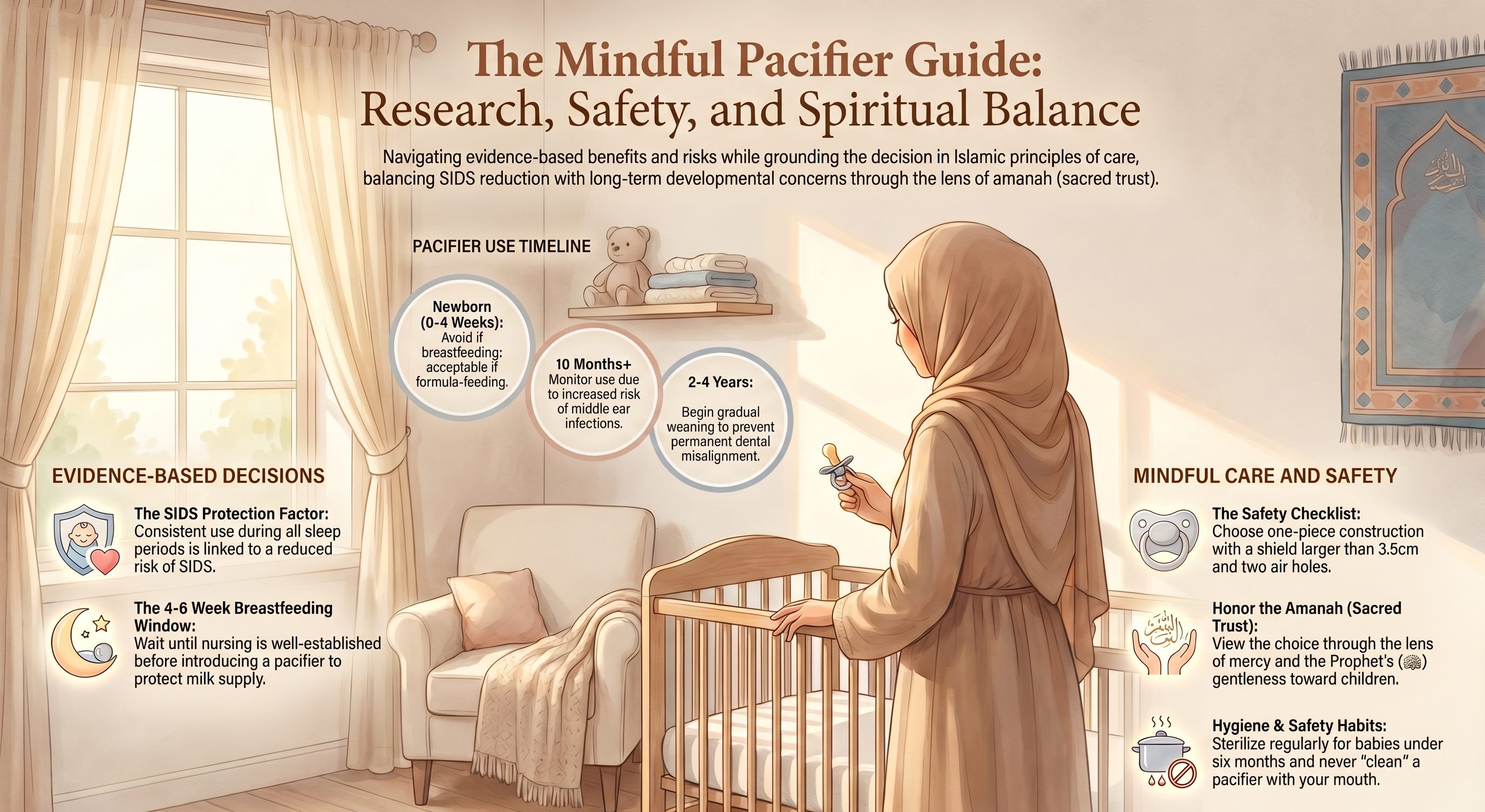
You’re standing in the baby aisle, holding two different pacifiers, trying to figure out if you even need one. Your mother-in-law says they cause dental problems. Your friend swears they saved her sanity during the newborn weeks. Online, you’re reading conflicting advice about nipple confusion and sleep safety.
I understand that confusion completely.
Here’s what I want you to know: pacifiers aren’t inherently good or bad. They’re tools. And like any tool, they work beautifully in some situations and create problems in others. When I dug into the research from the American Academy of Pediatrics, I found something that shifted my perspective—consistent pacifier use during every sleep might lower SIDS risk. [1] That’s significant. But the story doesn’t end there.
Let me walk you through what the evidence actually shows, so you can make a choice that fits your baby and your family.
Why This Guide Is Different From Generic Pacifier Advice
Scientific Research + Current Data — Every recommendation comes from peer-reviewed studies and 2022-2024 guidelines from the AAP, WHO, and pediatric research institutions.
Islamic Framework Integrated — This isn’t just safety tips—it’s about honoring the amanah (sacred trust) of your child’s wellbeing through both practical decisions and spiritual awareness.
Actionable Resources Included — You’ll get a free Pacifier Decision & Safety Guide to print and reference—not just information, but a tool you’ll actually use when making this choice and using pacifiers safely.
The SIDS Connection: Why Pediatricians Changed Their Stance
Let me start with what surprised me most when I studied the sleep safety research.
For years, pediatricians were cautious about recommending pacifiers. Then studies started showing something unexpected: babies who used pacifiers consistently during all sleep periods—naps and nighttime—had a reduced risk of sudden infant death syndrome. [2]
We’re talking about a meaningful protective effect. One comprehensive review found that pacifier use was associated with consistently lower SIDS risk across multiple studies. [2] Researchers don’t fully understand why, but theories include better arousal from sleep and improved airway positioning.
Here’s what this means for you: if you choose to offer a pacifier, the protective effect comes from consistency during sleep, not occasional use.
But and this is important, this benefit doesn’t mean every baby needs a pacifier. It’s one protective factor among many, including back sleeping, firm sleep surfaces, and room-sharing without bed-sharing.
The Breastfeeding Window: Timing Changes Everything
If you’re breastfeeding, the first four to six weeks are sacred time. This is when your milk supply establishes, when your baby learns to latch effectively, and when feeding patterns set the foundation for months ahead.
Introducing a pacifier too early can interfere with this process. [3] The sucking pattern your baby uses on a pacifier differs from the one they use at your breast. When pacifiers come into the picture before breastfeeding is solid, some babies reduce their nursing frequency or struggle with latch. This can affect your milk production and your baby’s weight gain during those critical early weeks.
The research is clear here: for breastfeeding mothers, waiting until around four to six weeks gives you the best chance of establishing nursing successfully before adding a pacifier. [4]
If you’re formula-feeding from birth, this concern doesn’t apply in the same way. You can offer a pacifier earlier if it helps soothe your baby.
Here’s what I wish someone had told me: if your baby doesn’t want a pacifier, that’s completely fine. Some babies refuse them entirely and find other ways to self-soothe—maybe by sucking their fingers, or simply by being held close to you.
What Happens Beyond the Newborn Stage
Now let me walk you through what changes as your baby grows, because pacifier use looks different at four months than it does at two years.
The Ear Infection Risk (After 10 Months)
When I studied the research on middle ear infections, I learned that the relationship with pacifiers isn’t straightforward. For babies under six months, pacifier use doesn’t seem to increase ear infection rates. But for babies older than ten months, frequent pacifier use is linked to higher rates of acute otitis media (middle ear infections). [5]
Why the age difference? The mechanics of a baby’s developing ear canal and Eustachian tube change as they grow. The repeated sucking motion may affect pressure and fluid in ways that become more problematic as babies get older.
This doesn’t mean you must stop at ten months. It means you factor this into your decision-making, especially if your baby already tends toward frequent ear infections.
The Dental Development Question (Long-Term Use)
Here’s where the timeline really matters. Occasional pacifier use during the first two years rarely causes lasting dental problems. The concern grows when pacifier use continues regularly past age three or four. [6]
Prolonged daily sucking creates persistent pressure on developing teeth and the shape of the palate. Over time—and we’re talking months and years here—this can shift tooth alignment or create bite problems that might need orthodontic correction later.
The longer the habit continues and the more hours per day your child uses a pacifier, the higher the risk. A child who uses a pacifier only for sleep is at much lower risk than one who keeps it in their mouth most of the day.
The Sleep Association Pattern
This is the part nobody warned me about: once your baby relies on a pacifier to fall asleep, they’ll often need it to fall back asleep when they wake during the night.
Young babies can’t find a fallen pacifier and put it back in on their own. This means that when it slips out at 2 AM, they cry, and you make trips to their room to replace it. Some families do this five, six, seven times a night.
Around eight months or older, many babies develop the motor skills to retrieve their own pacifiers during the night if you teach them how. Until then, you’re the pacifier replacement service.
I’m not saying this to scare you off—just so you know what you’re signing up for. For some families, the soothing benefit outweighs the nighttime wake-ups. For others, it creates more disruption than it solves.
Choosing a Safe Pacifier: What Actually Matters
If you decide to try a pacifier, safety features matter far more than brand names or trendy designs.
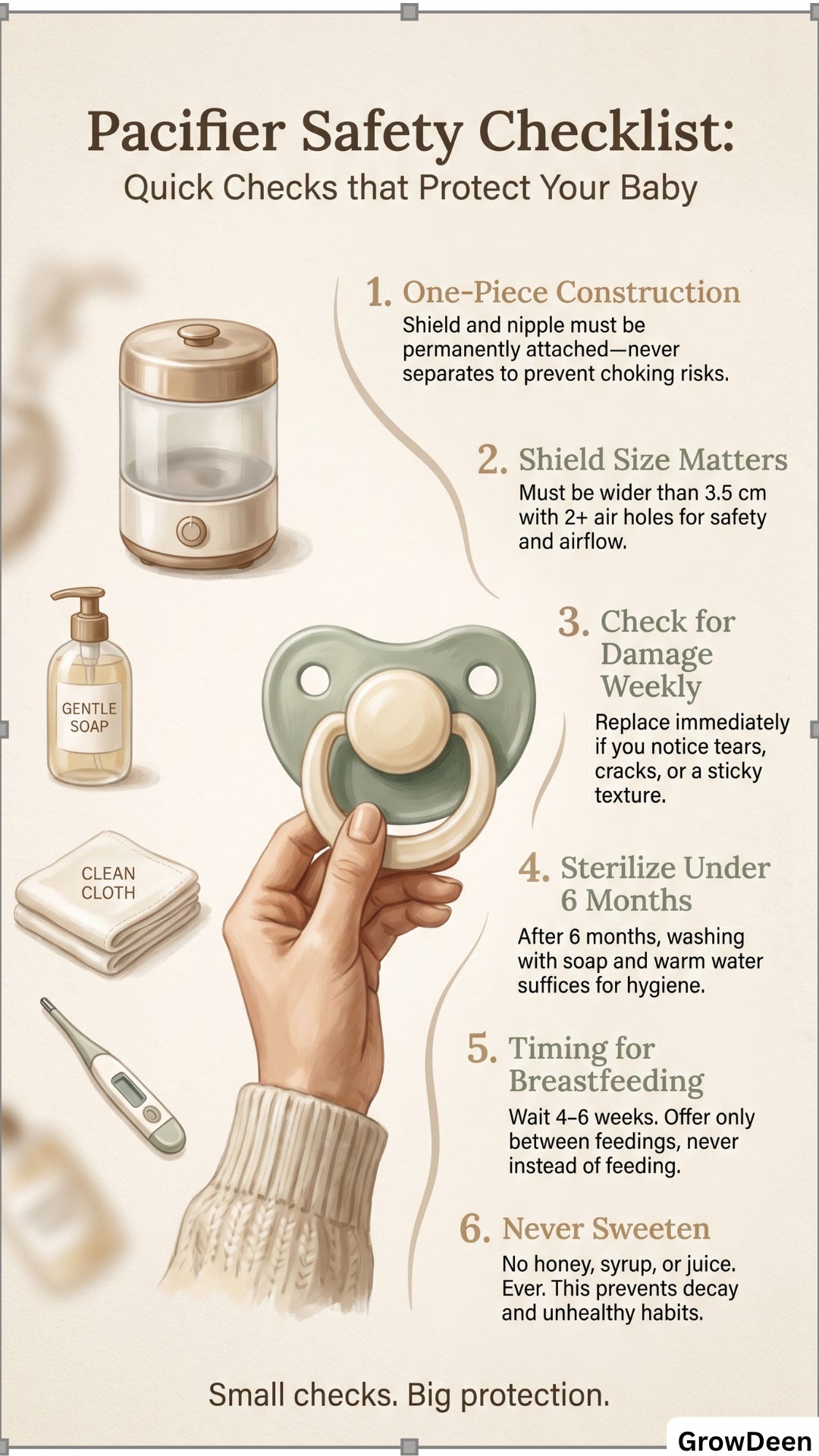
Look for one-piece construction. Two-piece pacifiers can break apart. If the nipple detaches from the shield, it becomes a choking hazard. [8] This is non-negotiable.
Check the shield size. It should measure more than 3.5 centimeters across with at least two air holes. This prevents the entire pacifier from slipping into your baby’s mouth and allows airflow if their face presses against it. [9]
Make sure you can grip it quickly. The ring or handle should be easy to grasp so you can pull the pacifier out fast if it ever becomes lodged.
Inspect for cracks or weak spots. Look for places where water could seep inside during washing. Moisture trapped in the nipple breeds bacteria and mold.
Match the age labeling. Most pacifiers come in sizes for babies under six months and over six months. Using the right size matters for fit and safety.
For babies under six months, choose pacifiers that can be sterilized without degrading. Many brands specify whether they hold up to boiling or steam sterilization.
I know this feels like a lot to track, especially when you’re managing sleepless nights and constant feeding schedules. That’s why I’ve created a free Pacifier Decision & Safety Guide—a printable reference with safety checklists, age-appropriate guidance, and cleaning protocols. Keep reading to download it at the end of this article—it’s designed to give you quick answers when you need them most.
How to Use Pacifiers Thoughtfully
The mechanics of using a pacifier safely matter as much as choosing the right one.
If you’re breastfeeding, offer the pacifier only when you know your baby isn’t hungry—after feedings or between them, not as a replacement for nursing. This protects your milk supply and ensures your baby gets the nutrition they need.
Inspect pacifiers regularly. Look for tears, discoloration, stickiness, or any change in texture. Pacifiers degrade with use, and a damaged one can break apart into small pieces your baby could choke on. [10] Replace them at the first sign of wear.
Keep extras on hand. Babies drop things constantly. Having spare pacifiers ready reduces stress when one lands somewhere you can’t immediately clean it.
Never sweeten the pacifier. Don’t dip it in honey, syrup, sugar water, or juice. This habit sets up tooth decay even before teeth fully emerge and teaches your baby to expect sweetness. [11]
Consider teaching pacifier independence around eight months. At this age, many babies can learn to find and replace their own pacifiers during sleep, which reduces those middle-of-the-night wake-ups where you’re the one doing the work.
If your baby develops oral thrush, replace the pacifier weekly even with careful cleaning. Fungal infections can survive on pacifiers despite washing, leading to reinfection. [13]
Pacifier Clips: Use Them Safely or Skip Them
Some parents find pacifier clips helpful for keeping pacifiers from constantly hitting the floor. If you use one, safety standards matter.
The clip or chain must be shorter than 22 centimeters, made from sturdy material that won’t break easily, and free of small decorative pieces like beads that could detach and become choking hazards. [12] Check that it meets the safety standards for your country.
Never—and I mean never—tie a pacifier around your baby’s neck or attach it to a crib, car seat, or any surface where it could tighten. Strangulation risk is real and preventable.
If you’re not confident in the safety of a clip, just skip it. Losing pacifiers to the floor is annoying, but it’s not dangerous.
Cleaning: What Changes as Your Baby Grows
For babies under six months, sterilize pacifiers regularly. Their immune systems are still developing, and sterilization reduces exposure to harmful bacteria.
You can boil pacifiers for several minutes, use a steam sterilizer, or soak them in sterilizing solution—whatever method you’re already using for bottles works fine.
Once your baby reaches about six months, their immune system has matured enough that thorough washing with soap and warm water is usually sufficient. [14] This makes pacifier care less time-consuming as your days get busier.
Don’t fall into the old habit of “cleaning” a pacifier by putting it in your own mouth. This transfers bacteria from your mouth to your baby’s, including bacteria that contribute to cavities and infections.
Store clean pacifiers in a covered container between uses to keep them free from dust and contaminants.
The Spiritual Dimension of Soothing Your Child
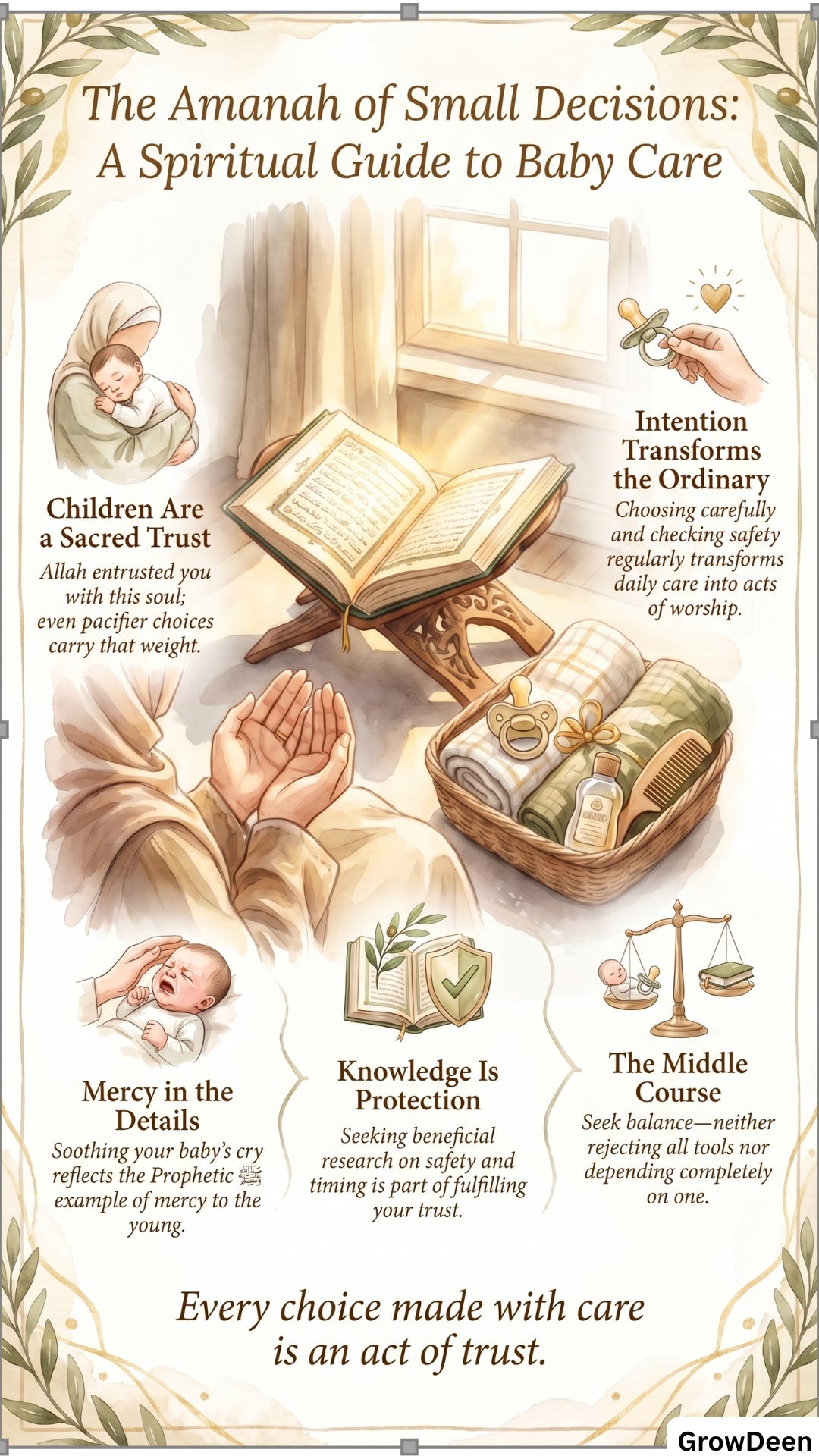
When I reflect on the verse where Allah says, “And We have enjoined upon man goodness to his parents. His mother carried him with hardship and gave birth to him with hardship,” [15] I think about how the care of children begins with sacrifice and continues through countless small decisions made with tenderness.
Choosing whether to use a pacifier is one of those decisions. It’s not a test you pass or fail. It’s a choice you make within the framework of your baby’s needs, your family’s circumstances, and the guidance Allah has given us through both revealed wisdom and the knowledge He allows humans to uncover through research.
The Prophet Muhammad ﷺ showed extraordinary gentleness toward children. He taught us, “He is not one of us who does not show mercy to our young ones and esteem to our elderly.” [16] When your baby cries and seeks comfort through sucking—whether at your breast, on a pacifier, or through their own fingers—responding to that need with patience reflects the mercy Allah asks of us.
Our children are an amanah, a sacred trust. The Qur’an says, “O you who have believed, indeed, among your spouses and your children are enemies to you, so beware of them. But if you pardon and overlook and forgive—then indeed, Allah is Forgiving and Merciful.” [18] This verse acknowledges that raising children involves challenges, yet it calls us to approach these difficulties with forgiveness—toward our children and toward ourselves when we make mistakes or struggle with decisions.
The Prophet ﷺ taught balance in all things. He said, “The best of affairs is the middle course.” [17] This applies here too. While pacifiers can serve a genuine purpose, allowing them to dominate your child’s day and night may tip into excess, affecting development in ways that moderation prevents.
Understanding both the benefits and the limits of pacifiers allows you to use them wisely if you choose to—keeping your child’s long-term wellbeing in focus while responding with compassion to their immediate needs.
Your Pacifier Decision & Safety Guide
If you’ve read this far, you’re the kind of parent who takes decisions about your child’s wellbeing seriously—not as worry, but as protective love. That tells me something beautiful about you.
Inside the Pacifier Decision & Safety Guide (one comprehensive PDF, 2 pages):
Page 1: Safety Checklist & Decision Timeline — A quick-reference card covering pacifier safety features, when to introduce based on feeding method, and red flags for replacement—designed like a laminated checklist you can keep with your baby supplies.
Page 2: Cleaning Protocols & Age-Specific Guidelines — Sterilization schedules by age, proper storage methods, and developmental milestones that affect pacifier use—organized by your baby’s age so you can reference what matters right now.
This isn’t just a PDF to download and forget. It’s a tool designed to stay where you’ll actually use it when questions come up—in your diaper bag, posted near the changing table, or saved on your phone.
This Pacifier Decision & Safety Guide is what every GrowDeen subscriber receives with each article. We cover the full journey of raising Muslim children, all backed by scientific research and rooted in Islamic wisdom.
If you’re a Muslim parent who wants both evidence-based guidance AND Islamic perspective, subscribe for free so future resources arrive in your inbox before you need them.
You’ll receive guidance when it’s ready. No spamming, no clutter, just guidance when there’s something worth sharing.
Tonight, if you’re using a pacifier, take one minute to inspect it. Check for tears, cracks, or any sign of wear. If it’s damaged, replace it. If it’s fine, you’ve just built a safety habit that takes almost no time but protects your baby.
May Allah place barakah in your efforts, accept your intentions, and make the care you give more protective, more merciful, and more rewarded than it feels in the moment.
Share This With Someone Who Needs It
Think of one person right now: a pregnant friend preparing for her baby’s arrival, a new mother in your family who’s overwhelmed by conflicting advice, someone who just asked you whether they should use a pacifier.
This article could help them make an informed choice. Share it with them today—not as advice-giving, but as support. Sometimes the most loving thing we can do is pass along knowledge that brings clarity.
Frequently Asked Questions
Q: Can I give my newborn a pacifier right from birth? A: If you’re breastfeeding, wait until nursing is well-established—typically around four to six weeks—to avoid interfering with latch and milk supply. [3] If you’re formula-feeding, you can offer a pacifier from birth. For more detail, see the “Breastfeeding Window” section above.
Q: Will a pacifier cause my baby’s teeth to grow crooked? A: Occasional use in the first two to three years rarely causes dental problems. The risk increases with prolonged daily use, especially beyond age three or four, when constant pressure can shift tooth alignment. [6] The longer and more frequently your child uses a pacifier, the higher the risk of needing orthodontic correction later.
Q: How often should I replace pacifiers? A: Inspect pacifiers every few days for tears, discoloration, stickiness, or cracks. Replace them immediately if you notice any damage, as broken pieces create choking hazards. [10] Even without visible damage, replace pacifiers every 4-6 weeks with regular use.
Q: My baby won’t take a pacifier. Is that a problem? A: No. Not every baby likes or needs a pacifier. Some babies refuse them entirely and self-soothe through other means, like sucking their fingers or resting against you. If your baby isn’t interested, there’s no need to force it.
Q: Does pacifier use really reduce SIDS risk? A: Research shows that consistent pacifier use during all sleep periods is associated with reduced SIDS risk. [1,2] The exact mechanism isn’t fully understood, but the protective effect appears across multiple studies. This is one factor among many safe sleep practices, including back sleeping and room-sharing.
Q: When should I stop giving my child a pacifier? A: Many families begin weaning between 12-24 months to avoid dental issues and reduce dependency. The longer the habit continues past age two or three, especially with frequent daily use, the higher the risk of dental problems. [6] Gradual weaning works better than sudden removal for most children.
References
[1] Moon, R.Y., Carlin, R.F., & Hand, I. (2022). Sleep-Related Infant Deaths: Updated 2022 Recommendations for a Safe Infant Sleeping Environment. Pediatrics, 150(1), e2022057990.
[2] Moon, R.Y., Tanabe, K.O., Yang, D., Young, H., & Hauck, F. (2011). Pacifier use and SIDS: Evidence for a consistently reduced risk. Maternal and Child Health Journal, 16(3), 609-614.
[3] Jaafar, S.H., Ho, J.J., Jahanfar, S., & Angolkar, M. (2016). Effect of restricted pacifier use in breastfeeding term infants for increasing duration of breastfeeding. Cochrane Database of Systematic Reviews 2016, 8. CD007202.
[4] O’Connor, N.R., Tanabe, K.O., Siadaty, M.S., & Hauck, F.R. (2009). Pacifiers and breastfeeding: A systematic review. Archives of Pediatrics & Adolescent Medicine, 163(4), 378-382.
[5] Uhari, M., Mantysanri, K., & Niemelä, M. (1996). A meta-analytic review of the risk factors for acute otitis media. Clinical Infectious Diseases, 22, 1079-1083.
[6] Adair, S.M., Milano, M., Lorenzo, I., & Russell, C. (1995). Effects of current and former pacifier use on the dentition of 24- to 59-month-old children. Pediatric Dentistry, 17(7), 437-44.
[7] Strutt, C., Khattab, G., & Willoughby, J. (2021). Does the duration and frequency of dummy (pacifier) use affect the development of speech? International Journal of Language and Communication Disorders, 56(3), 512–527.
[8] Red Nose National Scientific Advisory Group (NSAG). (2014). Information statement: Using a dummy or pacifier. Red Nose. Retrieved from https://rednose.com.au/article/using-a-dummy-or-pacifier.
[9] Sexton, S., & Natale, R. (2009). Risks and benefits of pacifiers. American Family Physician, 79(8), 681-685.
[10] Callaghan, A., Kendall, G., Lock, C., Mahoney, A., Payne, J., & Verrier, L. (2005). Association between pacifier use and breast-feeding, sudden infant death syndrome, infection and dental malocclusion. International Journal of Evidence-based Healthcare, 3(6), 147-167.
[11] Peressini, S. (2003). Pacifier use and early childhood caries: An evidence-based study of the literature. Journal of the Canadian Dental Association, 69(1), 16-19.
[12] American Academy of Pediatrics, Task Force on Sudden Infant Death Syndrome. (2005). Policy statement: The changing concept of sudden infant death syndrome. Pediatrics, 116, 1245-1255.
[13] Kramer, M.S., Barr, R.G., Dagenais, S., Yang, H., Jones, P., Ciofani, L., & Jané, F. (2001). Pacifier use, early weaning, and cry/fuss behavior: A randomized controlled trial. Journal of the American Medical Association, 286(3), 322-326.
[14] Moon, R.Y. (2016). SIDS and other sleep-related infant deaths: Evidence base for 2016 updated recommendations for safe infant sleeping environment. Pediatrics, 138(5), Article e20162940.
[15] Qur’an, Surah Al-Ahqaf 46:15
[16] Sunan al-Tirmidhi 1919 (Hasan)
[17] Sahih Muslim 2816
[18] Qur’an, Surah At-Taghabun 64:14