

In a normative study of 1,114 children aged two to twelve, every one screened to exclude any history of abuse, the body-curious behaviours that frighten parents most were commonest in the youngest children and became steadily less frequent as they grew. [1] It is development, not damage. What decides the outcome is the ten seconds after you walk in.
For the ten seconds after you walk in.
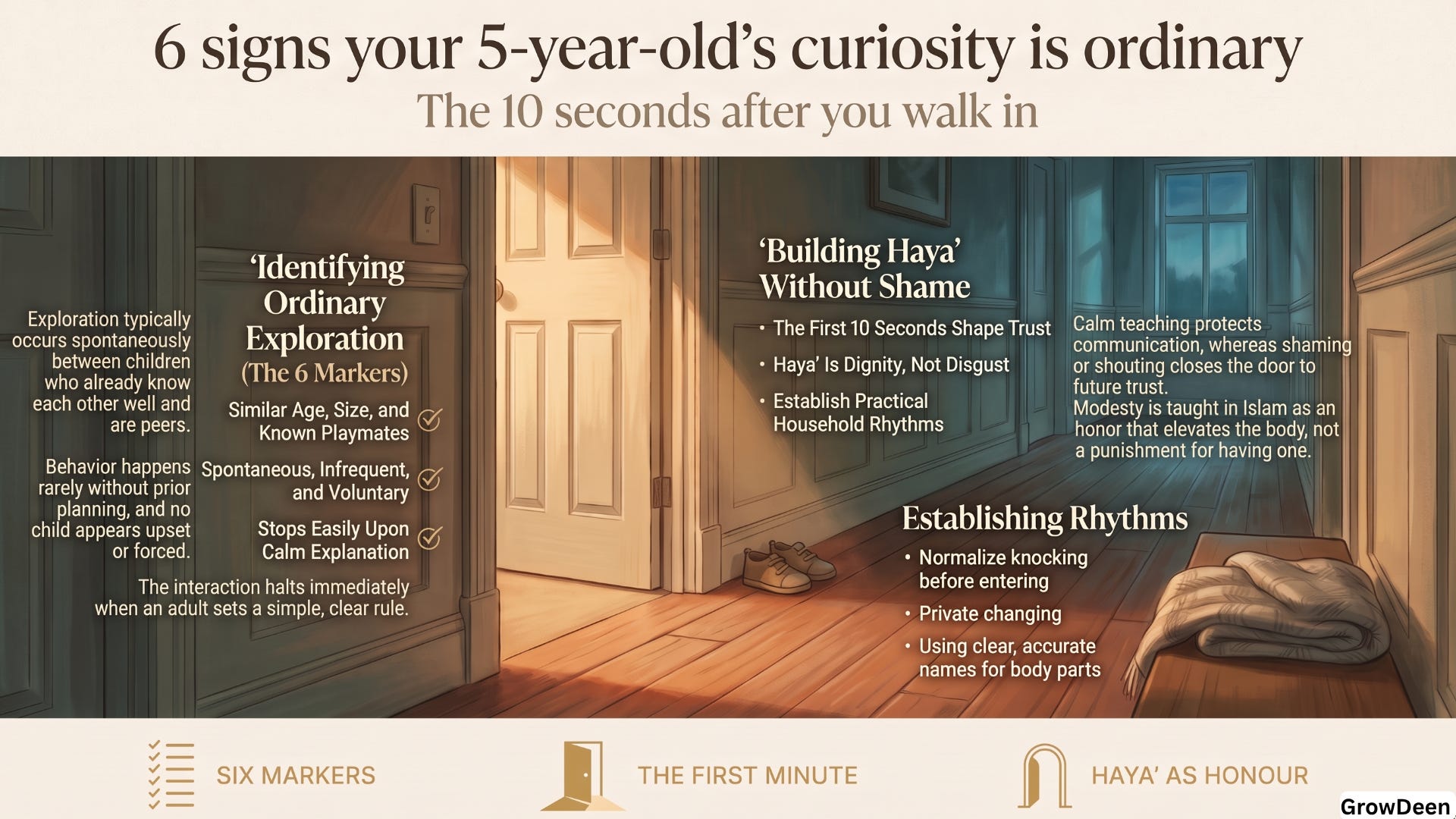
You open a door and two five-year-olds look up at you. Whatever you do in the next ten seconds, you will do it before you have had a chance to think about it.
That is the uncomfortable part of this subject. The behaviour is usually ordinary and the reaction usually is not, and it is the reaction the child remembers. A child who is shouted at learns that this is a subject you cannot be told about. A child who is answered calmly learns the opposite, and keeps telling you things for another ten years.
So this guide is in two halves. The first is how to tell ordinary curiosity apart from the small number of situations that need help, using six markers specialists actually use. The second is what to do in the moment, and how to teach haya’ as something that honours a child’s body rather than shames it — a disposition a child is born with, which these two years either grow or bury.
What makes this guide different
Every claim is tied to named research with a year on it: a 1998 normative study of 1,114 children, the typical-exploration markers used by specialists in child trauma, a 2023 systematic review and meta-analysis on exposure to sexual content, and a 2022 child-protection framework that places behaviour on a continuum rather than a line. [1][2][3][4]
The Islamic material sets the frame rather than closing the article. The Prophet ﷺ corrected a man washing uncovered without shaming him where he stood, and the reason underneath the rule — that bashfulness is owed even when nobody is watching — is what makes privacy hold at six when it was only a rule at four. [9][10]
You already have the free Ten Seconds Pack from the top of this page, which turns the six markers and the first ten seconds into something you can keep on the fridge rather than something you have to remember under pressure.
Why does my 5-year-old suddenly want the door closed?
A child who spent their toddler years perfectly content to run from the bath down the hallway without a stitch on starts, somewhere around their fifth year, to want the door closed. No parent teaches that in a single sitting. It arrives more or less on its own schedule, the way teeth do.
The research describes what parents notice. In a normative study of 1,114 children aged two to twelve, all screened to exclude any history of sexual abuse, the behaviours caregivers reported most often clustered in the youngest group, then became less frequent as children grew older and more modest [1].
That matters for how a parent reads their own child. A five-year-old who has not yet worked out the rules about bodies is not a child lacking haya’. They are a child in the middle of acquiring it.
What does body curiosity look like between four and six?
Between four and six, several things happen at once. Children become aware that boys and girls are built differently. They begin playing socially, with other children rather than beside them. And they discover, by trial and error, that there are rules about bodies which nobody has spelled out yet.
So they test. They ask where babies come from. They want to know why a cousin’s body is not the same as theirs. They try out a word heard at school without the faintest idea what it means, mostly to see what a parent’s face does. They copy what adults do, which at this age usually amounts to hand-holding and a kiss on the cheek. Some of it happens in games with children of the same age, the familiar sort where somebody is the doctor and somebody is the patient [2].
Very little of that is a warning sign. Most of it is a child doing the developmental work of their age out loud.
How do I know if my child’s behaviour is ordinary?
This is the part most parents are never given, and it is far more useful than a list of behaviours to fear.
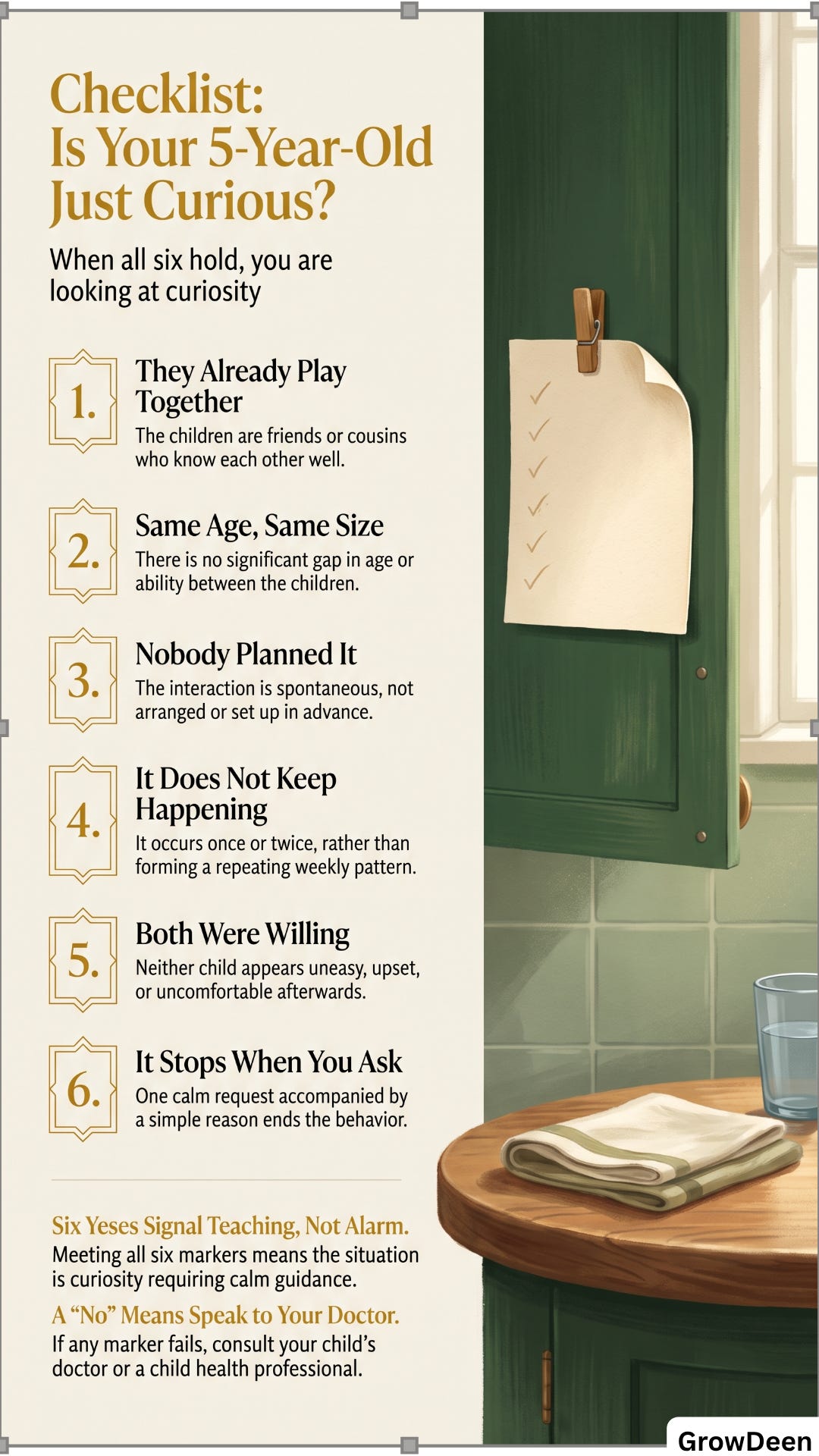
Specialists in child trauma describe typical childhood exploration as having a recognisable shape:
1. It happens between children who already play together and know each other well.
2. The children are of roughly the same age and size.
3. It is spontaneous rather than planned.
4. It happens infrequently.
5. It is voluntary, with nobody appearing upset or uncomfortable.
6. It stops easily when an adult asks it to stop and explains the rule [2].
Those six markers are what a parent is actually checking against when something catches them off guard. When all six hold, the situation is curiosity, and the response that follows is teaching rather than alarm.
The teaching still matters. Something being developmentally typical does not mean it should be waved through. When children behave this way it usually signals there is something they have not yet been told [2], which makes the behaviour a question waiting for an answer.
What is normal at four, at five and at six?
Around four. Still largely unselfconscious. A child may want to be naked, and may ask blunt questions in the least convenient places. Keep answers short and matter-of-fact. Start naming the rule rather than the shame: private parts stay covered when other people are around.
Around five. Modesty begins appearing on its own. A child may start closing doors, or object to being changed in front of a sibling. Honour that instinct the moment it shows. This is haya’ arriving, and the way a parent responds teaches the child whether it is something to be proud of.
Around six. More aware of social rules, and more likely to test them deliberately, often with words rather than behaviour. Questions get more specific. School and other households widen what a child is exposed to, so what is taught at home now has competition.
What should I do at home?
Talk a little and often, rather than once and perfectly. Health guidance for parents makes this point plainly: regular, relaxed conversations do more good than a single formal talk, parents remain their child’s most trusted source on these topics, and a parent waiting for the perfect answer often ends up saying nothing at all [7]. An imperfect answer beats silence.
Answer the question that was asked. A five-year-old asking where babies come from is usually not asking what an adult assumes. Give the smallest true answer, then stop and see whether more is wanted.
Use correct words for body parts, without flinching. A child with accurate language can describe what happened to them if they ever need to.
Teach haya’ as dignity rather than disgust. The body is not the problem, and a child who learns that their body is shameful learns something Islam never asked of them. Covering is taught in the Sunnah as honour, not as punishment for having a body at all.
Teach the safety layer alongside the modesty layer. Nobody may touch a child’s private parts or ask the child to touch theirs, and that stays true even when the person is someone the family knows. If it happens, it is never the child’s fault. A surprise is something revealed soon, like a gift. A secret a child is told never to tell is different, and that kind is not kept from parents. Make sure the child knows exactly which adults to tell [2].
Support Muslim Parenting Lab ❤️
Would you like the most rewarded kind of charity there is? Use the button below now, while you are well, rather than later.
Asked which charity is best, the Prophet ﷺ said the one given while you are healthy, not deferred until death is near. (Sahih al-Bukhari 1419)
What should I stop doing?
Do not shame. A child who is shouted at or made to feel dirty learns one lesson with total clarity: never let them find out. That is the opposite of what safeguarding requires.
Do not label the child. Child protection guidance is explicit that words such as perpetrator or predator should never be attached to a child. Name the behaviour, never the child [3].
Do not react in front of an audience. Separate the children calmly, then speak to each one alone.
Do not interrogate. Open questions work better than yes-or-no ones: what were you doing, how did you get the idea, where did you learn about this, how did you feel about it [2]. Those questions reveal where the idea came from, which is the single most useful thing a parent can learn.
Do not pretend you did not see it. Ignoring the moment loses the teaching opportunity the moment created.
What does a privacy routine look like day to day?
Small habits do most of this work, and none of them requires a difficult conversation.
Knock before entering, and expect the same. Permission becomes an ordinary household rhythm rather than a rule that suddenly appears at puberty.
Close the door when changing, and let the child close theirs.
Keep bathing and dressing private once a child can manage, and name who is allowed to help and why.
Keep the dhikr where it belongs. Say Bismillah on the way in and praise Allah on the way out, around the ordinary care of the body — before entering the bathroom and after leaving it, rather than while a child is uncovered — so the body sits inside the child’s relationship with Allah rather than outside it.
Narrate respect during care routines. Telling a child what you are about to do before doing it teaches them the body is theirs.
How much does what my child watches matter?
Children learn most of this by watching. How the adults in a home speak to one another, whether a four-year-old’s “no, I do not want a hug” is respected, whether screens are supervised. All of it teaches.
The screen question deserves honesty. A 2023 systematic review and meta-analysis found that children and young people exposed to non-violent sexual content were around 1.8 times as likely to show problematic sexual behaviours, and those exposed to violent or live sexual content around 2.5 times as likely, though the difference between those two figures was not statistically significant [4]. The research describes an association rather than a straight line of cause, and exposure is not destiny. But the direction is consistent enough that supervision counts as genuine protection rather than fussiness. Online safety guidance now maps children’s digital experience across the whole span from birth to eighteen, treating bodies, consent and privacy as areas that develop online as much as off [5].
Choose Islamically suitable, music-free, parent-approved content, and know what is on the screen rather than trusting the settings alone.
When should I be worried about my child’s behaviour?
Most of what parents worry about at this age turns out to be ordinary. A small number of situations are not, and those deserve a clear-eyed response rather than a hopeful one.
Child protection frameworks place children’s behaviour on a continuum running from developmentally appropriate, through developmentally inappropriate, to concerning and beyond. Where a behaviour sits is judged by the child’s age and stage, the context, how often it happens and whether it persists, how the child feels afterwards, and whether another child was involved without real mutuality [3].
In practice, the picture changes when the six ordinary markers break down. Look for behaviour well outside what would be expected of a child this age. Anything involving threats, force, or pressure. Children of markedly different ages or abilities rather than peers. A child left angry, anxious, or distressed afterwards [2]. And one more, often the clearest of all: behaviour that keeps returning after a parent has calmly set the limit more than once.
None of this describes a bad child. Frequently it describes a child who has been shown something, or had something done to them, and is now making sense of it in the only way a five-year-old can. Among children who go on to initiate problematic sexual behaviour, earlier exposure to sexually explicit material and prior experience of abuse both appear at high rates [6]. Frameworks in this area treat such behaviour as the communication of an unmet need rather than a character flaw [3].
Where any of this is present, the next step is not a stricter rule or a harder conversation. Speak with the child’s doctor or another qualified child health professional, who can arrange assessment with someone experienced in this area. Many countries also run confidential child protection helplines staffed by people who have heard this question many times and will not be shocked by it. None of this replaces professional advice, and seeking it early gives the child the best outcome.
Asking for help is not an admission that something has gone wrong in a home. More often it is evidence that it has not.
The Sacred Trust Behind a Closed Door
As Muslim parents, the instinct when a child’s curiosity surfaces is often embarrassment, and embarrassment makes us sharp. Islam points somewhere else.
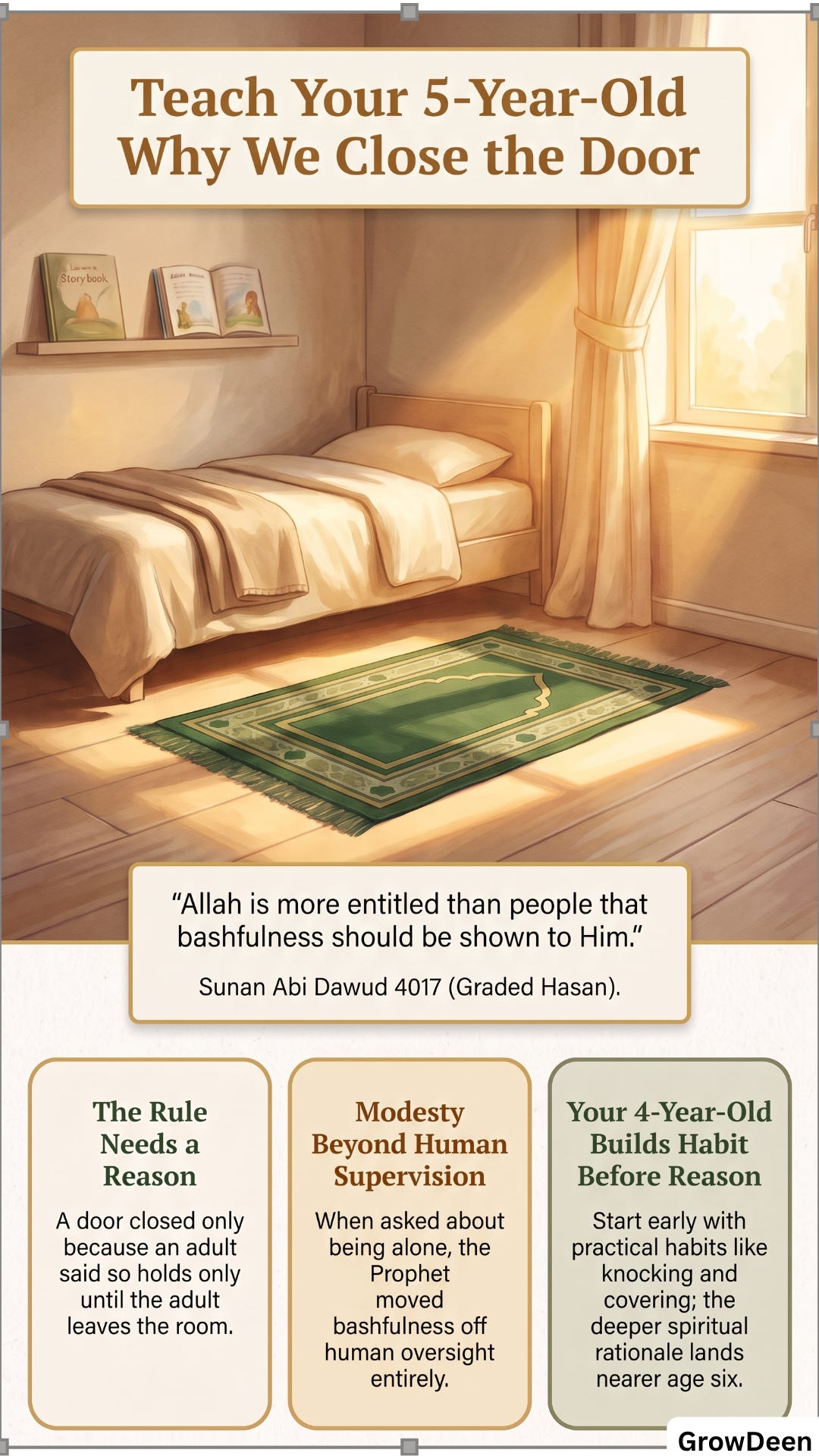
There is a narration worth returning to for how it handles a moment like this. The Prophet ﷺ saw a man washing in the open with nothing covering him. He did not confront him or shame him where he stood. He went up to the pulpit, praised Allah, and taught everyone present: “Allah is characterised by modesty and concealment” [9]. He then instructed that anyone washing should cover himself. The correction was public. The embarrassment was not. That is the template for walking in on a five-year-old.
What gives the rule staying power is the reason underneath it. Asked what a man should do when completely alone, the Prophet ﷺ answered: “Allah is more entitled than people that bashfulness should be shown to him” [10]. A four-year-old cannot reach that yet. A six-year-old can begin to, and it is the version of privacy that holds when nobody is supervising.
The supervising is not incidental either. Allah says: “do not betray Allāh and the Messenger or betray your trusts” [8]. According to Tafsir Ibn Kathir, amanat here means “the actions that Allah has entrusted the servants with,” and the ruling is general rather than tied to the incident that occasioned the verse. Knowing what reaches a child’s eyes sits inside that.
May Allah protect our children, and keep the door between us and them open.
Parent Checklist
[ ] I know the six markers that tell me exploration is ordinary.
[ ] My child knows the correct words for their body parts.
[ ] My child knows that private parts stay private, and why.
[ ] My child knows no one may touch their private parts, including people we know.
[ ] My child knows the difference between a surprise and a secret.
[ ] My child knows at least two adults they can tell.
[ ] Knocking and closing doors are normal in our home.
[ ] I know what my child watches, and it is music-free and parent-approved.
[ ] I have decided in advance to respond calmly rather than react.
[ ] I know which signs would prompt me to speak to a doctor.
A Final Word
Across these two years a parent is not assembling a list of prohibitions. They are raising a child who understands that their body belongs to them and is honoured, who knows which parts stay private and why, who has language for discomfort, and who is certain that nothing they say will make a parent turn away from them.
Haya’ grown that way tends to last. Haya’ enforced by fear of a parent tends to give way at precisely the age a parent most needs it to hold.
The Ten Seconds Pack: what is inside it
If you have read this far, you are the kind of parent who went looking for an explanation rather than a reassurance. That tells me something good about how this child is being raised.
Inside the Ten Seconds Pack (one comprehensive PDF, 3 pages):
Page 1: Six Signs To Act On. A tick-box sheet of the six signs that call for a response rather than teaching — the mirror image of the six markers above, so you are checking for the opposite thing. Two panels tell you what to do next: one for when none of them are present, one for when any single one is. It closes on the line that does most of the work in this whole article: name the behaviour, never the child.
Page 2: Your First Ten Seconds. The sequence to run before you say anything: breathe, ask them to get dressed, send them to separate rooms, steady yourself, then talk to one child at a time. Underneath it, the four questions that tell you where the idea came from, and the three reactions that never help.
Page 3: Covered and Honoured. The two narrations this article rests on, with their gradings and the moment each came from. And at the bottom, a scripted answer for the evening your six-year-old asks why privacy matters if nobody can see.
This is not a PDF to download and forget. Page 1 is built for the day something catches you off guard, and page 2 is built for the ten seconds after it.
The Ten Seconds Pack is what every subscriber receives with each article. Muslim Parenting Lab covers the full span of raising Muslim children, from the newborn weeks through the school years, with every recommendation tied to named research and rooted in the Qur’an and Sunnah.
Your micro-action for tonight
Decide your first ten seconds now, while nothing is happening. Say it to yourself once: breathe, ask them to get dressed, send them to different rooms, and do not ask a single question until you have steadied yourself. Deciding it tonight is what makes it available to you on the day you need it, because on the day you need it you will not be deciding anything.
Share this with someone who needs it
Think of one person right now: the mother who walked in on something last month, has not told anybody, and has been quietly frightened ever since about what it meant.
This article would tell her that there are six markers for exactly that situation, that most of the time all six hold, and that what she does in the first ten seconds matters more than what she says afterwards. Send it to her today, the way you would have wanted somebody to send it to you.
Frequently asked questions
Q: Is it normal for a 5-year-old to be curious about bodies? A: Yes. Between four and six children become aware that boys and girls are built differently, start playing socially rather than alongside each other, and work out by trial and error that there are rules about bodies nobody has spelled out. Testing those rules is the developmental work of the age. [1][2]
Q: How do I tell ordinary curiosity from something I should worry about? A: Six markers. It happens between children who already play together, of roughly the same age and size; it is spontaneous rather than planned; it happens infrequently; it is voluntary, with nobody upset; and it stops easily when an adult asks and explains the rule. When all six hold, it is curiosity. [2]
Q: What should I do in the first ten seconds? A: Breathe before you speak. Ask the children calmly to get dressed, send them to separate rooms, and steady yourself before you talk to either of them. Do not react in front of an audience, and do not interrogate — open questions work better than yes-or-no ones.
Q: Should I use the correct words for body parts? A: Yes, and without flinching. A child with accurate language can describe what happened to them if they ever need to. A child with only nicknames often cannot.
Q: How do I teach haya’ without making my child ashamed of their body? A: Teach it as dignity rather than disgust. The body is not the problem, and covering is taught in the Sunnah as honour rather than as punishment for having a body at all. The Prophet ﷺ corrected the behaviour publicly and left the embarrassment out of it, which is the template for walking in on a five-year-old. [9]
Q: When should I speak to a doctor? A: When the six markers break down: behaviour well outside what would be expected at this age, anything involving threats, force or pressure, children of markedly different ages or abilities rather than peers, a child left angry or distressed afterwards, or behaviour that keeps returning after you have calmly set the limit more than once. Asking early is a strength rather than a failure. [2][3]
References
[1] Friedrich, W.N., Fisher, J., Broughton, D., Houston, M., & Shafran, C.R. (1998). Normative sexual behavior in children: A contemporary sample. Pediatrics, 101(4), e9.
[2] National Child Traumatic Stress Network. (2009). Sexual development and behavior in children: Information for parents and caregivers. NCTSN, in partnership with the National Center on Sexual Behavior of Youth; funded by SAMHSA, U.S. Department of Health and Human Services.
[3] Paton, A., & Bromfield, L. (2022). Framework for understanding and guiding responses to harmful sexual behaviours in children and young people. Australian Centre for Child Protection, University of South Australia, with the Department of Communities.
[4] Mori, C., Park, J., Racine, N., Ganshorn, H., Hartwick, C., & Madigan, S. (2023). Exposure to sexual content and problematic sexual behaviors in children and adolescents: A systematic review and meta-analysis. Child Abuse & Neglect, 143, 106255.
[5] eSafety Commissioner. (2025). Online safety and sexual development guidance. Australian Government eSafety Commissioner.
[6] Bravehearts Foundation. (2026). Harmful sexual behaviours (including peer-instigated abuse). Bravehearts.
[7] Department of Health, Western Australia. (2019). Talk soon, talk often: A guide for parents talking to their kids about sex. HealthyWA.
[8] Qur’an, Surah Al-Anfal 8:27 (Saheeh International). Tafsir Ibn Kathir
[9] Sunan Abi Dawud 4012, narrated by Ya’la. Book 33 (Kitab Al-Hammam), Chapter: The prohibition of nudity. Graded Sahih (Al-Albani).
[10] Sunan Abi Dawud 4017, narrated by Bahz b. Hakim from his father, from his grandfather. Book 33 (Kitab Al-Hammam), Chapter: Regarding Nudity. Graded Hasan (Al-Albani).
We combine scientific research with Qur’an and authentic Sunnah, and we cite our sources. Even so, this is general guidance and no substitute for a doctor who can examine your child.