
A 2020 trial in the Journal of the American Academy of Child and Adolescent Psychiatry split 124 anxious children in two. Half went to therapy. Half never did, and their parents went instead. Both groups improved the same amount. [1]
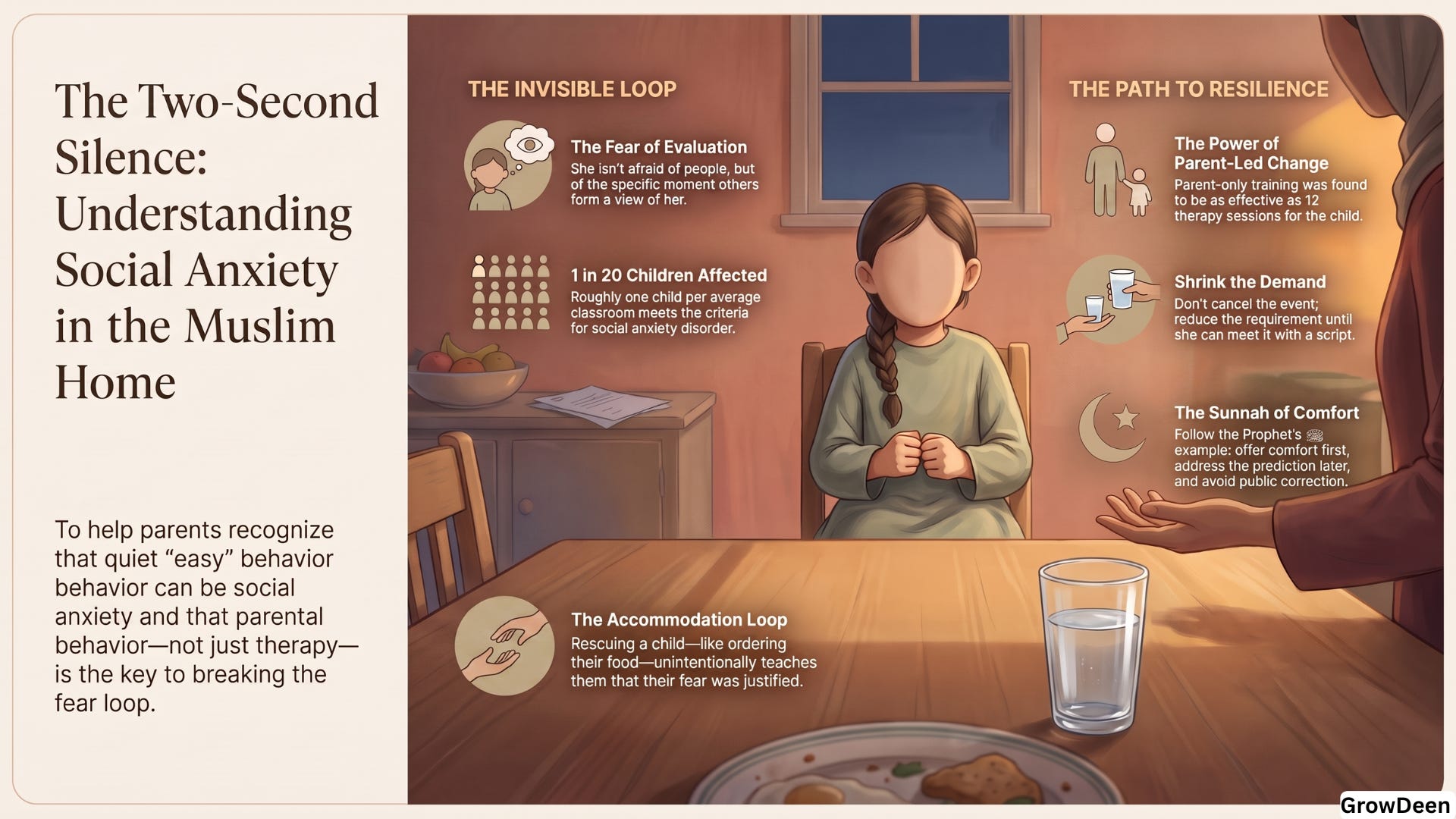
She wanted to go in.
You could see it from across the courtyard. Six children in a circle, your daughter four feet away with her shoes half off, watching. Not sulking. Watching the way you watch a bus you have decided not to run for.
A relative walks past and says the sentence said about children like her a thousand times a year. “Oh, she’s just shy.” And you nod, because last week the teacher said she was a pleasure to have in class. No concerns at all. Very quiet.
Roughly one in twenty children and adolescents meets criteria for a social anxiety disorder at any given time. [5] In an average class that is one child, and it is almost never the one the teacher mentions.
You are not missing something obvious. That is the whole difficulty with this one. There is nothing obvious to miss.
That school report and that courtyard are the same fact. A child with social anxiety does not disrupt anything. She becomes easy, so easy that nobody around her has a reason to look twice, and the pattern runs for years with a good report signing off on it every term.
Which is why the 2020 trial in the subtitle matters. [1] It says the person with the most power to change this is not a therapist. It is you.
Why This Guide Is Different
Current research, named and dated. Every claim here traces to peer-reviewed work or clinical guidance from 2015 onward, including a 2023 review of the pathways from early temperament to later anxiety. [3]
Islamic guidance that changes what you do, not just how you feel. The Sunnah contains a step-by-step record of how to stand beside a frightened person, and a specific rule about correcting someone without exposing them in front of a room. Both are used here as instructions, not decoration.
The Six Flashpoints Companion Pack. A free printable that turns this article into a two-week observation map and six exact scripts for the moments your child freezes.
What Your Child Is Actually Afraid Of
Ask a parent what their socially anxious child fears and most say “people.” That is the wrong noun, and getting it right changes everything you do next.
She is not afraid of her cousin. She is afraid of an assessment. The specific dread is the second or two when other people form a view of her and the view comes back bad. [2][8]
Which answers a question you have probably asked yourself without ever finding an answer.
Why does the same child who cannot manage two words to that cousin at the dinner table talk for forty solid minutes when the two of them are alone upstairs? Nothing about the cousin changed. The audience did. Hold onto that question, because it explains something later about why the fixes that feel most loving are the ones that do the most damage.
Once you know it is evaluation she fears and not people, the flashpoints stop looking random. Reading aloud. Being called on with no warning. Walking into a room where everyone is already seated and heads turn. Eating in front of others. Handing something to an adult. Every one of them has the same shape: for a moment, she is the thing being watched.
The Loop That Makes It Grow
Now for the part that reframes the whole problem.
Social anxiety does not sit still, waiting to be outgrown. Research on how it is maintained in pre-adolescent children describes a loop that feeds itself several times a day. [2]
Your child predicts something humiliating. She avoids it, or she takes cover: back of the room, one-word answers, eyes down. Nothing bad happens. And her brain files that as proof the cover was necessary, rather than as evidence the prediction was wrong. Then, on the way home, she replays the whole encounter hunting for the moment she embarrassed herself, and she finds one, because anyone looking hard enough will. [2]
Read that again slowly. Every successful escape is a lesson. The lesson is: the fear was right.
Every rescue teaches the fear it was right.
That sentence is worth putting somewhere you will see it, because it is about to describe something you do.
The Uncomfortable Part
Clinicians have a word for the small, loving adjustments families build around an anxious child. Accommodation.
Answering on her behalf when the silence stretches. Ordering her food. Declining the invitation because you know how the last one went. Emailing the teacher to ask that she not be called on.
Every one of those is an act of love. Every one of them also removes an opportunity for the fear to be proved wrong.
Which brings us back to that 2020 trial. [1] Half of the 124 children got twelve sessions of cognitive behavioural therapy. The other half got nothing at all, while their parents sat through twelve sessions learning to reduce accommodation and to answer their child’s anxiety in a way that carried two messages at once: I believe your distress is real, and I believe you can handle this. The parent-only group came out level with the therapy group on every measure, including what the children themselves reported. [1]
The children who never met a therapist said they improved as much as the ones who did.
The same theme shows up years earlier in childhood. A six-session parent group for the most inhibited preschoolers, built around countering the child’s avoidance, reducing overprotection, and helping parents manage their own visible anxiety, produced fewer anxiety disorders in those children later on. [9]
None of this means you caused this. Temperament is doing a great deal of the work here, and no amount of skilled parenting removes a child’s baseline wariness. [3] What it means is narrower and far more useful: the accommodation loop is the part of this that is fully inside your control.
I know what you are thinking, because most parents think it. “So I am supposed to just watch her suffer?” No. You are supposed to shrink the demand until she can meet it, which is a completely different thing, and it is what the second half of this article is for.
Before we get to the how, one practical thing. There is a lot to hold in your head here, and none of it is useful at 6pm in someone else’s living room. That is why I built the free Six Flashpoints Companion Pack: a two-week observation map and six word-for-word scripts for the exact moments your child freezes. It’s at the end of this article. Keep reading.
What the Prophet ﷺ Showed Us About Standing Beside Someone Afraid
You know the instinct. Your child’s face changes and something in you wants to say “there’s nothing to be scared of” and move the evening along. A better one is recorded at the very opening of Sahih al-Bukhari.
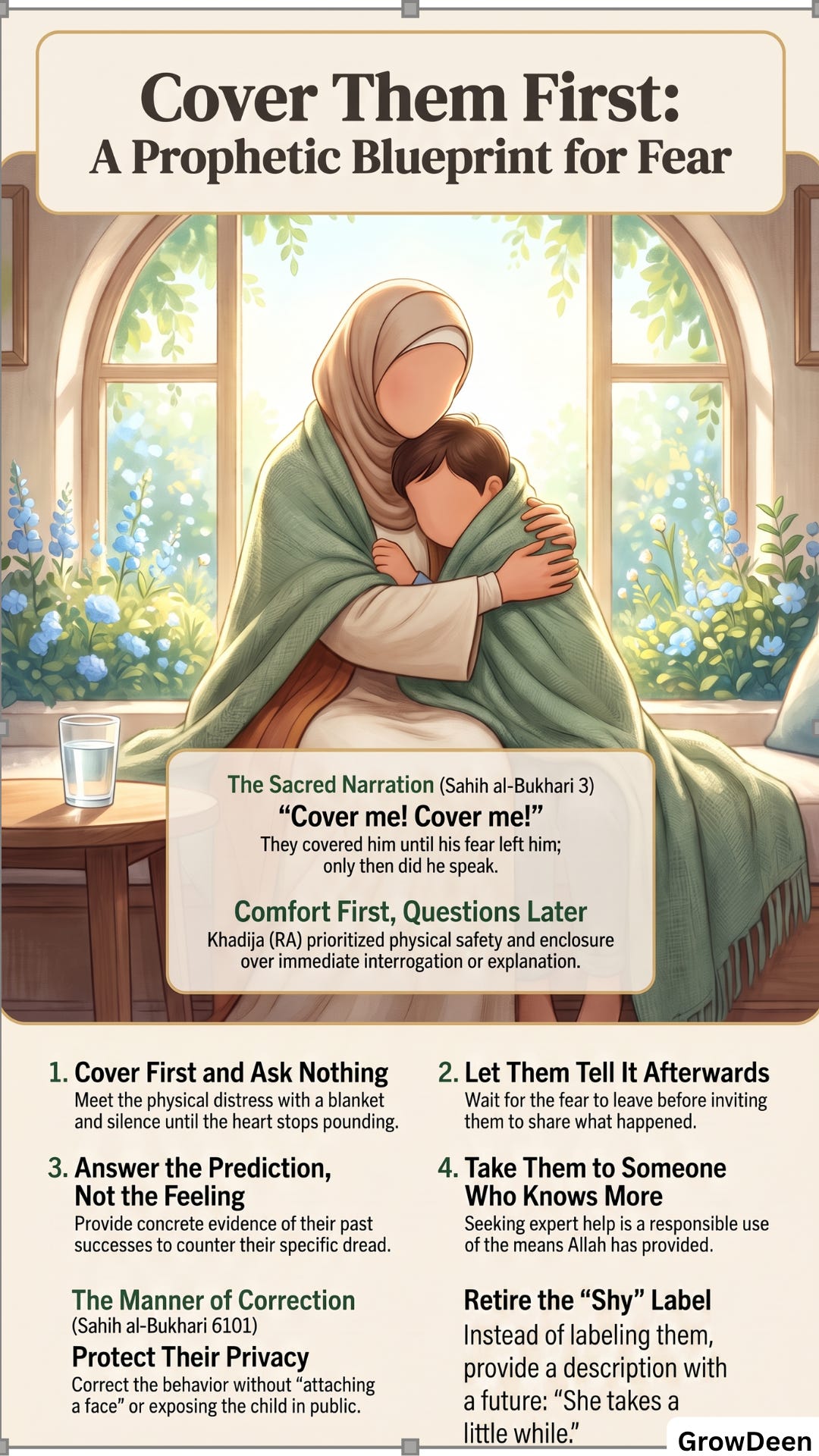
Aisha (may Allah be pleased with her) described the Prophet ﷺ coming home from the cave of Hira with his heart pounding, saying to Khadija (may Allah be pleased with her), “Cover me! Cover me!” They covered him until his fear left him. Only then did he tell her what had happened, and say, “I fear that something may happen to me.” She answered: “Never! By Allah, Allah will never disgrace you. You keep good relations with your kith and kin, help the poor and the destitute, serve your guests generously and assist the deserving calamity-afflicted ones.” Then she walked him to her cousin Waraqa bin Naufal, who had studied the earlier scriptures, and asked him to listen. [10]
Look at her order. Comfort first, no questions while the fear was running. Then an answer aimed at the prediction rather than the feeling, backed by four things he had actually done. Then someone who knew more than she did.
No claim is made that the Prophet ﷺ carried an anxiety condition. What this settles is smaller and more useful. Fear is not a defect of character. It came to the best of creation ﷺ, and the household that loved him met it with a blanket, then evidence, then help.
Support Muslim Parenting Lab ❤️
Is there something in your record you would like wiped? Give any amount today with the button below.
The Prophet ﷺ said charity extinguishes sin as water extinguishes fire. (Jami’ at-Tirmidhi 2616, hasan)
Six Flashpoints, and What to Do at Each One
So what does this actually look like on a Tuesday evening?
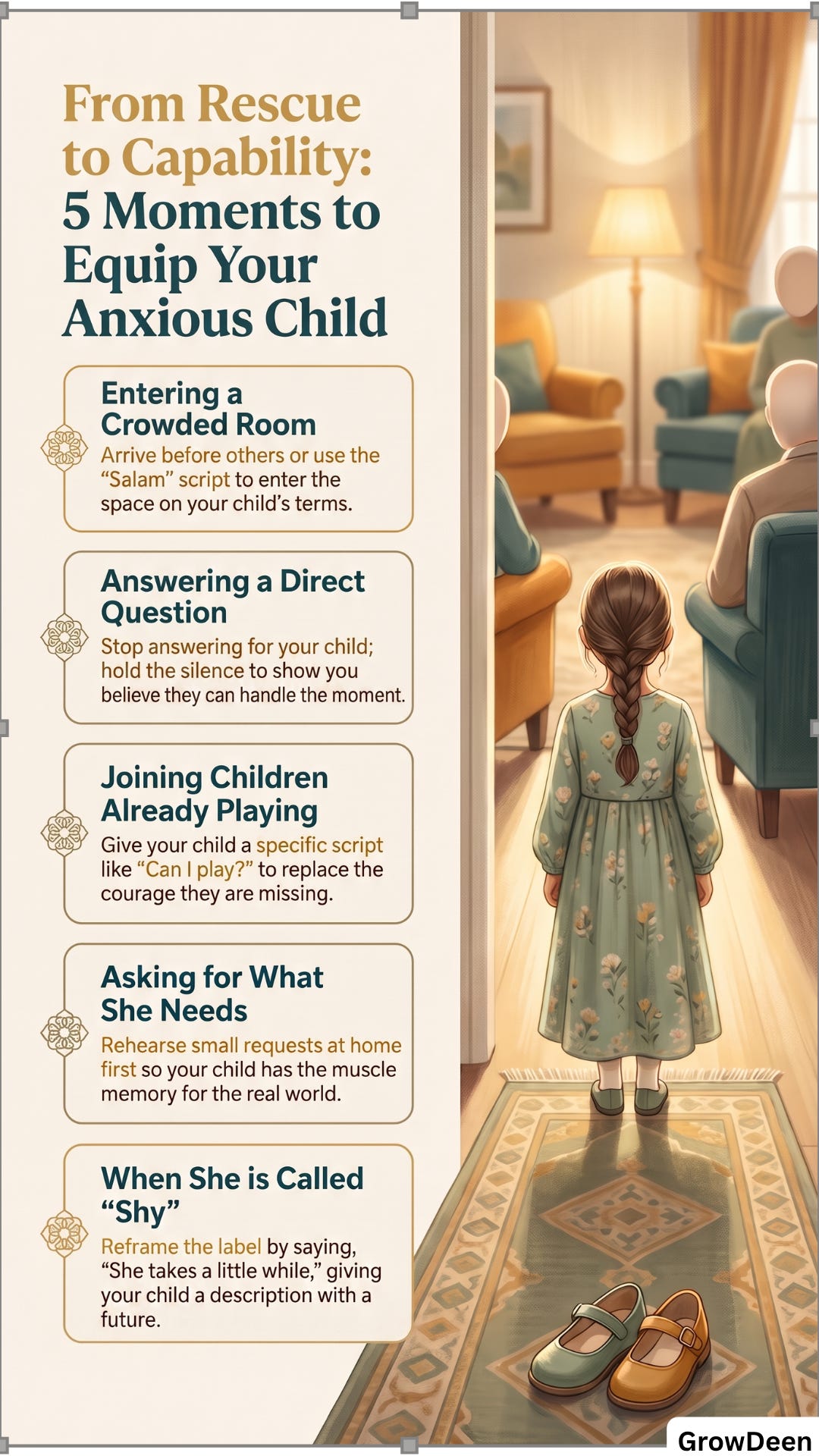
Start by finding out what you are dealing with, because you cannot practise a vague fear. For two weeks, every time the anxiety shows itself, note four things on your phone: where you were, who else was there, what she had been asked to do, and what she did.
The pattern that emerges is almost never the one parents predict. It turns out not to be school, but being called on with no warning. Not gatherings, but arriving after everyone has settled. Not adults, but adults who ask questions needing more than a yes.
That precision is the whole point. “Walk into a room where six people are already sitting down” is something a child can rehearse. “Confidence” is not.
Then work each flashpoint like this.
Rehearse the actual sentence. Act it out at home, with you playing the teacher or the shopkeeper, and your child saying the real words. “Can I have a glass of water, please.” “My name is Yusuf.” “Can I play?” Children who freeze are rarely short of courage. They are short of a script, and a script takes five minutes to hand over.
Test the prediction, with older children. When she says everyone will laugh, treat it as a claim that can be checked. What would actually happen? Did anyone laugh the last time somebody got an answer wrong? What would you think if a classmate got one wrong? Children hold other people to fairer standards than they hold themselves, and hearing themselves say so out loud does more than any reassurance from you.
Shrink, don’t cancel. Accept the invitation, then cut the demand: twenty minutes, one familiar face, arrive before everyone else so she is in the room first rather than walking into it.
Stop answering for her. This is the hardest one, because it is fast and kind and automatic. Someone asks your son how old he is, the silence stretches past the point of comfort, and you fill it. Every time you fill it, he learns the silence will always be filled, and he never finds out what happens when he speaks.
Praise at low volume. When she does the frightening thing, say so near her ear, in a sentence nobody else hears. The full celebration happens in the car.
Skip the debrief unless she starts it. She is already replaying the encounter hunting for her mistakes. [2] A long, gentle post-mortem on the drive home just hands her more material.
And build a ladder for the biggest flashpoint. Work backwards until the first rung is so small it is boring: giving salam to a neighbour she already knows, with you beside her. Then someone she has met twice. Then answering that person’s question. She stays on each rung until it stops producing anything. Gradual, repeated practice like this is the active ingredient in the best-evidenced treatments for childhood anxiety. [6][12] Four months of small steps holds. Four days of large ones collapses.
Salam is doing more work here than it looks. It is a fixed script for the exact moment she finds hardest, which is entering a space where other people already are. She does not have to invent an opening. One was given to her, and it comes with a reply built in.
The Sentence You Need to Stop Saying
Sahih al-Bukhari has a chapter in its book of manners titled, in the standard rendering, “Whoever did not admonish people in their faces.” Under it is a narration from Aisha (may Allah be pleased with her): the Prophet ﷺ did something and permitted it, some people held back from doing it, and when this reached him he gave a sermon in which he said, “What is wrong with such people as refrain from doing a thing that I do? By Allah, I know Allah better than they, and I am more afraid of Him than they.” [11]
The matter got addressed. Nobody got named. The people concerned were sitting right there and heard every word, and not one of them was held up in front of the room.
Now put that beside the things said over a child’s head at a family gathering. “Oh, she’s just shy.” “He won’t talk to anybody.” “Say salam. Say it. Why won’t you say it?”
Each one is a public correction of a child whose entire difficulty is a fear of public correction, delivered by the adult she trusts most, in front of exactly the audience she fears.
The alternative is not silence. It is the same move: handle it without attaching a face to it. When a relative remarks on how quiet she is, answer without agreeing and without a lecture. “She takes a little while, and then you can’t get a word in.” Said lightly, in front of her, it closes the conversation and hands her a description of herself with a future in it.
And retire the word shy as a label. The trait is fine. The problem is that a child who hears “she’s shy” enough times files it under things that are permanently true about her.
When It Stops Being a Phase
Three questions do more work than any label.
Is she avoiding things she actually wants? Wanting in and not being able to get in is the signal. Preferring a quiet afternoon is not.
Is it spreading? One difficult setting that stays one difficult setting is a preference. One that becomes four is a trajectory.
How long has it run? Past six months, and limiting school, friendships, or ordinary family life, is the clinical threshold for social anxiety disorder rather than a passing stage. [7]
One related thing worth naming. Some children speak freely at home and cannot speak at all in specific settings, usually school. That is selective mutism, an anxiety condition that often travels with social anxiety. [7] It is not stubbornness and it responds to treatment.
Say this part plainly, because parents assume less than the evidence supports. Childhood anxiety responds well to treatment. Cognitive behavioural approaches have a substantial evidence base with children, and while social anxiety sometimes improves more slowly than other presentations, meaningful improvement is a reasonable expectation rather than a hope. [6][12] Current clinical guidance puts psychological treatment first for children and young people with anxiety disorders. [13]
Your child’s teacher, a school counsellor, or your doctor are all sensible first conversations.
And seeking that help is not a failure of tarbiyah. Islam treats the pursuit of treatment as the responsible use of means Allah has provided, and your child’s mind sits inside the same amanah as the rest of her.
Your Free Six Flashpoints Companion Pack
If you have read this far, you are the kind of parent who would rather sit with an uncomfortable answer than a comfortable one. That already tells me something about you.
Inside the Six Flashpoints Companion Pack (one comprehensive PDF, 3 pages):
Page 1: The Two-Week Social Map. Fourteen dated rows with four columns to fill in, plus a decoder key at the bottom that turns your scribbled notes into one named trigger, designed as a single sheet you can fold into your bag and complete in ten seconds per entry.
Page 2: Six Flashpoints, Six Scripts. The exact words for the six moments socially anxious children freeze, with what your child says, what you say, and the one thing you must not do at each one, so you are never standing in someone’s hallway improvising.
Page 3: What Khadija Did First. The four-move sequence from the opening of Sahih al-Bukhari for being with a frightened person, alongside the rule the Prophet ﷺ set for correcting a matter without exposing anyone, written as a card to read before a gathering you are already dreading. [10][11]
This isn’t just a PDF to download and forget. It’s a tool designed to live in your bag and on your fridge, where you will actually reach for it in the moments this happens.
This companion pack is what every subscriber receives with each article. Muslim Parenting Lab covers the full span of raising Muslim children from birth through the early school years, all backed by peer-reviewed research and rooted in authenticated Islamic sources.
Do This in the Next Five Minutes
Open the notes app on your phone and start a note called two weeks. Nothing else. Tonight, the first time you see it happen, write four things: where, who, what she was asked to do, what she did.
That is the whole task. You are not fixing anything yet. You are finding out which room she cannot walk into.
May Allah make your child’s steps easier than they look tonight, and place barakah in every small thing you do to help her take them.
Share This With Someone Who Needs It
Think of one person right now: the sister at the masjid whose daughter stands outside the circle every week, or the friend who keeps repeating “she’s just shy” with a laugh that does not quite land, or the cousin who orders for her son in restaurants because it is faster.
Send this to her today. Not as advice, and not as a correction. Every rescue teaches the fear it was right, and nobody ever told her that.
Frequently Asked Questions
Q: What is the difference between shyness and social anxiety in a child?
A: Shyness is a temperament, and a shy child usually hangs back, watches, and joins in twenty minutes later. Social anxiety costs your child things she actually wants: she is still at the edge when it is time to leave, and dreads the next invitation because of how this one felt. Avoidance of wanted things is the line between the two.
Q: At what age does social anxiety start in children?
A: It is diagnosed most often in older children and teenagers, but it does not appear at eleven from nowhere. It is visible well before school age if anyone is looking, and early wariness in unfamiliar situations raises the odds of later anxiety difficulties. [3][4] That is a probability, not a sentence.
Q: Should I make my child talk to people?
A: Forcing rarely works and usually costs you trust. What does work is shrinking the demand until she can meet it, then repeating that step until it feels like nothing. See “Six Flashpoints, and What to Do at Each One” above for how to build that.
Q: Is it bad to call my child shy?
A: Not because the trait is bad, but because a child who hears it enough times files it under things that are permanently true about her. Swap it for something with a future in it: “She takes a little while, and then you can’t get a word in.”
Q: Can social anxiety in children be treated?
A: Yes, and better than most parents expect. Cognitive behavioural approaches have a strong evidence base with children, and clinical guidance puts psychological treatment first for childhood anxiety disorders. [6][13] In one trial, treating the parents alone matched treating the children. [1]
Q: My child speaks at home but not at school. What is that?
A: That pattern is called selective mutism, and it is classified among the anxiety disorders rather than as defiance or a speech problem. [7] It often occurs alongside social anxiety and it responds to treatment, so it is worth raising with your doctor rather than waiting it out.
Q: When should I take my child to a doctor about this?
A: When it is limiting her life rather than colouring it. The markers are consistent: she is missing things she wants, the physical symptoms are frequent, the pattern has run past six months, or her world is getting smaller instead of larger. [1][7]
References
[1] Lebowitz, E.R., Marin, C., Martino, A., Shimshoni, Y., & Silverman, W.K. (2020). Parent-based treatment as efficacious as cognitive-behavioral therapy for childhood anxiety: A randomized noninferiority study of Supportive Parenting for Anxious Childhood Emotions. Journal of the American Academy of Child and Adolescent Psychiatry, 59(3), 362-372. https://pubmed.ncbi.nlm.nih.gov/30851397/
[2] Halldorsson, B., & Creswell, C. (2017). Social anxiety in pre-adolescent children: What do we know about maintenance? Behaviour Research and Therapy, 99, 19-36. https://doi.org/10.1016/j.brat.2017.08.013
[3] Fox, N.A., Zeytinoglu, S., Valadez, E.A., Buzzell, G.A., Morales, S., & Henderson, H.A. (2023). Annual research review: Developmental pathways linking early behavioral inhibition to later anxiety. Journal of Child Psychology and Psychiatry, 64(4), 537-561. https://doi.org/10.1111/jcpp.13702
[4] Hudson, J.L., Murayama, K., Meteyard, L., Morris, T., & Dodd, H.F. (2019). Early childhood predictors of anxiety in early adolescence. Journal of Abnormal Child Psychology, 47(7), 1121-1133. https://doi.org/10.1007/s10802-018-0495-6
[5] Spence, S.H., Zubrick, S.R., & Lawrence, D. (2018). A profile of social, separation and generalized anxiety disorders in a nationally representative sample of children and adolescents: Prevalence, comorbidity and correlates. Australian & New Zealand Journal of Psychiatry, 52(5), 446-460. https://doi.org/10.1177/0004867417741981
[6] Hudson, J.L., Rapee, R.M., Lyneham, H.J., McLellan, L.F., Wuthrich, V.M., & Schniering, C.A. (2015). Comparing outcomes for children with different anxiety disorders following cognitive behavioural therapy. Behaviour Research and Therapy, 72, 30-37. https://doi.org/10.1016/j.brat.2015.06.007
[7] American Psychiatric Association. (2022). Diagnostic and statistical manual of mental disorders (5th ed., text rev.). American Psychiatric Association Publishing. https://doi.org/10.1176/appi.books.9780890425787
[8] Creswell, C., Waite, P., & Hudson, J. (2020). Practitioner review: Anxiety disorders in children and young people, assessment and treatment. Journal of Child Psychology and Psychiatry, 61(6), 628-643. https://doi.org/10.1111/jcpp.13186
[9] Rapee, R.M., Kennedy, S., Ingram, M., Edwards, S., & Sweeney, L. (2005). Prevention and early intervention of anxiety disorders in inhibited preschool children. Journal of Consulting and Clinical Psychology, 73(3), 488-497. https://doi.org/10.1037/0022-006X.73.3.488
[10] Sahih al-Bukhari 3, Book of Revelation, Book 1, Hadith 3. Narrated Aisha. Graded: Sahih. https://sunnah.com/bukhari:3
[11] Sahih al-Bukhari 6101, Book of Good Manners and Form (Al-Adab), Book 78, Hadith 128, Chapter: “Whoever did not admonish people in their faces.” Narrated Aisha. Graded: Sahih. https://sunnah.com/bukhari:6101
[12] Wolitzky-Taylor, K., & LeBeau, R. (2023). Recent advances in the understanding and psychological treatment of social anxiety disorder. Faculty Reviews, 12(8). https://doi.org/10.12703/r/12-8
[13] Melbourne Children’s Campus Mental Health Strategy Anxiety Guideline Development Group. (2024). Evidence-based clinical practice guideline for anxiety in children and young people (V.1.1). Melbourne Children’s. https://mentalhealth.melbournechildrens.com/media/elwh4zdn/evidence-based-clinical-practice-guideline-for-anxiety-in-children-and-young-people-2023.pdf
We combine scientific research with Qur’an and authentic Sunnah, and we cite our sources. Even so, this is general guidance and no substitute for a doctor who can examine your child.