

Four-year-olds ask for a friend by name. CDC sets each milestone at what 75% or more of children manage by that age, and by four that includes asking to play with one particular child. [1]
Print it before the next playdate.
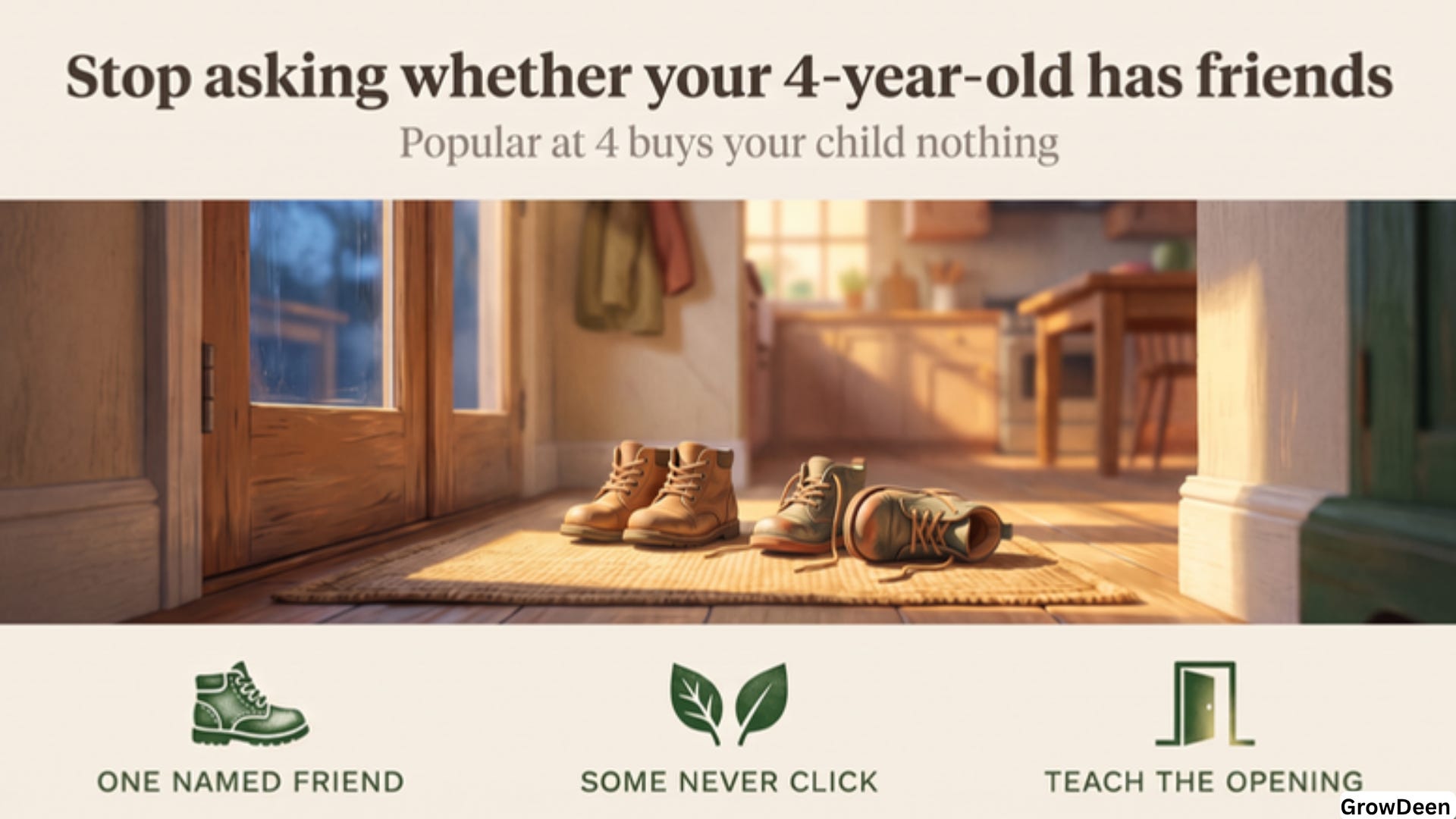
He came home and said nobody played with him.
You did the sensible thing. You invited the child he talks about most, cleared the afternoon, put out the good blocks. Twenty minutes in, the other child was building a tower and your son was sitting under the table with a bin lid on his head.
Nothing went wrong. Nobody was unkind. It just did not take, and you spent the rest of the evening quietly running the numbers on whether your child is the odd one out.
That feeling in your chest is not really about the playdate. It is the older fear underneath it, the one nobody says out loud: that your child might be the one nobody picks, and that somehow this is traceable back to you.
It is not. And the thing that actually predicts how this goes over the next twenty years is not the question you have been asking.
Why This Guide Is Different From Generic Preschool Advice
Every claim here is tied to a named source with a year: CDC milestone data, the American Academy of Pediatrics 2018 clinical report on play, and peer-reviewed studies on preschool aggression and peer inclusion published between 2018 and 2024.
The Islamic material is not decoration at the end. Two Qur’anic references and five verified narrations sit inside the practical guidance, each graded Sahih or Hasan and linked to its source.
You already have the free Friendship Kit from the top of this page, built for the three moments where friendship is actually taught at home rather than for a checklist nobody will read twice.
You Are Probably Asking the Wrong Question
There are two questions a parent can ask about a preschooler’s social life.
The first is the one that keeps you awake: does my child have friends? The second gets asked far less: is my child a good friend?
Almost all the worry goes into the first. Almost all the work lives in the second. And the second is the one Islam puts first. The Prophet ﷺ said that the best companion in the sight of Allah is the one who is best to his companion. [18] Read that slowly. It does not count how many friends a person gathered. It measures how he treated the one who was there.
The practical payoff is as real as the spiritual one. A child with one strong skill set, greeting, waiting, repairing, will find people anywhere he goes, at four and at forty. A child who happens to be popular at four has been given nothing he can carry.
Raise the friend, not the friend count.
Which leaves a question worth sitting with for the rest of this article: why can the same child play beautifully with one friend and fall apart with the next?
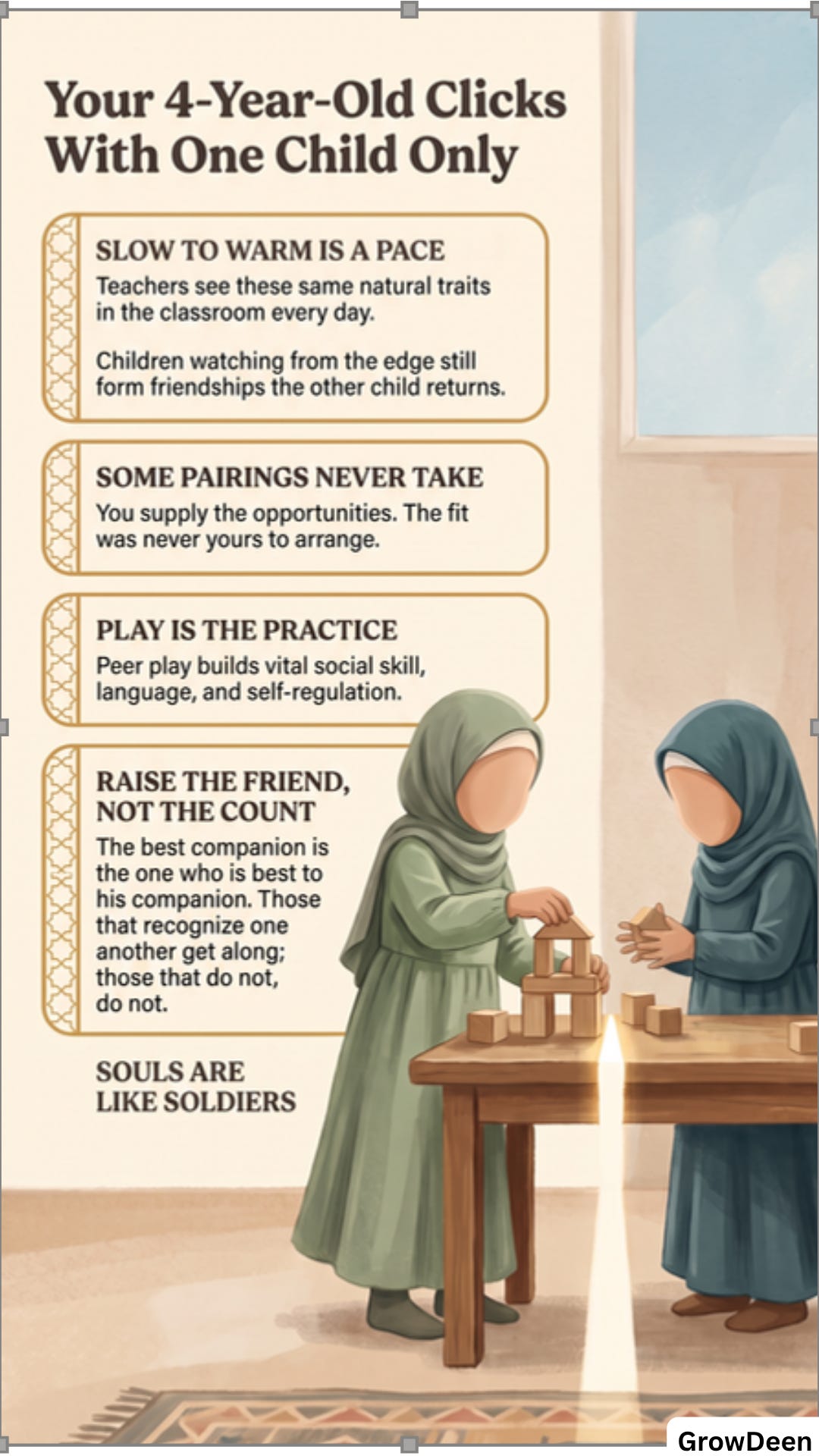
Why Your Child Clicks With One Child and Not Another
Temperament sets the pace, and it is not something you chose or caused.
Studies observing preschool classrooms have found consistent links between a child’s temperament traits and the social behaviour teachers actually see in the room. [4] Some children gather energy from noise and numbers. Others have a smaller appetite for company and are settled with one or two people they trust.
If yours hangs back, here is the finding that should take some weight off you. Researchers following behaviourally inhibited preschoolers, the ones who watch from the edge for a long time, found that these children do form friendships, including ones the other child returns. [5] They are not on a slower track to the same loneliness. They need a smaller room and an adult who is not visibly anxious about the delay.
And then there is the part no research explains, which the Sunnah names directly. Aisha (may Allah be pleased with her) heard the Prophet ﷺ say that souls are like conscripted soldiers, so those that recognise one another get along, and those that do not, do not. [6]
Sit with that for a second, because it lets you off a hook you have been hanging on. Some pairings simply do not take. That is not a defect in your child and it is not a failure of hosting. Your job is to keep offering the opportunities. Whose heart warms to whose was never on your list of responsibilities.
The Free Friendship Kit
This is a lot to hold in your head on a Tuesday evening when your child is upset and you have eleven minutes before bedtime. That is why the free Friendship Kit exists: a printable three-page pack built around a playdate run sheet, a repair sequence drawn for your child to follow themselves, and a card that teaches them to say salam first and make du’a for a friend by name. The download button is at the top of this page, and there is a full description of what is inside it below.
Before any of that is useful, though, there is something about where friendship is actually learned that most parents get backwards.
The Three Moments Where Friendship Is Actually Taught
Not in the conversation afterwards. In three ordinary moments you are already living through.
It helps to know what play is doing while it looks like nothing. The American Academy of Pediatrics reviewed the evidence in 2018 and concluded that play with parents and with other children is one of the main routes by which young children build social and emotional skill, language and self-regulation. [3] When two children set up a pretend scenario, someone has to be the teacher and someone the student, which means agreeing rules, holding them, and using more complicated language than either child uses alone. [3] Arguing over who gets to be the mother in the home corner is the lesson, not an interruption of it.
The doorway
Your child stands at the edge of a group and cannot work out how to start. Every child faces this. Muslim children already have the answer built into the day.
The Prophet ﷺ said that we will not enter Paradise until we believe, and will not believe until we love one another, then told us to spread salam among ourselves as the way to reach that love. [7]
Practise it at home first. Greet your child with salam when you walk into the room and wait for the reply properly, not over your shoulder. Then take it outside: at the park, at the masjid, in the nursery corridor, before the play starts. It solves the opening problem and turns the first move into worship rather than a social risk.
The argument
Words get sharp around three and four. Name-calling arrives, and so do the small contracts: if you do not give me that, I will not be your friend.
The Qur’an addresses adults on exactly this. Allah says: “let not a people ridicule another people, perhaps they may be better than them... and do not insult one another and do not call each other by offensive nicknames.” [8] Shrink that into a house rule short enough for a four-year-old and it becomes: we do not give people ugly names. It binds the grown-ups too, which is the useful part.
Then give your child the replacement sentence, because “stop being mean” is not a usable instruction. “I do not like that. Please stop.” Rehearse it while everyone is calm and it will be there when nobody is.
The kitchen table
This is the one parents miss, and it has nothing to do with the child’s behaviour at all.
The Prophet ﷺ said that the signs of a hypocrite are three: when he speaks he lies, when he is trusted he betrays, and when he promises he breaks it. [12] That last one runs straight to the playground. The promise a tired parent makes to end an argument in a supermarket is the same promise a child learns to make cheaply and break casually with his friends.
Keeping small promises to a four-year-old is friendship training. It is also a matter of honesty before Allah, which is a heavier thing than most of us treat it as at 5pm on a Thursday.
What to Say on the Evening They Come Home Excluded
There will be an evening. Probably several.
First, take it seriously even when it sounds small. Aggression at this age comes in two forms. There is the physical kind, which adults notice, and the relational kind, which they usually miss: excluding a child, threatening to withdraw friendship, telling other children that somebody is not nice. Studies tracking both across early childhood find they appear early and travel alongside the quality of a child’s relationships with teachers, parents, siblings and peers. [9][10] “You cannot come to my party” is not a lesser event than a shove. Children do not experience it as one.
Second, do not solve it immediately. Preschoolers say “you are not my friend” while they are working out what a group is and who controls the door, and researchers have found that they watch each other closely as they do it, forming judgements about which children include others and which shut them out. [11] Most of the time the two are playing again within twenty minutes. Watch quietly first.
Third, know the line. When it becomes persistent, one-sided and aimed at the same child, it has stopped being an argument. That is the point to involve the setting.
And if your own child is the one shutting others out, take him aside, away from his friends. A child humiliated in front of an audience learns only what humiliation feels like. Ask him to picture how the other child felt, then hand him something concrete: anybody who asks to join gets to join. Rehearse the words.
One more thing worth watching over months rather than days. The Prophet ﷺ compared a good companion to a seller of musk, from whom you will either receive some, or buy some, or at least walk away carrying the scent, and a poor companion to a man working the bellows, who will either burn your clothes or leave you smelling of smoke. [13] He also said that a person follows the way of his close friend. [14] At four this does not mean vetting playmates like job applicants. It means noticing which children leave your child calmer and kinder, and quietly making more room for those ones.
Why Islam Measures Friendship by the One Beside You
Coaching a four-year-old to hand over a bucket can feel like a chore with no horizon past the afternoon. Islam gives it a much longer one.
Allah says: “Close friends, that Day, will be enemies to each other, except for the righteous.” [16] According to Tafsir Ibn Kathir, this means every friendship formed for a purpose other than the sake of Allah turns to enmity on the Day of Resurrection, and only what was for Allah’s sake lasts. He reads it beside the words of Ibrahim to his people, that the affection between them belonged only to the life of this world.
Beside that verse sits a narration easier to hold on a hard evening. The Prophet ﷺ described seven people Allah will shade on the Day when there is no shade except His, and among them are two who loved each other for the sake of Allah, who came together upon that and parted upon that. [17]
Read together, they change what all this coaching is for. Every time your child is helped to give salam first, to wait, to choose a kinder word, to go back after a fight and mend it, what is being built is the character that makes a friendship worth keeping past this life.
Raise the friend, not the friend count. The research on early peer skills and the Islamic insistence on adab arrive at the same practice from opposite ends.
When to Talk to the Teacher, and When to Talk to a Doctor
Talk to your child’s teacher if the same complaint keeps returning at home, if one child’s name keeps appearing, or if you suspect repeated exclusion. Teachers see a whole day, and the classroom is one of the main places where young children build peer relationships in the first place. [19]
Talk to a doctor or another qualified professional if your child shows very little interest in other children over a sustained period, loses social skills he previously had, or is distressed in a way that does not settle. Asking early costs nothing. Taking the means and relying on Allah were never opposites.
Your Free Friendship Kit
If you have read this far, you are the kind of parent who treats a four-year-old’s friendships as something worth getting right rather than something to wait out. That says a good deal about you.
Inside the Friendship Kit (one comprehensive PDF, 3 pages):
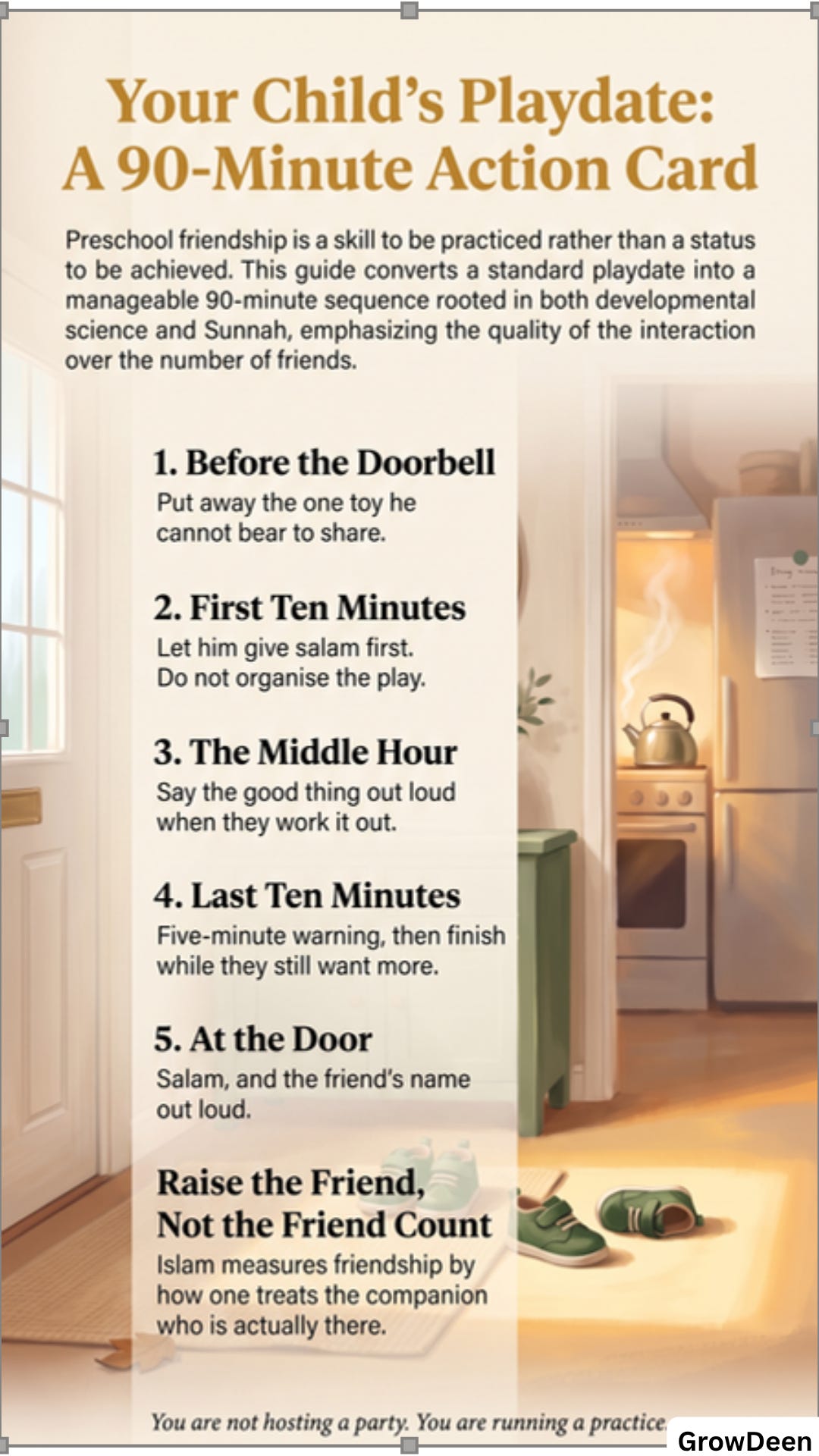
Page 1: The Playdate Run Sheet. A timed plan for a ninety-minute visit, from the three things to do before the doorbell to the two scripted lines for the two things that always go wrong, designed as a fridge-ready sheet you can follow while the kettle boils.
Page 2: How to Mend It. A four-panel picture sequence drawn for your child, not for you, so a preschooler who cannot yet read can look at it and follow the repair steps himself after a fight.
Page 3: Say Salam First, Then Say His Name. The salam greeting in Arabic with transliteration and meaning for your child to learn, plus a bedtime prompt built on the narration that a Muslim’s du’a for his brother in his absence is answered, with an angel saying ameen and may you have the same. [15]
This is not a PDF to download and forget. It is built to live on the fridge and in your child’s line of sight, where the hard moments actually happen.
The Friendship Kit is what every subscriber receives with each article. Muslim Parenting Lab covers the whole span of raising Muslim children, from newborn sleep to preschool behaviour to the questions that arrive at seven, all backed by current research and rooted in Qur’an and Sunnah.
If you want both evidence-based guidance and Islamic grounding in the same place, subscribe free so the next resource arrives before you need it.
Subscribe free for parenting resources backed by both science and Sunnah, guidance you will not find anywhere else. No spam, no clutter, just resources that matter.
One Thing You Can Do Tonight
At bedtime, after whatever du’a your family already says, ask your child to name one friend and ask Allah for something good for him. The one who was off sick. The one he fell out with today. Ten seconds. Start tonight and by next month it will be the part he reminds you about.
May Allah place barakah in your effort, soften the hearts that meet your child, and make him the one others are safer for having known.
Share This With Someone Who Needs It
Think of one person right now: the mother at the school gate who mentioned, lightly, that her son plays alone at break; your sister whose four-year-old has started saying “you are not my friend” and does not know where he learned it; the friend who arranged three playdates this term and is quietly wondering what she is doing wrong.
This article could change how she reads the next hard evening. Send it to her today, not as advice, but as company. Sometimes the kindest thing is to hand someone the frame that made it make sense.
Frequently Asked Questions
Q: At what age do children start making real friends?
A: Around three, many children can name a friend and will look for them at the door, though plenty cannot name anyone yet and still want to be included. By four, most children can tell a friend from a child they merely recognise and will ask to go and play with a specific one. [1] By five, most can hold the rules of a game and take turns without an adult refereeing. [2] Both patterns at three are normal.
Q: Is it normal for a 4-year-old to have no friends?
A: It is common and usually temporary, especially in children who take a long time to warm up. Research following behaviourally inhibited preschoolers found they do form friendships, including mutual ones, when they are given smaller settings and unhurried time. [5] What matters more than the count is whether your child wants company and is being taught how to enter it.
Q: How do I help my shy preschooler make friends?
A: Invite one child rather than a group, keep the visit short, and end it while everyone still wants more. Teach your child to watch a game before joining it and to enter with an offer of help or a role rather than a request. Practise salam at home first so the opening line is already familiar.
Q: What should I do when my child says “nobody plays with me”?
A: Listen first and resist fixing it on the spot, because most preschool fallings-out resolve within the hour. If the same name keeps appearing, or the exclusion is persistent and one-sided, speak to the teacher, who can watch what actually happens across a whole day. [19]
Q: Is excluding someone as serious as hitting at this age?
A: Take it as seriously. Studies tracking physical and relational aggression across early childhood find both appear early and both track alongside the quality of a child’s relationships at home and at school. [9][10] Preschoolers also notice and judge which children include others and which shut them out. [11]
Q: What does Islam say about choosing your child’s friends?
A: The Prophet ﷺ compared a good companion to a seller of musk and a poor one to a man working the bellows, [13] and said that a person follows the way of his close friend. [14] At four this is not about vetting playmates. It is about noticing over months which children leave your child calmer, and making more room for those ones.
Q: How do I teach a preschooler to apologise properly?
A: Model it first. Say sorry to your child out loud when you get something wrong, in a full sentence, with no defensive clause at the end. Then keep the expectation small: a returned toy, one sentence, a hand offered. A forced public apology teaches performance, not repair.
References
[1] Centers for Disease Control and Prevention. Milestones by 4 Years (Learn the Signs. Act Early.).
[2] Centers for Disease Control and Prevention. Milestones by 5 Years (Learn the Signs. Act Early.).
[3] Yogman, M., Garner, A., Hutchinson, J., Hirsh-Pasek, K., & Golinkoff, R.M.; AAP Committee on Psychosocial Aspects of Child and Family Health; AAP Council on Communications and Media. (2018). The Power of Play: A Pediatric Role in Enhancing Development in Young Children. Pediatrics, 142(3), e20182058.
[4] Gornik, A.E., Neal, J.W., Lo, S.L., & Durbin, C.E. (2018). Connections between preschoolers’ temperament traits and social behaviors as observed in a preschool setting. Social Development, 27(2), 335-350.
[5] Fleece, H., Wagner, N.J., Chronis-Tuscano, A., Smith, K.A., Novick, D.R., Druskin, L.R., Shakiba, N., Danko, C.M., & Rubin, K.H. (2024). Can behaviorally inhibited preschoolers make friends? Developmental Psychology, 60(7), 1203-1213.
[6] Sahih al-Bukhari 3336, narrated by Aisha (may Allah be pleased with her). Graded: Sahih. (also Sahih Muslim 2638, narrated by Abu Hurayrah)
[7] Sahih Muslim 54a, narrated by Abu Hurayrah. Graded: Sahih.
[8] Quran, Surah Al-Hujurat 49:11
[9] Perry, K.J., & Ostrov, J.M. (2023). Trajectories of physical and relational aggression across early childhood: Relations with peer risk factors. Aggressive Behavior, 49(4), 321-332.
[10] Swit, C.S., Harty, S.C., & Pascoe, S. (2024). Relational and physical aggression in preschool-age children: Associations with teacher, parent, sibling, and peer relationship quality. Aggressive Behavior, 50(1), Article e22115.
[11] Woodward, A.M., Knoll, S.J., Horen, L.A., & Beier, J.S. (2023). Do preschoolers track and evaluate social includers and excluders? Journal of Experimental Child Psychology, 232, Article 105677.
[12] Sahih al-Bukhari 33, narrated by Abu Hurayrah. Graded: Sahih. (also Sahih Muslim 59a)
[13] Sahih al-Bukhari 5534, narrated by Abu Musa al-Ash’ari. Graded: Sahih. (also Sahih Muslim 2628)
[14] Jami’ at-Tirmidhi 2378, narrated by Abu Hurayrah. Graded: Hasan. (also Sunan Abi Dawud 4833)
[15] Sahih Muslim 2733, narrated by Umm al-Darda and Abu al-Darda. Graded: Sahih.
[16] Quran, Surah Az-Zukhruf 43:67; Ibn Kathir, Tafsir Ibn Kathir, Surah Az-Zukhruf 43:67 commentary
[17] Sahih al-Bukhari 660, narrated by Abu Hurayrah. Graded: Sahih. (also Sahih Muslim 1031)
[18] Jami’ at-Tirmidhi 1944, narrated by Abdullah ibn Amr. Graded: Sahih (Darussalam).
[19] Neri Tejada, J., Li, L., & Hammer, M. (2024). Children’s classroom experiences in building peer relationships. Early Childhood Education Journal, 52, 991-1000.