

Two to four year olds fight 7.65 times an hour. [1] Fewer than five moves in a hundred end in repair. [2]
Three pages. For the talk after the fight.
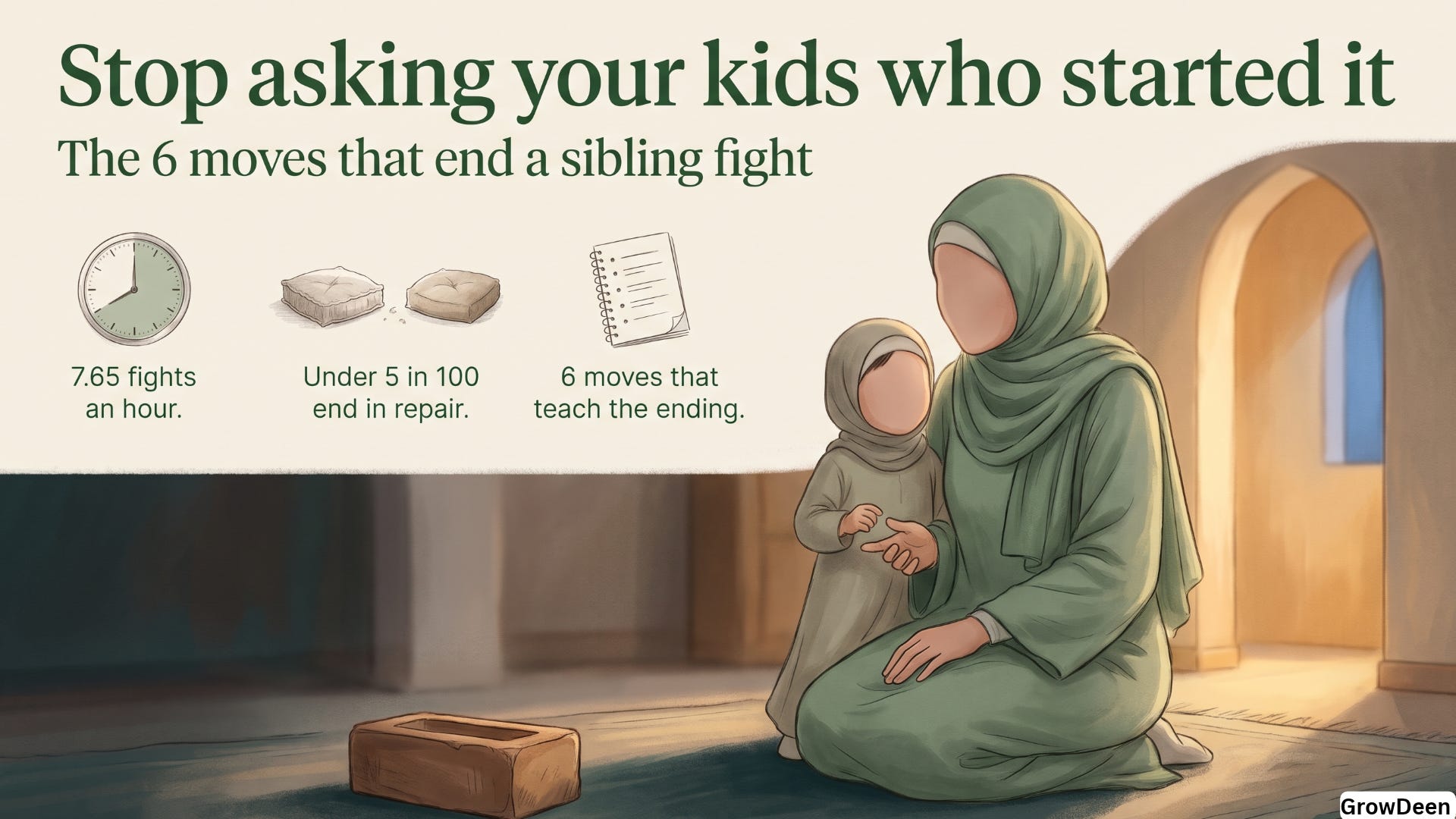
It was 6:40pm.
One of them was on the floor with a brick in her fist and the other was already running for you, arriving first, getting the story in first. You separated them. You said the thing about hands. Twenty minutes later it started again over a completely different brick.
You are not doing it wrong. You are doing the half that nobody told you was the smaller half.
Here is the question this article answers, and it is the one that keeps parents awake long after the children are asleep: why do two children who can share perfectly well at nursery come home and fail at it within four minutes of walking through the door?
What Makes This Guide Different
Built on observational research, not opinion. The numbers in here come from studies that coded what siblings actually did, move by move, in their own homes [1,2,7].
Islamic justice applied where it actually gets tested. Applied in the specific moment when one child is easier to like than the other.
You already have the free Sibling Repair Kit from the top of this page. Three printable pages built for the conversation that happens after the shouting stops.
The Ending Is The Part Nobody Taught Them
Your children are fluent in starting.
They have years of daily practice at it: the grab, the shove, the sentence that lands exactly where it was aimed. What they have almost no practice at is the other end. When researchers coded sibling conflicts across the two to eight age range, fewer than five moves in every hundred contained comfort, concern or an apology [1,2]. Think about that ratio for a second. Ninety-five parts escalation, five parts repair, running several times an hour, for years.
So a child who seems to fight constantly is usually not an aggressive child. They are a child with no exit.
Every fight needs an exit. And exits, unlike grabbing, do not install themselves.
This is also why ending the fight yourself feels productive and changes nothing. You supplied the exit. They watched you do it. Tomorrow at 6:40pm they will need one again and still not have one of their own.
What The Referee Reflex Costs You
There is a reflex most of us inherited, and it goes like this: a fight is a crime, the parent is the court, and the job is to find out who did it.
So you ask the question. “Who started it?”
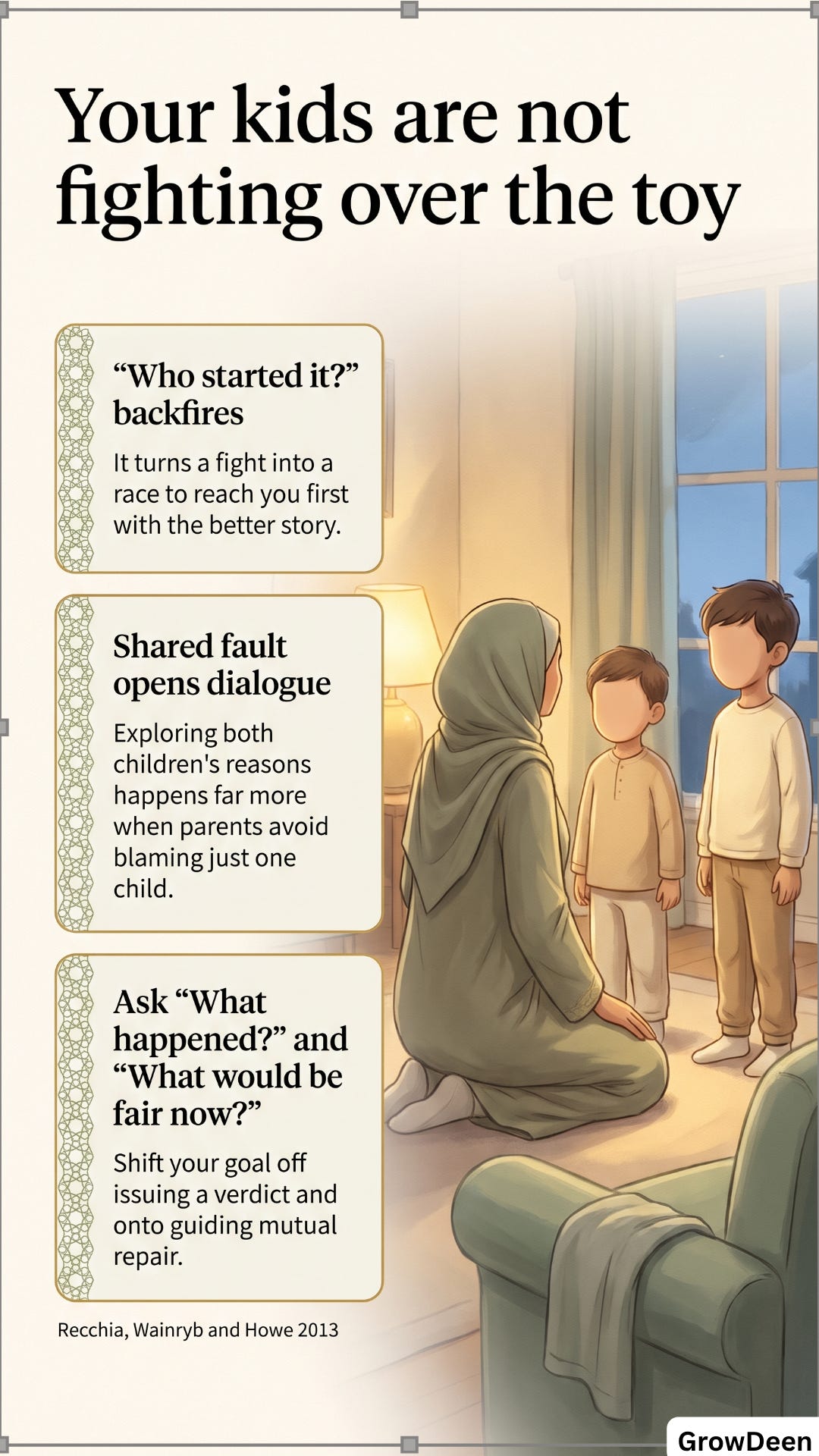
Researchers put this under a microscope with 61 primary caregivers whose children were four to ten, asking each parent to judge fault in a real conflict between their own two children, then watching the conversation that followed [7]. Parents who landed on shared fault, blaming both or neither, were markedly more likely to dig into the reasons behind each child’s behaviour and to bring both perspectives into the room [7]. Parents who pinned it on one child did much less of that. The same study found that where the age gap was wide, parents quietly supplied evidence in favour of the younger child [7].
Sit with that last finding if you have an older child who keeps insisting nobody ever believes them. They may be describing something real.
The verdict is the problem. A verdict tells two children that the way to win a fight is to reach the judge first with the better story, which is precisely the skill you have been watching them practise in the hallway.
Before You Can Teach An Exit, You Need One Yourself
Let us say the quiet part, because it is the part parents carry alone.
This is not only about their behaviour. It is about the moment at 6:40pm when your voice comes out louder than you meant and you see one of them flinch. It is about the thought that arrives later, in the dark: are these two going to like each other when they are forty? Did I do this?
That thought is doing you no good and it is also not evidence of anything. Emotion regulation, yours as much as theirs, is the competency research has tied most directly to warmer sibling behaviour [1,6]. But the temper is worth a plan, because two dysregulated children cannot be settled by a third dysregulated person.
Three slow breaths, before anything comes out of your mouth. Then drop your volume instead of lifting it, because a quiet voice pulls a room down and a loud one pulls it up. Walk towards them with a few repetitions of SubhanAllah going under your breath. If you reach the doorway already past your limit, hand it over to your spouse or another adult in the house and take five minutes elsewhere; knowing your own ceiling is part of the job. If the fight erupts in the car, pull over and stop properly before dealing with any of it, because turning round at speed adds a risk you do not need.
The Two Second Triage
Not every fight is yours to enter. Before your feet move, run one check.
Is this argument, or is one of them being hurt?
Argument is two children bargaining loudly over whose turn it is. Let that run where you safely can. They are rehearsing something they will use for the rest of their lives, and a parent who settles every round is teaching them to summon an adult instead of thinking.
Harm is different and it has signals:
hitting, shoving, grabbing, pinching, throwing
shouting that has curdled into mockery or contempt
threats, or one child using size or age to frighten the other
a child who has gone small and quiet while the other keeps going
The fourth one is the one that gets missed. Silence from the smaller child is almost never agreement.
Where it is harm, you step in and stop it, and you do it without a verdict. Separate, name the rule rather than the child, and say when the two of you will talk. “We do not hit in this house. We will sort this out after Maghrib.” Then keep that appointment, because a child in full flood cannot take in reasoning and everything you explain in that first minute is lost breath.
I know this is a lot to hold at 6:40pm with dinner burning. That is why the free Sibling Repair Kit exists: three printable pages carrying the triage, the conversation script and a reflection card for you. The download button is at the top of this page, and there is a full description of what is inside it below.
What The Qur’an Teaches About Standing Between Two People Who Are Fighting
Allah speaks to the believers about justice and attaches a warning to it: do not let how you feel about someone push you into treating them unfairly. The verse closes, “Be just; that is nearer to righteousness.” [12]
Tafsir Ibn Kathir places the passage under the necessity of observing justice and explains that a believer owes justice to everyone, friend or enemy alike, because justice is nearer to taqwa than any alternative [12]. His commentary then takes the command indoors, illustrating it through a father who gave one of his children something he had not given the others and was told to fear Allah and treat his children equally [12]. The scholars did not leave this principle in the courtroom.
Which is exactly where you meet it. Some evenings one child is easy and the other is not, and the pull towards the easier one is real and quiet and hard to admit. The Prophet ﷺ warned his community to guard against oppression, saying that “oppression is a darkness on the Day of Resurrection” [13]. A smaller sibling who is hurt has been wronged, and so has a child who is handed a verdict without being heard. The justice you dispense over a brick at 6:40pm is the same justice the verse is naming.
The Sulh Conversation, Move By Move
This is the part almost nobody is taught, and it is the part that moves the needle.
When parents were trained to mediate instead of ruling, their children reasoned more inside conflicts, named feelings more often, and read their sibling’s actual goal more accurately [4]. The gain landed hardest on the younger sibling, who in most households never holds the floor [4]. Children of trained parents came out of the study with more developed conflict-resolution skill than children of untrained parents [5], and the approach has since been described as workable for ordinary homes rather than clinics [3]. A 2021 meta-analysis of eight randomised evaluations found a substantial overall effect on sibling interaction (d = 0.85, 95% CI 0.27 to 1.43) while calling the evidence base immature [8]. Its honest counterweight is a 2023 trial of 74 parents in which both the treated and waitlisted groups improved and the specific advantage of the brief programme was modest [9].
Put plainly: the method works, and your repetition of it works harder.
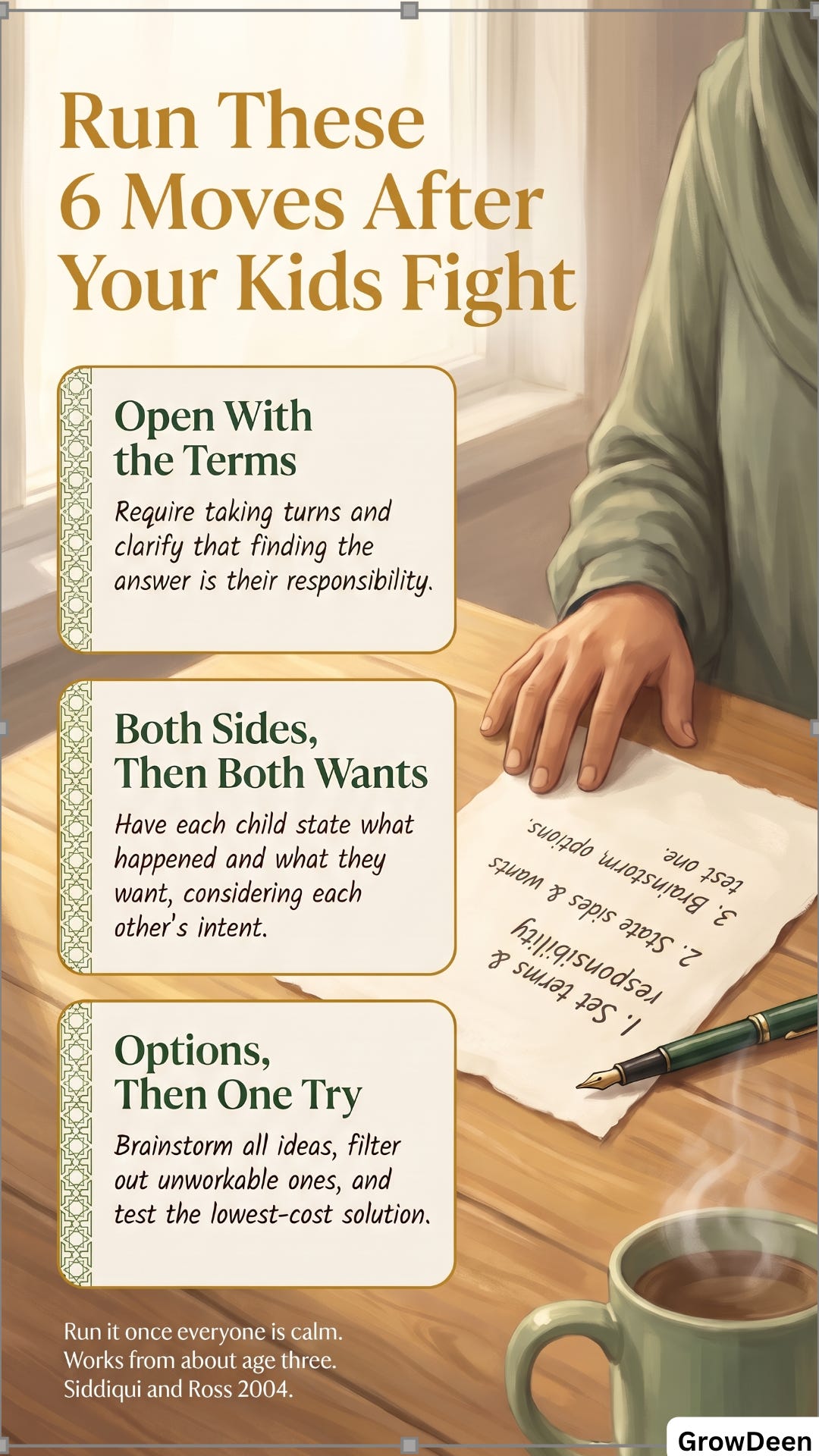
Run it once everyone is calm. It fits five to eight year olds comfortably and a shortened version works from about three.
Open with the terms. “Nobody touches the tablet until you two have worked this out. One person talks at a time. The answer is yours to find, not mine. Now, or after dinner?”
Each child states the problem. One speaks, the other listens, then swap. Ask for the other side out loud: “What do you think your brother was trying to do?” Tell them plainly that two people can both be partly right and still disagree.
Each child states what they want. Then hold it up to the light: “Is it fair for the bike to be yours all weekend?” The question does the work and you do not have to argue with anyone.
Collect options without ranking them. Let the silly ones in, write them all down, add one or two of your own and leave them unsorted with the rest.
Sort them together. Start with what will not work and why. Then look for the option that costs each of them least.
Pick one and run it. Try it for a few days and revisit it if it fails. If no agreement arrives today, park it until tomorrow, because an unfinished negotiation beats an imposed settlement every time.
With toddlers, compress all six moves into one sentence and a lot of proximity. “You both want the truck. Shall we use the timer?” Children under three have no working concept of the harm they can do, so they need you within arm’s reach.
Support Muslim Parenting Lab ❤️
Is there something in your record you would like wiped? Give any amount today with the button below.
The Prophet ﷺ said charity extinguishes sin as water extinguishes fire. (Jami' at-Tirmidhi 2616, hasan)
The Three Sentences That End A Fight
Children cannot use an exit they have never heard spoken. So teach the words themselves, the way you taught shoelaces, at a calm moment and out of context:
“I didn’t like it when you took that. Please ask me next time.”
“I’m sorry I hit you. I was angry about the tower.”
“Do you want it first, or shall I?”
They pick these up fastest from watching adults use them during real disagreements, which means the way you and your spouse handle friction is the course your children are actually enrolled in.
Give the forgiving child something to hold on to. The Prophet ﷺ said that “no one forgives another except that Allah increases his honor” [14]. A five year old can grasp the idea of growing taller by letting something go.
Two cautions, both learned the hard way by a lot of households. Never extract an apology mid-storm, because a performed apology teaches a child that the words are a fine to be paid and nothing more. And do not oblige the hurt child to accept it on the spot. Repair runs on its own clock.
Every fight needs an exit. These three sentences are the exit, in a size a child can carry.
Fair Does Not Mean Identical
Fairness arrives early in a child and arrives absolute, and it is the charge your children will bring against you most often.
Treating children justly and treating them identically are different things. A six year old and a three year old cannot carry the same expectations, and a consequence should answer the child’s age and the actual behaviour. What lodges for years is the comparison. Two sentences worth retiring from your house: “You should have known better, you are the older one,” and “You are the one who always starts it.” The first penalises a child for birth order. The second issues an identity and then waits for the child to wear it.
Build fairness into the structure instead of relitigating it every afternoon. Each child keeps a few things that are theirs alone and never enter the sharing pool. Each child gets time with a friend without a sibling attached. Each child gets a few minutes with you where nobody else is in the frame.
When This Is Not Just A Fight
Most sibling conflict is mild and bickering sits well inside the normal range. Some of it does not.
Researchers now describe sibling aggression and abuse as widespread and badly under-recognised, and argue they should be counted as adverse childhood experiences rather than written off as rivalry [10]. The effects follow children into adult mental health and adult relationships [10].
Speak to a doctor or a qualified child counsellor if one child is repeatedly aggressive towards the other, if there is threatening, intimidation or deliberate humiliation, if a child avoids being at home alone with their sibling [11], if a child cannot manage strong emotions at all, or if the conflict is damaging the wellbeing of anyone in the house. Where a child tells you a sibling is hurting them, believe them [11]. Resist the familiar urge to recast it as oversensitivity or provocation [11].
None of this replaces medical or psychological advice. If you are worried, a doctor can assess what is happening and point you to local support.
Your Free Sibling Repair Kit
If you have read this far, you are the kind of parent who treats a fight over a brick as something worth getting right. That says a good deal about you.
Inside the Sibling Repair Kit (one comprehensive PDF, 3 pages):
Page 1: The Two Second Triage Card. A single-glance card that sorts what is happening in front of you into argument or harm, with the four harm signals, the exact words for stepping in without issuing a verdict, and the one line that buys you time until everyone is calm, designed as a laminated card for the kitchen wall, where the fights actually happen.
Page 2: The Sulh Script. The six moves of the after-the-fight conversation, written out as lines you can read aloud, with the toddler-sized version on the same page and a space to write the agreement your children reach. So you can run a full repair conversation in under ten minutes without rehearsing anything.
Page 3: A Du’a for Two Hearts. The supplication from Surah Al-Hashr asking Allah to keep rancour out of the hearts of the believers [15], with Arabic, transliteration and English meaning, plus a short note on when to say it over your sleeping children. Something you can start tonight, on the evening that went badly.
This is not a PDF to download and forget. It is a tool designed to stay on your kitchen wall, where you will actually reach for it when you need it most.
This Sibling Repair Kit is what every subscriber receives with each article. We cover the full span of raising Muslim children, all backed by scientific research and rooted in Islamic wisdom.
One Thing To Do In The Next Five Minutes
Go and find the two of them. Say one specific true sentence about something one did for the other today, out loud, in front of both. “Yusuf, you gave her the blue cup without being asked.” Ten seconds. That is the whole task, and it is the cheapest repair move in the house.
May Allah place barakah in your effort, soften what is between them, and make the justice you practise over small things a weight in your favour on the day it counts.
Share This With Someone Who Needs It
Think of one person right now: the sister at the masjid who said her two have not played together without tears in a month, the cousin whose WhatsApp messages sound exactly like your own last year, the friend who apologised for her children’s noise at Eid when nobody minded.
This could change what happens in her house tonight. Send it to her today, not as advice, but because you have been where she is standing.
Frequently Asked Questions
Q: Should I always step in when my children fight?
A: No. Stand back when it is a verbal argument they can finish themselves, and step in when there is hitting, threatening, intimidation, or a child who has gone silent while the other keeps going. See the two second triage above for the four signals.
Q: Why shouldn’t I ask who started it?
A: Because it turns a fight into a competition to reach you first with the better story. Research on 61 caregivers found that parents who landed on shared fault explored both children’s reasons far more than parents who blamed one child [7]. Ask what happened and what would be fair now.
Q: At what age can children resolve conflicts on their own?
A: Children under eight rarely get there unaided while they are still upset, which is why mediation training for parents produces measurable gains in children’s negotiation skill [4,5]. Expect to be involved until around eight, and expect less involvement each year after that.
Q: My older child says I always take the younger one’s side. Is that likely to be true?
A: Possibly. In one study parents selectively supplied evidence favouring the younger child when the age gap was wide [7]. It is worth watching yourself for a week before dismissing the complaint.
Q: Is sibling fighting ever a sign of something more serious?
A: Yes. Repeated aggression, threats, deliberate humiliation, or a child avoiding being home alone with a sibling are reasons to speak to a doctor or counsellor [10,11]. Sibling aggression is now treated in the research literature as a widespread and under-recognised harm, not simple rivalry [10].
Q: What does Islam say about a parent stepping into their children’s fights?
A: Justice is owed to everyone, including the child who is harder to like that evening, and the Qur’an closes the instruction with the words “Be just; that is nearer to righteousness.” [12] Tafsir Ibn Kathir applies that command inside the family, to a parent treating their children unequally [12].
References
[1] Kramer, L. (2010). The essential ingredients of successful sibling relationships: An emerging framework for advancing theory and practice. Child Development Perspectives, 4(2), 80-86.
[2] Ram, A., & Ross, H. S. (2001). Problem solving, contention, and struggle: How siblings resolve a conflict of interests. Child Development, 72(6), 1710-1722.
[3] Ross, H. S., & Lazinski, M. J. (2014). Parent mediation empowers sibling conflict resolution. Early Education and Development, 25(2), 259-275.
[4] Siddiqui, A., & Ross, H. (2004). Mediation as a method of parent intervention in children’s disputes. Journal of Family Psychology, 18(1), 147-159.
[5] Smith, J., & Ross, H. (2007). Training parents to mediate sibling disputes affects children’s negotiation and conflict understanding. Child Development, 78(3), 790-805.
[6] Kennedy, D. E., & Kramer, L. (2008). Improving emotion regulation and sibling relationship quality: The More Fun with Sisters and Brothers Program. Family Relations, 57(5), 567-578.
[7] Recchia, H. E., Wainryb, C., & Howe, N. (2013). Two sides to every story? Parents’ attributions of culpability and their interventions into sibling conflict. Merrill-Palmer Quarterly, 59(1), 1-22.
[8] Leijten, P., Melendez-Torres, G. J., & Oliver, B. R. (2021). Parenting programs to improve sibling interactions: A meta-analysis. Journal of Family Psychology, 35(5), 703-708.
[9] Pickering, J. A., Crane, M. E., Hong, J., Nickel, A-K., Chainey, C., & Sanders, M. R. (2023). A randomized controlled trial of a parenting program to improve sibling relationships. Journal of Child and Family Studies, 32(5), 1438-1451.
[10] Tucker, C. J., Whitworth, T. R., & Perkins, N. H. (2025). Sibling aggression and abuse: Invisible and widespread public health problems. American Journal of Public Health, 115(9), 1383-1387.
[11] Tucker, C. J., Whitworth, T. R., & Finkelhor, D. (2023). Recommendations for parents on managing sibling conflict and aggression (SAARA Bulletin #2). Crimes against Children Research Center, University of New Hampshire.
[12] Qur’an, Surah Al-Ma’idah 5:8. English translation: Saheeh International. Tafsir insight verified via Tafsir Ibn Kathir.
[13] Sahih Muslim 2578 — Graded: Sahih.
[14] Sahih Muslim 2588 — Graded: Sahih.
[15] Qur’an, Surah Al-Hashr 59:10. English translation: Saheeh International. Tafsir insight verified via Tafsir Ibn Kathir.
We combine scientific research with Qur’an and authentic Sunnah, and we cite our sources. Even so, this is general guidance and no substitute for a doctor who can examine your child.