

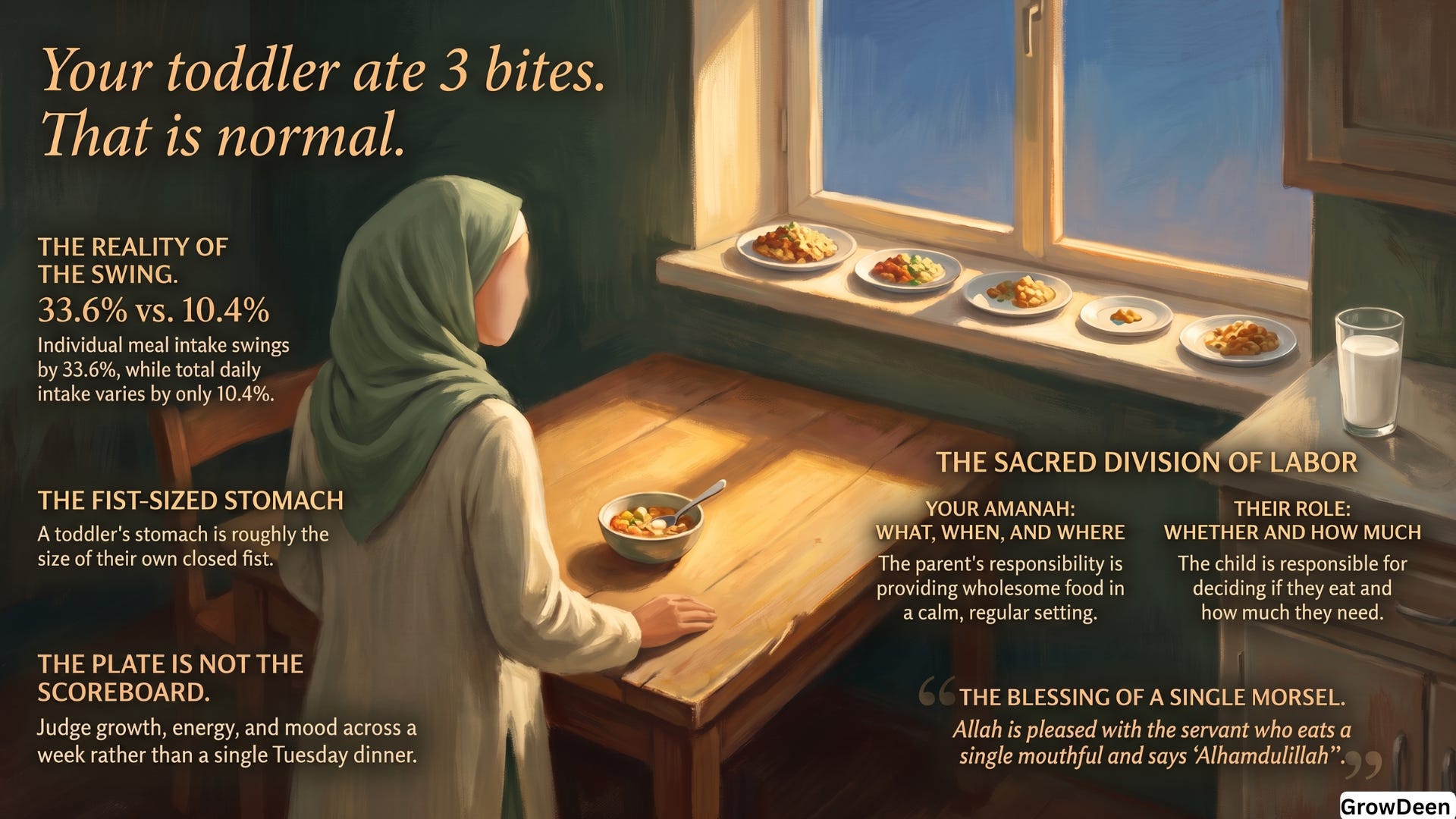
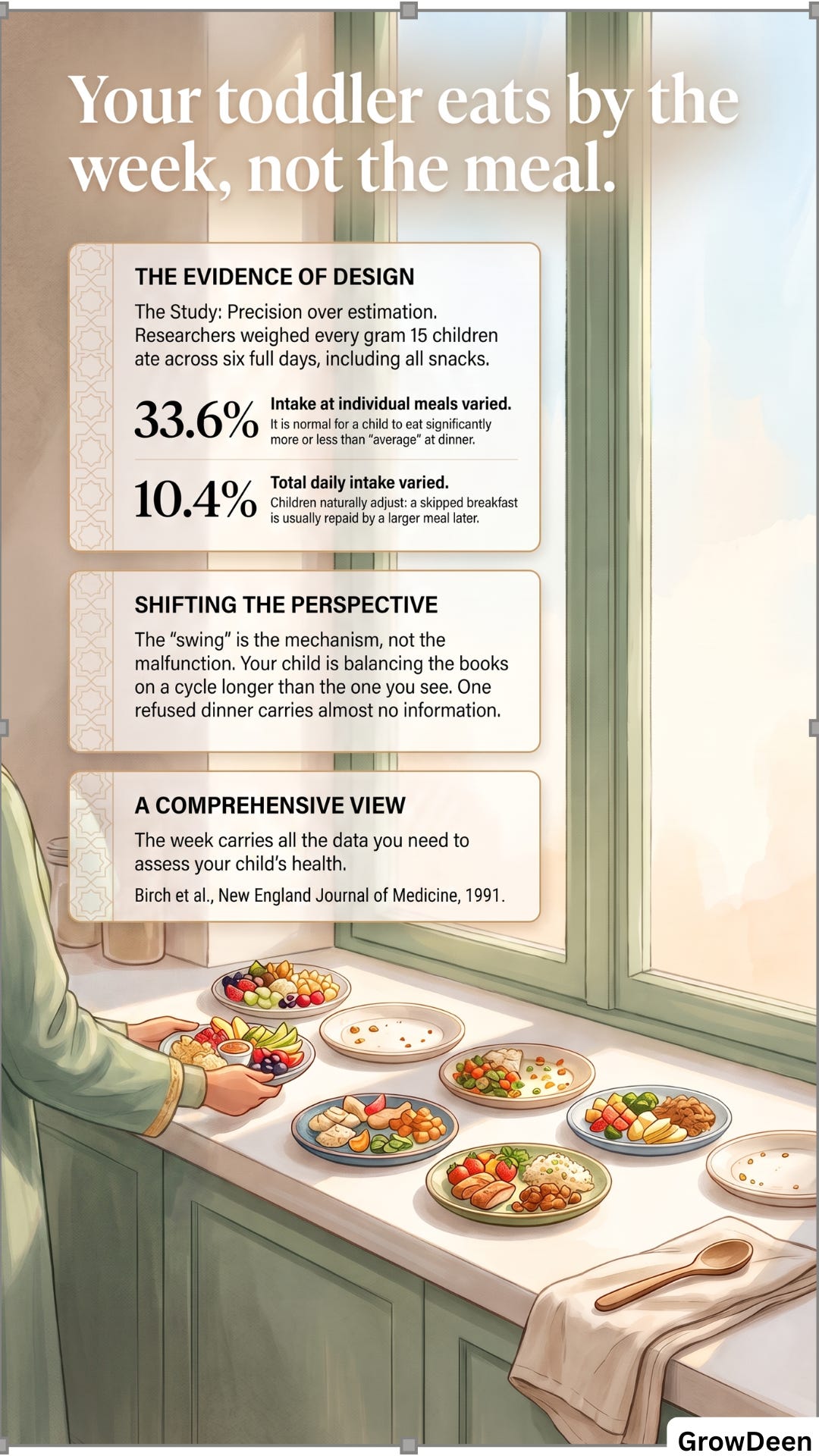
Researchers who weighed every gram fifteen toddlers ate across six full days found that intake at single meals swung by 33.6 percent, while total daily intake varied by only 10.4 percent. [1] Your child is balancing the books on a longer cycle than the one you are watching, and this guide shows you where to look instead.
It was almost seven o’clock.
You cooked the thing they liked last Tuesday. You sat down beside them. You said nothing about the plate, exactly like every calm parenting article told you to.
Three bites. Then down from the chair, gone.
And the feeling that arrives in that moment is not really about food. It is the quiet worry that you are failing at the one job that seems most basic of all: keeping your child fed. Nobody says that part out loud at the school gate.
Here is what changes it. When researchers weighed every gram of food fifteen young children ate across six days, they found something the table never shows you. Intake at individual meals swung around by an average of 33.6 percent. Total daily intake varied by only 10.4 percent. [1] A big lunch was followed by a small dinner. A skipped breakfast got repaid by mid-afternoon.
The swing is not the malfunction. The swing is the mechanism.
But before you change a single thing about dinner, there is somewhere else you need to look first, and it is not the table.
Why This Guide Is Different
Backed by current research. Every claim here traces to peer-reviewed work, including a landmark study in the New England Journal of Medicine [1] and a 2013 Pediatrics study of 1,311 children [6].
Islamically grounded. This is not only nutrition advice. It sits inside the amanah you carry as a parent, and inside a clear Qur’anic teaching about who actually provides.
Comes with tools. You get the free Small Appetite Companion Pack to print and keep on the fridge, so you are not trying to remember any of this at six in the evening.
Why Does My Toddler Eat Nothing Some Days and Everything the Next?
Think about the last week rather than last night. There was probably a day your child ate like they had just come off a mountain, and a day they lived on half a banana.
That pattern is the finding, not the problem. Children adjust intake at successive meals so that the daily total lands in roughly the same place. [1]
Which means the plate is a terrible instrument. It measures one data point in a system that operates across days.
The plate is not the scoreboard.
So what should you watch instead? Growth along your child’s own line, energy for play, mood, and the spread of foods they accept across a fortnight. Those are the measures a doctor uses. Not Tuesday’s dinner.
What Happens to a Toddler’s Appetite After the First Year
You are not imagining the change. Something did shift, and it is worth naming.
In the first year, your baby gained weight faster than they ever will again outside the womb. That pace stops. A toddler adds far less weight per month, so the fuel they need per kilogram drops, and appetite drops with it. The hungry, milk-hungry baby you remember has simply moved on to a slower stage.
Three more things are happening at once.
Their stomach is roughly the size of their own closed fist. An adult-looking portion does not read as dinner to a small person. It reads as an impossible task, and plenty of children give up before the first bite.
Their attention is somewhere else. Sitting still to eat has to compete with a doorway, a sibling, an unexplored corner of the room, a dropped spoon.
And refusing is one of the first real powers they have. A two-year-old cannot choose the day’s schedule or who visits on the weekend. They can absolutely choose whether that piece of chicken goes in. Liking a food on Monday and rejecting it on Wednesday is ordinary at this age, and food rejection in early childhood usually softens as children get older. [8] [9]
All of that is a stage with a predictable arc, and it passes.
Who Decides How Much: The Line That Ends Most Mealtime Fights
Ask yourself an uncomfortable question. When you leaned over the plate tonight, whose job were you doing?
There is a division of labour that ends most of these fights, and it comes from Ellyn Satter’s model of eating competence. You are responsible for what food appears, when it appears, and the setting it appears in. Your child is responsible for whether to eat and how much. Structuring it this way is linked to better self-regulation of intake and a calmer table. [2]
For a Muslim parent this should feel familiar. Your amanah is the effort: the halal and wholesome food, the regular timing, the calm room, the du’a, the example you set with your own plate. The outcome sits somewhere else entirely.
Cross that line and two things break. Your child stops reading their own hunger and starts reading your face, which is a far worse instrument. And you start carrying a weight that was never yours, usually while exhausted, usually at six in the evening.
Something to Make Tonight Easier
None of this is hard to understand. It is hard to remember at the exact moment your child pushes the plate away and you have been on your feet since Fajr.
That is why the free Small Appetite Companion Pack exists: a printable, fridge-ready set showing what a toddler-sized portion actually looks like, and a simple audit for working out where the hunger went. Keep reading, it is at the end.
The Five Things That Quietly Make It Worse
Some of the most instinctive parental responses have been tested directly. They backfire.
Pressing a child to finish. Preschoolers in one study were served the same food twice, once with a simple request to finish it and once without. Under pressure they ate significantly less, and their spoken comments about the food turned overwhelmingly negative. [3] The move meant to raise intake lowered it, and soured the food while it was at it.
And it does not stay in toddlerhood. Adults who recall being pressured to eat as children show distinctive eating patterns years later, with recalled pressure predicting adult behaviour more reliably than recalled picky eating does. [5] Retrospective accounts of forced-consumption episodes describe aversions to those exact foods that lasted decades. [4]
Clean-plate rules. Telling a child to finish what is served ties meal size to the plate rather than to fullness. [10] That is the habit adults spend years trying to undo.
Bribing with dessert. Offering a sweet as payment teaches your child that the vegetable is the work and the pudding is the wage. The status of the healthy food drops. In controlled comparisons, reward-based approaches did worse than simply offering the food again with no reward attached. [11]
Cooking a second meal. An alternative after a refusal teaches a child that refusing opens a menu. It also removes the repeated, low-pressure exposure that acceptance actually needs.
Calling them a fussy eater where they can hear you. Parents’ own accounts show how fast that description hardens into an identity a child then performs. [14]
Worth saying plainly, because you may be reading this with a knot in your stomach: fussy eating and parental pressure feed each other. Each one makes the other more likely. [12] [13] You did not start this loop. You can step out of it.
Where the Hunger Actually Went: Check the Six Hours Before Dinner
This is the part almost nobody checks, and it is where the answer usually is.
Milk first. Cow’s milk fills a child up and carries very little iron. In a study of 1,311 children aged two to five, each extra cup per day raised vitamin D levels by about 6.5 percent and lowered iron stores, measured as serum ferritin, by about 3.6 percent. Around two cups a day, roughly 500 millilitres, was the amount that kept vitamin D where it needed to be without meaningfully cutting into iron. [6] Children still drinking milk from a bottle showed sharper drops in ferritin and no vitamin D benefit at all. [6]
Read that twice, because it cuts both ways. A child who has had four cups of milk arrives at dinner already full, and the same pattern is quietly eroding the iron their brain is using to develop.
Snacks work the same way. Energy-dense snacks mid-morning measurably reduce what children eat at the lunch that follows. [7] Add juice, add sipping through the afternoon, and the appetite you were waiting for at six o’clock was spent at half past four.
Your child is not refusing dinner. Your child already ate.
Support Muslim Parenting Lab ❤️
Would you rather give a small amount that never stops than a large one you keep postponing? Set a monthly amount you are comfortable with, in a few seconds, using the button below.
The Prophet ﷺ said the deed most beloved to Allah is the most constant, even if little. (Sahih al-Bukhari 6464)
What Actually Makes a Table Work
Almost none of it is a recipe.
Shared family meals are linked to better dietary quality and healthier eating patterns in infants and toddlers. [15] And the wider family environment is associated with how fussy one to three year olds are, which means your child’s eating sits inside a household, not inside the child. [16]
In practice that looks unglamorous.
Sit down and eat with them instead of hovering or waiting until they are in bed. Eat the same food. Let them see you enjoy it, because your face at the table teaches more than any sentence you could construct about vitamins. Give the meal about twenty minutes, then end it without commentary. Take the plate calmly, say nothing about what was left, and offer water until the next scheduled eating time.
Serve less than feels right. A small portion finished builds confidence in a child who has started to associate the table with failing. A big portion that defeats them builds dread, and offering more is trivially easy when they ask.
Bring them into the making of it. A three-year-old washing courgettes or tearing lettuce is more likely to eat what they helped make. Let it be messy, because handling food and bringing it near their mouth is how a young child does the work of getting familiar with it.
Familiarity is usually the entire barrier. Repeated, pressure-free tasting is the best-evidenced route to a child accepting a food they currently reject, and it works when parents run it at home over a couple of weeks. [11] Cautious children may need many more encounters than that. Offer it, say nothing, take it away, offer it again next week.
The Sacred Trust of the Offering: What the Qur’an Says About Who Provides
You already know the feeling. The plate goes back to the kitchen barely touched, and somewhere underneath the tiredness is the thought that you are failing at something Allah asked of you.
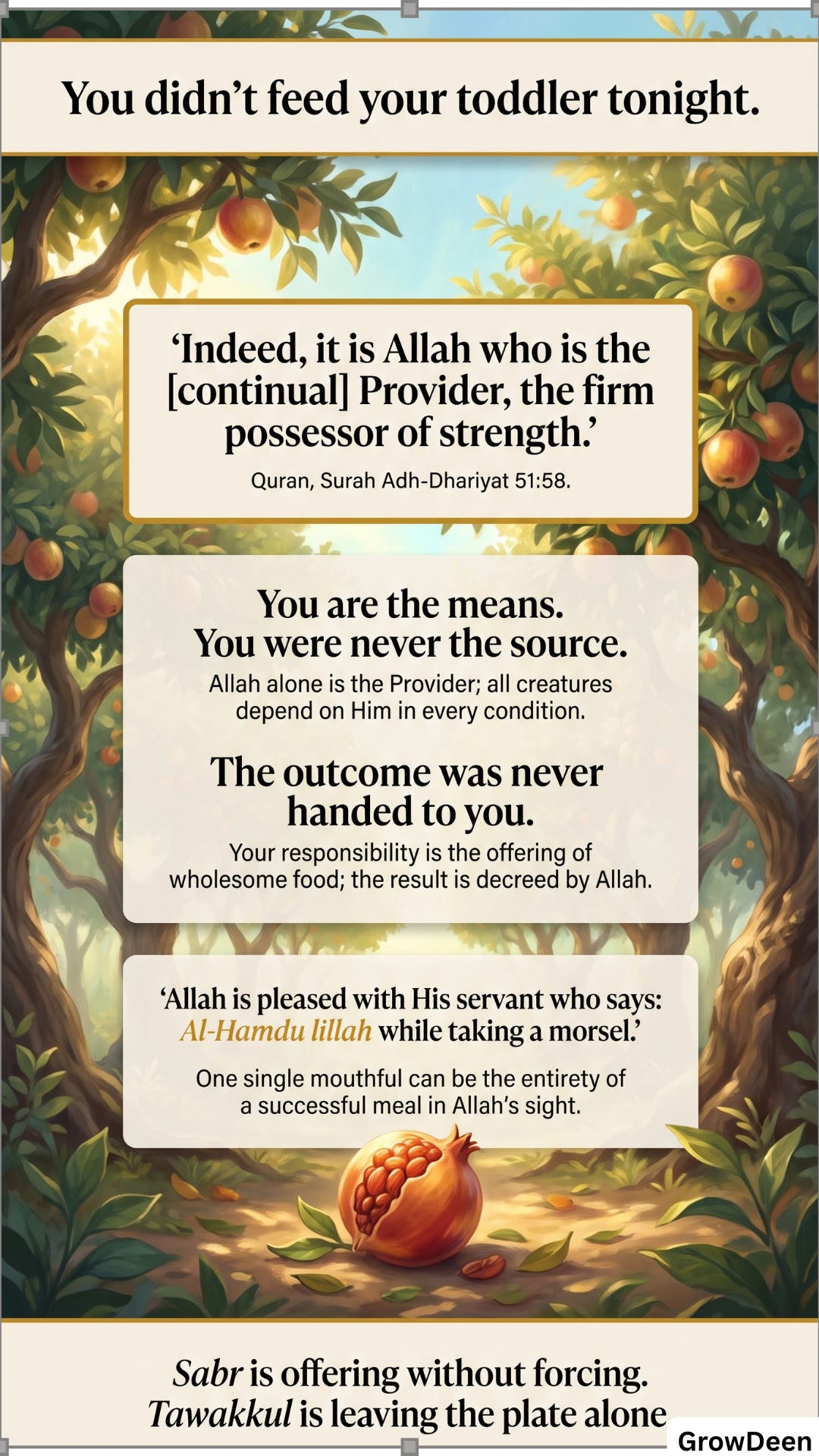
Sit with what Allah actually says: “Indeed, it is Allah who is the [continual] Provider, the firm possessor of strength.” [17]
According to Tafsir Ibn Kathir, this passage establishes that Allah has no need of His creatures. They are in need of Him in every condition, and He alone is their Creator and Provider. [17]
Every mouthful that has ever reached your child arrived by the decree of ar-Razzaq. The rice you cooked, the milk you poured, the hunger that made your child want any of it. You are the means. You were never the source.
And then there is the smaller mercy. Anas ibn Malik, may Allah be pleased with him, reported that the Messenger of Allah ﷺ said: “Allah is pleased with His servant who says: Al-Hamdu lillah while taking a morsel of food and while drinking.” [18]
A morsel. One mouthful. That is where Allah has set the bar for His pleasure at your table, which means a child who eats three spoonfuls and says Alhamdulillah has done the whole thing.
The research points the same way, putting your work in the offering rather than the outcome. Sabr belongs to the parent who keeps offering without forcing. Tawakkul belongs to the parent who can then leave the plate alone.
A Day That Works
So what does this look like at eight o’clock on a Tuesday?
Three meals and two or three small snacks at roughly predictable times, spaced far enough apart that hunger has room to build. Between them, water only. Keep milk near two cups a day and away from the hour before a meal, [6] and get the bottle out of the picture if it is still there.
Put the food down, say Bismillah out loud, then turn your attention to the conversation instead of the plate. Say Alhamdulillah at the end where your children can hear it, whatever was eaten, so gratitude becomes the sound a meal ends on rather than a verdict on quantity. That is tarbiyah, done in a few syllables, several times a day, with no lecture attached.
Let them serve themselves from shared dishes wherever they can manage it. Choosing from what you have already offered gives a two-year-old real autonomy inside a boundary you drew.
Put the new food beside two familiar ones. Offer it again next week even though it was refused this week. And judge the whole thing across seven days, because the plate is not the scoreboard. [1]
When to Speak to a Doctor
Most toddlers who eat little are healthy and growing. If your child is gaining weight along their own line, has energy to play and explore, and is generally well, they are almost certainly getting enough.
Persistent, narrow eating is the situation worth catching early. Children whose food range stays severely restricted over long periods can end up short on specific micronutrients, and iron is the one that matters most at this age. [8] [19]
Asking for help is part of taking the means, and it sits comfortably alongside trust in Allah. Book with a doctor, paediatrician, or dietitian if any of these apply:
Your child eats only a very narrow range of foods, or refuses whole food groups for more than a few weeks. [19]
Refusal is worsening rather than fluctuating.
Weight gain has stalled, or weight is dropping.
Your child looks pale or tires easily.
Eating causes pain, or there is frequent gagging, vomiting, choking, or coughing at meals.
Your child is unwell and refusing both food and fluids.
Seek urgent care if your child cannot keep fluids down, is much less responsive than usual, or shows signs of dehydration such as very few wet nappies.
And if the worry itself is affecting your household, that is reason enough to book the appointment. You do not have to justify it.
Your Small Appetite Companion Pack
If you have read this far, you are the kind of parent who wants to understand what is happening before deciding what to do about it. That says something about you.
Inside the Small Appetite Companion Pack (one comprehensive PDF, 3 pages):
Page 1: What a Toddler Portion Actually Looks Like. A life-size visual portion guide using your child’s own hand as the measure, covering nine common foods, plus a daily drinks strip showing where milk and water sit across the day. Designed as a fridge card you can hold a plate against before you serve it.
Page 2: The Appetite Audit. A simple backward walk through the six hours before dinner, with eight things to check and what to change for each one, so you can find where the hunger went without changing anything about the meal itself.
Page 3: One Morsel. An Islamic reminder card built on Qur’an 51:58 with Ibn Kathir’s commentary, and the narration of the Prophet ﷺ on Allah’s pleasure at a single mouthful praised (Sahih Muslim 2734a, graded Sahih). For the evenings when the plate comes back full and you need reminding what the meal was actually for.
This is not a PDF to download and forget. It is built to live on the fridge door at eye level, where dinner actually happens.
The Small Appetite Companion Pack is what every subscriber receives with each article. At Muslim Parenting Lab we cover the whole span of raising Muslim children, from newborns through the early school years, all backed by scientific research and rooted in Islamic wisdom.
One Thing to Do at the Next Meal
Serve half of what you were going to serve. Say Bismillah out loud. Then do not mention the plate again, not once, until the meal is over.
That is it. That is the whole practice.
May Allah place barakah in what you set on your table, accept the effort behind it, and make the feeding of your children lighter on your heart than it has felt lately.
Share This With Someone Who Needs It
Think of one person right now: the mother in your family who has started apologising for how little her toddler eats. The sister whose evenings have turned into negotiations over four peas. The friend who mentioned, half laughing, that her two-year-old lives on yoghurt.
Send this to her today. It will land as relief rather than advice. Sometimes the kindest thing is telling someone that the thing frightening them is normal.
Frequently Asked Questions
Q: How much should a 2 year old eat in a day?
A: Far less than most parents expect, and it varies enormously between meals. Children adjust intake across successive meals so the daily total stays fairly steady, so judge the day and the week rather than the plate. [1] A rough serving size is about what fits in your child’s own closed fist.
Q: Is it normal for a toddler to eat nothing all day?
A: A single low day is common and rarely a problem on its own if your child is well, active, and growing along their own line. What warrants a call is a pattern that persists or worsens over weeks, or weight that stalls or drops. See “When to Speak to a Doctor” above.
Q: Should I force my toddler to eat?
A: No. Pressure has been tested directly and it lowers intake and makes children speak more negatively about the food. [3] Recalled pressure in childhood also predicts adult eating patterns years later. [5] Offer, then step back.
Q: How much milk should a toddler drink a day?
A: Around two cups, roughly 500 millilitres, was the amount that maintained vitamin D without meaningfully lowering iron stores in a study of 1,311 young children. [6] More than that fills them up and eats into their iron. Keep it away from the hour before meals.
Q: Why does my toddler eat at nursery but not at home?
A: Usually the structure differs. Nursery has fixed mealtimes, no grazing in between, other children eating the same food, and nobody commenting on any individual plate. Copy those four conditions at home before changing what you cook.
Q: How many times do I need to offer a new food before my child accepts it?
A: More times than feels reasonable. Repeated, pressure-free tasting over a couple of weeks is the best-evidenced approach, and it works better than offering rewards. [11] Cautious children often need many more encounters than average.
Q: Is my toddler’s small appetite a sign of iron deficiency?
A: Not usually, but the two can be linked, particularly in children drinking a lot of milk. [6] Pallor, tiring easily, or unusual irritability alongside a narrow diet are worth raising with your doctor. [19]
References
[1] Birch, L.L., Johnson, S.L., Andresen, G., Peters, J.C., & Schulte, M.C. (1991). The variability of young children’s energy intake. New England Journal of Medicine, 324(4), 232–235. https://doi.org/10.1056/NEJM199101243240405
[2] Satter, E. (2007). Eating competence: Definition and evidence for the Satter Eating Competence model. Journal of Nutrition Education and Behavior, 39(5), S142–S153. https://doi.org/10.1016/j.jneb.2007.01.006
[3] Galloway, A.T., Fiorito, L.M., Francis, L.A., & Birch, L.L. (2006). ‘Finish your soup’: Counterproductive effects of pressuring children to eat on intake and affect. Appetite, 46(3), 318–323. https://doi.org/10.1016/j.appet.2006.01.019
[4] Batsell, R.W., Brown, A.S., Ansfield, M.E., & Paschall, G.Y. (2002). “You will eat all of that!”: A retrospective analysis of forced consumption episodes. Appetite, 38(3), 211–219. https://doi.org/10.1006/appe.2001.0482
[5] Ellis, J.M., Galloway, A.T., Webb, R.M., Martz, D.M., & Farrow, C.V. (2016). Recollections of pressure to eat during childhood, but not picky eating, predict young adult eating behavior. Appetite, 97, 58–63. https://doi.org/10.1016/j.appet.2015.11.020
[6] Maguire, J.L., Lebovic, G., Kandasamy, S., Khovratovich, M., Mamdani, M., Birken, C.S., & Parkin, P.C. (2013). The relationship between cow’s milk and stores of vitamin D and iron in early childhood. Pediatrics, 131(1), e144–e151. https://doi.org/10.1542/peds.2012-1793
[7] Birch, L.L., McPhee, L.S., Bryant, J.L., & Johnson, S.L. (1993). Children’s lunch intake: Effects of midmorning snacks varying in energy density and fat content. Appetite, 20(2), 83–94. https://doi.org/10.1006/appe.1993.1010
[8] Taylor, C.M., & Emmett, P.M. (2019). Picky eating in children: Causes and consequences. Proceedings of the Nutrition Society, 78(2), 161–169. https://doi.org/10.1017/S0029665118002586
[9] Lafraire, J., Rioux, C., Giboreau, A., & Picard, D. (2016). Food rejections in children: Cognitive and social/environmental factors involved in food neophobia and picky/fussy eating behavior. Appetite, 96, 347–357. https://doi.org/10.1016/j.appet.2015.09.008
[10] Birch, L.L., McPhee, L., Shoba, B.C., Steinberg, L., & Krehbiel, R. (1987). “Clean up your plate”: Effects of child feeding practices on the conditioning of meal size. Learning and Motivation, 18(3), 301–317. https://doi.org/10.1016/0023-9690(87)90017-8
[11] Wardle, J., Herrera, M.L., Cooke, L., & Gibson, E.L. (2003). Modifying children’s food preferences: The effects of exposure and reward on acceptance of an unfamiliar vegetable. European Journal of Clinical Nutrition, 57(2), 341–348. https://doi.org/10.1038/sj.ejcn.1601541
[12] Jansen, P.W., de Barse, L.M., Jaddoe, V.W.V., Verhulst, F.C., Franco, O.H., & Tiemeier, H. (2017). Bi-directional associations between child fussy eating and parents’ pressure to eat: Who influences whom? Physiology & Behavior, 176, 101–106. https://doi.org/10.1016/j.physbeh.2017.02.015
[13] Byrne, R., Jansen, E., & Daniels, L. (2017). Perceived fussy eating in Australian children at 14 months of age and subsequent use of maternal feeding practices at 2 years. International Journal of Behavioral Nutrition and Physical Activity, 14(1), 123. https://doi.org/10.1186/s12966-017-0582-z
[14] Markides, B.R., Laws, R., Hesketh, K., Maddison, R., Denney-Wilson, E., & Campbell, K.J. (2022). A thematic cluster analysis of parents’ online discussions about fussy eating. Maternal & Child Nutrition, 18(2), e13316. https://doi.org/10.1111/mcn.13316
[15] Verhage, C.L., Gillebaart, M., van der Veek, S.M.C., & Vereijken, C.M.J.L. (2018). The relation between family meals and health of infants and toddlers: A review. Appetite, 127, 97–109. https://doi.org/10.1016/j.appet.2018.04.010
[16] Piloquet, H., Berge, B., Maigret, P., & Hospital, V. (2024). Food fussiness is associated with family environmental factors in 1-3-year-old children: A large-scale cross-sectional study. Appetite, 192, 107043. https://doi.org/10.1016/j.appet.2023.107043
[17] Qur’an, Surah Adh-Dhariyat 51:58 — https://quran.com/51/58. Tafsir Ibn Kathir on 51:56–58 — https://quran.com/51:58/tafsirs/en-tafisr-ibn-kathir
[18] Sahih Muslim 2734a, narrated by Anas ibn Malik — Graded: Sahih — https://sunnah.com/muslim:2734a
[19] Taylor, C.M., Wernimont, S.M., Northstone, K., & Emmett, P.M. (2015). Picky/fussy eating in children: Review of definitions, assessment, prevalence and dietary intakes. Appetite, 95, 349–359. https://doi.org/10.1016/j.appet.2015.07.026
We combine scientific research with Qur’an and authentic Sunnah, and we cite our sources. Even so, this is general guidance and no substitute for a doctor who can examine your child.