

Toddlers aged one to four need at least 180 minutes of movement a day. [5] Most of that has to come from play nobody organised.
For the next hour you feel you wasted.
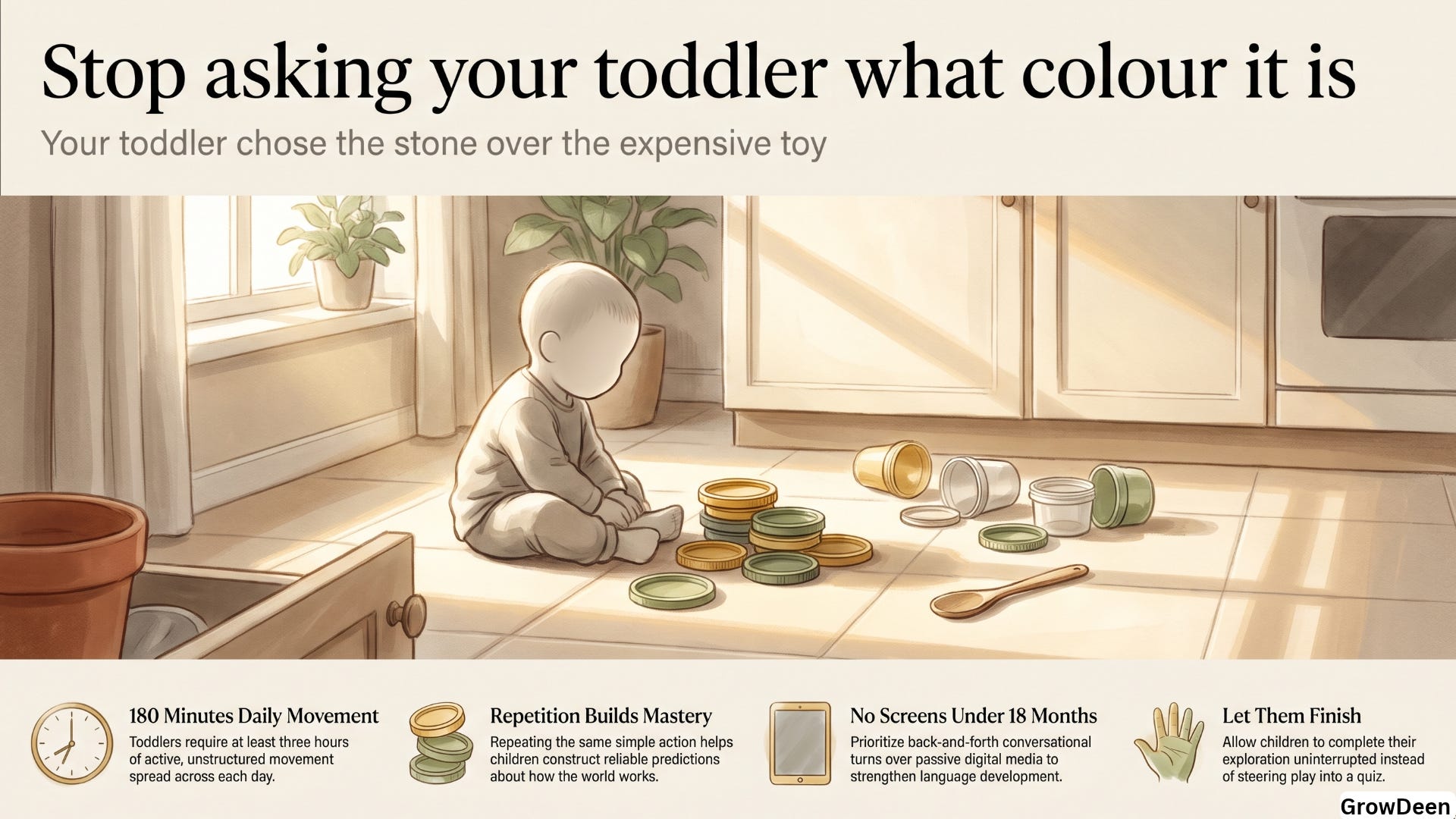
It is 7:40 in the morning. The cupboard is open again.
Every container is out, the lids are in a separate pile, and your toddler is putting one lid onto the wrong tub for the fourth time in a row. You crouch down and do the thing the parenting posts told you to do. You name the colours. You ask what shape that one is. Your child stops, looks at you, and walks away.
That is not a failure of technique. It is a message about who the play belonged to.
Most parents of one to three year olds carry a quiet worry that the day is slipping past without teaching anything. The toys were expensive. The flashcards are in the drawer. And the child would rather empty a cupboard for twenty minutes. Which raises the question worth holding onto for the rest of this article: why does the same toddler who ignores a brand new toy give four solid minutes to a single stone in the garden?
Why This Guide Is Different From A Generic List Of Toddler Activities
Every claim here is tied to named evidence: the AAP’s 2018 clinical report on play [1], the WHO’s 24 hour guidelines for under-fives [5], a 2,441 child cohort on screen time [7], and a 51 study meta-analysis on outdoor time and eyesight [8].
The Islamic layer is not decoration. Ease is the character of what Allah gave [9], and the Prophet ﷺ paced his own teaching so his listeners would not tire [10], which turns out to be the most practical parenting advice in this whole piece.
You already have the free Let Them Lead Card from the top of this page, so the method below arrives with a printable version attached rather than one more thing to remember.
The First Hour: What The Cupboard Is Actually For
Here is what your child is doing while you tidy. Testing whether that lid fits that tub, and whether it still does not fit if they push harder, and what sound it makes when they give up and throw it.
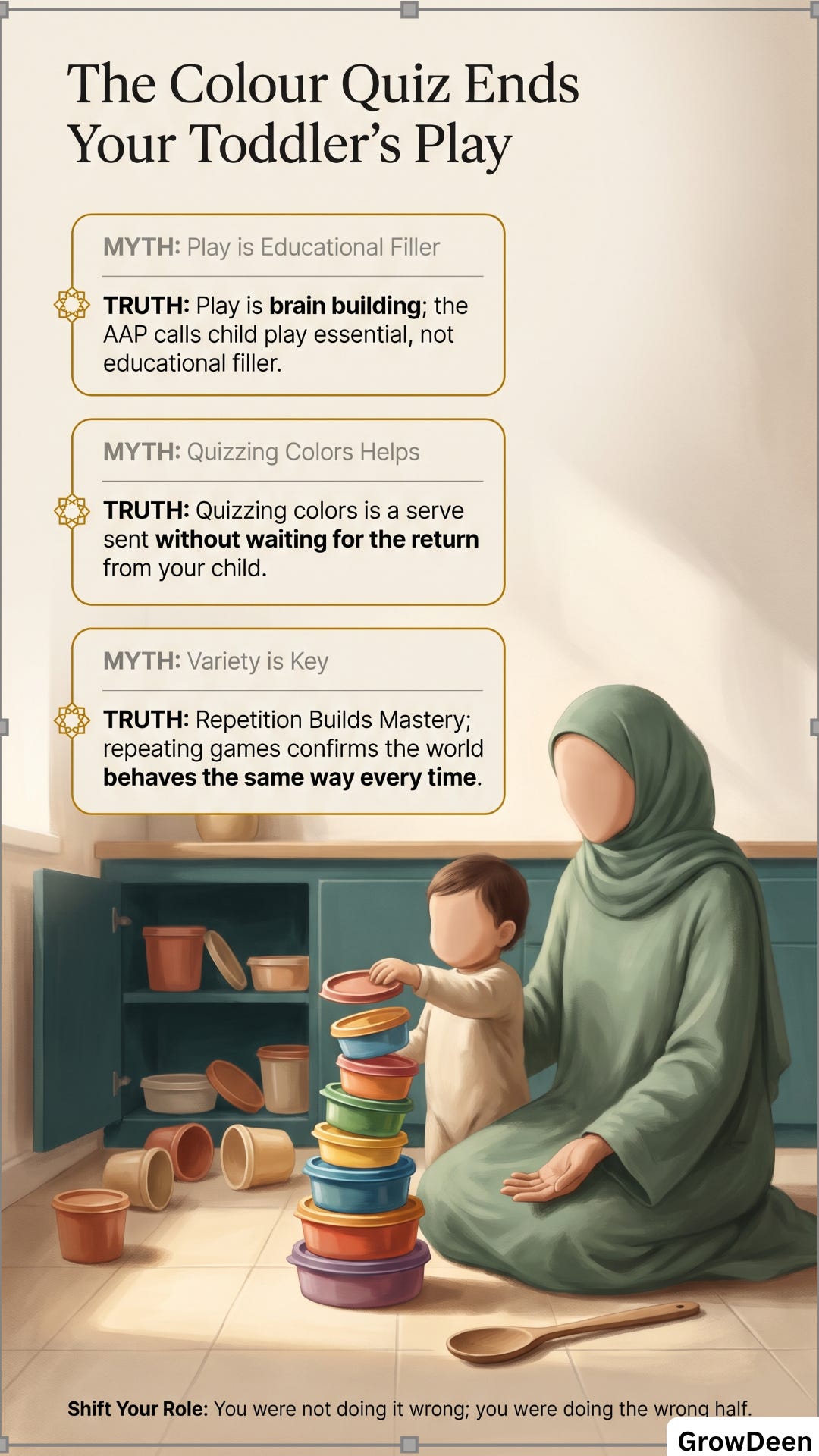
The American Academy of Pediatrics put its position plainly in 2018: children’s play is brain building, not filler to get through [1]. Their clinical report ties it to executive function, the bundle of skills a child will later need to hold a plan in mind, stop an impulse and change tactics when something is not working [1]. The same report describes play as a buffer against stress and as one of the strongest things a parent and a small child build between them [1].
Repetition is the part that looks most like nothing. It is the opposite. A toddler who runs the same experiment eleven times is checking that the world behaves the same way every time, which is how a small person builds a working prediction about anything at all.
And the part that makes it work is not what you buy. Researchers at Harvard describe the back and forth between a child and a responsive adult as serve and return: the child looks, points or pushes something toward you, and your answer closes the loop and strengthens what is being wired [2]. Their five steps are free: notice what has your child’s attention, return the serve, name what they are seeing, take turns and wait, then let them lead and let them finish [2].
That last step is where most of us fall down, and there is now brain evidence for why it matters. A team from MIT and Harvard recorded the home language of children aged four to six, then scanned them while they listened to stories. The number of conversational turns, not the number of words heard, predicted their language scores and the activity in Broca’s area, the region used for producing and processing speech, and the pattern held across family income and parental education [3]. Talking at a child does less than talking with one. Your colour quiz was a serve you sent without waiting for the return.
But knowing why the cupboard matters does not get anybody to lunchtime. There is a harder number waiting in the middle of the day.
Mid-Morning: The Three Hours Nobody Counts
The World Health Organization is specific about what a young child needs across a 24 hour day [5]:
One to two year olds: at least 180 minutes of physical activity at any intensity, spread through the day.
Three to four year olds: at least 180 minutes, with at least 60 of those minutes moderate to vigorous.
Both ages: no more than one hour at a time restrained in a pram, high chair or carrier.
Sleep: 11 to 14 hours for one to two year olds, 10 to 13 hours for three to four year olds, naps included.
Three hours sounds like a sentence handed down to a parent who is already tired. Then you add up an ordinary morning. The walk to the shop counts. The stairs count. So does the ten minutes of jumping on a cushion you were about to stop, and the long slow business of a toddler putting their own shoes on.
Getting outside does two jobs at once, and the second one surprises most parents. A systematic review and meta-analysis of 51 studies found that children who spent more time outdoors had a markedly lower risk of becoming short-sighted, with pooled estimates of roughly 43 to 46 per cent fewer new cases across clinical trials and longitudinal cohorts [8]. The same analysis found no effect on children who were already short-sighted, so this is prevention and not a treatment [8]. Daylight itself appears to be the active ingredient, which means the park, the garden and the walk to the masjid all count toward it.
There is an Islamic reading sitting underneath all of that. A child’s body was placed in your hands as an amanah, and letting that body do what it was built to do at this age belongs to keeping the trust rather than to the list of optional extras.
Outside is also where the questions start. Ants carrying crumbs away. A moon that changes shape across a month. These are the first conversations a small child can have about Allah’s creation, and they usually begin with one question asked at the right moment: who made this?
A Note Before The Afternoon
You are about four blocks into a day that has a lot of moving parts, and nobody holds all of this in their head at 10am with a toddler on their hip. That is what the Let Them Lead Card is for: the five serve and return steps with the exact sentences to say, a one page map of the day, and a reflection page you can stick on the fridge. The download button is at the top of this page, and there is a full description of what is inside it below.
Now, the part that most guides get wrong.
What The Qur’an And The Sunnah Show About Teaching Without Tiring A Learner
The pressure to make every hour productive is not modern, and Islam answers it more gently than most parenting advice does.
Allah says, “And We will ease you toward ease.” [9] According to Tafsir Ibn Kathir, this is a promise that Allah will make good deeds and good speech come easily to the Prophet ﷺ, and that the Law given to him would be easy and balanced, with no crookedness or hardship built into it [9]. Ease is not a discount offered to the weak. It is the character of what Allah gave.
The Prophet ﷺ taught the way he was taught. Ibn Mas’ud described how he ﷺ picked his moments for preaching and for teaching knowledge, so that the people with him would not grow bored or weary [10]. A man who could have spoken whenever he wished instead watched the people in front of him and stopped while they still wanted more.
Now hold that beside your two year old and the pile of lids. The pull is to turn it into a colour test and then a lesson about tidying up. The pattern in that narration points the other way: read the child in front of you and leave the rest alone. Your toddler will come back to the cupboard tomorrow, and more willingly if today ended before they had had enough.
Stop the game while they still want more. That line is the whole method, and it gets harder in the afternoon.
Afternoon: When Play Turns Into A Test, And When The Screen Comes On
The two o’clock version of a parent is a different person from the eight o’clock version. This is the hour when the quizzing creeps in, because teaching feels like progress and watching feels like wasting time.
It is also when the tablet comes out, and the guidance here is stricter than most families expect. The AAP advises avoiding screen media other than video chatting below 18 months, choosing high quality programming and watching it alongside your child between 18 and 24 months, and holding two to five year olds to one hour a day of high quality content viewed together [6]. The WHO does not recommend any sedentary screen time for one year olds and caps two to four year olds at one hour, with less being better [5]. The CDC gives the same one hour ceiling for a children’s programme with an adult present, and says to keep screens out of the bedroom [4].
A Canadian study of 2,441 children shows why the timing matters. More screen time at 24 months predicted lower scores on a developmental screening questionnaire at 36 months, and more screen time at 36 months predicted lower scores at 60 months, while the reverse direction did not show up in the data [7]. The authors are careful to call it an observational association rather than proof of cause [7]. The practical reading is still simple: an hour on a screen at this age is an hour not spent in the back and forth that builds language [3].
Two things for a Muslim home. Choose Islamically suitable, music-free, parent-approved content instead of whatever autoplay serves next. And what a small child’s eyes and ears take in belongs to the same trust as their body.
Background television gets its own line. Turn it off when nobody is watching it.
And when the tablet goes away, what fills the gap? Mostly things you already own.
Support Muslim Parenting Lab ❤️
Think your amount is too small to matter? Give whatever you have with the button below.
The Prophet صلى الله عليه وسلم said to shield yourself from the Fire even with half a date. (Sahih al-Bukhari 1417)
What To Put On The Floor Instead
Storytelling in your own voice beats any screen in the house. Stories of the Prophets, scenes from the Seerah, simple Islamic picture books, read while your child turns the pages, picks the same book again and finishes your sentences for you.
Rhythm without music does everything songs and nursery rhymes are usually brought in for. Small children want repetition and beat, and you can give both with short repeated lines, clapped patterns, gentle adhkar at tidy-up time, and soft Qur’an recitation in the background while they build.
Messy play with water, sand, dough or a tray of dry rice teaches textures no plastic toy can. Around water, constant supervision is the only thing that keeps a small child safe, with no exceptions and no quick trip to answer the door.
Pretend play works best with real objects. A small prayer mat in the corner where a toddler copies your salah. A dry cloth for pretend wudu. A wooden spoon and a pot. A cardboard box that is a car, and then a shop.
Open-ended things beat more toys. The AAP suggests blocks, empty containers, wooden spoons, shape sorters and puzzles, all cheap and better for a child’s invention than most electronic alternatives [11]. Old scarves and clothes hand a three year old the whole cast of a story.
Adab runs through all of it without turning into a lesson. Bismillah before the pretend meal. Alhamdulillah when the tower finally holds. Salaam at the door of the pretend house. MashaAllah when an older sibling builds something. In shaa Allah when you promise tomorrow.
By late afternoon, though, there is usually another child involved, and that is where the day gets loud.
Evening: Sharing, Sabr, And The End Of The Day
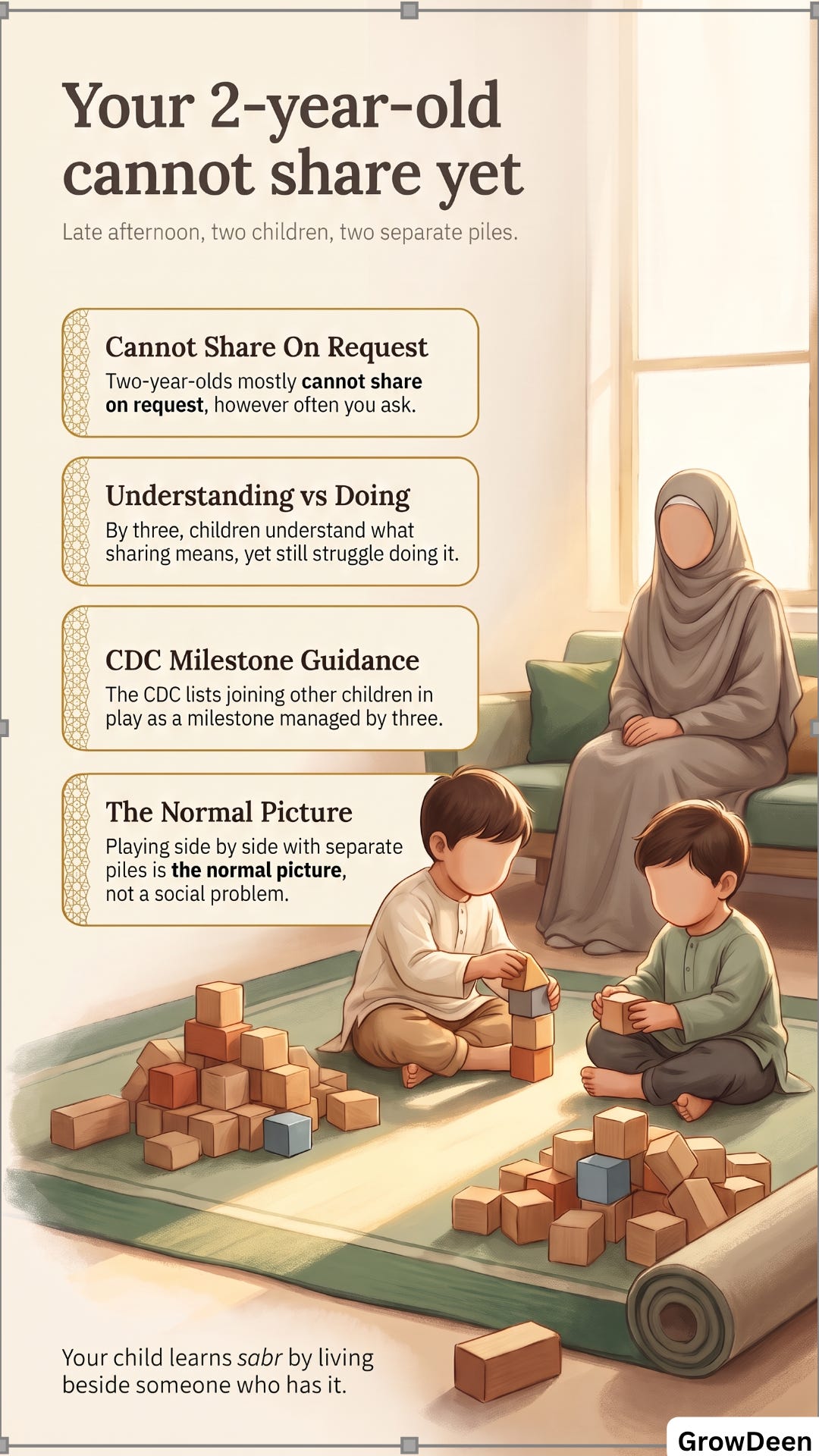
Most two year olds cannot share on request, however many times they are asked. By three, a child often understands what sharing means and still finds the doing of it very hard. The CDC lists noticing other children and joining them in play as something most children manage by three [4], which means that parallel play before then is the normal picture and not a social problem.
Pressure does not move this along. Practice does, and so does the example your child watches every day. A toddler learns sabr by living beside someone who has it, which is an uncomfortable sentence on an evening when yours ran out before maghrib. A child who watches a parent apologise and start again has learned something larger than a quiet half hour.
A rhythm that holds up in a real week looks roughly like this:
After breakfast: ten to fifteen minutes on the floor, child-led, with your phone in another room.
Mid-morning: outdoors, even briefly, for the daylight as much as the movement [8].
After the midday meal: messy play, drawing, or a dough tray while you clear up nearby.
Late afternoon: movement, because this is the hour when unused energy turns into trouble.
After maghrib: a story, a book, adhkar, and du’a before sleep.
Nobody runs this cleanly. Four days out of seven is already doing its work on your child.
If Your Child Has Additional Needs
If your child has a disability, autism or another additional need, plan the support that lets them get the most out of play. A child who finds spoken instructions hard may do better with pictures showing the steps of a game. Shorter sessions and fewer objects in view help a child who is quickly overwhelmed. Your child’s doctor or early intervention service can help you adapt specific activities, and most of what is above works with small adjustments rather than a different approach.
When To Speak With Your Doctor
Speak with your doctor if your child is not meeting developmental milestones, has lost a skill they previously had, does not play pretend or make-believe by around three, shows no interest in other children, or if anything about their movement, hearing or vision concerns you. The CDC’s standing advice is not to wait, but to raise it and ask about developmental screening [4]. Your own sense that something is different is worth acting on. This article is general guidance and does not replace medical advice from a qualified professional.
So, the stone in the garden.
Your toddler gave it four minutes because nobody set a target for it, nobody asked what colour it was, and nobody ended it early. The toy came with instructions and an adult watching for the right answer. The stone came with nothing, which is exactly why it held. Stop the game while they still want more, and most of the toys in the house start working again.
Inside The Let Them Lead Card
If you have read this far, you are the kind of parent who takes the early years seriously, and who suspects there is more going on in a pile of lids than it looks like. That instinct is correct, and it deserves something you can actually hold.
Inside the Let Them Lead Card (one comprehensive PDF, 3 pages):
Page 1: The Five Serves. The five serve and return steps written as five things to say out loud, with the exact wording for each one and the common mistake beside it, designed as a laminated reference card you can keep on the fridge or on the windowsill above the sink.
Page 2: The Day Map. One page covering the whole waking day in five blocks, with the movement minutes each block is worth, what to put out, and a tick box per block, so you can see at a glance whether today reached 180 minutes without doing arithmetic at bedtime.
Page 3: Stop While They Still Want More. A reflection page carrying Qur’an 87:8 and the narration of Ibn Mas’ud on how the Prophet ﷺ paced his teaching, both in English with their sources, alongside four lines on what each one changes about an ordinary afternoon with a two year old.
This is not a PDF to download and forget. It is built to live on your fridge, in the place where the hard hours of the day actually happen.
The Let Them Lead Card is what every subscriber receives alongside each article. Muslim Parenting Lab covers the whole span of raising young Muslim children, from the newborn weeks through the preschool years, with every piece built on current research and rooted in the Qur’an and Sunnah.
One Thing To Do Tonight
Tonight, when your child starts something on their own, set a timer in your head for ten minutes and do not teach during it. No questions about colours, no counting, no correcting the tower. Name what they are doing, wait, and let them finish. That is the whole exercise.
May Allah place barakah in the hours you give these small people, accept the effort nobody sees, and make the care you offer heavier on your scale than it feels in the moment.
Share This With Someone Who Needs It
Think of one person right now: the sister at the masjid who said her two year old “won’t play properly,” the friend whose toddler empties the same drawer every morning, the new mother in your family who has already bought three educational toys that sit untouched.
This article could take something off their shoulders tonight. Send it to them today, not as advice, but as company. Sometimes the kindest thing we can pass along is permission to stop trying so hard.
Frequently Asked Questions
Q: How much should a 2 year old play each day?
A: There is no fixed play quota, but the movement target is clear: at least 180 minutes of physical activity spread across the day for one to two year olds, and the same for three to four year olds with 60 of those minutes moderate to vigorous [5]. Most of it should be unstructured and led by your child.
Q: Why does my toddler play the same game over and over?
A: Repetition is how a small child reaches mastery and builds a reliable prediction about how things behave. It is a sign the learning is working, not a sign of a stalled imagination. See “The first hour” above for what is happening underneath.
Q: Is screen time bad for toddlers?
A: The AAP advises no screen media other than video chatting below 18 months, high quality programming watched together from 18 to 24 months, and a one hour daily cap from two to five [6]. In one cohort of 2,441 children, more screen time at 24 months predicted lower developmental screening scores at 36 months [7].
Q: Should my 2 year old be sharing yet?
A: Usually not on request. Most children begin noticing other children and joining their play around three [4], and even then sharing is understood long before it is comfortable. Practice and what your child sees you do matter more than reminders.
Q: What are the best toys for a toddler?
A: Open-ended ones. The AAP points to blocks, empty containers, wooden spoons, shape sorters and puzzles, which cost little and support a child’s own invention better than most electronic toys [11]. Cardboard boxes and old clothes belong on that list too.
Q: Is music-free play really enough for toddlers?
A: Yes, because what a toddler responds to is rhythm and repetition rather than melody. Short repeated lines, clapped patterns, gentle adhkar and parent-led storytelling give a child the same beat and the same language exposure, and storytelling in your own voice adds the conversational turns that predict language outcomes [3].
References
[1] Yogman M, Garner A, Hutchinson J, Hirsh-Pasek K, Golinkoff RM; AAP Committee on Psychosocial Aspects of Child and Family Health; AAP Council on Communications and Media. The Power of Play: A Pediatric Role in Enhancing Development in Young Children. Pediatrics. 2018;142(3):e20182058.
[2] Center on the Developing Child, Harvard University. Serve and Return.
[3] Romeo RR, Leonard JA, Robinson ST, West MR, Mackey AP, Rowe ML, Gabrieli JDE. Beyond the 30-Million-Word Gap: Children’s Conversational Exposure Is Associated With Language-Related Brain Function. Psychological Science. 2018;29(5):700-710.
[4] Centers for Disease Control and Prevention. Learn the Signs. Act Early.: Milestones by 3 Years. Reviewed 16 May 2026.
[5] World Health Organization. Guidelines on Physical Activity, Sedentary Behaviour and Sleep for Children Under 5 Years of Age. Geneva: WHO; 2019.
[6] American Academy of Pediatrics, Council on Communications and Media. Media and Young Minds. Pediatrics. 2016;138(5):e20162591.
[7] Madigan S, Browne D, Racine N, Mori C, Tough S. Association Between Screen Time and Children’s Performance on a Developmental Screening Test. JAMA Pediatrics. 2019;173(3):244-250.
[8] Xiong S, Sankaridurg P, Naduvilath T, et al. Time spent in outdoor activities in relation to myopia prevention and control: a meta-analysis and systematic review. Acta Ophthalmologica. 2017;95(6):551-566.
[9] Qur’an, Surah Al-A’la 87:8 (Saheeh International). Tafsir Ibn Kathir.
[10] Sahih al-Bukhari 68, Book of Knowledge, narrated by Ibn Mas’ud. Graded: Sahih.
[11] Yogman M. The Power of Play: How Fun and Games Help Children Thrive. HealthyChildren.org, American Academy of Pediatrics.
We combine scientific research with Qur’an and authentic Sunnah, and we cite our sources. Even so, this is general guidance and no substitute for a doctor who can examine your child.